(WASHINGTON) — Justice Stephen Breyer invoked the nation’s latest gun violence massacres, including those at Uvalde and Buffalo, in his dissent against the Supreme Court’s ruling to expand the Second Amendment on Thursday.
The 6-3 ruling struck down a New York state gun law that regulates the right to concealed carry, making this the most significant case regarding the Second Amendment since a 2010 decision to dismantle a nearly 30-year ban on handgun ownership in Chicago.
The decision comes as the country grapples with daily gun violence across the nation, and as investigations into the massacres at Uvalde and Buffalo are still underway.
In his dissent, Breyer noted the recent series of shootings.
“Since the start of this year alone (2022), there have already been 277 reported mass shootings—an average of more than one per day,” Breyer wrote.
Breyer argued that the court’s decision was made based on pleadings, rather than with “the benefit of discovery or an evidentiary record.”
As such, Breyer’s dissent includes a thorough recognition of instances of firearm violence within recent years.
Breyer added that this ruling “concerns the extent to which the Second Amendment prevents democratically elected officials from enacting laws to address the serious problem of gun violence…And yet the Court today purports to answer that question without discussing the nature or severity of that problem.”
Breyer wrote that the primary difference between his opinion and that of the court majority is that he believes the Second Amendment allows states to address the issues that are caused by gun violence. Therefore, Breyer believes the ruling will take away the state’s ability to do so.
“Many states have tried to address some of the dangers of gun violence just described by passing laws that limit, in various ways, who may purchase, carry, or use firearms of different kinds. The Court today severely burdens States’ efforts to do so,” Breyer wrote.
The opinion in Thursday’s case was authored by Justice Clarence Thomas for the conservative majority with the three liberal justices dissenting.
Thomas wrote that the Second and Fourteenth Amendments protect an individual’s right to carry a handgun for self-defense outside the home.
President Joe Biden also addressed the link between court’s decision and the recent atrocities at Uvalde and Buffalo.
“In the wake of the horrific attacks in Buffalo and Uvalde, as well as the daily acts of gun violence that do not make national headlines, we must do more as a society — not less — to protect our fellow Americans,” he said in a statement. “I urge states to continue to enact and enforce commonsense laws to make their citizens and communities safer from gun violence.”
Just a month before the court’s ruling, 19 students and 2 teachers were murdered at Robb Elementary School in Uvalde, Texas. The shooter legally purchased an AR-15 just days before committing the massacre.
Over a week before the shooting in Uvalde, a shooter killed 10 people, all of whom were Black, at a grocery store in Buffalo, New York. The shooter had also obtained an AR-15 while following state laws.
(WASHINGTON) — Thursday’s hearing of the Jan. 6 committee focused on the pressure then-President Donald Trump and his allies put on the Justice Department to help overturn the 2020 election.
Jun 23, 5:56 pm
Previewing next hearing, chair calls Jan. 6 attack ‘backup plan’ in a ‘political coup’
Summing up the hearing, Rep. Adam Kinzinger, R-Ill., said Trump continuing to push the lie of a stolen election and pressure his officials to break the law was “about protecting his very real power and very real fragile ego — even if it required recklessly undermining our entire electoral system by wildly casting faceless doubt upon it.”
“In short, he was willing to sacrifice our republic to prolong this presidency. I can imagine no more dishonorable act by a president,” he said.
Chair Bennie Thompson, D-Miss., closed by previewing the focus of hearings to come in July, calling the Jan. 6 mob attack on the Capitol Trump’s “backup plan of stopping the transfer of power” if he couldn’t get away with a “political coup.”
“We are going to show how Donald Trump tapped into the threat of violence, how he summoned a mob to Washington and how — after corruption and political pressure failed to keep Donald Trump in office — violence became the last option,” he said.
Jun 23, 5:42 pm
Trump considered ‘blanket pardons’ for everyone involved in Jan. 6
In a taped deposition, former director of the White House Presidential Personnel Office John McEntee said he witnessed Trump having conversations about the possibility of a “blanket pardon” for all those involved in Jan. 6.
When asked by the committee if Trump thought about pardons for his family members, McEntee said Trump had hinted at a blanket pardon “for all the staff and everyone involved” before he left office.
Rep. Adam Kinzinger responded to that by saying, “The only reason I know to ask for a pardon is because you think you have committed a crime.”
Jun 23, 5:45 pm
Trump WH officials testify which GOP representatives asked for presidential pardons
In a series of stunning taped testimony, former White House officials said several Republican members of Congress — including Rep. Matt Gaetz, Rep. Scott Perry, Rep. Louie Gohmert, Rep. Andy Biggs, Rep. Paul Gosar, and Rep. Mo Brooks — asked the White House for pardons in some form in the final days of the Trump administration following the Jan. 6 attack on the Capitol.
“Every Congressman and Senator who voted to reject the electoral college vote submissions of Arizona and Pennsylvania,” read an email from Brooks, requesting pardons for himself, Gaetz and others involved in election objections.
Former aide to Trump chief of staff Mark Meadows, Cassidy Hutchinson, also said Rep. Jim Jordan talked with the White House about pardon updates for members of Congress but did not specifically ask.
“The general tone was, we may get prosecuted because we were defensive of, you know, the president’s positions on these things,” recalled former White House lawyer Eric Herschmann.
“I know he had hinted at a blanket pardon for the January 6 thing for anybody, but I think he had all the staff and everyone involved, not January 6, but just before he left office,” said former Trump White House aide John McEntee in a taped deposition. “I know he had talked about that.”
“The only reason I know that you ask for a pardon is that you think you committed a crime,” said Rep. Adam Kinzinger, R-Ill.
Jun 23, 5:15 pm
Official recalls asking DOJ head of national security to stay on amid mass resignation planning
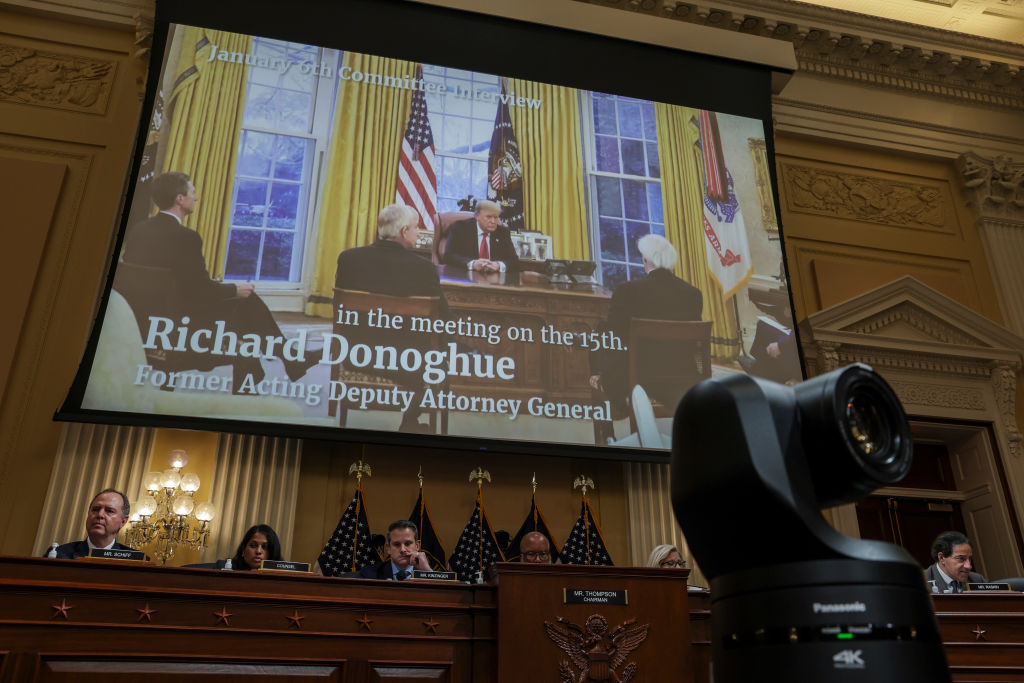
Former deputy acting attorney general Richard Donoghue illustrated how serious discussions were of mass resignations at the Justice Department as Trump threatened to replace his attorney general with a lower-level official who supported his plan to overturn the election, describing his fears of the potential impact that it could have in the final days of Trump administration.
Donoghue said he pleaded separately with the head of DOJ’s national security division, John Demers, to not be among those who would resign.
“I prefaced the call by saying, ‘John, we need you to stay in place. National security is too important and we need to minimize the disruption,'” Donoghue said in the hearing.
Donoghue said while Demers showed a willingness to resign, he agreed with Donoghue’s assessment, as they imagined what would happen to the nation’s top law enforcement agency should all the top officials resign.
“As Steve Engel noted, the goal was to make clear to Trump he would leave Clark leading a “graveyard,” a comment that “clearly had an impact on the president,” Donoghue said.
Jun 23, 5:13 pm
Trump on trying to change DOJ leadership: ‘What do I have to lose?’
While discussing whether to fire a top official in the Department of Justice in a 2.5 hour meeting at the Oval Office on Jan. 3, 2021, Trump turned to officials in the room and asked them a question, former deputy attorney general Richard Donoghue testified Thursday.
“What do I have to lose?” Trump asked, according to Donoghue.
“It was actually a good opening,” Donoghue said. “And I began to explain to him what he had to lose, and what the county had to lose and what department had to lose, and this was not in anyone’s best interest.”
Donoghue said no one in the room supported Jeffrey Clark taking over as the department’s top official, describing him to the president as unqualified. Clark at the time was a Trump-appointed Justice Department official overseeing the department’s Civil Division and environmental enforcement matters.
Jun 23, 5:08 pm
Former DOJ leader tells Trump that attorneys general across US would resign ‘en masse’
According to call logs displayed by the committee, the White House had already begun referring to Jeffrey Clark as “acting attorney general” on Jan. 3, 2021 — despite Jeff Rosen, who wouldn’t fall in line with election fraud conspiracies, actually serving as acting attorney general.
Trump also met with the aforementioned officials in the Oval Office on Jan. 3, and said, according to Rosen, “‘Well the one thing we know is you’re not gonna do anything. You don’t even agree that the concerns that are being presented are valid. And here is someone who has a different view, so, why shouldn’t I do that?'”
Former deputy acting attorney general Richard Donoghue recalled asking attorney generals across the country what they would do if Clark was put in charge.
“All essentially said they would leave,” he told the panel. “They would resign en masse if the president made that change in the department leadership.”
Jun 23, 4:54 pm
Inside GOP Rep. Scott Perry’s role in the DOJ pressure campaign
A hard-right conservative member of the House and leader of the House Freedom Caucus, Rep. Scott Perry, R-Penn., has been one of Trump’s most loyal supporters in Congress.
As the Jan. 6 committee laid out Thursday, that support continued after the 2020 election, when he was among the Republicans who met with Trump at the White House on Dec. 21, 2020, on how to continue challenging Joe Biden’s victory and push claims of voter fraud.
The next day, Perry introduced Jeffery Clark to Trump in a White House meeting. Clark did not work on election issues at the Justice Department, and he met with the president without the knowledge of his superiors in violation of DOJ rules.
“So, for criminal matters, the policy for a long time has been the only the attorney general in the deputy attorney general from the DOJ side can have … conversations with the White House,” Jeffrey Rosen, the then-acting attorney general, told the committee.
Why was Clark recommended? Here’s how Rudy Giuliani explained it, in his recorded interview with the committee: “I do recall saying to people that somebody should be put in charge of the Justice Department who isn’t frightened of what is going to be done to their reputation.”
Richard Donoghue, the acting deputy attorney general at the time, said Perry wanted Clark to “take over” the Justice Department, and pushed Mark Meadows, the White House chief of staff and his former House colleague, to make it happen.
-ABC News’ Benjamin Siegel
Jun 23, 4:46 pm
Trump, in emergency meeting, urged DOJ to seize voting machines, former officials say
Former acting attorney general Jeffrey Rosen and his former deputy Richard Donoghue described Thursday how Trump tried to get the Department of Justice to seize voting machines in late 2020.
Donoghue said an “agitated” Trump called an emergency meeting on New Year’s Eve to make the request.
“There was nothing wrong with them so we told him no,” Rosen told the committee. “There was no factual basis nor was there any legal authority to do so.”
“Toward the end of the meeting, the president, again, was getting very agitated,” Donoghue recalled. “And he said, ‘People tell me I should just get rid of both of you, I should just remove you and make a change in leadership, put Jeff Clark in, maybe something will finally get done.’”
After detailing an effort by Jeffrey Clark to replace acting attorney general Jeff Rosen in order to help Trump overturn the election, Rep. Adam Kinzinger, R-Ill., turned to former top DOJ lawyer Steven Engel on other efforts by Trump to pressure the department.
After Trump sent a proposed draft lawsuit, done outside the department, to top DOJ attorneys that he wanted to send to the Supreme Court, Engel called it a “meritless lawsuit” and an “unusual request” that the department would never bring.
“Obviously, even the person who drafted this lawsuit didn’t really understand in my view the law, and or how the Supreme Court works or the Department of Justice,” Engel said.
Trump and the White House also asked the Department of Justice if it could point a special counsel to look at widespread election fraud — which did not exist — with Engel detailing why “that was not legally available,” before Kinzinger claimed Trump even offered the position of special counsel to campaign attorney Sidney Powell, as his pressure campaign continued.
Jun 23, 4:18 pm
GOP congressman fought for Clark’s ascension: ‘We gotta get going’
The committee outlined how Rep. Scott Perry, R-Penn., played a role in trying to elevate Jeffrey Clark, then an obscure DOJ official, to department leadership amid the resistance from other DOJ officials to Trump’s efforts to undermine the election.
Records from the National Archives obtained by the committee showed Perry and Clark met Trump on Dec. 22, 2020. Perry later told a local television news network he had worked with Clark before and “obliged” when asked by Trump to introduce him.
The committee later displayed text messages which showed Perry advising White House chief of staff Mark Meadows to help with Clark’s ascension.
“Mark, just checking in as time continues to count down. 11 days to 1/6 and 25 days to inauguration. We gotta get going,” Perry wrote to Meadows on Dec. 26, 2020.
The next text, sent 30 minutes later, showed Perry telling Meadows to “call Jeff.”
“I just got off the phone with him and he explained to me why the principal deputy won’t work especially with the FBI. They will view it as not having the authority to enforce what needs to be done.”
Jun 23, 4:14 pm
DOJ official warned Clark’s plan could lead to ‘grave, constitutional crisis’
Former acting deputy attorney general Richard Donoghue said he tried to convey to Jeffrey Clark that a draft letter he circulated seeking to ask Georgia’s governor and other top state officials to convene the state legislature into a special session to investigate claims of voter fraud — which didn’t exist — could launch the country into a “constitutional crisis.”
“I had to read both emails and the attached letter twice to make sure I really understood what he was proposing — because it was so extreme to me, I had a hard time getting my head around it initially,” he recalled, adding he and former acting attorney general Jeffrey Rosen had “visceral reactions to it.”
“I thought it was very important to get a prompt response rejecting this out of hand. In my response, I explained a number of reasons that this is not the department’s rule to suggest or dictate [to] state legislatures,” he said.
“More importantly, this was not based on fact. This was actually contrary to the facts as developed by department investigations over the last several weeks and months,” he added. “For the department to insert itself into the political process this way, I think, would have had great consequences for the country. It may very well have spiraled into a constitutional crisis — and I want to make sure that he understood the gravity of the situation because he did not seem to really appreciate it.”
Jun 23, 4:03 pm
Trump: ‘Just say it was corrupt and leave the rest to us’
Drawing from handwritten notes, then-acting deputy attorney general Richard Donoghue documented that Trump told him to, “Just say that the election was corrupt + leave the rest to me and the R. Congressmen.”
When Donoghue told Trump he couldn’t change the outcome of the election, he recalled Trump “responded very quickly.”
“And said, ‘that’s not what I’m asking you to do — I’m just asking you to say it is corrupt and leave the rest to me and the Republican congressmen,” Donoghue said.
He also said Trump told him the Justice Department was “obligated to tell people that this was an illegal, corrupt election,” despite officials repeatedly telling him no widespread fraud existed and that Biden was the legitimate winner.
Rep. Adam Kinzinger emphasized the gravity of Trump’s request.
“‘Just say it was corrupt and leave the rest to us,'” he said. “The president wanted the top Justice Department officials to declare that the election was corrupt, even though, as he knew, there was absolutely no evidence to support that statement.”
Jun 23, 3:47 pm
Taped testimony previews showdown Oval Office meeting with Trump
Rep. Adam Kinzinger, R-Ill., played previous video testimony ahead of questioning live witnesses to preview how the committee would reveal findings from what took place inside a heated Oval Office meeting on Jan. 3, 2021, between Trump and top Justice Department officials.
“The meeting took about another two and a half hours from the time I entered. It was entirely focused on whether there should be a DOJ leadership change,” former deputy acting attorney general Richard Donoghue recalled in taped testimony. “I would say, directly in front of the president, Jeff Rosen was to my right. Jeff Clark was to my left.”
“He looked at me and he underscored,” said former acting attorney general Jeff Rosen, “‘Well the one thing we know is you’re not gonna do anything, you don’t even agree that the concerns that are being presented are valid. And here is someone who has a different view, so, why shouldn’t I do that, you know?’ That’s how the discussion went, proceeded.”
Former White House attorney Eric Herschmann underscored the purpose of the meeting, where “Jeff Clark was proposing that Jeff Rosen be replaced by Jeff Clark — and I thought the proposal was asinine.”
Donoghue recalled that Clark “repeatedly said to the president that if he was put in the seat, he would conduct real investigations that would, in his view, uncover widespread fraud.”
Jun 23, 3:46 pm
DOJ denied all of Trump’s requests ahead of Jan. 6: Rosen
Former acting attorney general Jeffrey Rosen told the committee that Trump made several requests to the Department of Justice after Bill Barr left his position in December 2020.
According to Rosen, Trump called him “virtually every day” between December 23 and January 3.
Trump wanted the DOJ to appoint a special counsel for election fraud, set up a meeting with Rudy Giuliani, to potentially file a lawsuit in the Supreme Court, hold a press conference and to send letters to state legislatures furthering baseless claims of fraud.
“I will say that the Justice Department declined all of those requests that I was just referencing,” Rosen said, “because we did not think that they were appropriate based on the facts and the law as we understood them.”
Jun 23, 3:40 pm
Former White House attorney suggests Clark ready to commit felony
The committee played a video of former Trump White House attorney Eric Herschmann recalling what he said he told Jeffrey Clark, a lower-level DOJ official overseeing environmental law enforcement, who supported Trump’s proposal to have him become acting attorney general to help overturn the election results.
“When he finished discussing what he planned on doing, I said ‘[expletive], congratulations. You just admitted your first step you would take as AG would be committing a felony,” Herschmann said. “‘You’re clearly the right candidate for this job.'”
“I told Clark the only thing he knew was that environmental and election both start with “e,” and I’m not even sure you know that,” he added.
In audio testimony, former deputy acting attorney general Richard Donoghue also recalled telling Clark, “Go back to your office, we’ll call you when there’s an oil spill,” and calling the draft letter he wanted to send swing states to appoint alternate slates “a murder-suicide pact.”
Rosen and Donoghue were detailing a two-and-half Oval Office meeting where Trump repeatedly pressed but was eventually dissuaded from his plan to install Clark atop the Justice Department to pursue baseless allegations of voter fraud just days before Congress was set to convene to certify Biden’s victory.
Jun 23, 3:20 pm
Cheney: Public to hear about members of Congress who sought pardons
Vice-chair Liz Cheney focused her opening statement Thursday on teasing a draft letter that Trump and former DOJ official Jeffrey Clark wanted the department to send to Georgia officials citing already disproven allegations of fraud.
“As you will see, this letter claims that the U.S. Department of Justice’s investigations have ‘identified significant concerns hat may have impacted the outcome of the election in multiple states, including the state of Georgia,'” Cheney said. “In fact, Donald Trump knew this was a lie. The Department of Justice had already informed the president of the United States repeatedly that its investigations had found no fraud sufficient to overturn the results of the 2020 election.”
ABC News obtained and published the draft letter in full last year. Read it here.
Cheney also said the public today will see video testimony by three members of Trump’s White House staff identifying certain members of Congress who contacted the White House after Jan. 6 to “seek presidential pardons for their conduct.”
Jun 23, 3:10 pm
Chair convenes hearing on Trump’s ‘brazen attempt’ to pressure DOJ
Three former top officials in the Justice Department — former acting attorney general Jeffrey Rosen, former deputy acting attorney general Richard Donoghue and former top DOJ lawyer Steven Engel — sat before lawmakers Thursday as Committee Chair Bennie Thompson, D-Miss., convened the fifth public hearing this month.
“Today, we’ll tell the story of how the pressure campaign also targeted the federal agency charged with enforcement of our laws, the Department of Justice,” Thompson said, going to call it “a brazen attempt to use the Justice Department to advance the president’s professional and personal agenda.”
All three witnesses are expected to detail how they resisted Trump and his allies’ repeated entreaties to enlist the Justice Department in his failed bid to overturn his election loss.
Jun 23, 2:51 pm
Rep. Adam Kinzinger to lead hearing
Rep. Adam Kinzinger will lead questioning in today’s hearing, committee aides confirmed to reporters. Kinzinger is one of the two Republicans on the nine-member committee.
“The threat to our democracy is real. And today, we’ll see just how close we came to losing it all,” Kinzinger tweeted ahead of the hearing. “Tune in as we uncover President Trump’s pressure campaign on [the Justice Department] in his desperate attempt to subvert the will of the people to stay in power.”
Jun 23, 2:27 pm
Filmmaker with new Trump footage sits for deposition
British documentary filmmaker Alex Holder sat for a deposition with the committee earlier Thursday after a subpoena commanded him to turn over documentary footage — never-seen publicly — filmed for a series on Trump’s final months in office.
“I have no further comment at this time other than to say that our conversation today was thorough and I appreciated the opportunity to share more context about my project,” Holder said in a statement to ABC News.
Holder was “given unparalleled access and exclusive interviews with President Trump, Ivanka, Eric, and Don Jr., Jared Kushner as well as Vice President Pence; in the White House, Mar-A-Lago, behind-the-scenes on the campaign trail, and before and after the events of January 6th,” according to a statement from his spokesperson.
He received a subpoena last Thursday from the committee to turn over footage shot for his documentary series and submitted the materials requested earlier this week.
-ABC News Ali Dukakis
Jun 23, 2:37 pm
House GOP leader dodges questions on Trump, integrity of 2020 election
House Minority Leader Kevin McCarthy, R-Calif., at a news conference Thursday dodged questions about endorsing Trump in 2024 and whether there was any widespread election fraud in the 2020 election.
McCarthy also said he had no regrets about not allowing Republicans to serve on the Jan. 6 committee. Trump has said McCarthy made a “foolish” mistake by refusing to allow Republican members to join the panel after House Speaker Nancy Pelosi blocked several of his picks.
“I do not regret not appointing anybody at all,” McCarthy told reporters.
There are two Republicans serving on the House panel: Liz Cheney of Wyoming and Adam Kinzinger of Illinois. The two outspoken Trump critics were appointed by Pelosi.
-ABC News’ Benjamin Siegel
Jun 23, 2:14 pm
Federal agents search home of former Trump Justice Department official
Federal agents searched the Virginia home of former Trump Justice Department official Jeffrey Clark on Wednesday morning, multiple sources with direct knowledge of the activity told ABC News.
It was unclear which federal agencies conducted the search, just hours before the House Jan. 6 committee was set to hold a hearing on then-President Donald Trump’s effort to corrupt the Justice Department in what it says was his plot to overturn the election, but one neighbor who witnessed the law enforcement activity said they saw officials entering the residence early Wednesday.
Clark, a former assistant attorney general for the environment and natural resources, emerged as a key player in Trump’s efforts to pressure the Justice Department in the wake of the 2020 election. He previously pleaded the Fifth Amendment in an appearance before the Jan. 6 committee and has declined to comment through an attorney when asked about specific details regarding his alleged coordination with Trump and others.
-ABC News’ Katherine Faulders, Alexander Mallin, Luke Barr and Mike Levine
Jun 23, 1:56 pm
Hearing to detail Trump pressure campaign on DOJ
The House select committee investigating the Jan. 6 attack on the U.S. Capitol and what led up to it is set on Thursday to bring into focus Trump’s relentless post-Election Day efforts to enlist the Justice Department in his failed bid to overturn his election loss.
The committee’s fifth hearing this month will feature testimony from three former top officials in the department who say they resisted Trump and his allies’ repeated entreaties, former acting attorney general Jeffrey Rosen, former deputy acting attorney general Richard Donoghue and former top DOJ lawyer Steven Engel.
All three have previously confirmed that they joined a group of top White House lawyers in threatening a mass resignation if Trump didn’t back away from plans to oust Rosen and replace him with another obscure official in the top echelons of the department who was sympathetic to the Trump’s baseless claims of widespread voter fraud.
Thursday’s hearing of the Jan. 6 committee is focusing on the pressure then-President Donald Trump and his allies put on the Justice Department to help overturn the 2020 election.
Here’s how the hearing is unfolding:
Jun 23, 4:46 pm
Trump, in emergency meeting, urged DOJ to seize voting machines, former officials say
Former acting attorney general Jeffrey Rosen and his former deputy Richard Donoghue described Thursday how Trump tried to get the Department of Justice to seize voting machines in late 2020.
Donoghue said an “agitated” Trump called an emergency meeting on New Year’s Eve to make the request.
“There was nothing wrong with them so we told him no,” Rosen told the committee. “There was no factual basis nor was there any legal authority to do so.”
“Toward the end of the meeting, the president, again, was getting very agitated,” Donoghue recalled. “And he said, ‘People tell me I should just get rid of both of you, I should just remove you and make a change in leadership, put Jeff Clark in, maybe something will finally get done.’”
After detailing an effort by Jeffrey Clark to replace acting attorney general Jeff Rosen in order to help Trump overturn the election, Rep. Adam Kinzinger, R-Ill., turned to former top DOJ lawyer Steven Engel on other efforts by Trump to pressure the department.
After Trump sent a proposed draft lawsuit, done outside the department, to top DOJ attorneys that he wanted to send to the Supreme Court, Engel called it a “meritless lawsuit” and an “unusual request” that the department would never bring.
“Obviously, even the person who drafted this lawsuit didn’t really understand in my view the law, and or how the Supreme Court works or the Department of Justice,” Engel said.
Trump and the White House also asked the Department of Justice if it could point a special counsel to look at widespread election fraud — which did not exist — with Engel detailing why “that was not legally available,” before Kinzinger claimed Trump even offered the position of special counsel to campaign attorney Sidney Powell, as his pressure campaign continued.
Jun 23, 4:18 pm
GOP congressman fought for Clark’s ascension: ‘We gotta get going’
The committee outlined how Rep. Scott Perry, R-Penn., played a role in trying to elevate Jeffrey Clark, then an obscure DOJ official, to department leadership amid the resistance from other DOJ officials to Trump’s efforts to undermine the election.
Records from the National Archives obtained by the committee showed Perry and Clark met Trump on Dec. 22, 2020. Perry later told a local television news network he had worked with Clark before and “obliged” when asked by Trump to introduce him.
The committee later displayed text messages which showed Perry advising White House chief of staff Mark Meadows to help with Clark’s ascension.
“Mark, just checking in as time continues to count down. 11 days to 1/6 and 25 days to inauguration. We gotta get going,” Perry wrote to Meadows on Dec. 26, 2020.
The next text, sent 30 minutes later, showed Perry telling Meadows to “call Jeff.”
“I just got off the phone with him and he explained to me why the principal deputy won’t work especially with the FBI. They will view it as not having the authority to enforce what needs to be done.”
Jun 23, 4:14 pm
DOJ official warned Clark’s plan could lead to ‘grave, constitutional crisis’
Former acting deputy attorney general Richard Donoghue said he tried to convey to Jeffrey Clark that a draft letter he circulated seeking to ask Georgia’s governor and other top state officials to convene the state legislature into a special session to investigate claims of voter fraud — which didn’t exist — could launch the country into a “constitutional crisis.”
“I had to read both emails and the attached letter twice to make sure I really understood what he was proposing — because it was so extreme to me, I had a hard time getting my head around it initially,” he recalled, adding he and former acting attorney general Jeffrey Rosen had “visceral reactions to it.”
“I thought it was very important to get a prompt response rejecting this out of hand. In my response, I explained a number of reasons that this is not the department’s rule to suggest or dictate [to] state legislatures,” he said.
“More importantly, this was not based on fact. This was actually contrary to the facts as developed by department investigations over the last several weeks and months,” he added. “For the department to insert itself into the political process this way, I think, would have had great consequences for the country. It may very well have spiraled into a constitutional crisis — and I want to make sure that he understood the gravity of the situation because he did not seem to really appreciate it.”
Jun 23, 4:03 pm
Trump: ‘Just say it was corrupt and leave the rest to us’
Drawing from handwritten notes, then-acting deputy attorney general Richard Donoghue documented that Trump told him to, “Just say that the election was corrupt + leave the rest to me and the R. Congressmen.”
When Donoghue told Trump he couldn’t change the outcome of the election, he recalled Trump “responded very quickly.”
“And said, ‘that’s not what I’m asking you to do — I’m just asking you to say it is corrupt and leave the rest to me and the Republican congressmen,” Donoghue said.
He also said Trump told him the Justice Department was “obligated to tell people that this was an illegal, corrupt election,” despite officials repeatedly telling him no widespread fraud existed and that Biden was the legitimate winner.
Rep. Adam Kinzinger emphasized the gravity of Trump’s request.
“‘Just say it was corrupt and leave the rest to us,'” he said. “The president wanted the top Justice Department officials to declare that the election was corrupt, even though, as he knew, there was absolutely no evidence to support that statement.”
Jun 23, 3:47 pm
Taped testimony previews showdown Oval Office meeting with Trump
Rep. Adam Kinzinger, R-Ill., played previous video testimony ahead of questioning live witnesses to preview how the committee would reveal findings from what took place inside a heated Oval Office meeting on Jan. 3, 2021, between Trump and top Justice Department officials.
“The meeting took about another two and a half hours from the time I entered. It was entirely focused on whether there should be a DOJ leadership change,” former deputy acting attorney general Richard Donoghue recalled in taped testimony. “I would say, directly in front of the president, Jeff Rosen was to my right. Jeff Clark was to my left.”
“He looked at me and he underscored,” said former acting attorney general Jeff Rosen, “‘Well the one thing we know is you’re not gonna do anything, you don’t even agree that the concerns that are being presented are valid. And here is someone who has a different view, so, why shouldn’t I do that, you know?’ That’s how the discussion went, proceeded.”
Former White House attorney Eric Herschmann underscored the purpose of the meeting, where “Jeff Clark was proposing that Jeff Rosen be replaced by Jeff Clark — and I thought the proposal was asinine.”
Donoghue recalled that Clark “repeatedly said to the president that if he was put in the seat, he would conduct real investigations that would, in his view, uncover widespread fraud.”
Jun 23, 3:46 pm
DOJ denied all of Trump’s requests ahead of Jan. 6: Rosen
Former acting attorney general Jeffrey Rosen told the committee that Trump made several requests to the Department of Justice after Bill Barr left his position in December 2020.
According to Rosen, Trump called him “virtually every day” between December 23 and January 3.
Trump wanted the DOJ to appoint a special counsel for election fraud, set up a meeting with Rudy Giuliani, to potentially file a lawsuit in the Supreme Court, hold a press conference and to send letters to state legislatures furthering baseless claims of fraud.
“I will say that the Justice Department declined all of those requests that I was just referencing,” Rosen said, “because we did not think that they were appropriate based on the facts and the law as we understood them.”
Jun 23, 3:40 pm
Former White House attorney suggests Clark ready to commit felony
The committee played a video of former Trump White House attorney Eric Herschmann recalling what he said he told Jeffrey Clark, a lower-level DOJ official overseeing environmental law enforcement, who supported Trump’s proposal to have him become acting attorney general to help overturn the election results.
“When he finished discussing what he planned on doing, I said ‘[expletive], congratulations. You just admitted your first step you would take as AG would be committing a felony,” Herschmann said. “‘You’re clearly the right candidate for this job.'”
“I told Clark the only thing he knew was that environmental and election both start with “e,” and I’m not even sure you know that,” he added.
In audio testimony, former deputy acting attorney general Richard Donoghue also recalled telling Clark, “Go back to your office, we’ll call you when there’s an oil spill,” and calling the draft letter he wanted to send swing states to appoint alternate slates “a murder-suicide pact.”
Rosen and Donoghue were detailing a two-and-half Oval Office meeting where Trump repeatedly pressed but was eventually dissuaded from his plan to install Clark atop the Justice Department to pursue baseless allegations of voter fraud just days before Congress was set to convene to certify Biden’s victory.
Jun 23, 3:20 pm
Cheney: Public to hear about members of Congress who sought pardons
Vice-chair Liz Cheney focused her opening statement Thursday on teasing a draft letter that Trump and former DOJ official Jeffrey Clark wanted the department to send to Georgia officials citing already disproven allegations of fraud.
“As you will see, this letter claims that the U.S. Department of Justice’s investigations have ‘identified significant concerns hat may have impacted the outcome of the election in multiple states, including the state of Georgia,'” Cheney said. “In fact, Donald Trump knew this was a lie. The Department of Justice had already informed the president of the United States repeatedly that its investigations had found no fraud sufficient to overturn the results of the 2020 election.”
ABC News obtained and published the draft letter in full last year. Read it here.
Cheney also said the public today will see video testimony by three members of Trump’s White House staff identifying certain members of Congress who contacted the White House after Jan. 6 to “seek presidential pardons for their conduct.”
Jun 23, 3:10 pm
Chair convenes hearing on Trump’s ‘brazen attempt’ to pressure DOJ
Three former top officials in the Justice Department — former acting attorney general Jeffrey Rosen, former deputy acting attorney general Richard Donoghue and former top DOJ lawyer Steven Engel — sat before lawmakers Thursday as Committee Chair Bennie Thompson, D-Miss., convened the fifth public hearing this month.
“Today, we’ll tell the story of how the pressure campaign also targeted the federal agency charged with enforcement of our laws, the Department of Justice,” Thompson said, going to call it “a brazen attempt to use the Justice Department to advance the president’s professional and personal agenda.”
All three witnesses are expected to detail how they resisted Trump and his allies’ repeated entreaties to enlist the Justice Department in his failed bid to overturn his election loss.
Jun 23, 2:51 pm
Rep. Adam Kinzinger to lead hearing
Rep. Adam Kinzinger will lead questioning in today’s hearing, committee aides confirmed to reporters. Kinzinger is one of the two Republicans on the nine-member committee.
“The threat to our democracy is real. And today, we’ll see just how close we came to losing it all,” Kinzinger tweeted ahead of the hearing. “Tune in as we uncover President Trump’s pressure campaign on [the Justice Department] in his desperate attempt to subvert the will of the people to stay in power.”
Jun 23, 2:27 pm
Filmmaker with new Trump footage sits for deposition
British documentary filmmaker Alex Holder sat for a deposition with the committee earlier Thursday after a subpoena commanded him to turn over documentary footage — never-seen publicly — filmed for a series on Trump’s final months in office.
“I have no further comment at this time other than to say that our conversation today was thorough and I appreciated the opportunity to share more context about my project,” Holder said in a statement to ABC News.
Holder was “given unparalleled access and exclusive interviews with President Trump, Ivanka, Eric, and Don Jr., Jared Kushner as well as Vice President Pence; in the White House, Mar-A-Lago, behind-the-scenes on the campaign trail, and before and after the events of January 6th,” according to a statement from his spokesperson.
He received a subpoena last Thursday from the committee to turn over footage shot for his documentary series and submitted the materials requested earlier this week.
-ABC News Ali Dukakis
Jun 23, 2:37 pm
House GOP leader dodges questions on Trump, integrity of 2020 election
House Minority Leader Kevin McCarthy, R-Calif., at a news conference Thursday dodged questions about endorsing Trump in 2024 and whether there was any widespread election fraud in the 2020 election.
McCarthy also said he had no regrets about not allowing Republicans to serve on the Jan. 6 committee. Trump has said McCarthy made a “foolish” mistake by refusing to allow Republican members to join the panel after House Speaker Nancy Pelosi blocked several of his picks.
“I do not regret not appointing anybody at all,” McCarthy told reporters.
There are two Republicans serving on the House panel: Liz Cheney of Wyoming and Adam Kinzinger of Illinois. The two outspoken Trump critics were appointed by Pelosi.
-ABC News’ Benjamin Siegel
Jun 23, 2:14 pm
Federal agents search home of former Trump Justice Department official
Federal agents searched the Virginia home of former Trump Justice Department official Jeffrey Clark on Wednesday morning, multiple sources with direct knowledge of the activity told ABC News.
It was unclear which federal agencies conducted the search, just hours before the House Jan. 6 committee was set to hold a hearing on then-President Donald Trump’s effort to corrupt the Justice Department in what it says was his plot to overturn the election, but one neighbor who witnessed the law enforcement activity said they saw officials entering the residence early Wednesday.
Clark, a former assistant attorney general for the environment and natural resources, emerged as a key player in Trump’s efforts to pressure the Justice Department in the wake of the 2020 election. He previously pleaded the Fifth Amendment in an appearance before the Jan. 6 committee and has declined to comment through an attorney when asked about specific details regarding his alleged coordination with Trump and others.
-ABC News’ Katherine Faulders, Alexander Mallin, Luke Barr and Mike Levine
Jun 23, 1:56 pm
Hearing to detail Trump pressure campaign on DOJ
The House select committee investigating the Jan. 6 attack on the U.S. Capitol and what led up to it is set on Thursday to bring into focus Trump’s relentless post-Election Day efforts to enlist the Justice Department in his failed bid to overturn his election loss.
The committee’s fifth hearing this month will feature testimony from three former top officials in the department who say they resisted Trump and his allies’ repeated entreaties, former acting attorney general Jeffrey Rosen, former deputy acting attorney general Richard Donoghue and former top DOJ lawyer Steven Engel.
All three have previously confirmed that they joined a group of top White House lawyers in threatening a mass resignation if Trump didn’t back away from plans to oust Rosen and replace him with another obscure official in the top echelons of the department who was sympathetic to the Trump’s baseless claims of widespread voter fraud.
Jabin Botsford/The Washington Post via Getty Images
(WASHINGTON) — After Thursday’s hearing, the House Jan. 6 select committee will delay its final hearings for several weeks, a spokesperson confirmed to ABC News Wednesday.
“The Select Committee continues to receive additional evidence relevant to our investigation into the violence of January 6th and its causes. Following tomorrow’s hearing, we will be holding additional hearings in the coming weeks. We will announce dates and times for those hearings soon,” the spokesperson said.
Initially, the committee was expected to hold its sixth and seventh hearings by the end of June. But after Tuesday’s session, members said they need more time to incorporate new information into their public presentations.
Chairman Bennie Thompson said later “at least two” are planned for next month starting the week of July 11, after the House returns from the Independence Day recess. But the panel has not ruled out adding even more hearings down the road.
He claimed the delay is due to the need to take in new information the committee has obtained, from a documentary filmmaker who turned over hours of taped videos with Trump and his inner circle spanning “almost a year,” and additional Trump White House records from the National Archives.
“There may well be a need for future hearings because of information elicited because of the hearings,” Majority Leader Steny Hoyer, D-Md., who is regularly briefed by committee chairs, told ABC News on Wednesday.
Following Tuesday’s hearing, Rep. Jamie Raskin, D-Md., also told reporters he expected the committee would continue its hearings beyond June because of new evidence they have been receiving.
The committee’s next hearing and last one for June, scheduled for Thursday at 3 p.m., will focus on what the committee has called Trump’s pressure campaign on the Department of Justice.
The new schedule comes after British documentary filmmaker Alex Holder, who had substantial access to Trump, his family and closest aides around the Jan. 6 attack, confirmed in a statement this week he “fully complied with all of the committee’s requests” and handed over footage which includes interviews with Trump, Donald Trump Jr., Ivanka Trump, Eric Trump, son-in-law Jared Kushner and Vice President Mike Pence.
According to Vice Chair Liz Cheney, the final two hearings will focus on how former President Donald Trump “summoned and assembled a violent mob in Washington and directed them to march on the U.S. Capitol” and “ignored multiple pleas for assistance and failed to take immediate action to stop the violence and instruct his supporters to leave the Capitol,” she said in the committee’s first June hearing.
Laurie Skrivan/St. Louis Post-Dispatch/Tribune News Service via Getty Images, FILE
(ST. LOUIS, Mo.) — Penelope Quigg is a lifelong Republican voter.
But the chair of the Republican Party in Cole County, Missouri, said she won’t vote for Eric Greitens, her state’s former governor, if he wins the party’s nomination this summer for an open Senate seat. Greitens — once disgraced — is now leading a resurgent campaign four years after he resigned amid a criminal investigation and the threat of impeachment, admitting to an extramarital affair but denying other claims that ultimately included alleged abuse of his ex-wife.
“Everything about him I question,” said Quigg, one of four county GOP chairs who told ABC News that they would not vote for Greitens in the general election — even if it means risking a Democratic victory in a state former President Donald Trump carried by more than 15% in 2020.
Quigg isn’t alone: Interviews with nearly a dozen current and former Republican Party leaders in Missouri, where voting in the Senate primary began this week, revealed a broad distaste for Greitens and a hesitation by many in the establishment to support him were he to win the nod on Aug. 2.
So what? says his campaign, which touted his allegiance to former President Donald Trump. “Greitens is doing exactly what he needs to do to win over voters,” his campaign manager Dylan Johnson said in a statement. “He’s holding grassroots events multiple times a week. He’s leading the conversation on the America First agenda.”
But the officials who spoke with ABC News nearly all expressed a belief that a Greitens win in the primary race would put the Senate seat, opened by retiring Republican Roy Blunt, in jeopardy of falling into Democratic hands — even in a national environment that favors the conservatives seeking to regain Congress.
Those concerns were underscored on Monday when Greitens’ campaign released an instantly controversial video ad showing him armed with an assault rifle and backed by weapon-carrying men dressed in camouflage to storm into a house to hunt “RINOs,” or Republicans in name only.
Many of the Republicans interviewed by ABC News condemned Greitens’ video, calling it “demented” and “tasteless” and they are worrying it could incite violence.
“It’s absolutely horrible,” said Gary Grunick, chair of the Republican Party in Lincoln County, northwest of St. Louis. “And I’m a gun person. I’ve got plenty of guns around. It’s just totally irresponsible.”
Rene Artman, a member of the Missouri Republican Party’s executive committee, told ABC News: “I’m quite concerned because I feel that there could be people who take him seriously. You don’t make comments like that in today’s climate with what’s going on.”
“I’m all in favor of the Second Amendment. If you want a gun, you can have a gun,” added Artman, who serves as the party chair in the state’s biggest county, St. Louis. “But for Greitens to use the word ‘MAGA’ and to call for the ‘hunting’ of ‘RINOs’ is a total disgrace and he needs to step down.”
Facebook removed the video and Twitter hid it behind a warning about “abusive behavior.”
In a statement, Greitens’ campaign manager said, ”Those who have an issue with the video and the metaphor are either lying or dumb. We believe Big Tech and its oligarchs are both.”
Greitens told a local morning show that he relished the “faux outrage” and noted how much interest the clip drove to his fundraising website.
‘So much baggage’
For all the headlines Greitens makes, some Missouri Republicans say he is not the best choice: Polls compiled by FiveThirtyEight show him leading by slimmer margins than his primary opponents in hypothetical matchups with leading Democrats, a discrepancy other conservatives attribute to the scandals that pushed him from office and the allegations of domestic abuse leveled by his ex-wife earlier this year.
In 2018, Greitens, who was elected governor two years prior, resigned while facing a charge connected to alleged campaign finance violations, which was later dropped in a deal with prosecutors. He had also admitted to an affair with a hairdresser, whom he was accused of blackmailing, which he denied. A felony invasion-of-privacy charge related to that case was also dropped.
Earlier this year, in a striking affidavit, his ex-wife said he had abused her and their young son during their marriage, claims which Greitens has rejected. The accusations by Sheena Greitens included a charge that her husband struck their son across the face during dinner and, in another altercation, hit the boy so hard that he was left with “a swollen face, bleeding gums, and [a] loose tooth.” (Court records in their ongoing custody dispute show the Greitens have been in mediation, with a trial set for July.)
“He’s not fit for office,” Jim Berberich, chair of the Republican central committee in Jefferson County, south of St. Louis, told ABC News. “Voters are not going to be happy to support a candidate for the U.S. Senate who has so much baggage that he amassed in such a short order.”
Cyndia Haggart, the GOP chair in Vernon County, in western Missouri, called Greitens “a non-starter.”
“He is damaged goods, and there are just those people who are not electable,” she said. “We will hand that seat to a Democrat.”
After the abuse allegations were disclosed in March, Artman, the member of the state Republican executive committee, wrote a letter asking Nick Myers, chair of the Missouri state GOP, to remove Greitens from the ballot. But she told ABC News the party did not take those steps.
Asked if she would vote for Greitens if he won the nomination, Artman told ABC News, “Hell no.”
Myers did not respond to multiple requests for comment about Greitens’ candidacy.
Still popular
Despite their misgivings, most Republicans who spoke to ABC News consider Greitens a serious contender to win the nomination over opponents like Rep. Vicky Hartzler and Missouri Attorney General Eric Schmitt.
“A lot of people don’t believe what happened,” said David Lightner, chair of the Republican Committee in Jackson County, which includes Kansas City. Lightner was referring to the domestic abuse allegations while explaining Greitens’ buoyancy with voters. Lightner also cited his high profile and connections to Trump.
“Yes, he lost a lot of Republicans. But the thing is, he’s got a 500,000 email list that he goes by, and he also has Kimberly Guilfoyle and [Donald Trump Jr.] and a few others who are supporting him,” Lightner added, referring to the former president’s oldest son and his son’s fiancée.
Greitens’ base of support, said Lightner, “is solid.”
Jean Evans, a former chair of the Missouri Republican Party who is now a political consultant, attributes Greitens’ popularity to a passionate slice of the base.
“There’s a real fervor among a certain segment of the Republican Party now to get rid of RINOs,” she told ABC News.
Meanwhile, some GOP leaders think polls might be undervaluing Greitens’ popularity.
“There’s a lot of diehard Republicans who just aren’t going to get out there in front and say they’re voting for him. When they go in and vote at the polls, it may be different,” said Violet Corbett, a member of the Johnson County Republican Central Committee.
Multiple local Republicans said that a PAC supporting Greitens has invested in attack ads against his primary opponents but, to their knowledge, Republican groups inside and outside Missouri have not coordinated financial attacks on him.
A spokesperson for the National Republican Senatorial Committee did not respond to a request for comment about the group’s involvement in the primary.
Greitens’ campaign dismissed any notion that he would be less competitive in a general election than other Republicans and struck back at county leaders who said they would refuse to vote for him.
“That’s the definition of a RINO— willing to let a seat turn blue because they aren’t willing to fight for conservative values,” Johnson, the campaign manager, said.
Can a Democrat win in Missouri?
Missouri, where Barack Obama ran neck-and-neck with John McCain in the 2008 presidential election, veered rightward in subsequent cycles, with Trump winning the state by double digits in 2016 and 2020 and outpacing President Joe Biden with Missouri voters in a hypothetical 2024 matchup, according to polls compiled by FiveThirtyEight.
But in Greitens, some see a chance for Democrats to take advantage of a weakened candidate and steal back a Senate seat in a red state, as Democrat Claire McCaskill did in Missouri in 2012 when she won out by 15 points over Todd Akins, a Republican who drew widespread backlash for a comment about “legitimate rape.”
In an interview, Lucas Kunce, a leading Democratic candidate for Senate, declined to say whether he would prefer to face Greitens in a general matchup over another Republican.
“We’re just running our race. He stands for everything that we don’t stand for,” Kunce told ABC News.
“I think the guy should be in a jail cell at this point. I don’t think he should be on the ballot at all. If it happens, we’re going to crush it. But I think it’s sad,” he added.
But Michael Butler, chair of the Missouri Democratic Party, said that facing anyone but Greitens would be more difficult.
“I think we’d have less of a chance,” he told ABC News,” but we’d definitely still have a chance.”
Bill Clark/CQ-Roll Call, Inc via Getty Images, FILE
(WASHINGTON) — John Wood, a Republican lawyer and former federal prosecutor who has helped lead the House Jan. 6 committee’s investigation, is leaving his role with the panel this week amid calls for him to instead enter the Missouri Senate race as an independent candidate.
Wood, whose last day with the committee is Friday — though hearings will continue into July — is expected to explore a bid for the seat of retiring Republican Sen. Roy Blunt.
Previously a U.S. attorney for the Western District of Missouri and a chief of staff at the Department of Homeland Security in the second Bush administration, Wood also worked as an aide to former Missouri Sen. John Danforth earlier in his career.
The contest to succeed Blunt is attracting notable names, with former Missouri Gov. Eric Greitens and state Attorney General Eric Schmitt among the contenders for the Republican nod and Lucas Kunce vying for the Democratic nomination. (Absentee voting in the party primaries is already underway.)
Most recently Wood has led the House select committee’s investigative “gold” team, which zeroed in on the role former President Donald Trump played in the Capitol riot. Alongside Rep. Pete Aguilar, D-Calif., Wood questioned witnesses in the panel’s hearing last week focused on the pressure campaign against former Vice President Mike Pence.
Danforth told ABC News that his super PAC planned to support an independent in the Missouri Senate election — and he hoped Wood entered the race.
“I’ve known John for decades and I’ve certainly talked to him about running for Senate,” Danforth said, noting that their last conversation was in the spring and he learned of Wood’s departure from the House committee in the press.
“He has a lot of experience in government,” Danforth said.
Danforth, who said that after the Jan. 6 insurrection he “regrets” backing his former protégé Josh Hawley in the 2018 Senate race against Democrat Claire McCaskill, told ABC News that he believes many Missourians think the country “is too polarized” and that both major parties do not represent them.
Those hoping for a Wood candidacy see him as an antidote.
“We deserve leaders who believe that our democracy must be held together – not torn apart by partisan politics that have divided our country for too long. John Wood embodies this principle,” a spokesman for the John Wood for Missouri Committee said. “We are encouraged by John’s decision to leave the select committee on Friday as an important next step in providing Missourians a principled, common-sense choice this November.”
According to the Missouri Secretary of State’s office, an independent candidate must file a petition with at least 10,000 signatures by Aug. 1 to enter the Senate race.
(WASHINGTON) — Nicholas Roske, 26, pleaded not guilty Wednesday to one count of attempting to kill a justice of the United States, two weeks after he was arrested outside the home of Supreme Court Justice Brett Kavanugh’s home with a gun.
He faces a maximum sentence of life in prison.
Roske was arrested in the early morning hours of June 8 near Kavanaugh’s Maryland home. He was allegedly armed with a gun and pepper spray, and had zip ties and several pieces of burglary equipment in a backpack, according to an arrest affidavit.
“Roske indicated that he believed the Justice that he intended to kill would side with Second Amendment decisions that would loosen gun control laws,” the affidavit said. “Roske stated that he’d been thinking about how to give his life a purpose and decided he would kill the Supreme Court Justice after finding the Justice’s Montgomery County address on the internet.”
Last week, he was indicted by a federal grand jury on one count of attempting to kill a justice of the United States.
Dressed in a burgundy pants, a shirt and unmasked, Roske rocked back and forth silently in his chair as he awaited court proceedings. After pleading guilty, Roske at times rested his head on the table with his hands folded around the back of his neck.
Roske will face a jury trial before Magistrate Judge Ajmel Ahsen Quereshi on Aug. 23.
ABC News’ Luke Barr and Alexander Mallin contributed to this report.
(WASHINGTON) — Included in the anti-gun violence legislation announced Tuesday night by a bipartisan group of senators is a measure that supporters hope will help protect victims of domestic violence.
The legislation includes a change to the so-called “boyfriend loophole,” which refers to a gap in the law on who can purchase guns.
Currently, federal law prohibits people convicted of domestic violence from purchasing a gun, but only if they are living with their partner, married to their partner or have a child with their partner. The law does not apply to dating partners.
Under the newly-introduced legislation, the definition has been expanded so that individuals in “serious” “dating relationships” who are convicted of domestic abuse would also be prevented from purchasing a gun.
Additionally, the bill includes language that allows those convicted of non-spousal misdemeanor domestic abuse to have their gun ownership rights restored after five years if they have a clean record.
“This is an incentive, I think for people who have made a mistake, committed domestic violence and received a misdemeanor conviction, to straighten up their act and not repeat it,” Republican Sen. John Cornyn of Texas, one of the bill’s lead negotiators, said in a floor speech Tuesday.
Advocates for victims of domestic violence had encouraged senators to close the loophole in the new legislation, negotiations for which began after the Uvalde, Texas, school shooting on May 24, which left 19 elementary-age students and two teachers dead.
On average, more than 12 million men and women in the United States are victims of rape, physical violence or stalking by an intimate partner each year, according to the National Domestic Violence Hotline, which offers free, 24/7 support for victims of domestic violence.
According to the Johns Hopkins Center for Gun Violence Solutions, a woman is five times more likely to be murdered when her abuser has access to a gun.
Last year, more than 17,000 people who reached out to the National Domestic Violence Hotline said firearms were a part of the abuse they experienced.
Katie Ray-Jones, CEO of the National Domestic Violence Hotline, said in a statement that her organization “applauds the [senators’] work” to address domestic violence in gun legislation.
“We appreciate the senators’ initiative to close this dangerous gap and protect millions more people experiencing relationship abuse in this country,” she said. “We also know while this is a significant step forward, there is even more work to be done to ensure that all survivors are protected.”
Exact timing for a final vote on the legislation in the Senate is not yet known but could happen toward the end of the week, with all involved hoping to approve the legislation before the two-week July 4 recess.
In addition to strengthening the ban on convicted domestic abusers possessing firearms, the bill also includes support for mental health and school security services and provides incentives to expand the federal background check system for prospective buyers under 21.
Both Senate Majority Leader Chuck Schumer and Senate Minority Leader Mitch McConnell said they supported the bill, indicating that it could reach a super-majority in the Senate — which is necessary to overcome any filibuster — barring more developments.
ABC News’ Rachel Scott and Trish Turner contributed to this report.
(WASHINGTON) — The House select committee investigating the Jan. 6 attack on the U.S. Capitol is set to bring into focus Thursday former President Donald Trump’s relentless post-Election Day efforts to enlist the Justice Department in his failed bid to overturn his election loss.
The committee’s fifth hearing this month will feature testimony from three former top officials in the department who say they resisted Trump and his allies’ repeated entreaties, former acting attorney general Jeffrey Rosen, former deputy acting attorney general Richard Donoghue and former top DOJ lawyer Steven Engel.
All three have previously confirmed that they went as far as joining a group of top White House lawyers in threatening a mass resignation if Trump didn’t back away from plans to oust Rosen and replace him with another obscure official in the top echelons of the department who was sympathetic to the president’s baseless claims of widespread voter fraud.
That former official, Jeffrey Clark, previously pleaded the Fifth Amendment in an appearance before the committee and has declined to comment through an attorney when asked about specific details regarding his alleged coordination with Trump and others.
Trump ultimately relented, and his behind-the-scenes campaign wasn’t publicly revealed until the New York Times reported on the dramatic standoff several days after President Joe Biden’s inauguration.
Throughout his four-year tenure, former President Trump completely disregarded and distorted Justice Department protocols in place since the post-Watergate era, where the department sought to generally avoid having the White House or the president directly involved in criminal matters.
Trump’s efforts following his loss to Biden blew up any notion of Justice Department independence on criminal investigations that might benefit the White House or president politically. Trump’s post-election interaction with top DOJ officials portray a president pressing for specific investigations that could potentially help him keep his grip on power.
And FBI and DOJ investigators did indeed end up investigating some of the more outlandish claims pushed by Trump election lawyers like Rudy Giuliani, John Eastman and others.
Similar to the committee’s first two hearings revealing evidence gathered from their nearly year-long investigation, much of the details of Trump’s effort to weaponize DOJ in his effort to undermine the results of the election have been reported on previously.
In remarks last week, the committee’s vice chair Rep. Liz Cheney, R-Wyo., said the hearing will seek to tie Trump’s effort to “corrupt the Department of Justice” into his broader plan to thwart the certification of Biden’s victory on Jan. 6, which culminated in the deadly attack on the Capitol.
ABC News has learned that Rosen on Thursday will testify that he was under repeated and constant pressure from Trump to find widespread corruption.
A source familiar with the matter told ABC News that Rosen would often simply reply to the president that his department was “just not seeing the evidence.”
The source said that at one point Clark discussed with Rosen that the president was about to name him acting attorney general and that Rosen could potentially stay on as Clark’s deputy. The source said Rosen used that information to coordinate with other department officials a plan of mass resignation if Trump were to remove him and install Clark.
In August last year, ABC News exclusively obtained emails showing how Rosen and Donoghue rebuffed Clark’s request to urge officials in Georgia to investigate and possibly overturn Biden’s victory in the state.
The emails showed a draft letter circulated by Clark on Dec. 28, which he sought to send to Georgia’s governor and other top state officials, advising them to convene the state legislature into a special session so lawmakers could investigate claims of voter fraud.
“There is no chance that I would sign this letter or anything remotely like this,” Donoghue responded roughly an hour after receiving Clark’s email. “While it maybe true that the Department ‘is investigating various irregularities in the 2020 election for President’ (something we typically would not state publicly) the investigations that I am aware of relate to suspicions of misconduct that are of such a small scale that they simply would not impact the outcome of the Presidential Election.”
Rosen responded several days later on Jan. 2, according to the emails, stating he had “confirmed again today that I am not prepared to sign such a letter.”
A day later, according to previous testimony from Rosen and Donoghue to both the Senate Judiciary Committee and House select committee, came the extraordinary meeting in the Oval Office.
Rosen said he arranged for the meeting through Trump White House chief of staff Mark Meadows after learning from Clark that Trump planned to replace him “so that [Clark] could pursue” his plan with the Georgia election.
“And I said “Well, I don’t get to be fired by someone who works for me,” in the case of Mr. Clark. I wanted to discuss it with the President,” Rosen told Congress last year.
That night, Meadows walked Rosen, Donoghue and Engel into the meeting with Trump, Clark, then-White House counsel Pat Cipollone and his top deputies — but Meadows then left the room for the discussion that followed, according to Rosen.
“The president said something near the very beginning, “One thing we know is you, Rosen, aren’t going to do anything. And you don’t even agree that I’m right about these concerns that people are telling me,”” Rosen recalled Trump saying.
What followed was a roughly two-and-a-half-hour meeting, by Rosen and Donoghue’s telling, where Trump repeatedly pressed but was eventually dissuaded from his plan to install Clark atop the Justice Department to pursue baseless allegations of voter fraud just days before Congress was set to convene to certify Biden’s victory.
What appeared to change Trump’s mind, according to Donoghue’s testimony, was unanimity among nearly everyone in the room that they would resign if Trump moved forward with the plot.
“And I said, “And we’re not the only ones. You should understand that your entire Department leadership will resign,” Donoghue said. “And I said, “Mr. President, these aren’t bureaucratic leftovers from another administration. You picked them. This is your leadership team. You sent every one of them to the Senate; you got them confirmed. What is that going to say about you, when we all walk out at the same time?”
Donoghue then detailed a nightmare scenario for Trump of hundreds of career officials in the department following en masse, resignations that he said Engel told Trump would leave Clark “leading what he called a graveyard; there would be no one left.”
The account of the Jan. 3 meeting could prove for gripping on-camera testimony as the committee seeks to show the country that the former president, desperate at clinging to power by any means necessary, was in the days leading up to Jan. 6 seriously entertaining a plot that would almost certainly thrust the country into an unprecedented constitutional crisis.
Rosen, Donoghue and Engel could also serve to bolster the committee’s line of argument that President Trump was persistent in moving forward with his attempt to overturn the election leading up to Jan. 6, even as he had been told repeatedly that he had lost.
While much of the focus thus far on that front in the committee’s investigation has zeroed in on Barr’s private statements to Trump as well as in an interview with the AP about the department finding no evidence of fraud that could overturn the election results, his resignation left a clear opening for Trump to continue seeking to use the department to aid his campaign to overturn the election.
Rosen has previously testified that at a meeting on Dec. 15, the day after former attorney general William Barr announced he would resign from the department, a group of top officials at the White House told Trump that “people are telling you things that are not right” regarding claims of widespread fraud in the election.
Donoghue said he later told Trump in a Dec. 27, 2020 phone call “in very clear terms” that DOJ had done “dozens of investigations, hundreds of interviews” and determined “the major allegations are not supported by the evidence developed.”
And unlike Rosen, Donoghue and Engel — Barr’s statements to the committee about his private interactions with Trump appear in direct conflict about his public actions leading up to his resignation.
Leading up to the 2020 election, Barr spent more time arguably than any other Trump cabinet official sowing doubts about expansions of mail-in voting, laying the groundwork for Trump and his legal team to later make their baseless claims of widespread voter fraud.
Barr pushed a conspiracy theory that foreign actors would be able to flood the country with millions of fraudulent ballots, even when top officials in the intelligence community were publicly disputing that was possible.
Barr told ABC News Chief Washington Correspondent Jonathan Karl in an interview that then-Senate Majority Leader Mitch McConnell had been urging him to speak out against Trump’s fraud claims “since mid-November,” in part over McConnell’s fears it would sabotage the GOP’s chances to win the Georgia Senate runoffs. Barr didn’t give his interview ruling out widespread fraud to the AP until Dec. 1.
But two weeks later, Barr gave his resignation letter to Trump, saying he “appreciate[d] the opportunity to update you this afternoon on the Department’s review of voter fraud allegations in the 2020 election and how these allegations will continue to be pursued.” The resignation letter showed no indications of Barr’s supposed concerns about Trump’s behavior, and instead lauded Trump as a victim of a supposed left-wing-led conspiracy to undermine all the accomplishments of his administration.
The Justice Department’s inspector general last year announced it had launched its own investigation into efforts inside the department to subvert the 2020 election.
Attorney General Merrick Garland, who is currently overseas, told reporters at the Justice Department last week that he plans to watch all of the committee’s hearings in their entirety, while adding, “I can assure you that the January 6 prosecutors are watching all of the hearings as well.”
(WASHINGTON) — President Joe Biden’s calls for Congress to pass a gas tax holiday were being met with skepticism Wednesday from both sides of the aisle.
In an exclusive interview with ABC News, Democratic Sen. Joe Manchin of West Virginia said he had several concerns with the proposal and signaled he would not support it.
“I’m not a yes right now, that’s for sure,” Manchin said, just hours before Biden was set to speak Wednesday afternoon.
For the last 25 years, all revenue from the federal gas tax has gone to the Highway Trust Fund, the major source of federal funding for highways, roads and bridges. Manchin noted Congress put an additional $118 billion into the fund when it passed the bipartisan infrastructure package.
“Now, to do that and put another hole into the budget is something that is very concerning to me, and people need to understand that 18 cents is not going to be straight across the board — it never has been that you’ll see in 18 cents exactly penny-for-penny come off of that price,” Manchin said.
Biden is expected to call on Congress to suspend the federal gas tax, which amounts to roughly 18 cents of gasoline and 24 cents per gallon of diesel through the end of September. Manchin, who chairs the Senate Energy and Natural Resources Committee took issue with the timing ahead of the fall midterm elections.
“My other would be the political ramification. It goes off at the end of September. Which politician up here is going to be voting to put that 18-cent tax back on a month before the November election? So, we just dig the whole deeper and deeper and deeper,” Manchin said.
He added, “we have an infrastructure bill for the first time in 30 years that we can start fixing roads and bridges, but electric vehicles have to pay proportionally also as they use the same roadways and vehicles. They’re not. They’re paying nothing. So, we need a lot of adjustments made.”
Manchin called on Congress to start thinking about Americans in their home districts, insisting “the people in West Virginia are having a hard time — they really are — these inflation checks have hit hard no matter how many checks we sent out during the COVID relief that’s all forgotten it’s all for not,” Manchin said.
“We put over $5 trillion out into the marketplace and it’s all forgotten and all we have now is higher inflation and really more hardship on people that need some good decisions here in the Congress. We just need to start looking at the long-term effect of what we are doing and how we are doing it,” he said.
Other Democrats skeptical, too, while Republicans not interested
Democratic Whip Dick Durbin of Illinois said it’s important to provide relief, but contends a gas tax holiday is a “temporary only” solution.
“Long term, it’s going to be an expensive infrastructure investment, which I support,” Durbin said. “We’ve got to get this behind us.”
But for Sen. Mark Warner of Virginia, a key Democrat negotiator on the roughly $1.2 trillion infrastructure bill that passed last year, the hit that a gas tax holiday would take to the Highway Trust Fund, and therefore the nation’s infrastructure spending, is concerning.
He said he’s “hesitant” about supporting a gas tax holiday. He also cited concerns about the president’s proposal to end the holiday in September.
“I want to make very clear if we were to take this action — its easy to take away this tax its hard to put one back on,” Warner said.
Sen. Chris Coons, D-Del., said he’s “willing to support” Biden’s gas tax holiday call but doesn’t know whether it will get the support it needs to pass the Senate.
And with even some Democrats sour to the idea, the president is unlikely to make up support with Republicans.
Senate Republican Leader Mitch McConnell, in floor remarks Wednesday morning, called the proposal an “ineffective stunt to mask the Democrats’ war on affordable American energy.”
The second-ranking Senate Republican echoed that.
“I think a lot of things being suggested by the administration are very gimmicky, short term, and I wonder if they would have any real impact,” Sen. John Thune, R-S.D., said. “This stuff is clearly political gimmickry it’s not the right long-term solution.”