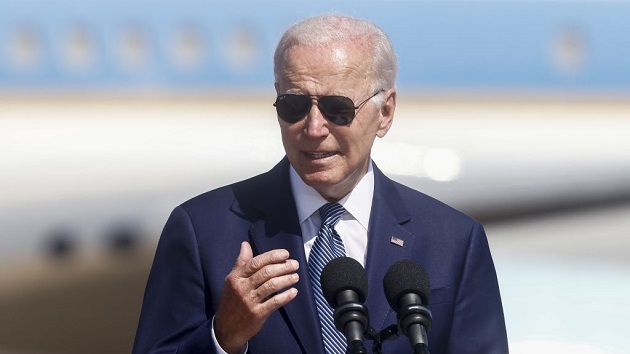
Kent Nishimura / Los Angeles Times via Getty Images
(WASHINGTON) — House Democrats will vote Friday on two measures to restore abortion rights after the Supreme Court’s overturning of Roe v. Wade.
The action comes as Democrats ramp up their political messaging on abortion ahead of the November midterm elections, hoping the issue will drive voters to the ballot box to preserve the party’s majorities in Congress.
“It’s outrageous that 50 years later, women must again fight for our most basic rights against an extremist court and Republican Party,” House Speaker Nancy Pelosi, D-Calif., said Friday in a press conference on the U.S. Capitol steps ahead of the vote.
“Democrats are honoring the basic truth: women’s most intimate health decisions are her own,” Pelosi added.
One bill, titled the Women’s Health Protection Act, would establish a statutory right for health care providers to provide, and patients to receive, abortion services. It would also prohibit states from imposing restrictions on abortion care.
The lower chamber passed this bill in September 2021, but it failed to move forward in the Senate.
Any abortion-related legislation will likely meet a similar fate in the upper chamber, where Democrats need 10 Republican votes to overcome the 60-vote filibuster.
“We must ensure that the American people remember in November, because with two more Democratic senators, we will be able to eliminate the filibuster when it comes to a woman’s right to choose and to make reproductive freedom the law of the land,” Pelosi said Friday.
The second bill to be voted on by the House on Friday, known as the Ensuring Access to Abortion Act, addresses recent efforts by state legislatures to punish Americans traveling for reproductive health care. The bill would would ensure no person acting under state law could prevent, restrict, or otherwise retaliate against a person traveling across state lines for lawful abortion services.
Senate Republicans on Thursday blocked a bill that would have both legally shielded the people who travel across states lines to receive an abortion and the providers who care for those patients.
At least 13 states have ceased nearly all abortion services after the high court’s June 24 decision ending Roe, and several Republican-controlled states are already considering legislation to bar women from seeking services out-of-state.
“Are we going to allow these lawmakers to hold American citizens hostage in their own states, forcing them to give birth?” Senate Majority Whip Dick Durbin, D-Ill., said in a floor speech on Thursday. “Does that sound like the America that we know? No it doesn’t, and we need to draw the line here and now.”
Just last week, hundreds of abortion rights activists protested outside the White House calling on President Joe Biden to do more to ensure abortion rights. Biden signed an executive order on July 8 aimed at protecting access, but said it’s ultimately up to Congress to codify Roe.
Biden’s message to the demonstrators was to “keep protesting.”
“Keep making your point. It’s critically important,” he said.
Salwan Georges/The Washington Post via Getty Images
(WASHINGTON) — The Secret Service deleted text messages from Jan. 5 and 6, 2021, after an internal watchdog requested them as part of a review of the department’s handling of last year’s Capitol riot, the watchdog said this week.
A letter sent Wednesday by the Department of Homeland Security Office of Inspector General to the heads of the House and Senate Homeland Security Committees, which was obtained by ABC News, said the messages were deleted “as part of a device-replacement program” despite the inspector general requesting such communications.
“First, the Department notified us that many US Secret Service text messages from January 5 and 6, 2021, were erased as part of a device-replacement program. The USSS erased those text messages after OIG requested records of electronic communications from the USSS, as part of our evaluation of events at the Capitol on January 6,” Joseph Cuffari, the inspector general, wrote.
“Second, DHS personnel have repeatedly told OIG inspectors that they were not permitted to provide records directly to OIG and that such records had to first undergo review by DHS attorneys,” Cuffari wrote. “This review led to weeks-long delays in OIG obtaining records and created confusion over whether all records had been produced.”
The director of communications at the US Secret Service, Anthony Guglielmi, said any insinuation the service intentionally deleted texts is false in a statement Thursday evening.
“The insinuation that the Secret Service maliciously deleted text messages following a request is false. In fact, the Secret Service has been fully cooperating with the Department of Homeland Security Office of Inspector General (DHS OIG) in every respect – whether it be interviews, documents, emails, or texts,” the statement said.
The statement continued that the Secret Service “began to reset its mobile phones to factory settings as part of a pre-planned, three-month system migration. In that process, data resident on some phones was lost,” and that DHS OIG requested electronic communications for the first time on Feb. 26, 2021, after the migration was underway. The agency added that OIG was notified of certain data missing.
The Secret Service also refuted the notion that they were not being cooperative with the DHS investigation.
“To the contrary, DHS OIG has previously alleged that its employees were not granted appropriate and timely access to materials due to attorney review. DHS has repeatedly and publicly debunked this allegation, including in response to OIG’s last two semi-annual reports to Congress. It is unclear why OIG is raising this issue again,” the statement said.
Ohio’s Rob Portman, the top Republican on the Senate Homeland Security Committee, said he was “deeply concerned” over the letter.
“I am deeply concerned by the letter I received from the DHS Inspector General documenting the Department’s delays in producing materials to the Inspector General and its deletion of records following requests by the Inspector General. It is essential that the Department be transparent with its inspector general, Congress, and the American public,” he said in a statement.
The DHS has not yet responded for comment.
Michigan Sen. Gary Peters, the chairman of the committee, echoed that.
“We need to get to the bottom of whether the Secret Service destroyed federal records or the Department of Homeland Security obstructed oversight,” Peters said in a statement. “The DHS Inspector General needs these records to do its independent oversight and the public deserves to have a full picture of what occurred on January 6th. I will be learning more from the DHS Inspector General about these concerning allegations.”
It is unclear whether the messages were deleted intentionally or by accident, though the inspector general’s letter comes as the Secret Service is once again under heightened scrutiny following hearings from the House committee investigating the insurrection.
Recent testimony suggested that former President Donald Trump tried to join his supporters in marching from the Ellipse to the Capitol last year but was stopped by the Secret Service. The agency has since said it will respond on the record to that testimony.
(NEW YORK) — Depositions of former President Donald Trump, Ivanka Trump and Donald Trump Jr. in connection with the New York attorney general’s civil investigation have been delayed, the New York Attorney General’s Office said Friday.
The AG’s office said the postponement was due to the death of Ivana Trump, the former president’s ex-wife and the mother of Ivanka and Donald Jr., on Thursday.
“In light of the passing of Ivana Trump yesterday, we received a request from counsel for Donald Trump and his children to adjourn all three depositions, which we have agreed to,” the office said in a statement. “This is a temporary delay and the depositions will be rescheduled as soon as possible. There is no other information about dates or otherwise to provide at this time.”
“We offer our condolences to the Trump family,” the statement added.
This is a breaking news story. Please check back for updates.
(NEW YORK) — Depositions of former President Donald Trump, Ivanka Trump and Donald Trump Jr. in connection with the New York attorney general’s civil investigation into the family’s businesses practices have been delayed, the New York Attorney General’s Office said Friday.
The AG’s office said the postponement was due to the death of Ivana Trump, the former president’s ex-wife and the mother of Ivanka and Donald Jr., on Thursday.
“In light of the passing of Ivana Trump yesterday, we received a request from counsel for Donald Trump and his children to adjourn all three depositions, which we have agreed to,” the office said in a statement. “This is a temporary delay and the depositions will be rescheduled as soon as possible. There is no other information about dates or otherwise to provide at this time.”
“We offer our condolences to the Trump family,” the statement added.
The New York Attorney General’s Office has been investigating potential discrepancies in how the Trump Organization valued certain assets when seeking loans or when pursuing tax breaks.
Trump has long denied any wrongdoing in the yearslong investigation.
The Trumps had sought to squash the AG’s subpoenas to testify on the grounds that they were politically motivated, but last month New York’s highest court declined to take up an appeal by the family, thereby obligating the Trumps to sit for depositions in the probe.
Ivana Trump died Thursday at her home in New York City at the age of 73. She was found unconscious and unresponsive at the bottom of a set of stairs in her Upper East Side apartment, according to police sources. A medical examiner will determine the cause of death, police said.
She and Donald Trump were married in 1977 and divorced in 1992.
(WASHINGTON) — As a slew of historic challenges pile up on Joe Biden’s presidency, he faces increasing dissatisfaction from within his own party and questions about his electability just months before crucial midterm elections.
Historic, global inflation and high gas prices have driven his popularity to lows that could threaten Democrats’ chances of retaining control of Congress this fall.
Amid calls from activists for Biden to show more urgency on issues such as abortion and gun reform, the White House has fired back, calling those who want more action on abortion “out of step.”
But a wide majority of Democrats in a New York Times/Siena College poll published this week – 64% – said that they want someone other than Biden to represent them in the 2024 presidential election.
Among those Democrats, the top reason they wanted another standard-bearer was because of Biden’s age (33%), followed by his job performance (32%). Further down the list, 4% cited his ability to win, and 3% pointed to his mental acuity.
Questions of age
At 79, Biden is the oldest president in U.S. history, and his age has drawn concerns from not just within his own party but from across the aisle — with nonstop negative coverage in conservative media of his perceived gaffes and constant questions about his mental fitness.
Fox News hosts constantly portray the president as a feeble, elderly man as they play short video clips they say show him looking confused at events, mixing up words and relying on notecards with basic instructions, like, “You take your seat.” (Former President Donald Trump used similar notes.)
While those attacks are amplified through Fox News’ partisan lens, Biden clearly lacks the energy he had as a younger vice president and senator before that, often walking in a halting manner and frequently tripping over his words.
In 2018, before he launched his most recent campaign for president, Biden said it was “totally legitimate” for voters to consider a candidate’s age and “what kind of shape you’re in,” CNN reported at the time.
“I think it’s totally appropriate for people to look at me and say if I were to run for office again, ‘Well, God darn, you’re old,'” he said, according to CNN. “Well, chronologically I am old.”
A White House official said aides “far younger” than Biden “have to fight to keep up” with the president, who works late into the night and “never takes a day off, wherever he is.”
“We see him throw himself into the hardest parts of the job,” the official said, noting Biden recently spent “hours comforting families” of victims of mass shootings in Buffalo, New York, and Uvalde, Texas.
Fired-up Biden tells ABC: ‘They want me to run’
In an impassioned exchange with ABC News this week, Biden defended his popularity among Democrats, noting that the same New York Times/Siena College poll showed that if he ended up facing off against former President Donald Trump in 2024, 92% of Democrats said they’d vote for Biden.
And among all voters, the poll found, Biden would best Trump by 44% to 41%.
When asked by this reporter what his message was to Democrats who do not want him to run again, Biden replied, “They want me to run.”
“Read the polls,” he responded, fired up and changing direction. “Read the polls, Jack. You guys are all the same. That poll showed that 92% of Democrats, if I ran, would vote for me.”
This reporter pointed out that most Democrats surveyed did, in fact, say they wanted someone else to run.
“But 92% said if I did, they’d vote for me,” Biden shot back, before walking away.
The president told ABC News in December he plans to run for reelection. “If I’m in the health I’m in now — from a good health, and, in fact, I would run again,” he said then.
Vice President Kamala Harris, too, has made clear she would run with him.
Biden’s message: Vote
In the wake of Supreme Court setbacks for abortion rights, gun restrictions and climate change, progressive activists — and many of their allies in Congress — have vocally called on Biden to take more drastic measures to protects Americans’ rights.
His message? Vote for Democrats in the November midterms.
“This fall, Roe is on the ballot,” he said the day the Supreme Court overturned Roe v. Wade last month. “Personal freedoms are on the ballot. The right to privacy, liberty, equality, they’re all on the ballot.”
While Biden has used his bully pulpit to speak out forcefully on these topics, he and his advisers insist they are hamstrung by legal limitations on what they can do — especially when it comes to protecting access to abortion.
His outgoing communications director, Kate Bedingfield, blasted activists who have been critical of Biden’s response to the Supreme Court ruling in Dobbs v. Jackson Women’s Health Organization, which found women do not have a constitutional right to an abortion.
“Joe Biden’s goal in responding to Dobbs is not to satisfy some activists who have been consistently out of step with the mainstream of the Democratic Party,” she said in a statement to The Washington Post earlier this week that ignited blowback from progressives. “It’s to deliver help to women who are in danger and assemble a broad-based coalition to defend a woman’s right to choose now, just as he assembled such a coalition to win during the 2020 campaign.”
At a news conference in Madrid last month, a reporter asked Biden if he was the best messenger to fight for abortion rights when his own views on abortion had evolved over the years. Many progressives want him to do more, the reporter noted.
“I’m the only president they got,” Biden replied, “and I feel extremely strongly that I’m going to do everything in my power which I legally can do in terms of executive orders, as well as push the Congress and the public.”
But he also said “the bottom line” is that people should “show up and vote.”
“Vote in the off-year and vote, vote, vote,” Biden said. “That’s how we’ll change it.”
Young Democratic candidates speak of disconnect with party
But the New York Times/Siena College poll showed younger Democrats, in particular, want a nominee other than Biden in 2024, with 94% of Democrats under 30 years old expressing that sentiment.
One millennial Democrat running to represent the Nashville, Tennessee, area in Congress, Odessa Kelly, told ABC News she traced those young Democrats’ apprehensiveness to a more deeply rooted disappointment that began before Biden assumed office.
As the founder of the nonprofit Stand Up Nashville, Kelly recounted distributing more than 300 food boxes per day to people “who still had their work uniforms on because they were coming in between work shifts to survive another day.” Among them, she said, were elementary school staff, including younger teachers who requested food supplies for their families and classrooms.
“The Democratic Party always talks about helping the next generation, but I noticed that the caretakers of children are all struggling paycheck to paycheck,” Kelly said.
She said economic pressures became especially acute in Nashville during the coronavirus pandemic.
“The people of Nashville are at their breaking points,” she said. “I understand when people say it feels like we haven’t elected people who come from these shared experiences we got.”
Another millennial Democrat running for Congress in Texas, Greg Casar, told ABC News he thought the disconnect younger voters are feeling stems from a generational difference on how to tackle salient political issues, such as climate change.
“So many Gen Z voters don’t want to just wait for things to somehow get better,” Casar, who is currently an Austin City Council member, said. “Younger voters want action. That is the kind of energy that is so often lacking in our politics.”
Both candidates back Biden – Kelly said she’d “vote for Biden any day over Trump” – with some reservations. Casar urged Biden to move faster to protect abortion access.
“Texans can’t just sit and wait for another election while their healthcare is being denied,” he said. “The president can speak urgently, but he needs to act more with that same urgency to help voters of color.”
Governors push for action — and spark 2024 speculation
Amid the Democratic discontent with Biden, other Democrats have stirred chatter of potential 2024 runs.
Biden says he’ll run again, but that hasn’t stopped speculation California Gov. Gavin Newsom may have ambitions for higher office, although on Wednesday he emphatically said would back a Biden bid in 2024.
Newsom, though, has criticized Democratic leaders for not confronting Republicans more aggressively. And this week, he visited Washington, where he delivered a speech where he spoke about national issues.
And Illinois Gov. J.B. Pritzker, who traveled to New Hampshire last month to campaign for Democrats and pitch Chicago as a 2024 presidential nominating convention site — and plans to fundraise for Florida Democrats this weekend — has fueled chatter he has higher aspirations. (He has insisted that he’s focused on his re-election as governor.)
After a shooting on the Fourth of July left seven dead in Highland Park, Illinois, Pritzker’s intense, confrontational response garnered widespread praise.
“If you’re angry today, I’m here to tell you be angry,” he said that day. “I’m furious. I’m furious that yet more innocent lives were taken by gun violence. I’m furious that their loved ones are forever broken by what took place today.”
Biden’s first public comments on the shooting were brief and did not mention Highland Park by name.
“You all heard what happened today,” he told an Independence Day gathering outside the White House. “But each day, we’re reminded there’s nothing guaranteed about our democracy, nothing guaranteed about our way of life. We have to fight for it, defend it, and earn it by voting to refine, evolve, and extend the calling of America to move forward boldly and unafraid.”
Two hours later, he decided to speak again, mentioning the city’s name, noting he had spoken with Pritzker and the mayor, and calling for a moment of silence. “We’ve got a lot more work to do,” he said. “We’ve got to get this under control.”
Pritzker met with Biden at the White House earlier this week when he was in town for an event marking the recent passage of gun safety legislation. He told reporters they did not discuss politics.
On Capitol Hill, a defense of Biden — while others block his agenda
Few Democrats on Capitol Hill are willing to publicly question whether Biden should run again in 2024, although progressives like Rep. Alexandria Ocasio-Cortez, of New York, often call on him to act with greater urgency.
Rep. Ro Khanna, a Democrat from California who has criticized Biden in the past, said recently that, as president and leader of the Democratic Party, Biden is “owed a degree of respect.”
“There’s a tone in which to challenge the administration and offer new ideas,” Khanna tweeted last week, “and that tone ought to be one of good faith to help the president, not throwing darts to weaken him when he’s the leader of our party.”
House Speaker Nancy Pelosi, meanwhile, has forcefully defended the president throughout his time in office.
“I wouldn’t waste my time on figuring out how enthusiastic this White House is about a woman’s right to choose,” she said Thursday. “They’re there.”
In the fact of setbacks, the president has responded with a call not just to elect more Democrats — but for Congress to take action.
Even though his party controls both chambers of Congress, Democrats’ majority in the House is narrow, and their 50-50 split with Republicans in the Senate has meant Biden has failed to achieve the 60 votes necessary to further most of his legislative priorities.
Senate Democrats could change the rules to require just a simple majority to move legislation forward, but Democratic Sens. Joe Manchin of West Virginia and Kyrsten Sinema have blocked that effort.
Manchin has also stood in the way of Biden’s attempts to force his major “Build Back Better” package – that would make massive investments in health care, education, fighting climate change and other Democratic domestic goals.
Biden has frequently lamented the tough spot he’s in.
“When you’re in the United States Senate, and you’re president of the United States, and you have 50 Democrats,” he joked during a CNN town hall last year, “every one is a president.”
ABC News’ Alina Kim and Mariam Khan contributed to this report.
(WASHINGTON) — Senate Republicans on Thursday blocked a bill that would have both legally shielded the people who travel across states lines to receive an abortion and the providers who care for those patients.
Senate Democrats needed the support of at least 10 Republicans to stop a GOP filibuster of the bill, but no Republicans stood to support the measure.
The Freedom to Travel for Health Care Act of 2022, authored by a trio of Democratic female lawmakers — New York’s Kirsten Gillibrand, Nevada’s Catherine Cortez Masto and Patty Murray of Washington — made an argument rooted in the 14th Amendment’s equal protection clause that, among other things, essentially allows citizens freedom of travel to states while enjoying equal protection under the law.
The blocked bill would codify the ability of people to travel without repercussion from a state where abortion is restricted to another state where it is legal.
The bill would extend those same protections to people or groups who assist in abortion access across states as well as health care providers who offer abortion services to out-of-state patients if they are legally allowed to offer those same services to in-state residents.
A group of Democratic senators attempted to call up their bill for debate on Thursday, but Sen. James Lankford, R-Okla., objected.
Senate rules require either the unanimous consent of all 100 senators to start debate on any bill or 60 votes to overcome any filibuster that seeks to block that debate.
Lankford is a longstanding opponent of abortion. In floor remarks opposing the bill — matched by similarly passionate comments by Democrats — he urged colleagues to consider the lives of who he described as unborn babies.
“The conversation today is not just about women. There are two people in this conversation, a child with 10 fingers and 10 toes and a beating heart and DNA that is uniquely different than the mom’s DNA or the dad’s DNA,” Lankford said. “Maybe this body should pay attention to children as well and to wonder what their future could be to travel in the days ahead.”
Lankford also argued that the proposed legislation was unnecessary at this time.
“To be very clear, no state has banned interstate travel for adult women seeking to obtain an abortion — no state has done that,” Lankford said. “Now am I confident there are some people that are out there talking, yes, but there are also in this Senate 5,000 bills that have been filed and how many of them are actually going to move?”
Indeed, some Republican-controlled states are already considering legislation that would bar women from traveling across state lines to receive an abortion. In Missouri, for example, legislation is being considered that would allow private citizens to sue anyone who assists a woman in traveling out of state to receive an abortion. Missouri is one of at least 13 states that have ceased nearly all abortion services.
Democrats warned that other states may soon consider proposals like the Missouri bill that aim to penalize women and those who help them travel across state lines.
“Anyone who tells you this is not a threat is either not paying attention or they are just trying to mislead you,” said Murray, the top Democrat on the Senate health committee.
“We don’t need to conjure up hypotheticals,” Sen. Amy Klobuchar, D-Minn., said on the Senate floor on Thursday. “We already know what’s happened.”
Klobuchar cited recent reports of a 10-year-old girl in Ohio who had to travel to Indiana to receive an abortion after being impregnated by her rapist. (A suspect has been arrested in that case.)
“Should the next little 10-year-old’s right or 12-year-old’s right or 14-year-old’s right to get the care that she desperately needs be put in jeopardy?” Klobuchar asked. “What about her mom? What about her doctor? Where will this end?”
Colorado Democratic Sen. Michael Bennet spoke of his three daughters as he made a plea for the right-to-travel bill. He called near-total abortion bans being implemented in some states “literally crazy” but said some Republican lawmakers want to go further.
“I can’t believe this is what we are handing over to the next generation of America, I cannot believe it, I cannot believe it,” Bennet said. “This is despicable, especially coming from the same people who can never stop telling us how devoted they are to freedom and liberty.”
Democrats knew their effort Thursday would fail, but they feel it had symbolic value for voters ahead of the crucial midterm elections — as Democrats seek to underline the stakes of abortion access, and highlight GOP opposition, in the wake of the Supreme Court striking down Roe v. Wade last month.
Thursday’s bill was part of a unified strategy among Democrats to have abortion-related votes up to Election Day, when — they and some outside activists hope — the issue may galvanize people to turn out at the ballot box to preserve their fragile majorities in Congress, despite other political headwinds like inflation.
When a draft of the eventual Supreme Court ruling that overturned Row leaked in May, Democrats attempted to pass the Women’s Health Protection Act, which would have codified a women’s right to choose and implemented a variety of other provisions to protect abortion access.
That effort was blocked unanimously by Republicans and by Sen. Joe Manchin, D-W.Va., who opposed the bill for going further than a basic codifying of Roe.
(AUSTIN, Texas) — Texas Attorney General Ken Paxton on Thursday filed the first legal challenge to President Joe Biden’s executive order on abortion — accusing the administration of turning emergency health care providers into “walk-in abortion clinics” and kicking off what is expected to be a protracted legal battle between the White House and red states.
At issue is Biden’s interpretation of a federal law that requires doctors to treat patients in medical emergencies, even if they do not have insurance, and provide the necessary “stabilizing treatment.”
Under guidance issued Monday, the Health and Human Services Department said the law would require doctors to perform abortions in medical emergencies if their clinical judgement finds such a procedure would help stabilize a pregnant patient.
The guidance was the result of a broader executive order signed by the president earlier this month that called on HHS to to protect reproductive services and expand access to medication abortion in the wake of the Supreme Court overturning Roe v. Wade.
On Thursday, Paxton said the administration went too far and filed a complaint in the U.S. District Court for the Northern District of Texas.
“This administration has a hard time following the law, and now they are trying to have their appointed bureaucrats mandate that hospitals and emergency medicine physicians perform abortions,” Paxton said in a statement.
The White House responded by calling Paxton’s position “radical.”
“This is yet another example of an extreme and radical Republican elected official. It is unthinkable that this public official would sue to block women from receiving life-saving care in emergency rooms, a right protected under US law,” press secretary Karine Jean-Pierre said.
Biden’s order and the subsequent HHS guidance were not expected to have a major impact on abortion access in states that restrict it as life-threatening medical emergencies facing pregnant patients are relatively rare.
Still, the order was aimed at addressing concerns by many medical experts that state laws allowing abortion to “save the life of a mother” were vague. Doctors said they weren’t sure how imminent death must be before a provider could act.
In guidance to hospitals on Monday, Health Secretary Xavier Becerra said the federal law — the Emergency Medical Treatment and Active Labor Act — should empower doctors to use their best clinical judgement. Becerra noted that because EMTALA is a federal statute, it would take precedence over any state laws restricting abortion.
“As frontline health care providers, the federal EMTALA statute protects your clinical judgment and the action that you take to provide stabilizing medical treatment to your pregnant patients, regardless of the restrictions in the state where you practice,” Becerra wrote.
According to the HHS guidance, emergency medical conditions involving pregnant patients may include “ectopic pregnancy, complications of pregnancy loss, or emergent hypertensive disorders, such as preeclampsia with severe features.”
EMTALA is enforced through complaints. If a hospital is found to violate the law through a federal investigation, it could lose access to the Medicare program or face fines.
A major anti-abortion group, Susan B. Anthony Pro-Life America, said Thursday it agreed with Texas on its suit over Biden’s emergency medical guidance.
In a statement provided to ABC News, the organization said the federal law cited by Biden has never specialized a particular method of stabilizing a patient. And if a pregnant person’s health is in danger “every attempt” should be made to stabilize both the mother and child, even if that means premature delivery.
“The new guidance is a complete distortion of [the law] EMTALA and we firmly stand with AG Paxton in Texas,” the group said.
(WASHINGTON) — The person whom former President Donald Trump was accused of having contacted following the Jan. 6 hearing when former administration aide Cassidy Hutchinson testified was a member of the White House support staff, sources told ABC News.
Trump’s alleged contact with the individual was described on Tuesday by the House Jan. 6 committee’s vice chair, Wyoming Republican Rep. Liz Cheney, who did not name the person.
“After our last hearing, President Trump tried to call a witness in our investigation — a witness you have not yet seen in these hearings,” she said at the close of the most recent committee hearing.
Cheney said the witness did not answer the call.
“Their lawyer alerted us, and this committee has supplied that information to the Department of Justice,” she said.
“Let me say one more time, we will take any effort to influence witness testimony very seriously,” Cheney added, as the committee continually warns against witness tampering in its ongoing investigation.
This person was not someone Trump would typically call. Many members of the support staff are those who work from administration to administration and would have not necessarily left when Trump left office.
When asked Tuesday night how he knew that the alleged phone call from Trump to a witness amounted to witness tampering, the committee chair, Mississippi Democrat Bennie Thompson, said “I don’t” and that’s why they alerted the DOJ.
CNN first reported the new details about the witness.
ABC News’ Libby Cathey contributed to this report.
(LOS ANGELES) — Gavin Newsom has never been afraid to throw an elbow.
During the surge of the COVID-19 delta variant, California’s Democratic governor sat on the glossy sound stage of The Late Late Show with James Corden, surrounded by Christmas lights, and slammed Florida GOP Gov. Ron DeSantis over what Newsom called his lax coronavirus policies.
“California’s example versus Florida? It’s not even close in terms out of the outcome if you care about life, and you care about the economy,” Newsom told Corden, adding later that “clearly” DeSantis was running for president to scoop up the Trump-aligned Republican vote, pointing to DeSantis’ policies as a “litmus test” to win attention from conservative-aligned news networks.
His criticism of DeSantis is one of many made over the course of the pandemic, but Newsom’s recent $105,000 advertising buy that ran in Florida, certainly an unusual move for a politician who is running a reelection campaign of his own, has spun the question of presidential aspirations toward Newsom.
During an interview with ABC News’ Zohreen Shah prior to the ad placement, Newsom, 54, insisted he had no White House ambitions, although several unaffiliated California-based political advisers told ABC News that claim doesn’t totally hold water, and the ad campaign was a foolproof way to elevate his profile and test public appetite as President Joe Biden’s stock with Democrats continues to dive.
On Wednesday while in Washington to accept an award on education, Newsom told reporters he emphatically supported a Biden reelection bid.
Still, during his remarks, he continued to speak out on national issues, criticizing what he called Republican efforts to regulate topics in the classroom: “I don’t want to sugarcoat it. Education is under assault … And we have an obligation, moral and ethical obligation, to call out what’s going on as it relates to the suppression of free speech,” he said.
Picking a fight across state lines is “very vintage” Newsom, consistent with his appetite to be a part of the national conversation in elevating California above other states, said Jessica Levinson, a California-based legal expert and former president of the Los Angeles Ethics Commission.
“He’s always talking about California as a nation-state. And I think he fancies himself the executive of a nation-state in some ways. And he really wants to put a stake in the ground and say California is different and better and therefore, I am different and better,” said Levinson.
His vision of his state as a shining “city on a hill” is clear from his Florida ad, in which he urges residents of the Sunshine State to “join the fight” against Republican leaders or “join us in California, where we still believe in freedom,” a clear knock at DeSantis’ “free state of Florida” mantra.
Levinson said Newsom has a penchant for wanting to be a beat ahead, almost defiant, of national Democrats on key issues, as when he began issuing same-sex marriage licenses as mayor of San Fransisco in 2004 to the chagrin of conservatives, and testing the waters with a high-profile attack on DeSantis is part of that calculus.
“And if that means my political career ends, so be it,” Newsom said nearly a decade ago.
But that defiance propelled him to the governor’s mansion, and now, possibly, if the tide shifts in his direction, toward the White House.
The idea that Newsom wouldn’t run for president is “total bull—,” said Levinson, who explained that he likely sees himself as the kind of lawmaker who could “fill a leadership vacuum” if given the opportunity.
And members of Newsom’s party may be looking for candidates to fill that vacuum as well. New polling from The New York Times/Siena College shows that nearly three-quarters of the Democratic party want a new nominee at the top of the ticket. Even more bleak for the White House, 94% of Democrats under 30 said they’d prefer a fresh face.
Dan Schnur, a veteran strategist in California who worked on Sen. John McCain’s presidential bid and former Gov. Pete Wilson’s team, told ABC News that Newsom’s toe-dip into the national news-cycle is great political posturing, given the uncertainty of the Democratic leadership.
“Whether Newsom runs in two years, or in 2028, he’s now a part of that conversation. If Biden, 79, decides not to run again, Newsom is ready to pounce. And if Biden does run for reelection, Newsom certainly can lay the groundwork for four years after that,” Schnur said.
Biden has made it clear he intends to run for reelection with Vice President Kamala Harris by his side, but slipping approval numbers and concerns over age and health are determinate factors that, coupled from pressure from within his own party, could force him to reconsider.
Some of that pressure has come from Newsom himself. A day after Politico reported the contents of a leaked Supreme Court draft that would overturn Roe, Newsom slammed Democrats for not taking decisive action to codify access to abortion with a biting exclamation: “Where the hell is my party? Where’s the Democratic Party?”
“Why aren’t we standing up more firmly, more resolutely?,” Newsom questioned. “Why aren’t we calling this out? “This is a concerted, coordinated effort and yes, they’re winning. They are, they have been … We need to stand up, where is the counter offensive?”
And casting himself as a hero is what Newsom does best, said Rob Stutzman, a Republican strategist who worked for former Gov. Arnold Schwarzenegger.
“Where Newsom thrives is when he’s able to be in contrast to a Republican that he can lead a progressive coalition against,” said Stutzman. “He’s going to go after the guy he perceives as the Republican frontrunner.”
Stutzman pointed out that national focus will once again be on states and governors partly due to decisions handed down by the Supreme Court on guns and abortion access. He pointed to the spotlight of Illinois Democratic Gov. J.B. Pritzker, too, who is lauded for his response to the deadly July 4 Highland Park shooting outside Chicago.
On Tuesday, weeks after the shooting, Florida Democrats announced Pritzker will keynote the state’s leadership gala this weekend. Biden was the keynote speaker at the same event in 2017.
Stutzman says another theory floating around California is that Newsom may also be laying the groundwork to succeed veteran Democratic Sen. Diane Feinstein, who is 88-years-old. She’s yet to formally announce she’s retiring, and has chided suggestions that her age limits her performance in any way.
It’s likely that Newsom’s team would have placed the ad in Florida regardless of Biden’s standing, said Schnur, “but the fact that so many Democrats are disappointed that Biden wouldn’t be combative right now just makes it even better for Newsom.”
“This is the best hundred thousand dollars a California politician has ever spent,” said Schnur.
In this way, experts agreed, Newsom is able to occupy a space in the Democratic party that puts him in contrast to those in Washington who are seen as slow, ineffective, but positions him in a less-radical space than Sens. Elizabeth Warren and Bernie Sanders or Rep. Alexandria Ocasio-Cortez.
As Newsom is expected to win his bid for reelection after beating back a recall attempt, there’s little to keep Newsom from leaving the state to campaign for other Democrats outside of California as DeSantis has done for down-ballot Republicans.
Seen from every angle, Newsom’s strategy here would appear to be a winning one, and allows him to keep all potential political options on the table.
“If he’s going to lock horns with DeSantis all of a sudden, is this a preview [for the 2024 election?,” said Stutzman. “If this was a Week One NFL game, is this a preview of the Super Bowl? People can imagine it. It’s plausible.”
(SACRAMENTO, Calif.) — Gavin Newsom has never been afraid to throw an elbow.
During the surge of the delta variant, California’s Democratic governor sat on the glossy sound stage of The Late Late Show with James Corden, surrounded by Christmas lights, and slammed Florida GOP Gov. Ron DeSantis over what Newsom called his lax coronavirus policies.
“California’s example versus Florida? It’s not even close in terms out of the outcome if you care about life, and you care about the economy,” Newsom told Corden, adding later that “clearly” DeSantis is running for president to scoop up the Trump-aligned Republican vote, pointing to DeSantis’ policies as a “litmus test” to win attention from conservative-aligned news networks.
His criticism of DeSantis is one of many made over the course of the pandemic, but Newsom’s recent $105,000 advertising buy that ran in Florida, certainly an unusual move for a politician who is running a reelection campaign of his own, has spun the question of presidential aspirations toward Newsom.
During an interview with ABC News’ Zohreen Shah prior to the ad placement, Newsom, 54, insisted he had no White House ambitions, although several California-based political advisers told ABC News that claim doesn’t totally hold water, and the ad campaign was a fool-proof way to elevate his profile and test public appetite as Biden’s stock with Democrats continues to dive.
Picking a fight across state lines is “very vintage” Newsom, consistent with his appetite to be a part of the national conversation in elevating California above other states, said Jessica Levinson, a California-based legal expert and former president of the Los Angeles Ethics Commission.
“He’s always talking about California as a nation-state. And I think he fancies himself the executive of a nation-state in some ways. And he really wants to put a stake in the ground and say California is different and better and therefore, I am different and better,” said Levinson.
His vision of his state as a shining “city on a hill” is clear from his Florida ad, in which he urges residents of the Sunshine State to “join the fight” against Republican leaders or “join us in California, where we still believe in freedom,” a clear knock at DeSantis’ “free state of Florida” mantra.
Levinson said Newsom has a penchant for wanting to be a beat ahead, almost defiant, of national Democrats on key issues, as when he began issuing same-sex marriage licenses as mayor of San Fransisco in 2004 to the chagrin of conservatives, and testing the waters with a high-profile attack on DeSantis is part of that calculus.
“And if that means my political career ends, so be it,” Newsom said nearly a decade ago.
But that defiance propelled him to the governor’s mansion, and now, possibly, if the tide shifts in his direction, toward the White House.
The idea that Newsom wouldn’t run for president is “total bull—,” said Levinson, who explained that he likely sees himself as the kind of lawmaker who could “fill a leadership vacuum” if given the opportunity.
And members of Newsom’s party may be looking for candidates to fill that vacuum as well. New polling from The New York Times/Siena College shows that nearly three-quarters of the Democratic party want a new nominee at the top of the ticket. Even more bleak for the White House, 94% of Democrats under 30 said they’d prefer a fresh face.
Dan Schnur, a veteran strategist in California who worked on Sen. John McCain’s presidential bid and former Gov. Pete Wilson’s team, told ABC News that Newsom’s toe-dip into the national news-cycle is great political posturing, given the uncertainty of the Democratic leadership.
“Whether Newsom runs in two years, or in 2028, he’s now a part of that conversation. If Biden, 79, decides not to run again, Newsom is ready to pounce. And if Biden does run for reelection, Newsom certainly can lay the groundwork for four years after that,” Schnur said.
Biden has made it clear he intends to run for reelection with Vice President Kamala Harris by his side, but slipping approval numbers and concerns over age and health are determinate factors that, coupled from pressure from within his own party, could force him to reconsider.
Some of that pressure has come from Newsom himself. A day after Politico reported the contents of a leaked Supreme Court draft that would overturn Roe, Newsom slammed Democrats for not taking decisive action to codify access to abortion with a biting exclamation: “Where the hell is my party? Where’s the Democratic Party?”
“Why aren’t we standing up more firmly, more resolutely?,” Newsom questioned. “Why aren’t we calling this out? “This is a concerted, coordinated effort and yes, they’re winning. They are, they have been … We need to stand up, where is the counter offensive?”
And casting himself as a hero is what Newsom does best, said Rob Stutzman, a Republican strategist who worked for former Gov. Arnold Schwarzenegger.
“Where Newsom thrives is when he’s able to be in contrast to a Republican that he can lead a progressive coalition against,” said Stutzman. “He’s going to go after the guy he perceives as the Republican frontrunner.”