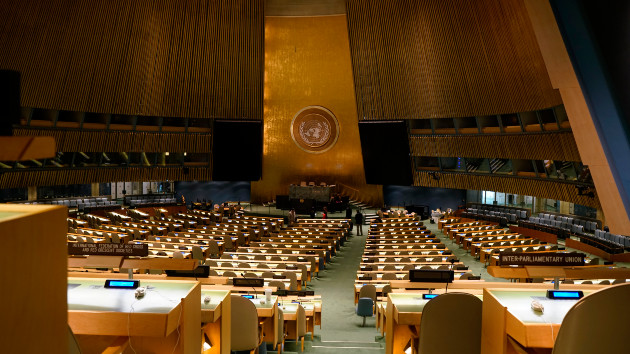
(NEW YORK) — Secretary of State Antony Blinken on Thursday called on the United Nations to send a clear message to Russia’s Vladimir Putin demanding an end to his “reckless nuclear threats.”
Blinken, addressing a U.N. Security Council meeting, said Putin has “doubled down” on the conflict despite concerns from the international community about the months-long invasion of Ukraine.
“That President Putin picked this week, as most of the world gathers at the United Nations, to add fuel to the fire he started shows his utter contempt for the U.N. charter, for the general assembly and for this council,” Blinken said.
“The very international order that we have gathered here to uphold is being shredded before our eyes,” he continued. “We cannot, we will not allow President Putin to get away with it.”
Putin on Wednesday announced a partial mobilization expected to conscript 300,000 Russian reservists to the fight after Ukraine recaptured parts of the Kharkiv region earlier this month, making a potential turning point in the conflict.
The Kremlin is also moving this week to hold “sham referendums” in Russian-backed regions of Ukraine for people to vote on whether to join Russia. Blinken urged all U.N. members to reject these referendums and declare that all Ukrainian territory will remain part of the Eastern European nation.
Blinken said Putin’s war was a distraction from other pressing global issues the security council should address, including climate change, famine and international health security.
Blinken’s Russian counterpart — Russian Foreign Minister Sergey Lavrov — was not in the room when the secretary of state spoke.
Blinken also discussed the mass graves uncovered in the recently recaptured Izium, stating the actions of Russian forces in the northeastern city are not acts of rogue units but fit a “clear pattern.”
Ukrainian President Volodymyr Zelenskyy implored world leaders to punish Russia in his virtual address to the U.N. General Assembly, in which he said Russia wants to prepare another offensive that would include “new Iziums.”
“Russia wants war,” Zelenskyy said. “It’s true. But Russia will not be able to stop the course of history. Mankind and the international law are stronger than one terrorist state. Russia will be forced to end this war.”
Blinken’s remarks came one day after President Joe Biden, in his own address to the U.N. General Assembly, rebuked Putin for having “shamelessly violated the core tenants” of the group’s charter.
Biden called for the U.N. to continue supporting Ukraine as he announced a U.S. commitment of $2.9 billion in global food aid as the war has disrupted supply chains and increased prices.
(WASHINGTON) — House Democrats, hoping to notch another major legislative win before the midterm elections, will vote Thursday on a long-delayed package of changes to policing and public safety.
Moderate and progressive Democrats hammered out a deal on Wednesday after frenetic negotiations — and on one of the House’s last working days before entering a recess that will stretch past the November races.
This new package of bills would fund recruitment and training for police departments across the country and includes new language on police accountability.
“House Democrats are committed to … building safer communities across America,” House Majority Leader Steny Hoyer tweeted on Wednesday. “Tomorrow, I will bring four public safety bills to the House Floor for consideration. I thank my colleagues for their continued work on behalf of the American people.”
To address mental health crises, one of the bills, sponsored by California Rep. Katie Porter, would create a grant program for departments to hire and dispatch mental health professionals — not law enforcement officers — in instances involving individuals with behavioral health needs.
The package also includes a bill from Nevada Rep. Steven Horsford that would direct the Department of Justice to establish a grant program for local agencies to hire detectives and victim services personnel to investigate shootings.
The legislation targets funding to smaller police departments with fewer than 200 officers; gives the DOJ the ability to preference applicants that use the funds for officer training to improve community safety and accountability; and allows the funding to not only go to officer pay and training but also be used for data collection regarding police and community safety.
Progressives have said they were particularly concerned about providing more grants and funds to police departments without including requirements on accountability for officers’ actions.
Moderates have long insisted on bringing forth public safety bills as a way to fire back at Republican attacks that blame Democrats for rising crime. Polls show some key Senate races tightening, with GOP candidates pressing their opponents on the issue — often citing advocates’ “defund the police” slogan, despite Democratic leaders rejecting such messages.
While Republicans seek to paint Democrats as soft on crime, President Joe Biden has slammed members of the GOP both for denouncing federal law enforcement after an FBI search of former President Donald Trump’s residence last month and for expressing support for those who stormed the Capitol on Jan. 6, 2021.
Biden and Democrats pushed in the 2020 cycle for broader policing reform, including changes to the standard to prosecute police misconduct and qualified immunity, after the murder of George Floyd by a police officer in Minneapolis.
But Senate Democrats ultimately failed to overcome Republican opposition to a major piece of legislation named after Floyd. Instead, Biden signed two smaller executive orders on policing earlier this year, on the second anniversary of Floyd’s death.
House Democrats can only afford to lose four votes on their new package, but party leaders are confident they will get the proposal over the line. If it passes, the legislation will then head to the Senate, where its fate is unclear.
Democratic Rep. Ilhan Omar, who represents the district in Minnesota where Floyd was killed, was one of the harshest critics of the ongoing police reform efforts but gave her approval on Wednesday. The package, she said, is “evidence-based, holistic legislation that addresses public safety and unifies the Democratic Caucus.”
“After significant, deliberate negotiations, we are pleased to share that … the bill will include a number of reforms to ensure funds are used to support smaller police departments, to invest in de-escalation and other important training, and for data collection and mental health,” Omar and Congressional Progressive Caucus Chair Rep. Pramila Jayapal, D-Wash., said in a joint statement.
(WASHINGTON) — As the November midterm elections quickly approach, all eyes are on the latest efforts by both parties to gain control of the House of Representatives and U.S. Senate.
House Majority Leader Steny Hoyer (D-M.D.) spoke with GMA 3 Wednesday to discuss his outlook on the Democrats’ chances of keeping their majority.
GMA 3:A recent Siena College-New York Times survey found Democrats up two percentage points over Republicans among registered voters. Here to discuss is House Majority Leader Steny Hoyer from Maryland. Leader Hoyer, thank you for being with us. And yes, T.J. just referenced that a lot is at stake. The power, the control of both the House and the Senate are at stake in that two percentage points. Difference is, as you know, razor thin. And we also know, looking back at 2016, not a lot of confidence necessarily in some of these polls that we’re seeing. So how are you feeling heading into the midterms as a Democrat?
Hoyer: Well, I’m feeling good.
Yes, that poll shows [two percentage points] but we’ve had some real polls. And what I mean by real polls, voting people going to the ballot box, casting their votes for candidates and expressing their opinion. And we’ve had two huge victories, actually, three but two members, one in New York, Pat Ryan, in a district that the Republicans were expected to win.
And then 2,600 miles further west in Alaska, again, we had former Gov. Sarah Palin running and our candidate, Mary Peltola, the first Native American to represent Alaska. And she is doing very, very well. So we won two races that we weren’t supposed to win, just this past four weeks.
And then the voters from Kansas, a red state with the Republican leadership, voted essentially 60-40 to make sure that a woman’s right to choose was protected, [and] that her freedom to choose her healthcare options would be protected. So, you know, in a red state, a Republican state, that we won that election as well.
But going forward, we have some very, very good candidates. The polling data you showed was a two-point ahead. But we have been as much as four or five points behind so that the movement and the momentum and the direction of support is coming our way. So I am confident that we’re going to hold the House. I think we can expand our membership in the Senate to beyond 50. And so I think that on Nov. 8, we’re going to have a good night and I’m looking forward to it.
And I think we are showing that by the issues that we’ve adopted, whether it was the rescue plan, whether it was the infrastructure investment that we’ve made that’s going to grow America and grow American jobs, or whether it was the bill that invests in science and chips to make sure that we rely on American technology, not a technology overseas that fails us. And then the inflation reduction plan where we’re reducing the costs of healthcare for people, reducing the cost of prescription drugs, capping the cost of insulin, and we’re going to make energy more available and more affordable for people. So I think that the issues are on our side, I think the people are on our side and I think the votes are on our side.
GMA 3:You talked about the polling and some of that polling that we look at has to do with the president’s approval rating, which has improved as gas prices continue to drop. We know that streak of gas prices dropping into the 99 days. They ticked up a little bit. We’ll see what happens then in the coming days and weeks. But also, look, food prices are at highs that we haven’t seen in the past since 1979, actually the inflation we’ve seen. So I know Democrats and the president love to talk about gas prices as one indicator, but what do you do when people are still hurting by trying to put food on the table?
Hoyer: T.J., what we did is we passed a food and fuel bill, unfortunately, got almost no Republican support for it, which was directed at making sure we have competition in the food producing industry, that we have availability of supply chains in getting food to where it needs to be. Now, that’s an uphill battle. Inflation is a serious issue that we are dealing with. That’s why we passed the Inflationary Reduction Act to bring other costs down. Medical costs in particular down and energy costs down for people. But we’ve got to bring food prices down as well. Unfortunately, we have a war in Ukraine. That is creating a real challenge of starvation in Africa and some other places, not in America, but it is pressing prices up and we’ve got to get a handle on that. I go to the grocery store almost every weekend and see those prices rising and people are hurting and we’re responding. And the Republicans don’t have any response to inflation. They can complain about it. They can point the finger.
And as you know, T.J., I’m sure inflation is impacting people throughout the world. Why? Because the pandemic, in effect, shut down the supply and it shut down supply routes. And so there are shortages. But people are hurting and we’re acting. The Republicans are simply talking and criticizing.
GMA 3:Let me ask you this. The president predicted and I’m going to quote him here, “If we lose the House or lose the Senate, it’s going to be a really difficult two years.” My question is, does it have to be difficult? Do you have any hope or belief that if either of those scenarios happen or one or both, could reach across the aisle, that Republicans and Democrats could work together to try and ease some of the pain that people are feeling in every part of their lives, especially when it comes to finances? Can you pass important legislation regardless?
Hoyer:We have passed important legislation. But very frankly, Amy, if you look at the record, when Paul Ryan was Speaker and when John Boehner was speaker just a few years ago, it was Democrats that stepped up to help them get legislation through that America needed because they couldn’t get the votes on their own side, even though they had the majority, very frankly, with a four-vote majority. We passed major pieces of legislation without help, which were designed to put people — put money in people’s pockets, get kids back in schools, and get 250 million shots in arms. Not a single Republican voted for that bill.
And so, yes, there is a possibility of doing that. But let me tell you what’s going to happen if the Republicans take over the House. They’ve said what they’re going to do. They’re going to investigate the president of the United States. They’re going to try to tear him down. And our country is going to be deeply divided. And very frankly, what the Republicans have done, what Donald Trump has done is deeply divide our country, [and] polarize our politics. That’s not good for our country. It’s not good for our people. It’s not good for success in the Congress of the United States. So I believe that Democrats over the years, whether it was Ronald Reagan, President George W. Bush, or any other president, we have seen Democrats support in a bipartisan way critical legislation. Frankly, we haven’t seen that from our Republican friends. And I hope we do in the future.
But I don’t want to see our country locked down by partisan politics. And that’s what’s going to happen, I’m afraid, if our Republican friends win the majority in the House of Representatives because their agenda is not a constructive agenda. It’s a negative agenda. It’s creating fear in people. It’s creating division in our country. And that’s not good for anybody. And it’s not good for the world. And we’re at war.
I’m wearing the Ukrainian flag as a symbol that we need to win this war against dictatorship and war criminals. And we need to be united to do that. And I think we Democrats, frankly, and I think Joe Biden, President Biden has worked all his life in trying to create bipartisanship. And so I will pursue that whatever happens in November.
(WASHINGTON) — President Joe Biden’s nominee to lead the National Archives and Records Administration faced lawmakers Wednesday in an unusually contentious hearing for a position not typically involving political fanfare.
During the Senate Homeland Security and Governmental Affairs hearing, Republican senators raised questions about the records dispute that resulted in the FBI raid of former President Donald Trump’s Mar-a-Lago estate. Biden’s pick to be the next chief archivist, Colleen Shogan, committed to promoting transparency at the National Archives generally, noting she was not involved in or briefed on the dispute.
Republican Sen. James Lankford of Oklahoma questioned why the National Archives’ request for documents in Trump’s possession was referred to the Justice Department.
“But as I understand it, when there is some concern about missing or damaged records in the general at the National Archives, at that point in time, to retrieve the records there is a voluntary exchange of communication with those individuals,” Shogan said. “And as I understand it — once again, I don’t have any past knowledge of this — the vast majority of the time the records are recovered and retrieved.”
Republicans pressed Shogan on her past analysis of presidential speeches, pointing to a paper she wrote titled, “Anti-Intellectualism in the Modern Presidency: A Republican Populism.” A scholarly work published by Cambridge University Press in 2007, the study described how leaders forge connections with the American people through presidential rhetoric. GOP Sen. Josh Hawley of Missouri accused Shogan of having “denigrated Republican presidents” in her writings.
“I will stand by my long experience — over 15 years — of nonpartisan service,” Shogan said in response.
The historian and scholar has held a series of nonpartisan positions, including at the Congressional Research Service, and most recently was a senior vice president at the White House Historical Association where she has served under both Biden and Trump. She defended her paper and said it does not constitute judgement on the American people or any voter.
Jason R. Baron, former director of litigation at NARA, stressed the importance of the apolitical work done at the archives, noting presidential records belong to the American people and should never have ended up at Mar-a-Lago.
“It would be unfortunate to characterize the National Archives staff as having any political bias in the course of the events since President Trump left office,” Baron said. “They have simply been fulfilling their important mission to the American people to preserve our shared history.”
Shogan’s nomination was broadly lauded by political scientists and historians after it was announced by the White House last month. She would be the first female Archivist of the United States if confirmed.
“Dr. Shogan has an outstanding record of executive leadership and service in government, an extensive record of research management, and an abiding commitment to the enduring value of the National Archives to our democracy and an informed citizenry,” the American Political Science Association said in a statement.
(MADISON, Wisc.) — Wisconsin Gov. Tony Evers announced Wednesday that he is calling a special session of the state legislature in his latest attempt to repeal a criminal abortion ban dating back to 1849 which suspended some abortion services in the state after the Supreme Court overturned Roe V. Wade in June.
“In Wisconsin, we still have an 1800s-era criminal abortion ban on the books that originated before the Civil War and when Wisconsin women did not have the right to vote, which could ban nearly all abortions, including in cases of rape and incest, if it goes back into effect,” Evers said in a statement on social media.
The Democratic governor had called a special session earlier this year, before the Supreme Court overturned Roe v. Wade, to repeal the then-dormant law. The Republican-controlled state legislature gaveled in and out of the special session without holding any discussion. Days later, the Supreme Court released its decision in Dobbs v. Jackson Women’s Health Organization, effectively overturning Roe. Abortion providers in Wisconsin have since suspended services amid the threat of prosecution.
Evers said he is now calling a special session to “create a pathway for Wisconsin voters” to repeal the abortion ban, which makes it a felony to provide an abortion except when the mother’s life is at risk.
The governor’s actions come a week after Republican U.S. Sen. Ron Johnson of Wisconsin suggested voters could challenge the abortion ban through a statewide referendum.
Voters in Wisconsin currently can not change state laws by referendum or introduce ballot initiatives, according to the governor’s office. Instead, a constitutional amendment must pass two consecutive state legislatures before heading to voters.
Evers proposes creating a process that would enable voters to “bypass” the state legislature and allow referendum ballot questions brought by the public.
“Wisconsinites were not only stripped of their reproductive freedom, but they currently can’t enact change to protect that freedom without having to get permission from the Legislature first. That’s just wrong, and it’s time for us to change that,” he said.
Evers has ordered the state legislature to act on his proposals on Oct. 4.
In response, the Republican leaders of the state legislature called Evers’ actions a “desperate political stunt.”
“Governor Evers would rather push his agenda to have abortion available until birth than talk about his failure to address rising crime and runaway inflation caused by his liberal DC allies,” state Senate Majority Leader Devin LeMahieu and state Assembly Speaker Robin Vos said in a joint statement.
Evers is further challenging the pre-Civil War abortion ban in a lawsuit filed in June by Wisconsin Attorney General Josh Kaul that names three Republican state legislative leaders among the defendants. Last week, Kaul named three district attorneys as new defendants in the ongoing case. The lawsuit argues that newer legislation, including a 1985 law that bans abortion only after fetal viability, should take precedence.
The governor, who is up for reelection this November, has vetoed more restrictive abortion laws passed by the state legislature in the past three years.
Kent Nishimura / Los Angeles Times via Getty Images
(NEW YORK) — A panel of judges on the 11th Circuit Court of Appeals has granted a request from the Justice Department to stay portions of a ruling by district Judge Aileen Cannon that had effectively paused the government’s investigation into former President Donald Trump’s potential mishandling of classified records after leaving office.
The three-judge panel, comprised of two Trump appointees and an Obama-era appointee, ruled unanimously that the Justice Department is no longer enjoined from using the documents with classifications recovered from Mar-a-Lago in its investigation and will no longer have to submit them to special master Ray Dearie for his review.
“[Trump] has not even attempted to show that he has a need to know the information contained in the classified documents,” the panel said in its ruling. “Nor has he established that the current administration has waived that requirement for these documents.”
They also agree with the Justice Department that Trump has submitted no record or claim that he ever declassified the documents at issue, and that his team resisted stating as much when pressed by Dearie.
“In any event, at least for these purposes, the declassification argument is a red herring because declassifying an official document would not change its content or render it personal,” the judges said. “So even if we assumed that Plaintiff did declassify some or all of the documents, that would not explain why he has a personal interest in them.”
(WASHINGTON) — The House on Wednesday approved a post-Jan. 6 election reform bill intended to blunt future challenges to presidential elections.
The Presidential Election Reform Act, crafted largely by Reps. Zoe Lofgren, D-Calif., and Liz Cheney, R-Wyo., passed by a 229-203 vote, with nine Republicans joining the Democratic majority in favor of it.
The legislation would alter the 135-year-old Electoral Count Act, which — as the House committee investigating Jan. 6 showed through a series of hearings — former President Donald Trump and his allies focused on in their efforts to overturn the results of the 2020 race Trump lost to Joe Biden.
Among other things, the new bill would confirm that the vice president’s role in overseeing the Electoral College count after each election is purely ministerial. The legislation would also raise the threshold needed for electoral objections by lawmakers to receive a vote in Congress and it would mandate that governors transmit state results to Congress.
As the Jan. 6 committee detailed, Trump and his allies pressed then-Vice President Mike Pence to not green-light the electors submitted from certain swing states and pushed governors to send to Congress alternate slates of electors who backed Trump over Biden.
Objections to some states’ electors on Jan. 6, 2021, also easily earned votes under the current standards, which only require one member each in the House and the Senate to back an objection. The new legislation raises that floor to one-third of each chamber.
Prior to Wednesday’s vote on the Presidential Election Reform Act, supporters emphasized the need for the legislation as numerous election deniers, including those running for office this year, still say the 2020 race shouldn’t have been certified, citing groundless claims of voter fraud.
“Let me be clear. This is a kitchen table issue for families, and we must make sure this anti-democratic plot cannot succeed,” Speaker Nancy Pelosi, D-Calif., said on the House floor. “It’s a kitchen table issue because denying the American people their fundamental freedom to choose their own leaders denies them their voice in the policies we pursue, and those policies can make tremendous difference in their everyday lives.”
“Our bill will preserve the rule of law for all future presidential elections by ensuring that self-interested politicians cannot steal from the people the guarantee that our government derives its power from the consent of the governed,” Cheney added in her own remarks.
The bill was not anticipated to garner significant Republican support in the House, though, outside of anti-Trump lawmakers.
The nine Republican votes came from Cheney and Reps. Anthony Gonzalez of Ohio, Adam Kinzinger of Illinois, Peter Meijer Michigan, Tom Rice of South Carolina, Jaime Herrera Beutler of Washington, John Katko of New York, Fred Upton Michigan and New York’s Chris Jacobs. None of them are returning next Congress, either because they are retiring or lost their primaries this year.
House GOP leadership had actively whipped against the bill, with Minority Whip Steve Scalise’s, R-La., saying in a memo Tuesday that “In their continued fixation to inject the Federal government into elections, this legislation runs counter to reforms necessary to strengthen the integrity of our elections.”
The House bill is also competing with Senate legislation crafted after bipartisan talks that included Sens. Joe Manchin, D-W.Va, and Susan Collins, R-Maine.
The two bills are similar, though the Senate legislation sets a lower threshold to introduce objections to the electoral count.
ABC News’ Benjamin Siegel contributed to this report.
(NEW YORK) — Speaking to the United Nations General Assembly, President Joe Biden on Wednesday cast the defining conflict facing global leaders as a duel between democracy and autocracy, directly responding to new threats from Russian President Vladimir Putin to escalate the war in Ukraine.
The speech is Biden’s first at the forum since Russia’s invasion, offering him the opportunity to condemn the Kremlin in front of an audience of fellow heads of state.
Biden opened his remarks with a strong rebuke of Putin after he earlier Wednesday ordered a partial mobilization of reservists in Russia and raised the specter of using nuclear weapons after a retreat in the northeastern Kharkiv region.
“Let us speak plainly, a permanent member of the United Nations Security Council invaded its neighbor, attempted to erase the sovereign state from the map,” Biden said. “Russia has shamelessly violated the core tenants of the United Nations Charter.”
“Just today, President Putin has made overt nuclear threats against Europe and reckless disregard of the responsibilities of a nonproliferation regime,” Biden continued. “Now, Russia is calling, calling up more soldiers to join the fight and the Kremlin is organizing a sham referendum to try to annex parts of Ukraine, an extremely significant violation of the U.N. Charter.”
Biden called the conflict “a war chosen by one man” and slammed Putin for his attacks on Ukraine’s schools, railway stations, hospitals.
“Even more horrifying evidence of Russia’s atrocity and war crimes: Mass graves uncovered in Izium, bodies, according to those that excavated those bodies, showing signs of torture. This war is about extinguishing Ukraine’s right to exist as a state, plain and simple. And Ukraine’s right to exist as a people. Whoever you are, wherever you live, whatever you believe, that should not–that should make your blood run cold,” he said.
Biden reaffirmed the U.S. commitment to help Ukraine and called on other U.N. members to do the same.
“Each of us in this body who determined to uphold the principles and beliefs we pledged to defend as members of the United Nations, must be clear, firm and unwavering in our resolve,” he said.
Biden also announced a commitment of $2.9 billion in global food aid, an effort to address growing famine in the Horn of Africa, and rising food prices worldwide due to the war in Ukraine, and inflation.
As Biden grapples with a series of complicated global issues, the high-stakes summit presents a range of challenges for the administration.
The no-shows
Although U.N. General Assembly meetings offer an abundance of opportunity for face-to-face diplomacy — something the president prides himself on — two key players weren’t in attendance: the leaders of Russia and China.
“Our competitors are facing increasingly strong headwinds, and neither President Xi nor President Putin are even showing up for this global gathering,” national security adviser Jake Sullivan told reporters on Tuesday.
In Putin’s case, the most pressing of those headwinds are losses on the battlefield in Ukraine, according to administration officials.
Ahead of an engagement with his counterpart from the U.K., Secretary of State Antony Blinken denounced reports that Moscow plans to hold sham referenda in occupied territories in Ukraine to pave the way to annex territory.
“I think this is also not a surprise this is happening now. We have seen in the last weeks significant gains by Ukraine,” Blinken said. “It’s a sign of weakness. It’s a sign of Russian failure.”
But as a number of other heads of state push for negotiations for peace, the gathering won’t offer a robust opportunity for Biden to pursue that path with the leaders of the countries involved in the conflict. Russia’s Foreign Minister Sergey Lavrov is in New York, but there are no plans for a meeting with U.S. officials on the books.
Ukraine’s President Volodymyr Zelenskyy will also give a speech on Wednesday, but he will do so remotely as the only leader allowed to appear virtually this year.
China’s Xi Jinping’s absence means there’s no chance an in-person meeting with the president, something that hasn’t happened since Biden took office. And the two have an ever-growing list of differences to discuss.
The past months have seen multiple escalations, with China responding to any step perceived as the U.S. moving towards recognizing Taiwan as a sovereign state with shows of force, a strategy a senior State Department official described as an attempt to normalize military pressure.
While the administration says Washington’s long-standing “One China” policy remains in effect, Biden also said U.S. troops would defend Taiwan if it were attacked.
The impermanent 5?
Russia’s exalted position as one of five permanent members of the U.N. Security Council has thrown a significant wrench in the body’s efforts to check its aggression, prompting calls that it should be removed altogether.
U.S. officials appeared to be aligning behind a plan that, instead of subtracting Russia as a permanent member, would seek to make additions to the Security Council.
A senior State Department official said that Biden would attempt to “reenergize” the push for reform by arguing the arm needs to be “more representative of the world’s population, and filled with countries that are ready to work together.”
The odds of expanding the council appear slim. Reforming its makeup would require amending the U.N. charter, a step that Russia or any other permanent member could veto.
The rest of the agenda
While the war in Ukraine is shaping up to dominate the General Assembly, administration officials have stressed they want to take on other global issues as well.
Biden in his speech discussed the need to tackle food insecurity, the ongoing COVID-19 health crisis and climate change.
“Let this be the moment, we find within ourselves, the will to turn back the tide of climate devastation and unlock a resilient, sustainable clean energy economy to preserve our plant,” Biden said.
One pressing matter facing the White House is its push to return to an Obama-era nuclear deal with Iran. Indirect negotiations appear to have stalled again, and officials from both countries appear increasing pessimistic that the pact can be renewed.
Sullivan said Biden plans to reiterate that the U.S. is open to returning to an agreement, but that he isn’t anticipating any major breakthroughs.
Even a meeting with one of America’s closest allies has its thorns. Biden will hold his first meeting with the U.K.’s new prime minister, Liz Truss, as the differences between the two’s economic policies become ever apparent.
Recently, Truss said completing a long-awaited trade deal with the U.S. was not a key priority and unlikely to happen anytime soon. But Sullivan said it would be on the president’s list.
“I do think that they will talk about the economic relationship between the U.S. and the U.K.,” Sullivan said, adding they would also hit other areas where Truss and Biden have more in common, such as support for Ukraine and addressing Europe’s energy crisis.
(WASHINGTON) — A new bill from a pair of Republican lawmakers would prevent the Biden administration from lifting key sanctions on Iran over the country’s alleged support of efforts to assassinate high-profile Americans and critics on U.S. soil.
The bill, set to be introduced Wednesday by Iowa Sen. Joni Ernst and Florida Rep. Mike Waltz, would codify Trump-era sanctions imposed on Iran — specifically, on major industries and financial institutions — according to legislative text shared first with ABC News.
Should the U.S. and its allies reach an agreement with Iran in ongoing negotiations to return to the 2015 nuclear agreement reached under President Barack Obama, the PUNISH Act would prevent the Biden administration from lifting the Trump sanctions — and unfreezing billions of dollars in Iranian assets — until the State Department can certify that Iran has not supported efforts to kill prominent American citizens or Iranian dissidents on American soil for five years.
While the Democratic majority isn’t expected to consider the proposal, it signals Republicans’ intent to pressure and constrain Biden’s foreign policy agenda and negotiations with Iran should they retake control of either chamber of Congress in the November elections.
“President Biden should not provide a dime of sanctions relief to the largest state sponsor of terrorism, which is actively trying to kill U.S. officials and citizens, at home and abroad,” Ernst will say Wednesday, according to prepared remarks shared with ABC News.
In August, an alleged Iranian operative with links to the country’s Revolutionary Guard Corps was charged by the Justice Department in what prosecutors called a plot to murder Trump’s former national security adviser John Bolton. The Justice Department accused the Iranian government of supporting the assassination attempt in response to the 2020 U.S. missile killing of military leader Qasem Soleimani. (Iran has claimed the case is “baseless” and politically motivated.)
Bolton and several top Trump administration officials, including former Secretary of State Mike Pompeo, Defense Secretary Mark Esper and Iran envoy Brian Hook, reportedly receive government protection due to ongoing threats from Iran.
The U.S. government has said Iran encouraged attacks on author Salman Rushdie, who was stabbed in August at a public event in upstate New York. (Iran denied involvement.) And in July, a federal court unsealed an indictment charging four Iranian nationals with conspiring to kidnap an outspoken Iranian American activist and journalist in Brooklyn.
It’s against this backdrop that Republicans say they must try to limit the White House’s ability to change sanctions without assurances of nonviolence.
“Whether you want to argue whether it’s a return to the [2015 nuclear agreement] or a new deal, it astounds me that we are continuing to negotiate with a regime with active plots against American officials … that is instigating attacks on Americans citizens,” Waltz told ABC News.
Republicans and some Democrats have questioned the Biden administration’s efforts to reenter the Obama-era deal to curb Iran’s nuclear program after the Trump administration withdrew from the agreement in 2018 and slapped on sanctions as part of a “maximum pressure campaign.” Iran responded by enriching more uranium at higher levels beyond the limits of the deal.
Biden’s critics have expressed concerns that Iran can still develop its nuclear program in secret while using newly unfrozen assets and oil revenue to support terrorist proxies and other groups across the Middle East that threaten U.S. interests and allies.
Last year, a bipartisan group of 140 U.S. lawmakers urged Biden to reach a “comprehensive” deal with Iran to limit its nuclear program and address other national security issues.
In an interview with CBS News that aired Sunday, Iranian President Ebrahim Raisi denied his country’s involvement in the alleged attempt against Bolton and said American pledges to abide by a new nuclear deal would be “meaningless” without a “guarantee” that the U.S. would not withdraw from a future deal and reimpose economic sanctions on Iran.
Raisi, who is now in New York for the U.N. General Assembly and is scheduled to address the gathering on Wednesday, met with French President Emmanuel Macron on Tuesday amid a stalemate in indirect negotiations over the return to a nuclear agreement.
Both sides have exchanged proposals in recent weeks, but they publicly remain at odds over a U.N nuclear watchdog investigation and Iran’s insistence on a guarantee that the U.S. would not pull out of any deal.
Republican efforts to codify sanctions on Iran are “designed to tie this president or future presidents’ hands so he or she cannot waive these sanctions to encourage better Iranian behavior and bring Iran’s nuclear behavior under a modicum of control,” Daryl G. Kimball, the executive director of the Arms Control Association, who has called for a return to the nuclear agreement, told ABC News.
Waltz, the lead author of the bill in the House, told ABC News that he thinks Iran “is constantly holding out because they believe they can get a better deal.” Waltz argued that if the country’s leaders “see these things codified by Congress, and they see clear action by the Congress, then that puts them in a weaker negotiation position.”
(WASHINGTON) — When he steps up to podium to deliver an address on Wednesday at the United Nation General Assembly, President Joe Biden is expected to cast the defining conflict facing global leaders as a duel between democracy and autocracy, and one with implications for every nation across the world.
The speech will be Biden’s first at the forum since Russia’s invasion of Ukraine, offering him the opportunity to condemn the Kremlin in front of an audience of fellow heads of state.
“He’ll offer a firm rebuke of Russia’s unjust war in Ukraine and make a call to the world to continue to stand against the naked aggression that we’ve seen these past several months,” National Security Advisor Jake Sullivan said.
“Countries cannot conquer their neighbors by force, cannot seize an acquired territory by force,” he said. “He will speak to every country in the world — those that have joined our broad-based coalition to support Ukraine and those who so far have stood on the sidelines that now is a moment to stand behind the foundational principles of the [UN] charter.”
Thanks to the so-far unshakeable coalition of NATO allies standing behind Kyiv, Sullivan said the president was heading into summit with “the wind at his back,” and would demonstrate the administration’s commitment to offsetting the collateral impacts of the war by pledging more than $100 million to food-security efforts.
As Biden grapples with a series of complicated global issues, the high-stakes summit presents a range of challenges for the administration.
The no shows
Although U.N. General Assembly meetings offer an abundance of opportunity for face-to-face diplomacy — something the president prides himself on — two key players won’t be in attendance: the leaders of Russia and China.
“Our competitors are facing increasingly strong headwinds, and neither President Xi nor President Putin are even showing up for this global gathering,” said Sullivan.
In Russian President Vladimir Putin’s case, the most pressing of those headwinds are losses on the battlefield in Ukraine, according to administration officials.
Ahead of an engagement with his counterpart from the U.K., Secretary of State Antony Blinken denounced reports that Moscow plans to hold sham referenda in occupied territories in Ukraine to pave the way to annex the territory and that Putin may move to surge additional troops to help the war effort.
“I think this is also not a surprise this is happening now. We have seen in the last weeks significant gains by Ukraine,” Blinken said. “It’s a sign of weakness. It’s a sign of Russian failure.”
But as a number of other heads of state push for negotiations for peace, the gathering won’t offer a robust opportunity for Biden to pursue that path with the leaders of the countries involved in the conflict. Russian Foreign Minister Sergey Lavrov is in New York, but there are no plans for a meeting with U.S. officials on the books.
Ukrainian President Volodymyr Zelenskyy will also give a speech on Wednesday, but he will do so remotely as the only leader allowed to appear virtually this year.
China’s Xi Jinping’s absence means there’s no chance of an in-person meeting with the president, something that hasn’t happened since Biden took office. And the two have an ever-growing list of differences to discuss.
The past months have seen multiple escalations, with China responding to any step perceived as the U.S. moving towards recognizing Taiwan as a sovereign state with shows of force, a strategy a senior State Department official described as an attempt to normalize military pressure.
While the administration says Washington’s long-standing One China policy remains in effect, Biden also said U.S. troops would defend Taiwan if it were attacked.
The impermanent 5?
Russia’s exalted position as one of five permanent members of the U.N. Security Council has thrown a significant wrench in the body’s efforts to check its aggression, prompting calls that it should be removed all together.
Biden won’t go quite that far, Sullivan said.
“It is not something that he is going to raise tomorrow, although I think the world can see that when a permanent member acts in this way it strikes at the heart of the U.N. Security Council and so that should lead everyone collectively to put pressure on Moscow to change course,” he said.
But U.S. officials appear to be aligning behind a plan. Instead of subtracting Russia from the permanent members of the council, they may seek to make additions.
A senior State Department official said that Biden would attempt to “reenergize” the push for reform by arguing the arm needs to be “more representative of the world’s population, and filled with countries that are ready to work together.”
The odds of expanding the council appear slim. Reforming its makeup would require amending the U.N. charter, a step that Russia or any other permanent member could veto.
The rest of the agenda
While the war in Ukraine is shaping up to dominate the General Assembly, administration officials have stressed they want to take on other global issues as well.
One pressing matter facing the White House is its push to return to an Obama-era nuclear deal with Iran. Indirect negotiations appear to have stalled again, and officials from both countries appear increasingly pessimistic that the pact can be renewed.
Sullivan said Biden plans to reiterate that the U.S. is open to returning to an agreement, but that he isn’t anticipating any major breakthroughs.
Even a meeting with one of the U.S.’s closest allies has its thorns. Biden will hold his first meeting with the U.K.’s new prime minister, Liz Truss, as the differences between the two’s economic policies become ever apparent.
Recently, Truss said completing a long-awaited trade deal with the U.S. was not a key priority and unlikely to happen anytime soon. But Sullivan said it would be on the president’s list.
“I do think that they will talk about the economic relationship between the U.S. and the U.K.,” Sullivan said, adding they would also hit other areas where Truss and Biden have more in common, such as support for Ukraine and addressing Europe’s energy crisis.