
McConnell calls Democrat Kyrsten Sinema ‘the most effective first-term senator’

McConnell calls Democrat Kyrsten Sinema ‘the most effective first-term senator’
Alex Wong/Getty Images

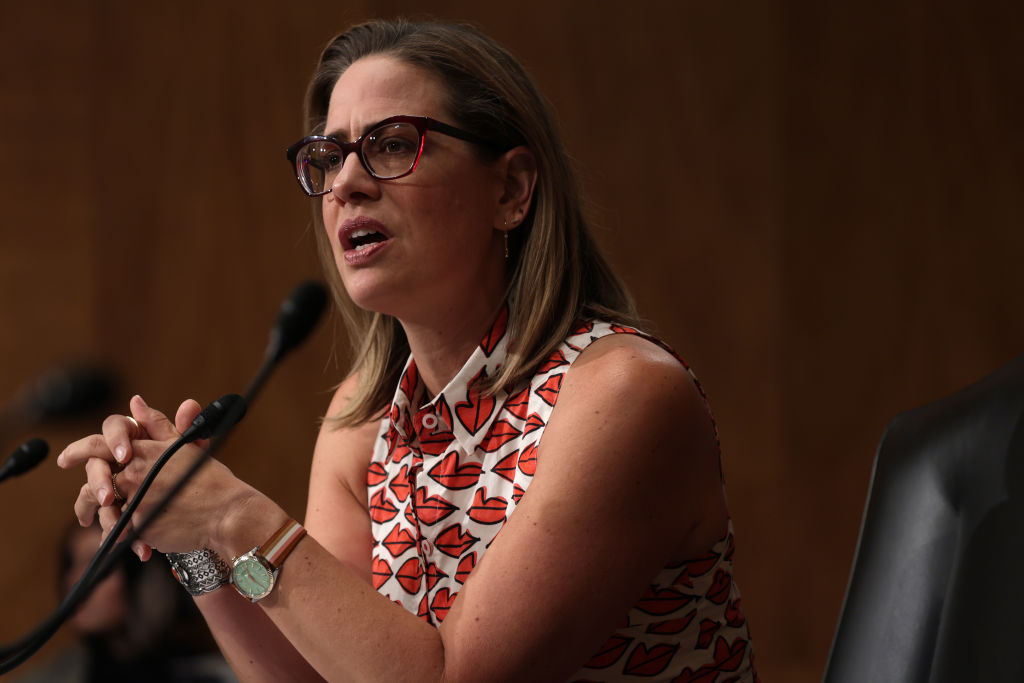
(WASHINGTON) — Arizona Democratic Sen. Kyrsten Sinema on Monday doubled down on her controversial support for the filibuster and displayed her unconventional friendship with Senate Minority leader Mitch McConnell during a speech hosted by the Republican in his home state of Kentucky.

Speaking at the McConnell Center at the University of Louisville, Sinema reiterated her stance that the Senate should continue passing legislation under a 60-vote threshold, clarifying that she hopes to resurrect the filibuster for “everything,” including all judicial and executive branch nominees. That move would almost guarantee that the 50-50 Senate would block nearly all of President Joe Biden’s appointments.

“I committed to the 60-vote threshold, it’s been an incredibly unpopular view. I actually think we should restore the 60 vote threshold for the areas in which it has been eliminated already,” the moderate Democrat said during her speech on “The Future of Political Discourse and the Importance of Bipartisanship.”

“It would make it harder for us to confirm judges. It would make it harder for us to confirm executive appointments in each administration. But I believe by restoring, we’d actually see more of that middle ground in all parts of our governance which is what I believe our forefathers intended.”

Sinema has over the past two years been the outlier among fellow Democratic senators who have attempted to pass legislation in a tied Senate, remaining steadfast in her allegiance to the filibuster rule despite mounting criticism. Her main argument against eliminating the filibuster was that doing so might turn the Senate into the House — a lower chamber without the longstanding Senate rule.

“The trouble with that is …the House with elections every two years, representing a smaller group of voters by each House, they really represent the passions of the moment in the political spectrum,” she said, noting the impending midterm elections just over a month and a half away. Sinema is not yet up for reelection for another term.

“Control changes between the House and the Senate every couple of years, it’s likely to change again, in just a few weeks … The Senate was designed to be a place that moves slowly to cool down those passions, to think more strategically and long term about the legislation before us.”

Ahead of her remarks, Sinema was called “the most effective first term senator I’ve seen in my time in the Senate,” by McConnell, who has served 37 years in the chamber and is poised to break records for leadership longevity.

His selection of Sinema for the bipartisan speaking series means the Arizonan is now part of a longstanding list of political heavyweights, including Supreme Court Justice Amy Coney Barrett, Sen. Amy Klobuchar, D-Minn., Biden while he was vice president and Hillary Clinton while she was secretary of state.

“She is today what we have too few of in the Democratic Party, a genuine, moderate, and a dealmaker,” McConnell said, noting with particular reverence her dedication to the Senate’s 60-vote threshold rule.

“It took one hell of a lot of guts for Kyrsten Sinema to stand up and say, ‘I’m not going to break the institution in order to achieve a short-term goal,'” he said, noting her departure from the Democrats’ desire to lower the threshold.

McConnell also said that former President Donald Trump “would harangue me on virtually a weekly basis,” about the same idea.

He also applauded Sinema’s involvement in moving forward bipartisan legislation — a role she has enjoyed as one of the few swing votes in the 50-50 Senate.

“Kyrsten has been right in the middle of, if not the principal leader, in getting us to an outcome in a highly partisan time, on infrastructure on school safety, mental health, postal reform, that ships bill you name it, every single thing that we’ve been able to work together on,” McConnell said.

Sinema, too, touted her friendship with the top Republican during her speech.

“At first glance, Sen. McConnell and I have relatively little — or some could even say nothing — in common,” she said. “For starters, he drinks bourbon, I drink wine. He’s from the Southeast and I’m from the great Southwest. He wears suits and ties, and I wear dresses and these fierce sneakers. Perhaps most obviously, we come from opposing political parties.”

“But despite our apparent differences, Sen. McConnell and I have forged a friendship — one that is rooted in our commonalities, including our pragmatic approach to legislating, our respect for the Senate as an institution, our love for our home states and a dogged determination on behalf of our constituents.”

Copyright © 2022, ABC Audio. All rights reserved.
Biden and DeSantis haven’t spoken directly as Hurricane Ian bears down on Florida

Biden and DeSantis haven’t spoken directly as Hurricane Ian bears down on Florida
Paul Hennessy/SOPA Images/LightRocket via Getty Images

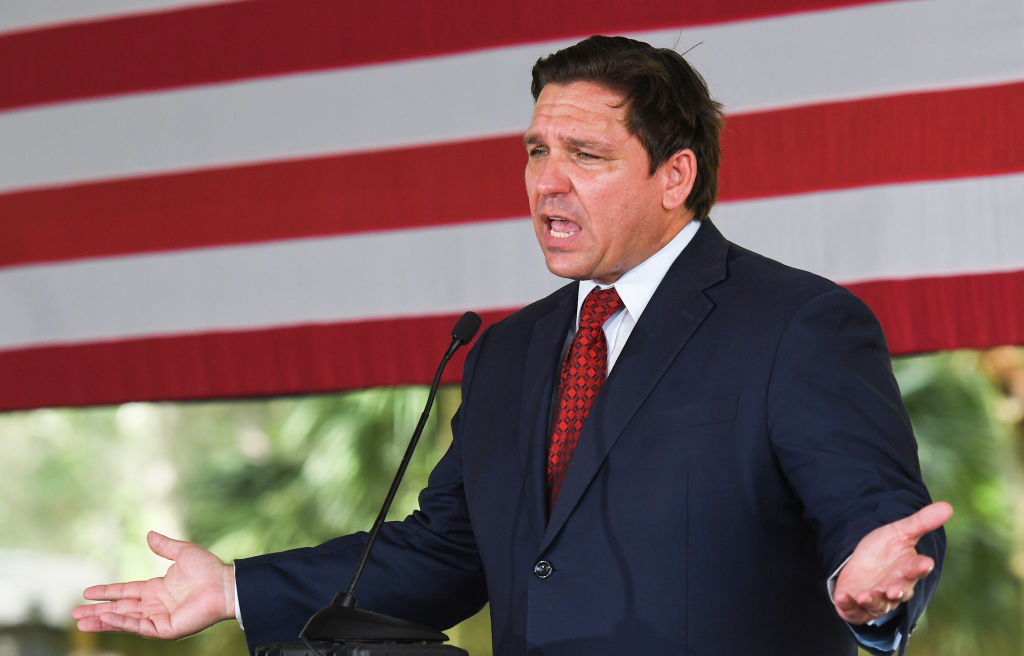
(WASHINGTON) — Ahead of Hurricane Ian’s expected landfall in Florida, White House press secretary Karine Jean-Pierre said Monday that President Joe Biden has yet to speak directly with GOP Gov. Ron Desantis.

“We don’t have any calls to preview or that’s locked into there, at this time,” Jean-Pierre said when asked by ABC Chief White House Correspondent Cecilia Vega.

Jean-Pierre insisted that the politically tense relationship between the two men is not at issue.

“It’s about the people of Florida. It’s not about public officials, especially in this time. And so again, the president, as president of the United States, as president for — for folks in red states and blue states, he’s going to keep that commitment. And you have seen him do that over the course of the 19 months when there has been extreme — extreme events, extreme weather that has happened again in blue states and red states,” she said.

When another reporter pointed out that President Biden never spoke with Mississippi GOP Gov. Tate Reeves during the height of Jackson’s water crisis, Jean-Pierre said the administration showed up for Mississippians, even without a Biden call to Reeves.

“When you mentioned the governor of Mississippi, they, you’re right, they didn’t speak and we still were able to deliver for the folks in Jackson and for the folks of Mississippi. You had our EPA administrator on the ground, you had FEMA administrator on the ground and not just them, but also folks who work for those — for those two agencies. And you have the Army Corps of Engineers. And so we put the full — the full power of the administration. We surged resources on the ground, to make sure that we did everything that we can to help the people of Mississippi. This is the same, there’s no difference here,” she insisted.

She did say that FEMA Administrator Deanne Criswell, who was in Miami Monday, will appear in the White House briefing room Tuesday to provide an update.

“FEMA has prepositioned supplies at strategic locations in Florida and also Alabama. That includes generators, millions of meals and millions of liters of water. FEMA also has staff on the ground supporting planning and preparation efforts. Tomorrow, Administrator Criswell will provide an update on the efforts underway in Florida — Florida to prepare for Hurricane Ian as well as ongoing recovery efforts in Puerto Rico and also Alaska,” Jean-Pierre said.

Biden has declared a state of emergency exists in Florida and has ordered federal aid to supplement state efforts.

An unrelated Biden trip to Florida scheduled for Tuesday has been postponed because of the storm.

Copyright © 2022, ABC Audio. All rights reserved.

Biden’s student loan forgiveness will cost $400B, new estimate says, as White House pushes back

Biden’s student loan forgiveness will cost 0B, new estimate says, as White House pushes back
Chris Kleponis/CNP/Bloomberg via Getty Images

(WASHINGTON) — President Joe Biden’s federal student loan forgiveness plan will cost $400 billion over 10 years, according to a revised estimate this week from the Congressional Budget Office.

That’s a lower number than from one leading outside estimate, but the nonpartisan federal agency’s projection drew quick pushback from the White House, which is sensitive to criticism it is growing rather than reducing the government deficit.

In a letter sent Monday to North Carolina Republicans Sen. Richard Burr and Rep. Virginia Foxx following their inquiries into Biden’s announcement last month to forgive up to $20,000 in federal student loans, the CBO noted that the cost of pausing repayments through the end of 2022 will add an additional $20 million onto that $400 billion price tag.

That CBO estimate does not include the cost of another feature of Biden’s plan: lowering the maximum amount a borrower can pay back to 5% of their income, down from 10%. The nonpartisan Committee for Responsible Federal Budget estimates that would tack on $120 million.

The CBO score, which the agency estimates is “highly uncertain” due to components that include projections dependent on future economic conditions and on how future terms of loans might be modified, is slightly less than the University of Pennsylvania’s Wharton Business School assessment that all three components of the forgiveness plan would cost about $605 billion.

Opponents of Biden’s student loan program — including some members of his own party — have insisted that the plan is impractical during a time of historic inflation rates and high gas prices, though the many Democratic supporters of the plan say it helps addresses education’s affordability issues.

The White House maintains that the cost of the student loan forgiveness plan pales in comparison to the president’s ability to foster debt reduction elsewhere.

The estimated loan cancellation price comes in higher than the $300 million amount that the Biden-backed Inflation Reduction Act is expected to reduce the federal deficit by, however. (An administration official noted to ABC News that, overall, the cash flow impact of debt cancellation will be very small in 2023 — about $21 billion.)

MORE: Biden’s student loan forgiveness policy: How to apply, who qualifies, more
In a statement, a White House spokesman emphasized that the president is still likely to reduce the federal deficit this year, despite the outlay for debt forgiveness, and the spokesman compared that with a major tax cut under Biden’s predecessor Donald Trump.

“The Biden-Harris Administration’s student debt relief plan provides breathing room to tens of millions of working families. It gives people who have been struggling with student debt that shot they want at starting a business, buying that first home, or just having a slightly easier time paying the monthly bills,” Abdullah Hasan said. “It’s a stark contrast to the Trump tax bill, which ballooned the deficit by nearly $2 trillion and provided the vast majority of benefits to big corporations and the wealthiest individuals.”

The White House also circulated a memo pushing back on the CBO estimate, noting that it assumed a 90% participation rate in the forgiveness program — though similar, smaller-scale programs had much lower participation.

The White House memo challenged how the CBO arrived at $400 billion, suggesting that the agency’s own logic pegged the number at around $250 billion.

The debt cancellation program is expected to open for applications in October.

Copyright © 2022, ABC Audio. All rights reserved.

Biden to propose new rule requiring airlines to disclose extra fees upfront

Biden to propose new rule requiring airlines to disclose extra fees upfront
Official White House Photo by Adam Schultz

(WASHINGTON) — President Joe Biden on Monday is expected to announce a new proposed rule that would allow fliers to see the total cost of an airline ticket, including extra fees, before they click on “purchase.”

Under the proposed rule, airlines and travel search websites would have to disclose fees upfront — the first time the airfare is displayed — charges associated with baggage, sitting with your child, and changing or cancelling your flight.

The announcement is part of a larger effort from the White House to help lower prices for consumers as record high inflation continues. It also comes with midterm elections approaching.

“Airline passengers deserve to know the full, true cost of their flights before they buy a ticket,” Transportation Secretary Pete Buttigieg said in a release. “This new proposed rule would require airlines to be transparent with customers about the fees they charge, which will help travelers make informed decisions and save money.”

Scott Keyes, founder of Scott’s Cheap Flights, believes giving clearer disclosure of these fees upfront will be a “major win for travelers” by making it “far easier” to compare the full cost of different flight options.

He explained that some airlines now make more money on fees than fares, partly due to the fact that fees are exempt from the 7.5% federal excise tax on airfare.

Airlines for America (A4A), which represents major U.S. passenger airlines, responded to the rule arguing that airlines already “offer transparency to consumers from first search to touchdown.”

“U.S. airlines are committed to providing the highest quality of service, which includes clarity regarding prices, fees and ticket terms,” the group said in a statement. “A4A passenger carriers provide details regarding the breakdown of airfares on their websites, providing consumers clarity regarding the total cost of a ticket. This includes transparency regarding taxes and government fees on airline tickets, which account for more than 20 percent of many domestic one-stop, roundtrip tickets.”

The public has 60 days to comment on the proposal before it can be finalized.

Copyright © 2022, ABC Audio. All rights reserved.

Next Jan. 6 hearing may be ‘more sweeping,’ Schiff says, as committee weighs criminal referral

Next Jan. 6 hearing may be ‘more sweeping,’ Schiff says, as committee weighs criminal referral
Photo by Mike Kline (notkalvin)/Getty Images

(WASHINGTON) — Ahead of what could be their final investigative hearing, scheduled for Wednesday afternoon, members of the House Jan. 6 committee on Sunday offered a small preview of what is to come as they rapidly approach the end of their timeline.

“We’re not disclosing yet what the focus will be. I can say that, as this may be the last hearing of this nature — that is, one that is focused on sort of the factual record — I think it’ll be potentially more sweeping than some of the other hearings,” Rep. Adam Schiff, D-Calif., said on CNN’s State of the Union.

“But it too will be in very thematic,” he said of the hearing. “It will tell the story about a key element of Donald Trump’s plot to overturn the election. And the public will certainly learn things it hasn’t seen before, but it will also understand information it already has in a different context by seeing how it relates to other elements of this plot.”

After the committee’s vice-chair, Rep. Liz Cheney, said Saturday that she believes the group will move forward unanimously, Schiff agreed and went a bit further when asked if there was going to be an unanimous criminal referral made about the former president’s conduct. (Former President Donald Trump has repeatedly said he did nothing wrong and cast the committee, which includes two Republicans, as partisan.)

“It will be … my recommendation, my feeling, that we should make referrals,” Schiff said. “But we will get to a decision as a committee, and we will all abide by that decision, and I will join our committee members if they feel differently.”

Cheney has also said the committee received around 800,000 pages of communications from the Secret Service in response to a subpoena. Members of the committee said Sunday they are still going through that information.

While the provided materials are not a substitute for the Jan. 6-related messages that were deleted, they offer some additional context, according to Schiff.

“We are still investigating how that came about [the deleted messages] and why that came about. And I hope and believe the Justice Department, on that issue, is also looking at whether laws were broken in the destruction of that evidence,” Schiff said on CNN. “But we do have a mountain of information that we need to go through. But I think it’s fair to say that it won’t be a complete substitute for some of the most important evidence, which would have been on those phones.”

Asked about former committee adviser Denver Riggleman’s recent suggestion that “the White House switchboard had connected to a rioter’s phone” during the attack on the Capitol last year — and if he viewed such a development as significant to the investigation — Schiff downplayed the comment.

“I can’t comment on the particulars. I can say that each of the issues that Mr. Riggleman raised during the period he was with the committee, which ended quite some time ago, we looked into. And one of the things that has given our committee credibility is we’ve been very careful about what we say, not to overstate matters,” Schiff said, adding, “Without the advantage of the additional information we’ve gathered since he left the committee, it poses real risks to be suggesting things. So, we have looked into all of these issues.”

Rep. Jamie Raskin, D-Md., appeared on NBC’s Meet the Press and was asked about the likelihood that the Jan. 6 committee will have testimony from Ginni Thomas and Newt Gingrich before Wednesday’s hearing.

“I doubt that. But I think that there is an agreement in place with Ginni Thomas to come and talk and I know the committee is very interested,” Raskin said, referring to Supreme Court Justice Clarence Thomas’ wife, a noted conservative activist who was in touch with Trump’s team as he pushed to overturn the 2020 results.

Raskin said that those testimonies — once they are given — will be included in the committee’s final report if the hearings have already concluded.

He was also asked if that report will be finished by the midterm elections.

“I don’t know whether it will be done then, but our commitment is to get it done by the end of this Congress [by January],” Raskin said. “The House of Representatives, unlike the Senate, ends every two years. A completely new Congress comes in. So that’s the end of our lease on life and we have to get it out to the people.”

Pressed further on the amount of work still left for them to do, Raskin pledged that the committee will “make sure our materials are made public and available for the future, and we’re going to preserve them. We’re not going to allow them to be destroyed.”

The committee chair, Bennie Thompson, told reporters last week that the hearings were wrapping up.

“Unless something else develops, this hearing, at this point, is the final hearing. But it’s not in stone because things happen,” Thompson, D-Miss., said then.

He promised “substantial footage” of the riot and “significant witness testimony” that hadn’t previously been released.

Copyright © 2022, ABC Audio. All rights reserved.

Cheney says she’ll campaign against Lake, Mastriano because of their election denials

Cheney says she’ll campaign against Lake, Mastriano because of their election denials
Drew Angerer/Getty Images

(AUSTIN, Texas) — Outgoing Rep. Liz Cheney, R-Wyo., reiterated this weekend that she would campaign against election deniers, singling out Republican gubernatorial nominees in Arizona and Pennsylvania who’ve floated conspiracy theories about the 2020 presidential race.

Cheney, who lost her primary last month to a challenger endorsed by former President Donald Trump, said at the Texas Tribune Festival in Austin on Saturday that she would seek to prevent Arizona Republican Kari Lake and Pennsylvania Republican Doug Mastriano from being elected to their states’ governors’ mansions.

“I’m going to do everything I can to make sure Kari Lake is not elected,” Cheney said at the closing night of the Texas Tribune Festival in Austin.

“I think we have to do everything we can in ’22 to make sure those people don’t get elected,” she added.

Turning to the governor’s race in Pennsylvania, she said, “We have to make sure [Doug] Mastriano doesn’t win.”

She also criticized Republican leaders like Virginia Gov. Glenn Youngkin for, in her words, accommodating election deniers even as she praised Youngkin because he “hasn’t bought into the toxin of Donald Trump.”

When asked if her efforts to stop Lake, Mastriano and others could include campaigning for Democrats, Cheney simply replied, “Yes.”

“In this election, you have to vote for the person who actually believes in democracy,” she said. “And that is just crucial, because if we elect election deniers, if we elect people who said that they’re not going to certify results or who are going to try to steal elections, then we really are putting the republic at risk.”

Cheney’s latest comments offer more specificity on a vow she made earlier this year while being interviewed by ABC News: to make faith in the electoral process a litmus test in the midterms.

“I’m going to be very focused on working to ensure that we do everything we can not to elect election deniers. … We’ve got election deniers that have been nominated for really important positions all across the country. And I’m going to work against those people, I’m going to work to support their opponents; I think it matters that much,” she told ABC News’ Jonathan Karl in August.

In taking on Lake and Mastriano, Cheney is challenging two far-right Republicans who are popular with conservative voters and who could have outsized sway in two key presidential battlegrounds.

Lake has been adamant in making unfounded claims that election fraud threw the 2020 White House race and has said she wouldn’t have certified Arizona’s results from that year.

Mastriano, who has promoted similar groundless allegations, would have the power as governor to appoint Pennsylvania’s secretary of state, who oversees elections there.

After Cheney’s criticism Saturday, Lake shot back in an interview on Fox News, pointing to Cheney’s loss in Wyoming last month.

“That might be the biggest, best gift I’ve ever received. I mean, the people of Wyoming can’t stand her. I’m pretty much sure that the people of Arizona don’t like Liz Cheney,” Lake said Sunday. (Mastriano’s campaign did not immediately respond to a request for comment on Cheney from ABC News.)

Beyond Lake and Mastriano, Cheney called out Youngkin, who has said President Joe Biden was legitimately elected but who will campaign soon with Lake.

“That’s the kind of thing we cannot see in our party. We cannot see an accommodation like that,” Cheney said on Saturday.

In response to Cheney’s criticism, Youngkin’s office referred ABC News to what he said when appeared at the Texas Tribune Festival.

There, when asked about campaigning for Lake given her attacks on elections, he cited Virginia’s issues grappling with the COVID-19 pandemic — relating in particular to school closures and “economic progress” — and said, “I was elected in 2021 and therefore was able to go to work in a state that had been blue and demonstrate what I believe are conservative commonsense solutions to problems and progress that we’ve made. I think I’m uniquely positioned to share this perspective.”

Cheney’s own electoral future is unclear. After her primary loss, she launched a political group that some saw as a potential vehicle for a 2024 presidential bid of her own — a prospect she has not ruled out.

However, one thing she has ruled out is supporting Trump if he runs in two years, even going so far as to say she could leave a party that was once nearly synonymous with her last name.

“I’m going to do everything I can to make sure he is not the nominee,” she said. “And if he is the nominee, I won’t be a Republican.”

Copyright © 2022, ABC Audio. All rights reserved.

Trump can’t ‘declassify documents by saying so,’ GOP Sen. Barrasso acknowledges when pressed

Trump can’t ‘declassify documents by saying so,’ GOP Sen. Barrasso acknowledges when pressed
ABC News

(NEW YORK) — After Donald Trump suggested last week that as president “you can declassify just by saying it’s declassified, even by thinking about it,” Republican Wyoming Senator John Barrasso disagreed — but only after George Stephanopoulos pressed him on the issue twice on ABC’s “This Week.”

During an interview on Sunday, Barrasso was asked by Stephanopoulos about Trump’s handling of classified material, which is under federal investigation as Trump denies wrongdoing.

Trump claimed to Fox News’ Sean Hannity last week that while “different people see different things,” his view of this authority was absolute: “If you’re the president of the United States, you can declassify just by saying it’s declassified. Even by thinking about it.”

Stephanopoulos asked if Barrasso agreed. The senator said that he had not heard about such an assertion and pivoted to criticizing the Department of Justice’s court-authorized search of Mar-a-Lago.

Barrasso said that he had “never seen anything like that before,” referring to the FBI “raid” Trump’s home, and that it had “become political.”

Stephanopoulos pushed back: “You know that a president can’t declassify documents by thinking about it. Why can’t you say so?”

The senator, who also said that he isn’t versed in the rules of presidential declassification and wants to get a briefing from the DOJ on the investigation, then agreed with Stephanopoulos. He said, “I don’t think a president can declassify documents by saying so, by thinking about it.”

That view lines up with what outside experts have told ABC News: The president must document his declassification process somewhere, whatever his process was.

Barrasso spent much of his “This Week” appearance pushing back on President Joe Biden’s foreign policy, including addressing the potential revival of the 2015 nuclear deal between the U.S. and Iran.

Stephanopoulos opened up the interview by having Barrasso respond to Jake Sullivan, Biden’s national security adviser. Sullivan was also interviewed on “This Week” on Sunday and said nuclear negotiations — so Iran never has a weapon “they can threaten the world with” — could be effective at the same time the White House was putting public pressure on the country over its treatment of women and protesters.

“Did you find his argument convincing for staying in the Iran nuclear talks?” Stephanopoulos asked Barrasso.

“No deal with Iran, George, is a good deal … They continue to claim ‘death to America.’ We cannot allow them to have a nuclear weapon,” Barrasso said.

Stephanopoulos also sought clarity from Barrasso on the GOP and Ukraine.

Citing criticism of American’s continued aid to Ukraine by some Republicans, like Ohio Senate nominee J.D. Vance, Stephanopoulos asked Barrasso if Democrats were right to warn that the GOP may restrict future support if they retake Congress.

“No. There continues to be bipartisan support in the House and in the Senate for weapons to Ukraine,” Barrasso said.

He said he wanted the White House to be quicker in providing weapons to Ukraine and said “we ought to be producing more American energy to help our European allies” and American consumers who are dealing with the fallout of the conflict with Russia, a major energy provider.

Stephanopoulos asked Barrasso, just as he asked Sullivan: “Do you believe that [Russian President Vladimir] Putin’s hold on power is secure?”

“I’m not sure,” Barrasso, a member of the Senate Foreign Relations Committee, said. “He is in a deep hole right now and he’s dug this hole. And I thought his statement to the country there really was desperate. It didn’t show really confidence or strength.”

“The Foreign Relations Committee is going to have a hearing this Wednesday on what additional things we can do in terms of sanctions [on Russia],” Barrasso said. “And also we have a secure briefing on Thursday in the Senate to take a look right at what’s happening on the ground in Ukraine.”

Copyright © 2022, ABC Audio. All rights reserved.

US sees signs Russia is ‘struggling,’ has warned of catastrophe if Putin uses nuclear weapon: Sullivan

US sees signs Russia is ‘struggling,’ has warned of catastrophe if Putin uses nuclear weapon: Sullivan
Tal Axelrod, ABC News

(NEW YORK) — The U.S. is seeing evidence that Russia is “struggling” in its invasion of Ukraine and has warned Moscow that there would be “catastrophic consequences” if it were to use a nuclear weapon in its war against Kyiv, the White House national security adviser said Sunday.

Jake Sullivan, in an interview with ABC “This Week” anchor George Stephanopoulos, pointed both to the protests against Russian President Vladimir Putin’s mobilization of 300,000 reservists and to what Sullivan called “sham” annexation referendums in Russian-controlled areas of Ukraine.

“These are definitely not signs of strength or confidence. Quite the opposite: They’re signs that Russia and Putin are struggling badly,” Sullivan said while noting Putin’s autocratic hold on the country made it hard to make definitive assessments from the outside.

“It will be the Russian people, ultimately, who make the determination about how Russia proceeds and the extent to which that there is resistance and pushback to what Vladimir Putin has tried to do, calling up these hundreds of thousands of young men,” Sullivan added.

“Do you want them to rise up and replace Putin?” Stephanopoulos asked.

“At the end of the day, the future of Russian politics is going to be dictated, not by Washington, not by anyone in Europe, but by the people inside Russia,” Sullivan responded. “And what you are seeing in the streets right now is a deep unhappiness with what Putin is doing.”

His comments come amid escalating rhetoric from Putin as Russian forces have been forced to cede large swaths of northeast Ukraine while retreating from a Ukrainian counteroffensive this month.

Last week, Putin called up reservists and suggested that tactical nuclear weapons could be used to change the course of the war, groundlessly accusing the West of threatening Russia’s territorial integrity. Since before attacking Ukraine in February, Putin has cast the invasion as a matter of Russian national security.

“The territorial integrity of our homeland, our independence and freedom will be ensured, I will emphasize this again, with all the means at our disposal. And those who try to blackmail us with nuclear weapons should know that the prevailing winds can turn in their direction,” Putin said in a speech last week.

“I want to remind you that our country also has various means of destruction, and some components are more modern than those of the NATO countries,” Putin added.

On “This Week,” Sullivan declined to explain precisely what warnings have been communicated between Russia and the U.S. but he said that there would be dire repercussions if such a weapon were used.

“We have communicated directly, privately, to the Russians at very high levels that there will be catastrophic consequences for Russia if they use nuclear weapons in Ukraine. We have been clear with them and emphatic with them that the United States will respond decisively alongside our allies and partners,” Sullivan said.

“So that means taking the fight directly to Russia?” Stephanopoulos asked.

Sullivan demurred: “We’ve been careful in how we talk about this publicly because, from our perspective, we want to lay down the principle that there would be catastrophic consequences but not engage in a game of rhetorical tit-for-tat.”

Stephanopoulos also asked Sullivan if protests in Iran over the death of a woman who was not adhering to the country’s strict female dress code would be enough to topple the government in Tehran.

“The United States … hasn’t necessarily over many decades had a great track record of perfectly predicting when protests turn into political change, and I can’t perfectly predict that sitting here today. What I can say is they do reflect a deep-seated and widespread belief among the population of Iran, the citizens abroad, the women of Iran, that they deserve their dignity and their rights,” Sullivan said.

Stephanopoulos pressed, given the Iranian government’s actions, if the Biden administration should continue seeking to revive the Obama-era nuclear deal which President Donald Trump scrapped. Conservatives have repeatedly criticized those efforts.

Sullivan said that the White House feels diplomacy and political pressure can go hand-in-hand.

“The fact that we are in nuclear talks is in no way slowing us down from speaking out and acting on behalf of the people of Iran,” he said. “We’re not going to slow down one inch in our defense and advocacy for the rights of the women and citizens of Iran.”

Copyright © 2022, ABC Audio. All rights reserved.

Biden struggles, as does his party, as most Democrats look elsewhere for 2024: POLL

Biden struggles, as does his party, as most Democrats look elsewhere for 2024: POLL
ABC News

(NEW YORK) — With his party struggling in the midterms, his economic stewardship under fire and his overall job approval under 40%, a clear majority of Democrats in the latest ABC News/Washington Post poll say the party should replace Joe Biden as its nominee for president in 2024.

In the November midterm election ahead, registered voters divide 47%-46% between the Republican and the Democratic candidate in their House district, historically not enough to prevent typical first-midterm losses. And one likely voter model has a 51%-46% Republican-Democratic split.

Looking two years off, just 35% of Democrats and Democratic-leaning independents favor Biden for the 2024 nomination; 56% want the party to pick someone else.

Republicans and GOP-leaning independents, for their part, split 47%-46% on whether Donald Trump should be their 2024 nominee — a 20-point drop for Trump compared with his 2020 nomination.

The unpopularity of both figures may encourage third-party hopefuls, though they rarely do well.

In a head-to-head rematch, the poll, produced for ABC by Langer Research Associates, finds a 48%-46% Biden-Trump contest, essentially tied. Among registered voters, the numbers reverse to 46%-48%. That’s even while 52% of Americans say Trump should be charged with a crime in any of the matters in which he’s under federal investigation, similar to views after the storming of the U.S. Capitol on Jan. 6.

On issues, the survey finds broad opposition to the U.S. Supreme Court’s ruling eliminating a constitutional right to abortion and a big Democratic advantage in trust to handle the issue. But there’s no sign it’s impacting propensity to vote in comparison with other issues: four rank higher in importance and two of them — the economy, overall, and inflation, specifically — work strongly in the GOP’s favor.

Biden and the midterms

The president’s standing customarily is critical to his party’s fortunes in midterms — and Biden is well under water. Thirty-nine percent of Americans approve of his job performance while 53% disapprove, about where he’s been steadily the past year.

Specifically on the economy, with inflation near a 40-year high, his approval rating is 36% while 57% disapprove — a 21-point deficit.

Each election has its own dynamic but in midterm elections since 1946, when a president has had more than 50% job approval, his party has lost an average of 14 seats. When the president’s approval has been less than 50% — as Biden’s is by a considerable margin now — his party has lost an average of 37 seats.

There’s one slightly better result for Biden: 40% say he’s accomplished a great deal or a good amount as president, up from 35% last fall. This usually is a tepid measure; it’s averaged 43% across four presidents in 11 previous polls since 1993.

There’s something else the Democrats can hang on to; their current results are better than last November, when the Republicans led in national House vote preferences by 10 percentage points, 51%-41% — the largest midterm Republican lead in ABC/Post polls dating back 40 years.

It’s true, too, that national House vote polling offers only a rough gauge of ultimate seats won or lost, in what, after all, are local races, influenced by incumbency, gerrymandering, candidate attributes and local as well as national issues.

Issues

The Democrats are not without ammunition in midterm campaigning: As noted, Americans broadly reject the U.S. Supreme Court ruling eliminating the constitutional right to an abortion — 29% support it, with 64% opposed. (Indeed, 53% strongly oppose it, compared with 21% strongly in support.)

And the public trusts the Democratic Party over the Republican Party to handle abortion by a wide 20 points. In another measure, while 31% say the Democratic Party is too permissive on abortion, many more, 50%, say the GOP is too restrictive.

But if abortion keeps the Republicans from entirely nationalizing the election around the economy, it doesn’t defang the public’s economic discontent.

Seventy-four percent say the economy is in bad shape, up from 58% in the spring after Biden took office. The GOP leads the Democrats by 16 points in trust to handle the economy overall and by 19 points in trust to handle inflation. Equally important, 84% call the economy a top issue in their vote for Congress and 76% say the same about inflation. Many fewer, 62%, call abortion a top issue.

Other issues also differentiate the parties. In addition to the economy, the Republicans can be expected to focus on crime in the campaigns’ closing weeks; they lead by 14 points in trust to handle it, and it’s highly important to 69%.

Democrats, in return, hold a wide 23-point advantage in trust to handle climate change, though it’s highly important to far fewer, 50%.

The parties run closely on two other issues — education and schools, Democrats +6, highly important to 77%; and immigration, essentially an even division, highly important to 61%.

When these are assessed as a combination of importance and party preference, inflation and the economy top the list, followed by abortion, then climate change, crime, education and immigration.

While inflation, the economy and abortion are marquee issues, one stands out for another reason: The Republicans’ 14-point advantage in trust to handle crime matches its largest since 1991. Among independents, it’s a whopping 34-point GOP lead.

Indeed, on abortion, supporters of the Supreme Court ruling are more apt than its critics to say voting is more important to them in this election than in previous midterms, 73% vs. 64%. Also, 76% of the ruling’s supporters say they’re certain to vote, as are 70% of its opponents.

Intention to turn out is influenced by other factors. Among all adults, it’s considerably higher among whites — 72% certain to vote — than among Black people (55%) or Hispanics (46%) — a result that advantages Republicans, whose support is strongest by far among whites.

Groups

Beyond differential turnout, weakness in midterm vote preference among Black and Hispanic voters may compound Democratic concerns.

While Democratic House candidates lead their Republican opponents by 61 points among Black adults who are registered to vote, that compares with at least 79-point margins in exit polls in the past four midterms.

This survey’s sample of Hispanics who are registered to vote is too small for reliable analysis, but the contest among them looks much closer than recent Democratic margins — 40 points in 2018, 27 points in 2014 and 22 points in 2010.

Republican candidates, meanwhile, show some strength among registered voters who don’t have a college degree, +11 points in vote preference compared with an even split in the 2018 ABC News exit poll.

A factor: Non-college adults are 8 points more likely than those with four-year degrees to say they’re not just concerned but upset about the current inflation rate. Results among other groups don’t provide evidence for the hypothesis that the abortion ruling might boost the Democrats, compared with past years, among some women.

Women younger than 40 support the Democratic candidate in their district by 19 points, but did so by 43 points in the 2018 exit poll. Suburban women split about evenly between the parties (44-47% Democratic-Republican), about the same as among suburban men (45-50% Democratic-Republican).

Independent women are +5 GOP in vote preference; independent men, essentially the same, +3. Independents overall — often a swing voter group — divide 42-47% between Democratic and Republican candidates. This is a group that voted Democratic by 12 points in 2018 — but Republican by 14 points in 2014 (when the GOP won 13 House seats) and by 19 points in 2010 (when the GOP won 63 seats).

Lastly, there are some milestones in Biden’s approval rating. He’s at new lows in approval among liberals (68%), Southerners (33%) and people in the middle- to upper-middle income range (34%). And his strong approval among Black adults — among the most stalwart Democratic groups — is at a career-low 31%.

Methodology

This ABC News/Washington Post poll was conducted by landline and cellular telephone Sept. 18-21, 2022, in English and Spanish, among a random national sample of 1,006 adults, including 908 registered voters. Results have a margin of sampling error of 3.5 percentage points, including the design effect. Partisan divisions in the full sample are 28%-24%-41%, Democrats-Republicans-independents, and 27%-26%-40% among registered voters.

Copyright © 2022, ABC Audio. All rights reserved.

New nuclear threats raise risk from a ‘cornered Putin’: Experts

New nuclear threats raise risk from a ‘cornered Putin’: Experts
ILYA PITALEV/SPUTNIK/AFP via Getty Images

(WASHINGTON) — Even before Russian troops invaded Ukraine, U.S. officials warned global peace would be endangered if Russian President Vladimir Putin were allowed to brazenly seize another sovereign country.

At the same time, analysts have warned that if he faced no option but defeat in that bid, the outcome could prove to be even more dangerous — a so-called “cornered Putin.”

Ukrainian successes on the battlefield have not only pushed Russian troops back but now have pushed Putin further into a corner — forcing him to take a series of dramatic steps to reinvigorate his brutal campaign: a sweeping military draft, labeled as a “partial mobilization,” to surge thousands of soldiers to the fight, and orchestrating what the West has called “sham” referenda in occupied territories in Ukraine — intended to pave the way for them to be “annexed” — considered, in Putin’s view, to be part of Russia.

Most alarming, in a rare televised address, Putin also issued a new round of thinly-veiled nuclear threats — warning that Russia will use “all available means” to protect what he now portrays as Russian people and territory.

While some of his rhetoric isn’t new, the changed circumstances in the conflict are. ABC News spoke to experts and former U.S. officials about why Putin’s latest saber-rattling escalates risks — for both Putin and the world.

Losing the home crowd

Putin’s “partial mobilization” to send Russians who have gone through military training to serve in Ukraine is broadly seen as a tacit acknowledgement that his military is failing to accomplish Moscow’s goals in Ukraine.

But Max Bergmann, a former State Department official and the director of the Europe Program at the Center for Strategic and International Studies, says it also puts Putin’s control over his own country in question.

“What is clearly happening here is that the Russian military position in Ukraine is collapsing,” he said. “Forcing people to go and fight in Ukraine is an extremely risky political decision. This is one of the most incredibly disruptive things that can be done to a society.”

Although economic penalties for the invasion continue to have a mounting impact, Bergmann says the move will bring the war home to many Russians for the first time. And what’s worse, he adds, is that Putin hasn’t even officially called his invasion of Ukraine a war — still describing it as a “special military operation.”

“There’s a total disconnect between the Russian government messaging that this is just some sort of tactical military effort in Ukraine, versus the need to suddenly rip men that have maybe at one time in their life served in the military for a year away from their families — many with children — and from their jobs, off to a battlefield where tens of thousands of people are dying,” he said.

Despite the Kremlin’s efforts to silence protest, Bergmann says if enough discontent builds, Putin risks losing public support, and with it, his grasp on power.

“He is gambling his entire regime over Ukraine,” he said.

A powerful tool in Putin’s arsenal is the state propaganda machine, but Bergmann believes Putin still has a steep hill to climb in portraying the war as defending the motherland.

“Putin hopes he can harken back to Russia’s past of repelling invaders, whether it’s Napoleon’s army or Hitler’s. But then, Russia was being invaded. It was an existential war. This is a war of imperial ambition,” he said. “He’s going to have to work incredibly hard to convince the Russian public that it’s worth it to lose their husbands, fathers and sons in an oblast in Ukraine.”

While the Russian president still appears to wield uncompromising control, Bergmann warns the tide can shift quickly.

“Autocratic regimes look incredibly stable until they’re not,” he said.

Buying time

Ukraine’s President Volodymyr Zelensky, in his speech this week to the United Nations General Assembly, warned Moscow was trying to wait his fighters out.

“Russia wants to spend the winter on the occupied territory of Ukraine and prepare forces to attempt a new offensive,” he said in a recorded address.

Analysts also say buying time to move newly conscripted troops to the front might be the motivator behind other elements of Putin’s strategy.

“Those troops will take a while to get to the battlefield,” said John Hardie, deputy director of the Foundation for Defense of Democracies’ Russia Program. “It’s definitely a game on his part.”

Putin’s latest efforts towards annexation, coupled with promises to defend its land, are likely aimed at giving Ukraine second thoughts about pursuing its counteroffensive — and giving the West second thoughts about supporting it, Hardie and Bergmann said. But they say it’s unlikely to prove effective.

“Putin’s hope is that this causes Ukraine and the West to freak out to give some pause about further advances,” Bergmann said. “But I think support for Ukraine will remain strong. And that Ukraine is going to advance militarily as it sees fit.”

One senior administration official called the referenda a “crass and desperate” maneuver that would not alter the U.S. outlook on the conflict, and predicted that other powers around the world — even those more closely aligned with Russia — would not be significantly swayed.

Still farther to fall

If Putin’s attempts to delay Ukraine’s military progress fail, the most pressing question becomes whether he will make good on his threats to go nuclear — and what the U.S. and its allies might do in response.

“It’s something that you have to take very seriously. Russia has the world’s largest nuclear arsenal,” said Bergmann. “And when the Russian president starts making nuclear threats, it’s something everyone has to pay attention to.”

While both Hardie and Bergmann agree Putin doesn’t appear ready to resort to the nuclear option, they say deterrence must be the priority. American officials have publicly and privately warned Moscow against using nuclear weapons, and Hardie said they should also press countries the Kremlin might be more receptive to listening to — such as China and India — to send the same messages.

But the consequences Russia could expect to face are less clear.

“Are we actually ready to do something more than sanctions? I tend to think we are probably not. I think the administration rightly wants to avoid World War III,” said Hardie.

Because of this, the Biden administration’s “strategic ambiguity” on repercussions is the best available avenue, he argues.

“If offers the benefit of leaving doubt in Putin’s mind,” Hardie said.

While Putin could ultimately disregard any doubts, Hardie says it will likely require Putin to grow considerably more desperate.

“I think this would be very much a last resort,” he said, noting the Kremlin might test the waters first with demonstrations before hitting critical infrastructure or troop concentrations. “But I think we’re a long way from that point.”

But Hardie said a significant incursion into Crimea — the peninsula annexed by Russia from Ukraine in 2014 — would likely move the needle much more, and that it’s possible Putin will decide to protect any newly annexed territory with the same ferocity.

“We’re in uncharted waters,” he said.

Copyright © 2022, ABC Audio. All rights reserved.