

First lawsuit over DC plane crash blames the airline, the FAA and the Army

First lawsuit over DC plane crash blames the airline, the FAA and the Army
Wreckage from American Airlines flight 5342 is pulled from the Potomac River near Ronald Reagan National Airport, Feb. 3, 2025. Tom Williams/CQ-Roll Call via Getty Images

(WASHINGTON) — Family members of one of those killed on American Airlines Flight 5342 announced the first federal lawsuit filed Wednesday over the January midair collision between a regional jet and a U.S. Army Black Hawk helicopter near Washington Reagan National Airport.

The lawsuit filed in federal district court in Washington alleges “wrongful death and survival claims, jointly and severally” against American Airlines and PSA Airlines — a regional carrier operating the flight for American — as well as the Federal Aviation Administration and the Army for what the suit calls their acts and omissions.

“The crash of American Eagle 5342 was predictable, it was preventable and caused the needless loss of 67 lives on that fateful evening,” Bob Clifford, one of the attorneys representing the families, said at a news conference.

All 67 people on board Flight 5342 and the helicopter were killed when they collided as the jet approached Reagan National, marking the nation’s first major commercial airline crash since 2009.

The lawsuit states that the crash could have been prevented if the Army and FAA had done what they were supposed to and had the FAA not created an environment which allowed certain conditions to exist in the Reagan National airspace.

“Knowing that there was massive congestion and these number of near-misses, we turned to the FAA and their responsibility to properly provide air traffic control that was not fully provided and properly provided on that evening,” Clifford said.

The lawsuit was also filed against American as the plaintiffs believe that despite having knowledge of the near-misses, the airline exposed its customers to the dangers and continued to seek more gates at the airport.

“Operators of a motor vehicle can’t run through a red light. Operators of a commercial aircraft cannot run through yellow lights, and they ran blatantly for years, many red lights here by allowing these planes to operate in the navigable space at DCA, knowing that there was massive congestion, that there was a massive intersection between military traffic regarding runways that were unique and required special training that they failed to provide to their pilots, the complaint against American is set out in a way that emphasizes their responsibility,” Clifford said.

Rachel Crafton, whose husband Casey was killed in the collision, said in a statement: “Because of systematic failures and reckless disregard for safety, his life, along with 66 others, was taken. Casey was betrayed by this system he trusted — we all were. As his wife, I cannot stand by and allow his life to be lost in vain.”

Crafton’s lawsuit is requesting a trial by jury and monetary damages from the airline and the U.S. government, with the compensation will be determined by a judge. The average time of a lawsuit of this nature is between two and three years, according to the lawyers.

Brian Alexander, a partner with the law firm of Kreindler and Kreindler which is also representing the families, said the lawsuit is also against the air traffic controllers who failed to issue a safety alert to the passenger jet, advising it to change course and avoid the collision.

“The primary duty of an air traffic controller is to separate traffic and to avoid midair collisions. In this particular case, they completely failed to meet that responsibility,” Alexander said.

In response to the lawsuit, American told ABC that the airline “has a strong track record of putting the safety of our customers and team members above everything else. We continue to support the ongoing NTSB investigation and will defend American and PSA Airlines against any legal action claiming the airline caused or contributed to this accident.”

The FAA said in a statement “Our hearts go out to the families who lost loved ones on that tragic January evening. Since the accident, [Transportation] Secretary [Sean] Duffy and the FAA have acted decisively to make the skies over our nation’s capital safer. We will continue to work closely with the NTSB to ensure no family has to suffer this pain again.”

The Army did not immediately respond to ABC News’ request for comment on the suit.

Copyright © 2025, ABC Audio. All rights reserved.
Trump hangs autopen image instead of Biden portrait in presidential portrait gallery

Trump hangs autopen image instead of Biden portrait in presidential portrait gallery
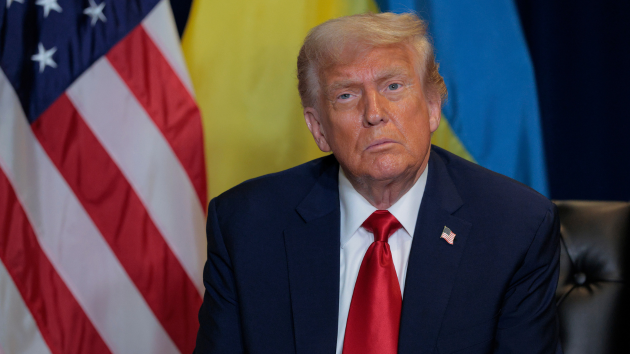
President Donald Trump listens to a reporter’s question during a bilateral meeting with President of Ukraine Volodymyr Zelensky at the 80th session of the United Nations General Assembly (UNGA) at the UN headquarters on September 23, 2025 in New York City. World leaders convened for the 80th Session of UNGA, with this year’s theme for the annual global meeting being “Better together: 80 years and more for peace, development and human rights.” (Photo by Chip Somodevilla/Getty Images)

(WASHINGTON) — President Donald Trump is once again making decorative changes to the White House — disparaging former President Joe Biden in the process. 

The White House has installed a new presidential portrait gallery along the West Wing Colonnade, unveiling the wall of photos on Wednesday. While the new “Presidential Walk of Fame” features portraits of all the presidents in gilded frames, Biden’s portrait is replaced with a picture of an autopen. 

The White House called attention to the change on its social media.

Trump has long criticized Biden’s use of the autopen, a routine method of executing official documents when signatories are unable to sign them. The use of autopen is commonplace on Capitol Hill and in the White House and has been used by former presidents on both sides of the aisle.

Trump has pushed unfounded claims that Biden didn’t understand what was going on during his presidency because of his use of an autopen to sign legislation and pardons. Trump has suggested that the pardons Biden signed using the technology should be considered null and void.

Biden has pushed back on Trump’s claims.

“Let me be clear: I made the decisions during my presidency. I made the decisions about the pardons, executive orders, legislation, and proclamations. Any suggestion that I didn’t is ridiculous and false,” Biden said in his statement.

Trump has teased in recent weeks that he would make good on this extraordinary move as he continues to disparage Biden’s legacy. 

“It’s a decision I have to make. We put up a picture of the autopen,” Trump said in an interview with The Daily Caller earlier this month.

The colonnade has served as an iconic part of the White House since it was built during Thomas Jefferson’s presidency. The open-air walkway has been used by presidents and their staffers to travel quickly between the West Wing and the Executive Residence. 

The gallery is part of Trump’s larger changes to the White House grounds which include paving over the grass and adding tables with umbrellas where he has since hosted dinners at the so-called “Rose Garden Club.”

Construction is also underway for an expansive new ballroom, which Trump has touted.

This also isn’t the first time Trump has attempted to use his power to erase symbols of those he has disagreed with from being featured inside the White House. 

In June, the Trump White House removed a portrait of Hillary Clinton, the former first lady and secretary of state as well as Trump challenger in the 2016 election. Clinton’s portrait was replaced it with a red, white and blue painting of Trump. Then in August, Trump moved portraits of former Presidents Barack Obama, George W. Bush and George H.W. Bush from the entryway of the White House to have a less-prominent position. 

Copyright © 2025, ABC Audio. All rights reserved.
Rubio meets with Russia’s Lavrov after Trump’s shift on Russia and Ukraine

Rubio meets with Russia’s Lavrov after Trump’s shift on Russia and Ukraine
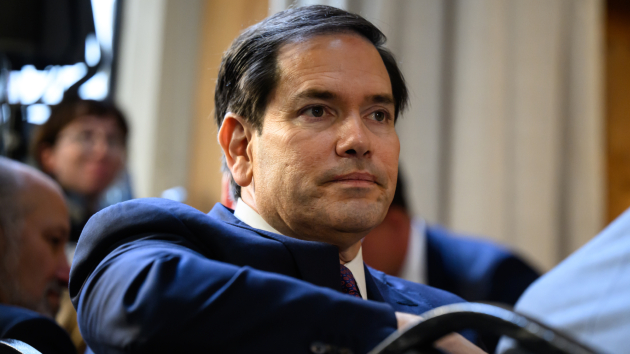
Leon Neal/Getty Images

(NEW YORK) — Secretary of State Marco Rubio and Russian Foreign Minister Sergei Lavrov met on Wednesday, one day after President Donald Trump called Moscow a “paper tiger” and said Ukraine could win back its seized land.

Rubio and Lavrov sat with their delegations on the sidelines of the United Nations General Assembly in New York. U.S. Ambassador to the United Nations Mike Waltz was also present for the meeting.

For months, Trump had said Kyiv would likely need to cede territory to Russia to end the war. But Trump abruptly reversed after meeting with Ukrainian President Volodymyr Zelenskyy on Tuesday.

“After getting to know and fully understand the Ukraine/Russia Military and Economic situation and, after seeing the Economic trouble it is causing Russia, I think Ukraine, with the support of the European Union, is in a position to fight and WIN all of Ukraine back in its original form,” Trump wrote. “With time, patience, and the financial support of Europe and, in particular, NATO, the original Borders from where this War started, is very much an option. Why not?”

Russia, he suggested, was a “paper tiger” as he criticized its military.

It wasn’t clear what made Trump change his tune. Zelenskyy said he believed Trump was aware of “more details” and that U.S. intelligence is now more aligned with that of Ukraine’s view. It also remains to be seen whether Trump’s shift in rhetoric will come with any change in policy.

Russia pushed back quickly that it was a “bear” not a “paper tiger,” and that Trump was mistaken.

Kremlin spokesperson Dmitry Peskov said Trump “heard Zelenskyy’s version of events. Apparently, this version was the reason for the assessment we heard. We cannot agree with everything here.”

“We will have the opportunity to convey our assessment of recent events to the American side. In particular, [Russian Foreign Minister Sergei] Lavrov will have a meeting,” Peskov added.

Rubio, at a U.N. Security Council meeting on Ukraine on Tuesday, warned there would “come a moment in which we will have to conclude that perhaps there is no interest in a peaceful resolution” from Rusia and that Trump’s “patience is not infinite.”

Zelenskyy addressed the United Nations General Assembly on Wednesday, in which he warned members that Putin wants to expand his war and spoke about what he said was a breakdown of international order.

“International law doesn’t work fully unless you have powerful friends who are truly willing to stand up for it,” Zelenskyy said. “And even that doesn’t work without weapons. It’s terrible but without it, things will be even worse. There are no security guarantees except friends and weapons.”

“If it takes pressure on Russia, it must be done and it must be done now otherwise Putin will keep driving the war forward, wider and deeper,” Zelenskyy added. “We told you before, Ukraine is only the first and now Russian drones are already flying across Europe, and Russian operations are already spreading across countries … No one can feel safe right now.”  

Trump on Tuesday said NATO countries should shoot down Russian aircraft if they enter their airspace.

Copyright © 2025, ABC Audio. All rights reserved.
The government could shut down in less than a week. Here’s what you need to know

The government could shut down in less than a week. Here’s what you need to know
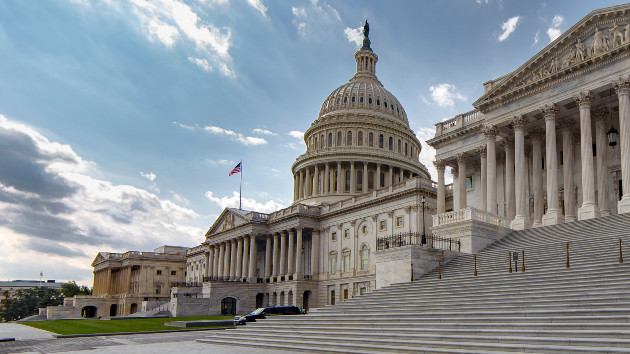
Photo by Mike Kline (notkalvin)/Getty Images

(WASHINGTON) — Congress is out of town this week, but when lawmakers return on Monday, Sept. 29, they’ll be facing an immediate government funding deadline. If Congress doesn’t act before Wednesday, Oct. 1, there will be a government shutdown.

Right now, congressional leaders are busy blaming one another for the looming shutdown, but no clear path is emerging for how funding might be approved.

Here’s what you need to know with less than a week until a possible government shutdown:

What needs to happen to avert a government shutdown?

The government runs out of funding as the clock strikes midnight from Tuesday, Sept. 30 to Wednesday, Oct. 1. To avoid that shutdown, Congress must pass either a short-term funding bill, called a continuing resolution (or CR), or they must approve 12 separate full-year funding bills.

Congress does not have time to finish work on the full-year funding bills before the deadline, so they’ll need a stopgap bill. 

Unlike the One Big Beautiful Bill Act, funding bills need at least 60 votes to pass in the Senate. That means any government funding solution will require at least seven Senate Democrats to pass if every Republican supports the proposal.

In a Washington under total Republican control, government funding is one of few must-pass pieces of legislation that requires Democratic votes.

Current state of play

Democrats and Republicans are currently locked in a staring contest. It’s not clear what, if anything, will be done to stop a shutdown next week.

Efforts to pass a short-term funding bill failed last week.

On Friday, House Republicans (and one Democrat) passed a bill that would have kept the government funded until Nov. 20. But within hours of the House action, Senate Democrats blocked the measure from passing the Senate and instead offered their own funding bill that included a number of health care provisions Democrats say are essential. Republicans blocked that bill from advancing in the Senate.

Since then, no new proposal has been offered. Congress is out of town this week with no plans to return early. 

Trump cancels meeting with Democrats

Democrats have alleged that the White House and congressional Republicans have been unwilling to negotiate with them on a path forward on government funding.

After President Donald Trump said he would meet with Democratic leaders Chuck Schumer and Hakeem Jeffries at their request, the president reversed course on Tuesday morning. 

“After reviewing the details of the unserious and ridiculous demands being made by the Minority Radical Left Democrats in return for their Votes to keep our thriving Country open, I have decided that no meeting with their Congressional Leaders could possibly be productive,” Trump posted on his social media channel. 

Democrats have responded by saying that Trump is running away from the negotiation table and will own the shutdown as a result.  

What Republicans, Democrats want

Republicans on Capitol Hill want Congress to pass a short-term funding bill without any additional add ons to keep the government funded at FY2024 levels through Nov. 20. Republicans say this will allow more time for Congress to work on the annual appropriations bills that they hope can be enacted before the next funding deadline. The White House has backed this approach.

Passing a short-term funding bill that doesn’t include any sort of major policy riders is pretty par for the course on Capitol Hill. Democrats advanced many of them while former President Joe Biden was in office. Republicans say Democrats are being disingenuous by not supporting this seven-week solution. 

“If [Democrats] want to shut down the government, they have the power to do so, but if they think they are going to gain political points from shutting down the government over a clean nonpartisan CR, something they voted for 13 times under the Biden administration, I would strongly urge them to think again,” Majority Leader John Thune said on Friday ahead of the Senate vote to block this short-term funding bill.

Republicans say that other policy priorities should be debated as part of the annual appropriations process, not as part of a short-term funding solution.

Democrats, on the other hand, want to use the funding deadline as leverage to secure health care-related wins and to restore cuts to Medicaid made by the One Big Beautiful Bill Act that Republicans passed in July. 

There’s a lot of health care provisions that Democrats outlined in their counter proposal that was rejected by the Senate last week – including the expansion of expiring Obamacare tax credits for federally backed health insurance premiums and the reversal of the Medicaid cuts that were signed into law under Trump’s megabil in July.

The non-partisan Congressional Budget Office estimated that the Democrat’s health care proposals would cost $1.4 trillion over 10 years. Democrats have said they’re willing to negotiate with Republicans, so this package should be viewed as an opening offer and not a set of red lines.

Democrats have repeatedly insisted they must secure health care-related wins to approve a funding package, but they have not yet been explicit about what specific wins they must secure in order to keep the government funded.

What’s different this time around?

In March, 10 Senate Democrats voted with Republicans to pass a continuing resolution to hold funding levels constant through the end of the fiscal year on Oct. 1. 

But now, what we’re seeing is a role reversal for both parties.

Many times in the past several years it has been Republicans pushing for policy concessions on short-term funding bills while Democrats have repeatedly beat the drum for a clean short-term funding extension.

This time though, it’s Democrats who are saying they must get policy concessions while Republicans challenge them to accept a stopgap funding solution with nothing attached. It bucks the historical trend.

What happens if there is a government shutdown? 

If there is a government shutdown, millions of federal employees will go without a paycheck and many — such as airport security officers, air traffic controllers and members of the military — will be told to come to work anyway. ICE agents also go without pay. National parks will close and the Smithsonian museums also typically close within a few days.

Federal contractors are not required to work and are also not guaranteed backpay. 

Social Security continues to be distributed, though there can be slow downs.

Copyright © 2025, ABC Audio. All rights reserved.

Arizona special House election could be a tipping point on releasing the Epstein files

Arizona special House election could be a tipping point on releasing the Epstein files
Democratic congressional candidate Adelita Grijalva speaks to the media during a primary election-night party, July 15, 2025, in Tucson, Ariz. Rebecca Noble/Getty Images

(WASHINGTON) — Tuesday’s special election for Arizona’s 7th Congressional District will likely narrow Republicans’ slim majority in the House and deliver the decisive vote on the release of the Jeffrey Epstein files.

The heavily blue district will vote to replace the late Democratic Rep. Raúl Grijalva, who served 22 years in Congress before passing away at 77 in March from complications with cancer treatments.

His daughter, former Pima County Supervisor Adelita Grijalva, is favored to win against Republican Daniel Butierez, who lost to the elder Grijalva last year by nearly 27 percentage points.

Tuesday’s election will likely deliver the decisive signature to allow a vote on compelling the Department of Justice to release all records related to Jeffrey Epstein. The bipartisan discharge petition was put forth by Republican Rep. Thomas Massie and Democratic Rep. Ro Khanna.

After Democrat Rep. James Walkinshaw won his special election in Virginia earlier this month, the newly sworn-in congressman brought the discharge petition to 217 signatures, inching it closer to the required 218 needed to force a vote on the matter.

Both Grijalva and Butierez told the Arizona Daily Star last week that they would sign the petition if elected.

This election also has broader implications in the overall makeup of the House of Representatives. House Republicans currently have a narrow majority with 219 seats, while the Democrats hold 213.

Some Republican states are also following President Donald Trump’s call to pick up seats by redrawing their congressional maps to produce more GOP-friendly districts ahead of next year’s midterm elections.

Grijalva seeks to continue her father’s legacy of environmental justice and public education, in addition to focusing on protecting Medicaid.

“I’m not running on my last name, it just is my last name,” she told ABC News ahead of the Democratic primary earlier this year. “So my dad left really big shoes to fill, but I stand on my own two feet in my more than two decades of public service to Arizona, and I’m proud to be supported by leaders and organizations that are leading the progressive movement.”

She was challenged in the crowded Democratic primary by 25-year-old progressive activist Deja Foxx, who would have been the first Gen-Z woman in Congress. Grijalva defeated Foxx by over 40 points. Butierez won the Republican primary with nearly 61% of the vote over two other candidates.

Butierez is a business owner who is focused on curbing illegal immigration and drug flow into the region. Speaking to KGUN about how he was once homeless, imprisoned, and addicted to drugs, Butierez believes these experiences allow him to understand his community’s needs and utilize a firsthand perspective to address these issues.

ABC News’ Lauren Peller, John Parkinson, Brittany Shepherd, and Rachael Dziaba contributed to this report.

Copyright © 2025, ABC Audio. All rights reserved.
Trump says NATO countries should shoot down Russian aircraft that violate their airspace

Trump says NATO countries should shoot down Russian aircraft that violate their airspace
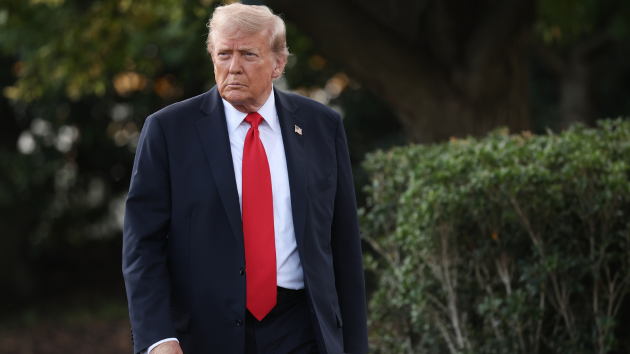
U.S. President Donald walks toward reporters while departing the White House on September 11, 2025 in Washington, DC. Trump is scheduled to travel to New York City this evening. (Photo by Win McNamee/Getty Images)

(WASHINGTON) — President Donald Trump on Tuesday said NATO countries should shoot down Russian aircraft if they enter their airspace.

The comments came as Trump met with Ukrainian President Volodymyr Zelenskyy on the sidelines of the United Nations General Assembly in New York.

Pressed on whether the U.S. would back up NATO allies in such a situation, Trump said “it depends on the circumstance.”

Poland and Romania reported violations of their airspace earlier this month by Russian aircraft, prompting NATO to scramble fighter jets in response. Estonia on Friday said three Russian jets entered its airspace, which Russia has denied.

Polish Foreign Minister Radek Sikorski, who had been critical of Trump’s approach to Russian President Vladimir Putin in peace negotiations, responded quickly to Trump’s comments that NATO allies should shoot down Russian drones in their airspace.

“Roger that,” Sikorski wrote on X.

NATO’s Secretary General Mark Rutte on Tuesday reaffirmed the group’s commitment to defend allied territory but stopped short of saying any Russian aircraft that violates allied airspace would be shot down.

“Decisions on whether to engage intruding aircraft, such as firing upon them, are, of course, taking in real time, are always based on available intelligence regarding the threat posed by the aircraft, including questions we have to answer like intent, armament and potential risk to Allied forces, civilians or infrastructure,” Rutte said.

In his speech to the U.N. General Assembly on Tuesday, Trump criticized Russia for its ongoing war in Ukraine.

“It’s not making Russia look good. It’s making them look bad,” Trump said.

Trump said the United States is prepared to enact severe tariffs on Russia should Moscow not be ready to make a peace deal, a threat he’s made for weeks.

But he said other countries need to pull back on buying Russian oil and energy products “otherwise we’re all wasting a lot of time.”

“Europe has to step it up. They can’t be doing what they’re doing. They’re buying oil and gas from Russia while they’re fighting Russia. It’s embarrassing to them,” Trump said.

Ukraine’s Zelenskyy said he supported the idea when he met with Trump later Tuesday.

European Commission President Ursula von der Leyen, in a bilateral meeting with Trump, said she wants Europe to abandon its use of Russian energy by 2027 or earlier.

“President Trump is absolutely right on it,” she said. “We have reduced already massively the gas supply from Russia, completely gotten out of Russian coal and massively also reduced the oil supply. But there’s still some coming to the European continent.”

“We want to get rid of it,” she said.

Trump said he believed targeting Russia’s economy would help lead to the end of the war.

“After getting to know and fully understand the Ukraine/Russia Military and Economic situation and, after seeing the Economic trouble it is causing Russia, I think Ukraine, with the support of the European Union, is in a position to fight and WIN all of Ukraine back in its original form,” Trump wrote on his social media platform after his bilateral meeting with Zelenskyy. “Ukraine would be able to take back their Country in its original form and, who knows, maybe even go further than that!” he added.

ABC News’ Hannah Demissie and Morgan Winsor contributed to this report.

Copyright © 2025, ABC Audio. All rights reserved.

Trump addresses United Nations General Assembly

Trump addresses United Nations General Assembly
 U.S. President Donald Trump speaks during the United Nations General Assembly (UNGA) at the United Nations headquarters on September 23, 2025 in New York City. (Photo by Michael M. Santiago/Getty Images)

(NEW YORK) — President Donald Trump is now delivering remarks to the United Nations General Assembly, as world leaders convene in New York for the body’s 80th session.

It is Trump’s first speech to the annual gathering since his return to office.

“Six years have passed since I last stood in this grand hall and addressed a world that was prosperous and at peace in my first term. Since that day, the guns of war have shattered the peace I forged on two continents, an era of calm and stability gave way to one of the great crises of our time,” Trump said as he opened his remarks.

Trump’s speech is expected to center on “touting renewal of American strength around the world,” White House press secretary Karoline Leavitt told reporters on Monday.

“The president will also touch upon how globalist institutions have significantly decayed the world order, and he will articulate his straightforward and constructive vision for the world,” Leavitt said.

Later Tuesday, Trump will participate in bilateral meetings with U.N. Secretary-General António Guterres and the leaders of Ukraine, Argentina and the European Union. He will also hold a multilateral meeting with leaders from Qatar, Saudi Arabia, Indonesia, Turkey, Pakistan, Egypt, the United Arab Emirates and Jordan.

Israel’s war against Hamas in Gaza and the Russia-Ukraine war are likely to dominate the U.N. General Assembly this week.

Several prominent world leaders, including key U.S. allies such as the United Kingdom and Canada, are moving to formally recognizing Palestinian statehood as international alarm builds over Israel’s ground offensive in Gaza and an ongoing hunger crisis in Gaza.

On Monday, French President Emmanuel Macron declared at the U.N. General Assembly that France will now recognize a Palestinian state.

“The time for peace has come,” Macron said.

Palestinian President Mahmoud Abbas spoke virtually before the U.N. General Assembly on Monday after the Trump administration revoked his U.S. visa last month to attend the conference in person.

Abbas called on Hamas to surrender their weapons and he condemned the killings on Oct. 7, 2023. He also expressed readiness to work with Trump to implement a peace plan and called for a “permanent ceasefire.”

Trump has said he wants the war in Gaza to end, but has disagreed with other nations on the issue of Palestinian statehood.

“He feels this does not do anything to release the hostages, which is the primary goal right now in Gaza; does nothing to end this conflict and bring this war to a close,” Leavitt said on Monday.

“And frankly, he believes it’s a reward to Hamas,” Leavitt continued. “So he believes these decisions are just more talk and not enough action from some of our friends and allies. And I think you’ll hear him talk about that tomorrow at the U.N.”

On the Russia-Ukraine war, Ukrainian President Volodymyr Zelenskyy called for those gathered at U.N. General Assembly to put “strong political pressure” on Russia.

“There is a real need for strong pressure on Russia, new joint steps from everyone in the world who believes that international law must work again,” Zelenskyy said.

Trump’s expressed increasing frustration with Russian President Vladimir Putin since their summit in Alaska last month yielded no breakthroughs. Last week, Trump said thought the war would be one of the easiest global conflicts to solve “because of my relationship with President Putin.”

“But he’s let me down,” Trump said. “He’s really let me down.”

Last week, while meeting with British Prime Minister Keir Starmer in the U.K., Trump signaled he could do more to pressure Russia, but said other countries need to pull back on buying Russian oil first.

“I’m willing to do other things, but not when the people that I’m fighting for are buying oil from Russia. If the oil price comes down, very simply, Russia will settle, and the oil price is way down.”

ABC News’ Mariam Khan contributed to this report.

Copyright © 2025, ABC Audio. All rights reserved.
Harris admits she was ‘reckless’ in not challenging Biden’s decision to run for reelection

Harris admits she was ‘reckless’ in not challenging Biden’s decision to run for reelection
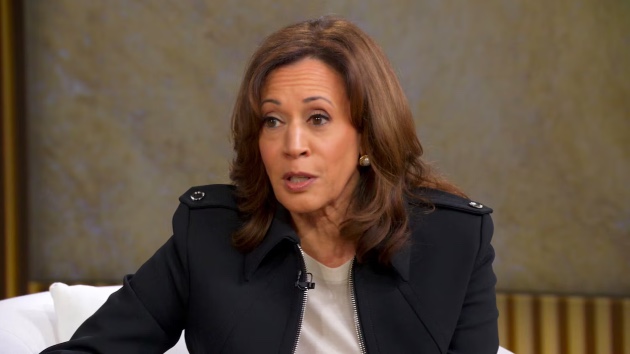
ormer Vice President Kamala Harris speaks with Michael Strahan on “Good Morning America,” Sept. 23, 2025, in New York City. ABC News

(NEW YORK) — Former Vice President Kamala Harris, on ABC’s “Good Morning America” on Tuesday, said she does regret not personally challenging former President Joe Biden’s decision to run for reelection.

In an interview with “Good Morning America” co-anchor Michael Strahan, Harris said it was “reckless” of her to not raise her concerns with Biden choosing to run for reelection.

“Do you regret not voicing your opinion in that moment?” Strahan asked Harris, who wrote in her campaign memoir “107 Days” out Tuesday that the reelection decision was Joe and Jill Biden’s to make.

“Yes,” Harris said, “and I, and I actually have reflected on that, and I’ve written about that.”

“Would that have mattered if you did?” Strahan asked Harris.

“I don’t know,” Harris replied. “I don’t know, but I can only take responsibility for myself and on reflection, you know, and I talk about it in the context of asking a question of myself, ‘was that grace to not bring it up to him, or was it reckless?’

She added, “And on my part, I do reflect on that and feel that it was — it was a recklessness about not raising it with him.”

She said she felt raising her concerns with Biden would be seen as “self-serving.”

“I talk about what was going through my head, right? And what was going through my head to not bring it up was that it would come off as being very self-serving, and therefore maybe lack the credibility that it deserved. But I do think about it. I do think about it,” she said.

“And I also say, though, and I speak extensively about this, my concern about him running for reelection was completely separate from my admiration and knowledge about his capacity to serve as president United States, which was consistent and never wavered,” Harris added.

This is a developing story. Please check back for updates.

Copyright © 2025, ABC Audio. All rights reserved.
Supreme Court allows Trump firing of FTC commissioner, accepts case for December argument

Supreme Court allows Trump firing of FTC commissioner, accepts case for December argument
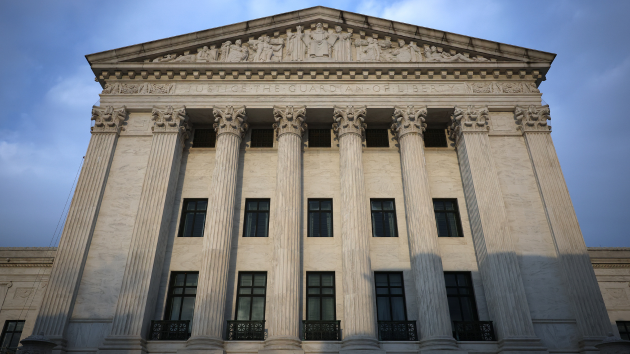
The U.S. Supreme Court is shown March 17, 2025 in Washington, DC. The Trump administration defied a federal judge’s court order this past weekend in a case related to the deportation of more than 200 alleged Tren de Aragua gang members to El Salvador under the Alien Enemies Act of 1789. (Photo by Win McNamee/Getty Images)

(WASHINGTON) — The Supreme Court on Monday in a 6-3 decision upheld President Donald Trump’s termination of Federal Trade Commissioner Rebecca Slaughter, at least on an interim basis, as the justices said they would expedite a review of the high-stakes dispute over the scope of executive power.

The Supreme Court did not explain its decision, but the move was in line with other recent orders by the conservative majority giving broad deference to the president over staffing of independent agencies that exercise significant executive authority.

Trump removed Slaughter — who was appointed by former President Joe Biden — without cause, citing purely policy differences.

Justices Elena Kagan, Sonia Sotomayor and Ketanji Brown Jackson dissented from the decision citing the text of federal law, which only allows the removal of FTC commissioners for cause and a longstanding high court precedent — Humphrey’s Executor v US — which upheld those terms.

“The president cannot, as he concededly did here, fire an FTC Commissioner without any reason,” Kagan wrote in dissent. “To reach a different result requires reversing the rule stated in Humphrey’s: It entails overriding rather than accepting Congress’s judgment about agency design.”

Kagan accused the majority of effectively overruling Humphrey’s on the Supreme Court’s emergency docket without saying so explicitly or holding briefing or argument.

“The majority may be raring to take that action,” Kagan wrote. “But until the deed is done, Humphrey’s controls, and prevents the majority from giving the President the unlimited removal power Congress denied him.”

The justices will take up that precedent directly during a December hearing, examining whether removal protections for members of the FTC violate separation of powers and Humphrey’s overturned, the Court said in its order.

In a separate order, the Court declined to take up expedited appeals by Cathy Harris, a Trump-fired member of the Merit Systems Protection Board, and Gwynne Wilcox, a Trump-fired member of the National Labor Relations Board, both of whom are also contesting the president’s actions under Humphrey’s.

The move suggests the Court plans to use the Slaughter case as the primary vehicle for resolving critical questions of presidential power across more than 50 executive branch independent agencies and corporations.

Copyright © 2025, ABC Audio. All rights reserved.

In NJ governor’s race, Ciattarelli and Sherrill grapple over if it’s a bellwether for Trump and incumbents

In NJ governor’s race, Ciattarelli and Sherrill grapple over if it’s a bellwether for Trump and incumbents
Aerial view of Trenton New Jersey Skyline featuring state capitol dome of New Jersey. (Visions of America/Joseph Sohm/Universal Images Group via Getty Images)

(TRENTON, N.J.) — As New Jersey’s 2025 election for governor — one of only two being held in the country this year — approaches, the candidates are grappling with whether the race is a bellwether for how voters feel about President Donald Trump, the upcoming battle for the U.S. House in the 2026 midterms, and the more general national sentiment against incumbent leaders.

In other words: as goes the Garden State, so goes the nation?

“All eyes in the United States are going to be on New Jersey. This looks like the most competitive race, certainly of one of magnitude in the country,” Daniel Bowen, a political science professor at The College of New Jersey, told ABC News.

On the Republican ticket, former state Assemblyman Jack Ciattarelli is making a third try for the office and hopes to flip the state’s governorship currently held by Democratic Gov. Phil Murphy, who cannot run for a third consecutive term. On the Democratic ticket is U.S. Rep. Mikie Sherrill, who beat out a crowded primary field in June and now looks to keep New Jersey’s governorship blue.

“I understand why people say there’s national implications here. There’s only two governor races in the entire country this year,” Ciatterelli told ABC News in a recent interview.

“But this is all about New Jersey’s future and that’s where I keep my focus. My only concern is fixing New Jersey … as I go around the state, that’s exactly what people want to hear. That’s exactly what people want.”

Sherrill, in a statement to ABC News, brought up her campaign aims of helping with affordability and accountability, while also framing the race as having national stakes.

“New Jerseyans know what’s at stake in this election, and we know that the nation is watching,” Sherrill said. “We can choose to elect a Trump lackey who is going to do whatever the President says, and make New Jerseyans foot the bill, or we can chart a different path forward… by delivering for working families, we’re laying the groundwork for Democrats in 2026 and beyond.”

The race could measure how voters are looking for change, Bowen told ABC News, given that “a fact of politics in 2025 is this distrust of politicians, distrust of those in power, dissatisfaction with where things are, and that could advantage an opposition candidate,” which could help Republicans in the state campaigning against New Jersey’s currently Democratic-controlled government.

But at the same time, Bowen added, “if you think of trying to react against the way things are going right now, who is determining the way things are going? Well, that’s largely being set by the federal government and the Trump administration. So your response isn’t necessarily to the state government. It’s probably more likely going to be the response to the federal government.”

The question of who voters are seeing as the “incumbent” played out during Sunday night’s gubernatorial debate, one of two where Ciattarelli and Sherrill are facing off. Sherrill, for instance, occasionally brought up Trump, and at one point criticized Ciatterelli’s praise of parts of the president’s signature tax and policy bill.

“I’m sure he would like you to focus on those four things, because he doesn’t want you to focus on his tariff plan, which is putting small businesses out of business … In every single way, we’re seeing costs go up on New Jersey families and Jack just says he has nothing he disagrees with Donald Trump on,” she said.

But Ciattarelli later tied Sherrill to incumbent Gov. Phil Murphy and the current Democratic control of the state, which he framed as causing disillusionment and challenges for New Jerseyans.

“Their party’s been in control [of the state legislature] for 25 years, and they’ve had the executive branch for eight years. But you don’t hear her, you don’t hear my opponent criticizing the current [New Jersey] administration, or the 25 year reign of the Democrats,” he said.

Similar to other high-profile races in 2025, millions have been spent already on advertising and campaigning, including by national groups such as the Democratic National Committee and Republican Governors Association.

The governor’s race in New Jersey is projected to see $140 million in ad spending, an expected 268% increase over spending in the state’s 2021 gubernatorial race, according to media tracking agency AdImpact. The agency has also tracked millions more spending in support of Sherrill than of Ciatterelli as of mid-September.

Those ads are playing for unaffiliated voters as well, which number over 2 million in New Jersey.

“The independent vote is really a material part of New Jersey’s political history … the fact that New Jersey has gone, and the governor’s mansion, from red to blue to red to blue,” Keith Norman, vice president for political practice at LG Ad Solutions, told ABC News. “It’s a state that doesn’t typically see one party holding the office consistently.”

Republicans point to 2024 as a sign they can flip the governorship. Democratic candidate Kamala Harris won New Jersey by around 6 percentage points in 2024, even though Joe Biden won the state by about 16 percentage points in 2020.

The campaigns are also working to reach the large number of voters around the state who don’t have traditional over-the-air TV or cable, and can target New Jerseyans using streaming platforms and internet-connected TV more precisely.

Off the airwaves, meanwhile, both sides are running large ground games to turn out the vote.

Kate Gibbs, the executive director of the New Jersey Republican Party, told ABC News that the party aims to knock on 1.2 million doors, is working with every local GOP organization, and is trying to narrow the gap between New Jersey’s registered Democratic and Republican voters.

As of the beginning of September, there were over 860,000 more registered Democrats in New Jersey than Republicans, according to data from the New Jersey Department of State.)

And Gibbs says the party feels voters are anti-incumbent towards the current governor: “What we’re hearing overwhelmingly is that people think the state’s on the wrong track and that they want change.”

The Sherrill campaign, meanwhile, says it has contacted over 1.7 million voters since the primary, knocked on almost 150,000 doors, and gotten donations from all 21 counties.

Copyright © 2025, ABC Audio. All rights reserved.