(PHILADELPHIA) — Pennsylvania’s Republican-led State House voted overwhelmingly to impeach Philadelphia District Attorney Larry Krasner over what they allege is his lax approach to crime, leniency toward criminal offenders and other allegations.
The House’s 107-85 vote on Wednesday will send the matter to the Republican-controlled State Senate. This sets the stage for what would be the first Pennsylvania Senate impeachment trial in nearly three decades.
With a 29-21 majority in the state Senate, Republicans will need a two-third vote to convict and remove Krasner from office.
In their resolution to impeach Krasner, State House Republicans cited what they called his alleged lax approach to crime, including his office’s policies to seek more lenient sentences for offenders, as well as his failure to prosecute some low-level offenses such as drug possession and prostitution.
Krasner said in a statement that the vote was the only time the state House has ever “used the drastic remedy of impeachment of an elected official because they do not like their ideas.”
He accused House Republicans of impeaching him without presenting a “single shred of evidence connecting our policies to any uptick in crime.”
“History will harshly judge this anti-Democratic authoritarian effort to erase Philly’s votes – votes by Black, brown, and broke people in Philadelphia. And voters will have the last word,” he added.
Republicans have blamed Krasner and his policies for a surge in gun violence in Philadelphia over the past few years, a trend consistent in cities across the country since the start of the pandemic.
Republican State Representative Martina White, who introduced the impeachment articles, said at Wednesday’s vote: “This man has denied that there is even a crisis of crime happening on our streets.”
To date, there have been 460 homicides in Philadelphia this year, a 5% decrease from 2021, according to the city’s Office of the Controller. There were 562 homicides in 2021, a 13% increase from 2020.
State Republicans also alleged Krasner obstructed the House’s investigation of his office.
Krasner’s office filed a motion in October seeking to quash a subpoena issued by the state legislative committee searching for grounds to impeach him, describing it as a “politically motivated effort” in a statement. In a letter to the committee, Krasner accused them of failing to specify the basis of his impeachment and repeatedly refusing to speak with him
Krasner is one of many progressive prosecutors elected in recent years amid growing concerns about racism and over-incarceration in the U.S. criminal justice system.
Krasner was overwhelmingly reelected by voters last year with significant support from Black voters living in neighborhoods historically most impacted by gun violence, according to reports from local news outlets like The Philadelphia Tribune and The Philadelphia Inquirer.
His office also reported that violent crime and all categories of crime remain historically low compared with the 1990s.
State House Democrats contend Republicans are scapegoating Krasner for wider problems with crime, accusing them of abusing legislative power for political ends.
Democratic Representative Joanna McClinton, whose district includes parts of Philadelphia, accused Republicans of wanting to “overturn the will” of the electorate during the House session on Wednesday.
“Impeachment now seems to be a measure that we’re using when we have a disagreement on public policy,” McClinton said.
(WASHINGTON) — Congressional Republicans say they’re poised to push ahead with an investigation into President Joe Biden’s family, including his son Hunter, in the coming session — despite warnings from some in their own caucus not to pursue “hyper-partisan” oversight probes.
Reps. Jim Jordan of Ohio and James Comer of Kentucky, two high-ranking members expected to helm powerful committees when Republicans take control of Congress in January, outlined their plans during a press conference on Thursday, pledging to “pursue all avenues” of wrongdoing and calling investigations into the president’s family a “top priority.”
Beyond their interest in Hunter Biden’s overseas business endeavors, which are already the subject of a Justice Department investigation, the lawmakers said their primary focus is finding out whether his father, President Biden, was more involved in those dealings than previously known.
“We’re not trying to prove Hunter Biden is a bad actor. He is,” Comer said. “Our investigation is of Joe Biden.”
But several voices from within their own party have balked at the prospect of targeting the president’s family, calling it a distraction from the issues voters care about and a political miscalculation that could exacerbate growing tensions within the party after a lackluster midterm performance. Republicans had hoped to comfortably win control of the House, but instead they appear poised to take control with a razor-thin margin.
Barbara Comstock, a former Republican congresswoman from Virginia, said pursuing Hunter Biden and others is a losing strategy, and would signal to voters that the party has failed to learn its lessons.
“When voters deliver such a dramatic rebuke, where expectations of a ‘red wave’ fail to come through, it’s time for humility and introspection,” said Comstock, an ABC News contributor. “And rabid oversight of Hunter Biden is not at all the message Republicans should take away from the midterms.”
Some new arrivals in Washington echoed that sentiment.
“If parts of our party want to go into these investigations, that’s their prerogative,” said Rep.-elect George Santos, R-N.Y., during an interview on Fox News this week. “I don’t want to waste my time in Washington engaging in hyper-partisan issues, I want to deliver results.”
On Thursday, Jordan, who is expected to take over the House Judiciary Committee, and Comer, the current ranking member on the House Oversight Committee, accused president’s son of committing a bevy of crimes, including tax evasion, wire fraud, and human trafficking, without providing evidence. They said they “would love” to speak with Hunter Biden, but did not announce plans to issue a subpoena.
Comer said his Oversight panel would focus on obtaining over 150 Suspicious Activities Reports, or SARs, pertaining to Hunter Biden from the Treasury Department. SARs are reports filed by financial institutions to flag questionable banking transactions, but do not amount to crimes.
As part of their efforts to more closely connect President Biden to his son’s business efforts, Republicans shared a copy of an email Hunter Biden purportedly wrote to a building manager seeking a spare set of keys to a new office for his “business partners” — a list that included his father’s name.
Several of the claims leveled by Republicans on Thursday have been publicly known for years, dating back to a Senate report published ahead of the 2020 election. That report, penned by Sens. Chuck Grassley, R-Iowa, and Ron Johnson, R-Wisc., found Hunter Biden’s overseas work “awkward” and “problematic,” but identified no wrongdoing.
DOJ investigators are examining whether Hunter Biden paid adequate taxes on millions of dollars of personal income, including money he made during business pursuits in China and Ukraine. Hunter Biden has repeatedly denied any wrongdoing, ethically or criminally, but has acknowledged that his family ties likely bolstered his career. He has not been charged with any crimes.
A Democratic spokesperson for the current Oversight Committee called the probe a “desperate attempt to return Trump to power,” following former President Donald Trump’s announcement on Tuesday that he is again running for president in 2024.
“Today’s press conference rehashed the same tired, partisan talking points Republicans have been using for years, ignoring the clear message Americans sent that they want real solutions — not partisan bickering,” the spokesperson said.
A lawyer for Hunter Biden declined to comment on Thursday’s press conference.
Kent Nishimura / Los Angeles Times via Getty Images
(WASHINGTON) — House Speaker Nancy Pelosi is stepping down from House Democratic leadership but will remain in Congress.
Pelosi, 82, made the announcement in a dramatic floor speech on Thursday after gaveling the House into session, receiving a hearty standing ovation from her colleagues.
“With great confidence in our caucus, I will not seek reelection to Democratic leadership in the next Congress,” Pelosi said, noting she will continue to represent her California district, as she has for 35 years. “The hour has come for a new generation to lead the Democratic caucus that I so deeply respect.”
The first woman to hold House speakership — Pelosi is the Democratic Party’s longest-serving House leader. Her decision will have a major impact on Democrats in their new position as House minority.
Pelosi’s fellow California delegation sat in the front of the chamber as the announcement was made.
House Democratic leadership — Reps. Pete Aguilar, Katherine Clark, Hakeem Jeffries, Jim Clyburn and Steny Hoyer — all sat together in the chamber, and were joined by Senate Majority Leader Chuck Schumer.
Not many Republicans were in the chamber to hear her speech. Notably absent was House Republican Leader Kevin McCarthy, who celebrated his party’s control of the House Wednesday night by telling Fox News’ Sean Hannity: “We have fired Nancy Pelosi.”
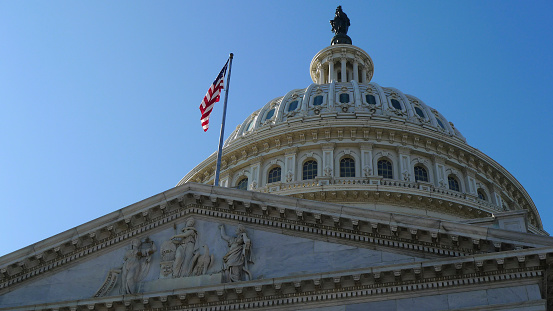
Pelosi began her speech with an ode to the Capitol itself, describing how she saw it for the first time when she was young as she accompanied her father, the late Maryland Rep. Thomas D’Alesandro Jr., to his swearing-ceremony.
“This is the most beautiful building in the world because of what it represents,” Pelosi said. “The Capitol is a temple of our democracy, of our Constitution, of our highest ideals.”
“When I first came to the floor at 6 years old, never would I have thought that I would go from homemaker to House speaker,” she said.
Pelosi reflected on her time working with “three presidents”: George W. Bush, Barack Obama and Joe Biden — notably not mentioning former President Donald Trump.
She celebrated the increase in diversity of the caucus over the years, noting when she came to Congress in the 1990s there were just 12 Democratic women in the group. Today, she said, there’s more than 90.
“And we want more,” she said, which received another standing ovation.
Pelosi’s spokesperson Drew Hammil said Wednesday she planned to make remarks on her political future, doing so just hours after ABC News projected that Republicans had officially won majority control in the U.S. House, ending a four-year Democratic majority despite a strong midterm showing for the party.
Pelosi delivered a warning in her speech that the Jan. 6 insurrection showed the democracy is still fragile, and so “must be forever defended.”
And despite losing the House, Pelosi said the midterm elections showed Americans “resoundingly rejected violence and insurrection, and in doing so, gave proof through the night that our flag was still there.”
“And now we owe to the American people our very best to deliver on their faith, to forever reach for the more perfect union, the glorious horizon that our founders promised,” she said.
A source told ABC News Congressional Correspondent Rachel Scott that Pelosi took home two different versions of floor speeches Wednesday night. As she arrived at the Capitol Thursday morning, Pelosi, wearing white and flanked by her top aides, did not respond to questions about her political future.
Pelosi had said the attack on her husband Paul would impact her decision to stay in House leadership post-midterms. On Thursday, she took a moment to thank and praise her husband as “my beloved partner in life and my pillar of support.”
Prior to the attack, several members have called for a younger generation of Democratic leadership. The top three Democrats in the House are all in their 80s.
While it’s unknown who exactly will succeed Pelosi, she addressed the next generation of leaders on Thursday, saying she’s “grateful that so many are ready and willing to shoulder this awesome responsibility.”
Among the top contenders for the jobs are Jeffries of New York for speaker, Clark of Massachusetts for minority whip and California’s Pete Aguilar is expected to be the caucus chair.
The current two other top leaders in the Democratic caucus, Hoyer and Clyburn, are stepping aside from their roles. The leadership elections are scheduled for the end of November.
President Joe Biden released a lengthy statement just after the speech concluded chronicling Pelosi’s career with praise and commending her for her “dignity.”
“Because of Nancy Pelosi, the lives of millions and millions of Americans are better,” Biden said, “even in districts represented by Republicans who voted against her bills and too often vilify her.”
“History will note she is the most consequential Speaker of the House of Representatives in our history,” the president said. “There are countless examples of how she embodies the obligation of elected officials to uphold their oath to God and country to ensure our democracy delivers and remains a beacon to the world.”
(WASHINGTON) — Sen. Raphael Warnock’s campaign is expanding its field organizing program, offering a look into the areas his team is focusing on ahead of the Dec. 6 runoff against Republican Herschel Walker.
As Georgia’s Senate candidates look to drive turnout ahead of the state’s shortened runoff cycle, Warnock has added roughly 300 paid staffers and new offices across the state to his voter contact program, his campaign said — increasing the direct voter contact programs to 18 counties and 19 offices across the state, and more than 900 paid staffers, according to details shared first with ABC News.
Campaign officials claimed the added investments and staff capacity would allow the campaign to knock on more doors during the four-week runoff than in the 16 weeks leading up to the general election, in which Warnock narrowly beat out Walker but failed to crack the 50% threshold required to win.
The voter contact program will be placed in priority counties for the Warnock campaign: Bibb, Chatham, Clarke, Clayton, Cobb, Columbia, DeKalb, Dougherty, Douglas, Floyd, Fulton, Gwinnett, Henry, Lowndes, Muscogee, Newton, Richmond and Rockdale.
These are either in core urban and suburban areas around Atlanta, include some of the state’s other big cities (like Augusta and Savannah) or are in the “Black belt” in Southern Georgia.
Three of the counties on the list voted for Walker in November’s election: Columbia, Floyd and Lowndes. But the Warnock campaign pinpointed these areas as ones where they believe he has an opportunity to eat into the margin.
In the November race, Walker received roughly 200,000 fewer votes than his Republican ticket-mate Gov. Brian Kemp. In those specific three counties the Warnock campaign is focused on, Walker underperformed Kemp by 5% in Columbia, in Floyd by 6% and by 3% in Lowndes.
Warnock finished less than 1% ahead of Walker in the general election, falling just shy of the cutoff needed to avoid a runoff. About 2% of voters went for Libertarian candidate Chase Oliver, who will not be on the December ballot.
In a battleground state like Georgia, where razor-thin margins have recently determined the outcome of federal elections, the campaigns see an incentive in face-to-face contact. Especially in a political climate up against potentially apathetic voters being asked to show up to the polls once again.
“Reverend Warnock knows what it takes to win a runoff in Georgia,” Warnock campaign spokesperson Sarafina Chitika. “The Warnock campaign has built a robust field operation to turn out voters across the state and re-elect Reverend Warnock.”
The expanded field program also comes as the Democratic Senatorial Campaign Committee announced it was spending $7 million on field organizing.
Democrats and Republicans alike are concentrating their efforts on getting supporters to the polls. The Mitch McConnell-aligned Senate Leadership Fund (SLF) announced last week it’s funding a ground game for the first time, investing $2 million to take over Kemp’s data and analytics operation.
“We’re in overtime,” Walker, a former football player, said at a recent stop.
Kent Nishimura / Los Angeles Times via Getty Images
(WASHINGTON) — House Speaker Nancy Pelosi on Thursday will address her “future plans” in Democratic leadership, according to her spokesperson, a decision that will have a major impact on Democrats in their new position as House minority.
“Speaker Pelosi has been overwhelmed by calls from colleagues, friends and supporters. This evening, the Speaker monitored results in the three remaining critical states. The Speaker plans to address her future plans tomorrow to her colleagues. Stay tuned,” spokesperson Drew Hammill said in a statement to ABC News.
It’s not clear whether the 82-year-old speaker will make a floor speech or when, but a source told ABC News Congressional Correspondent Rachel Scott Pelosi took home two different versions of floor speeches Wednesday night.
Pelosi — the first woman to hold House speakership — is the Democratic party’s longest-serving House leader.
On Sunday — when a House majority had not yet been called — Pelosi would not say on ABC’s This Week with George Stephanopoulos if she would run for the role again, should Democrats remain in control.
“I’m not — right now, I’ve said I’m not making any comments until this election is finished, and we have a little more time to go,” she said, noting that she had no plans to leave Congress.
Pelosi has said the attack on her husband Paul would impact her decision to stay in House leadership post-midterms. Prior to the attack, several members have a called for a younger generation of Democratic leadership. The top three Democrats in the House are all in their eighties.
The news comes just hours following ABC News projections that Republicans had officially won majority control in the U.S. House, ending a four-year Democratic majority despite a strong midterm showing for the party.
“This year, House Democrats defied expectations with an excellent performance: running their races with courage, optimism and determination. In the next Congress, House Democrats will continue to play a leading role in supporting President Biden’s agenda — with strong leverage over a scant Republican majority,” Pelosi said on Wednesday in a memo.
(WASHINGTON) — Texas Gov. Greg Abbott sent a letter to Joe Biden on Wednesday urging the president to, as Abbott described it, carry out his constitutional obligations to protect the country from what Abbott called an “invasion” of migrants at the southern border.
Abbott slammed the president’s policies, contending that Biden’s “inaction has led to catastrophic consequences” for Texas communities. The governor, a major Republican critic of Biden’s, has increasingly focused on the issue of immigration, facing backlash from migrants’ advocates and the Biden administration as a result.
“You must reinstate the policies that you eliminated, or craft and implement new policies, in order to fulfill your constitutional duty to enforce federal immigration laws and protect the States against invasion,” Abbott wrote.
His letter reflects his push to ramp up his rhetoric about what he has called the Biden administration’s “open-border policies.”
On Tuesday, Abott tweeted that he had “invoked the Invasion Clauses of the U.S. & Texas Constitutions to fully authorize Texas to take unprecedented measures to defend our state against an invasion.”
In the tweet, the governor included a list of actions he said he had constitutional authority to take, including deploying gun boats to parts of the border, deploying Department of Public Safety officers to arrest immigrants who have crossed illegally into the United States and building parts of the border wall.
That announcement sparked a series of misleading headlines that Abbott had officially declared an “invasion” at the southern border, a move that would give him added authority to activate local state law enforcement agencies to deport migrants.
Abbott’s budget director, Sarah Hicks, was asked Tuesday about the tweet during her testimony before the state’s Senate Committee on Border Security and she reassured the panel of Texas legislators that the governor was not announcing a new strategy, but was rather reiterating some of the actions he has already taken to stem illegal immigration.
“I don’t think it is a change in overall tactic as much as it is a reminder to all of us, to Congress and to the members working the issue that this is serious and it demands a full and serious response,” Hicks said.
Since Biden took office last year, Abbott has issued a series of executive orders aimed at curtailing immigration. In July, he authorized state law enforcement to return migrants suspected of entering the country illegally to ports of entry. That move has been criticized by immigration advocates and rights organizations who say it endangers migrants and may leave people who are lawfully hoping to claim asylum susceptible to racial profiling.
On Wednesday, the governor sent another letter to the Texas Department of Public Safety and the Texas Military Department urging them to “expand their unprecedented efforts to combat the growing illegal immigration along the Texas-Mexico border.”
“You have an essential assignment: Use every available tool and strategy to fight back against the unprecedented invasion that Texas is seeing at our border. Until Congress acts or the Biden Administration does its constitutionally required job, Texas Guardsmen and Troopers must bear the burden of securing the border. You must continue to keep Texans and Americans safe and protect against an invasion of the southern border. I order you to use all resources and tools available to repel immigrants from attempting to cross illegally, arrest those who cross illegally and return them to the border, and arrest criminals who violate Texas law,” the governor wrote.
Aaron Reichlin-Melnick, policy director at the American Immigration Council, told ABC News that Abbott may be overstepping his authority by saying he can declare an invasion at the border.
“The reality is that no governor can unilaterally declare that they’re being invaded by migrants to take over basic immigration enforcement practices. The U.S. Constitution does not authorize governors to usurp federal immigration authority and no matter how you look at it, migrants seeking asylum are not invading,” he said.
Abbott’s office did not respond to a request for comment; neither did the White House.
Reichlin-Melnick said he believes Abbott’s use of the word “invasion” is especially dangerous because Texas is home to one of the deadliest attacks on Latinos: the 2019 mass shooting at an El Paso Walmart that killed 23 people. Investigators have said the El Paso gunman wrote a screed posted online saying the massacre was in response to an “invasion” of Hispanics coming across the southern border.
“I think we have seen the dangers of harsh rhetoric against migrants,” Reichlin-Melnick said. “The El Paso shooting is the best example of that. It occurred in his own state and it involved a person who believes that the state is being invaded by Latinos, killing dozens of people. Rhetoric about invasions inflames the issue, it doesn’t promote compromise.”
(WASHINGTON) — California Rep. Karen Bass is projected to win her campaign to become Los Angeles’ mayor, ABC News reports.
Bass will be the first woman and second Black person, after Tom Bradley, to hold the office. She had appeared to be in a close race against the billionaire real estate developer Rick Caruso, a former registered Republican who campaigned as an outsider better able to address the city’s pressing issues, including public safety and homelessness.
But Bass, a former state Assembly speaker with endorsements from national Democrats including Vice President Kamala Harris and President Joe Biden, who had also considered picking Bass to be his No. 2, bet on a winning coalition from L.A., the country’s second-largest city and the center of the largest Democratic state in the country.
“We are in a fight for the soul of our city,” Bass said on election night. “We will win because we are going to build a new Los Angeles.”
With 76% of the expected vote reporting as of Wednesday, Bass leads with 53% of the vote compared to Caruso with 47%. As more mail votes have been counted, Bass’ lead has grown after she and Caruso were essentially tied during the initial returns last week.
Bass is finishing out her sixth term in Congress and is a member of the House Foreign Affairs and House Judiciary committees. She was also the author of a major piece of House legislation to change policing laws in the wake of George Floyd’s murder.
Caruso, by contrast, had mounted a competitive campaign as the more centrist option.
He drew a slew of notable celebrity endorsements — from Snoop Dogg to Katy Perry — as well as support from local groups like the L.A. police union.
“The wonderful thing I never knew as a candidate, when you’re running for mayor, is that you develop a larger family alongside the people that you would never have met in communities, because we’ve all come together for a cause,” he said last week.
Bass will succeed L.A. Mayor Eric Garcetti, taking over as the city is tested by a number of issues — from political scandals related to the city council to concerns about crime and the homeless.
(WASHINGTON) — Republicans are projected to retake control of the House in the midterm elections, breaking Democrats’ unified control of the federal government, ABC News reports.
Despite other midterm disappointments, that marks a major victory for the party that’s been the chamber’s minority since 2019 — and will be a blow to President Joe Biden’s agenda in Congress.
Democrats already won control of the Senate, securing 50 seats with the opportunity to gain one more in the Georgia runoff next month between incumbent Sen. Raphael Warnock and his Republican opponent, Herschel Walker.
But Republicans, who will take over in the House in January, will now be able to block White House legislative priorities, decide what bills come to the chamber floor and have the opportunity to launch committee investigations into the Biden administration.
Several House Republicans have already said they intend to investigate Hunter Biden, the president’s son, and look into the administration’s policies on COVID-19 and the southern border.
The GOP House leader, California Rep. Kevin McCarthy, was nominated by his colleagues this week to be the next speaker, the chamber’s top position and second in line to the presidency.
“I’m proud to announce the era of one-party, Democrat rule in Washington is over,” McCarthy said after the intraparty leadership vote on Tuesday.
In a tweet on Wednesday night, he wrote, “Americans are ready for a new direction, and House Republicans are ready to deliver.”
Biden also released a statement on Wednesday that alluded to some Republican losses in the midterms but said: “I congratulate Leader McCarthy on Republicans winning the House majority, and am ready to work with House Republicans to deliver results for working families.”
McCarthy unveiled his party’s vision for Republican rule ahead of the midterms. Their “Commitment to America” plan focused on four key areas: creating an “economy that’s strong,” “a nation that’s safe,” “a future that’s built on freedom” and “a government that’s accountable.”
The pitch to voters largely avoided specific policy, instead focusing on criticisms of and contrast with Biden’s leadership — specifically on high inflation and anxiety surrounding crime.
McCarthy also vowed to bring down federal government spending and said Republicans are prepared to seek more congressional oversight for the billions in financial assistance to Ukraine as the nation defends itself from Russia’s invasion.
Republicans had been favored for months to win back control of the chamber, according to FiveThirtyEight’s forecast. Midterms have historically been a referendum on the president’s party.
Just twice in the past 19 midterm cycles — stretching back nearly 40 years — has the president’s party actually gained seats in the House.
But the anticipated “red wave” didn’t fully materialize, as Democrats kept the Senate and limited their losses in the House. Exit polling showed that voters, including independents, favored Democrats on key issues like abortion access despite the public’s disapproval of economic conditions.
“We know our job will not be easy,” McCarthy said on Tuesday. “We know the task. We’ve got a close majority. We’ll have to work together. We want to work with anyone who wants to make America stronger.”
Biden, meanwhile, has celebrated staving off historical headwinds after casting the elections as a choice between Democratic priorities and those of far-right “MAGA Republicans” rather than an appraisal of his first two years as commander-in-chief.
“I’m incredibly pleased by the turnout,” Biden told reporters when Democrats were projected to win the Senate. “And I think it’s a reflection of the quality of our candidates.”
(WASHINGTON) — Sen. Mitch McConnell on Wednesday was comfortably reelected as the GOP leader in the upper chamber despite a challenge — his first in 15 years — and despite intraparty finger-pointing over the GOP’s disappointing performance in the midterms last week.
McConnell had faced opposition from Florida Sen. Rick Scott, who mounted a historic challenge for the post atop the Republican conference.
The leadership vote, done by secret ballot behind closed doors in the ornate Old Senate Chamber, was 37-10, with one member voting present, per Sen Kevin Cramer, R-N.D.
The conference met for three and a half hours.
McConnell, the stolid Kentuckian currently on track to break a Senate record for longest serving leader in history in 2023, had not previously faced any such defiance. The Scott move, recently pushed by former President Donald Trump, surprised many.
Scott, a McConnell critic of late — who clashed with the leader over Republicans not putting forward a plan ahead of the midterms for how they would govern if they gained the majority — exhorted his conference both in a speech behind closed doors on Tuesday afternoon and in a letter to them to make a change from “the status quo.”
Scott, in charge of the GOP campaign arm this cycle in which the party performed far below expectations, explained why he was the better choice over McConnell.
“Like each of you, I am deeply disappointed by the results of the recent election. Despite what the armchair quarterbacks on TV will tell you, there is no one person responsible for our party’s performance across the country,” Scott wrote.
He added, “Unfortunately, we have continued to elect leadership who refuses to do that and elicits attacks on anyone that does. That is clearly not working and it’s time for bold change. The voters are demanding it.”
McConnell minced no words in talking to reporters after the meeting on Tuesday, saying it was a matter of when — not if — he would be elected leader.
“I think the outcome is pretty clear, I want to repeat again, I have the votes and I will be elected,” McConnell said during a news conference. “The issue is whether we do it sooner or later.”
Asked to respond to Scott’s challenge, McConnell said: “I don’t own this job. Anybody in the conference is certainly entitled to challenge me. I welcome the contest.”
Republicans sound off on McConnell, Scott
The GOP conference met for more than three hours Tuesday for what one senator called “a spirited discussion” and another said was “kind of a rhetorical slugfest.”
“It was a really, really, good discussion. People have a desire to be a team and win, but we realize that we’re 50 individuals. The new people (senators) were probably, like, ‘Woah! What’s going on?’ But it was a healthy discussion,” said Sen. Shelley Moore Capito, R-W.Va., a McConnell supporter in line to be elected conference secretary by her colleagues on Wednesday.
About 15 to 20 senators stood to speak at the marathon conference meeting. Sen. Mike Braun, R-Ind., who spoke second, announced that he would be supporting Scott.
“When you measure how we’ve done in recent elections, especially the presidential ones, swing state Senate races, we got to do better,” Braun, who joined the Senate with Scott in 2018, said. “It’s very clear to me, I ran a business for 37 years, that if you don’t have a master plan, a mission statement, which I don’t think we have as a Republican Party, that it’s not going to work. And I think independents elect the swing state senators and the president and that was on view here in these [midterm] elections.”
“I think that when you keep having the same results, and presidential elections, we’ve won one popular vote since, what, 2004? It ought to cause you to have some deep thought about what you need to do differently,” continued Braun.
Republican senators said McConnell appeared surprised by the Scott move but offered a retort eventually, saying that being leader is not an easy thing.
“He counter-punched a time or two … in just the difficulty of the job, which is true. It’s not like any side has a mandate,” Braun told reporters.
According to Sen. Josh Hawley, who said he planned to support Scott, McConnell also took jabs at Scott’s performance in his current role.
“Sen. Scott disagrees with the approach that Mitch has taken in recent years, and he made that clear, and Senator McConnell criticized Senator Scott’s management at the NRSC and I imagine we’ll hear more about that tomorrow,” Hawley said.
As head of the National Republican Senatorial Campaign Committee, Scott controls the purse string of the GOP’s campaign arm. Under his leadership, the NRSC rounded the home stretch of campaign season with relatively little cash on hand, opening Scott to severe criticism, including from McConnell whose Super PAC had to pick up the slack.
“If you’re gonna assess blame for election losses, I don’t know how you trade in the leader for the gentleman at the NRSC,” Sen. Cramer told the Huffington Post.
Multiple GOP senators pointed to the sheer fundraising prowess of McConnell and his aligned super PAC, the Senate Leadership Fund, this cycle, as a top reason to keep him at the helm.
“I’m certainly supporting the current leadership team. Mitch raised an extraordinarily large amount of money, used it to help elect Republicans,” said Sen. Mitt Romney, R-Utah.
McConnell’s super PAC, according to AdImpact, raised “a total of $205M pooled across nine Senate races.”
Sen. Joni Ernst, currently a member of leadership and McConnell supporter, said she had no problem with the Scott challenge, but she said the Florida Republican failed to make a substantive case for why he should be chosen.
“I do think that elections are okay, and I think if people want to make challenges or throw their name in, I think that’s fine,” said Ernst, R-Iowa. “But what they have to do is present a real plan on what they want to see for the future of our conference, and I didn’t necessarily hear that coming from Rick Scott. He had a lot of things that he wanted to air out his grievances about, but we haven’t heard a conclusive plan yet.”
But Scott actually did offer a plan for the party in advance of the midterms. In February, he put forward his “12 Point Plan to Rescue America.” It made him no friends on either side of the aisle.
Congressional Democrats and the White House alike lambasted the Scott proposal, quickly turning it into a talking point. McConnell scorched Scott for suggesting that Republicans might raise income taxes.
“Let me tell you what would not be a part of our agenda,” McConnell said in March, shortly after Scott announced his plan. “We will not have as part of our agenda a bill that raises taxes on half the American people and sunsets Social Security and Medicare within five years.”
The public disagreement was the earliest sign that the relationship between McConnell and Scott was beginning to fracture. Trump, who has made his disdain for McConnell public, even nudged Scott to challenge McConnell for his seat, adding salt to the wound.
But while several Trump-aligned senators are expected to support Scott’s bid during the closed-door vote, it’s clear most Senate Republicans are prepared to keep McConnell a top the party.
Asked on Tuesday whether he thought Scott had any chance, Sen. Thom Tillis, R-N.C., was blunt: “Not at all. Not at all.”
(NEW YORK) — Former President Donald Trump’s onetime personal lawyer and fixer Michael Cohen can sue the Trump Organization to cover millions of dollars in legal fees, a New York appeals court ruled Wednesday.
The unanimous opinion from the Appellate Division, First Department said the trial judge erred when he dismissed Cohen’s lawsuit that sought indemnification for outstanding legal fees Cohen incurred in connection with the special counsel and congressional hearings, New York state attorney general, and Manhattan district attorney proceedings, and the proceeding related to FBI search warrants.
The victory followed a legal setback when a federal judge dismissed Cohen’s lawsuit that accused Trump, ex-Attorney General Bill Barr and the Trump administration of retaliating against him for speaking unflatteringly about his former boss.
In the lawsuit over legal fees, the appellate judges said it “should not have been dismissed based on the finding that those fees were not, as a matter of law, incurred by reason of the fact that he had been an employee of defendant.”