
A pro-abortion access Miss America roils North Dakota House race with independent bid

A pro-abortion access Miss America roils North Dakota House race with independent bid
Donald Kravitz/Getty Images

(BISMARCK, ND) — In November, there won’t be a Democrat running against incumbent GOP Rep. Kelly Armstrong for North Dakota’s sole congressional seat. The former nominee, Mark Haugen, announced earlier this month that he would drop out of the race due to what he called pressure from top members of his party to make room for Cara Mund, a 28-year-old former Republican congressional intern and 2018 Miss America who last week officially qualified for the race as a pro-abortion access independent.

The details of Mund’s late bid were surprising for political observers, especially when big-name North Dakota Democrats suggested their candidate leave the race as she jumped in.

But it’s her candidacy, some of those same state Democrats say, that reflects a more important reality: After the overturning of Roe v. Wade, the politics of abortion access have roiled races even in deeply conservative parts of the country — and abortion supporters appear increasingly galvanized while abortion opponents have seen some of their potential electoral victories, in Kansas and elsewhere, limited.

The big question is what will happen in November, when Democrats hope to protect their fragile majorities in the House and Senate from a resurgent GOP.

A victory for political newcomer Mund against the well-funded, two-term Armstrong — switching the seat from a Republican lawmaker to an independent — would be seen as a win, even as state Democrats insist they will have no role supporting her.

Armstrong, who opposes abortion, last won his seat with 69% of the vote.

“This cycle isn’t really the cycle for pro-life Democrats,” the state’s party chairman, Patrick Hart, told ABC News. “We had a long talk about viability, and in the end, Mark decided to drop out of the race.”

In early August, 59% of voters in historically Republican Kansas voted against an amendment that would strip abortion rights from the state constitution. And in Alaska, Mary Peltola — after also campaigning on abortion access — became the first Democrat in decades to win the state’s House seat over former governor and Republican vice-presidential nominee Sarah Palin.

Then, in another special election — this one for New York’s 19th District, a longtime swing seat — Democrat Pat Ryan won after largely campaigning on a pro-abortion rights message against Republican Marc Molinaro.

“Really, as we look what happened in Kansas and Alaska — there is a lot of energy for women’s health,” Hart said. “And we’ll see what happens in North Dakota at the ballot box this fall.”

On Sept. 3, two months ahead of November’s midterms, Haugen had a jarring Saturday morning breakfast meeting with Hart.

A few hours later, Haugen said that he received a call from North Dakota’s former Democratic Rep. Earl Pomeroy. Shortly after that, he said, he was contacted by the state’s former Democratic Sen. Kent Conrad.

According to Haugen, all three suggested that he should drop out of the race. Pomeroy later told the Forum of Fargo-Moorhead that he “didn’t lean on him [Haugen]” to drop out, but noted that in their conversation, he wanted to “maximize the contrast with the incumbent.” (Conrad’s office did not respond to a request for comment.)

Haugen announced the next day that he would quit. Last week, Mund qualified to appear on the November ballot against Armstrong.

“They want to give a clear shot for Cara Mund to be able to go up against Kelly Armstrong in the race,” Haugen said in an interview with ABC News. “I could have stayed in the race, but I just didn’t see a viable path to victory now with much of my base kind of not there.”

Mund, with a nominal war chest and no party backing, would need to earn a wild-card victory.

She told ABC News that she’s never been contacted by leading state Democrats like Conrad, Hart or Pomeroy, and she has no expectations of an endorsement or financial backing from the state party.

Hart said Democrats do not plan on supporting Mund and do not plan on putting up another candidate in the race.

Other North Dakota Democrats are watching Mund with interest — but not yet open arms.

“I’m saddened because there will not be a Democratic-NPL (North Dakota Democratic-Nonpartisan League Party) candidate on the ballot. If we are going to rebuild the two party system in Red States like North Dakota we need to run Democratic-NPL candidates. Plus, Mark has been a warrior for the Democratic-NPL brand and his willingness to take on a tough ‘red state’ race cannot be under appreciated,” former North Dakota Democratic Sen. Heidi Heitkamp, who has not endorsed Mund, said in a statement to ABC News.

But Heitkamp said that Mund “represents a new generation of leaders who do not want to be defined by allegiance to the two party system. This is ‘new generational energy” not only in North Dakota but nationwide.”

“Where I appreciate her position on reproductive health care, I will need to learn more about her position on Native American Rights, income and wealth disparity, health care and investment in education before I consider an endorsement.” Heitkamp said.

Haugen said his own conversations with some of North Dakota’s top Democrats featured mentions of Alaska and Kansas, where the party saw persuasive signs of how the issue of abortion was motivating voters even in deep-red states.

Haugen also said there was talk of Evan McMullin, a former GOP congressional staffer and supporter of abortion access running as an independent Senate candidate in Utah against Republican incumbent Mike Lee.

Utah Democrats have endorsed McMullin instead of putting up their own candidate.

In his conversations with others in his party, Haugen said, “They brought up the [Supreme Court’s] Dobbs decision, because I’m pro-life and what’s happened across the vote in Kansas recently.” Raising that issue surprised him, he said.

In July, the policy committee of the North Dakota Democratic-Nonpartisan League Party voted down a resolution calling for the party to pull support from Haugen’s candidacy over his anti-abortion stance.

“It failed and failed miserably. So I thought this was over,” Haugen said.

Hart, though, said the party kept hearing about abortion from residents.

In traveling as the party chair over the past few months, Hart told ABC News, many constituents brought up Haugen’s support of the Supreme Court overturning Roe and North Dakota’s resulting “trigger” law, which would ban nearly all abortions in the state. (It’s currently being challenged in court.)

“I’ve been hearing a lot of questions about Mark’s viewpoint and really about the state party being a part of that,” Hart acknowledged.

In deeply conservative North Dakota, where the GOP has held the at-large House seat since 2011, Mund told ABC she sees a certain legislative data point as an inroad for her potential victory: on the ballot in 2014 was a constitutional amendment on personhood, defining it as at the time of conception.

That proposal was defeated by 64% of voters.

“I think there’s the silent majority that just didn’t feel empowered, it didn’t feel like we’ll be represented,” Mund said. “It’s still an uphill battle. But it’s not an impossible battle. And especially after Kansas, after Alaska, don’t be surprised if there’s a big ‘Roe-vember.'”

“At this point in time, there has to be someone on the ballot who who identifies with a woman’s right to choose,” Mund said. “And especially after Dobbs, it just felt like there was really no hope, when you have both the Democratic candidate and the GOP candidate as pro-life.”

Mund said she remembers where she was when the Dobbs v. Jackson Women’s Health Organization decision came out that reversed Roe after some five decades.

The Harvard Law School graduate — who met the 1,000-signature threshold for listing on the ballot on Sept. 8, two days after she turned in more than 2,600 signatures to the North Dakota secretary of state — was preparing for the bar exam at home in Bismarck.

“I think like a lot of us that were studying thought … now what happens on the bar exam when the Supreme Court has overturned precedent and everything we’ve studied for?” she said.

Mund took the North Dakota bar in July but said she had begun thinking about her bid for the House seat months earlier. Her aspirations of running for office began as she took a class in law school on campaigns and elections — but she never thought she’d jump in this cycle.

When the draft opinion of Dobbs was leaked in May, however, she started moving forward on her campaign.

Mund said she has identified as a Republican for most of her life. After attending Brown University as an undergraduate, she interned for GOP Sen. John Hoeven in 2016 — she said the longtime North Dakota Republican is still one of her political heroes. (Hoeven did not respond to a request for comment.)

Mund said she was mulling a staff job with Hoeven before she jumped into the Miss America pageant — another dream. She attended the 2018 State of the Union address as Hoeven’s guest, following her Miss America victory.

“Coming from a state like North Dakota that had never won, people were constantly underestimating me. And here we are in 2022 and they’re still underestimating me,” Mund said.

If elected, she’d be North Dakota’s first woman in the House.

When she entered the race, Mund said she’d initially thought she would caucus with Republicans. She now says that while she could still vote with the GOP, she isn’t sure she would be embraced by the party — referring to a state Republican rule which bars candidates who have run as independents from seeking the party’s endorsement for six years.

Mund also stressed that her abortion politics set her apart from Republicans.

“I worked for a Republican senator, I grew up with a lot of conservative values,” she said. “But being pro-choice, I knew that there was no way that the party would ever endorse me.”

But Mund’s opponent has hesitations about the independent’s sometimes cloudy ideological stances.

“Running as an independent is not the same as being moderate. The democratic leadership in North Dakota did not chase out their moderate candidate for a more moderate candidate,” Armstrong said in a statement to ABC News.

She said she admires outgoing Wyoming Rep. Liz Cheney’s courage to challenge former President Donald Trump because “he’s not above the law.”

Mund, who is her own campaign manager, lacks robust fundraising mechanisms. “It would have been so much easier to go with a party. But I did not want a party to tell me what’s best for our people,” she said.

Heitkamp, the former senator, applauded her ambition despite their other differences. “Cara Mund is taking on the ‘Good Old Boys’ political establishment in North Dakota,” Heitkamp said in her statement. “She has proven herself to be someone who will call out the unfairness of institutions, whether it is in the political system or the Miss America world. She is very smart and very consistent in her beliefs.”

Copyright © 2022, ABC Audio. All rights reserved.
Biden touts tentative railroad deal as a ‘big win for America’

Biden touts tentative railroad deal as a ‘big win for America’
Official White House Photo by Adam Schultz

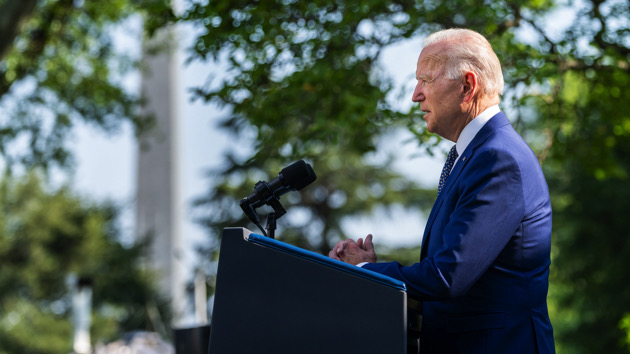
(WASHINGTON) — President Joe Biden on Thursday took a political victory lap after railway companies and unions reached a tentative labor agreement overnight — averting a strike that threatened to paralyze the nation’s supply chain and transportation rail service.

Speaking from the White House Rose Garden, Biden called the agreement a “big win for America” as the White House highlighted how he used his influence to avoid a crisis less than two months before the midterm elections.

“To the American people, this agreement can avert a significant damage that any shutdown would have brought,” Biden said. “Our nation’s rail system is the backbone of our supply chain.”

Biden said “every good you need” from clean water to food to liquefied natural gas gets delivered via rail.

“This agreement allows us to continue to rebuild a better America with an economy that truly works for working people and their families,” he said.

Before delivering remarks, Biden met with the negotiators who brokered the railway labor agreement in the Oval Office.

Administration officials hosted contract talks all day Wednesday hoping to broker a deal, negotiating for more than 20 consecutive hours, Secretary of Labor Marty Walsh said on Thursday. He described the deal as “hard-fought” and “mutually-beneficial.”

A White House official told reporters on Thursday that Biden called into Labor Department-led talks around 9 p.m. on Thursday to say a shutdown of railways was unacceptable and underscored the far-reaching economic consequences a strike would have. At 2 a.m., the official said, Walsh called the White House and said things were coming together. One union had to wake up their board to get sign off, the official added.

Biden thanked both sides for working in “good faith” to reach an agreement.

“In fact, the negotiators here today, I don’t think they’ve been to bed yet,” Biden said.

Unions will now vote on the agreement.

The Brotherhood of Locomotive Engineers Trainmen (BLET) and the SMART Transportation Division (SMART-TD) — the two largest rail unions and the final remaining union holdouts — confirmed the tentative agreement in a statement on Thursday.

The agreement includes one key sticking point throughout the negotiations: policies that allow workers to take a sick day or attend to a doctor’s appointment without being penalized.

“We listened when our members told us that a final agreement would require improvements to their quality of life as well as economic gains,” BELT and SMART-TD said in their joint statement.

Biden said on Thursday the workers “earned and deserved these benefits.”

“This agreement is validation of what I’ve always believed: unions and management can work together, can work together for the benefit of everyone,” he said.

Congress debated stepping into the fray to avoid the strike this week. Republican Sens. Wicker and Burr on Thursday attempted to push through a resolution that would have forced unions to accept the deal. Sen. Bernie Sanders, I-Vt., blocked the measure, arguing workers have the right to strike over working conditions.

House Speaker Nancy Pelosi applauded the tentative agreement on Thursday morning, stating Congress was ready to step in but “thankfully this action may not be necessary.”

“We congratulate the unions and railroads for coming to an agreement, because it is in the national interest that essential transportation services be maintained,” she said.

Copyright © 2022, ABC Audio. All rights reserved.

Same-sex marriage foe appeals to SCOTUS over anti-discrimination law

Same-sex marriage foe appeals to SCOTUS over anti-discrimination law
Grant Faint/Getty Images

(DENVER) — Four years after the U.S. Supreme Court ruled narrowly in favor of a Colorado baker who refused to make a wedding cake for a gay couple, the justices are preparing to take up a potentially more sweeping and consequential question: whether public accommodation laws that require business owners to offer all customers their goods and services infringe on freedom of speech.

Denver wedding website designer Lorie Smith, who opposes same-sex marriage, is asking the high court to strike down Colorado’s Anti-Discrimination Act, which would require her to serve LGBTQ couples or face fines. She says the law, which has no exemptions, forces her to implicitly express support for something that violates her religious beliefs.

“While I’m happy to serve everyone, and I have served everyone, including those who identify as LGBT, there are certain messages I am unable to promote through my business,” Smith told ABC News.

The case, 303 Creative LLC v. Elenis, pits the Free Speech Clause of the First Amendment against legislative efforts to stamp out discrimination against minority groups, particularly the LGBTQ community. Lower federal courts sided with Colorado, saying it has an overriding interest in ensuring equal access to publicly available goods and services.

“If you’re open to the public, you need to accommodate everybody. That’s a core of our civil rights law, and it has deep roots in American law,” said Colorado Attorney General Phillip Weiser.

If the justices were to allow a “free speech exemption” from anti-discrimination protections, Weiser said, the impact could extend far beyond sexual orientation to potentially allow discrimination based on someone’s religion, race or ethnicity.

“If a wedding website designer says I will sell Christian websites that have Biblical verses on it, they can choose to design their websites, design their product as they want,” Weiser said. “What they can’t do is say if you’re a same-sex couple, you can’t have this website.”

In 2018, the Supreme Court sided with Colorado baker Jack Phillips after he was fined by state officials for declining to make a wedding cake for a same-sex couple; but the 7-2 decision focused only on the Colorado Civil Rights Commission’s conduct in the matter, saying the panel had shown undue hostility to Phillips’ religious views during the investigation.

The court at the time did not address the broader question of denying service to certain customers on First Amendment grounds, which it will now consider this fall. Until Smith’s case is resolved, Phillips said he continues to stay out of the lucrative wedding cake business. Smith has also refrained from marketing wedding website services.

“The state doesn’t have a right to tell American citizens what to believe and what to speak and what they cannot speak,” Phillips said in an interview at his Masterpiece Cakeshop. “Lorie Smith’s concern is what the state did to me; it could happen to her, or it could happen to anybody.”

Phillips argues that he and Smith are artists and that each custom-made cake and website are acts of personal expression.

“The cake itself is a message,” he said. “If it’s not something I would say, then it’s not something I’ll write on a cake.”

LGBTQ advocates see things differently. Since the Court has recognized marriage as a civil right, regardless of sexual orientation, the nature of the couple seeking wedding services shouldn’t be a basis to discriminate, they say.

“And it’s not just cakes and flowers: Think about haircuts, think about clothing design, think about landscape design. Any kind of custom good or service can be thought of as having creative or artistic qualities,” said Jennifer Pizer, acting Chief Legal Officer of Lambda Legal, an LGBTQ advocacy group.

“This case has the potential to blow an enormous hole in our nation’s civil rights laws, and the stakes really could not be higher for LGBTQ people,” Pizer said.

Research published last year by the Journal of Legal Studies found that religious exemptions under civil rights law “can have a significant and robust, even if inadvertent, impact” on customers, estimating a 61% to 85% chance that same-sex couples will experience discrimination when planning a wedding.

“I think that what’s really important is that if somebody decides that they do need to speak up about unfair treatment that we have laws that protect them,” said Rex Fuller, CEO of The Center on Colfax, an LGBTQ community center in downtown Denver.

Twenty-six years ago, in the Supreme Court case Romer v. Evans, a 6-3 majority struck down a Colorado amendment that prohibited protections for LGBTQ people. The years since have seen significant expansion of rights and equality, but some fear the Smith case could mark a turn.

“There’s anxiety. We’re watching situations in other states, a lot of sort of more conservative states, like actively legislating against transgender folks and transgender acceptance,” said Sable Schultz, The Center’s manager of transgender programs.

Transgender discrimination is at the heart of Phillips’ latest legal battle involving Colorado’s Anti-Discrimination Act. Autumn Scardina, a transgender Denver woman, is currently suing the baker in state civil court for allegedly refusing to design her a pink and blue cake because of her gender identity.

“As soon as I told him who I was, then it became, I won’t sell it to you,” Scaridna told ABC News. “What I asked for was a pink and blue cake, and he freely admits he makes pink and blue cakes. Even though I was guarded, even though I expected that result and was hoping for the other, it still stung, stung tremendously.”

Phillips maintains he is unable to design a cake celebrating a gender transition because of his religious beliefs.

“We told this person, you know, we serve everybody; will gladly serve you – will make other custom cakes for you. You’re welcome to come in and shop, buy cookies, brownies, anything that I have, but I can’t create that cake because it is a message that I couldn’t create,” he said.

The state civil case, which is still pending on appeal, highlights the stakes in the higher-profile showdown playing out in Lorie Smith’s case at the nation’s highest court.

“I’m hoping the U.S. Supreme Court justices will stand for free speech because no one should live in fear of government punishment simply because the government doesn’t agree with their views on a certain topic,” Smith said.

Attorney General Weiser says he’s optimistic the justices will hold the line.

“The regulation of conduct to prohibit discrimination is protected activity, and it is really critical that we not break from that,” he said.

Copyright © 2022, ABC Audio. All rights reserved.

GOP hopefuls, lawmakers splinter over Lindsey Graham’s proposed abortion ban

GOP hopefuls, lawmakers splinter over Lindsey Graham’s proposed abortion ban
Kevin Dietsch/Getty Images

(WASHINGTON) — South Carolina Republican Sen. Lindsey Graham’s proposal this week of a 15-week national abortion ban — with limited exceptions — has drawn mixed reaction from other conservatives in the final eight weeks before the November midterms, after which Graham hopes to bring his bill up for a vote.

The announcement of the legislation was quickly seized upon by Democrats who see support for abortion access as a motivating issue for voters across the country, even in red states.

The potential ban also inspired a slew of questions for Republicans who had been assailing the Biden administration over high inflation numbers.

Graham defended the move to ABC News.

“I think that’s where the country is at. So, I don’t mind talking about pro-life issues,” he said Wednesday, adding, “I think my proposal over time will be supported by the public at large.”

“You need to stand up for what you believe, right? That’s a good thing,” he said.

With just about two months until the general election that will decide control of Congress, Graham’s proposal has splintered the Republican Party, which had worked to adopt mixed messages for different parts of the country since the Supreme Court overturned Roe v. Wade in June and ruled that abortion should be left up to individual states.

Graham’s proposal is the first GOP effort to ban abortion on a federal level since that decision and contains limited exceptions for cases of rape, incest or when the mother’s life is in danger.

Former Vice President Mike Pence said he supported a national ban, telling Real Clear Politics in a Wednesday interview that he believed “enthusiasm among pro-life Americans in states across the country is equal to, or greater than, any new motivation by people that support abortion rights.”

Pence said that barring access to most abortions after 15 weeks was “profoundly more important than any short-term politics.”

But other Republicans — some in difficult midterm races in battleground states — have distanced themselves from the proposed legislation, saying abortion restrictions should be up to individual states.

Blake Masters, Arizona’s Republican Senate nominee against incumbent Sen. Mark Kelly, avoided discussion of Graham’s abortion ban while at a Yuma border event on Wednesday, following his Tuesday remarks in support of the bill. He said Wednesday if Graham’s bill does not pass, Republicans should take up a “a third-trimester standalone bill.”

“Certainly we can all agree that in America, we shouldn’t tolerate late-term abortion like China and North Korea do,” Masters said in a statement to ABC News.

Masters — under fire in TV ads by Democrats for his anti-abortion stance — already supports a 15-week ban on abortion, with exceptions only for the life of the mother, soon to take effect in Arizona. He did, however, scrub his website of the topic after Roe was overturned, removing language that said “I am 100% pro-life.”

Abortion access has proven to be a driving issue for voters, demonstrated most strongly in Kansas, when the historically conservative state overwhelmingly rejected a referendum that would have stripped away abortion rights from the state constitution.

Abortion access has also been seen as an influencing factor in special elections in New York and Alaska, where Democratic candidates with campaigns focused on abortion won their races. Even Republicans in Graham’s home state of South Carolina are having trouble passing an abortion ban.

​​In Georgia, Republican Herschel Walker — locked in a tight race against incumbent Rep. Raphael Warnock — said the issue “should be decided at the state level, but I WOULD support” Graham’s proposal in the Senate.

Republican Sen. Ron Johnson, one of the party’s most vulnerable incumbents, up for reelection in Wisconsin, said “nothing is going to pass in Congress” and that the issue should be left up to states.

“It’s got to be decided in the states. I think that is the appropriate place for this to be decided,” Johnson told ABC News on Tuesday.

A spokesperson for Dr. Mehmet Oz, the GOP candidate for Senate in Pennsylvania, made a similar point, suggesting he would not support the Graham bill but not directly commenting.

“Dr. Oz is pro-life with three exceptions: life of the mother, rape and incest. And as a senator, he’d want to make sure that the federal government is not involved in interfering with the state’s decisions on the topic,” his spokesperson said.

Don Bolduc, the Trump-endorsed winner of New Hampshire’s Tuesday GOP primary, said he would not vote for the bill.

“I believe the federal government should stay out of it,” Bolduc, who has campaigned as anti-abortion, told ABC News. “Let the states deal with it. That’s going to be my position in Washington, D.C.”

The Republican Senate candidate in Colorado, Joe O’Dea, said he supported a different position on abortion restrictions — not what Graham called for.

“America wants balance on the abortion issue, not a forever cold war between the far left and the far right. Congress should pass a bill protecting a woman’s right to choose early in pregnancy, whether a woman lives in Mississippi or Massachusetts, and there should be sensible limits on non-medically necessary late term abortion and parental notification for minors. I don’t support Senator Graham’s bill,” O’Dea said in a statement.

“A Republican ban is as reckless and tone deaf as is Joe Biden and Chuck Schumer’s hostility to considering any compromise on late term abortion, parental notification, or conscience protections for religious hospitals,” O’Dea said.

Ohio GOP Senate nominee JD Vance and Nevada GOP Senate nominee Adam Laxalt did not respond to requests for comment.

The candidates’ distance comes as Senate Minority Leader Mitch McConnell on Tuesday threw cold water on Graham’s proposal. When asked if he would bring the measure to the Senate floor should the GOP retake the chamber, McConnell said “most of the members of my conference prefer that this be dealt with at the state level.”

Other Republicans have embraced the legislation.

Florida Sen. Marco Rubio is an original co-sponsor of Graham’s proposed ban. His support comes as his general election opponent, Democratic Rep. Val Demings, has levied campaign attacks on the incumbent’s anti-abortion views.

When asked if his position on the bill would influence support for him in his race against Demings, Rubio told reporters in Washington that he’d “never analyzed this politically” but that’s he’s staunchly “pro-life.”

“That has never been a mystery. I’ve never hidden that. And I’ll vote for any bill that helps it,” he said, noting that the legislation would not likely pass if voted upon.

“No, of course, this is going to be dealt with at the state level … If [Democrats] think this is such a big political winner, then they shouldn’t be worried about states deciding,” Rubio said. “They know it’s not going to pass here.”

A spokesperson for Demings told ABC News in a statement that Floridians will “hold Rubio accountable for his out of touch stance in November,” following news of his co-sponsorship of Graham’s ban.

Rep. Ted Budd, R- N.C., running in a competitive Senate race against Democrat Cheri Beasley, on Wednesday also signed on as co-sponsor of a House version of Graham’s Senate legislation.

Separately, big-name Republicans like Sen. John Cornyn of Texas and Sen. Thom Tillis of North Carolina have backed the idea that states should dictate their position on abortion.

Copyright © 2022, ABC Audio. All rights reserved.

Senators press Biden administration on ‘unacceptable’ monkeypox response; officials defend their work

Senators press Biden administration on ‘unacceptable’ monkeypox response; officials defend their work
Jackyenjoyphotography/Getty Images

(WASHINGTON) — At a congressional hearing on Wednesday with the nation’s leading public health officials, senators on both sides of the aisle criticized the Biden administration’s monkeypox response.

The strongest rebuke came from North Carolina’s Richard Burr, the ranking Republican member of the Senate Committee on Health, Education, Labor and Pensions (HELP), who labeled the government’s handling of monkeypox a “catastrophic failure” reminiscent of the onset of COVID-19 and implored officials to “do better.”

“You repeated each of the mistakes from the early days of the COVID response, and the cultural arrogance from public health officials who are supposed to be at the forefront of our response let this country down again,” Burr told the officials: Centers for Disease Control and Prevention Director Rochelle Walensky; National Institute of Allergy and Infectious Diseases Director Anthony Fauci; Food and Drug Administration Commissioner Robert Califf and Assistant Secretary for Preparedness and Response Dawn O’Connell.

Burr listed off delays on testing, therapeutics and vaccines — all of which were, and in some cases still are, challenging to access at the beginning of the monkeypox outbreak — and he criticized government health officials for not issuing stronger behavioral guidance during the many Pride parades nationwide for a disease that’s largely infecting the gay and bisexual male community.

“It isn’t a question of money. You’ve been given astonishing amounts of money. It’s a question of leadership. It’s a question of focus. It’s a question of squashing the typical bureaucratic roadblocks, arrogance and ineptitude. You need to do better,” Burr said.

Democratic Sen. Patty Murray, the committee chair, also had criticism of the overall monkeypox response — though she tempered hers with the news that access to vaccines, testing and therapeutics has increased while case growth has decreased.

Still, she called the response “unacceptable.”

“I know each of your agencies have worked relentlessly to respond first to COVID and now monkeypox. But I have to say, frankly, too many missteps were made early on in the response and a couple hundred cases turned into 21,000. It is unacceptable to communities who already experienced barriers to accessing health care, like the LGBTQ+ and the Black and Latino communities that are hardest hit by this outbreak,” Murray said.

For their part, members of the administration’s monkeypox response said that they had worked quickly to focus on key measures like testing and vaccines.

“On May 17, a case was reported in Massachusetts and was confirmed by CDC the following day. CDC immediately began its work searching for additional cases, educating clinicians and the public about this disease and supporting our state and local health public health partners in their response,” Walensky said.

“Over the last several weeks we’ve been pleased to see a decline in the growth of new cases here and abroad, though there are areas in the United States where the rate of rise in new cases is still increasing. We approach this news with cautious optimism, recognizing that we must continue to aggressively respond using our entire toolkit, including vaccination, testing and education about risk, to inform behavior change,” she said.

She said the U.S. has always had more testing capacity than testing being done and to date is still doing 14-20% of its total testing capacity. The underlying issue, she said, has been getting health care providers up to speed on a disease that’s not common domestically so that they quickly prescribe tests.

“There’s never been a shortage of tests, but there’s been a shortage of access to tests because of inefficiencies in the system,” said Califf, the FDA commissioner.

On vaccines, Burr pushed the officials on why vaccination rates aren’t higher — arguing that a lack of information on the new intradermal vaccination method, which is allowing the U.S. to increase its vaccine supply by up to fivefold, could be turning people off of the shots.

“We know that we have 13 to 15 million gay men in this country in the United States. … We have about 1.9 million HIV/AIDS positive gay men. There’s your immunocompromised population, 1.9 million; [and] your at-risk pool for sexually transmitted monkeypox [is] about 13 to 15 million. And somehow we’re cheering the fact that we put out 700,000 vaccines,” Burr said.

The administration has been doing some large-scale pop-up clinics at events like Atlanta Black Pride, Charlotte Pride, Boise Pride and Southern Decadence in New Orleans, Walensky said, and they had vaccinated around 7,200 people between the Atlanta and New Orleans events.

“What we need to do now is do those in smaller scale, and we’re actively doing that scale up … So rather than these big events, we need to meet people where they are with community-based organizations, trusted messengers,” she said.

O’Connell, who oversees the vaccine logistics within the Department of Health and Human Services, said the U.S. would be getting an additional 5.5 million vials of monkeypox vaccine in the coming months — which could be used as some 27 million doses, using the new intradermal approach — on top of the 1.1 million vials that have already been made available.

“Responses cannot be static. They must continue to evolve and calibrate to the current set of circumstances and regularly account for new information and evolving scientific understanding. This has been true of the monkeypox response thus far and will be true as it continues,” O’Connell said, defending the response.

But Walensky pointed out that there are holes in the administration’s work because of data hurdles.

The CDC does not have nearly the amount of information they need to design a more efficient testing and vaccination strategy, she said.

For example, “for monkeypox specifically, I can tell you that I don’t know the total number of people hospitalized with monkeypox,” Walensky said.

“It’s been hard, and it should not be this hard. And if we can’t make informed decisions, based on the best possible data coming into us, we’re not making the best decisions for the American people. The existing patchwork of data systems is not working. It’s not working to the best ability of the American people,” Walensky said.

She also said the CDC doesn’t know which people who are testing positive for monkeypox have been vaccinated or not.

While demographic data, such as race, ethnicity and gender, are reported in 91% of vaccinations, that data is only reported for 27% of tests and 47% of cases.

“We have been working closely, tirelessly, with state and local public health staff who have been doing the same to extract data on this outbreak specifically,” Walensky said.

Copyright © 2022, ABC Audio. All rights reserved.

Late Rep. Elijah Cummings’ official portrait unveiled at the Capitol

Late Rep. Elijah Cummings’ official portrait unveiled at the Capitol
Stefani Reynolds/AFP via Getty Images

(WASHINGTON) — With his widow and former colleagues looking on, the late Maryland Rep. Elijah Cummings had his official portrait unveiled Wednesday at the U.S. Capitol.

Cummings died in October 2019, at 68, after longstanding health challenges. He was first elected to the House in 1996 and served as chairman of the House Committee on Oversight and Reform until he died.

House Speaker Nancy Pelosi joined House Majority Leader Steny Hoyer and House Majority Whip James Clyburn on Wednesday and delivered remarks honoring Cummings.

“He was a leader of towering integrity, everybody knows that. A man whose life embodied the American dream,” Pelosi, a Maryland native, said.

Cummings’ portrait was commissioned by his widow, Dr. Maya Rockeymoore Cummings, and was painted by Baltimore-based artist Jerrell Gibbs. It will hang in the Rayburn House Office Building Government Oversight and Reform Committee hearing room.

“This entire process has been a beautiful challenge,” Gibbs said Wednesday. “Being tasked with creating a painting of this magnitude for someone as important as the honorable Elijah Cummings to be permanently housed in a place of such significance as the United States Capitol building seemed like an insurmountable feat.”

Rockeymoore Cummings told ABC News that the portrait “is going to help keep his legacy alive, because that portrait is going to actually stand and look over the Government Oversight and Reform Committee members as they deliberate on all matters of issues.”

“And he’s going to be a reminder to them that we have to hold ourselves to the highest levels of integrity, that we have to hold ourselves to the truth,” she said.

Copyright © 2022, ABC Audio. All rights reserved.

As railroad strike grows closer, congressional Dems hope for compromise — and not to have to act

As railroad strike grows closer, congressional Dems hope for compromise — and not to have to act
Tim Graham/Getty Images

(WASHINGTON) — As freight railroad carriers and a coalition of unions representing their workers move ever closer to a potential strike, a clash has erupted in Congress over whether and how to intervene in a labor dispute that could have devastating effects across an economy already buffeted by high inflation and recessionary pressures.

Republican Sens. Roger Wicker and Richard Burr on Monday introduced a resolution to stave off a strike by the industry’s unions, which represent more than 100,000 employees, by imposing what had been non-binding recommendations from the Presidential Emergency Board (PEB).

In a five-year plan presented in August, the board had recommended a 24% pay raise for rail workers retroactive to 2020, with $1,000 annual bonus. All but two of the major unions involved have come to an agreement with the railroad companies, but those two groups have said that unscheduled time off or sick leave continues to be a sticking point — and one that has dogged an industry beset with labor shortages.

The impasse presents a major problem for the unions’ political allies in Congress, largely Democrats, who defended workers against the railroads, which have made record profits through and heading out of the historic COVID-19 pandemic.

On Wednesday, in a sign of the potential conflict to come between lawmakers should Congress act to avert a strike, Sens. Wicker of Mississippi and Burr of North Carolina tried to force their resolution through — only to be blocked by Sen. Bernie Sanders, I-Vt, the self-described democratic socialist and prominent union supporter.

“If the trains stop running, our economy grinds to a halt,” Wicker warned. “The last thing we need is shutdown of the nation’s rail service, both passenger and freight, and yet that is what we are facing in less than a day and a half from this moment: a massive rail strike that will virtually shut down our economy.”

Burr noted one assessment that, in a strike, “the economic impact to the American people is $2 billion a day.”

“This is 160,000 trainloads of agriculture product at a time of harvest across this country … They haul coal. They haul gas. They haul petroleum. They haul gasses like helium that are required for manufacturing businesses,” Burr said. “They haul auto parts, which means you’re going to see auto assembly plants that shut down.”

Sanders shot back, “We’re talking about an industry that has seen its profit margins nearly tripled over the past 20 years. What Congress should be doing is not passing the Burr-Wicker resolution and forcing railroad workers back to work under horrendous working conditions. What we should be doing is telling the CEOs in the rail industry, ‘Treat your workers with dignity and respect, not contempt.'”

“It’s time for Congress to stand on the side of workers for a change and not just the head [sic] of large multinational corporations. Rail workers have a right to strike for reliable schedules. They have a right to strike for paid sick delays. They have a right to strike for safe working conditions,” Sanders said. “Rail workers have a right to strike for decent benefits. The Burr-Wicker resolution would take the fundamental rights away for workers.”

Indeed, in 2021, the nation’s largest railroad companies reported record profits coming out of the pandemic.

Burr, in a message to Senate Majority Leader Chuck Schumer, who must determine what bill to bring to the floor, said he could guarantee 48 Republicans would back his resolution with Wicker, suggesting only two GOP lawmakers did not support it in the 50-member conference.

Why Congress is involved

All labor disputes in the railway and airline industries — which are seen as critical to the U.S. economy, stretching across major industries from energy to agriculture — are governed by a 1920s-era federal law known as the Railway Labor Act (RLA).

Congress enacted that law after decades of sometimes violent worker strikes and when Americans had grown dependent on many industries, particularly farming and manufacturing.

The RLA is intended to protect employees’ right to unionize and collectively bargain — the first federal law to do this in the U.S. — and ensure timely settlement of any labor disagreements. It dictates the terms of such disputes, including when parties enter an “emergency” phase, as they have now and when a president must appoint a board to try to recommend solutions, though those are non-binding on all parties but are designed to help each side to reach a solution.

In this case, many of the unions accepted the PEB’s recommendations to avoid a strike, though Sanders has noted that the actual workers in the unions have yet to vote to approve the measures.

Under the RLA, if the parties in the rail labor dispute do not reach agreement on a new contract or extend the current cooling-off period by 12:01 a.m. on Friday, the railroads can either impose their own work rules or employees can strike — or both.

At that point, the RLA would no longer set the terms of behavior. Instead, only Congress and President Joe Biden would be empowered to act — as has happened in the past — if a longer-term labor crisis is to be averted.

But Democratic Whip Dick Durbin has urged workers not to lean on Congress to resolve the dispute, warning that, as the deadline looms, lawmakers may not be able to intervene fast enough.

“I think it is naive to believe that we could just quickly come up with an agreement on settling this strike, enacted in the Senate which requires 60 votes. It takes a lot more work than that,” Durbin said on Wednesday. “But I think the message to the railroads as well as the union is get the job done. Don’t count on Congress. Do it yourself. We think they are close, and they’ve got to understand the sense of urgency.”

Congress, acting with authority from the Constitution’s commerce clause, has not voted to end a railroad strike since April 1991 — less than 24 hours after a walkout. At the time, lawmakers approved a joint resolution — with President George H. W. Bush being roused from his bed in the middle of the night to sign the bill — that forced the parties in the dispute into a 65-day binding arbitration process. Had workers not approved the terms in arbitration, Congress mandated that less generous solutions from the Presidential Emergency Board be accepted.

Still, that last example was more than 30 years ago. In this bitterly partisan environment, and less than 60 days from a crucial midterm election when unions typically turn out in large numbers, Democrats — typically pro-union — are hoping that railway negotiations are successful and Congress is not needed.

“We’re all hoping that negotiations will continue so there is no strike, and we’re at the table with the secretary of labor. Secretary [Marty] Walsh has been very much hoping that we can get a resolution,” House Speaker Nancy Pelosi said Wednesday. “The main area of disagreement is there is no sick leave for the workers and that’s a problem.”

“I would rather see negotiations prevail so that there’s no need for any actions from Congress,” Pelosi told reporters.

ABC News’ Mariam Khan and Allison Pecorin contributed to this story.

Copyright © 2022, ABC Audio. All rights reserved.
Recapping the 2022 primaries: The environment got better for Dems — but voters still have concerns

Recapping the 2022 primaries: The environment got better for Dems — but voters still have concerns
Al Drago/Bloomberg/Getty Images

(WASHINGTON) — After Tuesday’s elections in Delaware, New Hampshire and Rhode Island, the six-month-long 2022 primary season has finally come to a close — and the party nominees now turn their attention to the eight weeks before November’s midterms.

A lot can change in the close of the campaign — just as a lot has changed throughout this year’s primaries.

Democrats braced at the beginning of the cycle for an expected wave of Republican success, given historical trends, President Joe Biden’s unpopularity and the drag of economic news, including gas prices and inflation.

At the beginning of June, FiveThirtyEight projected Democrats would lose an average of 20 House seats — more than enough to flip the chamber to the GOP.

Now, according to FiveThirtyEight’s forecast, Democrats are projected to lose an average of 13 seats. And FiveThirtyEight assesses that they are favorites to hold the Senate — albeit narrowly — in another reversal since June.

What shifted? Here’s a breakdown of key dynamics during the 2022 primary season and what it may mean ahead of the midterms.

The overturning Roe v. Wade in June gave a new focus for Democrats on the trail as they increasingly campaigned on abortion rights, which the Supreme Court had ruled should be left up to individual states. The first major litmus test of how Americans felt about abortion after the dismantling of Roe came in the historically red state of Kansas, where in August voters rejected a proposed state constitutional amendment that said there was no right to an abortion.

More than 900,000 Kansans went to the polls to vote, the biggest turnout for a primary election in the state’s history.

An ABC News/Ipsos poll released in August asked voters which candidate they would support if one favored keeping abortion legal and available and the other candidate supported limiting abortion except to protect the mother’s life. About half of Americans (49%) said they would be more likely to support the candidate who would keep access to abortion legal compared to the 27% of Americans who would be more likely to support the candidate who favored limiting abortion.

While anti-abortion voters are a core part of the Republican base, leading conservatives remain divided on the issue — some push for stricter restrictions nationwide while others argue for a more moderate position.

On Tuesday, South Carolina Sen. Lindsey Graham introduced legislation that would impose a federal ban on most abortions after 15 weeks, with exceptions for rape, incest and the life of the mother. But Minority Leader Mitch McConnell downplayed prospects for such legislation if his party retakes power, saying, “I think most of the members of my conference prefer this be dealt with at the state level.”

And some Republican candidates in tight races in swing states distanced themselves from a national ban. In Pennsylvania, Dr. Mehmet Oz’s campaign released a statement suggesting he would not support Graham’s legislation.

“Dr. Oz is pro-life with three exceptions: life of the mother, rape and incest. And as a senator, he’d want to make sure that the federal government is not involved in interfering with the state’s decisions on the topic,” spokeswoman Brittany Yanick told ABC News.

Former President Donald Trump continues to be an influential figure for Republican voters, even as others in his party suggested his endorsements were sometimes jeopardizing their general election prospects.

While Trump received mixed results with his endorsed candidates this primary cycle, one fact sticks out: In nearly every battleground Senate race, a candidate he endorsed or with whom he aligns won their primary, sometimes beating more moderate options.

Some exceptions prove that rule: In the Colorado Senate primary, where Trump did not make an endorsement, the candidate who won the primary, Joe O’Dea, has cast himself as a moderate Republican hoping to garner more voters in the purple state.

In August, McConnell predicted the House had a greater likelihood of flipping than the Senate, citing “candidate quality” in the Senate races — a veiled remark that many, including Trump himself, took to be about some of the GOP nominees backed by the former president. Heading into primary season, the party had also failed to recruit some popular names like Maryland Gov. Larry Hogan and New Hampshire Gov. Chris Sununu to target vulnerable Democratic incumbents.

Instead, Blake Masters in Arizona, Herschel Walker in Georgia and Oz in Pennsylvania are some of the first-time Senate candidates running in races that are either rated lean Democrat or toss-up by FiveThirtyEight. (McConnell has since publicly fundraised for Oz and Walker.)

In Maryland and New Hampshire, meanwhile, the Trump-aligned nominees Dan Cox and Don Bolduc triumphed over candidates backed by Hogan and Sununu, who won their blue states with more moderate coalitions. Cox and Bolduc energized their supporters in part by campaigning in Trump’s style, which included baseless attacks on the 2020 race.

President Biden’s approval rating consistently fell for much of the primary season, according to FiveThirtyEight — until gas prices began to fall in the summer and he notched a series of wins in Congress, which Democratic lawmakers have been happy to campaign on while on the trail.

Among the bills that were passed and signed — most of them by bipartisan majorities in Congress — were gun-safety reforms, veterans’ health care and domestic computer chip funding and, along party lines, the climate, health and tax package known as the Inflation Reduction Act.

In August, over Republican objections, Biden also announced he was fulfilling a campaign promise and would be forgiving up to $10,000 of federal student debt and an additional $10,000 in debt for those who received Pell grants.

His approval rating has rallied since a nadir in late July, according to FiveThirtyEight. As one example, according to a Quinnipiac University poll released in August, 40% of Americans approved of the job Biden has been doing compared to 52% who did not approve. This is up 9% from the last month.

The former president made clear that he would use his endorsements during the primaries to try and oust the House Republicans who voted to impeach him after Jan. 6 — and he largely succeeded. Of the 10 Republicans who voted for impeachment, four retired, four lost their primaries to Trump-backed challengers and only two will move onto the general election.

The two Republicans who survived their primarys are Reps. David Valadao of California and Dan Newhouse of Washington state.

Trump’s biggest target was Wyoming Rep. Liz Cheney, his biggest Republican critic and one of the lawmakers who has led the charge to prevent Trump from, in her words, ever holding office again. Cheney was handily defeated last month by Trump’s pick, attorney Harriet Hageman.

Even though Biden has seen notable improvement in his approval ratings, some Democratic candidates in battleground states still hesitated to campaign with the president.

In Ohio, Rep. Tim Ryan’s campaign told ABC News that they had not asked Biden or anyone from the White House to campaign with them.

In Wisconsin over the Labor Day weekend, Democratic Senate nominee and Lt. Gov. Mandela Barnes was absent as President Biden touted the power of union workers at a “Laborfest” in Milwaukee.

Pennsylvania Attorney General Josh Shapiro, the Democrat running for governor, did not join Biden when he visited Pittsburgh during his Labor Day stop after appearing with Biden at an official White House event in Wilkes-Barre the previous week.

In May, Shapiro told CNN that he would “welcome” Biden in Pennsylvania to campaign for him, adding that he was “focused on running a race here in the Commonwealth of Pennsylvania, listening to the people of Washington County, not Washington, D.C.”

Trouble continued to brew for Biden with the latest inflation report, which showed prices were 8.3% higher in August compared to a year ago — higher than expected. Food, shelter, medical care and education were among the categories that increased over the month. But the price of gasoline did fall, alleviating what voters have said is a major concern.

Republicans seized on the persistently high inflation as Biden released a statement that responded to the report, contending that “it will take more time and resolve to bring inflation down.”

The same day, Senate Republicans blasted the White House for celebrating the passage of the Inflation Reduction Act while inflation rates kept rising over last year.

“So they may be taking a victory lap at the White House but I can tell you one thing: The American people are not, because they are feeling the direct impact of this every single day,” Republican Whip John Thune said.

A recent ABC News/Ipsos poll showed that only 29% of Americans said they approved of the way Biden has been handling inflation — while 69% disapproved.

Heading into the general election, some firebrand Republicans who ran on Trump’s endorsement in swing states have started switching their tune on hot-button issues such as abortion.

In Pennsylvania, for example, state Sen. Doug Mastriano initially campaigned for the GOP nominee to be governor in part on a near-total ban on abortions — a portion of his platform he virtually stopped mentioning since winning the nomination.

Other Republican hopefuls downplayed their previous attacks on the 2020 race that Trump lost to Biden.

“If they want to be successful, they have to broaden their message,” Mike DuHaime, who helped former Republican Gov. Chris Christie twice get elected in New Jersey, previously told ABC News. “Yeah, you need the Republican base to be fired up — but you need to win over independents, and you need to win over some conservative, moderate Democrats. And you’re not going to do that by carrying Trump’s water about an election that happened two years ago. They need to move forward.”

In some key competitive races, candidates have rebranded their websites to appeal to more moderate voters, including removing their stances on abortion entirely. In North Carolina’s 13th Congressional District, GOP nominee Bo Hines, who proudly proclaimed that he was anti-abortion and touted his endorsement from Trump, has now removed both from the home page of his website.

“I think, many, many undecided voters won’t be tuning into this race until October,” DuHaime told ABC. “So, there’s certainly time. But you need to make that decision.”

Copyright © 2022, ABC Audio. All rights reserved.
Biden touts electric vehicle investments at Detroit auto show

Biden touts electric vehicle investments at Detroit auto show
Emily Elconin/Bloomberg/Getty Images

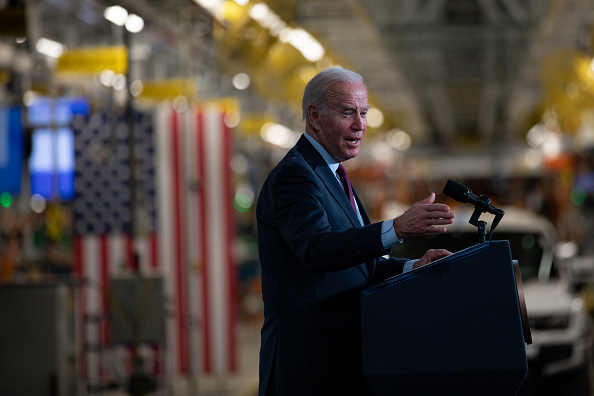
(DETROIT) — President Joe Biden on Wednesday touted his administration’s work on electric vehicles while touring the 2022 North American International Auto Show in Detroit, describing a future where charging stations are as easily available as gas stations.

“The great American road trip is going to be fully electrified,” Biden said as he announced the first round of federal funding for electric vehicle chargers from the Bipartisan Infrastructure Law he signed last year.

“We’re approving funding for the first 35 states, including Michigan, to build their own electric charging infrastructure throughout their state,” Biden said. “And you are gonna be part of a network of 500,000 charging stations.”

According to a White House official, the $900 million investment will help build chargers across 53,000 miles of the national highway system.

Biden also took a moment to promote the new EV tax credits included in the Inflation Reduction Act. The law, signed last month, includes a $7,500 credit for new vehicles and a $4,000 credit for purchases of used EVs.

The Inflation Reduction Act also requires that an electric vehicle and its batteries must be assembled in North America in order to qualify for the federal tax incentive.

“It used to be that to buy an electric car you had to make all sorts of compromises, but not now,” Biden said. “Thanks to American ingenuity, American engineers, American auto workers, that’s all changing. Today, if you want an electric vehicle with a long range, you can buy one made in America.”

Several states are beginning to phase-out gas-powered vehicles and shift to electric cars. California became the first state in the U.S. to implement regulations that ban the sale of new gas-engine vehicles by 2035. The Golden State will require all new cars to run on electricity or hydrogen.

Biden, a self-professed car enthusiast, toured the showroom alongside General Motors CEO Mary Barra and its president Mark Ruess. At one point, the president got inside a bright orange Chevrolet Corvette Z06 — which has gasoline-fueled V8 engine — and revved the engine.

“Move out of the way everybody, this thing flies,” the president said to the press. Biden has his own vintage 1967 Corvette.

After turning off the engine, Biden joked that he was going to tell his Secret Service detail he was driving home.

Biden also stopped to check out a bright blue Electric Chevy Silverado, a yellow-orange Mustang, and a group of new plug-in electric vehicle Jeeps before getting behind the wheel and driving an electric Cadillac Lyriq.

“Come on jump in, I’ll give you a ride back to Washington,” Biden quipped.

Copyright © 2022, ABC Audio. All rights reserved.
Ex-Cuomo aide sues former governor, alleging gender discrimination, sexual harassment

Ex-Cuomo aide sues former governor, alleging gender discrimination, sexual harassment
Lev Radin/Pacific Press/LightRocket/Getty Images

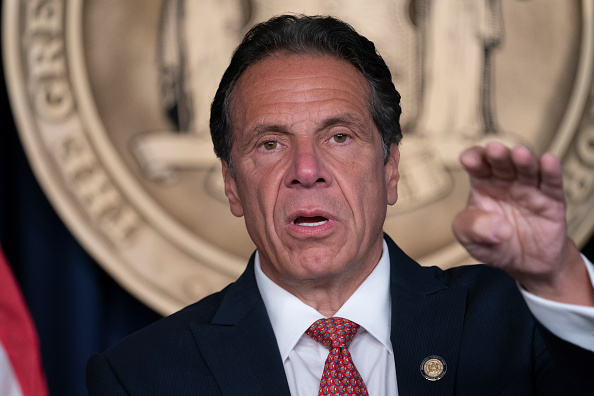
(ALBANY, NY) — Charlotte Bennett, a former aide who has accused ex-New York Gov. Andrew Cuomo of sexual harassment, sued him Wednesday in federal court, alleging gender discrimination, sexual harassment and retaliation.

In addition to Cuomo, the lawsuit, filed in Manhattan federal court, also named three of his top aides: Melissa DeRosa, Jill DesRosiers and Judith Mogul.

Bennett was among 11 women a New York Attorney General’s report found Cuomo harassed, which led to his resignation from office in August, 2021.

“Throughout her employment as Defendant Cuomo’s Executive Assistant, the then-Governor subjected her to sexualized comments about her appearance, assigned her humiliating and demeaning tasks, and beginning in early June 2020, subjected her to invasive and unwanted questions about her personal life, romantic and sexual relationships, and history as a survivor of sexual assault,” Bennett’s lawsuit said.

When Bennett reported her claims and her fear of retaliation to chief of staff DesRosiers Bennett, she was transferred “to an inferior position,” the lawsuit said.

“The Governor has always said he didn’t harass anyone and with each day that goes by more and more information is uncovered showing how evidence favorable to the Governor was suppressed and crucial facts ignored or omitted that undermined witness credibility. What else will come out during the discovery process? We’ll see them in court,” Cuomo attorney Rita Glavin said in a statement to ABC News on Wednesday.

Bennett went public with some her claims in a February 2021 article in The New York Times after another former Cuomo staff member, Lindsey Boylan, published her account. Cuomo claimed at the time that his actions involving Bennett were misunderstood.

The allegations in the lawsuit expand upon many of the public claims Bennett previously made, including an Oct. 4, 2019, phone call when she said Cuomo began singing the words, “Are you ready?” to the tune of “Do You Love Me?” by The Contours.

“When Plaintiff told Defendant Cuomo she did not recognize the song, Defendant Cuomo sang several lines from the song: ‘Do you love me, do you really love me? Do you love me, do you care?’ Defendant Cuomo’s singing to her made Plaintiff uncomfortable and she laughed awkwardly,” the lawsuit said.

A few weeks later, Cuomo asked Bennett a series of pointed questions about the size of his hands, the suit said.

“Given the common association between the size of a man’s hands and the size of his penis, Plaintiff understood Defendant Cuomo to be encouraging her to comment on the size of his genitals, which made her extremely uncomfortable,” the lawsuit said.

Bennett accused Cuomo of asking her uncomfortable questions about a time when she was sexually assaulted during college, the suit said.

“Defendant Cuomo’s questions made Plaintiff extremely uncomfortable, but she felt she could not decline to respond and briefly described an incident in which her then-boyfriend ejaculated on her clothing without her consent,” the lawsuit said. “Defendant Cuomo responded with something to the effect of, ‘Well, some people have it much worse.'”

Cuomo resigned last year after a five-month investigation by New York State Attorney General Letitia James. The 168-page report said “the governor engaged in conduct constituting sexual harassment under federal and New York State law.”

“Specifically, we find that the Governor sexually harassed a number of current and former New York State employees by, among other things, engaging in unwelcome and nonconsensual touching, as well as making numerous offensive comments of a suggestive and sexual nature that created a hostile work environment for women,” the report said.

In announcing his resignation, Cuomo said his first instinct was to fight the allegation, which he said were politically motivated. However, he said it would save the taxpayers millions of dollars for him to step down. “The best way I can help now is if I step aside,” he said last year.

However, he said, “Don’t get me wrong — this is not to say that there are not 11 women who I truly offended. There are. And for that, I deeply, deeply apologize.”


Copyright © 2022, ABC Audio. All rights reserved.