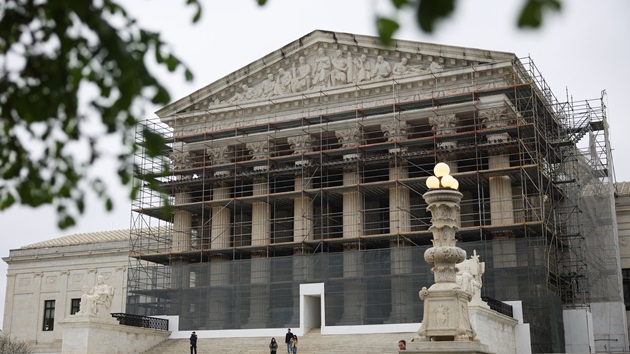
The U.S. Supreme Court is seen on April 07, 2025 in Washington, DC. Kayla Bartkowski/Getty Images
(WASHINGTON) — The Supreme Court on Wednesday moved to allow Federal Reserve governor Lisa Cook to remain on the central bank board into 2026, saying it would take up President Donald Trump’s appeal seeking to remove her for cause during a hearing in January.
The Court did not explain its decision. There were no noted dissents.
The decision to let Cook stay on the job pending the outcome of the case marks a sharp break with how the justices have handled other cases involving Trump’s removal power at independent federal agencies. In those cases, a majority of the Supreme Court showed deference to Trump’s firing power, at least on an interim basis, while the litigation plays out.
This is a developing story. Please check back for updates.
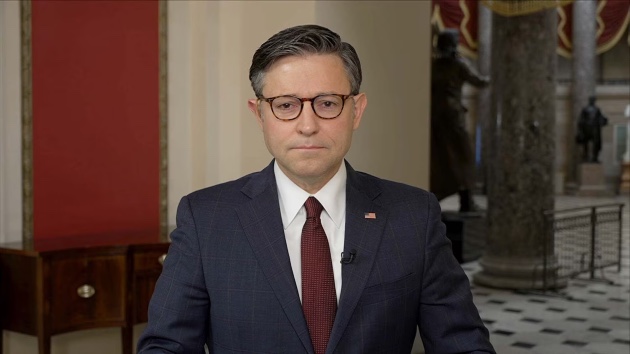
Mike Johnson speaks with ABC News, Oct. 1, 2025, following a government shutdown. (ABC News)
(WASHINGTON) — A day after President Donald Trump told top-ranking generals and admirals that the U.S. is fighting a “war from within,” Speaker Mike Johnson said the president’s comments show his ability to “take crime seriously,” whereas House Minority Leader Hakeem Jeffries said the remarks were “disturbing.”
The two politicians spoke on “Good Morning America” on Wednesday about the president’s statements along with the government shutdown, which took effect at 12:01 a.m. on Wednesday.
While Johnson said he had not heard Trump’s remarks on Tuesday — as he was “a little busy” — he said the president “takes crime seriously.” Johnson also said Trump’s comments about violence in American cities were “cherry-picked out of a long speech.”
Trump said Tuesday that the military’s job is not only to protect the United States from threats abroad, but also what he repeatedly referred to as a domestic enemy in American cities.
“It’s a war from within,” the president said to the room of high-ranking military generals who flew from across the globe to Quantico, Virginia. “We’re under invasion from within,” Trump said.
Trump talked about his efforts to increase the use of the U.S. military in American cities. Trump claimed Democratic-run cities, such as New York, Chicago and San Francisco, are in “bad shape,” and that he threatened to “straighten them out, one by one.”
“I told Pete [Hegseth] we should use some of these dangerous cities as training grounds for our military National Guard,” he said.
When asked if using military troops in American cities was appropriate, Johnson said, “I don’t serve on the Pentagon, I run the House of Representatives.”
Johnson then said that Trump has “cleaned up the crime problem” in Washington, D.C., after he mobilized the D.C. National Guard in August.
Jeffries said the president’s comment was a “deeply disturbing statement,” saying that we need “presidential leadership that brings people together instead of tearing us apart.”
“A single American should never be viewed as an ‘enemy from within’ or as target practice for the American military,” Jeffries said.
Jeffries told “GMA” that the Americans have “rejected the deployment and occupation of American cities and towns and counties with American military troops.”
“We have the finest military in the world and they should be used to keep us safe from external enemies,” Jeffries added.
Trump’s comments come after he ordered federal troops to Portland, Oregon, because of what he alleged were threats from domestic terrorists. The city’s mayor and the state’s governor both emphasized that they did not request the troops and objected to Trump’s action.
(WASHINGTON) — The U.S. government shut down at midnight on Wednesday, beginning funding stoppages that are expected to ripple through federal agencies, disrupting many government services and putting perhaps tens of thousands out of work.
The closure came amid an bitter impasse between congressional Democrats and Republicans, who are backed by President Donald Trump, over whether an extension of federal funding should include health care provisions.
The Senate late on Tuesday rejected in a 55-45 vote a 7-week stopgap funding measure supported by Republicans that would have allowed the government to continue operations. That was their second attempt of the night, after voting on a bill supported by Democrats. Hours later, the shutdown began.
As the government closed, rhetoric became heightened from both sides of the aisle, with each party and their allies pointing the blame at their counterparts — each claiming the opposing party “owns” the shutdown.
“Democrats have officially voted to CLOSE the government,” House Speaker Mike Johnson, a Republican, said on social media, following the Senate vote.
Democratic National Committee Chair Ken Martin said the shutdown amounted to “the clearest sign yet that Republicans are inept, incompetent, and lack any respect for the American people.”
Democrats mostly hung together to deny the votes necessary to keep the government funded as they continue to say that any funding solution must include health care related provisions. Several Democrats crossed party lines and voted in favor of the clean-funding bill.
Sen. Chuck Schumer, the minority leader, said after the vote and prior to the shutdown that Democrats wanted to “sit down and negotiate, but the Republicans can’t do it in their partisan way, where they just say it’s our way or the highway.”
“It’s the Republicans who will be driving us straight towards a shutdown tonight, and at midnight, the American people will blame them for bringing the Federal Government to a halt,” he added.
Former Vice President Kamala Harris in social media post said, “Republicans are in charge of the White House, House, and Senate. This is their shutdown.”
Republican National Committee Chair Joe Gruters meanwhile pointed the blame at Democrats, saying they were “solely responsible” for the shutdown.
“Democrats are holding up critical funding for our veterans, seniors, law enforcement, and working families because they want to pass a far-left wish list costing more than $1 trillion,” he said in a statement.
A spokesperson for the committee, Sonali Patel, echoed Gruters, saying the Democrats in the Senate “caved to the far-left, played partisan politics, and forced this shutdown.”
“They own it,” Patel said.
Senate Majority Leader John Thune said at a press conference after Tuesday’s failed votes that Republicans are now in the hunt for a few additional Democrats to support their clean, short term funding bill after three Democrats defected during tonight’s vote.
Sens. John Fetterman, Catherine Cortez Masto and Angus King — an independent who caucuses with Democrats — had bucked their party leader and voted with Republicans on a short-term funding bill aimed at keeping the government open for 7 more weeks.
Thune said he intends to bring that bill forward for a vote again tomorrow. And he believes more Democrats might be willing to support it.
“There are others out there, I think who don’t want to shut down the govt but who are being put in a position by their leadership that should make them, ought to make all of them very uncomfortable,” Thune said.
He added, “So we’ll see. I think that tonight was evidence that there was some movement there and will allow our democrat colleagues to have additional opportunities to vote on whether or not to keep the government open, or in the case of tomorrow now probably to open it back up.”
(WASHINGTON) — The federal government shut down at 12:01 a.m. Wednesday after the Senate was unable to pass Democratic and Republican proposals on Tuesday.
Both proposals fell short of the 60 votes needed to pass. The Democratic plan which would have restored $1 trillion in Medicaid cuts passed into law this summer on top of a permanent extension of the Obamacare subsidies set to expire at the end of the year, went down along party lines, 47-53.
Democratic Sens. Catherine Cortez Masto and John Fetterman and independent Sen. Angus King, who caucuses with Democrats, voted for the Republican plan that would have extended funding for seven weeks, but it failed on a 55-45 vote. Sen. Rand Paul was the only Republican to vote against it.
Congressional leaders pointed fingers at one another over the course of the day leading up to the votes.
Senate Majority Leader John Thune said in a news conference Tuesday afternoon that Democrats had voted for continuing resolutions to keep the government funded 13 times when they were in the majority.
“It begs the question as to what’s changed. And I think what’s changed is President Trump is in the White House. That’s what this is about. This is politics and there isn’t any substantive reason why there ought to be a government shutdown.”
The Republicans’ “clean” continuing resolution would have kept the government funded through mid-November after passing one in March that carried the government through the end of the fiscal year.
But Democrats are holding out for a deal that would restore Medicaid cuts that were part of President Donald Trump’s tax and policy bill passed into law this summer on top of a permanent extension of the Obamacare subsidies that were set to expire at the end of the year, saving health insurance for 3.8 million people at a cost of $350 billion over the next decade, according to the Congressional Budget Office.
Senate Minority Leader Chuck Schumer held firm to his belief that Republicans will own this shutdown for refusing to negotiate with Democrats on health care priorities.
“They call it clean, we call it extremely partisan. Not one discussion, House or Senate, between the two leaders. That is not how you negotiate and that is not how you pass appropriation bills,” Schumer said on the Senate floor Tuesday morning.
House Republicans passed their stopgap measure to keep the government open through Nov. 21, but that measure stalled in the Senate earlier this month.
Republicans crafted a clean seven-week funding bill in order to create more time for congressional appropriators to work through regular order: 12 separate full-year funding bills. Congress has not passed all 12 appropriations bills through regular order since 1997, and the task has been completed only four times since 1977 when current budget rules took effect.
Ahead of the votes, Senate Democrats appeared unlikely to vote with Republicans to pass the continuing resolution as several did in March.
“I have never seen Democratic senators more unified and resolute,” Connecticut Democratic Sen. Richard Blumenthal said. “We are absolutely determined that this ticking clock will not deter us from saving American health care. Literally, it’s about real lives, sickness that can’t wait for a so-called CR, continuing resolution extension of funding. They can filibuster a lot of things, but not people getting sick, and particularly children needing care.”
Democratic Sen. Dick Durbin of Illinois said Monday’s meeting at the White House with President Donald Trump and congressional leaders from both parties was a missed opportunity to avert a shutdown.
“I think yesterday was an opportunity that was missed. The gathering of the White House was a chance for the legislative leaders with the president to avoid a government shutdown, and there wasn’t any follow-up whatsoever,” Durbin said. “We haven’t had one meeting at the table of the leadership to talk about ending this. It happened yesterday in the White House, but apparently no follow-up.”
Meanwhile, Trump appeared to waver Tuesday on whether there would be a shutdown while continuing to push false claims about what Democrats want in the funding bill.
“Nothing is inevitable, but I would say it’s probably likely, because they want to give health care to illegal immigrants, which will destroy health care for everybody else in our country. And I didn’t see them bend even a little bit when I said, we can’t do that,” Trump said in the Oval Office.
But he later said, “We’re not shutting it down. We don’t want it to shut down because we have the greatest period of time ever. I told you, we have $17 trillion being invested. So the last person that wants to shut down is us.”
Trump said Democrats were “taking a risk” in not supporting the Republicans’ clean continuing resolution, “because of the shutdown, we can do things medically and other ways, including benefits. We can cut large numbers of people. We don’t want to do that, but we don’t want fraud, waste and abuse.”
ABC News confirmed last week that the White House had alerted agencies to prepare for furloughs ahead of a possible government shutdown and also threatening mass firings that could become permanent if a shutdown is not averted.
Asked if he thought it was appropriate to fire federal workers during a shutdown, Republican Sen. Lindsey Graham said, “I think you could reduce the federal work force and probably not hurt outcomes.”
Trump appeared open to more discussions earlier Tuesday as he returned from a speech to generals and admirals with Pentagon chief Pete Hegseth. Asked if he would talk to Democrats before the deadline, Trump replied, “Yes.”
Earlier Tuesday, 150 House Democrats rallied on the House steps, presenting unity as each party attempts to place blame for a lapse in funding.
House Minority Leader Hakeem Jeffries fired up Democrats, addressing a deepfake video generated by artificial intelligence shared Monday night by President Donald Trump, which disparaged Jeffries and Senate Minority Leader Chuck Schumer.
“Mr. President, allow me to reintroduce myself,” Jeffries said, quoting the opening lyrics from Jay-Z’s “Public Service Announcement” and receiving a loud round of applause from the caucus. “I’m the House Democratic Leader. Our caucus is 217 members strong. We serve in a separate and coequal branch of government. We don’t work for you. We work for the American people.”
In the post on his social media platform, Trump shared the video that presented Senate Minority Leader Chuck Schumer and Jeffries during their remarks at the White House after meeting with Trump and Republican leaders, but dubbed Schumer saying disparaging things about his party.
The video also showed Jeffries wearing a sombrero, prompting Jeffries to call it “bigoted.”
“Mr. President, the next time you have something to say about me, don’t cop out through a racist and fake AI video. When I’m back in the Oval Office, say it to my face!” Jeffries boomed.
Jeffries sharply criticized House Republicans for canceling votes this week.
“Shame on them for being on vacation all across the country and across the world on the eve of a government shutdown,” he said. “They’re on vacation because they’d rather shut the government down than protect the health care of the American people. That’s unfathomable, that’s unacceptable, that’s unconscionable, and that’s un-American. Do your job.”
Johnson posted Tuesday morning that Schumer and Democrats are “planning to SHUT DOWN the government — simply to oppose President Trump and appease their far-left base.”
President Donald Trump speaks to senior military leaders at Marine Corps Base Quantico, September 30, 2025 in Quantico, Virginia. Alex Wong/Getty Images
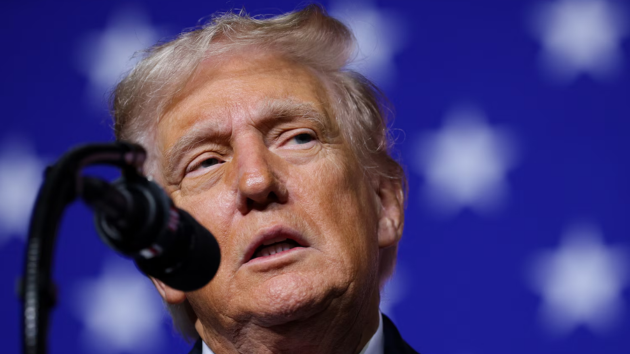
(WASHINGTON) — President Donald Trump on Tuesday told the military’s top generals about his controversial plans to send troops to “dangerous” Democratic cities, arguing, “We’re under invasion from within.”
Trump made clear that the military’s job is not only to protect the United States from threats abroad but also what he repeatedly referred to as a domestic enemy in American cities.
“It’s a war from within,” the president said to the room of high-ranking military generals who flew from across the globe to Quantico, Virginia. “We’re under invasion from within.”
Trump talked about his efforts to increase the use of U.S. military in American cities. Trump specifically said that Democratic-run cities, such as New York, Chicago and San Francisco, are in “bad shape,” and that he threatened to “straighten them out, one-by-one.”
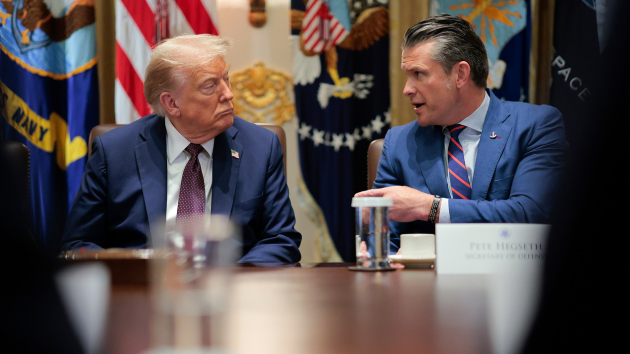
“I told Pete [Hegseth] we should use some of these dangerous cities as training grounds for our military National Guard,” he said.
Over the weekend, Trump announced that he ordered federal troops to Portland, Oregon, because of what he alleged were threats from domestic terrorists. The city’s Democratic Mayor Keith Wilson and the state’s Democratic Gov. Tina Kotek both stressed that they did not request the troops and objected to the action.
Trump mentioned his call with Kotek on Tuesday, claiming that Portland “is burning down.”
“I said ‘You don’t have it under control, governor, but I’ll check it and I’ll call you back.’ I called [her] back. I said ‘you, this place is a nightmare,'” Trump said.
Throughout Trump’s speech — which came after Hegseth called for an end to what he called “woke” culture in the military — the president’s words were met generally with silence and subdued reaction from generals, who did not seem to respond to the president’s often highly-partisan talking points. Reaction in the room among the military’s top leaders was even more limited when Trump talked about sending troops into American cities such as Chicago and Portland.
It was an unusual reception for Trump, who is used to delivering blockbuster speeches to friendly audiences.
The president took note of the mood in the room soon after he began talking, and appeared to be surprised.
“I’ve never walked into a room so silent before,” he said before making jokes.
“Just have a good time. And if you want to applaud, you applaud. And if you want to do anything you want, you can do anything you want. And if you don’t like what I’m saying, you can leave the room. Of course, there goes your rank, there goes your future, but you just feel nice and loose, OK, because we’re all on the same team,” Trump added.
There were a few chuckles from the crowd, including when Trump joked that he liked his own signature.
By the end of the speech, some members of the crowd stood and some lightly applauded.
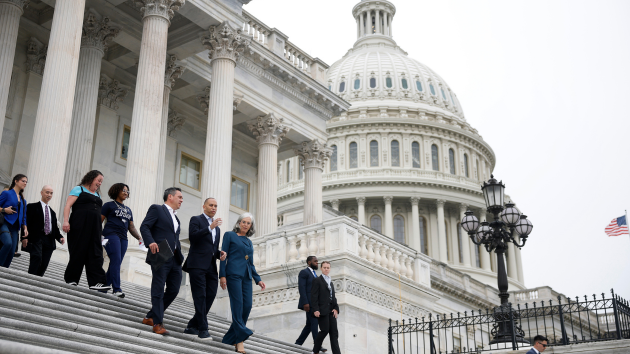
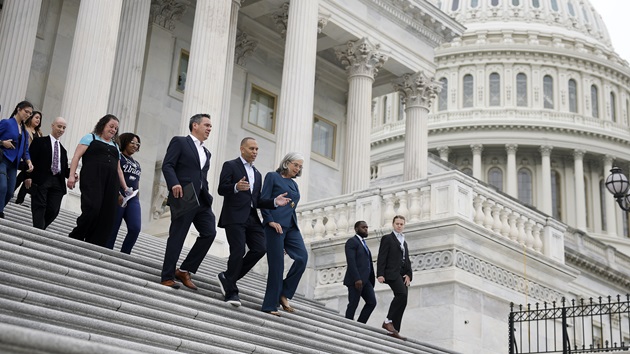
U.S. House Minority Leader Hakeem Jeffries (C), accompanied by House Minority Whip Katherine Clark (D-MA) and Rep. Pete Aguilar (D-CA) walk down the House Steps as they arrive for a press conference at the U.S. Capitol on September 30, 2025 in Washington, DC. Kevin Dietsch/Getty Images
(WASHINGTON) — As the clock ticks down towards a government shutdown, 150 House Democrats rallied on the House steps Tuesday morning ahead of a midnight government funding deadline, presenting unity as each political party attempts to shift and place blame for a lapse in government funding.
House Minority Leader Hakeem Jeffries fired up Democrats, addressing a deepfake video generated by artificial intelligence shared Monday night by President Donald Trump, which disparaged Jeffries and Senate Minority Leader Chuck Schumer.
“Mr. President, allow me to reintroduce myself,” Jeffries said, quoting the opening lyrics from Jay-Z’s “Public Service Announcement” and receiving a loud round of applause from the caucus. “I’m the House Democratic Leader. Our caucus is 217 members strong. We serve in a separate and coequal branch of government. We don’t work for you. We work for the American people.”
In the post on his social media platform, Trump shared the video that presented Senate Minority Leader Chuck Schumer and Jeffries during their remarks at the White House after meeting with Trump and Republican leaders, but dubbed Schumer saying disparaging things about his party.
The video also showed Jeffries wearing a sombrero, prompting Jeffries to call it “bigoted.”
“Mr. President, the next time you have something to say about me, don’t cop out through a racist and fake AI video. When I’m back in the Oval Office, say it to my face!” Jeffries boomed.
Jeffries reiterated that Democrats are “ready” to find a bipartisan path to avert a shutdown and he sharply criticized House Republicans for canceling votes this week.
“Shame on them for being on vacation all across the country and across the world on the eve of a government shutdown,” he said. “They’re on vacation because they’d rather shut the government down than protect the health care of the American people. That’s unfathomable, that’s unacceptable, that’s unconscionable, and that’s un-American. Do your job.”
Caucus Chairman Pete Aguilar blamed Republicans if the government shuts down.
“This is a shutdown they will own, and the American people are paying attention,” he said.
Trump appeared open to more discussions Tuesday. Asked while returning from a speech to generals and admirals with Pentagon chief Pete Hegseth if he would talk to Democrats before the deadline, Trump replied, “Yes.”
Democrats insist that any deal includes restoring $1 trillion in Medicaid cuts passed into law this summer on top of a permanent extension of the Obamacare subsidies set to expire at the end of the year, saving health insurance for 3.8 million people at a cost of $350 billion over the next decade, according to the Congressional Budget Office.
While House Republicans passed a stopgap measure to keep the government open through Nov. 21, the measure stalled in the Senate, where Thune will need at least seven Democrats to vote for it to pass.
Republicans crafted a “clean” seven-week funding bill in order to create more time for congressional appropriators to work through regular order: 12 separate full-year funding bills. Congress has not passed all 12 appropriations bills through regular order since 1997, and the task has been completed only four times since 1977 when current budget rules took effect.
Thune is expected to force the Senate to vote repeatedly on the House’s clean seven-week funding bill. His goal is to force Democrats to cast repeated votes against funding the government.
Jeffries and Schumer met Monday afternoon at the White House with Trump, House Speaker Mike Johnson, Senate Majority Leader John Thune, Vice President JD Vance and others but left without a deal.
Johnson posted Tuesday morning that Schumer and Democrats are “planning to SHUT DOWN the government — simply to oppose President Trump and appease their far-left base.”
On the White House driveway after the meeting, the Democrats and Republicans blamed each other for not reaching an agreement to keep the government funded.
Schumer told reporters in the White House driveway that “large differences” remain — particularly on health care.
A few minutes later, Vice President JD Vance joined Republicans in saying a shutdown was increasingly likely.
“I think we’re headed to a shutdown because Democrats won’t do the right thing,” Vance said.
Monday’s meeting was the first bicameral, bipartisan congressional leadership face-to-face meeting of Trump’s second term — and came after a meeting scheduled for last week was nixed by the president after he said he reviewed the Democratic proposal and judged that a meeting would not be productive.
(WASHINGTON) — Defense Secretary Pete Hegseth has ordered the military to review and revise the ways it investigates complaints of hazing and harassment, according to policy memos obtained by ABC News.
The memos, which came after Hegseth ordered top military generals and admirals to come to Virginia to hear a speech about the importance of the “warrior ethos,” call for a 30-day review of the definition of hazing, bullying and harassment within the military. Hegseth claims in the memos that the current policy preventing those behaviors is “overly broad” and puts combat readiness in jeopardy.
“While the Department of War remains firmly committed to upholding the highest standards of integrity and exemplary conduct, the current adverse information policy has too often resulted in unproven allegations being considered adverse information, cumulative penalties for a single event, procedural redundancies, and unnecessary administrative burdens,” Hegseth wrote.
“By embracing these changes, the Department will not only honor its commitment to fairness and integrity but also reinforce the core principles of the warrior ethos — courage, selflessness, and unwavering commitment to the mission,” he added.
Another policy calls for reforms to the Defense Department’s independent watchdog office, the Inspector General, which is currently investigating Hegseth’s handling of classified material.
Among the changes called for is that “non-credible complaints” must be closed no later than seven business days after receipt. Command-directed investigations must be closed within 30 days, according to Hegseth.
Other directives call for new tougher department-wide fitness standards and calls for a 60-day review of what is taught at the military service academies and training schools.
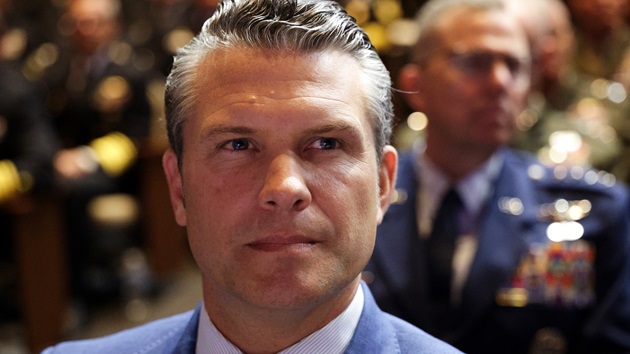
(WASHINGTON) — As the government teeters on the brink of a shutdown, President Donald Trump and Defense Secretary Pete Hegseth on Tuesday addressed an auditorium packed with several hundred of the nation’s most seasoned military commanders summoned last-minute from around the world.
The event occurred at a Marine Corps base in Quantico, Virginia, a secure site an hour south of the nation’s capital. Hegseth kicked off the event with an extraordinarily blunt speech on the importance of the “warrior ethos,” a term he uses to describe the spirit that makes combat units effective.
“We must be prepared,” he said. “Either we’re ready to win or we are not.”
“This speech today is about people and it’s about culture,” he said, calling for “the right culture at the War Department.”
He acknowledged why he fired Gen. CQ Brown as chairman of the Joint Chiefs of Staff and Chief of Naval Operations Adm. Lisa Franchetti and other senior leaders.
Hegseth said his rationale “has been straightforward,” contending it’s hard to change a culture with people who benefited from that previous culture.
He demanded no more “fat generals,” saying all service members would need to meet fitness tests and grooming standards.
“No more beardos,” he said. “The era of unacceptable appearance is over.”
Brown never pushed “quotas” for promotions within the military, which relies on a merit-based system that Hegseth claimed wrongfully punished too many people for “toxic leadership.” Brown and others pushed the idea of recruiting from a broader section of America so that the military would look more like the nation it serves.
The secretary added that the department is “clearing the way for leaders to be leaders.”
“You might say we are ending the war on warriors,” Hegseth said.
He told his audience that if all the new standards he has unveiled makes their “hearts sink,” then they should resign.
As expected, Hegseth, who now goes by the title “secretary of war,” pressed hard, as part of the broader rebranding ordered by Trump, the importance of enforcing combat standards that keep troops lethal.
Trump followed Hegseth with his own speech, echoing Hegseth’s statements. He said as president, he would have their backs and that he is committed to making the military stronger, faster and fiercer “than ever before.”
The president went on a long-winded speech talking about several topics, including his claims that he has ended more foreign conflicts than previous presidents.
Trump also took shots at his predecessor, former President Joe Biden, and his handling of the United States troops’ from Afghanistan, calling it “was the most embarrassing moment in the history of our country.”
The president also took credit for the rise in military enlistments.
Last week, general and flag officers at the one-star level and above were told to fly to Quantico from their duty stations with just several days’ notice and no hint as to what the meeting might be about. The Pentagon declined to comment on the meeting, and speculation quickly spread that the meeting might have to do with urgent cuts to the military force or the national defense strategy, which would set new priorities for the second Trump administration and could change how troops train and equip themselves.
In the end, though, sources said the meeting appeared — at least as of now — to be more of a “rally the troops” speech similar to what Hegseth frequently gives in public venues and in Fox News interviews. But his remarks, which will be livestreamed to the public, will also provide a prime photo opportunity with Hegseth addressing hundreds of top military generals as their boss.
On Sunday, the program was given an unexpected jolt when the White House announced Trump would join Hegseth at Quantico. The White House has not said when or how the president learned of Hegseth’s meeting or why he wanted to participate. Aides also haven’t said what Trump’s remarks will focus on.
The Defense Department, which now coined by Trump and Hegseth as the “Department of War,” has not said how much it will cost to fly in so many people last minute, although it is widely expected to cost several hundreds of thousands of dollars.
It’s also not clear exactly how many people were invited. Overall, there are 838 total general officers and admirals on active duty — 446 of them are from the higher two-star, three-star and four-star ranks — according to the Pentagon’s latest statistics from June.
The event comes as the government is careening toward a potential shutdown that could force some 2 million troops to work without pay if a spending bill doesn’t pass Congress by midnight Wednesday.
Most military personnel are on track to be paid Oct. 1, officials said Monday. But after that, troops would be at the mercy of negotiations on Capitol Hill, which remain at a stalemate.
According to a contingency plan posted by the Pentagon this weekend, all active-duty troops would be required to keep working. The plan says contracts can move forward, too, but under increased scrutiny with priority given to efforts to secure the U.S. southern border and build Trump’s U.S. missile shield known as “Golden Dome,” as well as operations in the Middle East and shipbuilding.
There had been speculation that the commanders traveling from around the world to hear Trump and Hegseth speak on Tuesday could get stuck away from their assigned work locations if the government shuts down that night. But according to government guidance, personnel must return home as soon as possible if a shutdown occurs while on work travel. Any travel costs incurred after the shutdown are reimbursable once spending resumes.
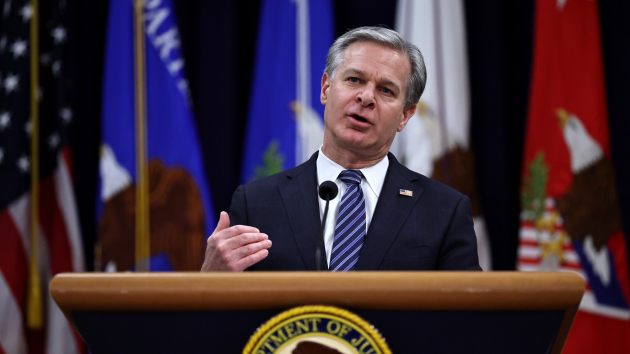
(WASHINGTON) — President Donald Trump suggested a criminal investigation into Christopher Wray, his appointee to lead the bureau in his first term, after a conservative media outlet reported the false claim that FBI agents were involved in the attack on the U.S. Capitol on Jan. 6, 2021.
“I would imagine. I would certainly imagine. I would think they are doing that,” Trump said in a phone interview with NBC News when asked whether the Justice Department should investigate Wray.
Trump appointed Wray to lead the bureau in 2017 after he fired former FBI Director James Comey. Comey was indicted in a grand jury last week on charges of making false statements to Congress and obstructing a congressional investigation after Trump just days before publicly urged Attorney General Pam Bondi to act “now” to prosecute his foes.
In a brief video posted to his Instagram account, Comey said, “My heart is broken for the Department of Justice. I have great confidence in the federal judicial system and I am innocent, so let’s have a trial, and keep the faith.”
Wray opted to depart the bureau before Trump took office for his second term because he had fears that Trump firing him could cause turmoil within the department. Wray had also drawn Trump’s ire over investigations into election interference from the Jan. 6 insurrection at the U.S. Capitol and Trump’s handling of classified documents, both of which were dropped after Trump won the 2024 election.
Trump first began suggesting Wray should be be investigated by the Justice Department after the conservative outlet The Blaze, citing an unidentified congressional source, reported last week that 274 FBI agents had been embedded in the pro-Trump mob that stormed the Capitol.
Trump promoted The Blaze’s story on his social media platform on Saturday, saying “It was just revealed that the FBI had secretly placed, against all Rules, Regulations, Protocols, and Standards, 274 FBI Agents into the Crowd just prior to, and during, the January 6th Hoax. This is different from what Director Christopher Wray stated, over and over again! That’s right, as it now turns out, FBI Agents were at, and in, the January 6th Protest, probably acting as Agitators and Insurrectionists, but certainly not as “Law Enforcement Officials.”
“Christopher Wray, the then Director of the FBI, has some major explaining to do. That’s two in a row, Comey and Wray, who got caught LYING, with our Great Country at stake.”
The DOJ’s Office of the Inspector General found no evidence that the FBI had undercover employees in the protest crowd in a December 2024 report. It also said that the FBI deployed tactical resources to the Capitol after the building had been breached by rioters and reports of two pipe bombs discovered at the Republican and Democratic national party headquarters.
That report also said while there were 26 informants in Washington, D.C., who were dubbed within the FBI as “confidential human sources,” or CHSs, the IG uncovered no evidence suggesting that any were instructed to join the assault on the Capitol or otherwise encourage illegal activity by members of the mob.
The IG report did not find fault with agents being sent to the Capitol where law enforcement had been overwhelmed and thousands of federal crimes had been committed, ranging from trespass and assault on federal officers to seditious conspiracy.
It’s not immediately clear whether Wray will be placed under criminal investigation, but Trump’s interview with NBC and his social media posts over the weekend show he appears to be increasingly emboldened in the wake of Comey’s indictment to call for the prosecution of more political foes.
In comments to reporters outside of the White House last week, Trump suggested he expected more criminal charges to be brought against his opponents while denying he was applying any direct pressure to Justice Department leadership.
“It’s not a list, but I think there will be others,” Trump told reporters. “I hope there will be others.”
(WASHINGTON) — As the government teeters on the brink of a shutdown, President Donald Trump and Defense Secretary Pete Hegseth on Tuesday will address an auditorium packed with several hundred of the nation’s most seasoned military commanders summoned last-minute from around the world.
The event is slated to occur at a Marine Corps base in Quantico, Virginia, a secure site an hour south of the nation’s capital. Sources say Hegseth is expected to kick off the event at 8:15 a.m. ET with a 30-minute speech on the importance of the “warrior ethos,” a term used to describe the spirit that makes combat units effective.
Hegseth, who now goes by the title “secretary of war” as part of a broader rebranding ordered by Trump, is also expected to touch on the importance of enforcing combat standards that keep troops lethal, as well as reference new standards for grooming that include requirements for troops to remain clean-shaven.
Trump is expected to follow Hegseth with his own speech before releasing the military general and flag officers to return to their duty stations after the hourlong event.
Last week, general and flag officers at the one-star level and above were told to fly to Quantico from their duty stations with just several days’ notice and no hint as to what the meeting might be about. The Pentagon declined to comment on the meeting, and speculation quickly spread that the meeting might have to do with urgent cuts to the military force or the national defense strategy, which would set new priorities for the second Trump administration and could change how troops train and equip themselves.
In the end, though, sources said the meeting appeared — at least as of now — to be more of a “rally the troops” speech similar to what Hegseth frequently gives in public venues and in Fox News interviews. But his remarks, which will be livestreamed to the public, will also provide a prime photo opportunity with Hegseth addressing hundreds of top military generals as their boss.
On Sunday, the program was given an unexpected jolt when the White House announced Trump would join Hegseth at Quantico. The White House has not said when or how the president learned of Hegseth’s meeting or why he wanted to participate. Aides also haven’t said what Trump’s remarks will focus on.
The Defense Department, which now coined by Trump and Hegseth as the “Department of War,” has not said how much it will cost to fly in so many people last minute, although it is widely expected to cost several hundreds of thousands of dollars.
It’s also not clear exactly how many people were invited. Overall, there are 838 total general officers and admirals on active duty — 446 of them are from the higher two-star, three-star and four-star ranks — according to the Pentagon’s latest statistics from June.
The event comes as the government is careening toward a potential shutdown that could force some 2 million troops to work without pay if a spending bill doesn’t pass Congress by midnight Wednesday.
Most military personnel are on track to be paid Oct. 1, officials said Monday. But after that, troops would be at the mercy of negotiations on Capitol Hill, which remain at a stalemate.
According to a contingency plan posted by the Pentagon this weekend, all active-duty troops would be required to keep working. The plan says contracts can move forward, too, but under increased scrutiny with priority given to efforts to secure the U.S. southern border and build Trump’s U.S. missile shield known as “Golden Dome,” as well as operations in the Middle East and shipbuilding.
There had been speculation that the commanders traveling from around the world to hear Trump and Hegseth speak on Tuesday could get stuck away from their assigned work locations if the government shuts down that night. But according to government guidance, personnel must return home as soon as possible if a shutdown occurs while on work travel. Any travel costs incurred after the shutdown are reimbursable once spending resumes.