(MADISON, Wisc.) — Wisconsin Gov. Tony Evers announced Wednesday that he is calling a special session of the state legislature in his latest attempt to repeal a criminal abortion ban dating back to 1849 which suspended some abortion services in the state after the Supreme Court overturned Roe V. Wade in June.
“In Wisconsin, we still have an 1800s-era criminal abortion ban on the books that originated before the Civil War and when Wisconsin women did not have the right to vote, which could ban nearly all abortions, including in cases of rape and incest, if it goes back into effect,” Evers said in a statement on social media.
The Democratic governor had called a special session earlier this year, before the Supreme Court overturned Roe v. Wade, to repeal the then-dormant law. The Republican-controlled state legislature gaveled in and out of the special session without holding any discussion. Days later, the Supreme Court released its decision in Dobbs v. Jackson Women’s Health Organization, effectively overturning Roe. Abortion providers in Wisconsin have since suspended services amid the threat of prosecution.
Evers said he is now calling a special session to “create a pathway for Wisconsin voters” to repeal the abortion ban, which makes it a felony to provide an abortion except when the mother’s life is at risk.
The governor’s actions come a week after Republican U.S. Sen. Ron Johnson of Wisconsin suggested voters could challenge the abortion ban through a statewide referendum.
Voters in Wisconsin currently can not change state laws by referendum or introduce ballot initiatives, according to the governor’s office. Instead, a constitutional amendment must pass two consecutive state legislatures before heading to voters.
Evers proposes creating a process that would enable voters to “bypass” the state legislature and allow referendum ballot questions brought by the public.
“Wisconsinites were not only stripped of their reproductive freedom, but they currently can’t enact change to protect that freedom without having to get permission from the Legislature first. That’s just wrong, and it’s time for us to change that,” he said.
Evers has ordered the state legislature to act on his proposals on Oct. 4.
In response, the Republican leaders of the state legislature called Evers’ actions a “desperate political stunt.”
“Governor Evers would rather push his agenda to have abortion available until birth than talk about his failure to address rising crime and runaway inflation caused by his liberal DC allies,” state Senate Majority Leader Devin LeMahieu and state Assembly Speaker Robin Vos said in a joint statement.
Evers is further challenging the pre-Civil War abortion ban in a lawsuit filed in June by Wisconsin Attorney General Josh Kaul that names three Republican state legislative leaders among the defendants. Last week, Kaul named three district attorneys as new defendants in the ongoing case. The lawsuit argues that newer legislation, including a 1985 law that bans abortion only after fetal viability, should take precedence.
The governor, who is up for reelection this November, has vetoed more restrictive abortion laws passed by the state legislature in the past three years.
Kent Nishimura / Los Angeles Times via Getty Images
(NEW YORK) — A panel of judges on the 11th Circuit Court of Appeals has granted a request from the Justice Department to stay portions of a ruling by district Judge Aileen Cannon that had effectively paused the government’s investigation into former President Donald Trump’s potential mishandling of classified records after leaving office.
The three-judge panel, comprised of two Trump appointees and an Obama-era appointee, ruled unanimously that the Justice Department is no longer enjoined from using the documents with classifications recovered from Mar-a-Lago in its investigation and will no longer have to submit them to special master Ray Dearie for his review.
“[Trump] has not even attempted to show that he has a need to know the information contained in the classified documents,” the panel said in its ruling. “Nor has he established that the current administration has waived that requirement for these documents.”
They also agree with the Justice Department that Trump has submitted no record or claim that he ever declassified the documents at issue, and that his team resisted stating as much when pressed by Dearie.
“In any event, at least for these purposes, the declassification argument is a red herring because declassifying an official document would not change its content or render it personal,” the judges said. “So even if we assumed that Plaintiff did declassify some or all of the documents, that would not explain why he has a personal interest in them.”
(WASHINGTON) — The House on Wednesday approved a post-Jan. 6 election reform bill intended to blunt future challenges to presidential elections.
The Presidential Election Reform Act, crafted largely by Reps. Zoe Lofgren, D-Calif., and Liz Cheney, R-Wyo., passed by a 229-203 vote, with nine Republicans joining the Democratic majority in favor of it.
The legislation would alter the 135-year-old Electoral Count Act, which — as the House committee investigating Jan. 6 showed through a series of hearings — former President Donald Trump and his allies focused on in their efforts to overturn the results of the 2020 race Trump lost to Joe Biden.
Among other things, the new bill would confirm that the vice president’s role in overseeing the Electoral College count after each election is purely ministerial. The legislation would also raise the threshold needed for electoral objections by lawmakers to receive a vote in Congress and it would mandate that governors transmit state results to Congress.
As the Jan. 6 committee detailed, Trump and his allies pressed then-Vice President Mike Pence to not green-light the electors submitted from certain swing states and pushed governors to send to Congress alternate slates of electors who backed Trump over Biden.
Objections to some states’ electors on Jan. 6, 2021, also easily earned votes under the current standards, which only require one member each in the House and the Senate to back an objection. The new legislation raises that floor to one-third of each chamber.
Prior to Wednesday’s vote on the Presidential Election Reform Act, supporters emphasized the need for the legislation as numerous election deniers, including those running for office this year, still say the 2020 race shouldn’t have been certified, citing groundless claims of voter fraud.
“Let me be clear. This is a kitchen table issue for families, and we must make sure this anti-democratic plot cannot succeed,” Speaker Nancy Pelosi, D-Calif., said on the House floor. “It’s a kitchen table issue because denying the American people their fundamental freedom to choose their own leaders denies them their voice in the policies we pursue, and those policies can make tremendous difference in their everyday lives.”
“Our bill will preserve the rule of law for all future presidential elections by ensuring that self-interested politicians cannot steal from the people the guarantee that our government derives its power from the consent of the governed,” Cheney added in her own remarks.
The bill was not anticipated to garner significant Republican support in the House, though, outside of anti-Trump lawmakers.
The nine Republican votes came from Cheney and Reps. Anthony Gonzalez of Ohio, Adam Kinzinger of Illinois, Peter Meijer Michigan, Tom Rice of South Carolina, Jaime Herrera Beutler of Washington, John Katko of New York, Fred Upton Michigan and New York’s Chris Jacobs. None of them are returning next Congress, either because they are retiring or lost their primaries this year.
House GOP leadership had actively whipped against the bill, with Minority Whip Steve Scalise’s, R-La., saying in a memo Tuesday that “In their continued fixation to inject the Federal government into elections, this legislation runs counter to reforms necessary to strengthen the integrity of our elections.”
The House bill is also competing with Senate legislation crafted after bipartisan talks that included Sens. Joe Manchin, D-W.Va, and Susan Collins, R-Maine.
The two bills are similar, though the Senate legislation sets a lower threshold to introduce objections to the electoral count.
ABC News’ Benjamin Siegel contributed to this report.
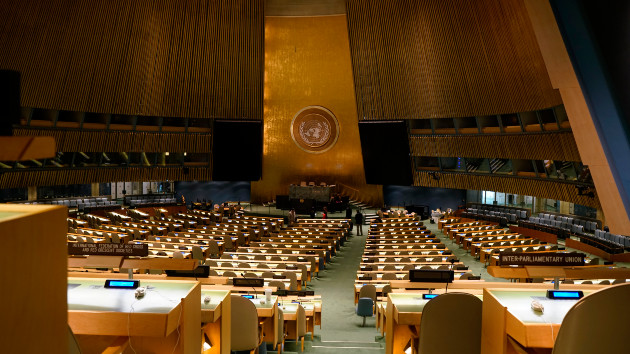
(NEW YORK) — Speaking to the United Nations General Assembly, President Joe Biden on Wednesday cast the defining conflict facing global leaders as a duel between democracy and autocracy, directly responding to new threats from Russian President Vladimir Putin to escalate the war in Ukraine.
The speech is Biden’s first at the forum since Russia’s invasion, offering him the opportunity to condemn the Kremlin in front of an audience of fellow heads of state.
Biden opened his remarks with a strong rebuke of Putin after he earlier Wednesday ordered a partial mobilization of reservists in Russia and raised the specter of using nuclear weapons after a retreat in the northeastern Kharkiv region.
“Let us speak plainly, a permanent member of the United Nations Security Council invaded its neighbor, attempted to erase the sovereign state from the map,” Biden said. “Russia has shamelessly violated the core tenants of the United Nations Charter.”
“Just today, President Putin has made overt nuclear threats against Europe and reckless disregard of the responsibilities of a nonproliferation regime,” Biden continued. “Now, Russia is calling, calling up more soldiers to join the fight and the Kremlin is organizing a sham referendum to try to annex parts of Ukraine, an extremely significant violation of the U.N. Charter.”
Biden called the conflict “a war chosen by one man” and slammed Putin for his attacks on Ukraine’s schools, railway stations, hospitals.
“Even more horrifying evidence of Russia’s atrocity and war crimes: Mass graves uncovered in Izium, bodies, according to those that excavated those bodies, showing signs of torture. This war is about extinguishing Ukraine’s right to exist as a state, plain and simple. And Ukraine’s right to exist as a people. Whoever you are, wherever you live, whatever you believe, that should not–that should make your blood run cold,” he said.
Biden reaffirmed the U.S. commitment to help Ukraine and called on other U.N. members to do the same.
“Each of us in this body who determined to uphold the principles and beliefs we pledged to defend as members of the United Nations, must be clear, firm and unwavering in our resolve,” he said.
Biden also announced a commitment of $2.9 billion in global food aid, an effort to address growing famine in the Horn of Africa, and rising food prices worldwide due to the war in Ukraine, and inflation.
As Biden grapples with a series of complicated global issues, the high-stakes summit presents a range of challenges for the administration.
The no-shows
Although U.N. General Assembly meetings offer an abundance of opportunity for face-to-face diplomacy — something the president prides himself on — two key players weren’t in attendance: the leaders of Russia and China.
“Our competitors are facing increasingly strong headwinds, and neither President Xi nor President Putin are even showing up for this global gathering,” national security adviser Jake Sullivan told reporters on Tuesday.
In Putin’s case, the most pressing of those headwinds are losses on the battlefield in Ukraine, according to administration officials.
Ahead of an engagement with his counterpart from the U.K., Secretary of State Antony Blinken denounced reports that Moscow plans to hold sham referenda in occupied territories in Ukraine to pave the way to annex territory.
“I think this is also not a surprise this is happening now. We have seen in the last weeks significant gains by Ukraine,” Blinken said. “It’s a sign of weakness. It’s a sign of Russian failure.”
But as a number of other heads of state push for negotiations for peace, the gathering won’t offer a robust opportunity for Biden to pursue that path with the leaders of the countries involved in the conflict. Russia’s Foreign Minister Sergey Lavrov is in New York, but there are no plans for a meeting with U.S. officials on the books.
Ukraine’s President Volodymyr Zelenskyy will also give a speech on Wednesday, but he will do so remotely as the only leader allowed to appear virtually this year.
China’s Xi Jinping’s absence means there’s no chance an in-person meeting with the president, something that hasn’t happened since Biden took office. And the two have an ever-growing list of differences to discuss.
The past months have seen multiple escalations, with China responding to any step perceived as the U.S. moving towards recognizing Taiwan as a sovereign state with shows of force, a strategy a senior State Department official described as an attempt to normalize military pressure.
While the administration says Washington’s long-standing “One China” policy remains in effect, Biden also said U.S. troops would defend Taiwan if it were attacked.
The impermanent 5?
Russia’s exalted position as one of five permanent members of the U.N. Security Council has thrown a significant wrench in the body’s efforts to check its aggression, prompting calls that it should be removed altogether.
U.S. officials appeared to be aligning behind a plan that, instead of subtracting Russia as a permanent member, would seek to make additions to the Security Council.
A senior State Department official said that Biden would attempt to “reenergize” the push for reform by arguing the arm needs to be “more representative of the world’s population, and filled with countries that are ready to work together.”
The odds of expanding the council appear slim. Reforming its makeup would require amending the U.N. charter, a step that Russia or any other permanent member could veto.
The rest of the agenda
While the war in Ukraine is shaping up to dominate the General Assembly, administration officials have stressed they want to take on other global issues as well.
Biden in his speech discussed the need to tackle food insecurity, the ongoing COVID-19 health crisis and climate change.
“Let this be the moment, we find within ourselves, the will to turn back the tide of climate devastation and unlock a resilient, sustainable clean energy economy to preserve our plant,” Biden said.
One pressing matter facing the White House is its push to return to an Obama-era nuclear deal with Iran. Indirect negotiations appear to have stalled again, and officials from both countries appear increasing pessimistic that the pact can be renewed.
Sullivan said Biden plans to reiterate that the U.S. is open to returning to an agreement, but that he isn’t anticipating any major breakthroughs.
Even a meeting with one of America’s closest allies has its thorns. Biden will hold his first meeting with the U.K.’s new prime minister, Liz Truss, as the differences between the two’s economic policies become ever apparent.
Recently, Truss said completing a long-awaited trade deal with the U.S. was not a key priority and unlikely to happen anytime soon. But Sullivan said it would be on the president’s list.
“I do think that they will talk about the economic relationship between the U.S. and the U.K.,” Sullivan said, adding they would also hit other areas where Truss and Biden have more in common, such as support for Ukraine and addressing Europe’s energy crisis.
(WASHINGTON) — A new bill from a pair of Republican lawmakers would prevent the Biden administration from lifting key sanctions on Iran over the country’s alleged support of efforts to assassinate high-profile Americans and critics on U.S. soil.
The bill, set to be introduced Wednesday by Iowa Sen. Joni Ernst and Florida Rep. Mike Waltz, would codify Trump-era sanctions imposed on Iran — specifically, on major industries and financial institutions — according to legislative text shared first with ABC News.
Should the U.S. and its allies reach an agreement with Iran in ongoing negotiations to return to the 2015 nuclear agreement reached under President Barack Obama, the PUNISH Act would prevent the Biden administration from lifting the Trump sanctions — and unfreezing billions of dollars in Iranian assets — until the State Department can certify that Iran has not supported efforts to kill prominent American citizens or Iranian dissidents on American soil for five years.
While the Democratic majority isn’t expected to consider the proposal, it signals Republicans’ intent to pressure and constrain Biden’s foreign policy agenda and negotiations with Iran should they retake control of either chamber of Congress in the November elections.
“President Biden should not provide a dime of sanctions relief to the largest state sponsor of terrorism, which is actively trying to kill U.S. officials and citizens, at home and abroad,” Ernst will say Wednesday, according to prepared remarks shared with ABC News.
In August, an alleged Iranian operative with links to the country’s Revolutionary Guard Corps was charged by the Justice Department in what prosecutors called a plot to murder Trump’s former national security adviser John Bolton. The Justice Department accused the Iranian government of supporting the assassination attempt in response to the 2020 U.S. missile killing of military leader Qasem Soleimani. (Iran has claimed the case is “baseless” and politically motivated.)
Bolton and several top Trump administration officials, including former Secretary of State Mike Pompeo, Defense Secretary Mark Esper and Iran envoy Brian Hook, reportedly receive government protection due to ongoing threats from Iran.
The U.S. government has said Iran encouraged attacks on author Salman Rushdie, who was stabbed in August at a public event in upstate New York. (Iran denied involvement.) And in July, a federal court unsealed an indictment charging four Iranian nationals with conspiring to kidnap an outspoken Iranian American activist and journalist in Brooklyn.
It’s against this backdrop that Republicans say they must try to limit the White House’s ability to change sanctions without assurances of nonviolence.
“Whether you want to argue whether it’s a return to the [2015 nuclear agreement] or a new deal, it astounds me that we are continuing to negotiate with a regime with active plots against American officials … that is instigating attacks on Americans citizens,” Waltz told ABC News.
Republicans and some Democrats have questioned the Biden administration’s efforts to reenter the Obama-era deal to curb Iran’s nuclear program after the Trump administration withdrew from the agreement in 2018 and slapped on sanctions as part of a “maximum pressure campaign.” Iran responded by enriching more uranium at higher levels beyond the limits of the deal.
Biden’s critics have expressed concerns that Iran can still develop its nuclear program in secret while using newly unfrozen assets and oil revenue to support terrorist proxies and other groups across the Middle East that threaten U.S. interests and allies.
Last year, a bipartisan group of 140 U.S. lawmakers urged Biden to reach a “comprehensive” deal with Iran to limit its nuclear program and address other national security issues.
In an interview with CBS News that aired Sunday, Iranian President Ebrahim Raisi denied his country’s involvement in the alleged attempt against Bolton and said American pledges to abide by a new nuclear deal would be “meaningless” without a “guarantee” that the U.S. would not withdraw from a future deal and reimpose economic sanctions on Iran.
Raisi, who is now in New York for the U.N. General Assembly and is scheduled to address the gathering on Wednesday, met with French President Emmanuel Macron on Tuesday amid a stalemate in indirect negotiations over the return to a nuclear agreement.
Both sides have exchanged proposals in recent weeks, but they publicly remain at odds over a U.N nuclear watchdog investigation and Iran’s insistence on a guarantee that the U.S. would not pull out of any deal.
Republican efforts to codify sanctions on Iran are “designed to tie this president or future presidents’ hands so he or she cannot waive these sanctions to encourage better Iranian behavior and bring Iran’s nuclear behavior under a modicum of control,” Daryl G. Kimball, the executive director of the Arms Control Association, who has called for a return to the nuclear agreement, told ABC News.
Waltz, the lead author of the bill in the House, told ABC News that he thinks Iran “is constantly holding out because they believe they can get a better deal.” Waltz argued that if the country’s leaders “see these things codified by Congress, and they see clear action by the Congress, then that puts them in a weaker negotiation position.”
(WASHINGTON) — When he steps up to podium to deliver an address on Wednesday at the United Nation General Assembly, President Joe Biden is expected to cast the defining conflict facing global leaders as a duel between democracy and autocracy, and one with implications for every nation across the world.
The speech will be Biden’s first at the forum since Russia’s invasion of Ukraine, offering him the opportunity to condemn the Kremlin in front of an audience of fellow heads of state.
“He’ll offer a firm rebuke of Russia’s unjust war in Ukraine and make a call to the world to continue to stand against the naked aggression that we’ve seen these past several months,” National Security Advisor Jake Sullivan said.
“Countries cannot conquer their neighbors by force, cannot seize an acquired territory by force,” he said. “He will speak to every country in the world — those that have joined our broad-based coalition to support Ukraine and those who so far have stood on the sidelines that now is a moment to stand behind the foundational principles of the [UN] charter.”
Thanks to the so-far unshakeable coalition of NATO allies standing behind Kyiv, Sullivan said the president was heading into summit with “the wind at his back,” and would demonstrate the administration’s commitment to offsetting the collateral impacts of the war by pledging more than $100 million to food-security efforts.
As Biden grapples with a series of complicated global issues, the high-stakes summit presents a range of challenges for the administration.
The no shows
Although U.N. General Assembly meetings offer an abundance of opportunity for face-to-face diplomacy — something the president prides himself on — two key players won’t be in attendance: the leaders of Russia and China.
“Our competitors are facing increasingly strong headwinds, and neither President Xi nor President Putin are even showing up for this global gathering,” said Sullivan.
In Russian President Vladimir Putin’s case, the most pressing of those headwinds are losses on the battlefield in Ukraine, according to administration officials.
Ahead of an engagement with his counterpart from the U.K., Secretary of State Antony Blinken denounced reports that Moscow plans to hold sham referenda in occupied territories in Ukraine to pave the way to annex the territory and that Putin may move to surge additional troops to help the war effort.
“I think this is also not a surprise this is happening now. We have seen in the last weeks significant gains by Ukraine,” Blinken said. “It’s a sign of weakness. It’s a sign of Russian failure.”
But as a number of other heads of state push for negotiations for peace, the gathering won’t offer a robust opportunity for Biden to pursue that path with the leaders of the countries involved in the conflict. Russian Foreign Minister Sergey Lavrov is in New York, but there are no plans for a meeting with U.S. officials on the books.
Ukrainian President Volodymyr Zelenskyy will also give a speech on Wednesday, but he will do so remotely as the only leader allowed to appear virtually this year.
China’s Xi Jinping’s absence means there’s no chance of an in-person meeting with the president, something that hasn’t happened since Biden took office. And the two have an ever-growing list of differences to discuss.
The past months have seen multiple escalations, with China responding to any step perceived as the U.S. moving towards recognizing Taiwan as a sovereign state with shows of force, a strategy a senior State Department official described as an attempt to normalize military pressure.
While the administration says Washington’s long-standing One China policy remains in effect, Biden also said U.S. troops would defend Taiwan if it were attacked.
The impermanent 5?
Russia’s exalted position as one of five permanent members of the U.N. Security Council has thrown a significant wrench in the body’s efforts to check its aggression, prompting calls that it should be removed all together.
Biden won’t go quite that far, Sullivan said.
“It is not something that he is going to raise tomorrow, although I think the world can see that when a permanent member acts in this way it strikes at the heart of the U.N. Security Council and so that should lead everyone collectively to put pressure on Moscow to change course,” he said.
But U.S. officials appear to be aligning behind a plan. Instead of subtracting Russia from the permanent members of the council, they may seek to make additions.
A senior State Department official said that Biden would attempt to “reenergize” the push for reform by arguing the arm needs to be “more representative of the world’s population, and filled with countries that are ready to work together.”
The odds of expanding the council appear slim. Reforming its makeup would require amending the U.N. charter, a step that Russia or any other permanent member could veto.
The rest of the agenda
While the war in Ukraine is shaping up to dominate the General Assembly, administration officials have stressed they want to take on other global issues as well.
One pressing matter facing the White House is its push to return to an Obama-era nuclear deal with Iran. Indirect negotiations appear to have stalled again, and officials from both countries appear increasingly pessimistic that the pact can be renewed.
Sullivan said Biden plans to reiterate that the U.S. is open to returning to an agreement, but that he isn’t anticipating any major breakthroughs.
Even a meeting with one of the U.S.’s closest allies has its thorns. Biden will hold his first meeting with the U.K.’s new prime minister, Liz Truss, as the differences between the two’s economic policies become ever apparent.
Recently, Truss said completing a long-awaited trade deal with the U.S. was not a key priority and unlikely to happen anytime soon. But Sullivan said it would be on the president’s list.
“I do think that they will talk about the economic relationship between the U.S. and the U.K.,” Sullivan said, adding they would also hit other areas where Truss and Biden have more in common, such as support for Ukraine and addressing Europe’s energy crisis.
NICOLAS MAETERLINCK/BELGA MAG/AFP via Getty Images
(NEW YORK) — As global leaders descend on New York City for the annual U.N. General Assembly, the body’s Secretary-General António Guterres issued a dire warning in an opening speech on Tuesday: “Our world is in big trouble.”
“Divides are growing deeper. Inequalities are growing wider,” he said. “And challenges are spreading farther.”
The annual gathering of high-level diplomats in the General Assembly is the first to happen in a fully in-person format since the beginning of the COVID-19 pandemic, and it’s the first to take place since Russia’s invasion of Ukraine — an international conflict that has drawn deep divides between the organization’s most powerful members, sparking calls for the U.N. to be reformed and prompting questions about whether it can still serve its stated purpose “to maintain international peace and security.”
Guterres alluded to these fractures in his address Tuesday, arguing they undercut the organization’s work.
“We are gridlocked in colossal global dysfunction,” he said. “The international community is not ready or willing to tackle the big dramatic challenges of our age. These crises threaten the very future of humanity and the fate of our planet. Our world is in peril — and paralyzed.”
Overcoming those major challenges, he said, depended on cooperation.
“Let’s work as one, as a coalition of the world, as united nations,” he urged.
Hunger on the horizon
While much of Guterres’ speech was devoted to outlining the problems facing the planet, he sought to remind the audience that the U.N. was still capable of finding solutions.
Large projectors in the room displayed a picture of a ship called Brave Commander that Guterres called “an image of promise and hope.” Laden with grain and flying the blue-and-white flag of the U.N., the vessel was the first to leave Ukrainian ports since the outbreak of Russia’s invasion, navigating Black Sea trade routes to bring its badly needed cargo to the Horn of Africa thanks to an agreement Guterres played a pivotal part in brokering.
“Some might call it a miracle at sea. In truth, it is multilateral diplomacy in action,” he said, calling the dozens of ships that have followed in Brave Commander’s path a testament to what can be accomplished through cooperation.
But while that safe passage deal is allowing grain exports to ameliorate the global food crisis, Guterres warned there was another on the horizon due to a shortage in fertilizer — saying that while the current problems can be chalked up to distribution issues, the world’s hunger may soon be the result of not having enough to go around at all.
“Without action now, the global fertilizer shortage will quickly morph into a global food shortage,” he said.
The secretary-general then alluded to the U.N.’s next major initiative: a proposal to export Russian fertilizer components through Ukraine.
“It is essential to continue removing all remaining obstacles to the export of Russian fertilizers and their ingredients, including ammonia. These products are not subject to sanctions, and we are making progress in eliminating indirect effects,” Guterres said.
The U.N. separately says it is “pursuing all efforts” to maximize fertilizer output, but the clock is ticking. The body’s trade negotiator advises that shortages need to be addressed in October and November before the window for the northern hemisphere’s planting season closes.
Dire problems, drastic plans
The secretary-general on Tuesday also spoke to the even broader-sweeping challenges of the day, and advocated for even more ambitious — or, to some, radical — plans to address them. “We need action across the board. Let’s have no illusions,” he said. “Our planet is burning,”
Guterres called not only for initiatives to address the root causes of damage to the environment but also to compensate developing countries that bear the brunt of those problems.
“Polluters must pay,” he said. “Today, I am calling on all developed economies to tax the ‘windfall’ profits of fossil fuel companies. Those funds should be re-directed in two ways: to countries suffering loss and damage caused by the climate crisis, and to people struggling with rising food and energy prices.”
Guterres argued that the climate crisis was fueling “a once-in-a-generation global cost-of-living crisis” that could only be remedied through radical change.
“Today’s global financial system was created by rich countries to serve their interests. It expands and entrenches inequalities. It requires deep structural reform,” he said. “The divergence between developed and developing countries — between North and South, between the privileged and the rest — is becoming more dangerous by the day. It is at the root of the geopolitical tensions.”
The U.S. agenda
While President Joe Biden isn’t scheduled to take part in the summit until Wednesday, Guterres’ speech mentioned a number of other items that coincide with the White House’s priority list.
On nonproliferation, the secretary-general noted that “a nuclear deal with Iran remains elusive.”
The Biden administration, with help from the European Union, has been embroiled in months of indirect negotiations with Tehran over returning to an Obama-era nuclear pact that then-President Donald Trump scrapped in 2018. But talks appear to have stalled again. Although a high-level delegation from Iran will participate in the General Assembly, there are no planned meetings with any U.S. officials.
While addressing women’s rights, Guterres also hit on a domestic matter: the overturning of Roe v. Wade.
The U.N. women’s rights committee has previously denounced the landmark ruling which reversed the national access to abortion in the U.S., calling “access to reproductive rights is at the core of women and girls’ autonomy and ability to make their own choices about their bodies and lives, free of discrimination, violence and coercion.”
More broadly, Guterres said that gender inequality is “going backwards” and “women’s lives are getting worse, from poverty, to choices around sexual and reproductive health, to their personal security.”
(WASHINGTON) — The number of suicides among military veterans dropped to its lowest rate in over a decade, according to a report released Monday by the Department of Veteran Affairs. The latest figures come days after a national suicide prevention nonprofit said the federal agency was underestimating the problem.
After instances of suicide rose among veterans from 2001 to 2018, the VA’s annual report documented a near 10% decline between 2018 to 2020.
The VA recognized 6,146 deaths from suicide among veterans in 2020, the most recent year with reportable data. This was 343 fewer instances than recorded in 2019, marking the sharpest decline since 2001. (By contrast with veterans, according to Pentagon data, there were 580 suicides among current service members in 2020.)
The drop in veteran suicides persisted during the onset of the COVID-19 pandemic in March 2020. The VA cited strengthened mental health programming, clinical support, community collaboration and paid media campaigns as important intervention methods for veterans in crisis.
But Monday’s report also acknowledged that there was still work to be done to create more comprehensive resources.
“Unemployment, chronic pain, insomnia, relationship strain, homelessness and grief are examples of factors outside of mental health that may play a role in suicide,” the report states. “We must also move beyond the individual factors in suicide and look to address broader international, national, community and relational factors that play a role.”
The VA said it remains cautiously encouraged by the drop in the suicide rate. The 10% decline between 2018 and 2020 is close to double the 5.5% reduction among non-veteran adults over the same two-year period.
The issue is still disproportionately impacting former service members. The report determined that in 2020, the age- and sex-adjusted suicide rate for veterans was more than 57% higher than non-veteran adults.
The VA found that on average in 2020, 16 veterans took their lives each day.
That may be an undercount, outside advocates say: A report released Saturday says the number could be closer to 24. America’s Warrior Partnership, a national suicide prevention nonprofit, found that when factoring in unexplained or accidental deaths as well as county record-keeping mistakes, the suicide rate was 37% higher than the VA estimated between 2014 to 2018.
America’s Warrior Partnership said this discrepancy is “likely due to undercounting of [former service member deaths] and the greater specificity of the decedent’s demographics, military experience, and death details available” to the nonprofit.
While America’s Warrior Partnership was working alongside Duke University and the University of Alabama using death records from eight states corroborated with the Department of Defense, the VA was using data from the Centers for Disease Control and Prevention and the Department of Defense.
The independent investigation, labeled “Operation Deep Dive,” also found unique risk factors that influenced a former service member’s decision to kill themselves. The report found the longer someone served in the military, the less likely they were to commit suicide, by a declining rate of 2% per year served.
The report also assessed that a demotion during military service was associated with an increased suicide risk of 56%.
America’s Warrior Partnership has requested the VA share its current data to better collaborate and make recommendations that would support former service members considering suicide.
“We need everyone at the table, leveraging work within and outside of clinical health care delivery systems to decrease both individual and societal risk factors for suicide,” the VA stated at the conclusion of its report. “The public health approach reminds us that what we do can and does make a difference.”
(NEW YORK) — Banning someone from buying a gun while under felony indictment goes against their Second Amendment right to bear arms, a federal judge in Texas ruled Monday.
“There are no illusions about this case’s real-world consequences—certainly valid public policy and safety concerns exist,” U.S. District Judge David Counts, a Trump appointee, wrote in his decision.
Counts cited a June Supreme Court decision, New York State Rifle & Pistol Association vs. Bruen, in which the justices rolled back concealed-carry permit restrictions for gun owners in New York state.
Counts’ opinion relied heavily on the framework set out by the high court in Bruen, saying that it was unclear after that ruling “whether a statute preventing a person under indictment from receiving a firearm aligns with this Nation’s historical tradition of firearm regulation.”
The Texas judge had been asked to weigh the case of Jose Gomez Quiroz, who was indicted for felony burglary on June 9, 2020, and then allegedly jumped bail, attempted to purchase an automatic weapon, lied on his ATF firearms transaction form and was able to purchase the gun.
Quiroz was convicted of making a false statement during the purchase of a firearm and illegal receipt of a firearm by a person under indictment. But he moved to dismiss the verdict “because of the United States Supreme Court’s recent ruling in Bruen.” (Quiroz’s burglary case is still pending.)
Counts agreed, finding that the Supreme Court had established a new “standard” with which to view Second Amendment rights.
“No longer can courts balance away a constitutional right. After Bruen, the Government must prove that laws regulating conduct covered by the Second Amendment’s plain text align with this Nation’s historical tradition. The Government does not meet that burden,” Counts found.
He also wrote that he was skeptical that a felony indictment should preclude anyone from owning a weapon.
“The nature of grand jury proceedings is one such area that casts a shadow of constitutional doubt on [making a false statement on a gun form],” he wrote. “Some feel that a grand jury could indict a burrito if asked to do so.”
The government has submitted notice of intention to appeal the decision.
ABC News’ Nicholas Kerr and Gina Sunseri contributed to this report.
(WASHINGTON) — The House select committee investigating the Jan. 6, 2021, riot on Capitol Hill will hold another hearing next week, the group’s chairman said Tuesday, suggesting that it could be the last time they convene publicly.
Rep. Bennie Thompson, D-Miss., told reporters at the Capitol on Tuesday that the committee will hold its final hearing on Sept. 28 at 1 p.m. ET.
“I can say that unless something else develops, this hearing at this point is the final hearing. But it’s not in stone because things happen,” Thompson said.
He added that the committee hearing will feature “substantial footage” of the riot and “significant witness testimony” that hasn’t previously been released, but he declined to divulge any details or the topic.
The hearing, should it be the last one, could mark a crescendo of the panel’s work before it releases a final investigative report, which is expected later this year.
The hearings so far have already featured multiple startling moments, including an array of former aides and associates of President Donald Trump recounting his state of mind after he lost the 2020 election and before and during the Jan. 6 riot by his supporters.
According to testimony at the hearing, Trump knew protesters in Washington were armed that day but still urged them to march to the Capitol and reacted angrily when he was barred from joining the group. (Trump has denied wrongdoing and said the committee is politically motivated.)
The panel is racing to finish its work before the next Congress starts up amid speculation that a House GOP majority would scrap the investigation entirely.
Outstanding questions remain over what witnesses may be called and whether committee investigators will press Trump or former Vice President Mike Pence to testify. The committee has also sent a letter to former House Speaker Newt Gingrich seeking information and records over communications with Trump’s team before and after the attack on the Capitol.
The committee has interviewed several people linked to Trump or who served in his administration, including several former Cabinet secretaries, whose testimonies have not yet been seen publicly.
Next week’s hearing will be the committee’s first since the FBI searched Trump’s Mar-a-Lago resort over his possession of what the government says was highly classified documents.