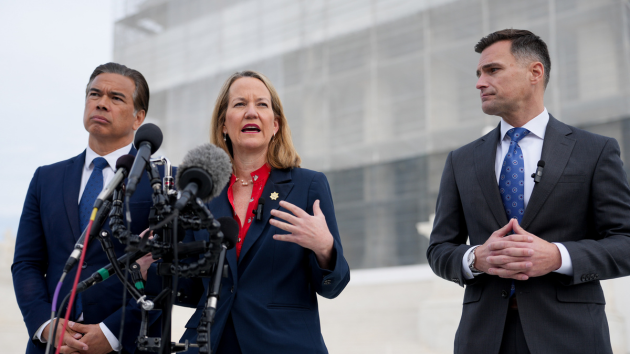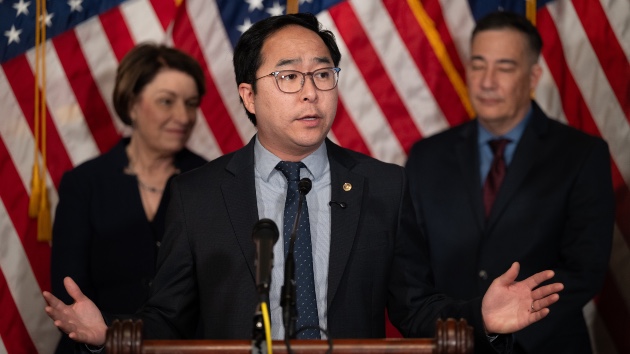
New Jersey Attorney General Matthew Platkin speaks at the National Safer Communities Summit in 2023. (Bing Guan/Bloomberg via Getty Images)
(NEW YORK) — A group of anti-abortion pregnancy centers in New Jersey is asking the Supreme Court on Tuesday to let it challenge an investigative subpoena from the state’s Democratic attorney general in federal court on grounds it violates the First Amendment.
First Choice Women’s Resource Centers, a faith-based organization that operates five locations across the state, claims the subpoena is part of a “hostile” campaign by Attorney General Matthew Platkin to harass the group and discourage people from supporting it.
The subpoena seeks thousands of pages of documents to determine whether the group “engaged in deceptive or otherwise unlawful conduct,” including the names and contact information of donors who may have wished to remain private.
“His demand for donor disclosure objectively chills First Choice’s associational and speech rights, causing its donors to think twice before supporting the faith-based non-profit,” the group’s attorneys argue in court filings.
Platikin insists he is pursuing a legitimate law enforcement inquiry and that First Choice has not yet been ordered by a state court to comply with the subpoena. (It is not self-executing, meaning there are no penalties for failure to comply in the meantime.)
“Non-profits, including crisis pregnancy centers, may not deceive or defraud residents in our State, and we may exercise our traditional investigative authority to ensure that they are not doing so — as we do to protect New Jerseyans from a range of harms,” Platkin said in a statement.
“The question before the U.S. Supreme Court focuses on whether First Choice sued prematurely, not whether our subpoena was valid,” he added. “I am optimistic that we will prevail.”
The case has potentially sweeping stakes for nonprofits and advocacy groups nationwide. If First Choice wins the ability to preemptively challenge the subpoena in federal court, it could make it easier for organizations to resist state investigations and strengthen the privacy of donors.
The dispute arose in the wake of the Supreme Court decision overruling Roe v. Wade and as states started drawing new battle lines over abortion.
Platkin pledged in 2022 to pursue enforcement actions aimed at promoting abortion access, which remains legal in New Jersey, and launched an investigation into First Choice on the belief that it may have engaged in false advertising and misled donors.
The attorney general issued a consumer alert in 2023 warning people with unplanned pregnancies that crisis pregnancy centers like First Choice don’t offer abortion as an option and may try to prevent a client from seeking medical information about ways to terminate a pregnancy.
“New Jersey’s attorney general is targeting First Choice — a ministry that provides parenting classes, free ultrasounds, baby clothes, and more to its community — simply because of its pro-life views,” said Erin Hawley, the attorney representing the group before the Supreme Court, in a statement.
“The Constitution protects First Choice and its donors from demands by a hostile state official to disclose their identities,” Hawley argued, “and First Choice is entitled to vindicate those rights in federal court.”
In a 2021 decision, the Supreme Court divided 6-3 along ideological lines to strike down a California law that required charities to privately disclose the identities of major donors to the state attorney general.
State officials had argued that the identities, which not-for-profit charities are allowed to keep secret from the public, would help enforce rules around tax-exempt status and catch potential fraud.
The New Jersey case, while similar, focuses primarily on where and when a targeted group can challenge an attorney general’s request in court.
After oral arguments Tuesday, the justices will draft an opinion in the case and release it sometime before the end of June 2026.
(WASHINGTON) — As billions of people worldwide use the internet to illegally stream or download copyrighted material like music, movies and TV shows, the entertainment industry is trying to crack down on American internet service providers for complicity in the alleged crimes of their customers.
A major case before the Supreme Court on Monday could determine whether those providers can be held financially liable to the tune of hundreds of millions of dollars for “contributing” to copyright infringement if they fail to cut off internet access to any account suspected of engaging in piracy.
Cox Communications, the third largest broadband provider in the U.S. and a party in the case, faces a $1 billion penalty awarded by a jury to Sony Music Entertainment and other media companies that sued over the distribution of pirated content online. It was upheld by a federal appeals court.
The company is asking the justices to toss out the verdict and put limits on contributory liability.
If the judgment is upheld, Cox says it could go bankrupt, potentially eliminating internet access entirely in some communities and leading to “mass evictions from the internet” in places where piracy has been suspected, such as “homes, barracks, hospitals, and hotels upon bare accusation.”
Cox says it opposes copyright infringement and takes steps to prevent it, but that it cannot be held responsible for the actions of individual users, who are impossible to pinpoint and trace.
“Your [internet service provider] does not purposefully participate in, or try to bring about, what you do online any more than your phone company or FedEx do in communications they transmit,” Cox attorneys wrote the high court in a legal brief.
Federal law makes it a crime to directly infringe on a copyright, but secondary liability by another party involved in copyright infringement — such as internet service providers — remains an evolving area of law.
As a general rule, anyone who “materially contributes to the infringing conduct of another may be held liable as a contributory infringer,” lawyers for the Motion Picture Association of America (MPAA), an entertainment industry trade group, told the court in a legal brief.
Copyright owners insist the risk of being sued creates an incentive for internet service providers to help root out online piracy and suspend the accounts of those suspected of dealing in protected material.
“Cox made a deliberate and egregious decision to elevate its own profits over compliance with the law,” attorneys for Sony Music Entertainment argue in a legal brief, “supplying the means for massive copyright infringement to specific users that it knew were habitual offenders because [it wanted to] to hold on to every subscriber [it] can.”
Nearly 19 billion downloads of pirated movies and TV shows were made using online peer-to-peer software in 2023, according to the MPAA. The copyright violations cost the U.S. economy more than $29 billion and “hundreds of thousands of jobs,” the group estimates.
Justices will hear oral arguments over the scope of potential “contributory liability” of internet service providers on Monday and issue a decision in the dispute by the end of June 2026.
(NEW YORK) — President Donald Trump’s redistricting push to preserve a Republican majority in Congress and allied voting rights cases in Texas and Louisiana could wipe out nearly a third of the 62-member Congressional Black Caucus (CBC) if all the electoral and judicial dominoes fall his way.
Missouri Democratic Rep. Emanuel Cleaver, who has served 11 terms in the House, called the efforts as “blind, and sometimes even mean-spirited, political decisions that those who perpetuate it could easily deny it.”
Cleaver’s district is one of those in the crosshairs of Trump’s march to enlist statehouses and the courts to increase Republican seats in Congress at the expense of Democrats — many longstanding, dozens of them Black and Brown.
“There are probably some good and decent people who, but for their cult-like political attitudes, would not like something like this to happen,” Cleaver added as he tried to make sense of how he and his district are threatened by what he says is a double-barreled salvo aimed at the Voting Rights Act and state legislatures.
Cleaver’s senior colleague from South Carolina was more blunt.
“These are people who are trying to rig the system, making it very clear that there are certain people who will not be represented in Congress,” said Democratic Rep. James E. Clyburn, who has worn multiple House leadership titles along with being a Presidential Medal of Freedom holder. He has represented the Palmetto State since 1993 and, like Cleaver, once led the CBC — a staple of Capitol Hill politics since 1971.
On Monday, a coalition of voters of color and civil rights advocates will ask the Supreme Court to maintain a lower court’s ruling that Texas Gov. Greg Abbott’s redrawn map is an illegal racial gerrymander.
Supreme Court Justice Samuel Alito temporarily paused the lower court’s order last week.
The Texas maps were set in motion by Abbott at the behest of Trump, who has openly called on Republican-controlled statehouses and governors to pass maps so that his party gains more seats and maintains control of Congress.
“A very simple redrawing; we pick up five seats. And we have a couple of other states where we’ll pick up seats also,” Trump said of Texas and other efforts in July.
Section 2 of the Voting Rights Act The effect of the new maps in Texas, Louisiana and elsewhere puts at risk so-called “majority-minority” seats made possible by Section 2 of the Voting Rights Act, which prevents any voting procedure or practice which results in a denial of the right to vote using race, color, or even language minority status.
It is also the main legal tool used to challenge election laws, like district maps, which may have a discriminatory result, even if that wasn’t the intent.
Such a challenge under Section 2 may lead to the creation of a majority-minority district where a racial minority group makes up the majority of the voting-age population. The goal in the case of such a district is to give the minority, racial or language group a realistic chance to elect the representative of their choice.
Many of those majority-minority districts are held by African American and Latina/Latino members. Some political and legal analysts say up to 19 members of the CBC stand to be wiped out.
Cleaver, whose Kansas City-area district would be cut in two in a redrawn Missouri map, told ABC News that the effort is part of an overall step backward when it comes to racial representation.
“We are just tearing apart a district in order to satisfy someone’s desire for reelection,” Cleaver told ABC News in September.
Clyburn said “It’s pretty clear what it’s about: What they’re trying to do now is render Section 2 ineffective.”
He added, “You got to hope that the Supreme Court will not take it up … The Supreme Court can stay out of it, and then what the law court has already done, it will stand. And there are a lot of people who think that may be the case.
“I hope the Supreme Court collectively will come to understand that they have unleashed severe threats to those constitutional principles that have kept this country together for all of these years.”
Louisiana’s congressional map was redrawn in 2022 because it violated the Voting Rights Act Section 2 by discriminating against African American voters.
The Pelican State went back to the drawing board to create a new map to follow the law. The majority-minority districts are now in front of the Supreme Court as to whether they violate the Constitution.
Janai Nelson, president and director-counsel of the NAACP Legal Defense Fund, called that challenge “specious and wrong.”
Republicans contend their redrawn maps are not about race but are driven by a desire for partisan advantage — something the Supreme Court has ruled is constitutional.
Abbott defended Texas’ redistricting effort, saying race had nothing to do with it and calling a lower court decision “clearly erroneous.”
“The Legislature redrew our congressional maps to better reflect Texans’ conservative voting preferences — and for no other reason,” Abbott said in a statement. “Any claim that these maps are discriminatory is absurd and unsupported by the testimony offered during ten days of hearings. This ruling is clearly erroneous and undermines the authority the U.S. Constitution assigns to the Texas Legislature by imposing a different map by judicial edict.”
Nelson said “Despite the Supreme Court’s permissiveness around partisan gerrymandering, this certainly is unconstitutional and is a case that they take up. I think the three-judge panel was quite clear on what the violations were. It was clear from the very beginning that the intention is to dilute the voting power of Black and Latino communities in Texas.”
Protecting vulnerable members Cleaver acknowledged the reality of fighting it out in state legislatures.
“We’re minorities politically. So, it’s not like we can submit a piece of legislation to make it right,” Cleaver told ABC News. “We’re going to lose on all of the votes.”
He said Rep. Gregory Meeks, chair of the CBC’s political action committee CBC-PAC, has identified vulnerable members who the group aims to put on a “protection plan.” Some of those members include Louisiana Reps. Troy Carter and Cleo Fields, Alabama Reps. Terri Sewell and Shomari Figures, Georgia Rep. Lucy McBath, Texas Reps. Al Green, Marc Veasey and Jasmine Crockett, Mississippi’s Bennie Thompson, Florida Rep. Sheila Cherfilus-McCormick and Clyburn.
The CBC-PAC will raise money for candidates who are “fighting for survival in these places where they were redistricted and left to win in a district that’s not normally responsive to us,” Cleaver said.
Members of other ethnic groups who are vulnerable include Texas Reps. Vicente Gonzalez, Joaquin Castro and Julie Johnson.
Cleaver said campaigning in the proposed new districts amounts to surrender.
“If you start saying, ‘I want to go out and start campaigning in the proposed district,’ you are actually playing right into the hands of the people who are trying to eliminate you. If we think we’re right, we ought to act like we are right,” he said.
Clyburn, a big ground-game supporter, backs efforts to pass referendums such as one building signature support in Missouri to block the new congressional map recently passed and signed by Gov. Mike Kehoe. The new map takes effect in early December, or 90 days after the end of the state’s legislative session, unless opponents collect enough signatures to put the new map to a vote.
However, the effort by referendum advocacy group People over Politicians, which claims it has the necessary signatures to put the new map to a vote is being challenged in court by secretary of state and the state General Assembly, which contends on constitutional grounds that the legislature’s authority over redistricting cannot be overturned by referendum.
People over Politicians says the Republican-led government’s argument is an attempt to justify a “power grab. A federal judge he’ll the matter by Dec. 9, two days before the deadline for gathering signatures for a referendum.
Until then, Cleaver is comforted by those fighting on his behalf which includes an unusual and large coalition of multi-racial clergy, grassroots activists and business leaders who normally are silent. “So, you know we’re not, those of us who are in office. We’re not alone. We’re not alone.”
Effect of striking down majority-minority districts So, what, at the end of the day, do the Louisiana and Texas Voting Rights Act-related cases mean for the law itself if majority-minority districts are struck down by the Supreme Court? Nelson explains both the practical and constitutional stakes.
Nelson said there are up to 19 districts that have been protected by or drawn in response to the Voting Rights Act. She explained the practical and constitutional stakes if majority-minority districts are struck down by the Supreme Court:
“And we expect that, you know, states that are opposed to, you know, shared power among people of all races and backgrounds will leap at the opportunity to redraw maps in a way that shuts out a significant portion of our electorate from ever being able to elect candidates of their choice.”
Nelson said such a move by the court “would be a colossal undercutting of power that would then translate into even more failed policies for some of the most vulnerable communities in our country. So the impact would be absolutely devastating,” she said. “This is not just, you know, political warfare or partisan competition. This is making a mockery of a representative democracy when you don’t have fair representation.”
Clyburn for his part would rather mobilize than wait for parties out of his control to act.
“We need to be involved, to turn out the vote and do what we can to make sure that people get to the polls, and hopefully do what is necessary to stop the redistricting at the polling places. That’s what we can do,” he said. “To sit around wringing our hands about what the court may or may not do is a waste of time, energy, and, I think, emotions.”
(WASHINGTON) — President Donald Trump said he will “permanently pause migration” from some countries following the shooting of two National Guard members in Washington, D.C., earlier this week.
In a post on his social media platform late Thursday, Trump did not specify which countries the pause would affect, saying it would apply to “Third World Countries.”
In June, Trump issued a proclamation banning travel to the U.S. from 12 countries, mostly in Africa and the Middle East, and imposing travel restrictions on several others.
In the post on Thursday, Trump also listed a number of actions he said the U.S. would take, though it’s not yet clear how the Trump administration plans to accomplish them.
He said the U.S. would “terminate all of the millions of Biden illegal admissions, including those signed by Sleepy Joe Biden’s Autopen, and remove anyone who is not a net asset to the United States, or is incapable of loving our Country, end all Federal benefits and subsidies to noncitizens of our Country, denaturalize migrants who undermine domestic tranquility, and deport any Foreign National who is a public charge, security risk, or non-compatible with Western Civilization.”
The suspect in Wednesday’s shooting, which claimed the life of one National Guard member and left the other in critical condition, is 29-year-old Rahmanullah Lakanwal.
Officials say Lakanwal came to the U.S. in 2021 during the Biden administration. He was granted asylum in April 2025 under Trump, according to multiple law enforcement sources.
In Afghanistan, the suspect was involved with the Zero Unit, working closely with the CIA and the Joint Special Operations Command, according to sources familiar with the investigation. The suspect was a trusted member of that team, which went after U.S. counterterrorism targets, according to sources.
Trump has vowed an immigration crackdown following the shooting, saying Wednesday the attack “underscores the greatest national security threat facing our nation.”
In the past, Democrats and immigration advocates have pushed back against the president’s immigration restrictions, including on asylum seekers, contending that he has exaggerated national security concerns and turned away millions of families in need.
Trump ordered National Guard troops to Washington this summer. He has also ordered members of the National Guard to other Democrat-led cities such as Chicago and Portland, Oregon.
(WASHINGTON) — President Donald Trump renewed his pledge to crackdown on immigration following the shooting of two National Guard members in the nation’s capital.
The White House posted a video Wednesday evening in which Trump called the shooting an “act of hatred,” and noted the alleged suspect, identified as Rahmanullah Lakanwal, an Afghan national, was among hundreds flown to the U.S. during and after the chaotic U.S. withdrawal from Afghanistan in August 2021 during the Biden administration.
Secretary of Homeland Security Kristi Noem posted on X that the suspect entered the U.S. “under Operation Allies Welcome on September 8, 2021.” It wasn’t clear whether the flight was part of the evacuation or resettlement process. Officials have confirmed Lakanwal worked for the CIA and the U.S. military in Afghanistan.
Trump railed against immigrants and those fleeing war-torn countries, calling for the reexamination of all Afghan immigrants admitted under Biden.
“This attack underscores the greatest national security threat facing our nation,” he said. “The last administration let in 20 million unknown and unvetted foreigners from all over the world, from places that you don’t even want to know about. No country can tolerate such a risk to our very survival.”
“We must now re-examine every single alien who has entered our country from Afghanistan under Biden, and we must take all necessary measures to ensure the removal of any alien from any country, who does not belong here, or add benefit to our country. If they can’t love our country we don’t want them,” he added.
U.S. Citizenship and Immigration Services announced Wednesday evening that it had paused immigration applications from Afghans.
“Effective immediately, processing of all immigration requests relating to Afghan nationals is stopped indefinitely pending further review of security and vetting protocols,” the agency said in an X post.
While Trump was quick to blame Biden, Lakanwal applied for asylum in 2024 and was granted asylum in April 2025, under Trump’s second administration.
Groups that have supported Afghan nationals pushed back against the administration’s actions.
Richard Bennett, the U.N. special Rapporteur for human rights in Afghanistan, said Thursday that “the perpetrator should face accountability but the entire Afghan community must not be punished due to the actions of one individual.”
“That would be terribly unjust and complete nonsense,” he said.
Shawn VanDiver, the president of Afghan Evac, an organization that helps Afghans immigrate, also condemned the suspect but called on leaders to “not demonize the Afghan community for the deranged choice this person made.”
“Afghan immigrants and wartime allies who resettle in the United States undergo some of the most extensive security vetting of any population entering the country,” he said in a statement.
The president on Wednesday night went on to attack Somalis living in Minnesota, which comes in the wake of his decision to once again attempt to terminate temporary protected status (TPS) for Somalis living in the state.
“An example is Minnesota, where hundreds of thousands of Somalians are ripping off our country and ripping apart that once great state. Billions of dollars are lost and gangs of Somalians come from a country that doesn’t even have a government, no laws, no water, no military, no nothing as their representatives in our country preach to us about our Constitution and how our country is no good,” Trump alleged.
“We’re not going to put up with these kind of assaults on law and order by people who shouldn’t even be in our country,” he added.
In the past, Democrats and immigration advocates have pushed back against the president’s immigration restrictions, including on asylum seekers, contending that he has exaggerated national security concerns and turned away millions of families in need.
“It’s not surprising that the President has chosen to broadly target an entire community. This is what he does to change the subject,” Minnesota Democratic Gov. Tim Walz said in a social media post this week after Trump announced he was ending TPS protections for Somali nationals.
(WASHINGTON) — The shooting of two National Guard personnel allegedly by an Afghan refugee in a bustling downtown neighborhood in Washington, D.C., has reopened a debate over a Biden-era program that rushed to resettle thousands of Afghans who had worked with the U.S. government during its 20-year war in Afghanistan.
The Biden administration brought some 76,000 Afghan refugees to the U.S. in 2021, according to a report at the time by the Department of Homeland Security. It’s likely that the suspect officials have identified, Rahmanullah Lakanwal, was one of only 3,300 of those refugees that year who were granted a “special immigrant visa,” a document that would have expedited his entry because of his employment with the Central Intelligence Agency and other U.S. agencies.
Officials say Lakanwal came to the U.S. from Afghanistan in 2021 during the Biden administration and applied for asylum in 2024. According to three law enforcement sources, Lakanwal was granted asylum in April 2025 under President Donald Trump.
FBI Director Kash Patel said in a news conference Thursday morning that the Biden administration did “absolutely zero vetting” of the refugees.
That isn’t accurate, though some questions remain around how thorough the vetting process would have been for Lakanwal in 2021 and again this year when the Trump administration granted him asylum.
CIA Director John Ratcliffe said the suspect had worked with the CIA during the war — an arrangement that would have almost certain required him to be vetted by the agency at the time.
It’s also likely he was vetted before being granted asylum this year. According to Homeland Security Secretary Kristi Noem, there have been 8,000 such individuals since Trump took office. Noem and Patel have both suggested in recent congressional testimony that the administration had carefully scrutinized all of them.
“During my tenure, we are going through the databases to make sure that no known or suspected terrorists enter this country to harm our nation,” Patel told the Senate Judiciary Committee in September.
In 2021, Alejandro Mayorkas, then President Joe Biden’s Homeland Security secretary, insisted in a document to Congress that all Afghans were vetted before entering the U.S.
“Prior to entering the United States, Afghan evacuees must successfully complete a rigorous and multi-layered screening and vetting process that includes biometric and biographic screenings conducted by intelligence, law enforcement, and counterterrorism professionals from multiple federal agencies,” he wrote in a 2021 briefing on the program.
The question is how comprehensive that vetting was, considering the rush to settle Afghans who were hastily airlifted to Doha, Qatar, and Europe in the wake of the chaotic U.S. troop withdrawal. Shortly after U.S. troops left Afghanistan, the government in Kabul collapsed and the Taliban took control.
FBI and other U.S. officials have warned for years that vetting refugees from certain war-town countries can be difficult when the U.S. has limited capabilities to gather intelligence in those countries.
According to a New York Times report, the process of resettling Afghan refugees spurred a humanitarian crisis in Doha as refugees packed into airport hangars and tents at a military base there. Flight manifests were at times incomplete or missing, visa or citizenship status was unknown, and there was a lack of demographic data, the Times reported.
Biden administration officials defended the program at the time as a moral imperative, providing protection to Afghans who would have otherwise been killed by the Taliban for cooperating with Americans during the war.
Anti-immigrant conservatives seized on the idea of resettling tens of thousands of desperate Afghans in a matter of months as dangerous.
“Just because an Afghan works with us, and is friends with us, does not actually mean they are safe to bring here,” Sean Parnell, now the Pentagon’s chief spokesman, said in 2021.
Advocacy groups say there’s no evidence that the vetting process failed.
AfghanEvac, which works to resettle Afghan refugees who helped the U.S. government during the war, said the immigrants undergo some of the most extensive security vetting of any population in the U.S.
“This individual’s isolated and violent act should not be used as an excuse to define or diminish an entire community,” AfghanEvac President Shawn VanDiver said in a statement.
(WASHINGTON) — President Donald Trump now says extending Affordable Care Act subsidies “may be necessary” as the enrollment deadline looms for millions of Americans who are set to see their premiums skyrocket in the new year.
“Somebody said I want to extend it for two years. I don’t want to extend it for two years. I’d rather not extend them at all,” Trump told reporters on Air Force One on Tuesday night, pushing back on reports that the White House was going to pitch a plan that would have included a two-year extension of the subsidies.
Trump, though, notably went on to say “some kind of an extension may be necessary to get something else done because the unaffordable care act has been a disaster. It’s a disaster.”
The comments come after a fight over the health care tax credits on Capitol Hill that resulted in the longest government shutdown in U.S. history, as Democrats pushed for an extension while Republicans largely balked.
A deal to end the shutdown in the Senate included Majority Leader John Thune promising to allow a vote on a bill of Democrats’ choosing related to the Affordable Care Act in December.
But House Speaker Mike Johnson, who during the funding battle called the subsidies a “boondoggle,” said he wouldn’t commit to a vote on ACA subsidies in the House.
“Am I going to guarantee a vote on ACA unreformed COVID-era subsidies that is just a boondoggle to insurance companies and robs the taxpayer? We got a lot of work to do on that,” Johnson said in mid-November. “We, the Republicans, would demand a lot of reforms before anything like that was ever possible. And we have to go through that deliberative process.”
Some vulnerable Republicans, though, have pushed Johnson to hold a vote on the issue.
A poll from KFF taken right before the federal government shutdown began showed 78% of Americans said they want the ACA marketplace tax credits extended — including 59% of Republicans.
The clock is ticking for a solution for the estimated 22 million ACA enrollees currently receiving a tax credit to lower monthly premiums. December 15 is the deadline for Americans to sign up for or change a plan that begins coverage on Jan. 1. The last day to enroll is marketplace health plans for 2026 is Jan. 15.
Congress is currently out of town for the Thanksgiving recess. Trump is spending the holiday at his Mar-a-Lago club in Florida.
White House press secretary Karoline Leavitt, on Monday, said the issue was a “topic of discussion that’s happening very frequently and robustly inside the West Wing” and that Trump was involved in the talks but didn’t reveal any further details.
Trump, on Air Force One on Tuesday, was pressed further on when he will unveil his health care plan and what may be included.
“Don’t give any money to the insurance companies, give it to the people directly. Let ’em go out, buy their own healthcare plan. And we’re looking at that, if, if that can work. We’re looking at that. That’s sort of taken off,” Trump said on Tuesday.
(WASHINGTON) — U.S. immigration authorities have detained a woman who is the mother of White House press secretary Karoline Leavitt’s nephew, according to a source familiar with the arrest.
A DHS spokesperson identified the woman as Bruna Caroline Ferreira.
A reporter with ABC New Hampshire station WMUR spoke with Leavitt’s brother, Michael Leavitt, who also confirmed the arrest and said she was detained a few weeks ago.
According to Michael Leavitt, his 11-year-old son has lived with him since he was born but says the child maintains a relationship with his mother, WMUR reported.
A DHS spokesperson described Ferreira, a Brazilian national, as a “criminal illegal alien” who has a previous arrest for battery and overstayed a visa that expired in 1999.
“ICE arrested Bruna Caroline Ferreria, a criminal illegal alien from Brazil. She has a previous arrest for battery. She entered the U.S. on a B2 tourist visa that required her to depart the U.S. by June 6, 1999. She is currently at the South Louisiana ICE Processing Center and is in removal proceedings. Under President Trump and Secretary Noem, all individuals unlawfully present in the United States are subject to deportation,” the spokesperson said.
Todd Pomerleau, an attorney for Ferreira spoke with Boston ABC station WCVB, and pushed back on claims that Ferreira has a criminal history.
“Bruna has no criminal record whatsoever, I don’t know where that is coming from. Show us the proof,” Pomerleau told.
Pomerleau also said Ferreira entered the country lawfully, previously held DACA status and is currently in the process of obtaining a green card. He said his client was arrested in her car in Massachusetts after being stopped with no warrant, adding that he now has to litigate her case in Louisiana thousands of miles away from her home. Pomerleau said he did not believe that his client’s connection to Karoline Leavitt could affect the case, adding that he believes it’s just “happenstance.”
The White House declined to comment.
An online fundraising campaign set up by a person claiming to be Ferreira’s sister says she was brought to the country when she was a child in 1998.
“Anyone who knows Bruna knows the kind of person she is. She is hardworking, kind, and always the first to offer help when someone needs it. Whether it’s supporting family, friends, or even strangers, Bruna has a heart that puts others before herself,” said Graziela Dos Santos Rodrigues.
(NEW YORK) — The ballooning field of Democratic candidates to succeed the term-limited Gavin Newsom as governor of California has political operatives stunned.
“This is as wide open as I’ve ever seen anything in 25 years,” said Steven Maviglio, a Sacramento-based Democratic strategist.
The challenge for those running will be proving to voters they can tackle California’s cost-of-living crisis, as well as fill the high-profile void Newsom will leave behind as a national leader in Democrats’ fight against President Donald Trump.
Last week, Rep. Eric Swalwell, who made a name for himself as an anti-Trump firebrand in the House of Representatives and launched a short-lived bid for the White House in 2020, announced his campaign for governor on ABC’s “Jimmy Kimmel Live!,” telling Kimmel that California “needs a fighter and a protector.”
Billionaire Tom Steyer, who also ran an unsuccessful campaign for president in 2020, announced his campaign the day before. Steyer, who is well-known in progressive circles for his environmental advocacy, spent millions backing Newsom’s recent Proposition 50 redistricting push.
“Everyone in this race is going to talk about affordability, but what Californians care about is results, and who’s going to be able to deliver when it comes to lowering costs. And Tom has a record of getting things done for California, even when the real politicians couldn’t,” a spokesperson for Steyer said.
Both Swalwell and Steyer join a crowded field of prominent Democrats, such as former Los Angeles Mayor Antonio Villaraigosa.
“I am a proven problem solver,” Villaraigosa told ABC News in a statement.
“As the Speaker of the California Assembly, I extended affordable health care to millions of children and I passed the toughest assault weapons ban in America. As Mayor, I reduced crime by 50% and increased our school graduation rate by 60%. No other candidate for governor has delivered results like those,” Villaraigosa added.
Villaraigosa is jockeying for position among other California politicians, including former Rep. Katie Porter and former California Attorney General Xavier Becerra, who was also secretary of Health and Human Services in the Biden administration.
“Secretary Becerra is the only candidate in this race to take on the Trump Administration and win, suing 122 times to protect Californians as Attorney General. He delivered affordable care for millions and he negotiated lower drug prices to save California families thousands of dollars,” a Becerra campaign spokesperson told ABC News in a statement.
Strategists are surprised that no candidate has clearly established themselves as a front-runner, signaling some instability in the race to lead a state of nearly 40 million people.
“It’s one of the most consequential races in the entire country that nobody’s ever heard of yet,” Democratic strategist Danielle Cendejas said. “There is a lot on the line who the next governor is.”
“A historically weak field” Democratic strategist Matt Rodriguez believes the reason the primary is so crowded is because no one candidate is very strong.
“I think it’s a very weak field, a historically weak field,” he said.
California employs a “jungle” or “top-two” primary, in which there is one nonpartisan primary for all candidates, with the top two candidates in the primary moving on to a runoff in November, regardless of party.
Rodriguez said having so many Democratic candidates in a jungle primary “definitely gives an advantage to a Republican getting into the top two. At some point, there’s just only so many Democratic voters to split up here.”
Maviglio said two Republicans ending up in the general election is “possible, not probable.”
“We’ve only seen it in legislative races a couple of times, where the party that actually has the majority doesn’t make it into the November election because of strangeness like that happening,” he said.
Slim chance for a Republican candidate GOP strategist and former executive director of the California Republican Party Jon Fleischman said that even if a Republican makes it to the general election, they would have a slim chance at winning the whole thing.
“Maybe the most important thing to remember in California is that if you have a general election between a Republican and a Democrat, unless some massive scandal of epic proportion were to strike the Democrat, we’re a blue state,” Felischman said.
“The only time it gets maybe more interesting is if two Democrats make the runoff,” Felischman added.
There are currently two major Republican candidates in the race, one of whom is former Fox News host Steve Hilton.
“A crowded Democratic field means those candidates will spend months fighting each other and defending the status quo, while Steve Hilton is focused on changing it,” Hilton campaign manager Matt Ciepielowski told ABC News in a statement.
“Californians are tired of the highest poverty in the nation, sky-high housing costs, failing schools, and a government that serves special interests instead of working families. Steve is running to make California affordable, safe, and full of opportunity again,” the statement continued.
The other major Republican running is Riverside County Sheriff Chad Bianco, who is emphasizing his law enforcement background to define himself as someone who will be tough on crime.
“Each Democrat running is hoping to be a more liberal version of the narcissist that is currently the Governor and Californians simply cannot afford to have that happen. Sheriff Bianco offers a new way forward and the public polling proves that his campaign is resonating with voters,” Rick Gorka, a spokesperson for the Bianco campaign, told ABC News in a statement.
A still-unsettled race Others might still jump in on the right, like tech entrepreneur Jon Slavet, who filed FEC paperwork Friday and told ABC News he plans to launch his campaign early next month.
Maviglio characterized the race as “unsettled” and “a revolving door.”
Vice President Kamala Harris was mulling a bid following her defeat in last year’s presidential election, but she announced in July she was no longer considering running. And U.S. Sen. Alex Padilla — who strategists say might have cleared the field had he launched a bid — decided against a run earlier this month.
“We’ve had people say they’re running and exit out of the race. We’ve had people that were lured into thinking about running, like Padilla and Harris, and then opting not to. So it’s really hard to track,” Maviglio said.
Two politicians — California Lt. Gov. Eleni Kounalakis and former president pro tempore of the California state Senate Toni Atkins — initially announced their candidacies, only to exit the race shortly thereafter.
Another rumored potential Democratic contender is billionaire Rick Caruso, who lost the 2022 Los Angeles mayoral race to Karen Bass. While Caruso has deep pockets and some name recognition, he was a Republican until 2019, which could alienate the progressive wing of his new party.
And while both Steyer and Caruso have the cash, strategists say they would have to use it wisely to mount successful campaigns.
“Self-funders do not do well here. It doesn’t mean they can’t, but they typically don’t,” Rodriguez said, pointing to the failed bids of Michael Huffington in the 1994 Senate race, Al Checchi in the 1998 gubernatorial election and Caruso in 2022.
Trouble for early front-runner Porter, the initial front-runner and only major female candidate in the field, seemed to have momentum after gaining backing from the progressive PAC EMILY’s List and several statewide labor unions. Cendejas acknowledged that Porter likely had an early advantage due to her name recognition and the fact that she is “beloved in a lot of progressive circles.”
“Katie is a fighter, a single mom of three, and a ruthless champion for working families who took on the Trump Administration and self-serving CEOs in Congress — and won,” Peter Opitz, a spokesperson for the Porter campaign, told ABC News in a statement.
But recent controversy surrounding Porter’s conduct has tightened her initial lead, indicating she may not be as strong of a candidate as was originally thought.
In a video that went viral online last month, Porter had a contentious interaction with a journalist, going so far as threatening to end the interview. Another video surfaced shortly thereafter showing Porter yelling at a staffer.
“What goes up must come down,” Cendejas said of Porter.
In her first appearance after the videos emerged, Porter apologized for the outbursts.
“I want people to know that I understand that what I did was not good,” Porter told an audience at the UC Student and Policy Center in Sacramento in October. “I’m not going to mince words about it, but I also want people to understand that I am in this fight because I am not going to back down and give one inch when people are hurting Californians. And both of those things can be true at the same time.”
Rodriguez expects that the ability for a candidate to successfully define themselves as someone who can lead California in going toe-to-toe with Trump will be “the whole thing.”
“I think Trump is going to be gigantic here,” Rodriguez added. “Everything is going to be Trump.”
The FBI logo at the entrance to the J. Edgar Hoover Building in Washington, D.C., on May 28, 2025. (Photo by STR/NurPhoto via Getty Images)
(WASHINGTON) — The FBI is attempting to schedule interviews with the six Democratic members of Congress who made a video saying troops should not obey any illegal orders, according to multiple sources familiar with the situation.
The FBI would conduct these interviews on behalf of the Justice Department, and it is unclear when the interviews would be held amid the upcoming Thanksgiving holiday, the sources said.
Democratic Sen. Elissa Slotkin, one of the six Democratic lawmakers in the video, said the “FBI’s Counterterrorism Division appeared to open an inquiry” into her.
“The President directing the FBI to target us is exactly why we made this video in the first place. He believes in weaponizing the federal government against his perceived enemies and does not believe laws apply to him or his Cabinet. He uses legal harassment as an intimidation tactic to scare people out of speaking up,” Slotkin said in a post on X on Tuesday.
“This isn’t just about a video. This is not the America I know, and I’m not going to let this next step from the FBI stop me from speaking up for my country and our Constitution,” Slotkin added.
The offices of the House Democrats in the video also released a statement to ABC News confirming the FBI’s attempt to schedule interviews, saying the president is “using the FBI as a tool to intimidate and harass members of Congress.
“No amount of intimidation or harassment will ever stop us from doing our jobs and honoring our Constitution. We swore an oath to support and defend the Constitution of the United States. That oath lasts a lifetime, and we intend to keep it. We will not be bullied. We will never give up the ship,” the House Democrats said in a statement.
In an interview that aired on X on Monday, FBI Director Kash Patel said career analysts and agents will make any determination on the Democratic lawmakers who urged members of the military to disobey illegal orders, when asked what his reaction to it was.
“Is there a lawful predicate to open up an inquiry and investigation or is there not? And that decision will be made by the career agents and analysts here at the FBI,” Patel said in the interview.
When asked if the FBI was involved, Patel said, “based on the fact that it’s an ongoing matter, there’s not much I can say.”
The U.S. Capitol Police referred questions to the FBI, who declined to comment.
The development was first reported by Fox News.
President Donald Trump has previously accused these members of Congress of “seditious behavior.”
“I’m not threatening death, but I think they’re in serious trouble. In the old days, it was death. … That was seditious behavior, that was a big deal. You know, nothing’s a big deal, today’s a different world,” Trump said last week.
The news of the FBI attempting to schedule these interviews comes after the Pentagon announced it would launch a “thorough review” into Democratic Sen. Mark Kelly, who is one of the six members of Congress in the video.
“The military already has clear procedures for handling unlawful orders. It does not need political actors injecting doubt into an already clear chain of command,” Defense Secretary Pete Hegseth said on Tuesday.
On Monday, Hegseth called the six Democrats in the video the “Seditious Six” but explained why the probe is focused solely on Kelly.
“Five of the six individuals in that video do not fall under [Defense Department] jurisdiction (one is CIA and four are former military but not ‘retired’, so they are no longer subject to UCMJ). However, Mark Kelly (retired Navy Commander) is still subject to UCMJ — and he knows that,” Hegseth posted on X.
In response to the FBI scheduling interviews with those in the video, Kelly’s office said the Arizona senator “won’t be silenced.”
“Senator Kelly won’t be silenced by President Trump and Secretary Hegseth’s attempt to intimidate him and keep him from doing his job as a U.S. Senator,” according to a statement from Kelly’s office.