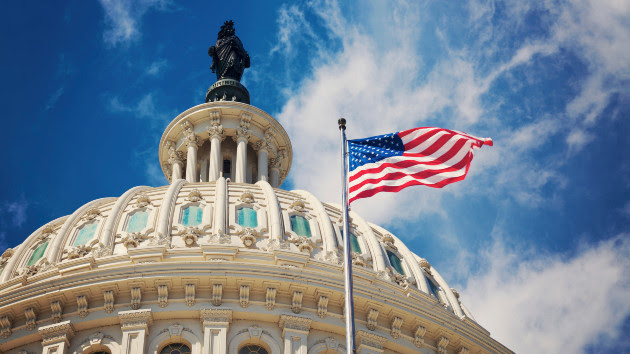
(WASHINGTON) — U.S. officials are expected to brief top congressional leaders on Tuesday about documents with classified markings that were in the possession of former President Donald Trump, President Joe Biden, and former Vice President Mike Pence.
The closed-door briefing to the so-called “Gang of Eight” — the top Republicans and Democrats currently in congressional leadership — is expected to provide more information on the nature of the documents, but officials are not expected to provide the documents themselves to congressional leaders, sources told ABC News.
The Senate Intelligence Committee had been pushing for a briefing from Director of National Intelligence Avril Haines about classified documents since the August search of Trump’s Mar-a-Lago home.
Committee Chair Sen. Mark Warner and Ranking Member Sen. Marco Rubio have said the news of documents found at both Biden’s office and home, in addition to Pence’s Indiana home, increased the urgency for the briefing. And those on the intelligence panels, in particular, have been demanding access for weeks to the specific documents.
The briefing is expected to take place at 4 p.m. and it’s unclear whether any of the lawmakers will speak afterward.
(WASHINGTON) — The House’s new committee on the U.S. and China will hold its first hearing in prime time on Tuesday night, focusing on the “overall threat” of the ruling Chinese Communist Party.
The panel, known as the House Select Committee on Strategic Competition between the United States and China, was launched by Republicans after they retook the majority in the midterm elections.
Establishing the committee was a priority of the House GOP and Speaker Kevin McCarthy but also had significant support from Democrats.
Chairman Mike Gallagher, R-Wisc., told reporters on Monday that the hearing will set the stage for the committee’s future bipartisan work.
“We want to understand what we got wrong about the Chinese Communist Party and what we need to understand about it going forward in order to get our policy right,” Gallagher said.
The witnesses on Tuesday will include one of former President Donald Trump’s White House national security advisers, H.R. McMaster, as well as Matt Pottinger, a former Trump deputy national security adviser and China expert.
The hearing comes as tensions remain high between China and the U.S. after the military downed a suspected Chinese spy balloon that had flown across much of the continental U.S.
The hearing also comes days after The Wall Street Journal reported that the U.S. Department of Energy now believes the COVID-19 pandemic most likely began with a lab leak in China, though other U.S. agencies say the virus could have first originated from natural exposure to an infected animal.
There is currently no consensus in the federal government on the origins of COVID-19.
Gallagher told reporters his committee will play a role in “teasing out what the [Chinese government] cover up of COVID origin tells us about the nature of the regime and why it can’t be trusted to operate as a responsible stakeholder in the international system in general and at the World Health Organization in particular.”
Chinese officials have adamantly denied the virus leaked from one of their labs, though they have also been criticized for not cooperating with investigations into the pandemic’s origins.
Primarily, Gallagher said, his committee’s work will focus on three areas of U.S.-China relations: military, human rights and the economy. In one of the committee’s first bipartisan actions, Gallagher and ranking member Raja Krishnamoorthi, D-Ill., reintroduced their legislation seeking to effectively ban TikTok on all devices in the U.S.
Gallagher also said he was open to calling CEOs of major American companies to testify on their dealings in China.
“Although, we haven’t determined hearings beyond this first one,” he said.
(WASHINGTON) — House Republicans are set this week to once again seize on the issue of U.S. immigration following a trip to see the Biden administration’s border security apparatus firsthand.
On Tuesday, the House Homeland Security Committee — now under Republican control — will hold its first full hearing on immigration since President Joe Biden took office. The panel will bring forth a variety of witnesses, including a mother to two young people who died of opioid overdoes and a hospital executive from Arizona who is expected to testify to the level of uncompensated care provided to migrants who entered the country illegally.
“We’re going to show the human costs to every American,” Chairman Mark Green told ABC News. “We’re going to show the financial costs. We’re going to show the criminal costs.”
Green led members on a trip to the Mexican border last week to meet with regional officials and observe U.S. Customs and Border Protection operations.
“It’s been eye-opening,” he said, adding that he heard extensively from border officials about the diversionary tactics used by criminal smuggling organizations.
After working to roll back many of the hardline immigration measures under former President Donald Trump’s tenure, the Biden administration has more recently instituted policies it says are designed to incentivize lawful and humane travel to the U.S. while maintaining other restrictions, including on asylum.
“Under this administration, our department has been executing a comprehensive strategy to secure our borders and rebuild our immigration system,” Homeland Security Secretary Alejandro Mayorkas said in testimony before the House last year.
He contended then that “we inherited a broken and dismantled system that is already under strain.”
Over the past two months, the Biden administration has rolled out a crackdown on asylum claims — drawing the ire of immigration advocates — while ramping up efforts to more quickly expel or deport migrants who illegally cross the southern border.
At the same time, the administration has offered new, yet narrow, pathways for migrants to obtain temporary status in the U.S. that allows them to seek humanitarian protections.
Biden officials maintain that the dual-track approach is essential for deterring frivolous claims for refuge in the U.S. while keeping options open for those fleeing violence and persecution, predominately in Central and South America.
The change in policy is the latest target for Republicans who have repeatedly challenged the administration with legal action over its immigration moves. Last month, 20 states with Republican attorneys general sued to stop some of the Biden administration’s latest immigration policies.
As Republicans have done throughout the Biden administration, the House Homeland Security Committee is expected to link the scourge of opioid deaths to what they claim are security lapses at the border.
GOP critics point out that the vast majority of smuggled narcotics — particularly the ultra-deadly synthetic opioid fentanyl — are trafficked through legal ports of entry. They say the surge in unauthorized migration is a separate matter.
Green told ABC News that criminal organizations are engaging in diversionary tactics, forcing authorities who would otherwise stop smuggling to turn their attention to stopping migrants.
However, the U.S. Border Patrol is a distinct federal agency and guards the vast stretches of land between official border crossing stations. And while the Department of Homeland Security has at times surged resources from elsewhere to address large numbers of migrants, Democrats have also proposed record funding for Border Patrol staffing as well as new resources for ports of entry.
Congress has repeatedly been stymied on passing bipartisan immigration legislation — given the sharp policy differences on the issue, largely among Republicans — much less the level of comprehensive reform called for by nearly every party involved in the debate.
(WASHINGTON) — The Senate will once again consider whether to approve President Joe Biden’s nominee to helm the federal agency responsible for maintaining and keeping record of classified documents — as Congress continues to grapple with the fallout over Biden, former President Donald Trump and former Vice President Mike Pence all retaining classified materials while out of office.
The Senate Homeland Security and Governmental Affairs Committee is scheduled on Tuesday to consider the nomination of Colleen Shogan to be the national archivist. Her job description would include management of some of the nation’s most important records, such as classified documents.
Shogan’s hearing comes on the same day that congressional leaders are set to receive a long-anticipated briefing from U.S. officials on the classified documents that have all been found in Biden, Trump and Pence’s possession since last year (in Biden’s case, from his time as a senator and vice president).
Shogan is a career government servant whose resume includes work at the Library of Congress and the White House Historical Association, yet her nomination was caught up last Congress in the ongoing political fight over improper handling of classified documents and subsequent concern among Republicans that the National Archives has become politicized.
“I think there are concerns, there’s a lot of concerns with what is going on at the archives,” Kentucky Sen. Rand Paul, the top Republican on the Senate Homeland Security and Governmental Affairs committee, said Monday. “We do want some assurances that people are going to be treated fairly on classified information.”
During a September hearing before the committee, just one month after news first broke that the FBI had searched Trump’s Mar-a-Lago property in search of classified documents, some Republicans used Shogan’s appearance as an opportunity to press her about what they perceived as the politicization of the National Archives.
Sen. James Lankford, R-Okla., asked Shogan about the archives’ involvement in the August raid, questioning why the agency’s original document inquiry was turned over to the FBI.
“In an unusual situation, it wasn’t just the FBI carrying out the raid, but it was a request of the National Archives to be able to engage with these records to then trigger something with the FBI,” Lankford said to Shogan. “A raid of a former president’s house is unprecedented, and it puts the entire process on full display to be able to say: How does this happen? Why does this happen? Everyone gets questions on it.”
Shogan was not employed by the National Archives during the Mar-a-Lago search and said she had not been briefed on it as the nominee for her post. She told Lankford she had “no information” about the decision of “sequence of events.” Court documents show the federal government engaged in a lengthy back-and-forth with Trump to retrieve some presidential records he kept from the White House.
“As I understand it, when there is some concern about missing or damaged records in the general at the National Archives, at that point in time, to retrieve the records there is a voluntary exchange of communication with those individuals,” Shogan told Lankford in September. “And as I understand it — once again, I don’t have any past knowledge of this — the vast majority of the time the records are recovered and retrieved.”
During that same hearing, Committee Chairman Gary Peters, D-Mich., defended Shogan’s independence, touting her as an “extremely well-qualified” candidate for the role.
“In our meetings about your nomination you have demonstrated keen judgement, nonpartisan independence and the necessary capabilities to succeed in this challenging role,” Peters said then.
The committee ultimately deadlocked on Shogan’s nomination, voting 7-7 on whether to advance her to a vote on the Senate floor.
Under the power-sharing agreement of the then-evenly divided chamber, Majority Leader Chuck Schumer could have forced a full vote on Shogan’s nomination. But he never did, leaving vacant a role that has not had a permanent appointee since April 2022.
Biden renominated her for the position, teeing up yet another potentially politically driven showdown on Tuesday.
But the political landscape concerning classified documents has changed drastically since Shogan last appeared before the committee: In the intervening months, classified records have been found at residences for both Biden and Pence — forcing a new bipartisan scrutiny of how issues like this are handled.
During Shogan’s September hearing, many Republicans also took issue with a 2007 academic article she wrote which analyzed presidential speeches and examined “anti-intellectualism” in GOP presidencies.
Sen. Josh Hawley, R-Mo., took her to task over her analysis.
“You wrote an article saying basically that Republican voters are stupid, that Republican presidents deliberately appeal to anti-intellectualism,” he said.
Yet Shogan stood by her writing. She also repeatedly vowed before the panel to be nonpartisan.
Hawley was not convinced. He said Monday that he’ll likely vote against Shogan again this time around.
“What you want in this role is somebody who is just an archivist, who is just nonpartisan, wants to do the job. The archives has become hugely political,” Hawley said. “That agency needs to be depoliticized, they just need to be able to do their job.”
Lawmakers seek more answers on documents
In the background of Shogan’s nomination hearing is an ongoing effort by the Senate’s intelligence panel to learn more about the contents of classified documents recovered from Biden, Trump and Pence.
U.S. officials are expected to brief congressional leaders, including Senate Intelligence Committee Chair Mark Warner and Vice Chair Marco Rubio, on Tuesday to provide more information on the nature of the records.
That briefing will stop short of giving the lawmakers access to the originally seized documents, something that Warner and Rubio have both demanded.
Peters, the chairman of the Senate Homeland Security and Governmental Affairs Committee, has also been tasked by Democratic leadership to work on legislation that could change the way federal records are managed. His efforts on that began last year, during a hearing held on presidential records reform before any of the classified documents were discovered.
It’s unclear if any legislative effort would garner bipartisan support.
(WASHINGTON) — The Biden administration is giving federal agencies 30 days to ensure they do not have TikTok on any federal devices, and to ensure vendors play by the same rules, according to new guidance on Monday from Office of Management and Budget Director Shalanda Young.
Young’s memo instructs agencies to ensure the Chinese-owned app is not installed on any federal devices within 30 days. Contractors must meet the same standard within 90 days.
“The Biden-Harris Administration has invested heavily in defending our nation’s digital infrastructure and curbing foreign adversaries’ access to Americans’ data,” Chris DeRusha, federal chief information security officer, said. “This guidance is part of the Administration’s ongoing commitment to securing our digital infrastructure and protecting the American people’s security and privacy.”
Some agencies, like the Department of Defense, the Department of Homeland Security and the State Department already had existing TikTok bans, for security reasons.
In December, Congress tucked a bill banning TikTok from federal government devices into the massive government spending package. The law gave the Biden administration 60 days to send instructions on the ban to agencies, which OMB did today.
Asked recently about the potential for a larger TikTok ban, President Joe Biden replied, “I know I don’t have it on my phone.”
(WSAHINGTON) — As Black History Month draws to a close, President Joe Biden and Vice President Kamala Harris on Monday evening marked the celebration by delivering remarks at a reception in the White House’s East Room.
The pair touted what they called the accomplishments their administration has made for the Black community in areas like government, housing and climate while implicitly rebuking some Republican efforts to revise African American history courses.
“History matters and Black history matters,” Biden said to an audience of Black Congressional leaders, students at historically Black colleges and universities and other guests.
“Look, I can’t just choose to learn what we want to know. We learn when we should know to learn everything: the good, the bad, the truth and who we are as a nation,” he said.
Harris echoed that.
“Let us all be clear. We will not as a nation build a better future for America by trying to erase America’s past,” she said to a round of applause.
“This month, and all year round, we must recognize the full arc of our nation’s history,” she said, adding, “So during Black History Month, we celebrate the heroes of the past as well as those who currently carry the baton.”
Black history — particularly how it’s taught and which perspectives are included — has become the center of debate in schools across the country as some members of the GOP have aimed to decry teachings of “critical race theory,” an academic concept about systemic racism typically taught in higher education institutions.
“We proudly require the teaching of African American history. We do not accept woke indoctrination masquerading as education,” Florida Commissioner of Education Manny Diaz Jr. recently tweeted about curriculum in his state, which was challenged by the state and revised.
Biden — whose 2020 presidential campaign was revived by his decisive win in South Carolina, home to many Black voters — began his remarks on Monday by thanking close ally Rep. James Clyburn, D-S.C., along with Black members of his administration.
“I wouldn’t be standing here without Jim,” Biden said.
He boasted of his administration’s diversity, of his selection of the first female Black vice president and female Black Supreme Court justice, Ketanji Brown Jackson, and of appointing more Black women to federal circuit courts than “than every other president in history combined.”
At one point, Biden began talking about his ties to the “Divine Nine” — the National Pan-Hellenic Council formed of African American sororities and fraternities — throughout his life in politics.
“I may be white boy, but I’m not stupid,” he said to a round of laughter.
“I know where the power is … I learned a long time ago about the ‘Divine Nine.’ That’s why I spent so much time in Delaware State campaigns and organizing my campaign in Delaware,” he said, nodding to his time organizing at Delaware State University, a historically Black institution.
Biden also highlighted some of his work as president and how it touched or would touch Black communities, including lowering unemployment levels for Black Americans, the environmental provisions passed as part of the sweeping Inflation Reduction Act and last year’s infrastructure investment legislation, a $6 billion increase in funding for existing grants that help historically Black schools and other efforts.
“I committed by 2025, we’re going to increase to 15% of every single contract I award as president will go to Black and brown small businesses,” he said.
ABC News’ Kiara Alfonseca contributed to this report.
(ATLANTA, Ga.) — After the foreperson of the Fulton County, Georgia, grand jury investigating former President Donald Trump and a push to overturn the 2020 election spoke out in several headline-making interviews, the judge overseeing the case told ABC News on Monday that jurors “can talk about the final report.”
But Judge Robert C. McBurney noted the matter can get “problematic” if jurors start to “synthesize the testimony” and the group’s thoughts on it.
McBurney said in an interview that after the grand jury submitted its report in January, he held a “farewell session,” at the request of the district attorney, in which he “reminded them of their oath, which is a statutory obligation that they not discuss with anyone outside their group their deliberations — that’s the one word that’s in the oath.”
McBurney emphasized that “it’s important for people to understand that witness testimony is not deliberations.”
“I explained you don’t talk about what the group discussed about the witnesses’ testimony, but you can talk about witness testimony,” he said. “You could talk about things that the assistant district attorneys told you. … And then finally, you can talk about the final report because that is the product of your deliberations, but it’s not your deliberations.”
Last week, the grand jury foreperson, Emily Kohrs, gave interviews to news outlets regarding her work as a juror, including confirming that the panel had recommended indictments against multiple people.
Kohrs also gave details on testimony from former White House chief of staff Mark Meadows, South Carolina Sen. Lindsay Graham and others in Trump’s orbit.
Kohrs’ statements sparked criticism from some, including Trump’s lawyers, who argued in an interview over the weekend that the investigation “has been compromised” and “if any indictments were to come down, those are faulty indictments.”
McBurney, however, emphasized that the special grand jury was essentially investigative and did not have the ability to bring indictments.
That decision that would ultimately rest with another grand jury, should Fulton County District Attorney Fanni Willis pursue a case. Trump has denied wrongdoing.
“This grand jury’s sole role was to prepare a report that was merely a set of recommendations for the district attorney — full stop. Nothing more,” McBurney said. “And so folks should think long and hard about what impact, at all, this special purpose grand jury’s work would have should there be an indictment down the road.”
“This grand jury could not and did not bring charges against anyone,” he reiterated.
McBurney declined to say if he saw anything in Kohrs’ public comments that overstepped his guidance or her oath. Kohrs hasn’t responded to ABC News’ request for comment.
The judge said people may be “more familiar with federal grand jurors and a more extensive oath of secrecy than is the case in Georgia.”
“It’s just important not to apply the wrong standard to grand jurors in this jurisdiction,” he said. “Their oath requires them to keep secret their deliberations, and it is a different oath than what federal grand jurors take.”
(NEW YORK) — Fox boss Rupert Murdoch said in a deposition under oath that any Fox News executives who knowingly allowed lies to be broadcast on the air should “should be reprimanded” or “maybe got rid of,” according to a new court filing on Monday by Dominion Voting Systems.
This is a developing story. Please check back for updates.
(NEW YORK) — Democratic Rep. Elissa Slotkin on Monday announced her candidacy for a U.S. Senate seat from Michigan, a critical battleground state in the 2024 election.
“We need a new generation of leaders that thinks differently, works harder, and never forgets that we are public servants,” Slotkin said.
Slotkin, who was widely speculated to jump in following Democratic Sen. Debbie Stabenow’s retirement announcement, is the first Democrat to announce she’s running in what’s expected be a highly competitive race.
In her video announcement, Slotkin highlighted her career in public service, working in the CIA as a Middle East analyst and completing three tours in Iraq. She emphasized her ability to work across the aisle, serving under President George W. Bush and Barack Obama working in several defense and intelligence positions.
Slotkin won her first House race in 2018, beating incumbent Republican Rep. Mike Bishop in a longtime Republican-leaning district. In 2022, Slotkin won reelection in a tough battleground district by five percentage points, defeating her Republican challenger, Tom Barrett.
Slotkin serves on the House Armed Services Committee, Homeland Security Committee and the House Veterans Affairs Committee.
And while Michigan’s Senate seat is critical for Democrats to maintain, other elected officials have said they would not seek the seat, including Democratic Gov. Gretchen Whitmer, Democratic Rep. Haley Stevens and Transportation Secretary Pete Buttigieg, who has residency in the state.
Rep. Cori Bush, D-Missouri, left, told ABC’s Devin Dwyer, right, she believes her state does not have legal standing to challenge the Biden administration’s student debt forgiveness plan in federal court because it is not directly harmed. — ABC News
(WASHINGTON) — Critics of the Biden administration’s plan to cancel federal student loan debt for more than 40 million Americans say it’s expensive, unfair and an abuse of executive power.
But when a group of six GOP-led states on Tuesday challenges the program before the U.S. Supreme Court, they’ll have to first answer the critical question of how, exactly, they are harmed.
“You can’t just go to the court and say I don’t like this, or I think this might be a problem,” said David Nahmias, a staff attorney with the Berkeley Center for Consumer Law and Economic Justice. “In order to sue, you have to show that you are going to be threatened with a certain impending injury.”
The states have alleged a future financial injury from lost revenue on student-loan discharges; fewer loans on the books, they say, would mean fewer taxes to collect.
The state of Missouri argues that it would be uniquely harmed by the impact of large-scale debt cancellation on Missouri’s Higher Education Loan Authority, or MOHELA, which is the nation’s largest loan servicer.
The Biden administration says the states’ claims are highly speculative and indirect, undermining their legal standing to bring the case in the first place.
“The basic threshold issue is, is Missouri, is Nebraska – are these states injured today?” said South Texas College of Law professor Josh Blackman.
Lower courts and legal scholars from across the ideological spectrum have divided on the question of injury, setting the stage for the justices to have the final say on whether the Biden debt relief plan inflicts clear harm on state governments.
“The answer is tricky because in recent years the states have been given latitude,” said Blackman. “This might be a case of the court scaling back on that broad authority, although I’m not sure.”
The U.S. Education Department last year, citing a need to protect borrowers from excessive economic hardship during the pandemic, invoked emergency powers to waive repayment terms for some federal student loans. The agency offered to absolve as much as $20,000 of federal debt for more than 40 million eligible borrowers.
The move drew an immediate legal challenge from Republican attorneys general in six states — Arkansas, Iowa, Kansas, Missouri, Nebraska and South Carolina — who saw it as a costly bailout to college students at the expense of other American taxpayers.
“Joe Biden had no legal authority whatsoever. I think the larger issue is it’s unfair to people who paid off their loans. It’s unfair to people who didn’t take out loans,” Sen. Eric Schmitt, Missouri’s Republican former attorney general who first brought the case, told ABC News in an interview.
“It’s adding to our debt,” Schmitt added. “I think the reason why this case is before the Supreme Court and why Missouri and the other states are ultimately going to win is because Missouri has a loan servicing organization called MOHELA that derives revenue from interest.”
MOHELA, a state-created company which manages more than 5 million federal student loan accounts totaling $148 billion, is at the heart of Missouri’s case and what the federal appeals court singled out as a lynchpin in their decision.
The Eighth Circuit Court of Appeals based in St. Louis, which put the Biden debt relief plan on hold last year, cited “threatened financial harm” to Missouri explicitly because of its ties to MOHELA.
MOHELA has contributed $6 million to state student aid programs in the current fiscal year, a spokeswoman for the Missouri Department of Higher Education and Workforce Development told ABC.
State law also requires MOHELA to pay $350 million to help fund improvements to state colleges and universities.
“The court has identified it as a public entity that administers student loans. It provides college assistance programs for people across the state of Missouri and so the state has an interest in it,” MIssouri’s new attorney general Andrew Bailey told ABC in an interview.
But liberal and conservative legal scholars say financial fallout from a MOHELA-Missouri link is too weak and speculative to justify the states’ Supreme Court case.
“The relationship between Missouri and MOHELA, as our research has shown, in the law that created MOHELA, is such that harm just cannot, cannot happen,” said Nahmias, who filed an amicus brief in the case on behalf of Missouri consumer advocates.
“MOHELA is completely separate and distinct from the state of Missouri. Its operations are distinct from Missouri. Its treasury and finances are completely walled off from the Missouri treasury,” he said.
MOHELA, which did not respond to our repeated requests for comment or an interview, is notably not challenging the Biden loan forgiveness plan.
Missouri Rep. Cori Bush says the company is being used as a pawn and that allegations fewer MOHELA-serviced loans would financially harm her state is exaggerated.
“The money that [MOHELA is] supposed to be paying to the state – again, they owe over, what, about $105 million – they have not kept that up,” Bush said in an interview. “So to say that you have borrowers who need to pay what they owe. Well, MOHELA does not pay what they owe.”
MOHELA financial records reviewed by ABC News confirm the loan servicer has not made a payment to the state fund for higher education capital improvements since 2008 and may not make any future payments – even if the Biden debt relief plan is struck down.
“The states have shown no link between debt cancellation and the effect of debt cancellation on MOHELA’s effect to even pay into the fund, even if they wanted to,” said Nahmias.
Asked about MOHELA’s lack of contributions, Attorney General Bailey said it’s “an issue that the [Supreme] Court is going to have to sort out.”
“The Fifth Circuit [U.S. Court of Appeals] sided with us on this issue, and so we’re optimistic about our chances at the U.S. Supreme Court,” he said.
Some top conservative legal scholars, however, have warned the justices in court filings that – while they don’t like the debt cancellation plan – allowing Missouri to challenge it could set a dangerous precedent.
“If these states are granted standing here, it could lead to far broader ability of the states to haul the federal government into court,” Blackman said.
It’s a high-stakes decision that many say will turn on whether the justices believe debt relief for millions of Americans hurts MOHELA, which in turn hurts Missouri.
“The court may very well say, look, no money’s been paid out [by MOHELA] in a very long time. This is too speculative of an injury,” Blackman said. “Or, the court could say the chance that even $1 might be paid at some point in the future might be enough” to establish harm.
Meantime, many of nearly half a million Missourians with federal student loans who applied for relief under the Biden plan are watching the case with anticipation.
“I spend a lot of time worrying about how I’m going to pay that money back,” said Anna Bain, a sophomore journalism major at the University of Missouri-Columbia, holding $12,000 in student debt.
“The soaring costs of higher education these days is so insane and so unacceptable for so many people,” Bain said. “I think that everyone has a right to say how their taxes are being spent. But I feel like taxes are for the greater good and this is for the greater good.”