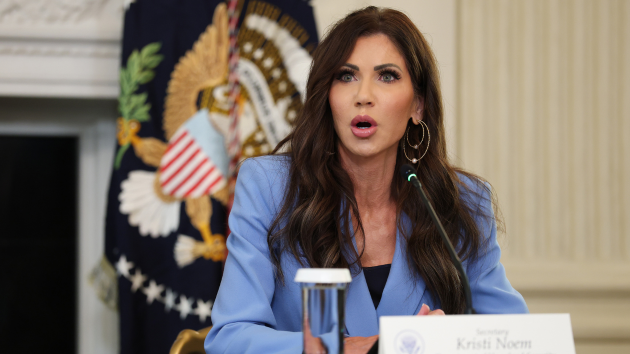
U.S. Secretary of Homeland Security Kristi Noem speaks during a roundtable discussion in the State Dining Room of the White House on October 08, 2025 in Washington, DC. Trump’s administration held the roundtable to discuss the anti-fascist Antifa movement after signing an executive order designating it as a “domestic terrorist organization”. (Photo by Anna Moneymaker/Getty Images)
(WASHINGTON) — Democratic senators are alleging that the Department of Homeland Security potentially violated the Hatch Act by asking airports across the country to play a video featuring DHS Secretary Kristi Noem blaming Democrats for the impacts of the government shutdown.
“This appears to be a flagrant violation of Sec. 715, which states ‘No part of any funds appropriated in this or any other act shall be used by an agency of the executive to branch… for the preparation, distribution or use of any… film presentation designed to support or defeat legislation pending before the Congress, except in presentation to the Congress itself,'” Connecticut Democratic Sen. Richard Blumenthal wrote in the letter to DHS citing a section from the Anti-Lobbying Act.
The Hatch Act restricts certain political activities by federal employees and by some state, Washington, D.C., and local government workers who are involved or work in federally funded programs. Penalties for violating it include removal from federal employment, suspension without pay, demotion, or blocking a party from federal jobs for up to five years, according to the Office of Special Counsel.
“The law’s purposes are to ensure that federal programs are administered in a nonpartisan fashion, to protect federal employees from political coercion in the workplace, and to ensure that federal employees are advanced based on merit and not based on political affiliation,” according to the U.S. Office of Special Counsel’s website.
In response to ABC News’ request for comment on the call for an investigation, DHS Assistant Secretary Tricia McLaughlin said “DHS responds to official correspondence through official channels.”
“It is TSA’s top priority to ensure that travelers have the most pleasant, efficient, and safe air travel security experience possible. It is a simple statement of fact that Democrats in Congress refuse to fund the federal government, and because of this, most of our TSA employees are working without pay. It’s unfortunate our workforce has been put in this position due to political gamesmanship. Our hope is that Democrats will soon recognize the importance of opening the government,” she said.
The letter followed a number of airports nationwide declining to play the video, saying their facilities’ policies bar the showing of political content. Some of them also pointed to the Hatch Act.
Among the major airports that declined to show the DHS video are LaGuardia, Newark Liberty, John F. Kennedy, Charlotte Douglas International, Seattle-Tacoma, San Francisco, Hartsfield-Jackson Atlanta, Chicago O’ Hare, Phoenix International and Colorado Springs.
As of Wednesday afternoon, officials at Detroit Metropolitan Wayne County Airport in Michigan and Bismarck Airport in North Dakota said the video was being shown on screens controlled by TSA at the airports and out of their control. Both airports said they were not involved in the decision to play the video. A spokesperson for Detroit Wayne Airport said it has requested that TSA stop playing the video.
The letter to DHS led by Blumenthal and Rhode Island Sen. Jack Reed was cosigned by 15 other senators and asks the department to “immediately remove these videos from all TSA checkpoints and cease illegally using federal funds for partisan political messaging.”
The senators also asked DHS to provide information on the funding used to produce the video, including the cost, the approver of the funds, whether anyone from the Trump administration was consulted on the video, and if any outside contractors or organizations were involved in its creation to assess whether any federal laws were violated or funds misused, according to the letter.
A similar letter was sent by Washington Democratic Sen. Maria Cantwell, ranking member on the Senate Committee on Commerce, Science and Transportation, to the Office of Special Counsel demanding an investigation into the video, adding that the OSC is responsible for enforcing the Hatch Act.
“When viewed in its totality, Secretary Noem’s video can only be reasonably interpreted as a partisan message intended to misleadingly malign the Trump Administration’s political opponents, convince Americans to blame ‘Democrats in Congress’ for the ongoing government shutdown, and influence their future votes — all while omitting the fact that Republicans currently control the White House, U.S. Senate, and U.S. House of Representatives,” Cantwell wrote in the letter.
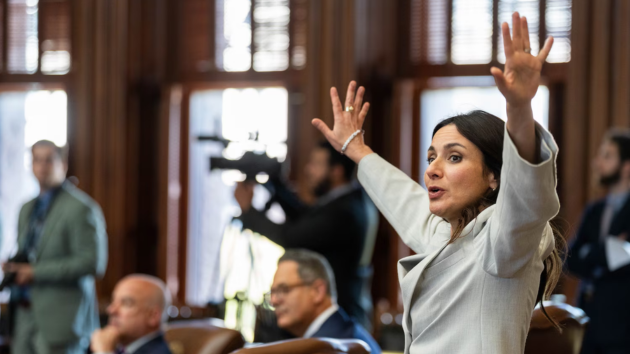
In this Aug. 18, 2025, file photo, Rep. Gina Hinojosa reacts as a proclamation by the Governor is read inside the House Chamber at the Texas Capitol in Austin, Texas. Mikala Compton/Austin American-Statesman via Getty Images, FILE
(TEXAS) — One of the Texas Democrats who attempted to block Republican efforts to redraw the state’s congressional maps mid-decade is looking to bring that fighting spirit to the governor’s mansion.
Austin-area state Rep. Gina Hinojosa, a Democrat, on Tuesday launched a bid to unseat Republican Gov. Greg Abbott.
Hinojosa told ABC News she believes Texas voters desire a spirited, fresh candidate to take on Abbott, who is running for a fourth term.
“I think Americans are done with politics as usual and are interested in shaking off labels and just wanting to see something real,” she said. “I’m as real as you get — a mom who got mad [who] ran for office.”
A former Austin ISD school board president, Hinojosa will center education, and campaigning on behalf of Texas public schools, in her bid. Hinojosa was elected to the statehouse in 2016.
“After 10 years, I now understand where our money is going and our money is going to vendor contracts and to enrich the billionaire class and not to the needs of Texans,” she said.
Hinojosa was part of the first wave of legislators who, this summer, left the state to deny their Republican counterparts a quorum, which brought the Abbott-backed special session to implement new GOP-favored congressional maps to a screeching halt.
The quorum break kicked off a national redistricting saga; high-profile Democrats, like California Gov. Gavin Newsom, Illinois. Gov. JB Pritzker, and New York Gov. Kathy Hochul hosted these lawmakers to protest the maps.
Pritzker took on an outsized role in the showdown, helping coordinate the travel and lodging of dozens of state lawmakers as they camped out in Illinois and ran out the clock. Former President Barack Obama even called into their Illinois’ encampment and offered support.
Texas Republicans did eventually pass new congressional maps after establishing a second special session, though Texas Democrats, Hinojosa among them, heralded their collective action as a win. Newsom and California Democrats, in turn, launched their own effort to pass blue-leaning maps, bringing the issue to voters on a proposition this November.
Hinojosa said her involvement in the quorum break “opened my eyes” that voters are ready for a fight.
“I can run for governor because I have faith in Texans that they will have my back and that they are in this with me. That quorum break did expand my understanding of where Texans, where voters are today in 2025 when it comes to what they want to see their leaders doing,” she said.
But Hinojosa, a self-described populist, has a lot of ground to gain. No Democrat has won a statewide office in Texas since 1994. And Texas’ Latino population has been slowly edging toward Trump over the last few elections. Trump led former President Joe Biden by 6 points in the state in 2020 — and the gulf grew in 2024, when trounced former Vice President Kamala Harris by 14 points.
She must also edge out serious Democratic challengers in the primary. Andrew White, the son of former Texas Gov. Mark White, is also running. And she faces the potential of more well-known Democrats jumping into the fray. (Though Hinojosa says both Rep. Joaquin Castro and former congressman Beto O’Rourke have told her they’ve ruled out a gubernatorial run.)
Despite it all, she feels she can navigate these challenges. And is making a bet that Texas voters feel the same.
“People want change. I’m the candidate of change. Greg Abbott is the candidate of status quo, of the insider club enriching themselves with our taxpayer dollars. So, I feel very good about being a candidate that represents the desires and what Texans want to see in a leader,” Hinojosa said.
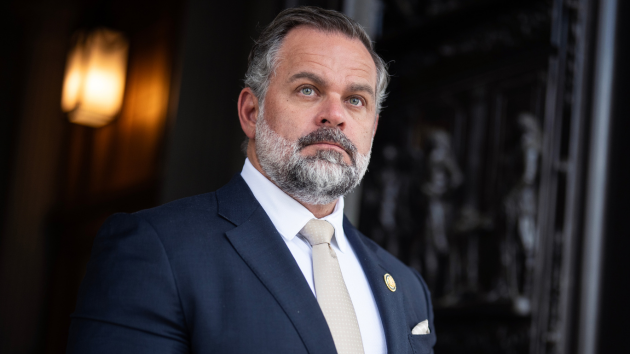
Rep. Cory Mills, R-Fla., leaves the U.S. Capitol after the last votes before August recess, on Wednesday July 23, 2025. (Tom Williams/CQ-Roll Call, Inc via Getty Images)
(FLORIDA) — A Florida judge issued a protective order against Republican Rep. Cory Mills after he was accused by a former girlfriend of threatening to release sexually explicit videos of her, according to court documents.
The judge ordered the congressman to refrain from contacting Lindsey Langston, who was named Miss United States in 2024 and is a Republican state committeewoman from Columbia County.
Langston alleged in July that Mills threatened to release videos of her after their breakup earlier this year and that he threatened to harm any future partners, according to a report obtained from the Columbia County Sheriff’s Office in Florida.
In the order, the judge wrote that Langston has “reasonable cause to believe she is in imminent danger of becoming the victim of another act of dating violence” and said the evidence supported Langston’s assertion that Mills had caused her “substantial emotional distress” and that Mills offered “no credible rebuttal” to her testimony.
The order, which remains in place until January 2026, prohibits Mills from contacting Langston in any way and from coming within 500 feet of her residence or place of employment.
In her first comments since the judge’s decision, Langston said she now “feels like I’m able to live my life again.”
“I do feel that justice was served, and I can’t even describe the relief that I felt once I got the phone call that I had been issued the injunction for protection. I felt like I’m able to live my life again,” Langston said on a Zoom call Wednesday with reporters, sitting next to her attorney.
Mills previously said in a statement to ABC News, “These claims are false and misrepresent the nature of my interactions,” and accused a former Florida primary opponent of “weaponizing the legal system to launch a political attack against the man who beat him.”
In the order, the judge said he did not find Mills’ testimony to be “truthful.”
“The court, considering the totality of the testimony and the circumstances, does not find the Respondent’s testimony concerning the intimate videos to be truthful,” the judge wrote.
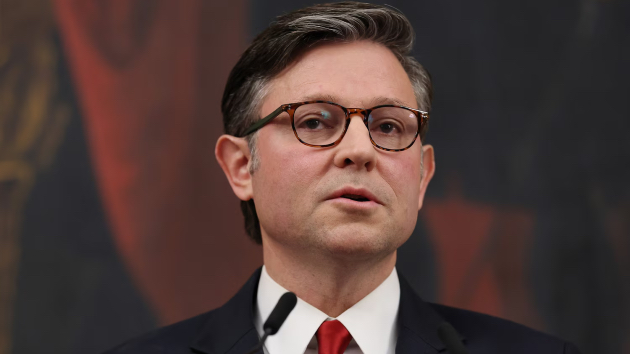
Speaker Mike Johnson, on Wednesday, was asked about allegations against Mills and told reporters, “I have not heard or looked into details of that. I’ve been a little busy. We have a House Ethics Committee; if it warrants that, I am sure they’ll look into it.”
“You have to ask Rep. Mills about that,” the Speaker added when pressed. “I mean, he’s been a faithful colleague here. I know his work on the Hill. I mean, I don’t. I don’t know all the details of all the individual allegations and what he’s doing in his outside life. Let’s talk about things that are really serious.”
Langston’s attorney Bobi Frank said Wednesday that her client plans to cooperate with any future investigations, including with the House Ethics Committee, and said she had been in contact with “other individuals” involved the matter and alleged that “Miss Langston is not alone.”
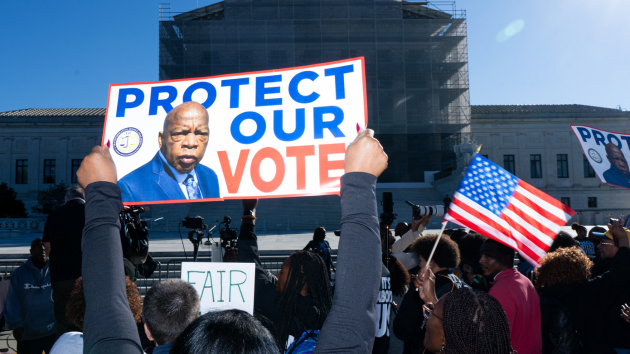
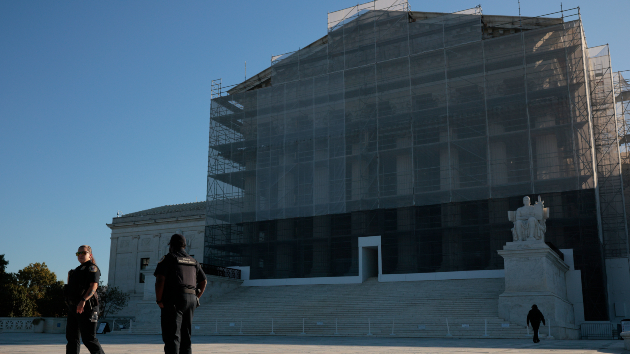
Voting rights activists protest outside the U.S. Supreme Court as the court prepares to hear arguments in a case challenging Louisiana’s congressional map in Washington on Wednesday, October 15, 2025. (Bill Clark/CQ-Roll Call, Inc via Getty Images)
(WASHINGTON) — The Supreme Court on Wednesday appeared ready to limit how a key part of the Voting Rights Act long aimed at protecting equal opportunity for racial minority voters is applied to the drawing of state election maps.
During oral arguments in a complicated case challenging the drawing of a second majority-black district in Louisiana, the court’s conservative majority suggested race may have improperly predominated as a factor in its creation.
At the same time, it was not clear whether a majority of the court was prepared to issue a more sweeping ruling that any use of race as a factor in redistricting is unconstitutional.
Section 2 of the Voting Rights Act has long been a guardrail against states “packing” Black voters into districts and “cracking” communities of color into other districts with an aim of diluting their electoral influence.
Courts that have found a violation of Section 2 then order states to redraw their maps, with an eye on race, to ensure minority voters are given fair chance at political participation.
The law does not require proof of intent to discriminate — prohibiting any discrimination in effect — but several conservative justices suggested that plaintiffs should have to show at least some possibility of intent, a tougher standard to meet.
Justice Brett Kavanaugh, who could be the key vote in the case, voiced particular concern about the indefinite use of race to draw maps compliant with Section 2.
“This court’s cases in a variety of contexts have said that race-based remedies are permissible for a period of time, sometimes for a long period of time, decades in some cases, but that they should not be indefinite and should have an end point,” Kavanaugh said.
“What is not grounded in case law,” replied Janai Nelson, president and director-counsel of the NAACP Legal Defense Fund, which is defending Louisiana’s map, “is the idea that an entire statute should somehow dissolve simply because race may be an element of the remedy.”
The court’s longstanding precedents have said that race cannot be a primary motivating factor when drawing congressional districts under the equal protection clause of the 14th Amendment, but they also grant states have breathing room to consider race in order to comply with the Voting Rights Act.
The court most recently upheld Section 2 in a 2023 decision.
“What Section 2 does is to say where the effects [of a congressional map] are discriminatory such that … African Americans here are not being given the same voting opportunities as white people are, then a remedy is appropriate,” Justice Elena Kagan told Louisiana Solicitor General Benjamin Aguinaga. “That remedy doesn’t have to be race-based, but sometimes it is race-based in order to correct the racially discriminatory situation that exists.”
Justice Ketanji Brown Jackson most vigorously defended the legacy of Section 2 and its use to create two majority-black districts in Louisiana, describing the Civil Rights-era law as a “tool” to identify racial disparities.
“It’s like a tape measure that we’re looking [at] as to whether or not certain circumstances exist, and those circumstances that Congress is worried about – unequal access to electoral opportunity,” she said. “That’s why it doesn’t need a time limit, because it’s not doing any work other than just pointing us to the direction of where we might need to do something.”
Justice Samuel Alito said outright that he believed lower courts did not correctly apply the Supreme Court’s precedents around Section 2 to the maps at issue in Louisiana.
“There’s a serious question about whether the Black population within the district in question in the illustrative map was geographically compact,” he said, referring to one of the legal requirements for a VRA-compliant map.
A decision in Louisiana’s favor could, at the very least, require the state to redraw its map under more race-neutral criteria ahead of the 2026 midterm election. The two majority-black districts are represented by Democrats.
A broader conclusion in the case could upend congressional maps nationwide, potentially triggering the redrawing of race-neutral districts in multiple states and in turn putting minority representation at risk in legislatures nationwide.
Nelson argued that a further rollback of the Voting Rights Act would be “catastrophic.”
“If we take Louisiana as one example, every congressional member who is Black was elected from a VRA opportunity district,” she said. “We only have the diversity that we see across the south, for example, because of litigation that forced the creation of opportunity districts under the Voting Rights Act.”
The court is expected to release a decision before the end of its term in June 2026. How quickly it releases its ruling could determine whether or not states will have sufficient time to redraw maps — if necessary — before midterm voting begins.
Farmer Scott Thomsen, pictured here with ABC’s Matt Rivers, is preparing for the fall soybean harvest in eastern Nebraska. Ben Siegel & Matt Rivers/ABC News
(WASHINGTON) — President Donald Trump’s $20 billion bailout of Argentina’s economy has raised red flags in the U.S., especially among American farmers desperate for help dealing with a crop crisis triggered by his trade war with China.
Argentina’s President Javier Milei met with Trump and top U.S. officials, including Treasury Secretary Scott Bessent, Tuesday at the White House.
The meeting came nearly a week after Bessent announced a $20 billion financial lifeline that included a currency swap framework with Argentina’s central bank aimed at propping up the Argentine peso.
“We just want to see Argentina do well,” Trump told reporters during the meeting.
Details still unclear
In an X post last week, Bessent said the U.S. finalized a $20 billion swap line, or a loan, with Argentina’s central bank, where the U.S. Treasury will exchange dollars for pesos.
The expectation, Bessent has said, is that those dollars will eventually be paid back.
Bessent also said last week the U.S. directly purchased pesos, without specifying how much.
The Treasury Department had not published any details about the terms of the swap agreement as of Tuesday and ultimately the dollars it’s offering to Argentina’s central bank are U.S. taxpayer dollars.
“You can call it a bailout, you can call it a rescue, it is a credit line to a country that otherwise would be out of reserves,” Brad Setser, a senior fellow at the Council on Foreign Relations and former Treasury official, told ABC News.
Bessent has repeatedly denied that the deal is a bailout, saying the U.S. is supporting the economic reforms of a key South American ally and advancing U.S. strategic interests in the region.
The Treasury Department has not responded to ABC News requests for more information on the deal.
Farmers, leaders on both sides sound off
The bailout has sparked controversy with farmers, Democrats and some Republicans questioning why the U.S. would commit billions to boost the economy of a foreign country, especially when thousands of American soybean farmers are suffering and in need of help.
China stopped purchasing American soybeans amid the trade war with the United States. According to the American Soybean Association, China is the largest buyer of American soybeans, purchasing more than 50 percent of U.S. exports in 2023 and 2024.
While some American farmers have said they are afraid of bankruptcies and foreclosures because of their losses, Argentina and Brazil’s farmers are increasingly supplying Chinese markets — with soybeans.
Ben Steffen, a Nebraska soybean and corn farmer, who spoke to ABC News from his tractor Tuesday, said the U.S. is “bailing out our competitor in the soybean production business.”
“Clearly, people are not happy about the markets, and my neighbors are not happy about bailing out Argentina,” he said.
Minnesota farmer Darin Johnson said China’s purchase of soybeans from Argentina has cost the U.S. leverage in trade talks, by satisfying China’s demand for the crop.
But he added that many farmers still support Trump, despite any frustrations with some of the administration’s policies.
“We’re going to put it to good faith in this administration that we are going to get a trade deal, but we are running out of time,” Johnson said. “Without a little help from this administration, which we don’t know what is going on yet, there is still a fair amount of uncertainty.”
Ryan Marquardt, an Iowa farmer, told ABC News on Tuesday that the bailout for Argentina seems to run counter to Trump’s “America First” vision.
“It does feel like you are propping up your competition. It does seem counterintuitive to the America First ideology,” he said. “I don’t see any place where we come out ahead from that transaction.”
Democrats have accused the White House of neglecting farmers and other Americans at a time of economic turmoil and uncertainty.
“The truth is clear: Trump put America second, bailing out another country while abandoning American farmers,” the Democratic National Committee said in a press release Monday.
Iowa Republican Sen. Chuck Grassley also criticized the priorities of the administration in an X post last month when word of the Argentine deal was making the rounds.
“Why would USA help bail out Argentina while they take American soybean producers’ biggest market, he said. “We shld use leverage at every turn to help hurting farm economy Family farmers shld be top of mind in negotiations by representatives of USA.”
The American Soybean Association’s president, Kentucky farmer Caleb Ragland, said in a statement in September that “frustration” with the Trump administration was “overwhelming.”
“U.S. soybean prices are falling, harvest is underway, and farmers read headlines not about securing a trade agreement with China, but that the U.S. government is extending $20 billion in economic support to Argentina while that country drops its soybean export taxes to sell 20 shiploads of Argentine soybeans to China in just two days,” Ragland said.
“The farm economy is suffering while our competitors supplant the United States in the biggest soybean import market in the world,” he added.
Trump has promised to help the soybean farmers, at one point claiming that money from tariffs would be used to assist them financially, but no such proposal had been formalized as of Tuesday.
The administration has blamed the current federal government shutdown for delaying the rollout of an assistance package.
The president has also called on China to purchase U.S. soybeans — to no avail.
“President Trump pledged to put American farmers first, and every historic trade agreement that his Administration has struck with the EU, Japan, and others includes unprecedented provisions to expand American agricultural exports,” White House spokesman Kush Desai said in a statement to ABC News.
“The Administration continues to fight for American farmers in trade negotiations, and also remains committed to using tariff revenue to support farmers who have been left in the lurch due to unfair foreign trade practices,” he added.
Trump says deal helps South American conservative ally before election
The Argentine bailout comes at a politically crucial time for its controversial president.
Milei has made headlines for his libertarian beliefs and has frequently been seen with conservative leaders and figures, including Elon Musk, who he joined at this year’s CPAC and gave him a what became a famous mock chainsaw, praising Musk’s DOGE cuts.
Trump has frequently praised Milei and backed his leadership, praising his right-wing, cost-cutting agenda in Argentina.
“They have a great leader,” Trump told reporters just before his meeting with Milei on Tuesday.
However, the 55-year-old is facing serious competition in Argentina’s Oct. 26 election as he has been hit with rising disapproval ratings over the last few months, according to Reuters.
The U.S. deal seeks to stabilize the peso just as Argentine voters head to the polls.
“We’re helping a great philosophy take over a great country … we want him to succeed,” Trump said Tuesday, adding that if Milei is successful, other countries in South America could follow its lead politically.
Trump later said the currency swap is dependent on Milei’s success during the country’s upcoming elections.
“If he loses, we are not going to be generous with Argentina,” Trump said. “If he doesn’t win, we’re gone,” he said.
Trump said “no” when asked how the currency swap was an “America First” policy — if it was just to help Milei in the upcoming election.
Bessent echoed the president’s sentiment Tuesday, claiming that the U.S. is using its economic strength to create peace in South America.
“It’s hope for the future,” Bessent said. “I think that with the bridge the U.S. is giving them and with the strong policies, that Argentina can be great again.”
Bessent’s finance colleagues come under scrutiny
Bessent has also been on the hot seat over Argentina’s ties to some of his former colleagues in the finance world.
Rob Citrone, a billionaire who once worked with Bessent, has sizable investments in Latin America and Argentina, according to SEC filings.
A spokesperson for Citrone and Discovery Capital Management, his hedge fund, declined to comment to ABC News.
Billionaire Stanley Druckenmiller — a longtime friend of Bessent — has publicly said he invested in Argentina after Milei’s election. Druckenmiller did not immediately return messages to ABC News for comment.
The Treasury Department did not respond to a message seeking comment about reports that Bessent had discussed Argentina with Citrone, or additional requests for comment on the deal.
Bessent denied the deal had any connection to his finance colleagues in a CNBC interview last week where he said the “trope that we’re helping out wealthy Americans with interest down there couldn’t be more false.”
“What we’re doing is maintaining a U.S. strategic interest in the Western Hemisphere,” he added.
-ABC News’ Isabella Murray and Fritz Farrow contributed to this report.
(WASHINGTON) — Speaker Mike Johnson dismissed the possibility he could change his strategy to end the government shutdown by negotiating legislative changes with Democrats, telling reporters on Tuesday that he doesn’t “have any strategy” to end the impasse in place of the GOP’s lackluster pressure campaign to pass a “clean” continuing resolution.
Johnson on Tuesday pushed Democrats to support the House-passed funding bill and slammed the Democrats’ $1.5 trillion proposal, which extends health care subsidies under the Affordable Care Act and reverses cuts to Medicaid.
Asked whether he may consider a different negotiation track as the pressure campaign against Democrats has so far failed to break the standoff, Johnson reiterated that the House-passed bill is a “clean” continuing resolution — free from legislative gimmicks or political games.
“Why don’t I change my strategy? I don’t have any strategy,” the speaker told reporters. “I’m doing the right thing, the clearly obvious thing, the traditional thing.”
The Senate is set to vote Tuesday night — its eighth time — on the GOP-backed “clean” continuing resolution that would fund the government. It’s expected to fail again as the shutdown enters its third workweek.
Congressional Democrats representing Maryland and Virginia — where a significant number of federal workers reside — criticized Republicans over the shutdown on Tuesday morning and supported the workers.
“What we have seen happen to our federal employees we will continues to speak out against,” Sen. Angela Alsobrooks, a Maryland Democrat, said. “We want them to know we appreciate them, we appreciate your service to our country, we still need you, we still need what you offer our country and we will continue to work until you can be able to offer it.”
Democratic Sen. Chris Van Hollen of Maryland said President Donald Trump and Office of Management and Budget Director Russ Vought are “viscously” attacking federal employees.
OMB is working on ways to get paychecks to federal law-enforcement officers amid the ongoing shutdown, according to an OMB official. This comes after recent moves to pay members of the military and fund the critical Special Supplemental Nutrition Program for Women, Infants, and Children program.
Trump said he’s directing Defense Secretary Pete Hegseth to use “all available funds” to pay members of the military on Wednesday, Oct. 15 despite the shutdown.
The Pentagon said Tuesday that it will use $8 billion found in research, development and testing funds to cover paychecks for the troops on Wednesday.
The move won the approval of Speaker Johnson.
“Look, my understanding of this is they have every right to move the funds around, duly appropriated dollars from Congress to the Department of Defense,” Johnson said Tuesday. “If the Democrats want to go to court and challenge troops being paid, bring it. OK?”
OMB said on its X account on Tuesday that the Trump administration is “making every preparation” to ride out the government shutdown without caving to Democrats’ demands. The agency said they’d continue cutting the federal workforce in the meantime.
“Pay the troops, pay law enforcement, continue the RIFs, and wait,” the post said.
Lawmakers are still in a stalemate with negotiations at a standstill.
“We’re barreling toward one of the longest shutdowns in American history,” Johnson said on Monday.
The record is 35 days and that was set in Trump’s first term.
House Minority Leader Hakeem Jeffries said during an MSNBC interview Monday that he does not believe the American people will allow the federal government shutdown to proceed much longer because they’ll pressure Republicans to negotiate with Democrats.
Jeffries said Republicans remain unwilling to negotiate over health care as the shutdown continues.
because they’d rather keep the government shut down than deal with the cost-of-living crisis that exists in the United States of America,” Jeffries said.
(WASHINGTON) — When a federal court concluded Louisiana’s 2022 congressional map violated the Voting Rights Act by discriminating against Black voters, the state legislature created a new map with a second majority-Black district to comply with the law.
In a blockbuster case that could be decided on the eve of next year’s midterm elections, the U.S. Supreme Court on Wednesday will consider whether the use of race in drawing that extra district ran afoul of the Constitution.
“The key question is whether a state can take race into account, indeed whether a state must take race into account, or whether that violates the Equal Protection Clause,” said Sarah Isgur, SCOTUSblog editor and ABC News legal contributor.
The outcome of the case could determine whether Louisiana and many other states may have to redraw their maps in a race-blind manner, which could in turn impact minority representation and the balance of power in legislatures nationwide.
“This could be a monumental decision,” said Jeffrey Rosen, president and CEO of the National Constitution Center.
For decades, the high court has said that race cannot be a predominant factor in drawing congressional district boundaries, but it has also given states breathing room to consider race in order to ensure minority voters receive equal opportunity to elect representatives of their choice.
Section 2 of the Voting Rights Act has long been a guardrail against states “packing” Black voters into districts and “cracking” communities of color into other districts with an aim of diluting their electoral influence.
More than one third of Louisiana’s population is Black. Two of its six U.S. congressional districts are majority-Black — both are represented by Democrats.
A group of self-described “non-white voters” sued the state over the second majority-minority district, setting up a legal clash of two competing principles: Section 2’s requirement that minorities be given equal opportunity to participate in the electoral process, and the 14th Amendment’s equal protection guarantee of race-neutral treatment by the government.
“Section 2 has been absolutely critical in protecting voters against racial discrimination in voting, and it’s been working in terms of moving us toward a true multiracial democracy where race doesn’t matter,” said Sophia Lin Lakin, director of the Voting Rights Project at ACLU.
“But what we know and what was shown in Louisiana, and multiple federal courts have agreed with us on this point, is that we’re not there yet,” she said.
Louisiana and the voter plaintiffs argue in court filings that racial classifications are “uniquely odious” and unconstitutional. There should be “zero tolerance for any consideration of race,” the state told the justices.
“If the court accepts those arguments, it could effectively dismantle Section 2,” said George Washington University law professor Spencer Overton. “And if that happens, that could allow legislatures like Louisiana, Georgia, Alabama, Mississippi, Texas, to dismantle districts where Black and Latino voters have an opportunity to elect candidates of their choice.”
“Even in states where legislatures are sympathetic to minority voters,” Overton added, “opponents of minority voting rights could bring lawsuits claiming that districts where voters of color have an opportunity to elect the candidates of the choice are unconstitutional racial gerrymanders.”
The Supreme Court’s conservative majority has signaled growing skepticism of racial classifications in other contexts, including college admissions, as well as the electoral process.
In a landmark 2013 opinion in Shelby County v Holder, the Court gutted Section 5 of the Voting Rights Act which had required states with a legacy of racial discrimination to seek preclearance from the Justice Department before implementing changes to voting laws.
Eight years later, in a narrow 6-3 decision in Brnovich v DNC, the Court narrowed the scope of Section 2’s protections around rules governing the time, place or manner of voting.
“Section 2 is the only part that imposes meaningful requirements that voting districts be created for racial minorities,” Rosen said. “What’s at stake is whether there’ll be any teeth left to the Voting Rights Act at all.”
The court could uphold Louisiana’s map — and two majority-minority districts — though most legal analysts think it’s unlikely.
Alternatively, the justices could rule narrowly in favor of the challengers, finding the map relied too much on race as a factor and force the legislature back to the drawing board. A broader ruling could potentially address the future of Section 2 overall and clarify how and whether any consideration of race in gerrymandering might be legal.
A decision is expected by the end of June 2026 when the court’s term ends.
(WASHINGTON) — The House Judiciary Committee wants former special counsel Jack Smith to testify before the panel behind closed doors about his investigations into President Donald Trump.
Committee Chairman Jim Jordan on Tuesday requested an interview by Oct. 28 and is demanding documents and communications as well.
This is a developing story. Please check back for updates.
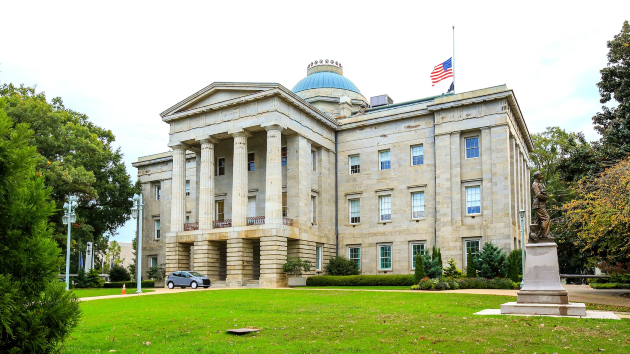
(RALEIGH, N.C.) — North Carolina’s GOP statehouse leaders say the legislature will meet next week to consider redrawing the state’s congressional districts, saying they want to bolster President Donald Trump as the White House continues to encourage Republicans to redistrict mid-decade ahead of next year’s midterm elections.
“President Trump earned a clear mandate from the voters of North Carolina and the rest of the country, and we intend to defend it by drawing an additional Republican Congressional seat,” state Rep. Destin Hall, the speaker of the North Carolina House, wrote in a blog post on Monday.
The Republican-controlled legislature was already scheduled to meet next week. Although North Carolina Gov. Josh Stein is a Democrat, the state’s constitution doesn’t allow him to veto redistricted legislative or congressional maps.
North Carolina’s congressional map is currently being litigated in multiple ongoing lawsuits, according to a roundup from NYU’s Brennan Center for Justice, over allegations the map racially discriminates and is a partisan gerrymander.
Currently, 10 Republicans and four Democrats make up North Carolina’s congressional delegation.
Sen. Phil Berger, the Senate majority leader, wrote Monday, “Picking up where Texas left off, we will hold votes in our October session to redraw North Carolina’s congressional map to ensure Gavin Newsom doesn’t decide the congressional majority,” referencing the the California governor’s Proposition 50 special election, when voters will decide if they want to adopt a map that could help Democrats flip five seats.
House Redistricting Chairmen Brenden Jones and Hugh Blackwell said in a joint statement: “We’re stepping into this redistricting battle because California and the radical left are attempting to rig the system to handpick who runs Congress. This ploy is nothing new, and North Carolina will not stand by while they attempt to stack the deck. President Trump has called on us to fight back, and North Carolina stands ready to level the playing field.”
In response, North Carolina Democratic Party Chair Anderson Clayton called state Republican leaders subservient to Trump and guilty of corruption.
“North Carolina Republicans Phil Berger and Destin Hall are weak subservient cowards willing to steamroll the people of our state so they can give Donald Trump what he wants — power without accountability. Today, [North Carolina General Assembly] Republicans announced they will be tearing up our already brutally gerrymandered congressional maps and redrawing them to give more seats to Congressional Republicans. Let me be clear: maps should not give you power; voters should. When politicians pick their voters instead of voters picking their politicians, that’s not democracy. That’s corruption,” Clayton said in a statement to ABC News.
Stein responded on Monday to the GOP statehouse leaders’ announcement by slamming them for failing voters and calling out how the state legislature has yet to pass a budget.
“The General Assembly works for North Carolina, not Donald Trump,” Stein wrote.
“The Republican leadership in the General Assembly has failed to pass a budget, failed to pay our teachers and law enforcement what they deserve, and failed to fully fund Medicaid. Now they are failing you, the voters. These shameless politicians are abusing their power to take away yours.”
North Carolina Democrats are planning an anti-redistricting rally on Oct. 21 in Raleigh.
(WASHINGTON) — Speaker Mike Johnson dismissed the possibility he could change his strategy to end the government shutdown by negotiating legislative changes with Democrats, telling reporters on Tuesday that he doesn’t “have any strategy” to end the impasse in place of the GOP’s lackluster pressure campaign to pass a “clean” continuing resolution.
Johnson on Tuesday pushed Democrats to support the House-passed funding bill and slammed the Democrats’ $1.5 trillion proposal, which extends health care subsidies under the Affordable Care Act and reverses cuts to Medicaid.
against Democrats has so far failed to break the standoff, Johnson reiterated that the House-passed bill is a “clean” continuing resolution — free from legislative gimmicks or political games.
“Why don’t I change my strategy? I don’t have any strategy,” the speaker told reporters. “I’m doing the right thing, the clearly obvious thing, the traditional thing.”
Asked whether he may consider a different negotiation track as the pressure campaign against Democrats has so far failed to break the standoff, Johnson reiterated that the House-passed bill is a “clean” continuing resolution — free from legislative gimmicks or political games.
“Why don’t I change my strategy? I don’t have any strategy,” the speaker told reporters. “I’m doing the right thing, the clearly obvious thing, the traditional thing.”
The Senate is set to vote Tuesday night — its eighth time — on the GOP-backed “clean” continuing resolution that would fund the government. It’s expected to fail again as the shutdown enters its third workweek.
Congressional Democrats representing Maryland and Virginia — where a significant number of federal workers reside — criticized Republicans over the shutdown on Tuesday morning and supported the workers.
“What we have seen happen to our federal employees we will continues to speak out against,” Sen. Angela Alsobrooks, a Maryland Democrat, said. “We want them to know we appreciate them, we appreciate your service to our country, we still need you, we still need what you offer our country and we will continue to work until you can be able to offer it.”
Democratic Sen. Chris Van Hollen of Maryland said President Donald Trump and Office of Management and Budget Russ Vought are “viscously” attacking federal employees.
OMB is working on ways to get paychecks to federal law-enforcement officers amid the ongoing shutdown, according to an OMB official. This comes after recent moves to pay members of the military and fund the critical Special Supplemental Nutrition Program for Women, Infants, and Children program.
Trump said he’s directing Defense Secretary Pete Hegseth to use “all available funds” to pay members of the military on Wednesday, Oct. 15 despite the shutdown.
A senior Trump administration official said on Tuesday that the military pay will come from the Department of Defense’s research and development funds — winning approval from Speaker Johnson.
“Look, my understanding of this is they have every right to move the funds around, duly appropriated dollars from Congress to the Department of Defense,” Johnson said Tuesday. “If the Democrats want to go to court and challenge troops being paid, bring it. OK?”
OMB said on its X account on Tuesday that the Trump administration is “making every preparation” to ride out the government shutdown without caving to Democrats’ demands. The agency said they’d continue cutting the federal workforce in the meantime.
“Pay the troops, pay law enforcement, continue the RIFs, and wait,” the post said.
Lawmakers are still in a stalemate with negotiations at a standstill.
“We’re barreling toward one of the longest shutdowns in American history,” Johnson said on Monday.
The record is 35 days and that was set in Trump’s first term.
House Minority Leader Hakeem Jeffries said during an MSNBC interview Monday that he does not believe the American people will allow the federal government shutdown to proceed much longer because they’ll pressure Republicans to negotiate with Democrats.
Jeffries said Republicans remain unwilling to negotiate over health care as the shutdown continues.
“House Republicans have actually canceled votes for the third consecutive week because they’d rather keep the government shut down than deal with the cost-of-living crisis that exists in the United States of America,” Jeffries said.