(WASHINGTON) — Dr. Rochelle Walensky, the director of the Centers for Disease Control and Prevention, is leaving the agency, President Joe Biden announced.
“She led a complex organization on the frontlines of a once-in-a-generation pandemic with honesty and integrity,” Biden said in a statement. “Dr. Walensky leaves CDC a stronger institution, better positioned to confront health threats and protect Americans.”
“We have all benefited from her service and dedication to public health, and I wish her the best in her next chapter,” Biden added.
Walensky will step down at the end of June.
While Walensky helmed the nation’s public health agency throughout the pandemic, her tenure was not without faults, including those she acknowledged in a review conducted last summer.
“For 75 years, CDC and public health have been preparing for COVID-19, and in our big moment, our performance did not reliably meet expectations,” Walensky said in August.
(NEW YORK) — Brandon Presley doesn’t want to be compared to Kentucky Gov. Andy Beshear or any of the other Democratic governors elected in recent cycles to serve in reliably red states like Kansas and Louisiana.
“Let me be clear about this … I’m my own man,” Presley in an interview with ABC News.
Presley is a Mississippi public service commissioner and former mayor of Nettleton, Mississippi, who happens to share a paternal great-grandfather with Elvis. And he’s battling in one of 2023’s trio of gubernatorial races.
Looking to flip a seat for the first time in two decades by defeating incumbent Republican Tate Reeves is a tall order. But the challenge has excited some Democrats in and outside of the state, where party strategists maintain that a path to victory, however narrow, does exist.
“I think statistically, one of the hardest races to win is against an incumbent governor,” Marshall Cohen, a former political director at the Democratic Governors Association, told ABC News.
“In order to beat an incumbent, you kind of need three things,” Cohen said. “You need a flawed incumbent, you need an above average, good challenger and you need an issue environment that is favorable to the challenger. And I think what you have in Mississippi is really all three of those things.”
Reeves’ flaws, as Cohen described them, include a scandal involving how millions of dollars in welfare funds were used by a state department under the previous administration, when Reeves was lieutenant governor. (“If you look at the initial forensic audit that was done, there was a group of individuals that were identified as being fraud, waste and abuse,” Reeves has said in response to the controversy. “We are going to go after every single one of those.”)
Reeves was elected governor in 2019 by about 5 points, or 45,000 votes, over Democrat Jim Hood.
Another potential boon, as political experts see it, is Presley’s base of support so far: Over his four terms serving on the Mississippi Public Service Commission and as mayor of Nettleton before that, he has repeatedly been elected in the rural northeastern region of the state, which Donald Trump swept in both 2016 and 2020.
“Brandon’s from a good part of the state to be from, he’s obviously got a golden last name and he’s a campaigner and Bennie Thompson is really squarely in his corner, which I think can help,” said James Carville, a longtime southern Democratic strategist, referring to Presley’s early support from Rep. Bennie Thompson, Mississippi’s only elected Democrat in state or federal office.
Thompson did not endorse then-Attorney General Jim Hood when Hood ran against Reeves in 2019.
“I think we have a real chance,” Carville said. “I really like our candidate, I really don’t like the incumbent. I’ve got a lot of friends in Mississippi, I’m trying to help him win anywhere I can.”
Reeves’ record includes cutting taxes, increasing teacher pay and boosting job development. He has also touted his efforts to improve education in the state, though his tenure in elected office is more complicated, observers say.
He abruptly changed course on one signal issue that divides him from Presley, however: expanding Medicaid in the country’s poorest state. In February, he said he would support the Legislature allowing women to use Medicaid for a year after giving birth — though he did not change his position on expanding Medicaid to working people with low-wage jobs that don’t provide private insurance.
Presley has said that on “day one” of his tenure as governor, if elected, he would “expand Medicaid and give 220,000 people health care that today Tate Reeves does not care about.”
He has also said that one of the first things he would do in office would be to call a special session of the Legislature for ethics reform to “scrub and sanitize this infected system and clean it up.”
The Reeves campaign did not respond to multiple requests for comment for this story. Earlier this week, he linked Presley to out-of-touch Democrats.
“This is a different governor’s campaign than we have ever seen before in our state because we are not up against a local yokel, Mississippi Democrat,” Reeves said at an event on Wednesday for his formal reelection launch on the Gulf Coast. “We are up against a national liberal machine. They are extreme. They are radical and vicious.”
“They believe that taxes are good and businesses are bad,” Reeves said. And, “They think they can teach all of us Mississippians a lesson. They do not like who we are and they do not like what we believe. They look at all we have accomplished as conservatives and they hate it.”
Presley pushed back on that in his interview with ABC News. “Principles that are totally true to me are not true to national political issues, but true to Brandon Presley and true to the average Mississippian that just simply needs a governor on their side,” he said.
On Wednesday, Presley’s campaign released their first round of fundraising numbers and said they had brought in $1.35 million, “more than any other Democratic gubernatorial candidate ever in this period” — and nearly twice as much as Hood in 2019.
Even so, such a sum is dwarfed by Presley’s rival: According to records filed with the Mississippi Secretary of State’s Office, Reeves began the year with nearly $7.9 million in campaign funds.
The Democratic Governors Association has been clear that their priorities in 2023 are to see Beshear reelected in Kentucky — where he won, narrowly, in 2019 against an unpopular incumbent and with his own locally famous last name — and to try and maintain control of the governorship in Louisiana after term-limited Gov. John Bel Edwards steps down. But in Mississippi, they see a real shot at picking up a seat.
“The DGA has a strong record of beating incumbent Republican governors in some of the toughest environments – including Kentucky, North Carolina and Wisconsin – and Mississippi is a real opportunity to do that again in 2023,” said DGA Communications Director Sam Newton, echoing DGA chariman New Jersey Gov. Phil Murphy’s calls for attention on the “sleeper” race.
Republicans, though acknowledging the race could be more competitive than it might seem, given Mississippi’s history, have said the state is safe for Reeves and that any buzz around it is manufactured.
“The Democrats are desperately trying to create a mirage in Mississippi. I think that they are more focused on a national narrative than on what’s actually happening on the ground in Mississippi and what Mississippi families care about,” said Daniel Scarpinato, senior communications adviser to the Republican Governors Association.
“The reality is, this is still a conservative state,” Mississippi GOP strategist Austin Barbour said. “This is still a race where Tate Reeves is the favorite.”
Ahead of the general election on Nov. 7, Reeves will have to defeat two long shot primary challengers, despite previous rumblings from others — including state House Speaker Philip Gunn and Mississippi Secretary of State Michael Watson — as he’s faced some disagreements with members of his own party that have since abated.
“You have a strong conservative element here, and they’re going to fight for what they believe in,” said one of Reeves’ previous detractors, state Sen. Chris McDaniel.
“Ultimately, in November, despite subtle differences, the party is going to unify around conservatives. And I think when they do that, I think that’s going to lead the Democrats out,” McDaniel said.
Who is Brandon Presley?
Presley, 45, is a resident of Tupelo, Elvis’ birthplace. He is planning to get married to his girlfriend, Katelyn Mabus, next month.
He’s said he was raised in poverty in nearby Nettleton by a single mother after his father was killed on the first day of his third-grade school year.
“I’m probably the first man elected to the government that has ever gotten a shutoff notice and had their electricity cut off growing up,” Presley said. “I know where people are because I have lived that life … I think that’s what makes me a much different type of candidate than what’s been seen in Mississippi and many other places. I’ve been there, and I am not the least bit ashamed of the abject poverty that I grew up in. It’s made me who I am.”
He was elected mayor of Nettleton at the age of 23. In that role, he has said he’s most proud of his work cutting taxes.
In his time as a public service commissioner, he boasts of how he was able to open up and livestream otherwise closed meetings and expand internet access across his rural district.
Presley describes himself as “pro-life” Democrat, “with the exception of rape” and “life of the mother,” which is in keeping with the convictions of some other red state members of his party like Bel Edwards.
Still, for Presley, many people may first learn about him in relation to the rock ‘n’ roll legend known as “the King.”
“I can sing a little bit, but I’m scared too, because I might lose votes,” he joked.
But he quickly pivoted back to his platform, including his support for Medicaid expansion, an issue compounded by the specter of rural hospitals closing across the state.
“Our state takes a lot of pride in being the birthplace of Elvis,” Presley said. “And so I’m proud to tell those stories — and then get right back to talking about, through those same voters, what a corrupt system we have and what expanding Medicaid would mean.”
(WASHINGTON) — A new piece of legislation being introduced this week would make sharing non-consensual AI-generated pornography illegal in the United States, and open up new legal avenues for those impacted.
“This bill aims to make sure there are both criminal penalties, as well as civil liability for anyone who posts, without someone’s consent, images of them appearing to be involved in pornography,” explained Congressman Joe Morelle who authored the Preventing Deepfakes of Intimate Images Act.
The rise of AI-generated content has exploded in recent years due to the accessibility and ease of use of tools that allow users to create hyper-realistic synthetic media.
Although a fabricated image of Pope Francis in a puffer jacket grabbed international headlines earlier this year, there’s a dark underbelly that doesn’t always make it into the public sphere — a large percentage of deepfakes are pornographic, non-consensual, and involve primarily women.
In 2019, synthetic media expert Henry Ajder and his colleagues set out to map out the state of deepfakes online. They found that 96% of the 14,000 deepfake videos found online were porn.
“If we fast forward to today, that number is infinitesimally small compared to the landscape as it is now,” Ajder told ABC News. “And that’s because these tools have become so much more accessible, awareness of these technologies has really grown. And so, I think we’re in a position now where we’re talking probably millions of women as victims.”
Deepfake pornography is often referred to as described by advocates as image-based sexual abuse — a term that also includes the creation and sharing of non-fabricated intimate images.
A few years back, a user needed to have a certain level of technical skills to create AI-generated content, but now it’s just a matter of downloading an app or clicking a few buttons.
Now experts say there’s an entire commercial industry that thrives on creating and sharing digitally created content of sexual abuse, including websites that have hundreds of thousands of paying members.
Dr. Mary Anne Franks, a law professor and president of the Cyber Civil Rights Initiative, a non-profit organization dedicated to combatting online abuse, explained that it’s hard to undo the harm once this content, real or fabricated, is shared publicly.
“It is not just the psychological harm, the intense depression, the anxiety, but also the economic consequences, because it can lead to further harassment online, online and offline harassment, requiring a lot of victims to invest in security systems or change the way that they go to work or go to school,” she added.
“My face has been digitally plastered countless times over other people’s naked bodies to create sex content I never consented to,” revealed Gibi, a popular YouTuber, in a video she posted in 2022.
“Porn of myself, I never created, has been viewed, distributed, and sold. It has been used to threaten and humiliate me in an attempt to grab power from myself. And my reality is not unique,” she added.
In a tearful video, a Twitch streamer who goes by QT Cinderella describes finding out how she became the subject of digitally created images of abuse and the toll it took on her.
“It should not be part of my job to have to pay money to have this stuff taken down, it should not be something that is found on the internet,” she said earlier this year.
Experts like Dr. Franks agree that the burden of seeking justice should not fall on the victim, but more should be done to deter perpetrators.
“Our emphasis at the Cyber Civil Rights Initiative has always been on trying to deter this behavior before it starts,” Franks told ABC News.“And that’s really hard to do unless you have a clear criminal prohibition that makes people worried that if they do this, they would face serious penalties.”
That’s exactly what Congressman Morelle hopes to achieve with his new legislation.
“This [bill] will signify to people who are posting this material, that it’s not going to be a free ride anymore, they’re not going to be able to be shielded from prosecution potentially. And they’re not going to be shielded from facing lawsuits,” he added.
(WASHINGTON) — Americans divide closely on whom they’d blame if the federal government defaults on its debts, even as most align with the Biden administration’s position on how Congress should handle the issue.
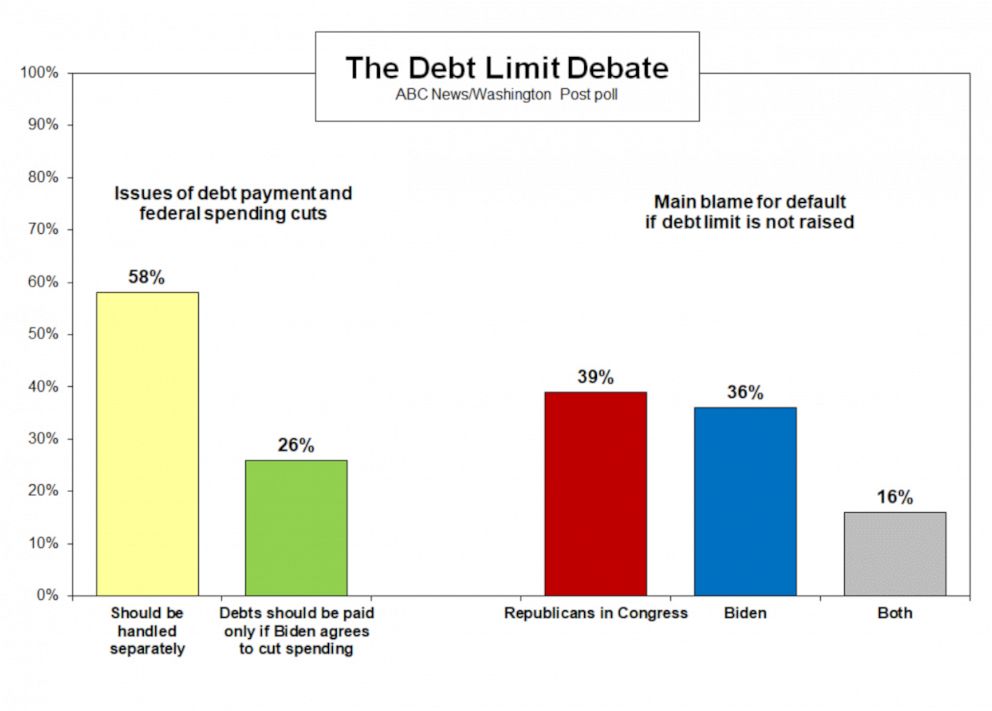
If default occurs — as Treasury Secretary Janet Yellen said Monday could happen by June 1 — 39% in this ABC News/Washington Post poll say they’d mainly blame the Republicans in Congress, while virtually as many, 36%, say they’d mainly blame Biden. Sixteen percent volunteer that they’d blame both equally.
That looks like a messaging snafu on President Joe Biden’s part, since many more people take his side than the Republican position on the issue. Fifty-eight percent say debt payment and federal spending cuts should be handled separately, as Biden has argued. Far fewer, 26%, take the GOP view that Congress should let government pay its debts only if the administration agrees to spending cuts.
Support for Biden’s position on the debt ceiling has lost 7 percentage points since February, dropping from 65% to 58% in this poll, produced for ABC by Langer Research Associates. However, the share who favor linking the debt ceiling with spending cuts has not grown; instead, more now are undecided.
Groups
While there are wide partisan differences in these views, it’s notable that 46% of Republicans part company with the party’s leadership in Washington and say the issues should be kept separate; 40% of Republicans instead favor linking them. Preference to keep debt payments and federal spending cuts as separate issues reaches 58% among independents and 74% among Democrats. (Both are down from the levels last month, when the question was preceded by one on concern about a default.)
In ideological terms, 75% of liberals and 61% of moderates prefer keeping the issues separate — as do 56% of people who describe themselves as somewhat conservative. This flips among those who are very conservative. In this group, just 36% favor separation, while 52% say the government should be allowed to pay its debt only if spending cuts are included.
Who’d actually take the blame in a default depends on the eventual circumstances. But as things stand, views are highly partisan. Among Republicans, 78% would mainly blame Biden. Among Democrats, 78% would mainly blame the Republicans in Congress. And independents divide three ways, but with a slight tilt in Biden’s favor: Thirty-seven percent say they’d mainly blame the GOP; 29%, mainly Biden; and 24%, both equally.
Methodology
This ABC News/Washington Post poll was conducted by landline and cellular telephone April 28 to May 3, 2023, in English and Spanish, among a random national sample of 1,006 adults. Partisan divisions are 26-25-41%, Democrats-Republicans-independents. Results have a margin of sampling error of 3.5 percentage points, including the design effect. Sampling error is not the only source of differences in polls.
The survey was produced for ABC News by Langer Research Associates, with sampling and data collection by Abt Associates of Rockville, Maryland. See details on the survey’s methodology here.
(NEW YORK) — Former President Donald Trump on Thursday sought to move his New York City criminal case to federal court since, his lawyers said, “the indictment charges [him] for conduct committed while he was President of the United States that was within the ‘color of his office.'”
Trump has pleaded not guilty to a 34-count indictment charging him with falsifying business records in connection with hush money paid to adult film actress Stormy Daniels before the 2016 presidential election.
Trump’s then-personal attorney Michael Cohen wrote the check and Trump reimbursed him with a series of monthly payments.
“This case is unprecedented in our nation’s history. Never before has a local elected prosecutor criminally prosecuted a defendant either for conduct that occurred entirely while the defendant was the sitting President of the United States or for conduct that related to federal campaign contribution laws,” Trump’s defense attorney Susan Necheles wrote in the motion.
Trump’s filing called the indictment “politically motivated” — brought because Manhattan District Attorney Alvin Bragg “disfavored President’s Trump’s acts and policies as President of the United States.”
Necheles argued federal courts have so-called “protective jurisdiction” over this case.
Trump himself has maintained prosecutors have “no case” and wrote on social media last month, “There was nothing done illegally!”
Defense attorney Todd Blanche informed Judge Juan Merchan, who is presiding over the case in New York state Supreme Court, about Trump’s intention at the conclusion of a hearing earlier Thursday related to a protective order in the case.
Prosecutors did not immediately address it. A spokeswoman for Bragg said later Thursday that “we are reviewing the notice of removal and will file an appropriate response in court.”
Merchan asked in court that both sides agree to a trial date in either February or March 2024, putting Trump’s trial in the middle of primary season as he seeks the presidency for a third time.
Once the date is set, the judge said no one associated with the case, including Trump, should schedule anything to interfere.
“He cannot agree to any speaking engagements, appearances,” Merchan said.
Merchan agreed to a request from the Manhattan district attorney’s office for an order meant to prevent Trump from attacking certain individuals associated with the case or speaking about specific evidence obtained through discovery. But he said he would not stop Trump from speaking generally about the case on the campaign trail.
“I’m straining to give him every opportunity to make his candidacy,” Merchan said. “This is not a gag order.”
Merchan also agreed with the district attorney’s office to set up a virtual hearing Trump will be required to attend at which the protective order will be read to him.
Assistant District Attorney Catherine McCaw said in court that Trump “has an extensive history” of making inflammatory remarks about witnesses, prosecutors and others associated with legal matters pending against him. However, she said, Trump will continue to have “many avenues” to discuss the case.
Blanche said he did not object to an order “limiting dissemination” of evidence by Trump on social media but he insisted Trump’s public defense “may include commentary on evidence.”
“Obviously Mr. Trump is different,” Merchan conceded. “It would be foolish of me to say he isn’t. He’s a former president and he’s running again.”
The judge added that Trump’s special status comes with a responsibility to recognize “his words do have consequences.”
(WASHINGTON) — The Biden administration on Thursday adamantly denied U.S. involvement in an alleged drone attack on the Kremlin after a spokesman for Russian President Vladimir Putin accused the U.S. of directing Ukraine in carrying it out.
While the United States may never “fully understand” what occurred in Russia on Wednesday, the U.S. “was not involved in this incident in any way,” according to National Security Council spokesman John Kirby.
“One thing I can tell you for certain is that the United States was not involved in this incident in any way contrary to Mr. Peskov’s lies,” he continued, referring to Putin’s spokesman, Dmitry Peskov. “And that’s what they are, just lies.”
Kirby, taking another shot at Peskov from the White House podium, called his accusations a “blatant, bold lie.”
Earlier Thursday, Russia accused the U.S. of helping Ukraine orchestrate what Moscow claimed was an assassination attempt against Putin.
“We understand well that the decision about such terror attacks are taken not in Kyiv, but in Washington. Often targets are determined not in Kyiv, but in Washington,” Peskov told reporters.
The Kremlin provided no evidence to back up its claims.
State media released videos Wednesday appearing to show two drones exploding above the Senate Palace — an alleged attack that Ukrainian President Volodymyr Zelenskyy said “allows Russia to try to justify its escalating terrorist tactics.” Putin was not in the building at the time, the Kremlin said.
Asked whether the U.S. had authenticated any of the videos of the alleged drone attack or confirmed such an attack took place, Kirby said no.
“We’re still trying to gather information about what happened and we just don’t have conclusive evidence one way or the other,” Kirby told reporters at Thursday’s daily briefing, adding he was “not going to speculate.”
Director of National Intelligence Avril Haines similarly said U.S. intelligence agencies “don’t have information that would allow us to provide an independent assessment on this.”
Haines made the remark during a Senate Armed Services Committee hearing on worldwide threats on Thursday.
Kirby told reporters he didn’t know whether the alleged drone attack was a false flag operation, but he did say it fit Putin’s narrative that Russia is under existential threat from the West.
“Whether he’s going to use this as some sort of pretext is up to him,” Kirby said. “But just in the last 24 hours, he’s bombing shoppers at a supermarket. So, the violence continues one way or the other.”
During the same Senate hearing at which Haines testified, Lt. Gen. Scott Berrier, the director of the Defense Intelligence Agency, suggested amid questioning from GOP Sen. Tom Cotton that misinformation could be at play.
Cotton questioned the capabilities of the drones used, asking, “These videos I’ve seen, they do not appear to be the kind of the size of weapons that can do significant damage to the Kremlin. Is that correct?”
“That is correct,” Berrier replied.
Cotton also implied the drones would have had to be controlled by line of sight locally based on their appearance, which Berrier agreed with.
Haines confirmed that Putin does not spend much time at the Senate Palace, which Cotton noted is “not like the White House” in the sense that it is not the Russian leader’s primary residence.
Russia has suffered over 100,000 casualties, including over 20,000 killed in action, since it stepped up its winter offensive in December, a representative for the NSC told ABC News. Ukraine has lost roughly the same number, according to Pentagon documents that were leaked last month.
-ABC News’ Nathan Luna, Justin Gomez and Patrick Reevell contributed to this report.
(NEW YORK) — Florida mayors across the state are speaking out in support of LGBTQ rights in light of several bills targeting the community that have been passed by the state legislature and are heading to the desk of Gov. Ron DeSantis.
At least eight mayors from Orlando, Miami Beach, Tampa, Tallahassee and more have signed the pledge in support of the LGBTQ advocacy organization GLSEN and its Rise Up campaign, according to the group.
Several local leaders issued city proclamations, which promised “safe learning environments that include and affirm all children, including LGBTQ+ students,” one proclamation read.
“I was elected to be mayor for every resident of Gainesville, and it is important to me that all our neighbors, particularly the youngest and most vulnerable, feel welcome and safe in our community,” Gainesville Mayor Harvey Ward told ABC News in a statement.
He continued, “I support the well-being and healthy development of every person in our community through the guarantee of basic human rights.”
The Rise Up campaign also advocates for LGBTQ affirming books, resources and curriculum, as well as advocacy against anti-LGBTQ bills and rhetoric.
“In Fort Lauderdale, you can be who you are without fear of reproach,” said Fort Lauderdale Mayor Dean Trantalis in a statement. “The city boasts a stalwart human rights ordinance that bans discrimination based on sexual orientation and gender identity in areas of employment, housing, and public accommodations.”
Trantalis continued, “Discrimination of any kind, particularly towards our LGBTQ+ children, has no place in any part of our society. Greater Fort Lauderdale boasts one of highest concentrations of same-sex households in the nation, and we welcome in an average of over 1.3 million LGBTQ+ visitors each year.”
Florida has been been leading the recent wave of legislation and policies targeting the LGBTQ community.
The bills passed by the Florida legislature Wednesday include a bathroom bill that bars transgender people from using restrooms or changing facilities that do not align with their gender assigned at birth.
Another bill expands the Parental Rights in Education law, which has been dubbed the “Don’t Say Gay” law by critics. This bill would restrict classroom instruction on gender identity or sexual orientation from prekindergarten through grade 12. However, the Florida Board of Education had already voted to expand the restriction from kindergarten through 12th grade.
The bill says school employees and students “may not be required” to refer to “another person using that person’s preferred personal title or pronouns” if they “do not correspond to that person’s sex” as assigned at birth, and would bar school employees from using pronouns or names that “do not correspond to his or her sex,” according to the bill.
Teachers would also not be allowed to ask students for their preferred pronouns or name.
The bill encourages education on “abstinence from sexual activity” and “the benefits of monogamous heterosexual marriage.”
The legislation also states that parents may object to school or library books, which must then “be removed within 5 school days of receipt of the objection and remain unavailable to students of that school until the objection is resolved.”
Critics slammed the legislation, saying that the bill not only removes and silences LGBTQ identities from classrooms and school programs, but also that the restrictions are a form of censorship against certain perspectives.
“Why can’t we teach our kids that these things exist in the world? What are you protecting them from?” said state Sen. Tina Polsky on the Senate floor. “If you’re in public school, you need to be with all the public. And this is a fact of life and you can’t change it by telling people what pronouns they can use.”
Those in support of the legislation say it gives some parents more of a say in what children learn at school and claim children will have more space to figure out “who they are,” Republican state Sen. Erin Grall says.
“We are depriving children of the ability to figure out who they are when we push an agenda … down onto children,” Grall said on the Senate floor.
Florida’s largest LGBTQ civil rights group Equality Florida has issued a travel advisory for the state, backed by the Florida chapters of the NAACP and the Florida Immigrant Coalition.
A spokesperson for DeSantis’ office called the move a “stunt” at the time.
“We aren’t going to waste our time worrying about political stunts. We will continue doing what is right for Floridians,” the statement read.
(WASHINGTON) — After a trial lasting several months, a jury in Washington on Thursday handed the Justice Department a major victory, reaching a partial verdict in the Proud Boys Jan. 6 seditious conspiracy case.
Proud Boys leader Enrique Tarrio was convicted of seditious conspiracy for his role in the Jan. 6 attack on the Capitol.
Three of the far-right group’s lieutenants also were found guilty of conspiring to disrupt the certification of the 2020 election and prevent Joe Biden from becoming president of the United States.
Tarrio and Ethan Nordean, Joe Biggs, Zachary Rehl were found guilty of seditious conspiracy, conspiracy to obstruct the certification of the 2020 election, actual obstruction of the certification, conspiracy to prevent officers from performing their duties, obstruction of law enforcement during civil disorder and aiding and abetting in destruction of government property.
The Proud Boys leaders were acquitted charges they assaulted, impeded or resisted officers.
Deliberations continued for the seditious conspiracy and conspiracy to obstruct an official proceeding charges for Dominic Pezzola.
Tarrio was not present in Washington on Jan. 6 after his arrest on separate charges just days before. Prosecutors argued he directed his troops remotely with messages about revolution and telling them “don’t f—ing leave” after the building was breached that afternoon.
Tarrio was accused of orchestrating a fighting force with a group they called the “Ministry of Self Defense” comprised of dedicated Proud Boys and top leaders.
Tarrio’s conviction follows the case of Stewart Rhodes, leader of another far-right group called Oath Keepers, who was convicted of seditious conspiracy for his role in the events of Jan. 6.
Video of the two ringleaders meeting in a Washington parking garage on the eve of Jan. 6 was part of the volumes of footage obtained by the Justice Department in the case.
Membership in the Proud Boys surged after then-President Donald Trump told the group to “stand back and stand by” during a 2020 presidential debate. Tarrio’s attorneys blamed Trump for encouraging and revving up the crowd that ultimately broke into the Capitol.
Thursday was the seventh day of deliberations during which jurors asked multiple questions.
With dozens of witnesses and mountains of video and social media evidence, the Proud Boys trial has been the longest to date in the Justice Department’s pursuit of Capitol rioters.
Since jury selection began in December, the case has dragged on with bitter arguments, frequent objections and mistrial motions. At times, Judge Timothy Kelly lost his temper and admonished the lawyers for interrupting or seeming to ignore his directions.
The Proud Boys insisted there were no plans to attack the Capitol and sought to cast themselves as nothing more than a hard-charging social club in which partying, drinking and exchanging crude jokes went along with attending political protests.
The group also describes themselves as “Western chauvinists,” an unapologetic brand of fervent nationalism.
Prosecutors emphasized to the jury that the Proud Boys did not need to have detailed — or successful — plans to be found guilty. The conspiracy allegations hinged on their mutual understanding to oppose the government by force.
This is a developing story. Please check back for updates.
(NEW YORK) — Former President Donald Trump will try to move the criminal case brought by the Manhattan district attorney’s office into federal court, his attorneys said Thursday.
Defense attorney Todd Blanche informed the judge of the impending motion at the conclusion of a hearing about a protective order in the case.
Judge Juan Merchan said he would impose an order to prevent Trump from attacking individuals associated with the case or speaking about specific evidence obtained through discovery, but said he would not stop Trump from speaking generally about the case.
“I’m straining to give him every opportunity to make his candidacy,” Merchan said. “This is not a gag order.”
Merchan asked both sides to agree to a trial date in either February or March 2024, meaning the criminal trial could occur in the heart of campaign season.
Once the date is set, the judge said no one associated with the case, including Trump, should schedule anything to interfere.
“He cannot agree to any speaking engagements, appearances,” Merchan said.
(WASHINGTON) — The already fierce debate over the debt ceiling turned more contentious this week as Republicans and Democrats feud over the politically explosive issue of veterans’ health care and other benefits.
Democrats can be expected to hit their claims hard when the Senate Budget Committee holds a hearing Thursday on the potential impact of House Republicans’ 2024 budget.
President Joe Biden and his congressional allies are accusing House Republicans of voting to cut funding for veterans’ services when they narrowly passed the budget proposal last week.
Republicans have shot back that Democrats are “shamelessly lying.”
The bitter back-and-forth comes as lawmakers face a fast-approaching June deadline to reach a solution on the debt ceiling or risk an unprecedented default that would wreak havoc on the economy.
House Speaker Kevin McCarthy and Biden are set to meet next week for their first conversation on the issue in months. Biden’s insisted the debt ceiling be raised without conditions on spending while Republicans are demanding steep cuts in exchange for a one-year debt ceiling increase.
The House GOP’s Limit, Save, Grow Act would revert government spending to pre-inflationary, fiscal year 2022 levels, which would amount to a cut of 22% across agencies, and limit spending increases to 1% per year.
The bill, however, doesn’t specify the exact agencies or programs that would be on the chopping block.
“The budget itself is silent on veterans and the Veteran Affairs budget,” Carrie Farmer, the co-director of the RAND Epstein Family Veterans Policy Research Institute, told ABC News. “So, it doesn’t specifically cut the VA budget, but it also doesn’t specifically protect the VA budget.”
The lack of a carve-out for benefits has been a point of concern for major veterans’ groups. More than 20 organizations wrote a letter to Congress last week protesting the budget and urging lawmakers to add in such protections.
“If the proposed budget reductions were applied across-the-board, the impacts would significantly affect the delivery of care and benefits to veterans,” the groups wrote, citing figures from Veterans Affairs that the budget could result in 81,000 jobs cut and 30 million fewer outpatient visits.
It’s also opened Republicans up to attacks from Democrats, with Biden trolling the party on Twitter.
I hear House Republicans out on TV saying they would never vote to cut veterans’ benefits.
In case there’s any confusion, I made a little chart that could help them out. pic.twitter.com/SVvamK3KC2
Republicans have pushed back, stating congressional appropriators will take care to protect veterans and defense funding as they determine what exactly will be cut.
“Republicans have always prioritized veterans in our budgets to ensure the men and women who have served have access to the care, benefits, and services they have earned,” House GOP leaders wrote in a press release.
“Joe Biden and the Democrats are yet again shamelessly lying to the American people,” Rep. Elise Stefanik, the No. 3 House Republican, tweeted on Monday.
Marc Goldwein, the senior policy director of the Committee for a Responsible Federal Budget, said it’s “misleading” for the Biden administration to connect the budget as is to a specific list of policies such as VA job cuts or reduced telehealth infrastructure.
But he noted critics have a “very good point” that the overall discretionary spending caps sought by Republicans could have an impact on veterans.
“It would be very hard to meet those caps without touching veterans or defense,” he told ABC News. “It would mean very deep cuts for everything else.”
Farmer echoed that analysis, stating it would be “challenging” but perhaps not impossible to meet their proposed spending cuts without touching discretionary VA funding.
“Like anything else, the devil’s in the details of how it is implemented,” she said.