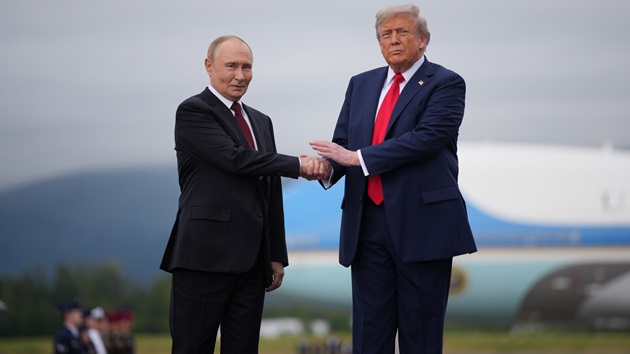
U.S. President Donald Trump (R) greets Russian President Vladimir Putin as he arrives at Joint Base Elmendorf-Richardson on August 15, 2025 in Anchorage, Alaska. Andrew Harnik/Getty Images
(WASHINGTON) — There are no plans for President Donald Trump and Russian President Vladimir Putin to meet “in the immediate future,” the White House said in a statement on Tuesday — calling off a summit that was expected in Budapest in the coming weeks.
This is a developing story. Please check back for updates.
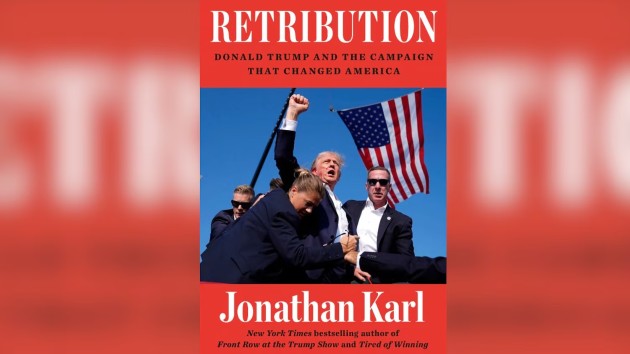
“Retribution,” a new book by Jonathan Karl. Penguin Random House
(WASHINGTON) — Steve Bannon hasn’t worked in the White House for years, but he played a pivotal, and previously unreported, role in the explosive meeting between President Donald Trump and Ukrainian President Volodymyr Zelenskyy earlier this year that changed the course of U.S. policy toward Ukraine.
The story is first reported in an excerpt in The Atlantic magazine from ABC News Chief Washington Correspondent Jonathan Karl’s upcoming book, “Retribution: Donald Trump and the Campaign that Changed America.”
Karl reports on a meeting of Trump’s national security team shortly before Zelenskyy’s visit to Washington in February where Trump stopped the meeting and asked then-national security adviser Michael Waltz to “get Steve Bannon” on the phone.
“Hey, Steve, I’ve got the boys here,” Trump said. “I’m going to put you on speaker.”
Trump, keeping Bannon on speakerphone for half an hour, had the MAGA firebrand make his case to the national security team against the deal, and Zelenskyy, who he referred to as “that punk.”
“I f—— hate it,” Bannon said, arguing that the deal “ties us to Ukraine.”
“If that punk comes here, he’s going to want a security guarantee,” Bannon said of Zelenskyy to Trump and his top advisers. He told the group they “can’t trust Zelenskyy” or “any of the Europeans.”
The previously unreported conversation set the tone for Trump’s combative meeting in the Oval Office with Zelenskyy, which devolved into a tense shouting match in front of reporters and television cameras.
“You’re not acting at all thankful,” Trump said to the Ukrainian leader. “You’re gambling with World War III.”
Zelenskyy left the meeting early that afternoon, and the relationship between the United States and Ukraine was at an all-time low since the start of the conflict with Russia.
While their relationship recovered — Zelenskyy visited the White House this past week seeking more American military assistance — the moment underscored the volatile dynamic between the two leaders, and the abiding influence of Bannon over Trump’s thinking.
In “Retribution,” Karl also reports that Bannon managed to keep in touch with Trump and his camp discreetly from federal prison, while he served four months after he was found guilty of contempt of Congress.
Bannon developed a “coded” system that allowed his daughter and top aide to pass along messages to Trump via the limited email communications he was allowed in prison, which were subject to review by the Bureau of Prisons, according to the excerpt of Karl’s book in The Atlantic.
“Bannon claims that an investigative officer at Danbury — an official he described as ‘pure MAGA’ — had warned him that his communications were being reviewed by ‘Main Justice,’ otherwise known as the Biden administration,” Karl writes.
“So he developed a coded system to let ‘the girls’ know which messages were to be passed on to Trump or to those around him, in particular the aide Boris Epshteyn: “I had just a system to get to Boris, kind of in quasi-code, through [daughter Maureen] into [aide Grace Chong],’ he said. Was there literally a code word? ‘Well, we had — ‘ he began, before catching himself. I don’t — the Bureau of Prisons could go back through it. We had a way that they could get to him,'” Karl writes.
According to Karl, Bannon used the system to tell Trump campaign officials he thought they were making a “huge mistake” by trying to “reduce tensions” across the country after the July 2024 assassination attempt against then-candidate Trump in Butler, Pennsylvania.
Editor’s note: Profanity included in the book has been altered for this account and some text has been edited for style. “Retribution: Donald Trump and the Campaign that Changed America,” by ABC News Chief Washington Correspondent Jonathan Karl, is being published Oct. 28 and is available for preorder at Penguin Random House.
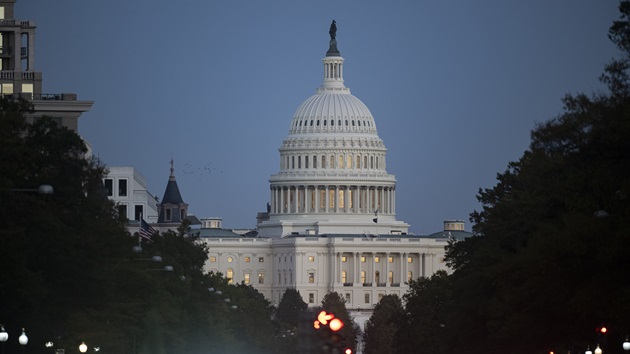
The U.S. Capitol building is seen from Freedom Plaza during the 20th day of the ongoing federal government shutdown in Washington, D.C., United States, on October 20, 2025. Celal Gunes/Anadolu via Getty Images
(WASHINGTON) — One of the biggest impacts of the government shutdown is about to hit tens of millions of the poorest Americans hard: the halting of a critical food assistance program.
Several states are now warning they will be forced to suspend Supplemental Nutrition Assistance Program benefits come Nov. 1 if the shutdown continues.
SNAP, often referred to as “food stamps,” serves roughly 42 million low-income Americans. The program, run by the USDA Food and Nutrition Service, issues electronic benefits that can be used like cash to purchase food.
Texas is now warning its millions of recipients that all November SNAP benefits will be halted if the shutdown continues past Oct. 27.
Pennsylvania officials say they will also not be able to distribute SNAP benefits if the shutdown — now in its 21st day — continues.
“Because Republicans in Washington DC failed to pass a federal budget, causing the federal government shutdown, November 2025 SNAP benefits cannot be paid,” an alert on the state’s Department of Human Services website reads.
Other states such as Minnesota and New York, are issuing similar warnings — saying benefits are “at risk” or “may be delayed” if the shutdown continues.
SNAP has traditionally been entirely federally funded, but is administered by states. That means the shutdown’s impact on SNAP and when benefits will start to dry up will vary state by state.
Earlier this month, the Special Supplemental Nutrition Program for Women, Infants and Children — commonly known as WIC — received $300 million to help support the program amid the shutdown. The White House said it would use tariff revenue to pay for WIC benefits, which help more than 6 million low-income mothers, young children and expectant parents get nutritious foods.
“We welcome efforts to keep WIC afloat during the shutdown, but families need long-term stability, not short-term uncertainty. We still don’t know how much funding this measure provides, how quickly states will receive it, or how long it will sustain operations. There is no substitute for Congress doing its job,” National WIC Association CEO Georgia Machell said in a statement.
In a letter to state health officials earlier this month, Ronald Ward — the acting head of SNAP — warned that “if the current lapse in appropriations continues, there will be insufficient funds to pay full November SNAP benefits for approximately 42 million individuals across the Nation.”
This has already been a tumultuous few months for SNAP. President Donald Trump’s megabill already cut the program by an estimated $186 billion over 10 years.
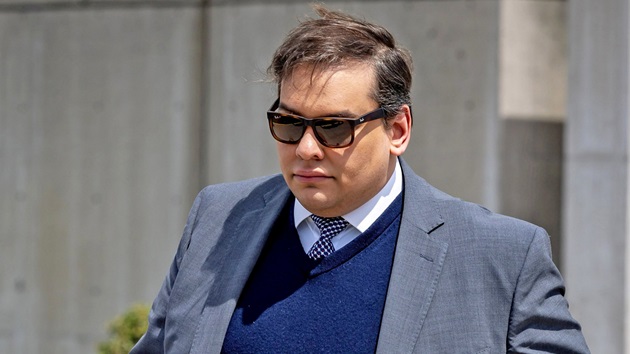
Former Congressman George Santos leaves court after being sentenced to 87 months in prison at the Alfonse D’Amato Federal Court House in Central Islip, New York, on April 25, 2025. J. Conrad Williams Jr./Newsday RM via Getty Images
(NEW YORK) — Former Rep. George Santos, R-N.Y., was freed from prison last week thanks to his federal fraud sentence being commuted by President Donald Trump — but he may not be free from criminal prosecution on the local level.
Prosecutors on Long Island are not ruling out the possibility of bringing local charges, however, the district attorney’s office in Nassau County, which is home to part of the district Santos represented, declined to say what, if anything, prosecutors might be investigating that could warrant state charges.
“Since first learning of George Santos’ actions, I have been at the forefront of bringing him to justice,” Nassau County District Attorney Anne Donnelly said in a statement. “I am proud of the work my office has done, and the conviction achieved in partnership with the U.S. Attorney’s office. While the office cannot comment on ongoing investigations, suffice it to say that I remain focused on prosecuting political corruption wherever it exists regardless of political affiliation.”
A spokeswoman for Donnelly’s office declined to elaborate.
Santos was three months into a seven-year prison sentence for deception, fraud and lying to Congress when Trump intervened, noting Santos had the “courage, conviction and intelligence to always vote Republican.”
This is a developing story. Please check back for updates.
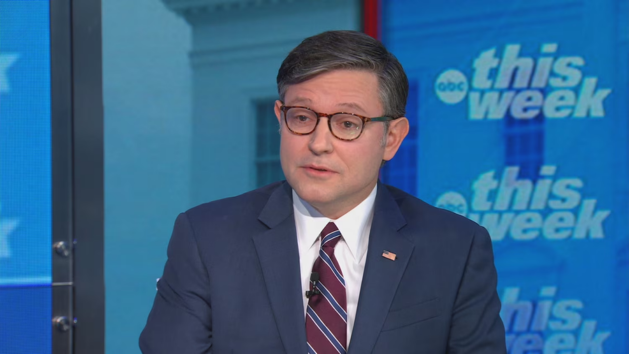
(WASHINGTON) — Speaker of the House Mike Johnson defended labeling this weekend’s “No Kings” rallies opposing President Donald Trump as “hate America” rallies, arguing that he was not referring to Democrats themselves but the message of the protesters.
“Just on this notion that these are, ‘hate America’ rallies — and you not only talked about anarchists, antifa advocates, pro-Hamas wing — you said this is the modern Democratic Party,” ABC News’ “This Week” co-anchor Jonathan Karl asked, referring to comments Johnson made last week. “But I remember not that long ago what you said after the murder of Charlie Kirk when you said that we should view fellow Americans, not as our enemies, but as our fellow countrymen.”
“I’ve never called anybody an enemy,” Johnson said, but claimed that “there were a lot of hateful messages” during Saturday’s protests.
“I mean, we have video and photos of pretty violent rhetoric calling out the president, saying fascists must die and all the rest,” he added. “So it’s not about the people, it’s about the message.”
Pressed by Karl about Johnson likening anarchists, antifa and Hamas to the modern Democratic Party, Johnson defended his remarks.
“I never said it was the whole Democratic Party, but you and I have to acknowledge the reality,” Johnson said before turning his criticism to New York City’s Democratic mayoral candidate Zohran Mamdani.
“Look at what’s happening in New York. They’re about to elect an open socialist Marxist as the mayor of America’s largest city. There’s a rise of Marxism in the Democratic Party. It’s an objective fact, and no one can deny it,” he said.
Mamdani has previously stated he is not a “communist,” as Trump has called him. He identifies as a democratic socialist and has repeatedly claimed that label.
Johnson also argued the “No Kings” branding of the nationwide protests was ironic.
“If President Trump was a king, the government would be open right now. If President Trump was a king, they would not have been able to engage in that free speech exercise out on the (National) Mall,” he said.
Here are more highlights from Johnson’s interview:
On not yet swearing in Democratic Rep.-elect Adelita Grijalva Karl: When are you going to swear in Representative-elect Adelita Grijalva?
Johnson: As soon as we get back to legislative session, when Chuck Schumer allows us to turn the lights back on.
Karl: Why haven’t you done already?
Johnson: Because this is the way the institution works. I’m following the Pelosi precedent, by the way.
…
Karl: And what about the Johnson precedent? I mean, you swore in two Republicans the day after their election.
Johnson: I’m happy to answer. I’m happy to answer. Pelosi precedent — Pat Ryan. Joe Sempolinski. They were elected during an August recess. So 21 days later, when the House returned to regular legislative session, they were administered the oath. That’s what we’re doing. We’re not in session right now. Rep. Grijalva was elected after the House was out of session. As soon as we returned the legislative session, as soon as the Democrats decide to turn the lights back on so we can all get back here, I will administer the oath —
Karl: You could swear in tomorrow, right?
Johnson: No. Not tomorrow. No, we couldn’t, we wouldn’t. There was an exception for two Floridians earlier in this Congress. But the reason was they were duly elected. They had a date set. They flew in all their friends and family and the House went out of session unexpectedly.
Karl: So if she flies in friends and family —
Johnson: We don’t have a date set. She was elected after we were out of session.
On former Rep. George Santos’ sentence being commuted
Karl: What do you make of that?
Johnson: The president has the right around the Constitution for pardon and —
Karl: For sure.
Johnson: And commutation, of course. We believe in redemption. This is a personal belief of mine. And I, you know, I hope Mr. Santos makes the most of his second chance.
…
Karl: Is it OK for him to say, essentially, “I’m pardoning someone because they always had the courage — “
Johnson: That’s not the reason.
Karl: “Conviction and intelligence to always vote Republican?”
Johnson: That’s one snippet of what he said, among many things about George Santos.
Karl: Should that be a factor in pardoning somebody that they vote Republican — or clemency?
Johnson: No, and I don’t think — I don’t think it was. No, I don’t think it was. I just think he’s talking about, this individual and his past, and at least he’s open and transparent about it. Joe Biden never told us anything. And frankly, we’re not even sure he knew who he’s pardoning on any one of those things.
How ICE is conducting enforcement operations Karl: I want to play something for you that (podcast host) Joe Rogan recently said about how this is being undertaken. Take a listen.
Joe Rogan (host, “The Joe Rogan Experience”): The way it looks is horrific. It looks — when you’re just arresting people in front of their kids and just normal, regular people that have been here for 20 years. That — everybody who has a heart can’t get along with that.
Karl: Do you worry that these ICE raids are going too far, or at least — or could go too far?
Johnson: I think everybody is aware of the optics, but I do believe in the rule of law. And I believe the American people were alarmed that the, the, the border was wide open for four years, and by many estimates, as many as 20 million illegal aliens get into the country, many of them hardened, dangerous criminals —
Karl: What you’re seeing people that have been in the country 20 years or more with that have families. You know, have American citizens as children, as spouses, that are facing, you know, these pretty rough deportations.
Johnson: Yeah. And no one takes any pleasure in that at all. What ICE has prioritized is the dangerous, hardened criminals first. And there’s probably a few million of those, OK? So they’ve been trying to round them up and send them back home with great success.
Whether he has concerns about military operations in the Caribbean Sea Karl: Don’t you have questions for him (Secretary of Defense Pete Hegseth) about what’s happening in Venezuela? We have this buildup around Venezuela. We have the, the targeting of these boats. I mean, you must at least have questions. I know we have questions.
Johnson: The targeting of the boats? You have drug cartels bringing in fentanyl and boatloads of it that would kill potentially hundreds of thousands of Americans. What we’re doing is restoring —
Karl: You have no questions about how they’re doing.
Johnson: No, I believe in peace through strength. I think that the president and the commander-in-chief are in charge of ensuring national security and the safety of the American people. And I think most common-sense Americans look at that and say “Thank goodness.”
(NEW YORK) — Activists and advocacy groups are staging a second round of “No Kings” protests across the country on Saturday in response to what they call abuse of power by President Donald Trump and his administration, including his immigration crackdown and his sending troops into American cities.
Organizers predict millions will take part.
Republicans are trying to brand the protests as “hate America” rallies and claim they’re prolonging the federal government shutdown.
Here’s what to know.
What are the “No Kings” protests? The daylong “No Kings” protests set for Oct. 18 follow up on the thousands held in mid-June. They are being run by a coalition of organizations including the American Civil Liberties Union, Indivisible, 50501 and others. Organizers say there are more than 2,600 events planned nationwide — including major cities such as New York; Washington, D.C.; Chicago and Los Angeles — and say millions are expected to attend.
They have been “organized by regular people, by volunteers,” Deirdre Schifeling, chief political and advocacy officer of the ACLU, told ABC News.
While organizers have not released details on fundraising ahead of the protests, and the coalition has remained relatively decentralized, a few groups have indicated either heavy spending to promote the rallies or planned star power to increase buzz around them.
For instance, Home of the Brave, a political group, said Monday it was spending $1 million to advertise the No Kings protests, including in local and national newspapers.
Celebrities, including Jane Fonda, Kerry Washington, John Legend, Alan Cumming and John Leguizamo, are slated to attend, according to a fundraising email on Thursday from the political action committee Progressive Change Campaign Committee.
“We’ll be in the streets for immigrant families under attack and for voters who are being silenced. For communities being terrorized by militarized policing. For families who are about to lose their health insurance. And for every single person whose rights are threatened by this administration’s cruelty,” the group wrote in the email.
In advance of Saturday’s rallies, law enforcement is actively monitoring social media and the internet, as well as working with local organizers and potential counter-protesters, to get a sense of what might be expected. That vigilance comes as there continues to be heightened concerns about large-scale public gatherings, especially political events.
What are Republicans saying about the protests? Republicans have been slamming the protests, claiming that the protests are a reason the Democratic Party does not want to end the ongoing federal government shutdown.
Senate Majority Leader John Thune asserted on Wednesday that Democrats are waiting to solve the funding issues until after Saturday’s “No Kings” rallies.
“The truth is — what Democrats really want is something Republicans can’t give them. And that is the approval of their far-left base,” Thune said.
Republican leaders have also framed the “No Kings” protests as a series of “Hate America” rallies, framing the upcoming events as meant to criticize America and what it stands for.
“And I encourage you to watch — we call it the ‘Hate America Rally’ that will happen Saturday,” House Speaker Mike Johnson told reporters on Wednesday. “Let’s see who shows up for that. I bet you see pro-Hamas supporters. I bet you see Antifa types. I bet you see the Marxists in full display, the people who don’t want to stand and defend the foundational truths of this republic.”
Johnson did not provide any proof to support his claims that “pro-Hamas supporters” and “Antifa types” will show up. Organizers have said they cannot control who shows up to protests from outside groups and have emphasized wanting to keep protests respectful and nonviolent.
In an interview taped with Fox News’ Maria Bartiromo on Thursday, Trump was asked about the rallies and he shot down that he was a “king.”
“They’re referring to me as a king. I’m not a king,” Trump said.
Some state leaders have also said they are calling up more law enforcement in light of the protests, which supporters of the protests have said may be meant to “suppress” them.
Texas Gov. Greg Abbott, a Republican, wrote on X on Thursday, that he “directed the Dept. of Public Safety and National Guard to surge forces into Austin” ahead of the rallies.
“Texas will NOT tolerate chaos. Anyone destroying property or committing acts of violence will be swiftly arrested,” Abbott wrote.
State Rep. Gene Wu, who chairs the state House’s Democratic caucus, wrote in response, “Sending armed soldiers to suppress peaceful protests is what kings and dictators do — and Greg Abbott just proved he’s one of them.”
How are protest organizers responding to Republican claims? Organizers have countered that Republicans in power are responsible for the ongoing shutdown, and have said that Johnson and some other Republicans not saying the name of the protest is telling.
“I think it’s really telling that he spent an entire week calling this a ‘hate American Rally,’ on the attack against this coalition and Americans across the country, and he won’t even say the name of the protest,” Leah Greenberg, co-executive director of Indivisible, one of the major groups in the “No Kings” coalition, told reporters on a press call on Thursday.
“That’s because if you say the name of the protest, ‘No Kings,’ the entire argument falls apart … there is nothing more American than saying that we don’t have kings and exercising our right to peaceful protest,” Greenberg said.
When asked if they thought the claims from Republicans would impact participant turnout on Saturday, organizers said they think it could have the opposite effect.
“I think, if anything, it will increase turnout,” said Schifeling. “I think Americans can really see through these sad attempts to distract attention from the failure of these Republican Congress people and Republican Trump administration to actually address what most Americans want and need from their government.”
Ezra Levin, the co-executive director of Indivisible, told ABC News that he welcomes the publicity, but simultaneously believes Republicans are trying to stop Americans from exercising their First Amendment right.
“I think the Republicans and Trump see that the largest peaceful protest in modern American history is coming together on Saturday to push back against the authoritarian overreach by this regime and its supporters in Congress, and they’re looking for ways to message against it ahead of time,” he said.
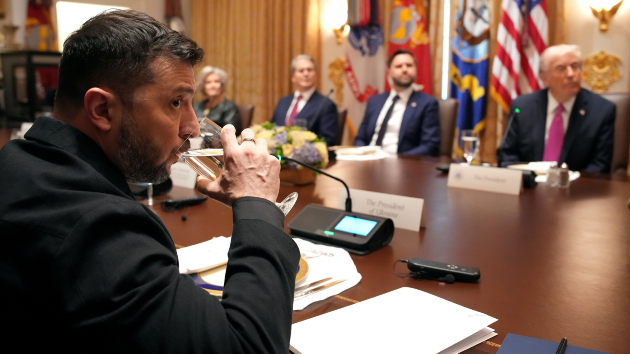
(WASHINGTON) — President Donald Trump greeted Ukrainian President Volodymyr Zelenskyy at the White House on Friday, with Zelenskyy in Washington to make his case for procuring American Tomahawk cruise missiles and other military assets.
Trump and Zelenskyy, wearing a dark suit, shook hands when the Ukrainian president arrived at the West Wing entrance. The two men are having a working lunch in the Cabinet Room.
“We want to see if we can get this done,” Trump said.
Zelenskyy said he thinks there is “momentum” to end the war. “We want peace. Putin doesn’t want. That’s why we need pressure on him,” he said.
“President Trump has a big chance now to finish this war,” Zelenskyy said, pointing to Trump’s brokering of a fragile ceasefire in the Middle East between Israel and Hamas. “That’s why I hope that he will do this, and we will also have such big success for Ukraine.”
Trump appeared bullish days ago about potentially selling the long-range weapons to Ukraine as he expressed disappointment in Moscow’s onslaught as the war drags on three-and-a-half years later.
But after a phone call with Russian President Vladimir Putin on Thursday, Trump seemed more cautious and began to express concern about depleting the U.S. supply.
“That’s a problem. We need tomahawks and we need a lot of other things that we’ve been sending over the past four years to Ukraine,” Trump said as he and Zelenskyy took questions from reporters on Friday.
Trump acknowledged it would be an “escalation” to sell the weapons to Kyiv, but said he and Zelenskyy would discuss it.
The president also he would share with Zelenskyy what he and Putin spoke about on Thursday. After their two-hour conversation, Trump said he and Putin are planning to meet again soon, this time in Hungary, to discuss the war.
This is a developing story. Please check back for updates.
(WASHINGTON) — President Donald Trump greeted Ukrainian President Volodymyr Zelenskyy at the White House on Friday, with Zelenskyy in Washington to make his case for procuring American Tomahawk cruise missiles and other military assets.
Trump and Zelenskyy, wearing a dark suit, shook hands when the Ukrainian president arrived at the West Wing entrance.
The two men are having a working lunch in the Cabinet Room.
“We want to see if we can get this done,” Trump said.
Zelenskyy said he thinks there is a “momentum to finish” Russia’s invasion, which is now nearing the four-year mark.
“We want peace. Putin doesn’t want. That’s why we need pressure on him,” Zelenskyy said.
Trump appeared bullish days ago about potentially selling the long-range weapons to Ukraine as he expressed disappointment in Moscow’s onslaught as the war drags on three-and-a-half years later.
But after a phone call with Russian President Vladimir Putin on Thursday, Trump seemed more cautious and began to express concern about depleting the U.S. supply.
“That’s a problem. We need tomahawks and we need a lot of other things that we’ve been sending over the past four years to Ukraine,” Trump told reporters as he and Zelenskyy took questions from reporters on Friday.
Trump acknowledged it would be an “escalation” to sell the weapons to Kyiv, but said he and Zelenskyy would discuss it.
Trump said he and Putin are planning to meet again soon, this time in Hungary, to discuss the war. The president said he would tell Zelenskyy what he and Putin spoke about on Thursday.
This is a developing story. Please check back for updates.