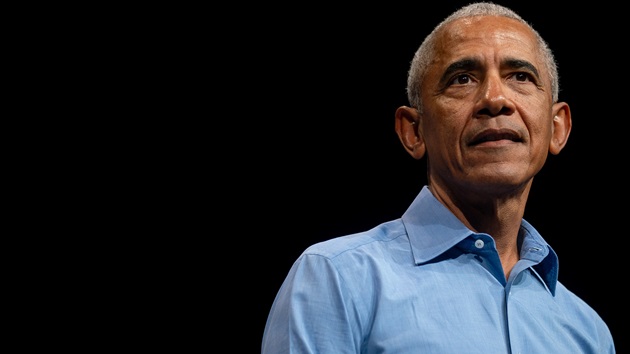
(WASHINGTON) — President Barack Obama gave a group of war heroes a surprise they will never forget.
The former president surprised a flight of Korean and Vietnam War veterans on an honor flight from Madison, Wisconsin, to Washington, D.C., ahead of Veterans Day, according to a video he posted on X.
“Ahead of Veterans Day, I was honored to welcome a flight of veterans and their families as they arrived in DC. To all those who bravely served our country, thank you to you and your family for your extraordinary service. The sacrifices that all of you have made to protect our country will be honored, today and every day,” Obama posted alongside the video on X.
Obama came aboard the flight and shared a special message on the intercom of the plane for the veterans.
“Hello, everybody. As we approach Veterans Day, I wanted to stop by and just say thank you for your extraordinary service. To you, your family, the sacrifices that all of you made to protect our country is something that will always be honored, and we are very grateful,” Obama can be seen telling the veterans upon touchdown in D.C. in the video.
The veterans were flying to D.C. on behalf of the Honor Flight Network, a nonprofit that provides flights to veterans and their families to visit monuments in the nation’s capital.
“Participation in an Honor Flight trip gives veterans the opportunity to share this momentous occasion with other comrades, remember the fallen, and share their stories and experiences with other veterans. Honored veterans always travel free of charge, thanks to generous donations to our organization,” their website reads.
The nonprofit has flown over 300,000 veterans to D.C. in the past 20 years, according to their website.
Obama also took to his Medium account to reflect on meeting the veterans and thank all who have served in the U.S. military for their service.
“To all those who bravely served our country, thank you to you and your family for your extraordinary service. The sacrifices that all of you have made to protect our country will be honored, today and every day,” Obama said.
The Honor Flight Network did not immediately respond to a request for comment.
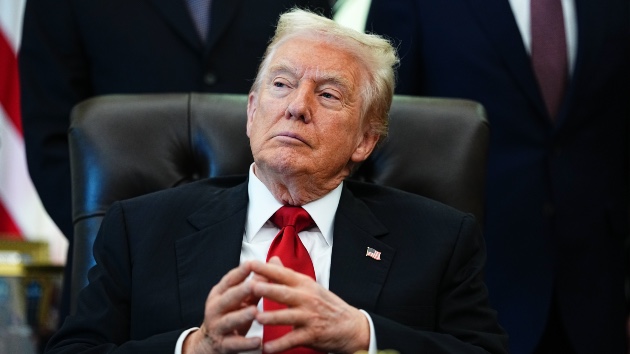
US President Donald Trump in the Oval Office of the White House in Washington, DC, US, on Thursday, Nov. 6, 2025. (Photographer: Aaron Schwartz/Bloomberg via Getty Images)
(WASHINGTON) — President Donald Trump said the U.S. economy is strong and insisted polls showing Americans are feeling economic pain are “fake” during an interview on Fox News that aired on Monday night.
Trump said bad news about the economy amounted to a “con job by the Democrats,” adding Democrats “feed” major news network anchors with the message the economy is bad and then “every anchor” does “exactly what they say.”
“I’ll never forget, they used a word like ‘manufactured,'” Trump said in the interview. “You remember the word ‘manufacture’? It’s a ‘manufactured’ economy. Nobody uses that word. Every anchor broke in ‘manufactured.’ They do exactly what they say. It’s such a rigged system.”
The U.S. economy grew at an annualized rate of 3.8% in the second quarter in the government’s final estimate, besting a 3.3% rate issued in its second estimate and far exceeding a 3% initial estimate. But consumer prices rose 3% in September compared to a year ago, with inflation at its highest level since January, the most-recent government data showed. The inflation reading came in lower than economists’ expectations.
Trump defended his handling of the economy, saying that costs are “way down” across the board.
“So are you ready? Costs are way down,” Trump said. “Gasoline is going to be hitting $2 pretty soon, or around $2. Gasoline is at $2.70 now and it was at $4.50 under Biden, under sleepy Joe. When gasoline comes down, when energy comes down — and everybody agrees energy is down — we drill, you know, drill, baby drill. We’re going like wild.”
The average consumer price for a gallon of gas in the U.S. was $3.072 on Tuesday, according to AAA, which said the average price was $3.083 a gallon a year ago.
Trump was also pressed about a rollout by his administration for a 50-year mortgage option, something that faced criticism on social media as critics pointed out that the extended payoff timeline would mean Americans would pay more in interest than they would through the life of a shorter loan.
Laura Ingraham, the Fox News host, suggested to Trump that longer loans could be construed as a “giveaway to the banks” and would simply be “prolonging the time it would take for Americans to own a home outright.”
Trump pushed back on Ingraham, saying that “all it means is you pay less per month.”
“You pay it over a longer period of time. It’s not like a big factor. It might help a little bit,” Trump said. “But even with interest rates up, the economy is the strongest it’s ever been. You know, you asked me, just to go back to the beginning of your question, you talked about prices. We’re down on energy. We’re down on interest rates.”
“Well, first of all, the East Wing was a beautiful, little, tiny structure that was built many years ago, that was renovated and expanded and disbanded and columns ripped out, and it had nothing to do with the original building,” he said. “It was a poor, sad sight, and I could have built the ballroom around it, but it would not have been — we’re building one of the greatest ballrooms in the world, by the way.”
“But the East Wing, that building was renovated 20 times, including adding a floor to the top, which was terrible, Trump continued. “It was at a common brick little, tiny windows. It looked like hell. It had nothing to do with the original building, and I didn’t want to sacrifice a great ballroom for an okay ballroom by leaving it right smack in the middle.
(WASHINGTON) — President Trump met on Monday at the White House with Syrian President Ahmed al-Sharaa, the White House said.
The visit marked the first time a Syrian president has ever visited the White House and is viewed as a crucial first step in normalizing U.S.-Syria relations.
The White House did not allow reporters and cameras access to the meeting.
Al-Sharaa is the former leader of U.S.-designated terror group al-Qaeda who was once wanted by the U.S. as a terrorist with a $10 million bounty on his head. He has even served time in the infamous Abu Ghraib prison.
A senior Trump administration official said Trump and al-Sharaa were expected to focus on counterterrorism efforts in Syria, and to discuss the signing of an agreement for Syria to join the U.S.-led coalition against the Islamic State. The coalition includes some 80 countries working to prevent a resurgence of the extremist group, according to the official.
It’s also the third meeting between Trump and al-Sharaa this year, as the Syrian leader confronts the challenges of rebuilding the country, seeking to restore ties with Arab countries and the West after years of civil war under Bashar al-Assad’s regime. The Assad regime’s fall brought to an end nearly 14 years of civil war.
Al-Sharaa arrived in Washington on Saturday and held meetings with members of Congress over the weekend, including with House Foreign Affairs Committee Chairman Brian Mast, a Republican who represents a district in Florida.
Mast shared in a statement that he and al-Sharaa “broke bread” and had a “long and serious conversation about how to build a future for the people of Syria free of war, ISIS, and extremism.”
“He and I are two former soldiers and two former enemies. I asked him directly ‘Why we are no longer enemies?’” Mast revealed.
“His response was that he wishes to ‘liberate from the past and have a noble pursuit for his people and his country and to be a great ally to the United States of America,'” Mast shared in the statement.
The U.S. on Friday removed sanctions on al-Sharaa just one day after the United Nations Security Council lifted similar sanctions ahead of his meeting with Trump.
According to a notice on the U.S. Treasury Department website, the United States removed Specially Designated Global Terrorist designations on Sharaa and Syria’s interior minister, Anas Khattab.
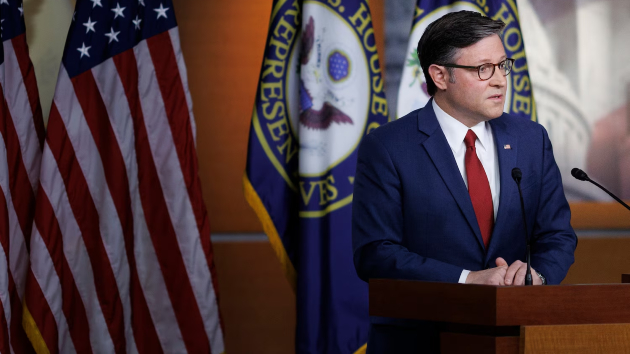
Speaker Mike Johnson delivers remarks to reporters on November 10, 2025 on Capitol Hill in Washington, DC. (Tom Brenner/Getty Images)
(WASHINGTON) — The longest government shutdown in U.S. history appears to be nearing its end, after senators suddenly advanced a funding deal over the weekend after 40 days of little progress.
The agreement still needs to pass the Senate and the House before going to President Donald Trump’s desk. In the meantime, pain continues to grow for Americans on everything from food assistance to air travel.
Here’s a timeline of major developments from the weekslong impasse.
Oct. 1: The federal government shut down at 12:01 a.m. after competing Republican and Democratic proposals that would have funded the government failed in the Senate at the eleventh hour. The Democrat bill included extensions for health care subsidies under the Affordable Care Act while the Republicans’ “clean” bill would have funded the government at current levels until Nov. 1.
Oct. 10: The Trump administration begins to lay off thousands of federal workers. Agencies impacted include the Commerce, Education, Energy, Health and Human Services, Housing and Urban Development, Homeland Security and Treasury departments.
Oct. 14: Two weeks into the shutdown with virtually no progress, House Speaker Mike Johnson predicts they are headed toward “one of the longest shutdowns in American history.” The House has remained out of session the entire shutdown after Republican members passed a clean, seven-week funding bill in mid-September.
Oct. 15: The Pentagon says that troops have been paid and will not miss a paycheck due to the shutdown after shifting existing funds.
Oct. 24: More than 500,000 federal employees miss their first full paycheck. Days later, the president of the country’s largest union representing federal workers called on lawmakers to pass a short-term spending bill to end the shutdown, a statement seized on by Republicans to ramp up pressure on Democrats.
Oct. 30: President Trump, after weeklong overseas trip, inserts himself in the shutdown showdown by calling on Senate Republicans to terminate the filibuster in order to unilaterally reopen the government. But Senate Majority Leader John Thune quickly rejected Trump’s demand.
Nov. 1: Funds run dry for SNAP benefits, leaving 42 million Americans vulnerable — and setting off a complex legal fight between the administration and states. Plus, open enrollment begins for Affordable Care Act recipients with prices for insurance premiums skyrocketing next year.
Nov. 4: The Senate fails for the 14th time to advance a clean, short-term funding bill.
Nov. 5: The shutdown becomes the longest in U.S. history. Trump brings Senate Republicans to the White House to talk shutdown, after Republican losses in key elections across the country. Democrats capitalize on election wins to argue Republicans should negotiate with them on health care.
Nov. 7: Air travel is even more heavily impacted as the Federal Aviation Administration begins to reduce flight capacity at major airports across the country. Senate Minority Leader Chuck Schumer put on the table a Democratic proposal for a short-term extension of government funding that includes a one-year extension of ACA subsidies. Republicans quickly rejected the offer.
Nov. 8: Thune said he plans to keep the Senate in session until the government is funded, and said Republicans will push forward with a plan to advance a short-term funding bill with a “mini-bus” of three, full-year funding bills for SNAP benefits and the Special Supplemental Nutrition Program for Women, Infants, and Children, as well as veterans programs. Schumer calls it a “terrible mistake” for Republicans to have rebuffed Democrats’ offer.
Nov. 9: A sudden breakthrough moment on Capitol Hill as senators reach a bipartisan deal to end the shutdown. Eight Democrats vote with Republicans to advance the measure in a 60-40 vote.
The bill does not include any of the Democratic demands on health care, but sources told ABC News that Republican leadership promised to allow a vote on a bill of Democrats’ choosing related to the ACA in December.
It also includes a new government funding extension of Jan. 30, 2026; language to reverse Trump administration firings during the shutdown; and to ensure furlough workers receive backpay.
Nov. 10: Senate reconvenes to move ahead on the deal, with questions remaining on how fast they can get it done. Speaker Johnson tells House members to start returning to Washington immediately, and says the House will vote as quickly as possible on the funding bill once it clears the Senate to send it to President Trump’s desk.
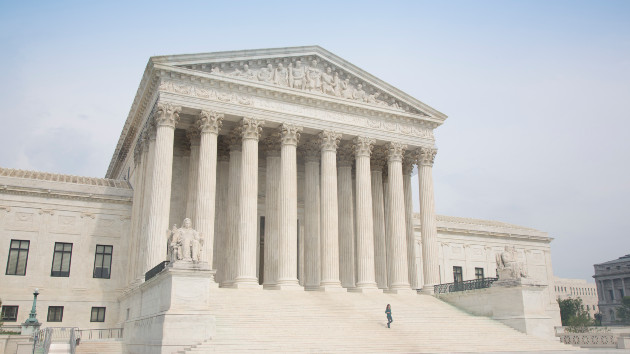
(WASHINGTON) — The Supreme Court on Monday denied a bid from former Kentucky county clerk Kim Davis to appeal her $100,000 damages suit and get the justices to revisit the landmark 2015 decision in Obergefell v Hodges.
The court did not explain its decision.
Davis gained international attention after she refused to issue a marriage license to a gay couple on religious grounds in open defiance of the high court’s ruling and was subsequently jailed for six days. A jury later awarded the couple $100,000 for emotional damages plus $260,000 for attorneys fees.
In a petition for writ of certiorari filed in August, Davis argued First Amendment protection for free exercise of religion immunizes her from personal liability for the denial of marriage licenses.
She also claimed the court’s decision in Obergefell v Hodges — which rooted marriage rights for LGBTQ couples in the 14th Amendment’s due process protections — was “legal fiction.”
Lower courts had dismissed Davis’ claims and most legal experts considered her bid a long shot.
Davis’ appeal to the Supreme Court comes as conservative opponents of marriage rights for same-sex couples pursue a renewed campaign to reverse legal precedent and allow each state to set its own policy.
This is a developing story. Please check back for updates.
(WASHINGTON) — The Senate passed a key test vote Sunday night on a plan that would be a major step toward reopening the government.
After 40 days of a standoff, the bill advanced by a vote of 60-40, just barely meeting the 60 votes needed to keep it moving forward.
The vote was gaveled down to applause in the chamber at 10:49 p.m. ET.
Democratic Sens. Tim Kaine, Dick Durbin, Maggie Hassan, Jeanne Shaheen and Jacky Rosen were the Democrats who flipped to vote for this bill.
They join Democrats Catherine Cortez Masto, John Fetterman and Independent Angus King, who have been voting in favor of a government funding bill for weeks. Sen. Rand Paul was the only Republican to vote against it.
The vote was a big test to gauge whether enough Democrats would vote with Republicans to break the impasse, even though they wouldn’t get an extension of Obamacare subsidies that expire at the end of the year, which they have been holding out for through the 40-day shutdown, the longest in U.S. history.
Multiple Senate sources told ABC News’ Jonathan Karl earlier on Sunday that the bill would extend funding to Jan. 31 as well as provide funding for the remainder of the fiscal year to other agencies like the Department of Agriculture to pay for SNAP benefits and the Department of Veterans Affairs.
A senior Democratic senator told Karl there would be more than enough Democratic votes to pass this, although a majority of Democrats, including most of the leadership, voted against it.
Democrats would get nothing on health care beyond a promise that the Senate will vote on extending Affordable Care Act subsidies before the end of the year — essentially what Senate Majority Leader John Thune offered more than a month ago and Democrats objected to.
Although most Senate Democrats may have opposed this bill, they were resigned to the fact that this part of the fight is over, sources said. They will take the battle over health care to the midterms and argue that Republicans refused to do anything for the millions of Americans who will see their health insurance premiums skyrocket.
Passage of the bill does not immediately reopen the government. The House will also have to approve the bill. The House has been out of session since September and Speaker Mike Johnson would need to call his members back to Washington to consider this bill before it could head to President Donald Trump’s desk.
The Senate wants to modify the bill in a number of ways. Now that the bill has passed the test vote, the debate can begin. There are some key modifications that senators want to make to the bill:
They want to change its expiration date from Nov. 21 to the end of January.
They want to attach three full-year funding bills to it. The government is usually funded through 12 full-year appropriations bills. The three that senators hope to include are Military Construction and Veterans Affairs, the Legislative Branch, and the Department of Agriculture. If lawmakers fail to fund the government by the new deadline, programs covered by these bills would be fully funded through the end of the fiscal year.
There could be the inclusion of some sort of language guaranteeing Democrats a vote by a certain date on a bill to address health care. There could also be some sort of language to reverse some of the administration’s reductions in force of government workers that occurred during the shutdown.
Unless there’s total agreement by all senators to quickly adjust the bill, it could take the Senate up to a week to process it.
(WASHINGTON) — President Donald Trump issued a sweeping pardon to key figures allegedly involved in the plan to arrange an alternate slate of electors and “expose voting fraud” during the 2020 election, according to U.S. Pardon Attorney Ed Martin.
Trump pardoned high-profile individuals allegedly involved in his attempt to overturn the election, including Rudy Giuliani, Sidney Powell, Boris Epshteyn, John Eastman and Mark Meadows — and 72 other individuals allegedly associated with the effort to challenge the 2020 election results.
The pardon, which Trump appears to have signed on Friday, covers each of the president’s co-defendants who were charged in Georgia for a sweeping scheme to overturn election results.
Four of the pardon recipients pleaded guilty in the Georgia case.
“This proclamation ends a grave national injustice perpetrated upon the American people following the 2020 Presidential Election and continues the process of national reconciliation,” the pardon says.
The pardon language explicitly states that it does not apply to Trump himself. “This pardon does not apply to the president of the United States,” according to the pardon.
(NEW YORK) — For the first time in more than two decades, the Pentagon has begun sending conventional ground forces to Panama to train in the jungle there, returning U.S. soldiers and Marines to a three-week course once called the “Green Hell” because of its similarities to Vietnam.
The training program at Base Aeronaval Cristóbal Colón, formerly known as Fort Sherman, is relatively small in scope but is expected to ramp up over the next year, according to one defense official.
The program began earlier this year and is not intended to prepare troops for a potential mission, including inside Venezuela, the official said.
Still, the military’s interest in jungle warfare in Latin America is noteworthy given Trump’s heightened focus there. Since taking office, Trump has vowed to “take back” the Panama Canal and repeatedly threatened to attack Venezuela because of its alleged role in transiting illegal narcotics.
“If you can train and fight in one of the most difficult and challenging locations in the world, you build a really lethal, effective force,” the defense official said of the rationale behind the new training program.
Alex Plitsas, a former Pentagon official and senior fellow at The Atlantic Council, said the new training course wouldn’t likely play a role in potential operations inside Venezuela. The training effort appears to be more about building Panama’s capacity to handle security threats in the region.
But the move signals a shift in priorities by the Trump administration, he said.
“It’s an expansion of an existing military relationship, but it’s not happening in a vacuum,” Plitsas said. “It’s happening as a broader change in policy. There’s a renewed interest in South America, where the president sees the drug flow to the United States as a national security issue with the intention of potential military action.”
Jungle training hasn’t been a priority for the military since 9/11, when the nation’s focus shifted to counterterrorism operations in the Middle East. The Defense Department in recent years has relied on a smaller Army jungle training center in Hawaii and at a Marine Corps site in Okinawa, Japan.
During the Vietnam War, however, Fort Sherman was considered a prime location where most troops could hone their jungle survival skills before shipping off to war.
Conditions at the Panamanian training site are considered among the harshest in the world, including venomous snakes and several layers of thick, towering vegetation that can make it difficult to operate communications and night-vision equipment or evacuate wounded personnel.
By 1999, the training site shuttered and the last of the U.S. military departed Panama as part of an agreement ceding U.S. control of the Panama Canal.
Shortly after taking office, though, Trump expressed renewed interest in the region, declaring the U.S. would be “reclaiming” the Panama Canal. That effort has since been couched by Pentagon officials as a renewed “partnership” with Panama to prevent Chinese influence over the canal, which the U.S. relies on heavily for shipping.
Trump also has overseen an unprecedented buildup of U.S. troops to the region, deploying 10,000 troops and, more recently, the USS Gerald R. Ford, the world’s largest aircraft carrier. The public display of force appears to be a kind of pressure campaign aimed at forcing out Venezuelan President Nicolás Maduro.
By August, the military had set up the “Combined Jungle Operations Training Course” with Marines and Panamanian forces training as part of a pilot program. A military spokesperson said there have since been 46 graduates of the three-week course: 18 Marines, one Army soldier and 27 personnel from Panama’s National Aeronaval Service, National Border Service and National Police.
According to the Defense official, the Army plans to ramp up training over the next year, eventually sending in platoons of some 40 soldiers at a time to train.
Steve Ganyard, a retired Marine Corps colonel and ABC contributor, said the renewed interest in Panama is likely a practical one, but it also can be used to send a message.
“From a practical perspective, it’s easier to get to Panama than Okinawa. And the jungles of Central and South America have their own unique challenges,” he said. “That said, no doubt a message is being sent to Maduro by conducting combat training in his neighborhood.”
(WASHINGTON) — President Donald Trump on Sunday claimed that a “dividend of at least $2000 a person” will be paid to all Americans except for “high-income people,” saying the country is now wealthy as a result of his tariff policies.
“People that are against Tariffs are FOOLS! We are now the Richest, Most Respected Country In the World, With Almost No Inflation, and A Record Stock Market Price. 401k’s are Highest EVER,” the president wrote.
“A dividend of at least $2000 a person (not including high income people!) will be paid to everyone,” he added.
In an interview on ABC News’ “This Week” on Sunday, Treasury Secretary Scott Bessent said that he had not spoken with Trump about the proposed dividend.
Calling opponents to tariffs “fools,” Trump claimed “A dividend of at least $2000 a person (not including high income people!) will be paid to everyone.”
“The $2,000 dividend could come in lots of forms, in lots of ways, George,” Bessent told anchor George Stephanopoulos. “You know, it could be just the tax decreases that we are seeing on the president’s agenda — you know, no tax on tips, no tax on overtime, no tax on Social Security, deductibility of auto loans.”
(WASHINGTON) — Treasury Secretary Scott Bessent said Sunday that there is no formal proposal from the White House to defund the Affordable Care Act and instead send money directly to Americans, despite a social media post from President Donald Trump on Saturday promoting such a plan.
“The president has also come forward with a new proposal overnight, saying it’s time, instead, to do away with Obamacare and said to have the money go directly to the people. Do you have a formal proposal to do that?” ABC News’ “This Week” anchor George Stephanopoulos.
“We don’t have a formal proposal,” Bessent said.
But pressed by Stephanopoulos about whether such a plan would be proposed to the Senate, Bessent said that the administration was not proposing it “right now.”
Bessent also hedged when asked about Trump’s push to end the Senate’s filibuster.
“Is the best way to end the shutdown right now to end the filibuster?” Stephanopolous asked.
“The best way is for five Democratic senators to come across the aisle,” Bessent said.