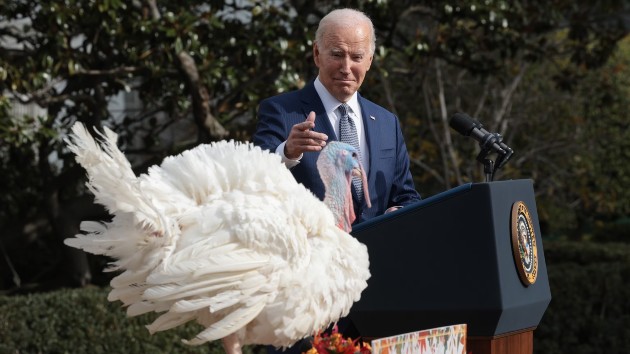
(WASHINGTON) — President Joe Biden gave the official presidential pardon to turkeys Liberty and Bell on the White House South Lawn on Monday — an event stuffed with jabs at Biden’s age and healthy sides of corny jokes.
Hailing from Willmar, Minnesota, Liberty, weighing 42.5 pounds, and Bell, a svelte 42.1 pounds, escaped the “fowl” fate of ending up on anyone’s Thanksgiving dinner plate this year because of the pardon.
After a morning at D.C.’s Willard InterContinental Hotel, the turkeys received their pardon during a lighthearted ceremony. Biden, who celebrated his 81st birthday on Monday, joked that this year marks the 76th anniversary of the event — but he didn’t attend the first one.
“I was too young to make it up,” he said with a laugh.
Acknowledging his birthday, Biden joked “it’s hard turning 60!”
The president commented that while Liberty and Bell hail from Minnesota, their namesake is the Liberty Bell in Philadelphia.
“They have a new appreciation for the phrase, ‘Let freedom ring,'” Biden said to the crowd.
The ceremony marks the “unofficial start of the holiday season” and is a time to give thanks and gratitude, Biden said. On a more serious note, the president addressed the spirit of the Thanksgiving, and made reference to the recent death of former first lady Rosalynn Carter.
“This week we’ll gather with the people we love and the traditions that each of us have built up on our own families. We’ll also think about the loved ones we lost, including just yesterday when we lost former first lady Rosalynn Carter, but walked her own path in inspiring the nation and the world along the way. And let’s remind ourselves that we’re blessed to live in the greatest nation on this face of the earth,” he said.
To finish the set dressing, one of the turkeys was hoisted on to a table for the official pardon proclamation.
“I hereby pardon Liberty and Bell,” Biden bellowed, adding, “Congratulations, birds!”
Liberty and Bell were hatched as part of the presidential flock in July — and were prepped for their turn in the spotlight with some hype-up music so the noise and festivities didn’t ruffle their feathers, said National Turkey Federation President Steve Lykken at a news conference Sunday.
“I can confirm they are in fact Swifties, and they do enjoy some Prince,” Lykken said.
The two traveled in style from Minnesota, driven in their own personal vehicle to D.C. ahead of Monday’s event.
After their pardon, it’s all gravy for Liberty and Bell. The two will return to the University of Minnesota and the College of Food, Ag and National Resource Sciences to rest their feathers and live out the rest of their post-pardon lives.
Previous pardon recipients under Biden include Chocolate and Chip in 2022 and Peanut Butter and Jelly in 2021.
History of poultry pardons
The origin of the presidential turkey pardons is a bit fuzzy. Unofficially, reports point all the way back to President Abraham Lincoln, who spared a bird from its demise at the urging of his son, Tad. However, the story may be more folklore than fact.
The true start of what has evolved into the current tradition has its roots in politics and dates back to the Truman presidency in 1947.
President Harry Truman ruffled feathers by starting “poultry-less Thursdays” to try and conserve various foods in the aftermath of World War II, but Thanksgiving, Christmas and New Years all fell on Thursdays.
After the White House was inundated with live birds sent as part of a “Hens for Harry” counter-initiative, the National Turkey Federation and the Poultry and Egg National Board presented Truman with a bird as a peace offering — although the turkey was not saved from the holiday fest.
President John F. Kennedy began the trend of publicly sparing a turkey given to the White House in November 1963, just days before his assassination. In the years following, the event became a bit more sporadic, with even some first ladies such as Pat Nixon and Rosalynn Carter stepping in to accept the guests of honor on their husband’s behalf.
The tradition of the public sparing returned in earnest under the Reagan administration, but the official tradition of the poultry pardoning at the White House started in 1989, when President George H.W. Bush offered the first official presidential pardon. In the more than three decades since, at least one lucky bird has gotten some extra gobbles each year.
(WASHINGTON) — President Joe Biden said Monday he believes a deal is near to free some of the more than 200 hostages being held by Hamas in Gaza.
Biden was participating in the annual Thanksgiving turkey pardon at the White House when he was asked if an agreement was close.
“I believe so, but I’m not prepared to talk to –” Biden said before he was cut off by the reporter, who pressed him: “You believe so?”
“Yes,” Biden replied. The president then crossed his fingers.
Hamas took more than 230 hostages, including Americans, during its Oct. 7 terror attack on Israeli communities, according to Israeli officials. Only a handful of hostages have been released in the weeks since, including a mother and daughter with dual American and Israeli citizenship and two elderly Israeli women.
The administration said that 10 Americans who are unaccounted for are believed to be among the hostages.
More than 1,200 people were killed in Israel during the initial terror attack and thousands more have been killed and injured in retaliatory operations in Gaza since, according to the Hamas-run Gaza Health Ministry.
U.S. National Security Council spokesman John Kirby reiterated at the White House briefing Monday that the administration believes it’s “closer than we’ve ever been,” but said there are no updates to publicly discuss. He declined to get into detail when asked how many hostages may be released or whether women and children are being prioritized.
“I want to be careful here, I don’t want to negotiate in public, but if you’re going to secure the release of hostages, and we certainly hope we’re going to be able to do that soon, you’ve got to make sure they can get from where they are to safety and do that as safely as possible, which means you’re gonna have to have at least a temporary localized stop in the fighting to allow them to move,” he told reporters.
Kirby said the administration is working “hour by hour” and emphasized nothing is set in stone until it’s “all done.”
On the timeline of a potential hostage deal, a U.S. official said the negotiation process had reached the stage now where an agreement could be reached “at any point” — but warned that it could still implode as well.
Beyond the assessment that Hamas is an unreliable player and talks have collapsed multiple times in recent weeks, the official said there were several other complicating factors that could impede the eventual release of any hostages that still needed to be worked through with all parties involved.
(WASHINGTON) — The two men who seem likely, at this point, to face each other in a presidential election rematch next November spent their Sundays in different parts of the country doing the same thing: marking Thanksgiving with service members.
President Joe Biden headed to Virginia on Sunday afternoon for a screening of the upcoming musical film Wonka and to host a Friendsgiving — both events for service members and families.
The president and first lady Jill Biden spoke before the film screening at a Naval facility in Norfolk, with Jill Biden thanking the families and mentioning her late stepson Beau Biden’s own service in the National Guard, according to reporters traveling with the Bidens.
Later Sunday, the president and first lady attended a Friendsgiving dinner with troops and their relatives at the Norfolk Naval Station.
Speaking there, Jill Biden mourned the just-announced death of former first lady Rosalynn Carter.
“I’m sorry to lead this off with a sad announcement that former first lady Rosalynn Carter has just passed,” Jill Biden said. “She was well known for her efforts on mental health and caregiving and women’s rights. So I hope that during the holidays, you’ll consider saying [you’ll] include the Carter family in your prayers.”
The Friendsgiving dinner is part of the first lady’s longtime initiative to support service members, called Joining Forces.
While celebrating the upcoming Thanksgiving holiday, Joe Biden was not too far from other headlines. As he arrived to the Navy base, a reporter shouted out to ask about ongoing work to reach a deal to free many of the 200-plus hostages believed to be held by Hamas in Gaza, amid the Israel-Hamas war in the wake of Hamas’ Oct. 7 terror attack.
“Mr. President when will more hostages get out?” the reporter asked.
According to the press pool with the president, he responded, “I’m not in a position to tell you that. … I want to make sure they’re out, and then I’ll tell you.”
While traveling on Sunday, Joe Biden ignored — or did not hear — another shouted question about the youth vote in the wake of new polling indicating younger voters have soured on him a year out from the election.
Across the country, former President Donald Trump was officially endorsed by Texas Gov. Greg Abbott and then doubled down on border security in uncharacteristically short on-stage remarks near the Texas border on Sunday.
Introduced by Abbott just after the governor endorsed him, Trump spoke for just 10 minutes — much shorter than his typical campaign remarks, which are usually at least an hour long, at times even going for nearly two hours.
He spent longer time serving meals to service members earlier in the day, shaking hands and taking pictures with nearly 200 Texas National Guard soldiers, Texas Department of Public Safety troopers and other officials that will be stationed on the border during Thanksgiving.
Trump and Abbott served food for more than 30 minutes inside the Texas Department of Public Safety hangar at the South Texas International Airport in Edinburg.
Afterward, both Trump and Abbott spoke briefly inside the hangar, thanking service members, and then they came out to the tarmac for their remarks.
Trump, polls show, remains the clear front-runner in the once-crowded Republican presidential primary, despite his ongoing controversies and legal troubles.
He is charged in four separate criminal cases but denies all wrongdoing and has pleaded not guilty.
On Sunday, he swiped at Biden, claiming the president doesn’t spend enough time in Texas, which Trump suggested was part of the Biden administration’s failures at the border.
Biden, for his part, has increasingly focused on Trump by name as his campaign appears to be sharpening its focus for a likely repeat of the 2020 race.
Last week, he condemned Trump for calling political enemies “vermin” whom Trump would “root out.”
Some historians said that rhetoric had clear parallels with infamous dictators of the past like Adolf Hitler and Benito Mussolini.
Trump’s campaign adamantly denied this.
ABC News’ Tia Humphries contributed to this report.
(WASHINGTON) — President Joe Biden is celebrating his 81st birthday on Monday, as questions about age continue to dominate the 2024 election.
Biden is the oldest commander in chief in U.S. history. If reelected, he will be 82 at the start of his second term and 86 when it ends.
Former President Donald Trump, the Republican front-runner, isn’t far behind at 77 years old. But Biden has so far faced more scrutiny over his age than Trump, though both have experienced noticeable blunders on the campaign trail.
Biden’s common refrain to those who press him on his age has been to “watch me.” The administration defends his stamina and underscores his record when questioned about his ability to do the job, with his stiff gait and verbal gaffes regularly seized on by critics and Republicans.
“I get the question on age. Certainly, we all do,” White House press secretary Karine Jean-Pierre said in September. “But what we’re going to continue to talk about is the record that this president has had. It’s been a historic record.”
But poll after poll shows the issue is still top of mind for voters.
Three-quarters of Americans (74%) said Biden was too old to run for another term in a survey conducted by ABC News and the Washington Post in September. That number represented a 6% increase since May, a month after Biden launched his second White House bid.
Half of Americans (50%) thought the same of Trump, according to the poll.
A CNN survey out of New Hampshire — which will hold the first presidential primary in January — found 56% of likely Democratic primary voters said age was their biggest concern regarding Biden. The poll, conducted by the University of New Hampshire, was released last week.
Biden frequently jokes about his age on the campaign trail.
“I know I’m 198 years old,” he quipped back in June while giving remarks on the one-year mark of the U.S. Supreme Court overruling Roe v. Wade.
“I’ve never been more optimistic about our country’s future in the 800 years I’ve served,” he said at a campaign reception in New York in September.
Questions about age and politics are not limited to Biden. This year, alarming episodes involving longtime Republican Senate leader Mitch McConnell and powerhouse Democrat Dianne Feinstein, who died in September, made headlines and stoked fierce debate about how old is too old to serve in public office.
S. Jay Olshansky, a professor of public health at the University of Illinois at Chicago, previously told ABC News such a question is “unanswerable.”
Last year, Biden marked his milestone 80th birthday with a subdued brunch at the White House with his family. At the time, Biden was mulling whether to run again as other veteran Democrats like former House Speaker Nancy Pelosi were announcing they were stepping down from their leadership roles to usher in a new generation.
Biden made a passing reference to his birthday last week as he met with Chinese President Xi Jinping at the Asia-Pacific Economic Cooperation summit in San Francisco.
According to a senior administration official, Biden wished President Xi’s wife a happy birthday as the two share the same birthday. Xi thanked Biden for reminding him, stating he’d been “working so hard that he had forgotten his wife’s birthday” was approaching.
Former first lady Rosalynn Carter, the wife of former President Jimmy Carter and a devoted advocate for mental health, died peacefully at home Sunday, the Carter Center announced. She was 96.
“Rosalynn was my equal partner in everything I ever accomplished,” Jimmy Carter said in a statement. “She gave me wise guidance and encouragement when I needed it. As long as Rosalynn was in the world, I always knew somebody loved and supported me.”
She is survived by her children — Jack, Chip, Jeff and Amy; 11 grandchildren and 14 great-grandchildren, the Carter Center said.
“Besides being a loving mother and extraordinary First Lady, my mother was a great humanitarian in her own right,” Chip Carter said. “Her life of service and compassion was an example for all Americans. She will be sorely missed not only by our family but by the many people who have better mental health care and access to resources for caregiving today.”
Rosalynn Carter entered hospice care at home in November 2023, six months after she was diagnosed with dementia, the Carter Center announced at the time. Her husband had been in hospice care at home since February that same year.
“Mrs. Carter has been the nation’s leading mental health advocate for much of her life. First in the Georgia Governor’s Mansion, then in the White House, and later at The Carter Center, she urged improved access to care and decreased stigma about issues surrounding mental health,” the Carter Center said in a statement after her dementia diagnosis.
Mrs. Carter served as the country’s first lady during her husband’s only term as U.S. president, from 1977 to 1981. The former first lady carved out a profound role at the White House, serving as an envoy abroad and as a political surrogate to her husband. She also raised four children, 12 grandchildren and 13 great-grandchildren.
In 1982, Jimmy and Rosalynn Carter founded The Carter Center, a nonprofit devoted to advancing human rights and alleviating human suffering, shortly after Jimmy Carter lost his reelection bid to Ronald Reagan.
Early life
Eleanor Rosalynn Smith was born in Plains, Georgia – also the hometown of her future husband – on Aug. 18, 1927, to Wilburn Edgar Smith and Frances Allethea Murray, one of four children, including two brothers and a sister. She was named after Rosa, her maternal grandmother.
Rosalynn’s father died of leukemia when she was 13. As the eldest, she helped her widowed mother keep house and look after her siblings, while also working at a local hairdresser’s shop to earn spending money. Despite the demands on her time, Carter graduated as Plains High School’s valedictorian in 1944.
Throughout her childhood, Rosalynn Smith’s closest friend was Ruth Carter, whose older brother, Jimmy, Rosalynn would eventually marry. The pair corresponded while Jimmy was a midshipman at the U.S. Naval Academy in Annapolis, MD.
“We would continue to write each other letters,” former President Jimmy Carter said in a 2016 interview with The Atlanta Journal-Constitution celebrating the couple’s 70th anniversary. “Mostly her letters were about all the boys she was going with … I was in the Naval Academy and I was kind of isolated from the outside world.”
Jimmy Carter proposed in December 1945 but Rosalynn turned him down, determined to finish her degree at Georgia Southwestern College. Two months later, she changed her mind and accepted Carter’s proposal during a visit to Annapolis.
They were married on July 7, 1946, in the Plains Methodist Church. That same year, she graduated from college.
A Navy family
For the first seven years of marriage, Jimmy Carter’s career as a Navy engineer and commissioned officer kept the Carters moving from base to base.
The couple’s three oldest children were born in far-flung locations: John William “Jack” Carter in Portsmouth, Virginia; James Earl Carter in Honolulu, Hawaii, three years later; and Donnel Jeffrey Carter, was born in New London, Connecticut. Amy Lynn Carter, the first couple’s only daughter, was born in Plains, Georgia, in 1967.
Jimmy Carter’s naval duties often left Rosalynn Carter to deal with periods of solitude.
“I felt inadequate and very lonely,” she said of those times in an interview with PBS’ “American Experience.” “Sometimes I cried, though I didn’t let Jimmy know. He has no patience with tears, thinking instead that one makes the best of whatever situation with a smile,” she said.
“I learned to be very independent. I could take care of myself and the baby and do things that I never dreamed I would be able to do alone,” Rosalynn added.
From the family farm to the White House
After the death in 1953 of Jimmy Carter’s father, former Georgia House of Representatives lawmaker James Earl Carter Sr., the Carters moved back to Plains, Georgia, to manage the family peanut farm, where Rosalynn helped take control of the finances without drawing a salary.
In 1962, Jimmy Carter followed his father into politics, when he elected to the first of two terms as a Georgia state senator. He was defeated in his 1966 gubernatorial bid, but succeeded four years later to become the state’s 76th governor.
As the first lady of Georgia, Rosalynn Carter took on the duties of managing the operations and gardens of the governor’s mansion. She also became a member of the Governor’s Commission to Improve Services to the Mentally and Emotionally Handicapped, as well as the honorary chair of the Georgia Special Olympics.
Jimmy Carter announced his bid for the presidency in December 1974 as his term as governor of Georgia was ending. Despite being a relative unknown, he defeated incumbent Gerald Ford to win the 1976 presidential election. Not content to play the traditional first lady role, Rosalynn routinely asked her husband about his decision-making process – to the point that he invited her to attend Cabinet meetings, according to PBS’ “American Experience” documentary.
“The first year Jimmy was in office, I became so frustrated. Every night, Jimmy would get off the elevator at the White House and I would say, ‘Why did you do this?’ or ‘Why did you do something?'” she recalled. “And one day he finally said, ‘Why don’t you come to Cabinet meetings? Then you’ll know why we do these things.’ So I started going. It was always on my calendar. And I just listened. I didn’t participate. But I listened. And then I knew why the decisions were made.”
Additionally, she routinely sat in on National Security Council meetings that had traditionally been reserved for only the president and senior staffers.
As first lady, Rosalynn Carter also made trips to the Caribbean, as well as Central and South America, and learned to converse in Spanish. The high-profile meetings placed her front and center in heated discussions about human rights, demilitarization and narcotics.
Rosalynn Carter was also an influential force when her husband brokered the peace talks between Israeli Prime Minister Menachem Begin and Egyptian President Anwar Sadat that resulted in the landmark Camp David Accords in 1978, which in turn led to the Egypt-Israel Peace Treaty the following year.
During her husband’s reelection campaign in 1980, Rosalynn Carter became the president’s loyal surrogate. While Jimmy Carter was tethered to the White House amid the escalating Iran Hostage Crisis – in which 52 Americans were held hostage in Iran for a total 444 days, beginning Nov. 4, 1979 – the first lady hit the campaign trail, giving speeches at large rallies to fight her husband’s Republican opponent, Ronald Reagan.
Jimmy Carter’s political star faded as the U.S. economy sagged and relations worsened with the Soviet Union. Those facts, as well as the repercussions of the Iran hostage crisis, left him with a 21% approval rating. He won just six states and the District of Columbia in the presidential election, for a total of 49 electoral votes compared to Reagan’s 489. The Carters’ time in the White House was at an end.
National treasure
When Rosalynn and Jimmy Carter returned to private life after leaving White House in 1981, they kept fighting for people in need.
Rosalynn Carter penned a 1984 autobiography, “First Lady from Plains,” and numerous other books about mental health. In 1995, she also co-authored “Everything to Gain: Making the Most of the Rest of Your Life” with the former president, about their time after leaving the White House.
In 1982, the Carters established the Carter Center to “promote peace and be a champion of human rights,” according to its website. The organization touches lives in 80 countries around the world building houses for the homeless, helping farmers in developing nations, training nurses, and eradicating Guinea worm disease, a debilitating parasitic infection spread by drinking water contaminated with the worm’s larvae. In 1986, the disease affected 3.5 million people per year in 21 African countries, but by 2017, it had been reduced by 99.99%, to just 30 cases, according to the Carter Center.
The Carters also became the highest-profile supporters of Habitat for Humanity, the nonprofit devoted to creating affordable housing. They personally helped to build, renovate and repair 4,390 homes in 14 countries, according to the organization, which also called Jimmy and Rosalynn Carter “two of the world’s most distinguished humanitarians.”
Improving mental health and reducing the stigma of mental illness had long been priorities for the former first lady, who chaired the Carter Center’s Mental Health Task Force and each year hosted the Rosalynn Carter Symposium on Mental Health Policy.
She also teamed up with first lady Michelle Obama to improve treatment for soldiers returning from Iraq and Afghanistan and suffering from Post-Traumatic Stress Syndrome.
“I hope I’ve contributed something to the mental health field,” Rosalynn said in a 2013 interview in Parade magazine. “But I hope people will think—I’ve had so many wonderful opportunities, I tried to take advantage of them.”
In an interview with ABC News in 2021, the former president and first lady reflected on their “extraordinary” marriage, and their years of service.
“We’ve been blessed to be able to travel the world, almost,” Rosalynn Carter said in the interview. “Everything with Jimmy Carter has been an adventure.”
For his part, Jimmy Carter said marrying Rosalynn Carter was the “most important thing in my life.”
“It was happy and joyful and obviously long-lasting,” he said. “Rose did say OK finally, and staying with me all this long has been the most wonderful thing in my life.”
While San Francisco’s struggles to rebound after the COVID-19 pandemic are well known, as images of tent-lined sidewalks, empty downtown storefronts and broken car windows become all too common sights, Mayor London Breed says she has not lost hope — and that progress is being made.
“When people are coming to San Francisco, they are surprised that things aren’t as bad as what they thought they were,” Breed told Martha Raddatz in an interview at City Hall for ABC’s “This Week.”
“Are things perfect in San Francisco? No they’re not. Are they perfect in any other city in the country or in the world? No, they are not. But we continue to work aggressively at it in order to solve some of our most pressing problems,” Breed said.
The city last week hosted the Asia-Pacific Economic Cooperation summit, marking the biggest gathering of world leaders in San Francisco since the U.N. charter was signed there in 1945. Breed said she saw the conference as an opportunity for her city, which has long held strong economic ties to Asia and served as an American “gateway” to the region.
“Our relationship with China has been important because of the people who not only live here, but also the people who conduct business here,” Breed said. “We’re really excited about the opportunity to build on the economic prosperity that we know can exist when those relationships are solid.”
The conference came at a critical time for San Francisco, which has struggled to recover after COVID shutdowns intended to limit the spread of infection and death from the virus.
Breed acknowledged San Francisco’s reputation was affected by the lockdowns at the start of the pandemic three years ago, but she said that the public health choices were life-saving.
“San Francisco shut down first, and we got a lot of attention. At first it was very negative, that we would shut down San Francisco to deal with a global pandemic, and eventually we saw that we saved so many lives from the decisions we made, and then San Francisco was a leader during COVID,” Breed insisted.
She also referenced the scrutiny the city frequently receives, including from conservatives who seek to paint it as a failure of liberal politics. (Breed and many other San Francisco leaders are Democrats — and have been for decades.)
“We are used to the kind of attention that we get, sometimes not necessarily fairly, but we are committed to dealing with the challenges that exist here,” she said.
At the same time, the city’s economy has shifted as, post-shutdowns, major companies withdrew from in-person offices that were a local staple.
Breed said empty offices didn’t tell a complete story about her city and that going forward, areas like downtown had to be adapted to be more than just retail.
“I think that sometimes people equate the vacancy rate for office in downtown with what’s happening in San Francisco, but San Francisco has created a number of new neighborhoods where people want to be that’s unlike what downtown has been,” she said.
Breed, who was first narrowly elected mayor in a crowded 2018 special election, insisted San Francisco is seeing progress thanks to her administration’s homelessness and crime policies.
While law enforcement data shows San Francisco is not nearly among the country’s most violent cities per capita, it has grappled with poor public perception and higher rates of property crime. A Gallup survey from July found that barely half of Americans said they rated San Francisco as safe to live in or visit.
Breed told Raddatz that things are getting better.
“We have since 2018 helped over 10,000 people exit homelessness in San Francisco,” she said. “When you look at the data of what is happening with our crime numbers over the past five years, they are showing a decline, especially with car break-ins, burglaries and other challenges that people are talking about.”
Still, Breed has faced some criticism in recent months for her proposal to mandate drug screenings and treatment for welfare recipients, with recent headlines alleging a “swing to the right.”
“Do you think you’re coming down too hard on this?” Raddatz pressed.
Breed said it wasn’t her idea alone.
“What is important to note here is when I put forward the legislation in order to require treatment for people suffering from addiction, if they want to receive general assistance from the city, this came from people who are former addicts themselves, who felt that San Francisco was not being as aggressive as they should have to help people get clean and sober, especially in light of the number of people who are dying from drug overdoses on the streets of San Francisco every single day,” she said.
“I’m willing to do what’s necessary in order to save lives,” Breed added. “No, it’s not always the popular thing to do, and this is not about right or left. This is about — do we want to save lives, or do we want to continue to do things the same way we’ve done them? And I’m willing to take the kinds of risks necessary in order to save lives just like I did during COVID.”
A lifelong San Franciscan who was raised by her grandmother in public housing, Breed said her background makes her uniquely positioned to deal with the city’s challenges.
“I grew up in the most challenging conditions of the city and lived over 20 years of my life in public housing in the midst of the crack epidemic that destroyed our community, so I’ve lived in these kinds of conditions,” Breed said.
She lost her sister to a drug overdose, and her brother is serving time in prison for involuntary manslaughter and armed robbery.
“In my community, that was normal. It wasn’t just my family that suffered a lot of challenges. It was everyone I lived next to,” Breed said.
“Growing up in poverty, I didn’t want to live like that for the rest of my life,” Breed told Raddatz. “I felt that there was something better. And, fortunately, I was able to go to college. But that didn’t happen for everyone that grew up around me.”
Despite the challenges San Francisco faces, Breed said she holds steadfast optimism about its future.
“The thing that gives me hope is the fact that finally some of the policy decisions, some of the financial investments, some of the things that we’ve been working towards are working,” Breed said.
“You are optimistic and you are doing things and you’re making changes. But people see what’s happening,” Raddatz said, noting a “degradation” over time — and concerns about homelessness or what it’s like to walk out on the streets.
Breed responded that San Francisco is not the only city experiencing such challenges.
“The difference is how we are handling it here,” she said, going on to tout a controversial initiative in which police detain people who use drugs in public and then try to get them sober.
“We have made the courageous decision to make arrests of not only people who are dealing drugs, but people who are using drugs. We’re getting help from the U.S. attorney’s office, from the Drug Enforcement Agency, from our federal and state partners,” Breed said. “That is really helping us to make an impact on our streets. That has not happened before. The kinds of partnerships that are helping us deal with the challenges of San Francisco are finally starting to show a difference on the streets of this city.”
“At the end of the day, yes, we have problems,” she continued. “I’m not pretending that we don’t. But we can’t just throw our hands up. We have to keep working towards solutions. And we have to be prepared to make the hard decisions to get to a better place, and that is what I have done.”
Hostage negotiations to free many of the 200-plus people believed to be held by extremists in Gaza have “reached a very sensitive stage” as some of the key areas of disagreement preventing a deal have “narrowed,” suggesting a breakthrough could be imminent but not certain, a top White House official said Sunday.
“These talks have clearly reached a very sensitive stage,” the deputy national security adviser, Jon Finer, told ABC “This Week” co-anchor Martha Raddatz. “We’re following this minute by minute, hour by hour, and have been over a number of weeks. And this is an incredibly high priority for all of us in this administration up to and including, certainly, the president.”
Amid new reporting that an agreement is on the verge of being struck for dozens of captives to be released in exchange for a pause in the fighting sparked by Hamas’ Oct. 7 terror attack on Israel, Finer said progress was being made but cautioned that the work was not done.
“[S]ome of the gaps have now narrowed. Some of the issues that were at odds have now been closed out. But we are not finished — there is not yet a deal in place. And I think it would be premature to conclude that this is inevitable given how close we have come in the past,” he said.
(NEW YORK) — The U.S. is keeping all options on the table as negotiations to free scores of hostages in Gaza press on — playing a significant role in advancing talks between Israel and Hamas while actively formulating plans with international partners for tactical recovery operations that could be put into action if it’s determined they could be carried out with a reasonable level of risk, according to two American officials.
The U.S., along with Qatar and Egypt, is working to move Israel and Hamas toward a deal to free many of the more than 200 captives Israel assesses are being detained, potentially including some of the 10 Americans that are still unaccounted for following Hamas’ surprise terror attacks on Israel on Oct. 7.
On Friday, President Joe Biden spoke with the emir of Qatar to discusses “the urgent need for all hostages held by Hamas to be released without further delay.”
Despite the push for diplomacy and reports that both sides were close to reaching an accord earlier in the week, a senior State Department official said on Friday that the U.S. was still unconvinced a deal would be reached.
Multiple sources confirm to ABC News that Israel and Hamas are discussing an arrangement that would exchange at least 50 hostages, mostly women and children, for a multi-day truce as well as the release of an unspecified number of Palestinian women and minors detained by Israel, but that both sides had not reached a consensus on specific details.
Although Biden expressed varying levels of hope through the week that a deal would happen, a senior administration official says Israel and Hamas have been close to an agreement at various points in recent weeks, but that each time, those talks had broken down in the final stages.
In the early days of the conflict, officials said that the circumstances on the ground in Gaza made any kind of targeted attempt to physically extract hostages untenable. While recovery missions always come with inherent danger and the U.S. believes a brokered deal is the best option for securing a large number of the detainees, sources say tactical plans are being developed in case circumstances change.
U.S. military or law enforcement personnel would not necessarily be involved in actually carrying out any such operation, as foreign forces have often carried out plans developed in partnership with their American counterparts in the past.
The various potential courses of action unfolding simultaneously against the intricate web of diplomatic negotiations reflect the unparalleled complexity of the Gaza hostage crisis, which involves a massive number of individuals now believed to be held by Hamas and other terrorist groups through various locations in the besieged enclave for more than 40 days.
“There are a few different things that can make hostage takings and hostage recovery negotiations extremely complicated. This hostage situation has all of them,” said Danielle Gilbert, a member of the Bipartisan Commission on Hostage Taking and Wrongful Detention at the Center for Strategic and International Studies and political scientist at Northwestern University.
Gilbert points to the lack of information available about the hostages’ wellbeing and the likelihood that Hamas will want to retain a significant number of detainees for leverage during future negotiations, as well as the deep distrust between the parties.
“Sometimes hostage-takers have in the past quite intentionally used an iterated nature of a negotiation to gather as many concessions as possible while retaining hostages as well — so they might negotiate some sort of swap and then only release a portion of the hostages that they are holding and continue to demand more to let more people go,” she said. “So that is something probably both the kidnappers and target governments are thinking about: ways to ensure they won’t be taken advantage of in this way.”
Christopher O’Leary, the former director of the U.S. task force on hostage recovery, says that the situation is like none other he has experienced through the course of his career, but as it plays out, the U.S. and Israel will likely be able to piece together a more completed intelligence picture that can inform recovery efforts.
“There’s always multiple lines of effort being planned. There’s a recovery being planned from the second an American gets taken. Our special operations and intelligence units are collecting data and coming up with options for recovery and that is constant,” he said.
“The movement into Gaza actually aids in that,” O’Leary, who is also the senior vice president for global operations at The Soufan Group, an intelligence and security consultancy, continued. “For every block that is taken, every apartment complex that is seized, battlefield evidence is being collected, detainees are being taken, so biometrics are being run, tactical questioning is done, [and] electronic devices are being exploited. That is all feeding into the intelligence picture to try to locate where the hostages may be held.”
While O’Leary says these efforts will unfold on a separate track from negotiations, it seems unlikely that Hamas will ever agree to turn over some of the hostages — including members of the Israel Defense Forces.
“I would be surprised if you didn’t see some form of hostage rescue for some of the members that aren’t getting negotiated out,” he said.
Pressed on the total number of American hostages, national security adviser Jake Sullivan told ABC “This Week” co-anchor Jonathan Karl that America doesn’t have a “precise number.” So far, Hamas has released two American hostages and two Israeli hostages since Oct. 7.
(PLAINS, Ga.) — Former first lady Rosalynn Carter has entered hospice care at home, nine months after her husband, former President Jimmy Carter, started hospice care.
Rosalynn Carter, 96, and “President Carter are spending time with each other and their family,” their grandson said in a statement Friday.
In May, the Carter Center said the former first lady had been diagnosed with dementia.
“She continues to live happily at home with her husband, enjoying spring in Plains, [Georgia], and visits with loved ones,” the Carter Center said in a statement at the time.
Jimmy Carter, 99, is the oldest-living American president and the longest-living president in U.S. history. The Democrat served as president from 1977 to 1981, defeated in his bid for reelection by Ronald Reagan.
The Carters, who wed in 1946, are also the longest-married presidential couple in American history. The president told ABC News two years ago that marrying Rosalynn Carter was the “most important thing in my life.”
The couple made a rare public appearance this September, attending the Plains Peanut Festival in their Georgia hometown.
The Carters have four children: three sons and one daughter. They are also the grandparents of 12 (one deceased) and great-grandparents to 14 children, according to the Jimmy Carter Library.
(WASHINGTON) — Embattled GOP Rep. George Santos is facing another resolution to expel him from Congress.
Republican Rep. Michael Guest, chairman of the House Ethics Committee, filed the resolution on Friday — one day after his panel released an explosive report stating a monthslong probe of the New York congressman “revealed a complex web of unlawful activity involving Representative Santos’ campaign, personal, and business finances.”
This is a developing story. Please check back for updates.