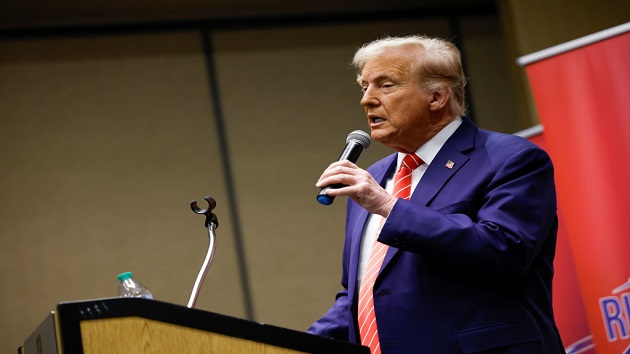
(NEW YORK) — Former President Donald Trump says he’ll be in court Tuesday when the Washington, D.C., Court of Appeals hears arguments over his efforts to dismiss his federal election interference case based on his claim of presidential immunity.
It could mark the first of two court appearances Trump makes this week, as he’s also expected to attend closing arguments in his civil fraud trial in New York on Thursday.
Trump is seeking the dismissal of the federal election interference case on the grounds that he has “absolute immunity” from prosecution for actions taken while serving in the nation’s highest office.
The former president confirmed his plans to attend Tuesday’s hearing in a social media post early Monday morning.
“I will be attending the the Federal Appeals Court Arguments on Presidential Immunity in Washington, D.C., on Tuesday,” he wrote. “Of course I was entitled, as President of the United States and Commander in Chief, to Immunity. I wasn’t campaigning, the Election was long over. I was looking for voter fraud.”
Last month, special counsel Jack Smith asked the Supreme Court to step in and quickly rule on the issue, but the court declined to grant a writ of certiorari before judgment — meaning it would allow a federal appeals court to hear the matter first, which is what Trump’s legal team had urged the court to do.
“This case involves — for the first time in our Nation’s history — criminal charges against a former President based on his actions while in office,” Smith’s team said in their petition to the Supreme Court to expediate the appeals process. “And not just any actions: alleged acts to perpetuate himself in power by frustrating the constitutionally prescribed process for certifying the lawful winner of an election.”
“The Nation has a compelling interest in a decision on respondent’s claim of immunity from these charges — and if they are to be tried, a resolution by conviction or acquittal, without undue delay,” Smith’s filing said.
Trump in August pleaded not guilty to charges of undertaking a “criminal scheme” to overturn the results of the 2020 election by enlisting a slate of so-called “fake electors,” using the Justice Department to conduct “sham election crime investigations,” trying to enlist the vice president to “alter the election results,” and promoting false claims of a stolen election as the Jan. 6 riot raged — all in an effort to subvert democracy and remain in power.
The former president has denied all wrongdoing and denounced the charges as “a persecution of a political opponent.”
(NEW YORK) — President Joe Biden on Monday will speak in Charleston, South Carolina, Monday to give campaign remarks at Mother Emanuel Church, where nine Black congregants were killed in a white supremacist attack in 2015, to underscore what he sees at the stakes of the 2024 election.
His campaign says his speech will include a warning that “MAGA (Make America Great Again) Republicans, led by Trump, are running on a hate-fueled, dangerous agenda.”
Biden, a campaign official said, “will emphasize that it is the job of a president to root out hate and extremism and to bring the nation together — turning horror and tragedy into action and progress” and “remind the American people that the same hate that plagued the Mother Emanuel Church years ago hasn’t gone away,” but “it is incumbent on our elected officials to do their part in rooting out hate, extremism, and division in our country.”
Biden will meet with survivors and families of those killed in the mass shooting by white supremacist Dylann Roof, according to two sources familiar with the matter. Clergy, interfaith leaders and Rep. Jim Clyburn, D-S.C., the highest-ranking Black lawmaker in Congress, will also be in attendance.
Clyburn’s endorsement in Feb. 2020 during a crowded Democratic primary was seen as instrumental in shoring up the Black vote in South Carolina which led Biden to clinch the primary and ultimately propelled him to the presidency.
He’s said few places embody what’s at stake in 2024 as Mother Emanuel AME Church.
“This year’s election will determine the fate of American democracy, our freedoms, and whether this country will stand up against hate and vitriol embodied by Donald Trump and MAGA Republicans,” Clyburn said in a statement via the campaign. “Few places embody these stakes like Mother Emanuel AME – a church that has witnessed the horrors of hate-fueled political violence and a church that has spoken to the conscience of this nation and shown us the path forward after moments of division and despair.”
“I have always said that South Carolina picks presidents and I know President Biden and Vice President Harris agree,” he added.
Monday’s remarks comes as Biden looks to shore up support among Black voters, a constituency key to his election four years ago but whose approval of him has waned since he’s taken office.
He started his presidency with an 86% average approval rating among Black Americans, according to FiveThirtyEight, higher than any other racial group, but that number dropped to 60% by early last year, the lowest it’s been for Biden among Black Americans since he assumed office.
South Carolina was pivotal to Biden’s 2020 win, clinching the state’s Democratic primary by nearly 30 points — a turning point for his campaign following losses in Iowa and New Hampshire.
The trip — his first this year to an early voting state — comes as some Democrats, like Clyburn, express concerns not only with Biden’s appeal to Black voters and the party’s more progressive wing but with how he’ll break through the so-called “MAGA wall.”
“I’m not worried. I’m very concerned,” Clyburn said on CNN’ “State of the Union” Sunday, asked if he was worried about Black voters turning out to the polls.
“I have no problem with the Biden administration and what it has done. My problem is we have not been able to break through that MAGA wall, in order to get to people exactly what this person has done,” he said, ticking through achievements he thinks Biden should hit harder, such as how he’s lowered the cost of prescription drug and appointed more Black women to the Court of Appeals than any other president.
The Democratic National Committee reorganized its primary calendar this year to lead with South Carolina with the primary election just 26 days away, on Feb. 3.
Biden’s appearance in Charleston comes on the heels of his first major 2024 campaign event, a speech near Valley Forge, Pennsylvania, last Friday to mark the anniversary of the Jan. 6, 2021 attack on the U.S. Capitol.
There, the president cast Trump as a danger to democracy,
“The choice is clear. Donald Trump’s campaign is about him, not America, not you. Donald Trump’s campaign is obsessed with the past, not the future. He’s willing to sacrifice our democracy, put himself in power,” Biden said. “Our campaign is different… Our campaign is about preserving and strengthening our American democracy.”
The Biden-Harris campaign told ABC News it raised more than $1 million online in the 24 hours following Biden’s democracy and freedom-focused message in the battleground state.
“In election after election, democracy and freedom are mobilizing issues for the American people,” digital director Rob Flaherty said in a statement on Monday. “In 2024, that will be no different, and we are encouraged by the strong grassroots enthusiasm we are seeing around the President’s core campaign message.”
(WASHINGTON) — President Joe Biden was exasperated at not more quickly being informed of Defense Secretary Lloyd Austin’s ongoing hospitalization — which was only publicly revealed late last week after several days — a U.S. official tells ABC News as the Pentagon is providing new details about Austin’s health issues.
The U.S. official said that there will be a review of the unusual way in which Austin’s medical treatment was disclosed and someone could lose their job.
The White House is publicly standing by Austin, with one administration official telling ABC News on Sunday that Biden “has full confidence in Secretary Austin” and is “looking forward to him being back at the Pentagon.”
The president and Austin also spoke Saturday evening and had what the White House official called a “warm conversation.”
However, the U.S. official said White House aides were angered at the lack of information about Austin being hospitalized at Walter Reed National Military Medical Center in Bethesda, Maryland. (The White House did not have further comment for this story.)
The frustration comes as another U.S. official confirmed to ABC News on Saturday that the White House did not learn about Austin’s hospitalization until Thursday night — three days after he was hospitalized on the night of New Year’s Day for complications resulting from what was characterized as “a minor, elective procedure.”
Congress was first notified of Austin’s hospitalization on Friday afternoon, shortly before it was made public in a Pentagon news release, ABC News reported on Saturday.
The timeline of information being shared about the health problems of the country’s top defense official, who is 70 years old, has raised questions inside and outside of the government.
Later on Sunday, a Pentagon spokesperson for the first time provided day-by-day details of how Austin came to be in intensive care at Walter Reed.
In a statement provided exclusively to ABC News, Maj. Gen. Pat Ryder said that Austin had his elective procedure on Dec. 22 and then went home the next day.
On Jan. 1, “he began experiencing severe pain and was transported” back to Walter Reed, Ryder said.
“For privacy reasons, we’re not able to provide additional information. He was placed in the hospital’s intensive care unit to ensure immediate access … due to his medical needs, but then remained in that location in part due to hospital space considerations and privacy,” Ryder said.
Kathleen Hicks, Austin’s deputy, was not informed in advance and was on vacation in Puerto Rico when he was hospitalized, according to the U.S. official who also described Biden’s exasperation.
She had to be taken to a secure location to help fill in for her boss, this official said
Austin “is recovering well and in good spirits,” Ryder said in another statement on Sunday, adding that officials “do not have a specific date for his release at this time.” The secretary resumed his duties on Friday night.
While the White House was in the dark for days, according to officials, Gen. CQ Brown Jr., the chairman of the Joint Chiefs of Staff, was informed on Tuesday that Austin had been hospitalized the night before, one U.S. official said.
Austin offered a mea culpa on Saturday, saying in a statement that he “could have done a better job ensuring the public was appropriately informed. I commit to doing better.”
“But this is important to say: this was my medical procedure, and I take full responsibility for my decisions about disclosure,” he said.
The Pentagon, led by Austin, is currently embroiled in several major international issues including tensions in the Middle East related to the Israel-Hamas war — which led to the U.S. deploying increased military assets to the region — and supporting Ukraine as it battles a Russian invasion that began in 2022.
(WASHINGTON) — Congressional leaders have at last reached agreement on the overall price tag of the next batch of government spending bills, sources tell ABC News — a major step toward averting a partial shutdown that is set to begin later this month.
Details of the deal, struck by leadership in the House and Senate and top appropriators in each chamber, will be formally announced later Sunday, sources said.
Agreeing on the top-line spending figures now allows lawmakers in the House and Senate to begin working on the text of individual bills.
Agriculture, energy, housing, and transportation programs, among others, were all slated to run out of funds on Jan. 19 under the last stopgap government funding bill passed by Congress in the fall.
This is a developing story. Please check back for updates.
(WASHINGTON) — Special counsel Jack Smith’s team has uncovered previously undisclosed details about former President Donald Trump’s refusal to help stop the violent attack on the U.S. Capitol three years ago as he sat watching TV inside the White House, according to sources familiar with what Smith’s team has learned during its Jan. 6 probe.
Many of the exclusive details come from the questioning of Trump’s former deputy chief of staff, Dan Scavino, who first started working for Trump as a teenager three decades ago and is now a paid senior adviser to Trump’s reelection campaign. Scavino wouldn’t speak with the House select committee that conducted its own probe related to Jan. 6, but — after a judge overruled claims of executive privilege last year — he did speak with Smith’s team, and key portions of what he said were described to ABC News.
New details also come from the Smith team’s interviews with other White House advisers and top lawyers who — despite being deposed in the congressional probe — previously declined to answer questions about Trump’s own statements and demeanor on Jan. 6, 2021, according to publicly released transcripts of their interviews in that probe.
Sources said Scavino told Smith’s investigators that as the violence began to escalate that day, Trump “was just not interested” in doing more to stop it.
Sources also said former Trump aide Nick Luna told federal investigators that when Trump was informed that then-Vice President Mike Pence had to be rushed to a secure location, Trump responded, “So what?” — which sources said Luna saw as an unexpected willingness by Trump to let potential harm come to a longtime loyalist.
House Democrats and other critics have openly accused Trump of failing to do enough that day, with the Democrat-led House select committee accusing Trump of committing “an utter moral failure” and “a clear dereliction of duty.” But what sources now describe to ABC News are the assessments and first-hand accounts of several of Trump’s own advisers who stood by him for years — and were among the few to directly engage with him throughout that day.
Along with Scavino and Luna, that small group included then-Chief of Staff Mark Meadows, then-White House counsel Pat Cipollone, and Cipollone’s former deputy, Pat Philbin.
According to sources, when speaking with Smith’s team, Scavino recalled telling Trump in a phone call the night of Jan. 6: “This is all your legacy here, and there’s smoke coming out of the Capitol.”
Scavino hoped Trump would finally help facilitate a peaceful transfer of power, sources said.
In his wide-ranging indictment against Trump, announced this past August, Smith accuses the former president of trying to unlawfully retain power by, among other things, “spread[ing] lies” about the 2020 election and pressuring Pence to block Congress from certifying the results when it convened on Jan. 6. The former president has pleaded not guilty to all charges.
‘Very angry’
As the House investigation established, after Trump finished his remarks at the “Save America” rally early on Jan. 6, as protesters began making their way to the Capitol, Trump returned to the White House, where he and Meadows settled into chairs around a table in the Oval Office dining room to watch TV coverage of the event.
But, as also previously recounted in public reports, when Scavino and other White House officials learned that rioters had violently stormed the Capitol, they rushed into the dining room to urge Trump to help calm the situation.
Still, Trump didn’t do anything.
According to what sources said Scavino told Smith’s team, Trump was “very angry” that day — not angry at what his supporters were doing to a pillar of American democracy, but steaming that the election was allegedly stolen from him and his supporters, who were “angry on his behalf.” Scavino described it all as “very unsettling,” sources said.
At times, Trump just sat silently at the head of the table, with his arms folded and his eyes locked on the TV, Scavino recounted, sources said.
After unsuccessfully trying for up to 20 minutes to persuade Trump to release some sort of calming statement, Scavino and others walked out of the dining room, leaving Trump alone, sources said. That’s when, according to sources, Trump posted a message on his Twitter account saying that Pence “didn’t have the courage to do what should have been done.”
Trump’s aides told investigators they were shocked by the post. Aside from Trump, Scavino was the only other person with access to Trump’s Twitter account, and he was often the one actually posting messages to it, so when the message about Pence popped up, Cipollone and another White House attorney raced to find Scavino, demanding to know why he would post that in the midst of such a precarious situation, sources said.
Scavino said he was as blindsided by the post as they were, insisting to them, “I didn’t do it,” according to the sources.
Some of Trump’s aides then returned to the dining room to explain to Trump that a public attack on Pence was “not what we need,” as Scavino put it to Smith’s team. “But it’s true,” Trump responded, sources told ABC News. Trump has publicly echoed that sentiment since then.
At about the same time Trump’s aides were again pushing him to do more, a White House security official heard reports over police radio that indicated Pence’s security detail believed “this was about to get very ugly,” according to the House committee’s report.
As Trump aide Luna recalled, according to sources, Trump didn’t seem to care that Pence had to be moved to a secure location. Trump showed he was “capable of allowing harm to come to one of his closest allies” at the time, Luna told investigators, the sources said.
With the chaos inside the Capitol continuing, Trump’s aides believed Trump still needed to do more. Sources said Cipollone recalled telling Trump that he needed to explicitly instruct rioters to leave the Capitol.
Scavino printed out proposed messages to post on Twitter, hoping that Trump would approve them despite his reluctance to write such posts himself, sources said. The congressional probe found that even Trump’s daughter, Ivanka, “rushed down to the Oval Office dining room” to convince her father that issuing a public message could “discourage violence,” as the congressional report put it.
More than a half-hour after Trump was first pressed to take some sort of action, Trump finally let Scavino post a message on Trump’s Twitter account telling supporters to support law enforcement and “stay peaceful.” It was 2:38 p.m.
Minutes later, Trump supporter Ashli Babbitt was fatally shot when she tried to break through a barricaded entrance near the House chamber.
And the violence at the Capitol continued to escalate.
At least six of Trump’s closest aides continued to push Trump to do something more forceful than posting what they saw as a weak message on Twitter, sources said.
Trump listened to the pleas, “but he was just not interested at that moment to put anything out,” Scavino told Smith’s team, according to the sources. Instead, Trump was focused on watching TV and taking in the chaotic scenes, Scavino said, the sources added.
Testifying before the House committee, an aide to Meadows similarly said she heard Meadows say of Trump that day, “He doesn’t want to do anything.”
As recounted in public reports, then-House Minority Leader Kevin McCarthy, other members of Congress, members of Trump’s family, and even Fox News personalities also tried to push Trump to take further action. But in response, Trump repeated to many of them that his supporters were simply angry about the election being stolen, sources said.
In his own closed-door interviews with federal investigators, Meadows confirmed previous media reports saying that when a desperate McCarthy called Trump, the then-president told him, “Well, Kevin, I guess these people are more upset about the election than you are.”
Instead of taking action at that point, Trump allegedly continued to watch Fox News on TV.
“During this time, law enforcement agents were attacked and seriously injured, the Capitol was invaded, the electoral count was halted and the lives of those in the Capitol were put at risk,” the House committee said in its report.
‘Doesn’t justify this’
Sources said that eventually, at the urging of Ivanka’s husband, Jared Kushner, Trump agreed to record a video for release. The video, more than a minute long, was posted to Twitter at about 4:15 p.m.
“This was a fraudulent election,” Trump said. “[But] we have to have peace. So go home. We love you. You’re very special.”
Sources said that when investigators questioned him, Scavino told them he has yet to be shown any evidence of fraud that would have changed the outcome of the election. As ABC News has previously reported, sources said other loyal aides to Trump, including Meadows, allegedly provided similar statements about the 2020 election when speaking to Smith’s team.
According to the House panel’s report on Jan. 6, the video Trump released — several hours after the attack on the Capitol began — “immediately had the expected effect; the rioters began to disperse immediately and leave the Capitol.”
As for Trump, after the video was released, he returned to watching TV coverage of the day with Philbin and others, according to sources. And when clips of the riot were splashed across the screen, Trump declared something to the effect of, “This is what happens when they try to steal an election,” Philbin recalled to investigators, sources said.
According to the sources, Philbin said he responded: “Mr. President, it doesn’t justify this.”
Sounding ‘culpable’?
As described by sources, it was a tense, uncomfortable evening for Trump. Sources said one close aide told Smith’s team that Trump was in “disbelief” that night, even as he showed no remorse.
None of the Trump aides who spoke with investigators said they heard Trump concede even in private that he lost the election, sources told ABC News.
According to the sources, shortly before 6 p.m. on Jan. 6, Trump showed Luna a draft of a Twitter message he was thinking about posting: “These are the things and events that happen when a sacred landslide election victory is so unceremoniously and viciously stripped away from great patriots. … Remember this day for forever!” it read.
The message echoed what Trump had allegedly been saying privately all day.
Sources said Luna told Trump that it made him sound “culpable” for the violence, perhaps even as if he may have somehow been involved in “directing” it, sources said.
Still, at 6:01 p.m., Trump posted the message anyway.
About an hour later, Twitter suspended Trump’s account.
After that — but before Congress reconvened to finish its vote certifying the 2020 election — Cipollone called Trump, relaying what a “horrible day” it had been and urging Trump to tell Republican allies in Congress that they should withdraw any objections to the certification so the country could move on, sources said.
Instead, Trump again declined to act, telling Cipollone, “I don’t want to do that,” Cipollone recalled to investigators, according to sources.
Trump then had another strained phone conversation, when he called Scavino to ask for his take on how the public was digesting the day’s events, sources said.
“Not good,” Scavino told Trump, according to the sources.
Scavino had hoped Trump’s presidency would end on a better note, and he told investigators his conversation with Trump was not “comfortable,” sources said.
But Scavino also essentially told Trump that — despite how the media might portray Jan. 6 — his “legacy” could remain intact if he took the right steps moving forward, sources said.
As a longtime Trump associate, Scavino has been so supportive of Trump over the years that he was asked to speak at the Republican National Convention in 2020. At a campaign rally in Colorado a few months earlier, Trump joked that, as a close aide to the president, Scavino was “the most powerful man in politics.”
In April 2022, the House held Scavino in contempt of Congress for refusing to comply with a subpoena seeking testimony in the congressional investigation, after Scavino cited executive privilege. The Justice Department ultimately declined to charge him in that matter, but last year — after a monthslong court battle — a federal judge ruled that Scavino had to comply with a grand jury subpoena from Smith’s team.
A federal judge similarly ruled that, despite any claims related to executive privilege, Meadows, Cipollone, Philbin and Luna also had to comply with Smith’s subpoenas for testimony.
When asked about what sources told ABC News regarding Scavino’s statements, including his comments to Smith’s team about “smoke coming out of the Capitol” and Trump’s “legacy,” a spokesperson for the Trump campaign said, “President Trump and Dan Scavino both agreed that it could be part of legacy but, regardless, wanted to get it done and did it. There is no dispute over that.”
“Media fascination with second-hand hearsay shows just how weak the Witch-Hunt against President Trump is,” the spokesperson added. “Dan Scavino is one of President Trump’s longest-serving, most loyal allies, and his actual testimony shows just how strong President Trump is positioned in this case.”
An attorney for Scavino, Stanley Woodward, declined to comment to ABC News, as did an attorney representing both Cipollone and Philbin, Michael Purpura. An attorney for Luna did not respond to a request for comment.
A spokesperson for the special counsel also declined to comment to ABC News.
(WASHINGTON) — Former House Speaker Nancy Pelosi on Sunday lambasted former President Donald Trump for his reported inaction to quell the violence at the U.S. Capitol on Jan. 6, 2021.
“He incited an insurrection,” the California Democrat told ABC News “This Week” anchor George Stephanopoulos one day after the three-year mark of the riot.
Trump has long maintained he did nothing wrong during Jan. 6 and has downplayed the chaos of that day.
Pelosi invoked the nation’s history as she argued the stakes were high heading into the 2024 race, in which Trump is seeking to return to the White House against President Joe Biden.
“I’m proud of the national anthem. And in it, it says ‘proof through the night that our flag was still there.’ We have to prove through this campaign in the night that our flag is still there with liberty and justice for all and not have an acceptance of Confederate flags under [the] Lincoln dome [at the Capitol] with a president sitting in the White House doing nothing to stop the violence,” Pelosi said. “He talks about the big steal as he can engages in the big lie.”
Pelosi’s comments come after new reporting from ABC News on Sunday on previously undisclosed details about how Trump had remained uninterested in getting involved to stop the violence during the riot, according to sources familiar with testimony in the special counsel’s investigation of Trump.
Trump has pleaded not guilty to the felony charges he faces in his federal election subversion indictment. He has denied all wrongdoing and claimed political persecution, which prosecutors reject.
According to ABC News’ new report, sources said Trump’s former deputy chief of staff, Dan Scavino, told special counsel Jack Smith’s investigators that Trump “was just not interested” in doing more to stop the mob that went on to ransack the Capitol in 2021.
Additionally, sources said that when Trump was informed that then-Vice President Mike Pence had to be transported from the halls of the Capitol to a secure location, Trump responded, “So what?”
A spokesperson for Trump told ABC News in response to the new reporting, in part, “Media fascination with second-hand hearsay shows just how weak the Witch-Hunt against President Trump is.”
An attorney for Scavino declined to comment to ABC News for Sunday’s new report. The Trump spokesperson said in that story that Scavino was “one of President Trump’s longest-serving, most loyal allies.”
Appearing on “This Week,” Pelosi seized on the details to note that many of the revelations that have come out about Trump’s efforts to overturn the 2020 election results and his actions on Jan. 6, 2021, have come from Republicans.
“What’s interesting about it all is that in every case, every piece of this, whether it was in our case, in terms of the Electoral College, whether it was what happened with the Jan. 6 select committee or this testimony now, is all coming from Republicans,” she said, adding, “It’s very clear what happened that day.”
Still, Stephanopoulos noted, recent polling has showed a sizeable chunk of Republicans continue to falsely believe Trump won the 2020 election and that the FBI instigated the violence on Jan. 6.
“It’s a challenge that we have in our country,” Pelosi acknowledged. “We have people who don’t want to believe the truth or whatever attitudes they have otherwise. But again, during this period, this campaign year, it behooves us to speak with respect for all concerns in a unified way to bring people together. But there is no way that anybody can think that that assault on the Constitution … it cannot stand. He [Trump] is not above the law.”
When pressed by Stephanopoulos over whether Trump should be barred from running for president again under the 14th Amendment, a part of which prohibits insurrectionists from running for federal office, Pelosi demurred, saying the courts will ultimately have to rule on the matter.
But in her view, she said, “I think that he engaged in an insurrection.”
Stephanopoulos also separately asked Pelosi about Republicans’ demands for major immigration reform as part of any other movement on the White House’s pending national security proposal, including recent threats that House GOP hard-liners could vote against a bill to fund the government if a deal is not reached on beefing up border security.
“We know what works. It’s not rocket science,” House Speaker Mike Johnson said last week during a trip to the southern border to spotlight the high amount of illegal immigration.
Responding to that on “This Week,” Pelosi said, “We can’t have a government shutdown. Let’s be grown-up about how we deal with our responsibilities.”
“We have to handle this with care,” she said. “We must secure our border. That’s for sure. There’s no question about that. But we also must honor our responsibilities in terms of asylum and the rest, and the president has that in his proposal.”
(WASHINGTON) — President Joe Biden was exasperated at not more quickly being informed of Defense Secretary Lloyd Austin’s ongoing hospitalization — which was only publicly revealed late last week after several days — a U.S. official tells ABC News.
This person said that there will be a review of the unusual way in which Austin’s health issues were disclosed and someone could lose their job.
The White House is publicly standing by Austin, with one administration official telling ABC News on Sunday that Biden “has full confidence in Secretary Austin” and is “looking forward to him being back at the Pentagon.”
The president and Austin also spoke Saturday evening and had what the White House official called a “warm conversation.”
However, the U.S. official said White House aides were angered at the lack of information about Austin being hospitalized at Walter Reed National Military Medical Center in Bethesda, Maryland. (The White House did not have further comment for this story.)
The frustration comes as another U.S. official confirmed to ABC News on Saturday that the White House did not learn about Austin’s hospitalization until Thursday night — three days after he was hospitalized on the night of New Year’s Day for complications resulting from what was characterized as “a minor, elective procedure.”
Congress was first notified of Austin’s hospitalization on Friday afternoon, shortly before it was made public in a Pentagon news release, ABC News reported on Saturday.
The timeline of details being shared about the health of the country’s top defense official, who is 70 years old, has raised questions inside and outside of the government.
Kathleen Hicks, Austin’s deputy, was not informed in advance and was on vacation in Puerto Rico when he was hospitalized, according to the U.S. official who also described Biden’s exasperation.
She had to be taken to a secure location to help fill in for her boss, this official said.
While the White House was in the dark for days, according to officials, Gen. CQ Brown Jr., the chairman of the Joint Chiefs of Staff, was informed on Tuesday that Austin had been hospitalized the night before, one U.S. official said.
A U.S. Department of Defense spokesperson said Saturday that Austin remained hospitalized but had resumed his duties on Friday night.
Austin offered a mea culpa on Saturday, saying in a statement that he “could have done a better job ensuring the public was appropriately informed. I commit to doing better.”
“But this is important to say: this was my medical procedure, and I take full responsibility for my decisions about disclosure,” he said.
The Pentagon, led by Austin, is currently embroiled in several major international issues including tensions in the Middle East related to the Israel-Hamas war — which led to the U.S. deploying increased military assets to the region — and supporting Ukraine as it battles a Russian invasion that began in 2022.
(WASHINGTON) — Republican Rep. Tony Gonzales is defending his endorsement of former President Donald Trump despite their sharply different views on Jan. 6.
In an interview on Sunday with ABC News “This Week” anchor George Stephanopoulos, Gonzales was repeatedly pressed on his support for Trump in the 2024 presidential race given that Trump has called participants in the U.S. Capitol attack who have been prosecuted “hostages” and downplayed the riot itself as a “beautiful day.”
Gonzales, a Texas lawmaker, noted that he was in the Capitol on Jan. 6, 2021, and went on to help police respond. He said he could sense the “chaos” before it unfolded.
“There was an anger built in our country then and, three years later, that anger has not stopped,” he said. “There’s this division that continues to get fueled. The easiest thing to do in politics is to blame someone else. I think it’s time for us as Americans to set aside our differences, and [focus on] how do we heal this country and bring it back together?”
Stephanopoulos pointed out that Gonzales’ comments about Jan. 6, including calling those who participated “domestic terrorists,” have long been at odds with the former president.
Gonzales said that Trump “wasn’t responsible” for Jan. 6, arguing instead that the riot broke out because people “no longer believe in the system.”
“I look at it through the lens [of] that was a dark day and I never want to see Jan. 6 happen again, or something like that or riots across our country. How do we calm everybody down? How do we bring this country together?” Gonzales said.
He maintained that the residents of his district, which includes much of Texas’ border with Mexico, “aren’t talking about Jan. 6” and are instead “talking about feeling safe in their homes, they’re talking about putting food on the table, keeping their kids safe in school.”
But given Gonzales’ differences with Trump over Jan. 6, Stephanopoulos asked if he believes as Trump does that the rioters should receive presidential pardons.
“They’re certainly not hostages … They’re certainly not heroes,” Gonzales said. “They broke the law, and we have to obey our laws.”
Gonzales contended, however, that “we never got to the root of why they did that … If we continue to kick the can down the road and not get to the root of the issue of why people are angry, it’s going to create more dangers.”
Stephanopoulos pushed back, saying that the anger of Jan. 6 participants was in part because “they were fed a lot of lies about the election from the man you now support to be president again.”
“Well, they felt as if President [Joe] Biden stole that election, and nothing has changed since then,” Gonzales said.
Stephanopoulos followed up: “Did President Biden steal the election?”
“Of course not,” Gonzales replied. “But Sen. Biden was this bipartisan, deal-making individual that everyone thought they were going to get. President Biden has turned out to be much different.”
“This is the reason why Americans are angry and upset. And unless we tackle that issue, we’re going to see more of the same,” Gonzales said. He suggested there could be future domestic threats: “I worry about 9/11, but I also worry about — think back to the Oklahoma City bombing. I mean, when people are angry, they do desperate things.”
Gonazles said he wanted to see Trump back in office to see a return to Trump’s “successful” policies, including at the southern border.
Gonzales pointed to the current high rates of illegal immigration, which he said have a major impact on his district. Under Trump-era policies, Gonzales said, his district didn’t have as many issues.
“We did not have the border crisis that we have now. We did not have the humanitarian turmoil,” he said. “We did not have the chaos. That’s the No. 1 thing in my district. Our lives are turned upside down, and we just want to get back to normal.”
Ultimately, Gonzales said, “I just want solutions. I think the American public also wants solutions.”
“I’d much rather see leaders come to the table and go, ‘How do we solve problems?'” he added.
Again, Stephanopoulos pushed back.
“If you want to bring people together, if you want to solve these problems, doesn’t the responsibility begin with not endorsing a candidate for president who’s spreading lies about the last election?” he said.
Gonzales suggested that him backing Trump in the upcoming election shouldn’t be over-interpreted.
“This is what I’ve learned about endorsements: You get all their enemies and hardly any of their friends,” he said. “Endorsements are just a piece of paper. But I do endorse — I do endorse President Trump, and I think President Trump’s policies were very successful.”
Gonzales insisted that he didn’t think his stances on Trump were as important to his job in Congress as other duties such as “border security solutions.”
“If everything Donald Trump says and does, you want to put on my back, we’re going to be here all day,” he said.
(MASON CITY, Iowa) — On Jan. 6, 2021, then-President Donald Trump spoke on the Ellipse near the White House on the heels of his 2020 election loss, telling supporters to march to the U.S. Capitol “peacefully and patriotically,” but also proclaiming, “If you don’t fight like hell, you’re not going to have a country anymore.”
Soon after, a pro-Trump mob stormed the Capitol, and Trump’s efforts to overturn the election are now at the center of his federal election subversion case. (The case is currently stayed while the appeals process plays out, and Trump has denied all wrongdoing.)
On Saturday, on the third anniversary Jan. 6, Trump is spending the day in Iowa, delivering his closing message before the Jan. 15 GOP caucuses, continuing to use the events of Jan. 6 as a rallying cry.
On the campaign trail, Trump has downplayed the violence that ensued that day and has called those charged and convicted in attack “hostages.”
“The J6 hostages, I call them. Nobody has been treated ever in history so badly as those people nobody’s ever been treated in our country,” Trump said at a rally Friday in Iowa on the eve of the anniversary.
Jailing those who broke into the Capitol that day, he said, is “one of the saddest things in the history of our country.” He’s said he would grant clemency to a “large portion” of them.
In the three years since the assault on the U.S. Capitol, federal prosecutors have charged more than 1,265 defendants across nearly all 50 states and Washington, D.C., and secured convictions and incarceration for more than 460 people, according to numbers from the U.S. Attorney’s Office in D.C. released Friday.
Trump’s claims of widespread election fraud have been rejected in at least 60 court cases, according to PolitiFact.
In referring to Jan. 6, Trump’s embrace of what he’s called a “beautiful day” extends even to his campaign walk-up song where he sometimes plays “Justice for All” by the so-called “J6 Prison Choir” — a group of men incarcerated for their roles on Jan. 6 — singing the “Star Spangled Banner” as Trump recites the Pledge of Allegiance.
Now, with the 2024 presidential cycle heading toward a potential rematch between Trump and President Joe Biden, both have made the aftermath of the 2020 a central part of their campaign messages.
Biden is portraying Trump as a dire threat to democracy and freedom as he did in his first 2024 campaign event Friday on the eve of the Jan. 6 anniversary. His campaign also released an ad on Saturday comparing the attack on the Capitol to the white supremacist rally in Charlottesville, Virginia, in 2017– the event that Biden says inspired him to run for president.
Speaking in battleground Pennsylvania, Biden called Jan. 6 “a violent assault,” slamming Trump repeatedly by name.
“He tried to rewrite the facts of January 6. Trump is trying to steal history the same way he tried to steal the election,” Biden said in his fiery speech.
“Today, I make this sacred pledge to you, the defense, protection, and preservation of American democracy will remain, as it has been, the central cause of my presidency,” he said. “America, as we begin this election year, we must be clear, democracy is on the ballot. Your freedom is on the ballot.”
Trump has tried to flip the script on Biden, calling his speech “pathetic” and “fear mongering.” He and his campaign claim Biden is the actual “threat to democracy,” pointing to Trump’s multiple criminal indictments to accuse Biden, without evidence, of weaponizing the Justice Department to prosecute his most formidable political opponent.
“Joe Biden is not the defender of American democracy. Joe Biden is the destroyer of American democracy and it’s him and his people. They’re the wreckers of the American dream. The American dream is dead with them in office. It’s sad,” Trump said at a campaign stop last month.
Trump’s GOP primary challengers have started to get more vocal in condemning Trump’s involvement in Jan. 6. Former South Carolina Gov. Nikki Haley has called it a “terrible day,” saying people who broke the law should “pay the price to show that it will never happen again.”
Florida Gov. DeSantis has claimed the attack would never have happened under his watch because, he said, “I would have won the election.”
“Whatever his intention was, you know, he put those people in jeopardy, and a lot of people have now gotten caught up in that. So, it was not good,” DeSantis said.
(DES MOINES, Iowa) — Eight years ago, then-first time presidential hopeful Donald Trump kicked off his campaign rallies dancing to the 1970s’ disco anthem “YMCA.”
He still does, except now the campaign also plays in-depth videos explaining the caucus process, hosts panel discussions among caucus precinct captains and even gives out “limited edition” Trump-signed hats to campaign volunteers as supporters wait for him to take the stage.
It’s an effort by the Trump campaign to flip the script for his third presidential run by revamping its Iowa playbook, recognizing the importance of ensuring that the excitement supporters show at campaign rallies translates into their actually heading to their local precinct to caucus for the former president.
It’s a lesson Trump, then an Iowa caucus novice, learned from his loss to Texas Sen. Ted Cruz in 2016, despite having momentum from earlier in the cycle.
Now, returning to Iowa for his third presidential bid, he’s armed with a more experienced and sophisticated operation that includes a ground game his team has been building for years.
With just days to go until the GOP caucuses, Trump, at a Friday night Iowa rally, repeatedly told his supporters to make sure to vote on Jan. 15.
“We’re not taking any chances,” he said. “The biggest risk is, you say you know what? He’s winning by so much, darling. Let’s stay home and watch television. Let’s watch this great victory. And if enough people do that, it’s not going to be pretty. But we’re not going to let that happen.”
Lighter schedule compared to 2016
Friday marked Trump’s first campaign appearance in Iowa this year, headlining a rally in Sioux Center in the afternoon and another rally in Mason City later that evening.
On Saturday, on the third-year anniversary of a pro-Trump mob attacking the US. Capitol on Jan. 6, 2021, he was set to criss-cross Iowa for rallies in Newton and Clinton.
After that, Trump isn’t making another public campaign appearance in Iowa until much closer to the caucus date — making two stops each on Jan. 13 and Jan. 14. That’s except for a town hall with Fox News’ Bret Baier and Martha MacCallum in Des Moines as his counterprogramming to the CNN GOP debate on Jan. 10 with rivals Florida Gov. Ron DeSantis and former South Carolina Gov. Nikki Haley.
The campaign is filling in the dates in between with Trump surrogates — a move kicked off with South Dakota GOP Gov. Kristi Noem on Wednesday. But Trump himself will hold fewer events than what was expected to be a barnstorming tour in the final stretch.
Trump’s relatively light schedule in the first two weeks of this year is especially notable compared to his 11-stop cross-state campaign leading up to the 2016 Iowa caucuses, during which he jumped from Mississippi to New Hampshire to South Carolina to Iowa then to Nevada from Jan. 2 through Jan. 15, even adding a few stops in non-early voting states in between.
In fact, throughout 2023, Trump visited Iowa only 18 times and held just under 40 campaign events and other appearances, not nearly as many as his fellow contenders, some of whom have visited the state dozens of times and held hundreds of events.
DeSantis, who has been aggressively campaigning in hopes of gaining momentum from Iowa, completed his “Full Grassley” last month — a reference to Iowa GOP Sen. Chuck Grassley’s efforts to visit all 99 counties in the state every year. And entrepreneur-turned presidential hopeful Vivek Ramaswamy earlier this week completed his “Double Grassley,” visiting all 99 Iowa counties at least twice.
One reason has been Trump’s legal battles — where he faces 91 felony counts across four criminal cases as well as a civil fraud trial in New York. He has plead not guilty and denied all wrongdoing.
All through last year, he has had to navigate his court schedule in between campaign rallies, including popping in and out of multiple courthouses for arraignments and witness testimony as well as taking a mugshot.
This coming Tuesday, just days out from the Iowa caucuses, Trump is planning to appear at the federal appeals court in Washington, D.C., as it hears arguments on his efforts to dismiss the federal election subversion case citing presidential immunity — while his contenders campaign in Iowa.
Still, Trump’s support in the state appears not to have waned, embodied not only in the polls where he continues to boast wide gap between his contenders, according to 538’s Iowa polling average, but also in numerous yard signs that can be seen driving through little towns in Iowa and thousands of loyal supporters that gather at every Trump visit.
Hasn’t stopped campaigning in Iowa since 2015, allies say
In 2015, Iowa was one of the first states Trump visited after announcing his presidential bid that summer.
After making his debut before more than 1,000 Iowa voters packed inside Oskaloosa High School at his first-ever Iowa rally in July 2015, he visited the state about a dozen more times through the end of Iowa caucuses.
He continued to draw thousands of people — often tens of thousands — at most of his campaign rallies throughout the 2016 cycle, showcasing voters’ excitement over the prospect of a President Donald Trump.
But those who have observed his first presidential campaign describe it as a wheels-up, wheels-down operation, as he hopped from one state to another, introducing himself to the country as a presidential candidate, not just as a businessman or entertainer.
It was a beginner’s campaign, working with a smaller ground operation in Iowa, without the seasoned expertise and experience to navigate the state’s complicated Iowa caucus system nor the robust data-backing the current Trump campaign boasts.
But after being beaten by Cruz in January 2016 and his eventual victory that November, Trump’s allies in Iowa say he never stopped campaigning there, from appointing former Iowa Gov. Terry Branstad as U.S. ambassador to China to working closely with state leaders to help Republicans gain control of Iowa’s House congressional delegation in 2022.
And long before his 2024 rivals started campaigning in Iowa, the Trump campaign says, it has been laying the groundwork with Iowa voters, building a staff that understands the nuances of the caucus process and developing relationships with the state’s powerbrokers, as well as Trump familiarizing himself with issues that matter to Iowans.
“Ground game organization, collection of data, outreach and engagement to supporters and potential caucus goers to turnout for the caucus — well-organized events that are used as both a recruiting and organizational tool,” said Eric Branstad — who served as Trump’s Iowa state director during his 2016 campaign and has advised his 2020 campaign — explaining how he has seen the Trump campaign evolve over the years.
And for the past few months, his campaign events have been billed as “Commit to Caucus” events, designed to not only have Trump speak before supporters eager to see him but also for the campaign to promote its ground operation, recruit volunteers and to educate voters about the caucus process.
‘Commit to Caucus’
Now the campaign boasts of securing dozens of Iowa legislative endorsements, recruiting over 2,000 caucus precinct captains who will speak on Trump’s behalf on caucus night and getting more than 50,000 caucus commitment cards signed by Iowa voters. The campaign has also hosted more than 400 caucus training sessions this cycle.
“Caucus night will come out to turn out and getting people to the caucuses on a cold night in January,” said Iowa Attorney General Brenna Bird, who has been campaigning for Trump as his surrogate. “He has a lot of new people coming into the caucus process that will be going to the caucus for the first time as an Iowa voter and you’re working to make sure those people have all the information they need to go and vote so his campaign has a good ground game.”
And Trump’s “Commit to Caucus” stops in Iowa this cycle have been meticulously planned out as well — not only to maximize his exposure to the largest crowd possible but also capitalizing on a strong support he has garnered in eastern Iowa over the years, which had previously been a Democratic stronghold with an industrial, blue-collar demographic that had voted for former President Barack Obama before they flipped to Trump in 2016.
“Similar to Ohio and Florida, President Trump ushered in a fundamental shift to Iowa’s electorate in 2016 — these states are far more Republican today than before,” said the Trump campaign’s early states director Alex Latcham, who worked with the 2016 Trump campaign’s Iowa team.
“I would argue he’s done that really nationwide, but Iowa is a perfect microcosm of that shift,” Latcham continued. “The Republican Party is the party of working class voters and President Trump is their candidate. He’s their voice.”
Hitting big and small Eastern Iowa cities like Cedar Rapids, Dubuque, Maquoketa, Davenport and Coralville, Trump has been strengthening his support base with voters that are particularly receptive to his messages on bread and butter economic issues, Latcham said.
‘Sometimes polls are wrong’
For Trump, the key this time is not just garnering more support ahead of the caucuses, but getting those supporters to actually turn up on Jan. 15.
“The name of the game here for caucuses is voter turnout,” senior Iowa adviser Alex Meyer told a roomful of voters, including caucus captains, at Team Trump’ headquarters in Urbandale, Iowa, last month.
Trump himself has spent more time on the campaign trail emphasizing the importance of caucusing — telling people to not sit out on caucus night.
“On television today, they said the primaries are over,” Trump said at a campaign event in Cedar Rapids last month. “I said, don’t listen to that. Don’t listen. Nothing’s over. I’ve seen things that are over and bad things can happen.”
“You’ve got to get out and vote, even if you think we’re gonna win,” Trump said at another campaign event in Coralville, Iowa, later that month. “Who knows? You know, sometimes polls are wrong. They gotta really be wrong – that would be record-setting. But you gotta get out and vote, vote, vote, and then we worry about November. Do one thing first.”