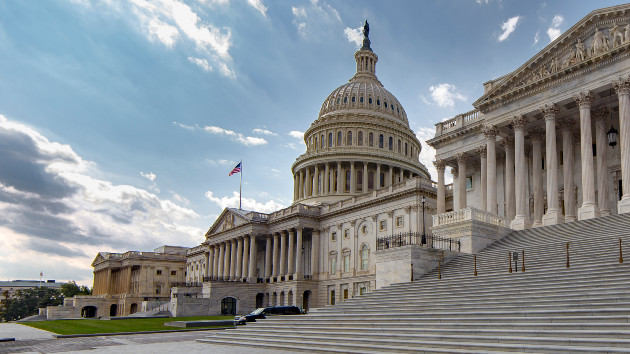
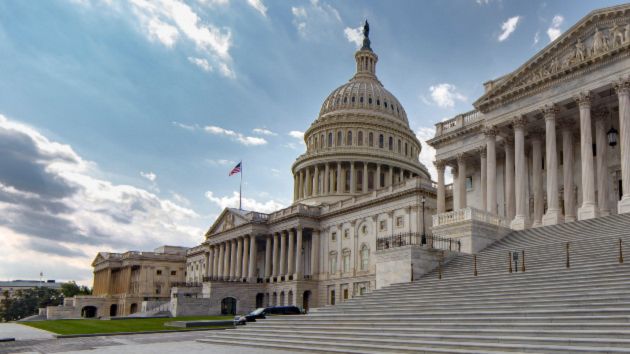
US Capitol Building (Photo by Mike Kline (notkalvin)/Getty Images)
(WASHINGTON) — Democratic Sens. Martin Heinrich and Mark Kelly will introduce legislation in the Senate on Tuesday that would strip out a provision in the just-passed government funding bill that allows senators to sue the government if their phone records are investigated without notifying them.
The bill comes after Senate Republicans included within the massive government funding bill that ended the 43-day government shutdown a provision that would allow senators whose phone records were subpoenaed by Special Counsel Jack Smith as part of his investigation into the Jan. 6 attack on the Capitol to sue for $500,000 per accessed device.
News of the Senate’s inclusion of this provision caused bipartisan outrage in the House of Representatives.
House Speaker Mike Johnson last week said the House would hold a standalone vote on a provision to strip the language out of the funding bill this week. Due to the bipartisan objection to these provisions, the House bill has a high likelihood of being successfully passed out of the lower chamber.
“I think that was way out of line. I don’t think that was a smart thing … and the House is going to reverse — we are going to repeal that, and I’m going to expect our colleagues in the Senate to do the same thing,” Johnson said at a press conference last week.
Kelly and Heinrich’s bill is not identical to the House provision but the two bills closely resemble one another.
Efforts to repeal the phone record provision face a far more difficult path in the Senate than in the House.
The bill has 24 Democratic co-sponsors but currently no GOP supporters.
Sources told ABC News that Senate Majority Leader John Thune was personally responsible for including the language in the bill. Thune would be the one responsible for placing the bill on the floor, where it would need 60 votes to advance.
Councilmember Chi Osse speaks as Starbucks workers go on strike outside a Starbucks store, Nov. 13, 2025, in Brooklyn, New York. Michael M. Santiago/Getty Images
(NEW YORK) — New York City councilmember Chi Ossé appeared to confirm he would challenge House Democratic leader Rep. Hakeem Jeffries for his seat representing New York’s 8th congressional district in an X post on Monday.
Ossé responded to another post calling him out for saying last month that he was not going to run. This comes after Ossé’s name appeared on FEC filings launching a bid for NY-08 earlier Monday.
“How can Brooklyn voters take you at your word when just last month you said this? ‘It would take a very dire situation in order for me to even consider spending the rest of my 20s in DC. Just to be clear, I’m not running for Congress,'” a post said.
Ossé responded: “Seems like we’re in a dire situation.”
Ossé told Axios that he is “currently exploring” the challenge and that the filings are legitimate.
“The Democratic Party’s leadership is not only failing to effectively fight back against Donald Trump, they have also failed to deliver a vision that we can all believe in,” Ossé, who recently joined the Democratic Socialists of America, said in a statement to Axios.
“These failures are some of the many reasons why I am currently exploring a potential run for New York’s 8th Congressional District,” he told the outlet.
Ossé is floating a challenge without the complete and total blessing from progressives. New York City Mayor-elect Zohran Mamdani’s team has reportedly been attempting to discourage Ossé from running, and Adam Green, co-founder of the Progressive Change Campaign Committee, said in a statement that “it is not the right moment to launch a primary challenge to Hakeem Jeffries.”
Asked about Ossé’s FEC filings in a press conference on the Hill Monday afternoon, Jeffries appeared to welcome the challenge, saying, “Come on in, the water is warm.”
A spokesperson for Jeffries said in a statement to ABC News that they “welcome this primary challenge” from Ossé and “look forward to a rigorous debate.”
“Leader Jeffries is fighting hard to lower the high cost of living, address the Republican healthcare crisis, combat corruption and win back control of the House for the good of the country. We welcome this primary challenge and look forward to a rigorous debate about the type of serious leadership required to deliver for the people of Brooklyn and the nation,” said Justin Chermol, Jeffries’ spokesperson.
Ossé, 27, made waves as New York’s first Gen Z city councilmember when he was sworn into office in 2022 and led the charge on the FARE Act, which was passed last year and forces landlords to pay broker’s fees instead of tenants.
Ossé left the New York City chapter of the Democratic Socialists of America in 2020 “very shortly after signing up,” saying on X that he “wasn’t aligned with the organization itself.” He later rejoined NYC-DSA in 2025.
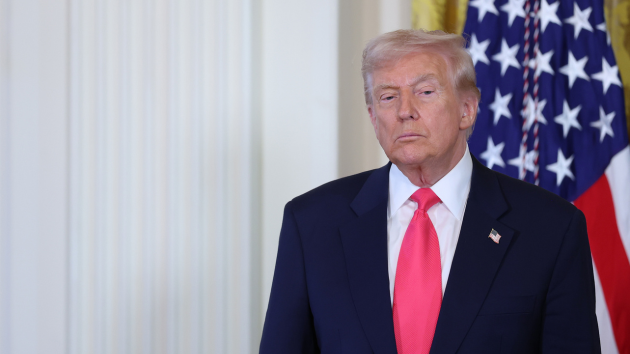
U.S. President Donald Trump listens as first lady Melania Trump speaks at a signing ceremony for the “Fostering the Future” executive order in the East Room of the White House on November 13, 2025, in Washington, DC. (Photo by Anna Moneymaker/Getty Images)
(WASHINGTON) — President Donald Trump on Monday said he would sign the bill to compel the Justice Department to release all files relating sex offender Jeffrey Epstein if it comes to his desk.
“I’m all for it,” he said as he took reporter questions during an event in the Oval Office, contending the controversy is deflecting from his administration successes.
Pressed again moments later if he would sign the bill that the House is set to take up Tuesday, Trump replied: “Sure I would.”
“Let the Senate look at it. Let anybody look at it. But don’t talk about it too much, because, honestly, I don’t want it to take away from us. It’s really a Democrat problem,” he said.
This is a developing story. Please check back for updates.
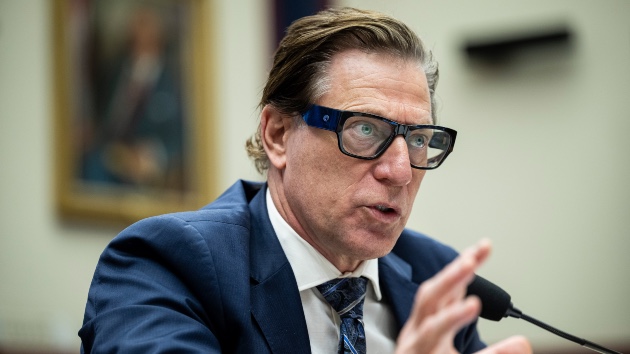
David Richardson, acting administrator of the Federal Emergency Management Agency (FEMA), during a House Transportation and Infrastructure Subcommittee hearing in Washington, DC, US, on Wednesday, July 23, 2025. (Photographer: Graeme Sloan/Bloomberg via Getty Images)
(WASHINGTON) —Acting Federal Emergency Management Agency David Richardson resigned on Monday after six months on the job.
Richardson, who was temporarily installed in May after former acting Administrator Cameron Hamilton was fired by Secretary of Homeland Security Kristi Noem a day after telling Congress the agency should not be disbanded, putting him at odds with President Donald Trump’s suggestions that FEMA be downsized or dissolved.
Richardson was also in charge of the department’s countering Weapons of Mass Destruction office.
In an exclusive statement to ABC News, Richardson said that he stepped up when others didn’t weeks before the start of hurricane season.
“I agreed to be the acting administrator through hurricane season when others wouldn’t. Hurricane season ends on 1 December. Since the danger has largely passed, I can now leave for other opportunities,” Richardson said. “Many were asked. One raised his hand and said, ‘I’ll do it.’ I knew hurricane season was three weeks away and time was of the essence. I didn’t hesitate. It was the same in the 2006 during the worst days of Iraq and the streets of Ramadi. Nobody wanted to train and fight alongside the Iraqis. I said, ‘I’ll do it.'”
The Department of Homeland Security confirmed that Richardson resigned as FEMA administrator and said that FEMA Chief of Staff Karen Evans will step into the role on Dec. 1.
“The Federal Emergency Management Agency (FEMA) and the Department of Homeland Security (DHS) extend their sincere appreciation to the Senior Official Performing the Duties of the Administrator, David Richardson, for his dedicated service and wish him continued success in his return to the private sector,” a DHS spokesperson said. “Mr. Richardson led FEMA through the 2025 hurricane season, delivering historic funding to North Carolina, Texas, Florida, New Mexico and Alaska, and overseeing a comprehensive review that identified and eliminated serious governmental waste and inefficiency, while refocusing the agency to deliver swift resources to Americans in crisis.”
Richardson has faced criticism during his tenure at the top of the agency.
In a House Transportation Committee hearing following the deadly flooding in Texas in July, Democrats panned Richardson’s and FEMA’s response.
“You’re the leader, but you did not lead, as you are required to by federal law. But worse, you seem uninterested to learn what went wrong and how to respond,” Rep. Greg Stanton, D-Ariz., said.
Richardson was on vacation with his two sons during the flooding but he testified that he immediately coordinated a response with Texas officials, the White House and others from his truck.
Sources close to Richardson contend that he was available during the disaster. A source said he was on the phone from the moment the floods struck while on vacation and drove back to Washington as soon as he could.
In June, shortly after hurricane season began at the beginning of the month, Richardson told staff in an all-hands that he was unaware it had started, according to sources familiar with the meeting.
It was unclear if Richardson was joking, but a Department of Homeland Security spokesperson argued he was.
When asked by reporters during a White House press briefing whether Trump was “still comfortable” with Richardson after his remarks, press secretary Karoline Leavitt dismissed concerns and said FEMA is taking hurricane season “seriously, contrary to some of the reporting we have seen based on jokes that were made and leaks from meetings.”
Richardson’s comments followed an internal review indicating FEMA was “not ready” for the 2025 hurricane season in mid-May.
The DHS spokesperson denied FEMA is unprepared, saying “Despite meanspirited attempts to falsely frame a joke as policy, there is no uncertainty about what FEMA will be doing this Hurricane Season.”
“FEMA is laser-focused on disaster response and protecting the American people,” the spokesperson added.
Senate Minority Leader Chuck Schumer, D-N.Y., slammed Richardson, posting on X that he is “unaware of why he hasn’t been fired yet.”
“Trump’s FEMA chief is incompetent,” Sen. Ed Markey, D-Mass., added. “People will die.”
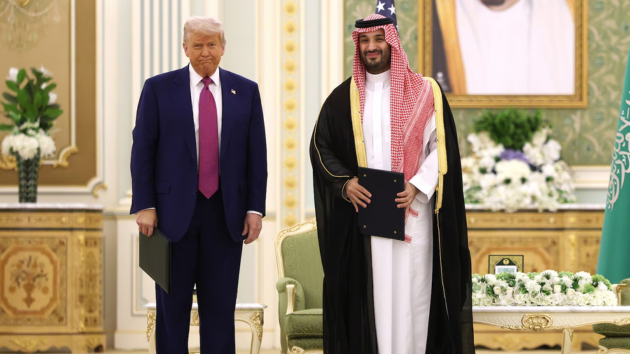
xPresident Donald Trump and Saudi Crown Prince Mohammed bin Salman attend a signing ceremony at the Saudi Royal Court, May 13, 2025, in Riyadh, Saudi Arabia. (Win Mcnamee/Getty Images)
(WASHINGTON) — Tuesday marks the first time His Royal Highness Prince Mohammed bin Salman, the crown prince and prime minister of Saudi Arabia, steps foot in the U.S. since 2018, following the death of Saudi critic Jamal Khashoggi by Saudi agents in Istanbul, which caused global outrage.
The crown prince denied ordering the operation but ultimately acknowledged responsibility as the kingdom’s de facto ruler.
Now more than seven years later, the Saudi leader has business on his mind as he seeks to deepen ties with the U.S. through cooperation on oil and security, while also expanding the regime’s global outreach in finance, artificial intelligence and technology. Saudi Arabia notably boasts the world’s largest economy and maintains its lead as the world’s top oil producer.
The crown prince will meet with President Donald Trump at the White House and he’ll be invited in with pomp and circumstance. Saudi flags were seen draped in front of the White House, next to American flags, ahead of his visit.
Trump is also hosting a dinner for the Saudi leader on Tuesday night.
A focus on defense and business
The prince’s trip to the U.S. is being billed as an “official working visit,” and is designed to follow up and advance on Trump’s May appearance in Riyadh — the first official visit of Trump’s second term in office.
“A lot of the financial and economic and artificial intelligence deals that they announced that were very ambiguous six months ago, I think we might start to see some teeth from them this time around and hopefully get a little bit more clarity on what those deals actually are,” said Elizabeth Dent, a senior fellow at the Washington Institute for Near East Policy and former director for the Gulf and Arabian Peninsula in the office of the Secretary of Defense at the Pentagon.
During that May visit, Trump announced a $142 billion arms package with the Saudis, which according to a White House fact sheet was the “the largest defense cooperation agreement” Washington has ever done.
The agreement covers deals with more than a dozen U.S. defense companies in areas including air and missile defense, air force and space advancement, maritime security and communications, the fact sheet said.
The kingdom in turn announced a $600 billion investment in the U.S. spanning multiple sectors, including energy security, defense, technology, global infrastructure and critical minerals.
Some of the other notable deals announced under the $600 billion pledge included investments in: U.S.-based artificial intelligence data centers and energy infrastructure; advanced technologies; Saudi infrastructure projects; U.S. energy equipment and commercial aircraft; the U.S. health care supply chain; and U.S. sports industries.
Trump confirmed on Monday during an event in the Oval Office that he plans to sell F-35s to Saudi Arabia as part of a weapons deal, which experts say would mark the first time those jets have been sold to an Arab military.
“There’s a whole host of issues that encompass this. Part of it is that Israel has to be able to maintain their congressionally-mandated qualitative military edge, which Congress does determine that,” Dent said. “And so, if the deal goes forward, I think we just have to see how they’re going to figure out the best way to ensure Israel can maintain that, as the only country in the Middle East that currently has F-35s.”
“I think the Israelis are probably pretty uncomfortable with these rumors swirling around without normalization in sight,” Dent added.
Saudis insist on ‘credible pathway’ to Palestinian statehood
The Saudi leader is seeking security guarantees from the U.S. amid turbulence in the Middle East. The security agreement with the U.S. has been in a development stage and has not yet been formalized, but the kingdom is seeking to deepen military and security ties between the two countries.
The security guarantees are viewed by some as part of a larger regional “megadeal” involving normalization with Israel, something Trump will surely push for, even as the Saudi kingdom has refused to do so under the current Israeli leadership.
Trump told reporters on Air Force One on Friday that he would discuss the issue with the crown prince.
“I hope that Saudi Arabia will be going into the Abraham Accords fairly shortly,” he said.
Earlier this year, Trump signed an unprecedented defense pact with Qatar via executive order that recognizes the “enduring alliance” between the U.S. and Qatar and provides Qatar an explicit security guarantee in the event of “external attack.”
Many analysts have said they believe the Saudis are looking for a similar defense pact with the U.S.
“I think it’ll be kind of similar to Qatar’s, where it basically just says it will consider any sort of threat or attack on Saudi Arabia to be an attack on the United States, and then the United States will respond appropriately, which could range from political to military options. So, I think that the administration will make sure to give themselves that decision space,” Dent said. “There’s a lot to work through here. Obviously, I think a lot of it will be about expectation management.”
The kingdom is notably invested in implementing the president’s 20-point Gaza peace plan. The kingdom has previously stated it wants to see the emergence of a credible path toward an independent and a free Palestine as a condition for supporting the demilitarization of Hamas and reconstruction of Gaza.
But Israel has put up a roadblock to Palestinian statehood, which will undoubtedly cause angst among Arab regional partners who are pushing for sustained peace in Gaza.
“Our opposition to a Palestinian state in any territory has not changed,” Israeli Prime Minister Benjamin Netanyahu said Sunday during his weekly cabinet meeting. “Gaza will be demilitarized and Hamas will be disarmed, the easy way or the hard way.”
Netanyahu has long opposed a Palestinian state, saying in recent months that its creation would only reward Hamas and endanger Israel’s security.
ABC News’ Christopher Boccia contributed to this report.
David Richardson, acting administrator of the Federal Emergency Management Agency (FEMA), during a House Transportation and Infrastructure Subcommittee hearing in Washington, DC, US, on Wednesday, July 23, 2025. (Photographer: Graeme Sloan/Bloomberg via Getty Images)
(WASHINGTON) — Acting FEMA Administrator David Richardson resigned on Monday, according to multiple sources familiar with the situation.
Richardson, who was temporarily installed in May after former Acting Administrator Cam Hamilton was essentially fired by Secretary of Homeland Security Kristi Noem.
Richardson was also in charge of the department’s countering Weapons of Mass Destruction office. It is unclear if he will still stay on in that role.
It is unclear who will lead the disaster management agency.
Richardson told staff in an all-hands meeting in June that he was unaware hurricane season had started, according to sources familiar with the meeting.
It was unclear if Richardson was joking, but a Department of Homeland Security spokesperson argued he was.
When asked by reporters during a White House press briefing whether President Donald Trump was “still comfortable” with Richardson after his remarks, press secretary Karoline Leavitt dismissed concerns and said FEMA is taking hurricane season “seriously, contrary to some of the reporting we have seen based on jokes that were made and leaks from meetings.”
Richardson’s comments followed an internal review indicating FEMA was “not ready” for the 2025 hurricane season in mid-May.
The DHS spokesperson denied FEMA is unprepared, saying “Despite meanspirited attempts to falsely frame a joke as policy, there is no uncertainty about what FEMA will be doing this Hurricane Season.”
“FEMA is laser-focused on disaster response and protecting the American people,” the spokesperson added.
Senate Minority Leader Chuck Schumer, D-N.Y., slammed Richardson, posting on X that he is “unaware of why he hasn’t been fired yet.”
“Trump’s FEMA chief is incompetent,” Sen. Ed Markey, D-Mass., added. “People will die.”
This is a developing story. Please check back for updates.
A prison officer patrols in front of a gate at the Terrorism Confinement Center (CECOT) in Tecoluca, in San Vicente, El Salvador, April 4, 2025. (Anadolu via Getty Images)
(WASHINGTON) — A federal appeals court on Friday denied a request to reconsider an earlier decision that prevented a federal judge from investigating whether Trump administration officials acted in contempt for allegedly violating a court order when it deported hundreds of alleged gang members to El Salvador under the Alien Enemies Act in March.
The decision will allow Judge James Boasberg to attempt to proceed with the early stages of the contempt proceedings, including requesting evidence from the Trump administration about the decision not to turn around a plane bound for El Salvador after he ordered it be returned.
In a statement authored by three judges in the majority, the court described Boasberg’s actions as “a measured and essential response to what it reasonably perceived as shocking Executive Branch conduct.”
“The district court has every ability to set a new deadline for production of the information it sought regarding the probable contempt it identified or to proceed otherwise within his sound discretion,” the ruling said. “For its part, the government will have the full opportunity at the appropriate time to raise any defenses it may have. If it is dissatisfied with any appealable order the district court may enter, it will have the opportunity to seek review through the ordinary process. That is how our system of justice is designed to work.”
On Monday, Boasberg said the parties will discuss at a hearing on Wednesday how to proceed with the court’s contempt inquiry.
In the time between Boasberg’s original order and Friday’s decision, a whistleblower came forward to allege the Trump administration deliberately planned to defy Boasberg’s order. That new context could inform how Boasberg proceeds with the case.
“The facts the district court recounted present grave rule-of-law concerns. Obedience to court orders is vital to the ability of the judiciary to fulfill its constitutionally appointed role. Judicial orders are not suggestions; they are binding commands that the Executive Branch, no less than any other party, must obey,” the ruling said.
Lee Gelernt, an attorney for the American Civil Liberties Union, told ABC News the ruling will allow the group to proceed before Boasberg.
“And now we have more evidence that the government deliberately violated the court’s order not to hand over the Venezuelan men to El Salvador,” Gelernt said.
The Trump administration in March invoked the Alien Enemies Act — an 18th-century wartime authority used to remove noncitizens with little-to-no due process — to deport two planeloads of alleged migrant gang members to the CECOT mega-prison in El Salvador by arguing that the Venezuelan gang Tren de Aragua is a “hybrid criminal state” that is invading the United States.
Boasberg issued a temporary restraining order and ordered that the planes be turned around, but Justice Department attorneys said his oral instructions directing the flight to be returned were defective, and the deportations proceeded as planned.
Boasberg subsequently sought contempt proceedings against the government for deliberately defying his order.
In a video from World Without Exploitation, Jeffrey Epstein survivors are seen holding photos of their younger selves, as some of them recite their ages when they met him. (World Without Exploitation)
(NEW YORK) — The anti-trafficking group World Without Exploitation released a video PSA featuring a group of Epstein survivors advocating for the release of all Epstein files.
In the video released Sunday, the women are seen holding photos of their younger selves, as some of them recite their ages when they first met sex offender Jeffrey Epstein. Some of the eleven women featured in the video cry or grow emotional as they speak.
“It’s time to bring the secrets out of the shadows. It’s time to shine a light into the darkness,” the women say.
The video concludes with on-screen text that reads, “Five administrations and we’re still in the dark.” Following the message is a plea to call Congress and demand the release of the Epstein files.
The House is set to vote this week on a bill to compel the release of the full Justice Department files related to Jeffrey Epstein. Over the weekend, President Donald Trump marked a sudden shift in his stance on the topic — calling for Republicans to vote in favor of the files’ release.
Trump had previously called the release of the emails a Democratic “hoax” and added “some stupid” and “foolish” Republicans had fallen for it.
None of the documents previously made public contain allegations of wrongdoing by Trump.
Groups of Epstein survivors have called on Congress to make the files public in the past.
In September, a group of Epstein survivors shared their stories on Capitol Hill and called on lawmakers to support the release of the files. One of the women, Anouska De Georgiou, said the survivors want their voices to be heard.
“The days of sweeping this under the rug are over. We the survivors say ‘no more,'” she said.
A group of Epstein survivors plan to be in D.C. for a press conference on Capitol Hill on Tuesday morning with Republican Rep. Thomas Massie, Democratic Rep. Ro Khanna and Republican Rep. Marjorie Taylor Greene, who sparred with Trump over the handling of the Epstein investigation.
Jason C. Andrew/Politico/Bloomberg via Getty Images
(NEW YORK) — President Donald Trump and Rep. Marjorie Taylor Greene escalated their feud over the weekend after the Georgia Republican slammed the president and the administration over a number of topics, including the handling of the Jeffrey Epstein investigation.
Trump went so far as to withdraw his support for Greene and said he would support a primary challenger.
“Lightweight Congresswoman Marjorie Taylor Brown (Green grass turns Brown when it begins to ROT!), betrayed the entire Republican Party when she turned Left,” Trump said in a social media post Saturday morning as part of an online back and forth with Greene.
Greene said Saturday in an X post that she had received death threats.
“As a Republican, who overwhelmingly votes for President Trump‘s bills and agenda, his aggression against me which also fuels the venomous nature of his radical internet trolls (many of whom are paid), this is completely shocking to everyone,” she said.
The conflict began this week after Greene questioned in an NBC News interview if Trump was focused on domestic affairs.
“No one cares about the foreign countries. No one cares about the never-ending amount of foreign leaders coming to the White House every single week,” she said in the interview.
On Friday, Trump responded to her words, telling reporters aboard Air Force One, “she is a very different figure,” and that he was no longer “a fan.”
“Something happened to her over the last period of a month or two where she changed. I think politically, I think that her constituents aren’t going to be happy,” he said. “But when she says, ‘Don’t go overseas.’ If I didn’t go overseas, we might be in a war right now with China.”
Trump added he would consider backing a primary challenger and in a social media post later in the night withdrew his endorsement of the congresswoman.
He wrote, “all I see ‘Wacky’ Marjorie do is COMPLAIN, COMPLAIN, COMPLAIN.”
“I understand that wonderful, Conservative people are thinking about primarying Marjorie in her District of Georgia, that they too are fed up with her and her antics and, if the right person runs, they will have my Complete and Unyielding Support,” the president added.
Greene pushed back against Trump Friday night in an X post, contending that the president was upset with her after she texted him about the ongoing Epstein investigation.
“And of course he’s coming after me hard to make an example to scare all the other Republicans before next weeks vote to release the Epstein files,” she said. “It’s astonishing really how hard he’s fighting to stop the Epstein files from coming out that he actually goes to this level.”
“I never thought that fighting to release the Epstein files, defending women who were victims of rape, and fighting to expose the web of rich powerful elites would have caused this, but here we are,” Greene said in an X post Saturday morning “And it truly speaks for itself.”
The president, who spent Saturday morning golfing in Florida, slammed Greene in a social media post arguing she, “became the RINO that we all know she always was. Just another Fake politician.”
(WASHINGTON) — As the federal government reopens after the House passed a short-term funding bill Wednesday, Democratic voters across the country reckon with their party’s handling of the standoff — and the fact that in the end, Democrats were not able to extend the Affordable Care Act subsidies they shut the government down over in the first place.
Carl Davidson, a 64-year-old car salesman from Oakland, California, told ABC News in an interview that he will be “greatly affected” by the expiring subsidies.
“My California coverage is potentially going to go from $580 to $1,240,” Davidson said.
Meanwhile Teresa White, a 67-year-old administrative assistant who is also from California, told ABC News she is most concerned about her son, whose “premiums are going to double.”
“These are young men in their 30s. They are not high-risk … a lot of their friends are just going to forego insurance, and that’s wrong,” White said.
White and Davidson, as well as the rest of the voters named in this article, participated in an ABC News/Washington Post/Ipsos poll and were called back to be interviewed about their views.
Even those not directly affected by the expected jumps in health care premiums believe it is a worthy cause. Jeffrey Martin, a 54-year-old electrician from Berkeley, Massachusetts, told ABC News he was “100%” supportive of congressional Democrats’ fight for ACA subsidies.
“I think they could have held out, because I think that they were in the right. I think they were fighting for something important,” Martin said.
Like Martin, 58-year-old Kevin Wolfe of Parkville, Maryland, wished congressional Democrats had “held out” for longer over the subsidies. Wolfe told ABC News in an interview that he is “kind of upset that they voted to end” the shutdown, even going so far as to say that he thinks Democrats “need to shut it down again.”
“I don’t know if we’d have gotten anything, but I think they could’ve held out a little longer to see,” Wolfe said.
The government shutdown — which lasted 43 days in total, making it the longest shutdown in U.S. history — is funded only until Jan. 30, leaving open the possibility for the government to be shut down again if Congress can’t come to an agreement over health care spending by the end of January.
Like Wolfe, White also said that the Democrats should shut the government down again when the short-term funding bill ends, even if it disrupts things like air travel.
“People don’t have to travel, but you have to eat. And if you have a medical emergency, then you have to have care,” White said.
But while voters like White, Martin and Wolfe wished Democrats had fought for longer, many said they believe that Democrats were successful in bringing national attention to the fight over health care taking place in Washington.
“I don’t think it accomplished what its overall goal was, but I do believe it brought more attention to what is going to happen,” Wolfe said.
“I don’t think people realized at all what is going to happen with premiums,” he added.
Davidson added that shutting down the federal government “concentrated the minds of many people who aren’t following politics day-to-day.”
The one thing many Democratic voters were in agreement on: Republicans are to blame for the shutdown. And with the 2026 midterm elections fast approaching, many speculate that the government shutdown will prove to be a stain on Republicans running for reelection.
“People do have a memory when it hits their wallets, so it could have some ramifications for Republicans in the midterms,” Davidson said.
“I figure that the Republicans, who had the House, the Senate and the presidency, and also the Supreme Court — they are responsible for the shutdown,” said 71-year-old Curtis McLeod of Greensboro, North Carolina.
“I hope all the Republicans that held out lose their seat in the next election. That’s all I’m thinking about,” McLeod added.
But there were some Democratic voters who had more ambiguous feelings about the fight over ACA subsidies, especially those who were affected by federal cuts to SNAP that took place during the shutdown.
Dora C., a 59-year-old in southern Texas, told ABC News in an interview that the government “should have never been shut down from the beginning.”
“I’m a grandmother raising three of my grandkids, and I am — and still to this day — I am on SNAP benefits … When they took that away for a short period of time, it did affect me — of course it did — because I’m not feeding only myself, I’m feeding three kids,” Dora said.
“Yeah, I got these SNAP benefits put back in my card, but not all of them,” Dora added.
Others called the government shutdown a “lose-lose situation.”
“I think the Democrats always look kind of weak because the Republicans kind of do whatever they want and get away with it … I think [Democrats were] trying to fight back. And then the one time they fight back, it blows up like this,” said Brittany D., a 29-year-old small business owner from the suburbs of Fort Lauderdale, Florida.
Vicki, a 57-year-old Democrat from Pennsylvania who declined to provide her last name, told ABC News in an interview that ultimately, the decision congressional Democrats faced to end the shutdown was “a Solomon’s Choice.”
“Do you choose the people that need food, or do you choose people that need health care? I would’ve had a hard decision choosing what to do,” she said.