
Russia to get hit with ‘major sanctions’ in response to Navalny’s death, US says

Russia to get hit with ‘major sanctions’ in response to Navalny’s death, US says
belterz/Getty Images

(WASHINGTON) — The White House will announce a new “major sanctions” package on Friday “to hold Russia accountable” for the death of Alexei Navalny, the longtime Russian opposition politician and critic of Russian President Vladimir Putin, said National Security Communications Adviser John Kirby.

“Whatever story the Russian government decides to tell the world, it’s clear that President Putin and his government are responsible for Mr. Navalny’s death,” Kirby said Tuesday morning. “In response and at President [Joe] Biden’s direction, we will be announcing a major sanctions package on Friday of this week to hold Russia accountable for what happened to Mr. Navalny.”

Kirby did not go into detail about what the new sanctions package would include, but noted the sanctions will also work to hold Russia accountable for its ongoing war with Ukraine.

“I think what you’ll see in this package that we’re going to be announcing Friday is a set of sanctions — a regime that not only is designed to hold Mr. Putin accountable for now two years of war in Ukraine, but also specifically supplemented with additional sanctions regarding Mr. Navalny’s death,” Kirby said.

Later Tuesday, national security adviser Jake Sullivan shed more light on the U.S. move, noting that the administration is timing them to coincide with the two-year anniversary of the start of the conflict.

Asked about what impact the sanctions would have, Sullivan said the upcoming package was “substantial,” and covers “a range of different elements of the Russian defense industrial base, and sources of revenue for the Russian economy” that he said power their war machine and ongoing aggression and repression.

“We believe that will have an impact,” he said.

” … This is another turn of the crank, another turn of the wheel and it is a range of targets a significant range of targets that we have worked persistently and diligently to identify, to continue to impose costs for what Russia has done for what it’s done to the army for what it’s done to Ukraine, and for the threat that it represents to international peace and security,” Sullivan added.

Last week, Navalny died in prison at age 47. Shortly after news of Navalny’s death, Biden placed the blame directly on Putin.

“We don’t know exactly what happened, but there is no doubt that the death of Navalny was the result of something that Putin and his friends did,” Biden said.

Secretary of State Antony Blinken said last week that “Russia is responsible for this.”

Yulia Navalnaya, Navalny’s widow, on Tuesday called for the remains to be returned so they could be “buried with dignity.”

She released a video in which she alleged that Navalny’s body was being kept from the family because he had been murdered, perhaps by poison.

Dmitry Peskov, the Kremlin spokesperson, on Tuesday said those allegations were “unfounded, unsupported and borish.”

Russia is already heavily sanctioned: sanctions signed by Biden in December went after financial institutions that indirectly allowed Russia to keep building its war arsenal amid its aggression against Ukraine.

ABC News’ Kevin Shalvey and Sarah Beth Hensley contributed to this report.

Copyright © 2024, ABC Audio. All rights reserved.

White House to target Russia with ‘major sanctions’ in response to Navalny’s death

Russia to get hit with ‘major sanctions’ in response to Navalny’s death, US says
belterz/Getty Images

(NEW YORK) — The White House will announce a new “major sanctions” package on Friday “to hold Russia accountable” in response to Alexei Navalny’s death, said National Security Communications Advisor John Kirby.

This is a developing story. Please check back for updates.

Copyright © 2024, ABC Audio. All rights reserved.

Supreme Court allows elite high school to adopt admissions plan aimed at boosting racial diversity

Supreme Court allows elite high school to adopt admissions plan aimed at boosting racial diversity
www.fuchieh.com/Getty Images

(NEW YORK) — The U.S. Supreme Court will allow one of the nation’s top public schools to move forward with a new admissions policy that critics say has “racial balancing” at its core.

The closely watched case from Fairfax County in northern Virginia involves Thomas Jefferson High School for Science and Technology.

For years, it’s student body — drawn from a race-blind process relying heavily on standardized tests — was more than 70% Asian American. In 2020, school board officials shifted to a more holistic approach that has resulted in greater numbers of white, Hispanic and Black students enrolled. While fewer Asian American students were admitted, they still made up more than half the incoming class.

A district court struck the policy because of alleged racial motivations of officials, but a narrowly divided appeals court reversed the decision and said it was permissible.

A majority of Supreme Court justices voted to let that ruling stand; they did not explain their decision.

Justices Clarence Thomas and Samuel Alito dissented from the decision, saying it violates the Constitution’s Equal Protection Clause and is “indefensible.”

“The holding below effectively licenses official actors to discriminate against any racial group with impunity as long as that group continues to perform at a higher rate than other groups,” Thomas and Alito wrote.

“Today, the American Dream was dealt a blow, but we remain committed to protecting the values of merit, equality, and justice — and we will prevail for the future of our children and for the nation we love and embrace,” said Asra Nomani, co-founder of Coalition for TJ, which brought the suit against the school district.

“For the courageous families who have tirelessly fought for the principles that our nation holds dear, this decision is a setback but not a death blow to our commitment to the American Dream, which promises equal opportunity and justice for all,” Nomani said.


Copyright © 2024, ABC Audio. All rights reserved.

Bipartisan House members unveil new border, foreign aid proposal

Bipartisan House members unveil new border, foreign aid proposal
Bloomberg Creative Photos/Getty Images

(NEW YORK) — After Speaker Mike Johnson rejected the Senate-passed national security supplemental, a bipartisan group of House lawmakers unveiled a new proposal late last week to provide defense-only aid for Ukraine, Israel and Taiwan and funds for the U.S. southern border — however, it’s not yet clear if GOP leadership will consider it.

The $66.3 billion bipartisan package, titled the “Defending Borders, Defending Democracies Act,” would provide the aid for one year after enactment. The biggest chunk of the money — $47.69 billion — would go to supporting the defense of Ukraine.

To address the surge of migrants at the southern border, the legislation would require the suspension of entry of inadmissible aliens and require immigration officers to detain and immediately expel inadmissible aliens.

“Securing one’s borders is necessary to preserving one’s democracy and, therefore, necessary to maintaining world order and world peace,” Republican Rep. Brian Fitzpatrick of Pennsylvania said in a news release about the proposal.

“As the world’s oldest and strongest democracy, the United States’ primary responsibility must be to secure its own borders. But we also have an obligation to assist our allies in securing their borders, especially when they come under assault by dictators, terrorists, and totalitarians. Ukraine, Israel, and Taiwan are all freedom-loving democracies, they are our allies, and we must assist them in protecting their borders just as we must protect our own. We can, and must, achieve all of the above.”

Fitzpatrick told ABC New last week that House members “all have the ability to find a way to navigate a bill to get to the floor and you know, all options are on the table but there are plenty of us that are not going to allow Ukraine to fail on our watch. It’s too existential.” He worked with several other lawmakers — fellow Republicans as well as Democrats — to craft the proposal.

This proposal will certainly put pressure on Johnson, but it’s not yet clear if GOP leadership would consider it. Fitzpatrick said he is going to try to push the proposal forward.

“We’re going to talk to [Johnson] about it. You know, our job is to legislate … Hopefully … we can win this support,” Fitzpatrick said.

Minority Leader Hakeem Jeffries made it clear last week that he wants a vote only on the Senate-passed supplemental that Johnson said he was opposed to because it didn’t include any border changes.

“Mike Johnson simply needs to put the bipartisan national security bill on the House floor for an up-or-down vote, and it will pass,” Jeffries said last week at a news conference.

ABC News reached out to Johnson’s office for comment, but hadn’t heard back by the time of publication.

The proposal may lose some momentum given the timing of its release — just before the House embarked on a nearly two-week recess. The House returns to session on Feb. 28.

Republican Sen. Lindsey Graham of South Carolina said he could support the new bipartisan proposal out of the House.

“Yes, I’m saying that the House proposal, it depends on how it’s written, makes perfect sense to me,” Graham said on CBS’s “Face the Nation” on Sunday.

Graham said he has not spoken to former President Donald Trump about this new House proposal, but said border funding cannot wait. Previously, Trump had called on Republicans to oppose the Senate’s bipartisan national security package — contributing to its tanking.

“President Trump says let’s wait on the border. With all due respect, we cannot wait,” Graham said. “It’s a national security nightmare.”

ABC News’ Fritz Farrow contributed to this report.


Copyright © 2024, ABC Audio. All rights reserved.

Trump uses brief comment on Navalny’s death to claim his own political persecution

Trump uses brief comment on Navalny’s death to claim his own political persecution
Republican presidential candidate former President Donald Trump speaks to supporters during a rally on February 17, 2024 in Waterford, Michigan. CREDIT: Scott Olson/Getty Images

(NEW YORK) — Former President Donald Trump on Monday used his first direct comment on Russian opposition leader Alexei Navalny’s death to complain about the alleged political persecution he claims he’s facing in his own legal battles.

“The sudden death of Alexei Navalny has made me more and more aware of what is happening in our Country,” Trump wrote on his social media platform, claiming that his political and court opponents, as well as judges in his cases, are “leading us down a path to destruction” in a “slow, steady progression.”

Trump’s primary challenger Nikki Haley has been blasting him for not commenting on Navalny’s death and not condemning Russian President Vladimir Putin. Navalny had been a vocal critic of Putin and President Joe Biden immediately accused Putin of being responsible for the death.

Last night, Trump appeared to make a similarly compare himself to Navalny, sharing on Truth Social an opinion piece with a headline that said, “Biden:Trump::Putin:Navalny.”

Trump’s first direct — but brief — comment on Navalny’s death comes three days after it was announced — and he has yet to mention it on the campaign trail — neither during a brief news conference Friday evening, at his appearance at “SneakerCon” in Philadelphia Saturday afternoon nor at his rally in Michigan later that evening.

Instead, his campaign remarks over the weekend zeroed in on his own political and legal battles, including more than $350 million in penalties New York Judge Aurthur Engoron imposed on him in a civil fraud case in which Trump was accused of inflating values of his properties — the ruling coming out the same day Navalny’s death was revealed.

Haley, who served as Trump’s ambassador to the United Nations, has been capitalizing on Navalny’s death as she ramps up her attacks on Trump ahead of their rematch in the South Carolina Republican primary, hitting the former president on his self-proclaimed close relationship with Putin.

“Either he sides with Putin and thinks it’s cool that Putin killed one of his political opponents, or he just doesn’t think it’s that big of a deal,” Haley told ABC “This Week” co-anchor Jonathan Karl on Sunday amid Trump’s silence on Navalny’s death. “Either one of those is concerning. Either one of those is a problem.”

Monday morning on “Fox and Friends,” Haley accused Trump of being “weak in the knees” when it comes to Putin, and called for Trump to announce plans to seize Russian assets.

“It’s amazing to me how weak in the knees he is when it comes to Putin,” Haley accused. “… He has yet to say anything about Navalny’s death — which Putin murdered him,”

“He’s yet to say anything about seizing Russian assets and allowing that money to go to Ukraine,” Haley continued. “Why would you not want to have those assets seized? It’s sitting in Congress; he should be calling for that. He doesn’t talk about anything. All he does is go on late night rants talking about his court cases.”

On the campaign trail, Trump has boasted about his self-proclaimed positive relationship with the Russian leader, claiming the Russia-Ukraine war would not have happened under his presidency. He didn’t condemn Navalny’s poisoning in August 2020 while he was president, saying there was no proof.

Earlier this month, Trump received backlash for saying he would “encourage” Russia to “do whatever the hell they want” to a NATO ally of the United States that doesn’t pay what he called a “fair share” of defense funding. The Trump campaign defended his comment, saying Trump got U.S. allies to increase their NATO spending while accusing Biden of letting foreign allies “take advantage of the American taxpayer.”

The Trump campaign did not respond immediately to an ABC News request for comment.

ABC News’ Hannah Demissie and Nick Kerr contributed to this report.


Copyright © 2024, ABC Audio. All rights reserved.

Biden says GOP making ‘big mistake’ on Ukraine aid, willing to meet with Johnson

Biden says GOP making ‘big mistake’ on Ukraine aid, willing to meet with Johnson
President Biden. CREDIT: Official White House Photo by Adam Schultz

(NEW YORK) — President Joe Biden, in the wake of the death of Russian opposition leader Alexei Navalny, said congressional Republicans are “making a big mistake” by not passing additional aid to Ukraine.

Biden, returning to the White House on Monday, was asked by a reporter if he’d go so far as to say House Republicans had Navalny’s “blood on their hands” amid their opposition to funding for the war-torn nation as Russia’s invasion enters its third year.

“No, I wouldn’t use that term,” the president responded. “They’re making a big mistake not responding.”

Biden continued, “Look, the way they’re walking away from the threat of Russia, the way they’re walking away from NATO, the way they’re walking away from leaving our obligations, it’s just shocking. I mean, it’s been a while. I’ve never seen anything like this.”

Navalny’s death was reported by Russia’s Federal Penitentiary Service on Feb. 16. No information has been shared about the cause of death. According to Navanly’s team, his family has been denied access to his body.

Biden has blamed Russian President Vladimir Putin for Navalny’s death.

Biden said Monday he is considering additional sanctions on Russia over Navalny’s death, though he didn’t elaborate on when those sanctions could be implemented or what they would target. Officials have told ABC they’re weighing additional sanctions against human rights violators connected to Navalny’s imprisonment.

Asked if Navalny’s death could spark movement from Republicans on Ukraine aid, Biden said: “I hope so, but I’m not sure anything’s gonna change.”

In a shift from past statements from the White House, Biden said he would be willing to meet with House Speaker Mike Johnson on the issue.

“I’d be happy to meet with him if he has anything to say,” Biden said.

Johnson has said he’s been asking for a sit-down with President Biden for weeks to discuss aid to Ukraine, Israel, Taiwan and border security, but those requests were denied.

“What is there to negotiate really, truly?” White House press secretary Karine Jean-Pierre told ABC News Chief White House Correspondent Mary Bruce last week.

Jean-Pierre cited Johnson’s shifting positions on how to deal with the border and foreign aid. House Republicans have stalled two bills that would deal with foreign aid: a bipartisan Senate compromise tying immigration changes to the aid and a stand-alone measure passed by the Senate providing $95 billion for Ukraine, Israel and Taiwan.

In the wake of Navalny’s death, Johnson was critical of Putin but didn’t commit to providing additional aid to Ukraine. The House is currently in recess until the end of the month.

“As Congress debates the best path forward to support Ukraine, the United States, and our partners, must be using every means available to cut off Putin’s ability to fund his unprovoked war in Ukraine and aggression against the Baltic states,” Johnson said in a statement.


Copyright © 2024, ABC Audio. All rights reserved.

Haley won’t say if she’d still back Trump as GOP nominee: ‘I am running against him for a reason’

Haley won’t say if she’d still back Trump as GOP nominee: ‘I am running against him for a reason’
Win McNamee/Getty Images

(WASHINGTON)– Republican presidential candidate Nikki Haley on Sunday wouldn’t definitively say if she’ll back primary rival Donald Trump in the general election but stressed that she’s staying in the race against him because of what she called his unfitness for office.

“I am running against him for a reason. … The last thing on my mind is who I’m going to support. The only thing on my mind is how we’re going to win this,” Haley told ABC News “This Week” co-anchor Jonathan Karl when he asked if she would stick with the pledge she previously signed to support whomever the party’s eventual nominee is even as she has become vocally critical of Trump.

“I’m not going anywhere,” Haley added. “We’re going to do this for the long haul and we’re going to finish it.”

Noting that she’d already signed the party’s pledge, Karl pressed Haley, “Does that mean you will not support him if he’s the Republican nominee?”

“Y’all can talk about support later. Right now you can ask him if he’s going to support me when I’m the nominee,” she said.

“Do you think he would [support you]?” Karl asked.

“Do you think he would?” Haley asked back, laughing. “I highly doubt it.”

Appearing on “This Week,” the former South Carolina governor repeated her criticism of Trump as too unstable to lead the U.S. at a time of crises elsewhere, like in the Middle East and Europe.

“This is not the time to talk about America hiding in a bubble and not doing anything with the rest of the world,” she said.

She called out Trump’s silence in the wake of the death of the imprisoned Russian opposition leader Alexei Navalny — suggesting that it shows how he really feels about Russian President Vladimir Putin.

“Either he sides with Putin and thinks it’s cool that Putin killed one of his political opponents, or he just doesn’t think it’s that big of a deal,” Haley told Karl. “Either one of those is concerning. Either one of those is a problem.”

Haley and other leading American politicians, including President Joe Biden, have said Putin is to blame for Navalny’s death, which the Kremlin denies.

Rather than comment on Navalny, Trump on social media vowed to “bring Peace, Prosperity, and Stability” if he is elected again.

Haley, who served as Trump’s U.N. ambassador, also accused the former president of emboldening Putin after saying earlier this month that he would “encourage” Russia to “to do whatever the hell they want” to U.S. allies who don’t spend enough on their defense.

“That’s bone-chilling because all he did in that one moment was empower Putin,” Haley said on “This Week.”

“We need to remind the American people that Vladimir Putin is not our friend. Vladimir Putin is not cool,” Haley said. “This is not someone we want to associate with. This is not someone that we want to be friends with. This is not someone that we can trust.”

Standing against Putin also means standing with “the Russian people who believe Navalny was really talking for them,” Haley said — calling Navalny a “hero” — and standing with Ukraine in fighting against Russia’s invasion.

But pressed by Karl on Ukraine aid legislation that is stalled in Congress, with Republican Speaker of the House Mike Johnson refusing to bring it up for a vote over a dispute about border politics, Haley turned to President Joe Biden.

“Well, I think first you have to talk about what should Joe Biden be doing,” Haley said. “The reason you’re seeing America become more isolationist is at no point has Joe Biden had a conversation with the American people about why Ukraine is important.”

“It’s not Biden that is stopping that aid in Congress. It’s Republicans,” Karl said back, noting Biden’s earlier visit to the war-torn country and the multiple prime-time addresses to the nation he’s given on the issue.

“This is not the time to pick which side is right or wrong,” Haley replied, adding that Biden “needs to be speaking more to the American people about what this package means” while contending that Congress was also “failing” and “needs to do their job and make sure that they go and do everything they can for national security.”

“They’re making this sound like you have to choose between Ukraine and Israel and securing the border. They are lying to the American people. That’s a false premise. We can do both,” she said.

Karl cited Trump’s yearslong skepticism about NATO and asked if Haley was concerned that, if elected again, Trump “could actually threaten the NATO alliance?”

Haley said that she was “worried about a lot of things if Trump is reelected,” including that, calling the post-World War II alliance “a 75-year success story” in preventing widespread conflict.

“This is not the time to leave an alliance. This is not the time to side with a thug and not side with our friends who stood with us after 9/11,” Haley said. “We have to make sure that we stand firm because when we stand firm with our friends, our enemies stay on their heels.”

Amid the controversy over Trump’s latest NATO remarks, a campaign spokesperson defended him by saying he “got our allies to increase their NATO spending by demanding they pay up. … When you don’t pay your defense spending you can’t be surprised that you get more war.”

Haley on Sunday also criticized Trump’s push to install new leadership at the Republican National Committee, including one of his top aides and his daughter-in-law, Lara Trump.

While a party’s presidential nominees historically shape the party around them, Donald Trump is still in a primary race against Haley, though he’s won every state so far.

“The part I worry about is the RNC is now going to be the piggy bank for Trump’s legal fees,” Haley said on “This Week,” arguing that such a move would impact races across the country.

Lara Trump has said that under new leaders, “Every single penny will go to the No. 1 and the only job of the RNC, that is electing Donald J. Trump as president of the United States.”

“You can hang up winning the House and the Senate or having any resources for us to win any other races if all they’re doing is thinking about how they’re going to pay his court season,” Haley said on Sunday.

She repeated her pitch to voters: “We need a new generational leader that’s not distracted by court cases, that’s not filled with vengeance towards our enemies, that’s not in the drama.”

Copyright © 2024, ABC Audio. All rights reserved.

Gov. Shapiro, top Biden surrogate, acknowledges close race with Trump: ‘Stop worrying and start working’

Gov. Shapiro, top Biden surrogate, acknowledges close race with Trump: ‘Stop worrying and start working’
Drew Angerer/Getty Images

(WASHINGTON)– Pennsylvania Gov. Josh Shapiro, one of Joe Biden’s top Democratic surrogates, on Sunday urged the president’s other supporters to start putting in the work to reelect him amid worries over his prospects at the ballot box.

“Well, the race is close. But understand, the campaign hasn’t really even joined yet,” Shapiro told ABC News “This Week” co-anchor Jonathan Karl when asked why the early polls are so tight between Biden and former President Donald Trump in Pennsylvania, which is likely to be a key swing state in the election.

“This is the reason why we run races,” Shapiro said. “And I would say to folks who are worried about the numbers: Stop worrying and start working.”

Shapiro’s comments come as some Democrats privately and publicly voice concerns over Biden’s political future — both because of the polls and his unpopularity as well as the public’s well-established unease about his age and fitness for office.

Biden has acknowledged those issues but said his record proves his qualifications.

“My memory — take a look at what I’ve done since I’ve become president. None of you thought I could pass any of the things I got passed. How’d that happen?” he told reporters earlier this month.

Still, he has notable skeptics in his party.

New York Times columnist Ezra Klein, a Biden supporter, said last week that the president should step aside out of fear he would lose to Trump — a call Shapiro shot down.

“I think Ezra is right: The stakes could not be higher, but Joe Biden is going to be our nominee, and I’m proud to support him,” Shapiro said. “The president, the vice president and those of us who are privileged to support him and have a front row seat to this, we’ve got to go out and do this important work now.”

Some other outside voices, like popular radio host Charlamagne tha God did in a “This Week” interview that also aired Sunday, have called on Biden to rely more on Shapiro and other big-name politicians to help boost his standing.

The governor is seen as a rising Democratic star and won his election in 2022 by some 15 points — a huge margin in a battleground state.

Shapiro told Karl that he appreciated Charlamagne’s perspective and said that he intends to help persuade Pennsylvanians to stick with Biden.

“I’m going to do everything in my political power over the course of the next several months to make the case, to prosecute the case, against Donald Trump — to make the case about how Joe Biden is the candidate standing up for our freedom,” Shapiro said.

He touted some of the work that Biden himself often cites, like infrastructure investments, and said that Trump is running on a platform to restrict abortion access and end the Affordable Care Act, known as Obamacare, which Shapiro said provides health care access to more than a million people in Pennsylvania.

Trump has publicly avoided taking a strict stance on abortion restrictions but has celebrated the end of Roe v. Wade and privately signaled support for a national, 16-week ban, with some exceptions, ABC News previously reported. He has also promised to implement other health care legislation over Obamacare.

On “This Week,” Shapiro invoked Trump’s first term in office.

“Remember what it was like when Donald Trump was president: He was in our faces and in our living room every day injecting chaos,” Shapiro said.

Despite Biden’s issues, he said that the president’s likely rematch against Trump was about something bigger.

“While Donald Trump and Joe Biden’s names may ultimately be on the ballot and be our choices in November, this election really is about all of us and whether or not we’re going to rise up and use our voices and ultimately our vote to protect our fundamental freedoms, to scream out for the kind of country that we want,” Shapiro said.

He pointed to the elections in Pennsylvania since 2016, when Trump narrowly won the state, to predict that voters there will again reject the former president’s brand of politics.

“Every other time Pennsylvanians have had the opportunity to go to the ballot [after 2016], they have voted for freedom and against extremism,” Shapiro said. “They rejected Donald Trump in 2020, they voted for me by an historic margin in 2022. Just last year in 2023, we had a Supreme Court race that was largely focused on freedom and the right to choose, and we elected the Democrat.”

“In many ways, this election is less about Joe Biden and Donald Trump and more about us and the kind of country that we want to build,” he went on to say. “And I’ve got confidence in the American people that just as they did in 2020, they will rise up. They will demand more. They will seek justice. And they will look to defend freedom in this nation, and they will reject Donald Trump.”

Copyright © 2024, ABC Audio. All rights reserved.
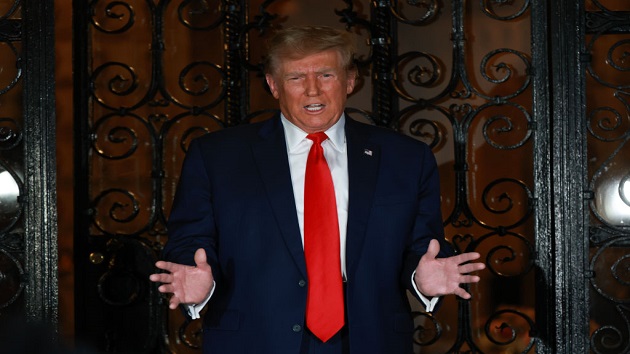
Trump met with boos and chants while selling sneakers in Philadelphia

Trump met with boos and chants while selling sneakers in Philadelphia
Chip Somodevilla/Getty Images

(PHILADELPHIA, Penn.)– The day after a New York judge fined him $355 million in the wake of a lengthy fraud trial, former President Donald Trump spent his Saturday in two battleground states, Pennsylvania and Michigan.

First stop: Sneaker Con in Philadelphia.

“Sneakerheads, your sneakerheads, right? Does everybody in the room consider themselves a sneakerhead?” Trump said in a short speech to an unusual crowd that was divided between chanting for and booing at him.

The event was supposed to be part of an unveiling of the latest Trump merchandise: gold “Never Surrender” high-top sneakers selling for $399, which are already listed as sold-out online, and “Victory47” fragrances for $99. (Also available: “Red Wave” and $199 “POTUS 45” shoes.)

Trump himself took the stage holding a pair of the high-top sneakers.

But his five-minute remarks, in a heavily Democratic city, were sometimes barely able to be heard as members of the diverse, young crowd were consistently screaming and chanting throughout.

While many booed and chanted at him, others attempted to drown them out with anti-Joe Biden and USA chants.

“This a slightly different audience than I’m used to, but I love this audience,” Trump said, struggling to get through his speech.

He attempted to divert the attention by acknowledging his supporters in the crowd, even bringing one of them, a woman, up to the stage where she talked about how much she loves Trump because she said he is a Christian family man.

“They’re after him for no reason. Go out and vote for Trump,” she said to boos and some cheers.

Trump even acknowledged he wasn’t necessarily in friendly territory — “Right after this, I go to Michigan … I’ll be talking about a slightly different subject than sneakers. But you know what? It’s all part of Americana,” he said.

That didn’t stop him from making his pitch in Philadelphia.

“What’s the most important thing: to go out and vote, right? We have to go out and vote. We got to get young people out to vote,” he said.

Later, in Michigan, an angry Trump came out swinging, railing against all the prosecutors investigating him. He faces 91 criminal charges, all of which he denies. 

He told the fired-up crowd that if he wins swing state, which will likely be a key battleground, then he will win the entire election.

However, he also misstated the upcoming Republican primary date and gave the wrong year for when he won Michigan — gaffes that critics like primary rival Nikki Haley have seized on to argue that he is “diminished.”

Trump has attacked President Joe Biden for similar slips but defended his own mental acuity. “I feel my mind is stronger now than it was 25 years ago,” he said in January.

The former president returned to the campaign trail this weekend in the wake of perhaps his biggest legal setback to date, when the judgment came down at the end of a monthslong civil fraud lawsuit in New York.

With a 92-page order issued late Friday, Judge Arthur Engoron dealt Trump a legal and financial blow that could permanently damage the business empire that propelled him to the presidency.

In addition to the nine-figure penalty, Engoron temporarily stripped Trump and his sons of the ability to lead their own businesses or apply for financing.

Trump’s lawyers plan to appeal the ruling, vowing that higher courts would reverse Engoron’s ruling.

ABC News’ Peter Charalambous contributed to this report.

Copyright © 2024, ABC Audio. All rights reserved.

Trump was fined $355 million and barred from his NY business temporarily. What happens now?

Trump was fined 5 million and barred from his NY business temporarily. What happens now?
Joe Raedle/Getty Images

(NEW YORK) — With a 92-page order issued late Friday, Judge Arthur Engoron dealt Donald Trump a legal and financial blow that could permanently damage the business empire that propelled him to the presidency.

Beyond the staggering $355 million Trump was ordered to pay – likely to climb to over $450 million with interest – Engoron stripped Trump and his sons of the ability to lead their own businesses or apply for financing for two or three years.

The penalties – which New York Attorney General Letitia James applauded as effective ways to “ensure this fraud cannot continue” – leave the Trump Organization in legal, financial, and personnel limbo, as the former president embarks on a costly presidential campaign amid his ongoing legal battles.

“We will get back to work,” Trump vowed Friday. “We’ll appeal, we’ll be successful, I think because frankly, if we’re not successful, New York State is gone.”

Trump’s lawyers plan to appeal the ruling, vowing that higher courts would reverse Engoron’s ruling.

“If allowed to stand, this ruling will only further expedite the continuing exodus of companies from New York,” a Trump Organization spokesperson said in a statement.

Lengthy appeal

Trump and his lawyers have already vowed to appeal Engoron’s ruling to New York’s Appellate Division, First Judicial Department.

That same court handed Trump an early victory in his case last year by pausing the cancellation of Trump’s business certificates, which Engoron ordered in his September summary judgment ruling. On Friday, Engoron reversed course on that penalty – nullifying part of his past order – but placed the Trump Organization under an independent monitor for at least three years.

“That was a very carefully crafted remedy that the judge put in place,” said former federal prosecutor Josh Naftalis, who said the early penalty was likely vulnerable to an appeal.

“It’s also much harder for the president to get [the new ruling] thrown out on appeal,” Naftalis said.

Engoron’s lengthy opinion also leaned heavily on the facts of the case – including lengthy portions on the testimony from each witness – in a manner that could strengthen the case on appeal, according to trial attorney Ryan Saba.

“This court sat one yard away from the witnesses on the stand, had a clearer view of the witnesses and was able to assess their credibility,” Saba said about Engoron’s role as a factfinder during the jury trial. “The findings in this opinion, if the appeal is based upon a factual challenge, are going to be very difficult to overturn.”

Even if the initial appeal is unsuccessful, Trump could ask New York’s Court of Appeals – the state’s highest court – to weigh in, possibly making the appeal a yearslong process. While that approach would give Trump more time to find money for the fine, the penalty will accrue annual interest and only becomes pricier over time.

Trump’s lawyers have expressed confidence in their future appeal, lauding the First Department’s past rulings limiting the statute of limitations for conduct in the case.

“President Trump will of course appeal and remains confident the Appellate Division will ultimately correct the innumerable and catastrophic errors made by a trial court untethered to the law or to reality,” Trump’s attorney Chris Kise told ABC News.

Not-so-family business

While Trump’s lawyers fight Engoron’s opinion in court, the former president’s namesake business faces its own challenges — beginning with a lack of leadership.

Currently run by senior vice presidents Donald Trump Jr. and Eric Trump, the Trump Organization lost its top executives on Friday when Engoron banned them from leading New York corporations for two years. Engoron also barred Trump from applying to loans from any New York banks, severely limiting Trump’s access to capital.

“He’s being choked on a personnel level, and he’s being choked on a capital level,” Naftalis said.

According to Trump’s most recent financial disclosure, the former president still owes money to Deutsche Bank but took new loans from California-based Axos Bank, potentially offering the president a workaround from the penalty.

Moreover, Engoron’s decision presents a red flag for potential lenders who might distrust any financial statement prepared by the Trump Organization, according to Naftalis.

“I think practically what this means is that a bank is not going to want to do business with them because he effectively has a scarlet letter on his chest,” Naftalis said.

Engoron ordered Judge Barbara Jones to continue monitoring the company as well as appoint a director of compliance for the company, increasing the independent oversight of the company. In addition to Jones’ past responsibilities, Engoron ordered that the Trump Organization would need to get prior approval from Jones before issuing any financial disclosure to a third party.

Potential cash crunch

If Trump’s appeal is unsuccessful in limiting the fines imposed by Engoron, the former president might be unable to find the cash to cover the fine, potentially forcing him to sell off some of his prized buildings. Trump also was ordered to pay columnist E. Jean Carroll $83.3 million last month in a civil suit, adding to his financial obligations.

“That’s a pretty significant hit towards anybody’s overall liquidity, regardless of the total amount of money that you have,” Saba said.

Even if Trump is elected president in nine months, he faces no way out of the disgorgement if his fraud trial appeal fails — and declaring bankruptcy would be unlikely to resolve the financial troubles since legal fines are generally not dischargeable, according to Illinois College of Law Professor Robert Lawless.

“There are remedies the person holding the judgment can do to force payment, everything from, you know, seizing property to taking the wages of the person that owes the money,” Lawless said.

Copyright © 2024, ABC Audio. All rights reserved.