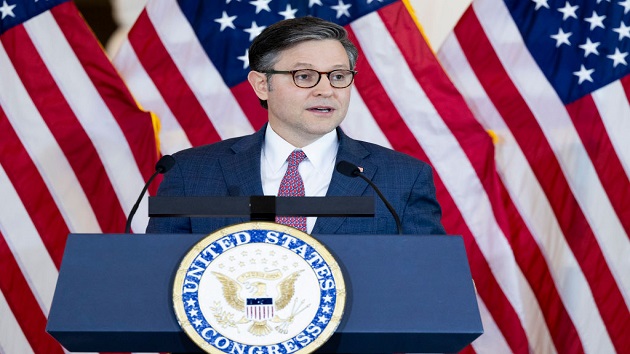
(WASHINGTON) — Former President Donald Trump and Speaker Mike Johnson have a joint appearance at Mar-a-Lago Friday afternoon where they are discussing “election integrity.”
The topic is a chief priority for Trump, the presumptive GOP nominee, who continues to falsely claim that he won the 2020 election. Trump’s calls for “election integrity” come in an election year when there is expected to be another tight matchup against President Joe Biden.
Johnson has echoed Trump’s calls for “election integrity” and was one of the 147 GOP lawmakers who voted to overturn the results of the 2020 election. He also led the charge to get 125 of his Republican colleagues to sign an amicus brief to the Supreme Court, supporting Texas’ lawsuit that would have invalidated the election results in key battleground states.
ABC News is fact checking some of Trump’s previous and false comments on elections and voting ahead of the joint appearance with Johnson.
State and federal courts have dismissed more than 50 lawsuits across six states from Trump and his allies aiming to overturn the results of the 2020 election. In many of the cases, Trump pushed thinly supported allegations of election misconduct and fraud.
Trump has continued to falsely claim he won the 2020 election in Pennsylvania, Wisconsin and Michigan, but he lost all three of those states in the last presidential election. In Pennsylvania, Biden won by 81,660; in Michigan, Biden won by about 21,000 votes; in Wisconsin, Biden won by more than 20,000.
The United States National Intelligence Council, comprised of the United States’ intelligence and security agencies, announced in 2021 that it found “no indications that any foreign actor attempted to alter any technical aspect of the voting process in the 2020 elections.”
Trump has also criticized voting methods.
Trump routinely disparages mail-in voting and has made unfounded claims about the process which he claims, in part, led to his 2020 election loss. Despite his repeated claims about mail-in vote fraud, no widespread fraud has been found. A Washington Post analysis of data collected by three vote-by-mail states with help from the nonprofit Electronic Registration Information Center found that there were 372 possible cases of double voting or voting on behalf of deceased people out of about 14.6 million votes cast by mail in the 2016 and 2018 general elections. That comes out to 0.0025%.
“Mail-in voting is totally corrupt. Get that through your head. It has to be,” Trump said at a rally in Michigan in February, repeating unfounded claims about mail-in voting.
Trump has also continued to float claims against voting machines, pushing for paper ballots instead.
“I will secure our elections. We are going to secure our elections. Our goal will be one-day voting with paper ballots — very simple — and a voter ID, but until then, Republicans must win. Landslide. We want it to be too big, too big to rig,” Trump said at an April 2 rally in Wisconsin, where he continued to falsely claim he won the state in 2020.
However, the vast majority of Americans already vote with hand-marked paper ballots or on touch-screen machines that print one.
Trump and his allies have claimed that Democrats are “importing voters” to allow non-U.S. citizens participate in the U.S. elections.
“That’s why they are allowing these people to come in — people that don’t speak our language — they are signing them up to vote,” Trump said at a January rally in Iowa.
While election officials and law enforcement authorities have found cases of non-citizens voting or attempting to vote over the years — either by mistake or with malicious intent — it has not been enough to affect the any outcome of an election, the Washington Post reported.
PolitiFact reported that it has found no effort by Democrats to register people in the country illegally.
“Most noncitizens don’t want to risk jail time (or deportation if they are here illegally) by casting a ballot. Election officials take several steps to ensure that only eligible voters cast ballots,” PolitiFact reported.
In Georgia, for example, the attorney general’s office announced in 2022 that the state had found a total of 1,634 cases of potential noncitizens registering to vote in the state since 1997 — none of whom were permitted to vote.
(WASHINGTON) — High-level U.S. officials are urgently trying to pressure Iran to back down from its threat to launch a retaliatory strike against Israel — the latest challenge facing the Biden administration as it tries to avert an all-out regional war in the Middle East.
At the same time, the U.S. was moving troops and other assets to the Middle East as Iran readied a large number of missiles and drones for a potential strike against Israel, according to U.S. officials.
The deployment of American troops was intended to try to deter Iran from launching a large-scale attack and protecting U.S. troops in the region
Two U.S. officials said that Iran has readied more than a hundred cruise missiles for a possible strike.
The U.S. assets being moved into the region in response could assist with air defense, according to one official.
Some 3,400 US troops are in Iraq and Syria with tens of thousands more U.S; personnel in the Mideast region.
Earlier Friday, White House national security spokesman John Kirby said the administration was monitoring the situation “very, very closely,” and that while its top priority was ensuring Israel is able to defend itself from a potential Iranian attack, the U.S was also “doing everything we can to protect our people and our facilities.”
“It would be imprudent if we didn’t take a look at our own posture in the region, to make sure that we’re properly prepared as well,” he said.
In a sign of how seriously the U.S. views the risk of escalation, the Pentagon confirmed on Thursday that Gen. Michael “Erik” Kurilla, the commander of U.S. Central Command, had “moved up” a previously scheduled trip to Israel to meet with senior Israeli military leaders “due to recent developments.”
Defense Secretary Lloyd Austin also spoke by phone with Israeli Defense Minister Yoav Gallant on Thursday afternoon “to discuss the current situation in the Middle East and to reaffirm the U.S.’s ironclad commitment to Israel’s security against threats from Iran and its proxies,” according to Maj. Gen. Pat Ryder, the Pentagon’s press secretary.
Although the U.S. does not have direct diplomatic ties to Iran, State Department spokesperson Matthew Miller said that Secretary of State Antony Blinken had been working the phones with his counterparts in countries that do — encouraging them to use their influence to dissuade Iran from taking military action in response to the bombing of its consulate in Damascus, Syria.
In his conversations with Chinese Foreign Minister Wang Yi, Turkish Foreign Minister Hakan Fidan, and Saudi Foreign Minister Faisal bin Farhan, Blinken made clear “that escalation is not in anyone’s interest and that countries should urge Iran not to escalate,” according to Miller.
U.S. officials previously told ABC News that the administration believes Iran could retaliate against Israel in the coming days — potentially using drones and missiles to attack “regional assets” — and that information about the threat has been shared with lawmakers on Capitol Hill.
At a White House press conference on Wednesday, President Joe Biden said Iran was “threatening to launch a significant attack on Israel” and that he had assured Israeli Prime Minister Benjamin Netanyahu that the U.S. commitment to his country’s security was “ironclad.”
“We’re going to do all we can to protect Israel’s security,” he said.
While officials say they still believe Iran may could change course, the State Department announced it had placed new restrictions on U.S. personnel in Israel on Thursday, prohibiting employees and their family members from undertaking personal travel outside of the greater Tel Aviv, Jerusalem, and Be’er Sheva areas until further notice.
According to a travel alert from the department, the limits were imposed “out of an abundance of caution.” Miller declined to speak to any specific security assessments that motivated the change in policy but acknowledged Iran’s vow for revenge.
“Clearly we are monitoring the threat environment in the Middle East and specifically in Israel, and that’s what led us to give that warning to our employees and their family members and to make it public so all U.S. citizens who either live in Israel or traveling there are aware of it,” he said.
The renewed concern over a widening conflict in the Middle East was sparked by a strike on an Iranian facility in Syria that Tehran says was carried out by Israel and killed 12 people, including Gen. Mohammad Reza Zahedi, a senior leader in Iran’s Islamic Revolutionary Guard Corps.
Although Israel has attacked a number of targets linked to Iran in recent years, primarily as part of its efforts to disrupt arms transfers to Hezbollah and other proxy groups in the region, the Israeli military has not taken credit for the incident in Damascus, which occurred on April 1.
(NEW YORK) — The judge overseeing former President Donald Trump’s classified documents case is hearing arguments Friday from his co-defendants Walt Nauta and Carlos De Oliveira on motions to have the charges against them dismissed.
Attorneys for Nauta, Trump’s longtime aide, will ask U.S. District Judge Aileen Cannon to dismiss the case based on unconstitutional vagueness.
Nauta and De Oliveira, the property manager at Trump’s Mar-a-Lago estate, pleaded not guilty last August, along with Trump, to obstruction charges related to alleged attempts to delete Mar-a-Lago surveillance footage, after Trump pleaded not guilty in June to 37 criminal counts related to his handling of classified materials after leaving the White House.
“Because the indictment fails to allege that Mr. Nauta acted corruptly in any of the conduct as alleged in the indictment, Counts 33, 34, 35, 40, and 41 must be dismissed,” Nauta’s attorney Stanley Woodward said in a filing. “Otherwise, ‘corruptly’ as required under the applicable statutes and as applied to Mr. Nauta is void for vagueness.”
De Oliveira is also asking Cannon to dismiss the charges against him.
Nauta is also charged with lying to the FBI in May of 2022 when he told agents that that he was unaware of boxes being brought to Trump’s residence and said he didn’t know where they had been stored before they were taken there. A transcript of that interview was made public on the court’s docket Friday morning.
Friday’s hearing comes one week after Cannon denied one of Trump’s requests to have the documents case dismissed based on the Presidential Records Act.
Trump’s attorneys had argued, as part of multiple motions to dismiss, that Trump should have been able to have custody of the documents in question and declare them as personal records, even after he was president, due to the Presidential Records Act.
Judge Cannon is expected to delay the start of the trial, currently on the public docket for May 20, following recent arguments from both the defense and the special counsel.
(WASHINGTON) — The House is one step closer on Friday to reauthorizing a key U.S. spy program considered crucial to national security.
After hard-line Republicans dealt a blow to Speaker Mike Johnson on Wednesday by tanking a routine procedural vote on the bill, the House passed the rule on Friday morning — teeing up debate, consideration of amendments and a final vote. All Republicans voted for the rule.
The measure would renew Section 702 of the Foreign Intelligence Surveillance Act, which is set to expire on April 19.
Section 702 allows the U.S. government to collect electronic communications of non-Americans located outside the country without a warrant.
It has come under scrutiny among some lawmakers on both sides of the aisle and civil liberties groups because it sometimes results in the collection of data on Americans who are in contact with those surveilled individuals.
Wednesday’s failed vote, in which 19 Republican hard-liners voted against part leadership, came after former President Donald Trump weighed in on the issue at the last-minute. In a message posted to his social media platform, Trump wrote: “KILL FISA.”
House Republicans huddled Wednesday evening and Thursday to regroup, and the House Rules Committee on Thursday night voted 8-4 to advance the FISA bill, teeing it up for a full floor vote on Friday.
The committee approved a new version of the FISA bill, which would reauthorize it for two years. The previous version would have done so for five years.
Some of the GOP members who voted to tank the rule vote on Wednesday indicated they’ll support the new plan.
“I am really grateful at the receptiveness to some of our requests,” Rep. Matt Gaetz, R-Fla., said.
“We just bought President Trump an at-bat. The previous version of this bill would’ve kicked reauthorization beyond the Trump presidency. Now, President Trump gets an at-bat to fix the system that victimized him more than any other America,” Gaetz added.
Gaetz said he was given “absolute assurance” from Speaker Johnson that next week the House will vote on a privacy bill from Rep. Warren Davidson, R-Ohio.
Texas Rep. Chip Roy said he is “optimistic” they are moving in the right direction on FISA and Virginia Rep. Bob Good said “going from five years to two years is a good thing.”
The White House in a statement Thursday that the administration “strongly supports” reauthorizing section 702 of FISA, warning without it they would be deprived of “insight into precisely the threats Americans expect their government to identify” such as terrorist threats, fentanyl supply chains, critical infrastructure threats and more.
However, the White House expressed strong opposition to an amendment being offered that would require the government to get a warrant to see data from Americans who are found to be communicating with foreign targets.
“The amendment would prohibit U.S. officials from reviewing critical information that the Intelligence Community has already lawfully collected, with exceptions that are exceedingly narrow and unworkable in practice,” the White House argued.
Despite White House opposition, the Congressional Progressive Caucus publicly backed it along with many far-right Republicans.
The progressive caucus said the amendment would target abuse and “codify” protections for Americans’ Fourth Amendment rights. It was introduced by Arizona Republican Andy Biggs, Washington Democrat Pramila Jayapal, New York Democrat Jerry Nadler, Ohio Republican Jim Jordan and California Democrat Zoe Lofgren.
The amendment will be one of six amendments considered before final passage of the FISA reauthorization. It’s not clear if it will pass.
ABC News’ Molly Nagle and Alexandra Hutzler contributed to this report.
Democratic presidential nominee Joe Biden speaks during the Democratic National Convention at the Chase Center in Wilmington, Delaware, Aug. 20, 2020. — Stefani Reynolds/Bloomberg via Getty Images
(WASHINGTON) — Washington state has just joined Ohio and Alabama in signifying through election officials that President Joe Biden could be left off their general election ballots due to conflicts between the dates of the Democratic National Committee’s nominating convention and state ballot deadlines. The Evergreen state, though, appears to have already proposed a way for the Democrat to remain eligible.
On Thursday, the director of elections at the office of Washington’s Secretary of State sent a letter — obtained by ABC News — to DNC Chair Jamie Harrison, warning that the deadline for ballot certification under state law falls on Aug. 20, the day after the DNC convenes in Chicago to nominate their presidential and vice presidential selections.
Stuart Holmes, the Director of Elections under Democratic Secretary Steve Hobbs, signaled that their office would make an exception for the party if they submit a provisional certification of nomination no later than Aug. 20, according to the letter.
This comes as Ohio and Alabama’s Republican Secretaries of State over the past week have indicated they’d enforce similar state election codes in a way that experts have said is unprecedented and perhaps partisan in nature.
Ohio Secretary of State Frank LaRose and Alabama Secretary of State Wes Allen have alerted Democrats about comparable conflicts between their respective state’s deadlines and the scheduling of the DNC convention in mid-August, cautioning that Biden’s nomination in Chicago comes too late to get on their general election ballots.
In Ohio, LaRose flagged in a letter last week that the DNC’s convention, set to begin on Aug. 19, would miss their Aug. 7 ballot certification deadline. In Alabama, Allen sent a letter to Democrats on Tuesday warning that their Aug. 15 cutoff would occur before the convention.
This scheduling conflict isn’t a new obstacle — a late August convention has occurred several times in past years for both parties — but states have historically avoided banning major party candidates from their ballots by either easily granting provisional ballot access, the way Washington is suggesting, or working through their legislatures to allow certification extensions.
But now, the red-state officials, experts say, are uniquely leveraging the issue against Joe Biden and Vice President Kamala Harris, the presumptive Democratic nominees, even as their predecessors made exceptions for former President Donald Trump and former Vice President Mike Pence to appear on their ballots when the when the RNC convention came too late for their certification.
“This has not been something anybody has ever dealt with. … [The GOP Secretaries] just cooked it up. No, this has never happened before,” Elaine Kamarck, a senior fellow at the Brookings Institution and a member of the Democratic National Committee, said.
Richard Winger, a ballot access expert and political analyst, agreed.
“These deadlines don’t exist for partisan reasons. … But it is kind of partisan this year,” he told ABC News.
“You have to go all the way back to 1964 to find a state that kept a major party presidential candidate off the ballot, and that had nothing to do with deadlines. … There’s never ever since been a major party candidate who was off the ballot in any state,” Winger added.
Do Democrats have a game plan to get Biden on the ballot?
Now, the Biden campaign, along with Democratic officials, are looking into ways to ensure the president will appear on the ballot in front of Ohio and Alabama voters.
In response to the news from Ohio and Alabama, Biden’s reelection campaign has maintained that “Joe Biden will be on the ballot in all 50 states.” They see this happening first by provisional certification (the process of formally notifying states before the convention that they expect Biden to be the nominee); second by changing the state’s election filing deadlines through the state’s GOP-controlled legislatures; third through litigation in court; and finally, by virtually nominating the Biden-Harris ticket ahead of their in-person convention.
Historically, in both Ohio and Alabama — and across a handful of other states — provisional ballot access certification has been granted to nominees of both major parties if they weren’t able to square their convention dates with state election code certification deadlines.
Ahead of the 2020 general election, Oklahoma, Illinois, Washington and Montana accepted provisional certifications from the DNC and the Republican National Committee. Alabama also accepted a provisional certification from Republicans that year in order to make Trump and Pence qualify.
In 2020, the Alabama legislature moved their certification deadline for that election only to Aug. 20, 2020, but that was still ahead of the Republican convention’s end a week later. The RNC then submitted a provisional certification, which was accepted by the state.
In Ohio, the Biden campaign has said they are in conversation with the Secretary’s office about steps forward in terms of provisional certification.
In a letter received by the Ohio Secretary of State and reviewed by ABC News this week, Democratic Ohio-based lawyer Donald McTigue said the Democratic party would provisionally certify Biden and Harris by the state’s Aug. 7 deadline and later confirm the results at the convention.
Ben Kindel, a spokesperson for LaRose’s office, said their legal counsel was in the process of reviewing the letter.
In Alabama, attorney Barry Ragsdale, representing the Biden campaign, sent a letter — obtained by ABC News — to general counsel for the Alabama Secretary of State’s office on Wednesday, saying the DNC could provisionally certify Biden and Harris as party nominees by the state’s Aug. 15 deadline and then later confirm the results at the convention.
“This proposal avoids the constitutional problems that would arise if your office were to interpret Ala. Code § 17-14-31(b)’s certification deadline to preclude President Biden and Vice President Harris from appearing on the Alabama general election ballot,” Ragsdale wrote.
“It would allow the many Alabamians who support President Biden and Vice President Harris to exercise their fundamental constitutional right to meaningfully participate in the presidential election,” he added.
In response to the letter, Allen said in a statement to ABC News that he would not provide “for ‘provisional certifications’ or any other exceptions.”
If provisional ballot certification cannot be achieved, the Biden official said their strategy would shift to the state legislatures. This legislative action has worked not only in Alabama but also in Ohio, where laws were passed ahead of both the 2012 and 2020 elections to skirt around the state’s 90-day deadline for nomination ahead of an election. These laws aided both Republicans and Democrats in getting their candidates on the ballot, most recently in 2020, when Democrats and Republicans both held conventions ahead of the deadline.
In their initial letter to Democrats, legal counsel for Secretary LaRose gave two options: either move up the date of the DNC convention or by May 9, the state’s GOP-led legislature would need to pass a law allowing for an extension.
In the days following Alabama’s warning to Biden, Democratic state senator Merika Coleman introduced a bill that would move the state’s deadline back to Aug. 23, after the DNC Convention.
One of the final courses of action would be through litigation in court, which the Biden campaign claims they have a “strong case” for.
In their letter to Alabama leadership, Biden’s counsel wrote that “a court would have little difficulty finding that strict application of the eighty-two- day deadline imposes a severe restriction on President Biden and Vice President Harris’s access to the ballot,” arguing that the state’s actions in barring the presumptive nominees were “unjust and unconstitutional.”
Courts might even cite the recent Supreme Court decision on Trump v. Anderson, the challenge that sought to bar Trump from Colorado’s GOP primary ballot, as the high court’s justices ruled that states have no power to bar candidates for federal offices – especially the Presidency — from appearing on the ballot.
The final step would be for the DNC to hold a virtual vote to nominate the Biden-Harris ticket before their August convention.
“If for some reason they don’t do the provisional certification, there’s the legislature. If, for some reason, the legislature doesn’t play ball and we have litigation, the case for litigation is really strong. But if for some reason we are unsuccessful, then we have this procedure on this that the DNC can use and like completely nullify the issue,” a Biden campaign official said to ABC News.
“So bottom line is we’re gonna be on the ballot in both these states,” they added.
ABC News has requested comment from Washington’s Secretary of State.
ABC News’ Kendall Ross contributed to this report.
(TUCSON, Ariz.) — Vice President Kamala Harris will travel to Tucson, Arizona, for a campaign event on Friday — three days after the Arizona Supreme Court upheld a near-total ban on abortion in the state, a ruling celebrated by abortion opponents but lambasted by Democrats and abortion rights supporters, who contend women will die from the policy.
Harris is expected to place blame for the court decision squarely upon former President Donald Trump for allowing abortion bans like Arizona’s, calling him “the architect of this healthcare crisis” because of his role in the overruling of Roe v. Wade’s nationwide abortion guarantee.
Arizona Democratic Senate candidate Ruben Gallego, Arizona Secretary of State Adrian Fontes and others will join Harris on Friday, along with the second gentleman, Doug Emhoff.
“Here in Arizona, they have turned the clock back more than a century on women’s rights and freedoms,” Harris plans to say, warning that “here’s what a second Trump term looks like: more bans, more suffering, less freedom. But we are not going to let that happen.”
That echoes what she said last month in Phoenix: “The former president, Donald Trump, handpicked three members of the United States Supreme Court because he intended for them to overturn Roe. He intended for them to take your freedoms, and he brags about it.”
Trump this week criticized Arizona’s strict restriction, saying he feels it goes too far, while also touting the end of Roe and saying abortion must now be decided by the people of each state.
“It needs to be straightened out, and I’m sure that the governor and everybody else will bring it back into reason and that will be taken care of,” he said.
Harris and the Biden reelection campaign have seized on the issue in the early phases of the general election fight against Trump.
The vice president on Friday may also offer criticism of Republican state lawmakers who blocked a push this week to repeal the 19th-century ban, adjourning until next week instead, with legislative leaders saying they need more time to hear from constituents and weigh next steps.
Under the 160-year-old law predating Arizona’s statehood, the only exception permitted is to save the life of the mother, and doctors could face punishment of up to five years in prison for aiding with an abortion.
Republican leaders in the politically important battleground state, many of whom praised the U.S. Supreme Court decision against Roe two years ago, have softened their rhetoric on abortion this week.
Senate candidate Kari Lake, as well as House Reps. David Schweikert and Juan Ciscomani, all criticized the state Supreme Court’s decision Tuesday. All three face competitive elections in November.
If the Arizona Legislature doesn’t pass a new law dismantling the 1864 ban, voters could still see abortion rights on the ballot come November.
Organizers at Arizona for Abortion Access say they’ve already exceeded the necessary signature threshold for a ballot initiative that would, if approved by voters, enshrine abortion rights in the state’s constitution. But advocates say that they’ll continue to gather every signature possible until the state’s July 3 filing deadline.
The Biden-Harris campaign praised that coalition in a new campaign memo on Thursday, in which senior adviser Jen Cox called it “one most ambitious operations our state has ever seen.”
“Donald Trump is responsible for the state of reproductive freedom in Arizona today,” Cox wrote. “Arizona women know it, and it’s why a broad coalition of Democrats, independents, and moderate Republicans will stand together to defeat him in November – just like they did in 2020.”
“Abortion has always been a central issue at the heart of the 2024 race in Arizona, now it’s more politically potent than ever,” she added.
Biden’s 2020 win in Arizona was the most narrow of his battleground victories over Trump.
His reelection campaign launched a media blitz in Arizona on Thursday, hitting Trump’s record on abortion as part of a seven-figure ad buy, seizing on the issue they see as galvanizing to wide swaths of the electorate — while Trump has been hammering Biden over high inflation, immigration and more.
“Your body and your decisions belong to you, not the government, not Donald Trump,” Biden said in a new ad the campaign said will target young, female and Latino voters on broadcast and digital platforms. “I will fight like hell to get your freedom back.”
Editor’s note: This story has been updated to reflect that Harris’ visit is not part of her “reproductive freedoms” tour.
(WASHINGTON) — Annelle Sheline publicly resigned in March from her position with the U.S. State Department over the Biden administration’s Israel policy.
Sheline, who holds a Ph.D., worked for one year as a foreign affairs officer at the Office of Near Eastern Affairs in the Department of State’s Bureau of Democracy, Human Rights, and Labor.
She resigned from her job due to the administration’s position on the Israel-Hamas conflict. According to Sheline, she initially attempted to voice her opposition within the administration and found that many of her colleagues at the State Department shared her concerns and were also devastated by the impact of U.S. policy on Palestinians in Gaza.
Sheline sat down with ABC News Live to talk about her departure in-depth and how she was shocked and horrified by the terrorist acts of Hamas.
ABC NEWS LIVE: Joining us now for more is Doctor and Annelle Sheline, a former U.S. State Department official who resigned weeks ago from her position over the administration’s stance on the war. Dr. Sheline, you just heard Matt’s story. What is your reaction to the images and videos that IDF soldiers are posting on social media?
ANNELLE SHELINE: I think they’re very disturbing. I think that it reflects the impunity that these members of the IDF are accustomed to operating. That they know that they will face no repercussions as the IDF soldier, dual national in South Africa, said. He hadn’t heard anything from the IDF, condemning what he had done or any sort of, repercussions and disciplinary measures.
I think that obviously this comes from the top. This is something that also reflects the fact that the United States has continued to provide unconditional military aid to Israel for years, regardless of years of human rights abuses. And my concern is that even now, with the levels of devastation and the violation of international law that Israel is engaging in, we still are not, in fact, seeing the U.S. condition military aid.
ABC NEWS LIVE: I want to get more into your resignation. You wrote in an op ed: “Whatever credibility that the United States has had as an advocate for human rights has almost entirely vanished since the war began.” Now, Dr. Sheline, you know, you worked in an office devoted to promoting human rights in the Middle East. At what point did you decide that it was better to speak up from the outside, as opposed to try to have a seat at the table on the inside?
SHELINE: At first I tried to raise opposition on the inside. Like many of my colleagues, people inside the State Department, many of them are devastated by what U.S. policy is enabling Israel to do to Palestinians inside Gaza. I co-authored a dissent memo. I signed two other dissent cables. I attended internal forums to speak about what was happening, to raise concerns, and I let my supervisors know that I would be resigning over Gaza.
I initially was not planning to resign publicly. I just let it be known inside the department that I, that why I was resigning. But then it was with come in conversation with colleagues at State who said that they they hoped I would reconsider. They hoped I would resign publicly. They hoped that I would contribute to the public pressure because that does seem to be the only thing that is having any kind of an impact, even though up to this point, we really have not seen the Biden administration adopt a new approach.
They continue to send weapons. We’ve seen announcements of new weapons. It’s, it’s really shocking that this has been allowed to go on for six months now.
ABC NEWS LIVE: Dr. Sheline, let’s go back to October 7. How did you feel on that afternoon about what happened in Israel? Did you agree with the initial justification for going into Gaza that Israel had a right to defend itself?
SHELINE: I was shocked and horrified by the terrorist acts of Hamas. This is a terrorist organization. However, fairly quickly it became clear that Israel’s intent was not to merely rescue their hostages or go in with a surgical strikes to go after the leaders of Hamas that were responsible for that, but instead to engage in a policy of collective punishment.
There were statements from senior Israeli officials saying they were going to cut off water, electricity, food. I, unfortunately, the the way again, that U.S. policy has given Israel a green light for decades, I think is why we’re seeing such a horrifying outcome right now in Gaza.
ABC NEWS LIVE: I understand you voted for Joe Biden in 2020. I’m curious this time around. Are you planning to sit the election out, or can either candidate earn your vote now in 2024?
SHELINE: Part of the reason I’m speaking out is in hopes that it will contribute to this pressure on President Biden. Many people are engaging in this because I do, I know for some he’s lost their vote. And, you know, there’s no way they would vote for him. But I would if he took the measures that he is able to take.
You know, Israel, Israeli officials themselves have said they cannot conduct this war without U.S. weapons. So I want Biden to uphold American law and stop American military support for Israel.
ABC NEWS LIVE: Dr. Annelle Sheline thank you so much for taking the time to speak with us today.
(WASHINGTON) — A bill to reauthorize a spy program considered critical to U.S. national security is in limbo on Capitol Hill.
An attempt on Wednesday to move ahead with reforming and renewing parts of the Foreign Intelligence Surveillance Act was blocked by House Republicans, in another blow the Speaker Mike Johnson.
Johnson and members of the GOP caucus huddled privately after the failed procedural vote but disagreements remained, making FISA’s future unclear.
The House is aiming to vote on a newly revised plan Friday morning.
Here is what to know about the surveillance measure.
What is FISA?
The federal law sets out rules and procedures for gathering foreign intelligence through electronic surveillance, physical searches, pen registers and more. It established the U.S. Foreign Intelligence Surveillance Court (FISC) and the U.S. Foreign Intelligence Surveillance Court of Review.
It was passed in 1978 in the aftermath of the Watergate scandal and other intelligence controversies unearthed around that time, including surveillance against U.S. dissidents such as anti-war protesters and Martin Luther King, Jr.
It has been amended several times since then, including after the Sept. 11, 2001, terrorist attacks.
What is Section 702?
The FISA debate on Capitol Hill largely centers around Section 702, which allows the U.S. government to collect electronic communications of non-Americans located outside the country without a warrant.
But it sometimes results in the collection of data on Americans who are in contact with those surveilled individuals, making it controversial.
Critics of the program, such as civil liberties groups like the ACLU, have called for requiring a warrant to access the data of those Americans. Some lawmakers are also opposed to reauthorizing the program without an amendment requiring a warrant or other reforms to protect Americans’ privacy.
Intelligence officials, though, have warned a warrant amendment would cripple a program relied upon for counterterrorism.
FBI Director Christopher Wray said if Congress were to impose such a requirement, it would “blind ourselves to intelligence in our holdings.”
Congress is facing a time crunch to come to a resolution, as Section 702 is set to expire on April 19.
“If we lost 702, we would lose vital insight into precisely the threats Americans expect us in government to identify and counter,” national security adviser Jake Sullivan told reporters.
That includes, he said, “terrorist threats to the homeland; fentanyl supply chains bringing deadly drugs into American communities; hostile governments’ recruitment of spies in our midst; transnational repression by authoritarian regimes; penetrations of our critical infrastructure; adversaries’ attempts to illicitly acquire sensitive dual-use and military commodities and technology; ransomware attacks against major American companies and nonprofits; Russian war crimes; and more.”
When has FISA been used?
Section 702 was used to target al-Qaeda leader Ayman al-Zawahiri, who was killed in a U.S. drone strike in August 2022. Al-Zawahiri was Osama bin Laden’s deputy and helped coordinate the Sept. 11 attacks.
Section 702 played a role in locating ISIS commander Hajji Iman, who was killed by U.S. Special Operations Forces in 2016, according to the Office of the Director of National Intelligence.
The agency added that it has also been used to help the government gain insight on plans to smuggle fentanyl and other drugs into the U.S. and to mitigate ransomware attacks on U.S. infrastructure.
Former President Donald Trump and some of his conservative allies in Congress have broadly criticized FISA after surveillance against Carter Page, a former adviser to his 2016 presidential campaign. Trump this week urged lawmakers to “KILL FISA,” which likely contributed to its demise earlier this week.
The Justice Department admitted errors in the FISA applications for surveillance on Page, however the ordeal didn’t include Section 702 but rather another provision of the law.
ABC News’ Jay O’Brien, Lauren Peller, Arthur Jones and Alexander Mallin contributed to this report.
(WASHINGTON) — Education Secretary Miguel Cardona will name LaWanda Toney as deputy chief of staff for strategic communications, as the secretary’s team looks to tackle college affordability with enrollment deadlines quickly approaching.
“The message is clear: We want to make college possible for folks like the secretary, who’s a first-generation college student [and] wasn’t sure if college was possible for him,” Toney told ABC News in an exclusive interview.
Pushing for adequate college and career training programs have been among Cardona’s top priorities during his three years as education secretary. But the last several months have been mired by higher education woes, such as the Supreme Court’s gutting of affirmative action last year and President Joe Biden’s initial student debt relief plan introduced in 2022 (and struck down by SCOTUS last year).
Most recently, there were widespread issues with the Free Application for Federal Student Aid, or FAFSA, form. The department has tried to simplify the form over the course of this year — implementing the Better FAFSA Form — and has ramped up operations this spring, fixing an issue that prevented contributors without a Social Security number (SSN) from starting or accessing the form.
“There’s nothing more important to the Department of Education,” Cardona said during a House Committee on Appropriations’ fiscal year 2025 budget request hearing this week. “We’re working on this around the clock because we want to make sure our students have the information they need to make informed decisions.”
However, the price of college has gone up over the years, according to higher education sources who spoke with ABC News, and some colleges never recovered from the 2008 financial crash. This comes as the annual cost of tuition has risen to nearly six figures at some institutions and millions of students are wary about their college prospects.
“We’re really trying to make it so that higher education is more affordable and accessible across the country,” Cardona told ABC’s “GMA3” on Tuesday.
Meanwhile, higher education experts say college affordability is the top barrier to entry cited by students and families.
With Toney’s strategic messaging, the department will work to ensure college is attainable, a senior Department of Education official told ABC News. “Time is of the essence,” the official said, so the department is working toward what every young student needs: The choice to either choose their career or attend college.
“We want everyone to have the opportunity to further their education,” Toney told ABC News. “Whatever path they [students] choose. If it’s to go to a career, then making sure that high schools are set up to support them in that way. And if they choose to go to college, they have those options.”
The daughter of college-educated teachers, Howard University shaped Toney, according to a source familiar, and Toney’s experience at the historically Black institution empowered her.
Toney was elevated to deputy chief of staff from her senior adviser role in the office of communications and outreach.
Prior to her work at the department, Toney ran the strategic communications team at the National Parent Teacher Association (PTA). Executive Director Nathan Monell worked with her for years and said Toney spear-headed “college readiness and accessibility” strategies.
(WASHINGTON) — Robert F. Kennedy Jr.’s independent presidential campaign says it has ended its contract with a consultant who was seen on video encouraging people to vote for him in order to get “rid of Biden” even if that means electing former President Donald Trump.
Campaign manager Amaryllis Fox announced the decision in a post on X in response to a Kennedy supporter asking for the campaign to distance itself from the consultant, Rita Palma.
Video of Palma’s comments had energized Democrats online as they said it confirmed their accusations that the purpose of Kennedy’s campaign is to hand the White House back to Trump over President Joe Biden. Kennedy rejects that.
“We terminated her contract for misrepresentation immediately upon seeing the longer video in which she gave an inaccurate job title and described a conversation that did not happen,” Fox wrote on X, referring to Palma.
While speaking to a crowd in New York on Friday at an event unaffiliated with the campaign, Palma falsely identified herself as the campaign’s New York state director, according to the Kennedy campaign and the video of Palma’s comments that circulated online.
Recent Stories from ABC News “My time with Team Kennedy has been one of the best political adventures of my life filled with some of the best people I’ve encountered, and i have encountered many,” Palma told ABC News via text message after she was terminated.
“I hold no ill will and look forward to the next seven months of watching Bobby shine,” Palma wrote.
She did not respond to a question about why she identified herself as the campaign’s New York state director.
PHOTO: Independent presidential candidate Robert F. Kennedy Jr. speaks at a Cesar Chavez Day event at Union Station on March 30, 2024 in Los Angeles. Independent presidential candidate Robert F. Kennedy Jr. speaks at a Cesar Ch…Show more Mario Tama/Getty Images, FILE Kennedy’s team had already been pushing back on Palma’s comments in the video, which has been shared by Democratic operatives on social media and elsewhere.
At the Friday event, Palma told Kennedy supporters that backing him in New York, even if Trump ultimately won the White House, made sure “we’re rid of Biden either way.”
“Why wouldn’t we put our vote to Bobby and at least get rid of Biden and get those 28 electoral votes in New York … to Bobby rather than to Biden, thereby reducing Biden’s 270?” Palma said in the video. “And we all know all that works, right — 270 wins the election. If you don’t get to 270, if nobody gets to 270, then Congress picks the president, right?
“Who are they going to pick if it’s a Republican Congress? They’ll pick Trump,” Palma said in the video. “So we’re rid of Biden either way.”
Kennedy’s campaign manager told ABC News earlier this week that she had spoken to Palma on Monday and determined she was “operating as a private citizen” at a “health freedom event.”
“She definitely does not speak on behalf of the campaign,” Fox said. “She’s never been to one of our strategy meetings or any kind of leadership meeting on electoral strategy in New York or nationally.”