Mark Cuban of the Dallas Mavericks walks onto the court before a game against the Boston Celtics at the TD Garden on March 01, 2024 in Boston, Massachusetts. (Brian Fluharty/Getty Images)
(DALLAS) — Billionaire businessman Mark Cuban, who voted for former South Carolina Gov. Nikki Haley in the 2024 GOP primary and is now supporting President Joe Biden, attended the president’s second fundraiser in Dallas, Texas, on Wednesday night.
Biden’s appearance Wednesday night with Cuban, the former majority owner of the Dallas Mavericks, is part of the president’s larger effort to court donors and supporters of Nikki Haley following her exit from the race.
Cuban is one of the main sharks of the ABC reality television series Shark Tank and will exit the show in 2025.
He confirmed his attendance late Wednesday night, telling ABC News he “wanted to show my support and say hi to the President.”
At the fundraiser in the backyard of a sprawling home in a wealthy Dallas neighborhood, Biden dug into his differences with former President Donald Trump and asked the iconic question coined by Ronald Reagan: “Are you better off now than four years ago?”
“Let me ask you – does anyone here want to go back to 2020? When fear ruled our lives and Trump was president? I don’t think so,” Biden said, calling on “Democrats, independents and Republicans,” to join together to defeat Trump once again.
A source familiar told ABC News the Biden campaign has also been hosting Zoom calls with former donors of Haley since she suspended her campaign on March 6.
Cuban, who says he cast his ballot in Texas for Haley, told Bloomberg earlier this month that he would vote for Biden over Trump.
Biden’s re-election campaign has said they are confident they’ll be able to persuade Haley supporters who oppose a second Trump term to cross party lines and back the president in the fall.
“Donald Trump made it clear he doesn’t want Nikki Haley’s supporters. I want to be clear: There is a place for them in my campaign,” Biden said in a statement minutes after Haley suspended her presidential campaign.
The Biden-Harris campaign has pointed to Haley still receiving a sizable share of votes in primary elections even after she dropped out of the race to argue Trump will have trouble uniting Republicans in November.
“Nikki Haley is describing to the world exactly where and with whom Donald Trump is weak, and our campaign is paying attention to that and will be engaging voters very intentionally, to draw that contrast and invite them in,” a campaign aide said on a press call Monday.
Aides point to exit polling as well to show there are Republican primary voters who say they would support Biden in the general election. In Ohio, for instance, as reported by ABC News, exit polling Tuesday found eight in 10 Haley supporters said they wouldn’t vote for Trump in the general, with nearly half saying they’d back Biden — a figure the Biden campaign blasted to reporters.
At least half a dozen former Haley bundlers have opted to help Biden’s campaign rather than Trump’s, according to reporting from CNBC that was distributed to reporters on Tuesday by Biden’s team. Veteran media executive and former Haley donor Harry Sloan was one of those donors recruited to help reelect Biden and raise money for his campaign.
Cuban visited the White House earlier this month for a roundtable on lowering prescription drug costs, something Cuban is passionate about — he started Cost Plus Drug Company, which provides medication at low costs to consumers. Biden has touted his own efforts to tackle the high costs of prescription drugs — namely capping the cost of insulin at $35 for seniors.
(WASHINGTON) — After nearly eight hours of contentious testimony, Oversight Committee Chairman James Comer gaveled Wednesday’s impeachment hearing out of session — but not before announcing his intention to call President Joe Biden to testify about his alleged involvement in his family’s business endeavors.
“In the coming days, I will invite President Biden to the Oversight Committee to provide his testimony and explain why his family received tens of millions of dollars from foreign companies with his assistance,” Comer said in a closing statement. “We need to hear from the president himself.”
The hearing — perhaps as expected — retreaded over well-worn allegations of Biden family impropriety by House Republicans, while Democrats sought to cast the probe as a political hit job with no merits.
“The Bidens don’t sell a product or service or set of skills,” Comer said in his opening statement. “The Bidens sell Joe Biden. That is their business.”
“With any luck, today marks the end of perhaps the most spectacular failure in the history of Congressional investigations, the effort to find a high crime or misdemeanor committed by Joe Biden and then to impeach him for it,” said Rep. Jamie Raskin, the ranking Democrat on the Oversight Committee.
Tony Bobulinski and Jason Galanis, both former associates of Hunter Biden, testified during the hearing. Bobulinski was in the hearing room. Galanis participated via Zoom from the Alabama prison where he is serving a 14-year prison sentence for securities fraud.
Bobulinski faced withering criticism from Democrats and clashed with lawmakers on multiple occasions.
Rep. Alexandria Ocasio-Cortez had a particular contentious back-and-forth with Bobulinski over his claim that he witnessed the president commit a crime.
“Corruption statutes, RICO and conspiracy, FARA,” Bobulinski said, naming the alleged crimes he witnessed.
“And what is it? What is? What is the crime, sir?” Ocasio-Cortez asked, noting that RICO is not a crime.
Comer had publicly invited Bobulinski and Galanis to appear alongside Hunter Biden and another witness in the probe, Devon Archer. Hunter Biden and Archer declined the invite.
Democrats called as their witness Lev Parnas, a onetime Rudy Giuliani associate-turned critic of the impeachment allegations.
Ian Sams, the White House spokesperson for oversight and investigations, called the hearing “embarrassing” in a statement to ABC News.
“That hearing was embarrassing for House Republicans,” he said. “A total waste of time. It’s time to move on from this sad charade. There are real issues the American people want us to address.”
(NEW ORLEANS) — A federal appeals court on Wednesday heard arguments about whether to temporarily block the state of Texas from enacting a sweeping and controversial new immigration law while further litigation plays out.
The state’s Senate Bill 4, also known as SB4, allows Texas authorities to arrest unauthorized immigrants and order them to leave the U.S. or face prison time, law enforcement action that is typically carried out by federal agents.
While Gov. Greg Abbott, a Republican, calls the law necessary to address the White House’s “dangerous” border policies, the Biden administration has warned that it will “throw immigration enforcement into chaos” and blatantly conflict with the constitutional authority of federal immigration authorities.
The legislation has been cheered on by conservatives but harshly criticized by civil rights and immigration advocates.
Some local authorities say they do not have enough resources to fully enforce the law and have no plans to make it a priority.
Texas Solicitor General Aaron Lloyd Nielson said before the 5th U.S. Circuit Court of Appeals on Wednesday that Texas has a right to defend itself and the federal government should not get in the way.
“Texas has decided that we are at the epicenter of this crisis — we are on the front line — and we are going to do something about it,” Nielson told the court.
He argued that the SB4 effectively “mirrors” federal law by outlawing illegal border crossings on a state level.
Department of Justice Attorney Daniel Tenny argued to the court that the responsibilities of enforcing immigration law are exclusively a federal responsibility and that Texas is interfering with deportation processes.
“There are plenty of things that a state can do that would affect the problems that Texas is complaining about,” Tenny said.
The panel appeared divided on the question of whether to put SB4 on hold as litigation proceeds on the merits of the dispute.
It remains unclear how certain provisions of the law would interact with federal enforcement. For example, the court questioned Nielson about what would happen if a migrant was delivered to a port of entry and then re-released by Border Patrol.
“This is uncharted because we don’t have any cases on it,” Nielson said. But he said that he believes such migrants could be re-arrested by the state under SB4.
Chief Judge Priscilla Richman, a George W. Bush appointee, several times voiced skepticism of Texas’ claims. “This is the first time, it seems to me, that a state has claimed it has the right to remove illegal aliens,” she said. “This is not something that has historically been exercised by states, right?”
Judge Andrew Oldham — a Donald Trump appointee, former general counsel to Gov. Abbott and former deputy solicitor general of Texas — was the most sympathetic to the state.
The panel’s third judge, Joe Biden appointee Irma Ramirez, also the first Latina to serve on the 5th Circuit, did not ask any questions during the argument.
Legal analysts expect the court to render a decision relatively quickly, in days or weeks, on whether to stay SB4 for the duration of litigation.
Whatever they decide will almost certainly end up back at the U.S. Supreme Court which, despite temporarily allowing the law to go into effect on Tuesday, still has not weighed in officially on the merits of the state law.
ABC News’ Mireya Villarreal contributed to this report.
(PHOENIX) — Arizona Republican Senate candidate Kari Lake is gearing up for a likely contest against Democratic Rep. Ruben Gallego, one she’s warned will get “nasty,” by leaning into former President Donald Trump’s “America First” policies.
“I’m going to spend the next seven months working my tail off. You all know I did that in the governor’s race. I’m going to work even harder,” Lake said Tuesday at a “victory party” she hosted to celebrate Trump, before someone shouted to the stage — falsely — “You won!”
Lake narrowly lost the Arizona governor’s race in 2022 to Democrat Katie Hobbs after campaigning as a firebrand on immigration, voting and other issues. But has not conceded either that defeat or Trump’s loss to President Joe Biden in 2020.
Instead, she has primed supporters for a “too-big-to-rig election on Nov. 5, 2024.”
She called on Tuesday for Republicans, independents, and “disaffected Democrats” to join the “America First” movement — a slight softening from her previous “MAGA” branding — to defeat Gallego, whom she characterized as a “mini-me Joe Biden.”
“I don’t think anyone in here agrees with Joe Biden 100% of the time, except Ruben,” she said, seeking to depict Gallego as soft on crime and border security. “There’s really not a difference between the two — except maybe like 50, 60 years of age, probably like 8 or 9 inches in height.”
Gallego, meanwhile, in his sixth congressional term representing a safely Democratic district, was in Washington on Tuesday after holding a press conference in Nogales on Monday to urge Republicans to pass bipartisan border legislation that would tighten immigration laws, but which some conservatives argue is insufficient.
He has painted Lake, a former news anchor, as a “loser” and an “extremist” while leaning into his experiences as a Marine and son of an immigrant.
On social media this week, he slammed Lake as “an election denier and conspiracy theorist,” citing her baseless attacks on the 2020 and 2022 races.
Their expected general election fight, in November, will be closely watched in Washington since the outcome could help determine control of the narrowly divided Senate.
While Lake and Gallego weren’t on the ballot Tuesday in Arizona — their primary race is July 30 — she told her supporters to be prepared to get out the vote this year “whether that’s by mail, whether you vote in person,” after previously questioning the integrity of mail-in ballots.
“We can’t throw our hands up and say the system doesn’t work. Of course it doesn’t,” she claimed. “But we need to get out and get more people to vote.”
However, speaking to reporters later, Lake reiterated her previous position that she wants see a single Election Day, despite early, mail-in-voting being a hugely popular method in Arizona for at least three decades.
“I’d like to get back to Election Day … but we’re not in that world right now,” she said.
Arizona state Senate President Warren Peterson, standing alongside Lake at Tuesday’s election party, and likely well aware that upwards of 70% of Arizonans vote by mail, was quick to chime in.
“I was encouraged to hear President Trump encouraging people to get their early ballots.” he said, adding, “I fill [my ballot] out and I turn it in immediately, and for me, that’s the best thing I can do to help my candidates because then you stop spending money on trying to get me to vote.”
“Republicans used to be the absolute leader on early voting ballots, and I think we’re going to do that this time,” Peterson said.
‘The same person’
Lake is facing criticism or praise, depending on who’s asked, regarding whether she’s rebranding her image after she disparaged Republicans in the state like the late Sen. John McCain during her unsuccessful gubernatorial run.
“I’m the same person I’ve always been,” she told ABC News on Tuesday. “I’m somebody who cares greatly and deeply about this great state, and I care about my family. I care about our future, care about the U.S. Constitution. I’m working to bring even more people together and nothing’s changed in me.”
Earlier in the day, as Lake cast her ballot for Trump as the 2024 GOP nominee, asked by another reporter whether she regrets any past statements about Republicans in this state, she indicated some comments were a mistake but didn’t offer an outright yes.
“We’re all human. We make mistakes. Occasionally, I do as well. I’m not perfect and I never want to hurt feelings. But politics is a rough and tumble game, and sometimes things are said,” she said.
Lake recently reached out on social media to McCain’s daughter Meghan McCain, a commentator, who swiftly rejected Lake’s appeal.
Peterson, the state senate president at Lake’s watch party, said that he sees an improving politician.
“I see Kari Lake is learning and she’s improving, just like all of us,” he said. “We’re always learning, we’re improving every single day. Now what I’ve seen that she’s doing is she’s really focusing on broadening the base, uniting Republicans, and that’s why she’s leading and that’s why she’s going to win.”
Moving on from 2022?
As Lake campaigns for Senate, she’s also lifting up the campaign of fellow Trump endorsee Abe Hamadeh, who narrowly lost the Arizona attorney general’s race in 2022 and is now running for the 8th Congressional District.
Asked about former Senate candidate Blake Masters, who unsuccessfully ran alongside Lake and Hamadeh in 2022 — but who is also now running for the same congressional seat as Hamadeh — Lake appeared taken aback by the question.
She called it “random” after, not along ago, she touted a “Lake and Blake” ticket.
“I can’t even remember the last time I talked to him,” she told ABC News. “I haven’t even heard anything about if he’s even running, if he’s got the signatures yet. Has he made the ballot yet? Not sure. We’ll find out. … I’m supporting Abe Hamadeh for that congressional seat.”
Masters told ABC News on Wednesday that he’s not thinking about his relationship with Lake.
“Kari very kindly reached out to me after my son was born a few weeks ago – we had a nice exchange and I appreciated her well wishes very much,” he wrote in a text message. “I’m focused on winning in [my district] and then helping our Republican nominees to victory up and down the ballot in this critical state.”
Last August, amid reporting that Masters was considering running for Senate again, Lake posted on X that he had been “quite silent” on election fraud issues. (Masters is the only Republican candidate in Arizona who campaigned regularly with Lake to concede their loss.)
Lake didn’t ask the crowd on Tuesday to donate to her ongoing election challenges, which have been repeatedly rejected. Instead, she asked supporters, several of whom also donned Make America Great Again baseball caps, to pray for Trump as she does “every day, every meal” and to donate to his campaign.
“The evil is just working so hard to try to bring him down, and he will not fold,” she said.
She also said she’s had conversations with Trump about coming to Arizona “hopefully soon” after it was rumored that he was going to travel to Phoenix last weekend, before he went to Ohio to campaign with Senate candidate Bernie Moreno instead (something Lake did herself, too, on Monday in Ohio).
“There were other campaigns where he went and helped out some of the people he supports — I wasn’t on the ballot today, so we can wait,” she said. “We’re patiently going to wait for President Trump to come to Arizona.”
(WASHINGTON) — Now two weeks after she ended her 2024 presidential campaign, former U.N. Ambassador Nikki Haley continues to win some votes against Donald Trump in the Republican primary, despite the former president clinching the party’s nomination on March 12.
It remains unclear how many of these anti-Trump votes were cast early, while Haley was still in the race, compared to afterward as a more pointed form of displeasure with Trump. But in the immediate weeks after Haley suspended, she keeps earning some ballots.
For example, with 83% of the expected vote reported from Tuesday’s nominating contest in the key swing state of Arizona as of Wednesday afternoon, Haley is at 19% of the total — or about 108,000 ballots — with the caveat that Arizonans had seen two weeks of early voting before Haley ended her bid right after Super Tuesday.
She did the best in the counties of Maricopa and Pima, together earning approximately 86,000 votes of those counted so far.
Those areas will likely be key for Trump if he wants to flip the state back in November’s general election after rival Joe Biden won it in 2020 by less than 11,000 votes.
“Even though I was hoping and praying that a miracle would happen and Haley would pull it out, I still feel like it’s important that my voice was heard,” said Patricia Coughlin, of Phoenix, who mailed in her early ballot for Haley. “I’m still hoping and praying that something will happen, but I could never vote for Trump … I will vote for the candidate that believes in our democracy and the rule of law.”
In Trump’s home state of Florida, with 98% of the expected vote reported from Tuesday’s primary, Haley is at 14%, or around 155,000 votes — which is only slightly less than the amount of votes that Biden would need to win back from Trump if he were to flip Florida blue in November.
And in Ohio, two in 10 to as many as three in 10 Republican primary voters continued to resist Trump’s candidacy. More to the point, among those supporting Haley, nearly half of respondents in an ABC News exit poll said they’d back Biden in November.
Though Haley’s numbers are dwarfed by what Trump has earned in the nominating races overall, she repeatedly argued, before she suspended her bid, that the anti-Trump GOP minority was worthy of attention — and would prove problematic for Trump in November’s general election.
“The majority of Americans don’t just dislike one candidate. They dislike both,” she said in February, referring to Trump and President Biden, who like Trump clinched his party’s nomination last week. “As a country, we’ve never seen such dissatisfaction with the leading candidates. We’ve never had so many Americans mired in pessimism and division.”
As she left the race on March 6, Haley said, “It is now up to Donald Trump to earn the votes of those in our party and those beyond it to support him. I hope he does that.”
Trump has played that argument down while also making some outreach to Haley’s supporters.
“Oh, they’ll vote for me again, everybody. And I’m not sure we need too many. I’m not sure,” he told reporters in New Hampshire before that state’s January primary. “I think that Biden is the worst president in the history of this country. But … they’re all coming back.”
Biden’s campaign says they see an opening and has specifically targeted Haley’s supporters.
He said in a statement when she suspended her bid for the White House that “Donald Trump made it clear he doesn’t want Nikki Haley’s supporters. I want to be clear: There is a place for them in my campaign.”
At least half a dozen former Haley bundlers have also opted to help Biden campaign, as opposed to Trump, according to reporting from CNBC that was distributed to reporters on Tuesday by Biden’s team.
Haley voters have to decide where to go
In South Carolina, where Trump won the state’s primary in late February by 20 points, he lost three population-rich counties to Haley by double digits.
Candace Reese, a 67-year-old independent voter from Summerville, South Carolina, just outside of Charleston where Haley won, previously told ABC News that “as much as I think they’re both too old, I can’t do Donald Trump for another four years.”
Jane Miller from Camden, South Carolina, who, like Reese, voted for Haley, said she found Trump scary.
“I think he’s a loose cannon and he really scares me. As bad as Biden is, at least we know where he’s going,” Miller said in an earlier interview with ABC News.
In the November battleground of North Carolina, Mary Coggins, who identifies as a moderate Republican and said she voted for Trump in 2020, spoke with ABC News as she attended a Haley rally in Charlotte with her young daughter in early March.
Coggins said then that she was looking for a president who can be a role model for her daughter and other children — and she didn’t see Trump fulfilling that role.
In a general election rematch between Trump and Biden, she said she would consider voting for Biden.
“We think about it a lot,” Coggins said. “I mean, some days, most days we lean towards voting for Biden just because we’re kind of scared of what things would look like under Trump again, which is tough because we voted for Trump before. But it’s hard to say.”
Eli Raykinstein, an 18-year-old freshman at Michigan State University who identifies as a moderate Republican, also supported Haley before she suspended her campaign.
Haley was the first candidate Raykinstein had ever been able to vote for.
He told ABC News that he’s now an undecided voter, struggling to decide if he should support Trump or Biden in the general.
“I did support Trump in 2016 and 2020, in terms of kind of him as a candidate and, you know, the MAGA Republican brand. My parents were both immigrants from the Soviet Union. So that’s kind of where my Republicanism came from,” Raykinstein said. “But now I just can’t see myself supporting him. He’s not the candidate I see for our party or for the country going forward but I also don’t think that Biden is the right person to go forward.
“So it just put me in a sticky position.”
History undercuts how much this matters
With Trump and Biden now the two major presumptive presidential nominees, voters are facing a nearly eight-month general election fight — unprecedented in recent decades.
Both candidates also face low approval and/or favorability numbers, polling consistently finds.
Because the 2024 election is expected to be tight and center on a handful of closely divided swing states — just as in the 2016 and 2020 races — the anti-Trump voters in the Republican primary have continued to attract attention, though they are a relatively small slice of the broader conservative electorate.
Haley, and some others, have cited the argument that Trump will be weak in the general election because the primary results show he isn’t consolidating GOP voters behind him.
A similar dynamic is playing out, to a lesser degree, on the Democratic side, where a protest movement against Biden over his stance on Israel’s war against Hamas in Gaza has had some relative success in the swing state of Michigan and in a few other places, like Minnesota.
On Tuesday, anti-war protesters in Arizona claimed victory after Biden won only 90% of the total votes, with 82% of the expected ballots reported.
Long shot Democratic candidate Marianne Williamson, whom the protesters had chosen as their symbolic choice, won 13,000-plus votes in Arizona — larger than the margin of Biden’s victory over Trump in 2020.
And in Ohio’s primary on Tuesday, Rep. Dean Phillips, who has already left the race, got more than 67,000 votes versus Biden (who received around 456,000).
Still, the history of primaries in recent years — both contested and uncontested — suggest that none of this is unusual or that it conclusively shows what voters will do in a general election.
In the 2020 Democratic nomination fight, Vermont Sen. Bernie Sanders continued to earn a notable amount of ballots against Biden in some states after he ended his campaign. Sanders got more than 280,000 votes in Pennsylvania’s primary that year, or about 18% of the total. Even so, Biden went on to win the key swing state over Trump later that year.
And in 2016, Texas Sen. Ted Cruz won hundreds of thousands of votes against Trump in the Republican primary race though he left the race that May. In California’s primary that June, he got about 211,000 votes — around 10% of the total.
This also isn’t the first year that “uncommitted” has gained traction.
In the 2012 Democratic primary in Kentucky, when then-President Barack Obama was running for reelection and didn’t face a concerted protest like Biden is now, uncommitted nonetheless got about 87,000 votes in the state.
More broadly, recent decades of results from contested primaries compared with exit polling and general election returns indicate that a party’s nominee does usually go on to consolidate much of their respective bases — as happened with Trump in 2016 and Obama in 2008.
But, observers this year say, any movement among voting blocs could affect the outcome come November.
Whether Biden and Trump will be able to woo back their skeptics this year — while they each fight to win over swing voters and independents — remains a question that will only be answered on Election Day.
ABC News’ Gabriella Abdul-Hakim, Tal Axelrod, Lalee Ibssa, Soo Rin Kim, Gary Langer and Isabella Murray contributed to this report.
(WASHINGTON) — With days until a partial government shutdown deadline, Speaker Mike Johnson said the newly negotiated bill text for the funding package will be out by Wednesday afternoon, triggering a timeline that means lawmakers would need to act fast to prevent a shutdown before a Friday deadline.
“We’ve been very consistent, very adamant that we had to get our government funded. We had to get the appropriations process done,” Johnson said Wednesday morning when asked at the GOP press conference about where things stand with supplemental funding, which includes aid for Ukraine and Israel.
Johnson said the Department of Homeland Security bill was “the most difficult to negotiate because the two parties have a wide chasm.” Funding for DHS was the final major sticking point in negotiations for the six spending bills that need to pass to avert a shutdown.
When the legislative text of bill comes out, lawmakers are up against the clock to prevent a shutdown. The House has a rule requiring 72 hours for members to review legislation before voting; the Senate also can take a few days to process House-passed bills. That means a vote may not happen until the end of the week or weekend — increasing the chances of shutdown — unless Johnson speeds up the process.
“I think the final product is something that we were able to achieve a lot of key provisions in, wins in, a move in the direction that we want — even with our tiny, historically small majority. There was some very tough negotiation, but that having come to an end now, the attention — as I’ve said all along — we’ll turn to the to the supplemental issues,” he said.
Johnson detailed some of those Republican wins during a closed-door meeting with the conference Wednesday morning, sources tell ABC News. Some of those wins in the package include border enforcement and defense spending — such as a 25% increase on border technology, a 6% cut to foreign aid and cuts to Defense Department climate programs.
Johnson declined to elaborate on a path forward for Ukraine funding in the House and dodged Senior Congressional Correspondent Rachel Scott’s question on a loan for Ukraine.
“I have not specifically talked about the mechanism of funding Ukraine. We’re talking about the whole supplemental in all these pieces, whether they would go individually or as a package, all those things are being debated and discussed internally. I think there is a big distinction in the minds of a lot of people between lethal aid for Ukraine and the humanitarian component,” Johnson said.
“Look, we understand the role that America plays in the world, we understand the importance of sending a strong signal to the world, that we stand by our allies, and we cannot allow terrorists and tyrants to march through the globe,” he said.
House Foreign Affairs Chairman Mike McCaul told ABC News that he’s working on a supplemental bill with appropriators, saying that “it can’t vary too much from the Senate, but it’s going to have our stamp on it.”
Senate Majority Leader Chuck Schumer on Wednesday vowed that the Senate will move quickly to prevent the looming shutdown.
“We don’t yet know precisely when the House will act, but as soon as they send us the funding package, I will put it on the Senate floor. And from there, as we all know, it will take cooperation to get on the bill and consent and every senator to keep this process moving quickly,” Schumer said on the floor. “Even with the partisanship, it’s going to be a tight squeeze to get this funding package passed before the weekend deadline.”
Schumer encouraged his colleagues “to be flexible, to be prepared to act quickly, and to prioritize working together in good faith so we can finish the appropriations process.”
“Today, appropriators continue working on the legislative text and despite the tight deadline, they continue to make very good progress,” Schumer said. “They’re very diligent. They worked through the night, and we salute them on both sides of the aisles.”
(WASHINGTON) — Israeli Prime Minister Benjamin Netanyahu will address Republican senators via a video conference at their conference lunch Wednesday — a move that comes days after Senate Majority Leader Chuck Schumer called for Israel to hold a new election seen as a way to replace Netanyahu.
Senate Republican Conference Chair John Barrasso invited Netanyahu to address the conference, his spokesperson said.
Netanyahu was previously scheduled to speak virtually with Senate Republicans at their retreat last week, but he had a scheduling conflict. Members heard from Israeli Ambassador Michael Herzog last week instead.
The meeting comes as in an election year as tensions on Capitol Hill and at the White House over Israel have mounted following what is seen as Schumer’s calls to replace the prime minister and President Joe Biden’s warnings against Israel launching an invasion of the southern Gaza city of Rafah.
In a formal address on the Senate floor last week, Schumer delivered a scathing speech that was highly critical of Netanyahu, saying he is an “obstacle to peace” and that he has “lost his way” as Israel bombards Gaza amid a growing humanitarian crisis there.
“As a lifelong supporter of Israel, it has become clear to me: The Netanyahu coalition no longer fits the needs of Israel after Oct. 7. The world has changed — radically — since then, and the Israeli people are being stifled right now by a governing vision that is stuck in the past,” Schumer said.
Republicans, led by Minority Leader Mitch McConnell, have sharply rebuked Schumer’s remarks. McConnell said calls for the election of a new leader in Israel are “grotesque” and “unprecedented.”
Former President Donald Trump appeared to take aim at Democrats like Schumer when he said in a recent interview with his former White House adviser Sebastian Gorka that Jewish Americans who vote for Democrats — amid Israel’s war against Hamas and other tensions in the Middle East — “hate” their religion and Israel and that they “should be ashamed of themselves.”
“Any Jewish person that votes for Democrats hates their religion,” he said in the interview. “They hate everything about Israel, and they should be ashamed of themselves because Israel will be destroyed.”
In a floor speech Tuesday, Schumer said Trump’s comments to Gorka were “reprehensible and dangerous.”
“The former president’s comments were utterly disgusting and a textbook example of the kind of antisemitism facing Jews, pushing the dangerous antisemitism trope of dual loyalty,” Schumer said. “To say you hate Israel or your religion because you have one political view over the other is sick, it’s hateful, it is unadulterated antisemitism and it serves to use Israel as a political wedge further damaging the bonds between US and Israel.”
Netanyahu’s comments to the Senate Republicans come after Biden and the prime minister have clashed over Israel’s expected military invasion in Rafah.
In the latest development in a standoff between Biden and Netanyahu that’s gone on for weeks — with the U.S. demanding a satisfactory “plan” from Israel — national security adviser Jake Sullivan said Tuesday that Netanyahu, at Biden’s request, would be sending a delegation to Washington to try to work out what he called “an alternative approach.”
The GOP meeting with Netanyahu will occur behind closed doors, but Republican leadership will hold its weekly press conference immediately after.
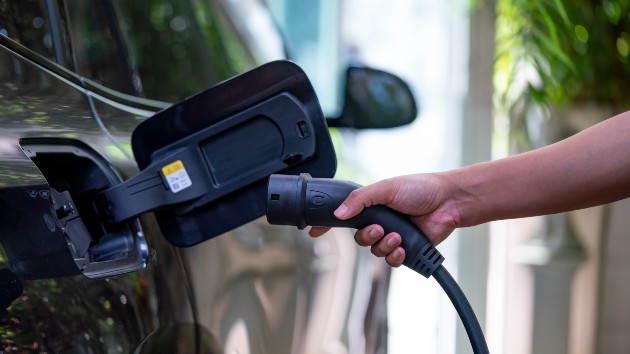
(WASHINGTON) — Amid a contentious election year debate over the future of U.S. auto manufacturing, the Environmental Protection Agency on Wednesday announced new vehicle emissions standards that will pressure the industry to make more electric vehicles.
“With transportation as the largest source of U.S. climate emissions, these strongest-ever pollution standards for cars solidify America’s leadership in building a clean transportation future and creating good-paying American jobs, all while advancing President Biden’s historic climate agenda,” EPA Administrator Michael Regan said.
The standards impact newly manufactured cars and trucks from model years 2027 to 2032 and represent an average of allowed emissions across an auto manufacturer’s entire fleet of offered vehicles.
“Three years ago, I set an ambitious target: that half of all new cars and trucks sold in 2030 would be zero-emission,” President Joe Biden said in a statement.
“I brought together American automakers. I brought together American autoworkers. Together, we’ve made historic progress. Hundreds of new expanded factories across the country. Hundreds of billions in private investment and thousands of good-paying union jobs,” he said. “And we’ll meet my goal for 2030 and race forward in the years ahead.”
Senior administration officials emphasized that manufacturers will have multiple pathways to compliance using a combination of battery electric vehicles, plug-in hybrids, strong hybrids and improved internal combustion engines.
Officials explained that these new standards will reduce U.S. greenhouse gas emissions by 7.2 billion metric tons through 2055. That’s about four times the total emissions of the transportation sector as of 2021.
“This actually is a huge win for all Americans. The standards will help tackle one of the nation’s largest sources of climate pollution — our cars and our trucks,” Luke Tonachel, senior strategist for the transportation sector for the Natural Resources Defense Council, told ABC News. “There is a shift that the auto industry is undergoing towards cleaner vehicles, but these standards ensure that we get to the lower pollution levels that we absolutely need.”
The standards are also expected to have public health impacts, with officials saying they will prevent up to 2,500 premature deaths in 2055 and reduce health issues such as heart attack, aggravated asthma and decreased lung function.
Wednesday’s announcement is not the most ambitious version of these standards proposed by the EPA in April 2023, but allows for a slower ramp up to compliance for auto manufacturers.
Administration officials say they decided on a slower rollout of the standards to make them more durable and give the auto market more lead time to come into compliance.
In a press call on Tuesday, League of Conservation Voters vice president of federal policy Matthew Davis explained that the Biden administration is also mindful of releasing these standards during an election year and insulating them from possible rollbacks.
“We certainly have had conversations with the Biden administration and they are crystal clear about the importance of getting rules out to make sure that they withstand both legal challenges from the fossil fuel industry and any congressional attacks should Republicans take over the Senate and the White House,” Davis said.
The Trump administration previously rolled back Obama-era standards that were meant to affect vehicles manufactured through 2025.
The announcement of new standards also comes just days after former President Donald Trump criticized Biden’s handling of the transition to electric vehicles at a campaign event for Ohio Senate candidate Bernie Moreno.
“We’re gonna put a 100% tariff on every single car that comes across the line, and you’re not gonna be able to sell those guys, if I get elected,” Trump said.
Despite the contentious rhetoric around EVs and car manufacturing in the U.S., environmental groups say it’s important to characterize the rules correctly, noting that they don’t call for a ban on traditional gas-powered cars.
“It’s important to underscore that EPA standards — they’re performance based. They don’t require manufacturers to sell any particular type of vehicle,” Peter Zalzal, associate vice president of clean air strategies for the Environmental Defense Fund, told ABC News. “You can see the standards being met by improvements in internal combustion engine vehicles, hybrids, plug-in hybrids, and battery electric vehicles, so it’s really about more choice.”
Davis echoed that sentiment, saying, “There are a variety of pathways to meet the standards, and any messaging indicating that this is a fossil fuel car ban is just misinformation from the fossil fuel industry and should be treated as such.”
ABC News’ Lalee Ibssa and Soorin Kim contributed to this report.
(WASHINGTON) — The House Oversight and Judiciary Committees are holding an impeachment hearing on Capitol Hill Wednesday amid growing scrutiny of Republicans’ ongoing probe of President Joe Biden and his family.
Tony Bobulinski and Jason Galanis, both former associates of Hunter Biden, are scheduled to testify. Bobulinski is in the hearing room. Galanis will participate via Zoom from the Alabama prison where he is serving a 14-year prison sentence for securities fraud.
Oversight Committee Chairman James Comer had publicly invited the two men to appear alongside Hunter Biden and another witness in the probe, Devon Archer. Hunter Biden and Archer declined the invite.
Democrats have called as their witness Lev Parnas, a onetime Rudy Giuliani associate-turned critic of the impeachment allegations.
Comer gaveled the hearing into session moments ago.
“The Bidens sell Joe Biden,” Comer said in an opening statement. “That is their business.”
(WASHINGTON) — In a decision late Tuesday, the Fifth Circuit Court of Appeals issued a decision that again blocks Texas from enforcing its strict immigration law, SB4.
Earlier in the day, the Supreme Court rejected a Biden administration request to intervene and keep Texas’s strict immigration enforcement law on hold while it is challenged in lower courts.
But in the late-night decision, the appeals court dissolved a pause on an order from a lower court that prevented the law from going into effect until litigation is concluded.
On Wednesday, the appeals court will hear arguments in the case to determine if the law should remain on hold until the court rules on SB4’s legality.
The SB4 law would authorize local and state law enforcement to arrest migrants they suspect crossed into the state illegally. It would also give judges the power to order migrants to be transported to a port of entry and returned to Mexico regardless of their country of origin.
The Biden administration has argued that immigration law is solely the responsibility of the federal government, and not local jurisdictions, as laid out in the Constitution.
“This Court has long recognized that the regulation of entry and removal of noncitizens is inseparably intertwined with the conduct of foreign relations and thus vested ‘solely in the Federal Government,'” the administration wrote in a filing with the U.S. Supreme Court earlier this month.
Texas, meanwhile, has argued that it is within its rights to arrest migrants because SB 4 is applicable under the State War Clause of the Constitution, which allows states to act when it is “actually invaded, or in such imminent Danger as will not admit of delay.”