(WASHINGTON) — The Virginia Supreme Court on Friday overturned the state’s redistricting ballot measure, delivering a major setback to Democrats who hoped the new map would allow them to flip up to four congressional seats.
This is a developing story. Please check back for updates.
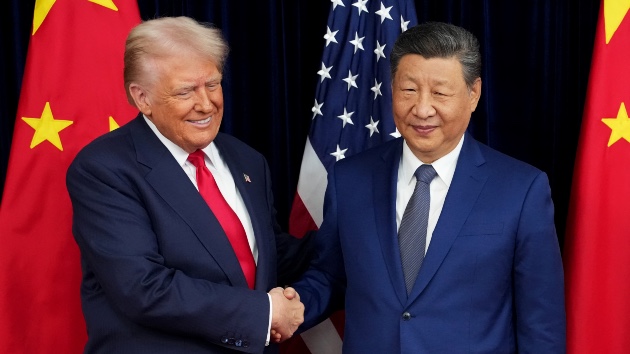
U.S. President Donald Trump greets Chinese President Xi Jinping ahead of a bilateral meeting at Gimhae Air Base on October 30, 2025 in Busan, South Korea. (Photo by Andrew Harnik/Getty Images)
(WASHINGTON) — When President Donald Trump arrives in Beijing next Thursday, he’ll be the first U.S. president to set foot in China in nearly a decade. The last visit was Trump’s own, in 2017.
He arrives in a very different position than he expected: the trip was originally scheduled for earlier this spring, then postponed because of the Iran war.
Trump had said the war would only last four to six weeks. Instead, there’s no end in sight with the the Strait of Hormuz remaining closed and U.S. gas prices surging — as the president faces record-low approval ratings.
That backdrop has flipped the leverage dynamic, according to experts who study the region.
The leverage flip
Beijing would have preferred this war never started — the energy disruption and the hit to global demand are real headaches for an export-dependent economy, experts say. But they say the conflict has handed Xi a relative advantage: Trump now has too many fires to put out at home and abroad to risk another escalation cycle with China.
“China is a relative bright spot in Trump’s foreign policy right now,” said Jon Czin, a former director for China at the National Security Council.
The longer the Iran war drags on, Czin argued, the more it minimizes the chance of another economic confrontation — Beijing has also already demonstrated it can retaliate — as it did with tariffs and rare earth export controls — and the administration backed down before.
Both sides are still trying to eke out an edge in the run-up. The Treasury Department recently sanctioned Chinese oil refiners and shipping firms tied to Iranian crude to cut off funding. In an unprecedented move, Beijing invoked a “blocking rule” for the first time, directing Chinese companies not to comply with sanctions on Chinese oil refiners.
Daniel Shapiro, a former deputy assistant secretary of defense for the Middle East, points out the war has reduced the U.S. military posture in the Indo-Pacific with long-term consequences for deterring China and defending Taiwan.
“Trump’s position and leverage at the summit is considerably weaker if he goes to Beijing with the war still unsettled, or even with renewed escalation. And the Iranians know that. So they are whittling down the terms to end the war to something much more modest than what Trump originally envisioned,” Shapiro wrote in a post on X.
What Trump wants
The administration clearly wants Beijing to use its influence over Tehran. Secretary of State Marco Rubio this week urged Beijing to use the Iran’s foreign minister’s visit to China earlier this week to press Tehran on reopening the Strait of Hormuz.
“I hope the Chinese tell him what he needs to be told,” Rubio said when asked about China’s top diplomat meeting with Iran’s foreign minister. “And that is that what you are doing in the strait is causing you to be globally isolated. You’re the bad guy in this.”
Beyond the war in Iran, Trump will be looking for wins on trade and investment: For instance, Chinese commitments to buy Boeing planes and U.S. agricultural goods as well as an extension of the trade truce reached during the last Trump-Xi meeting in South Korea last year, according to experts.
The administration also wants China to continue its pause on rare earth export controls, analysts say. U.S. Trade Representative Jamieson Greer has also proposed a “Board of Trade” to manage economic ties between the countries and goods the two sides are trading.
What Beijing wants — and what it doesn’t
Here’s the gap between the administration’s public framing and what analysts who study China most closely are saying: Beijing doesn’t actually plan to deliver much on Iran or get deeply involved.
Beijing’s statement after the meeting with the Iranian Foreign Ministry was carefully worded to not blame Iran for the crisis while also calling for greater efforts to open the Strait of Hormuz.
“The Chinese are not interested in assuming any kind of direct role in the conflict,” according to Patricia Kim, senior fellow at the Brookings Institution. “They see this as a problem that the United States needs to solve, and they have no interest in intervening on Tehran’s behalf.”
Czin’s read is similar. While Beijing’s meeting with the Iranian foreign minister this week let it “posture as peacemakers,” he says the Chinese don’t want Iran to take up too much summit time. His analog: even on North Korea, right on China’s doorstep, Beijing rarely puts real pressure on Pyongyang.
China’s energy buffer is part of why the urgency is lower than the Trump administration assumes. Beijing has built strategic oil reserves, invested heavily in green energy, and can shift to domestically produced coal. The bigger risk for China isn’t the energy crunch itself.
“The bigger issue for China is the secondary and tertiary effects from this conflict,” Czin said — such as a war-driven global slowdown that hits the Southeast Asian and European consumers that Chinese exports depend on.
What Beijing actually wants from the summit is more stability: lock in the trade truce, push back on U.S. export controls on advanced technology and ease restrictions on Chinese investment in the U.S.
What’s unclear is how hard Xi will push Trump on Taiwan. Any small shift in U.S. declaratory language on Taiwan would be significant, though Czin is skeptical Trump would stick with new wording even if he agreed to it.
Bottom line
Expect fanfare, expect deliverables on the margins — purchase commitments or a possible Board of Trade announcement — and don’t expect breakthroughs on the hard issues, experts say.
The summit’s significance is less in what it produces than in what it preserves: a tenuous stability that both leaders, for different reasons, want to keep intact through the rest of the year.
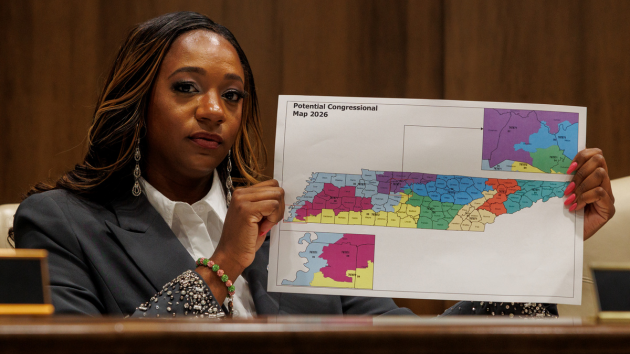
State Senator London Lamar, a Democrat from Tennessee, holds a copy of the proposed Congressional map for Tennessee during a special legislative session at the Tennessee State Capitol in Nashville, Tennessee, US, on Wednesday, May 6, 2026. Tennessee is considering redrawing its House congressional map following a key Supreme Court decision last week, a move expected to bolster Republicans ahead of what are forecast to be tough midterm elections in November. (Photographer: Madison Thorn/Bloomberg
(TENNESSEE) — As protesters accused them of racial gerrymandering, Tennessee state lawmakers passed into law on Thursday a new congressional map that could allow Republicans to flip the state’s lone Democratic-held seat, notching the GOP another win in the mid-decade redistricting scramble.
Republican Tennessee Gov. Bill Lee signed the bill into law Thursday afternoon.
The session was interrupted by chaotic scenes with lawmakers shouting over protesters’ voices and at one point forcing police clear the balcony above the House floor before it voted on the new map.
The new map breaks up the state’s current 9th Congressional District, which is primarily made up of Memphis, and the state’s only majority-Black district. The district is currently represented by Democratic Rep. Steve Cohen.
The legislature also passed bills on Thursday that will allow the state to legally redistrict outside of the normal once-a-decade cycle, as well as providing funding to help implement the new map in time for the 2026 elections.
Impact on the midterms and representation in Congress
With the map passed, it paves the way for President Donald Trump and Republicans to gain an additional House seat in the next Congress, increasing their chances of maintaining control of the House as they continue their redistricting battle across the country.
Tennessee Democrats will likely not have any representation in Congress next year if Republicans flip the seat and the map will dilute the Black vote by breaking up Memphis.
But legal challenges against the map are expected.
Cohen said Thursday he will file a lawsuit against the new map.
Cohen posted on X after the vote “[President Donald] Trump knows he HAS TO rig the game to keep his majority in November. And the TN GOP was willing to go along with it. It’s shameful. Next stop is the courts.”
Cohen had said earlier this week on CNN that the Republicans’ redistricting effort was a foregone conclusion, adding that he hopes the new congressional map can take effect in 2028 rather than 2026.
The speed at which the process occurred was remarkable — it was only last week that the Supreme Court struck down Louisiana’s congressional map as an unconstitutional racial gerrymander, dealing a blow to Section 2 of the Voting Rights Act.
And just one day after the Supreme Court’s ruling in Louisiana v. Callais, Trump posted on Truth Social that he spoke with Lee and that the governor said he would work to redraw the state’s congressional maps in order to net another GOP seat for Tennessee in the House. Lee called a special session the next day, April 30, to review the state’s congressional map.
Potential redistricting efforts are also currently underway in Louisiana, Alabama and South Carolina, although each state has different procedural or legal barriers to overcome.
With Tennessee’s new map, Republicans potentially could flip 14 Democratic-held seats in Texas, Missouri, North Carolina, Ohio and Florida. Democrats could pick up 10 from new maps passed in California, Utah and Virginia.
Acrimonious debate and protests in the state capitol
The proposed congressional map underwent much acrimonious debate and protest inside the legislature on Thursday before it was passed.
On the House floor, Democratic representatives condemned the map, saying it would dilute the Black vote in the state. At one point, chants of “our house!” started in the House gallery.
As the vote came up for the new map on the House side, chaos erupted in the room. A trooper was asked to clear out the balcony above the House floor as people protested.
Earlier, Democratic State Rep. Justin Pearson, who is running for Congress in the 9th District that will be broken up on the new map, said that “what is happening here is immoral and wrong.”
“This is about attacking, targeting and cracking District 9 into pieces for more political and racial dominance and white supremacy in the state of Tennessee. And we need to realize that the Callaisdecision that you all are basing your decisions off of that gutted the Voting Rights Act, that that Voting Rights Act was paid in blood,” Pearson said.
Pearson later confronted law enforcement officers, ABC affiliate WKRN reported, as they worked on clearing the House gallery of protestors. Pearson later said his brother KeShaun Pearson was arrested.
After the House passed the bill and it was taken up in the Senate, Republican state Sen. John Stevens spoke in support of the new map over audible protests and yelling.
“Tennessee is a conservative state, and I submit its congressional delegation should reflect that. The proposed map ensures that,” Stevens said.
He later said, “This bill represents Tennessee’s attempt to maximize our partisan advantage and allow Tennesseans to support a national Congress to be a Republican majority.”
But Democratic state Sen. London Lamar, who is Black, slammed the new map during debate as an attack on Black voters and said it “diminishes Memphis.”
“This map does not reflect Memphis. It diminishes Memphis. It slices our city into pieces and stretches our communities hundreds of miles away to places of different needs, different economies, different histories and different lived realities,” she said. “You cannot take a majority-Black city, fracture its voting power and then tell us race has nothing to do with it. Racism does not become less racist because it’s called partisan.”
Later, chants of “Hands off Memphis!” rang out and another lawmaker soon unfurled a banner that read “NO JIM CROW 2.0 – STOP THE TN STEAL.”
Ken Martin, chairman of the Democratic National Committee, speaks to the reporters following a press conference, August 05, 2025, in Aurora, Illinois. (Scott Olson/Getty Images)
With six months until the high-stakes midterm elections, the Democratic Party is struggling to raise money and keep up with its GOP counterparts, leading to frustrations among some donors with Democratic National Committee leadership and its chair Ken Martin.
At the end of March, the Republican National Committee outraised the DNC $21.2 million to $11.4 million, according to new reports filed with the Federal Election Commission. The RNC reported having nearly eight times more cash on hand — $116 million to the DNC’s $13.8 million. In addition, the DNC is a little over $18 million in debt, according to FEC filings.
Democrats, though, are performing better than they did in 2018 at this point in the cycle when the party had raised $7 million and had little more than $9 million cash on hand. The party had just under $6 million in debt at that time, too.
Multiple Democratic bundlers, strategists and donors told ABC News that they are still angry over how funds were allocated during the 2024 presidential election — and frustrated at Martin’s unwillingness to publicly release a DNC audit that examined what went wrong for Democrats in 2024.
After Martin won his campaign to be DNC chair in 2025 following the presidential election, he committed to conducting a review of the 2024 election and making it public. However, Martin has yet to release the full audit, saying instead he’s focused on looking forward and has released “lessons” from the audit.
Democratic officials and leaders — including Democratic Sen. Brian Schatz, who is poised to become the No. 2 Senate Democrat after the midterms — have urged for the report to be released as they look toward the midterms.
“What’s in the report that you wouldn’t want publicized?” “Pod Save America” host and former Obama administration speechwriter Jon Favreau asked Martin during an episode released April 28.
Martin replied that there was no “smoking gun” and that he wants to “keep the focus on the lessons.”
A longtime DNC finance member, who spoke to ABC News on the condition of anonymity, noted many donors are still questioning how funds were allocated during the 2024 race and the unreleased results of the DNC’s promised audit.
The member said donors were upset that, despite the DNC’s massive fundraising during the 2024 election, Kamala Harris didn’t win a single battleground state. It raised concerns about allocations toward paid media, voter outreach and, most troubling for many donors, the amount of money that went to consultants.
But following the 2024 election and Martin taking over the reins at the DNC, there has been a shift toward investing in state parties long before elections, as well as podcasts, influencers and more modern forms of public relations and communications
Cooper Teboe, a Democratic strategist in California, told ABC News that donors are “feeling incredibly jaded, incredibly unhappy” with the DNC over the 2024 election — with some questioning whether their financial contributions make a difference.
“We’re coming off of record fundraising for Democrats that seem to really not move the needle,” Teboe said. “So, folks have been in a position of, well, does my money actually do anything? Does my money do anything to change the needle?”
DNC spokesperson Mia Ehrenberg said the party is investing in ways that will help Democrats win.
“Democrats are putting our resources into the field, building infrastructure to power wins today and for years to come, and delivering overperformances all across the country, meanwhile Republicans are losing elections at a humiliating rate in spite of their billionaire donors,” Ehrenberg said in a statement to ABC News.
As frustrations with Martin over how he’s handling his job grow, a few members have started exploring options and rules for removing a chair, a source familiar with the situation told ABC News — although the source framed the efforts as very informal and focused on asking about the process.
“I don’t see Ken as a leader. The DNC reached out to me probably six months ago, and I told them to take me off their list, that it’s a waste of their time to send me anything, and the more they send, the less chances they ever have of getting me back,” said one longtime Democratic donor, who is now focused on individual candidates as opposed to the national committee.
Asked about his job to raise money for the party on “Pod Save America,” Martin said “the job of the DNC chair is singular: It’s to win,” adding that he has been helping the party succeed in that effort.
Michael Knapp, a DNC member, said he supports Martin’s work as chair, telling ABC News that Martin “came in with a clear mandate to shift the DNC towards long-term party building.”
“[Ken’s] investing in state parties, organizing, partisan voter registration, infrastructure … the things that actually win elections over time,” Knapp said to ABC News in a text message.
“On the fundamentals of the job, I think he’s very strong. The DNC’s raising significant grassroots money even while paying down inherited debt,” Knapp also said.
Daniel Weiner, director of the Brennan Center for Justice’s elections and government program, told ABC News that historically, the party out of power has had an “uphill battle with fundraising that’s not unique to this moment.”
“Frankly, over the years, the president has become much more habituated to raising the sort of big money that you would expect an incumbent to raise, and that Democratic incumbents have also raised, to some degree,” Weiner said. “And so we see the more traditional pattern emerging of the party in power just raises a lot more money than the party out of power.”
A longtime DNC finance member said frustrations with the DNC have led donors to focus on “individual elections as opposed to the DNC as an organization.”
While the national party is struggling to raise money, individual Democratic candidates are seeing a massive cash infusion ahead of November’s midterm elections, as donors show greater interest in investing in individual candidates.
Many of the Democratic Party’s top Senate candidates posted gainful fundraising hauls for the first quarter of 2026, massively outraising their Republican opponents, according to FEC filings.
“I think folks are very desperate for new leaders and new voices in the party, and I think that’s why you’re seeing the party infrastructure raising less, because the donors, both the donor class and the grassroots, want to see what is out there to define the future of the Democratic message and that’s just not going to come from the DNC,” Teboe said.
One senior Democratic official in touch with donors and party leaders told ABC News that while many big donors are frustrated by the results of the last election, an increasing number are expected to get off the sidelines and contribute more to various Democratic candidates and organizations through the summer and fall.
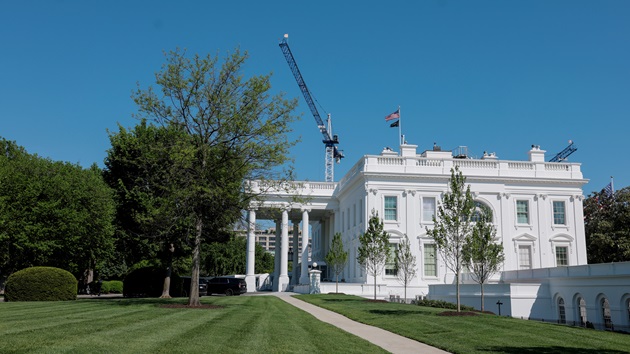
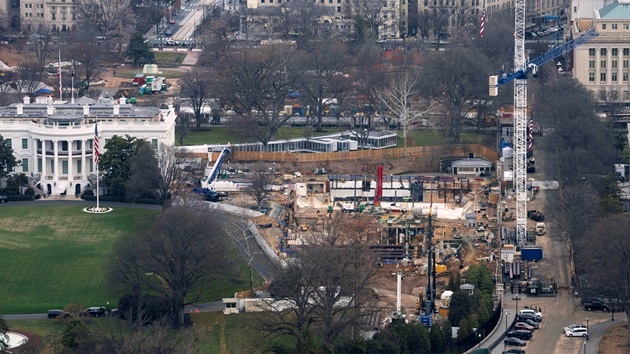
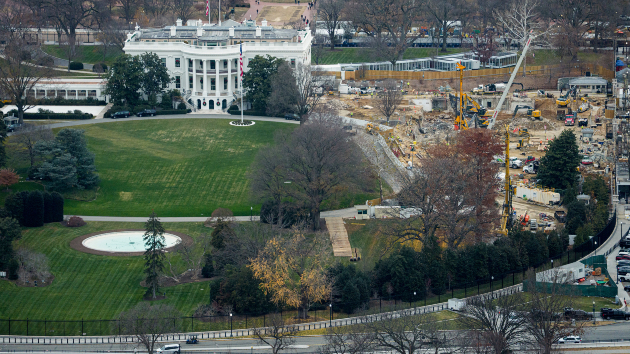
Construction cranes are seen the White House on April 16, 2026 in Washington, DC. (Anna Moneymaker/Getty Images)
(WASHINGTON) — Amid intensifying scrutiny of the Senate Republican proposal to spend up to $1 billion on security for the new White House ballroom, top Department of Homeland Security and U.S. Secret Service officials say the money would also be spent on “other critical missions.”
Those missions, they said, would include securing “frequently visited venues” outside of the White House.
In a letter to congressional leaders obtained by ABC News, Homeland Security Secretary Markwayne Mullin and Secret Service Director Sean Curran described the proposed billion-dollar package as “critical funding to address urgent needs in response to the unprecedented increase in threats against the President and other public officials.”
The letter said the security upgrades to the “East Wing Modernization Project” will “afford needed protection for the President, his family, and visitors, along with the below-ground security functions.”
The officials noted that, per the text of the Senate reconciliation bill, “none of these funds will be used to support non-security improvements at the White House.”
The Senate proposal, released earlier this week, would provide $1 billion for the Secret Service “for the purposes of security adjustments and upgrades, including within the perimeter fence of the White House Compound to support enhancements by the United States Secret Service relating to the East Wing Modernization Project.”
Without spelling out how much of the billion dollars would be spent on the ballroom construction project specifically, the officials said the funding would also be directed toward other locations, including “frequently visited venues facing heightened risk due to their public visibility and static nature.”
The text of the Senate’s bill makes no reference to “frequently visited venues” outside of the White House that Mullin and Curran mentioned in their letter.
Also, Mullin and Curran said the additional money would also go toward training USSS agents, USSS training facilities, the Secret Service’s Special Operations Division’s work on drones and biological and “other emerging threats,” as well as securing “high profile national events that require significant planning.”
Overall, the $1 billion package is described in the letter as a “critical infusion to ensure the safety of the current President and future Presidents.”
By comparison, to fund all of its operations, USSS receives more than $3 billion a year from Congress via the regular appropriations process.
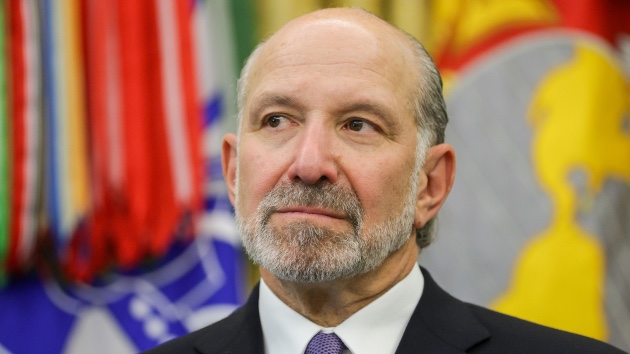
U.S. Commerce Secretary Howard Lutnick attends an event on advancing health care affordability in the Oval Office of the White House on April 23, 2026 in Washington, DC. (Photo by Alex Wong/Getty Images)
(WASHINGTON) — Commerce Secretary Howard Lutnick testified behind closed doors on Wednesday about his relationship with Jeffrey Epstein, making him the first Trump cabinet official to face questions as part of the House Oversight Committee investigation into the late financier.
Lutnick agreed to the voluntary transcribed interview after months of criticism over his relationship with Epstein — who was once Lutnick’s neighbor — and past statements distancing himself from the notorious sex offender.
During an interview last year with The New York Post, Lutnick described Epstein as “gross” and claimed that he said in 2005 he would “never be in the room with that disgusting person ever again” after touring Epstein’s New York City mansion.
However, documents released by the Department of Justice showed that Lutnick planned a visit to Epstein’s private island in 2012 — years after Epstein pleaded guilty to two prostitution-related charges in 2008.
“We are looking forward to visiting you,” Lutnick’s wife emailed Epstein’s assistant. “We would love to join you for lunch.”
When asked about the documents in February, Lutnick acknowledged he visited the island and said that he did not see anything inappropriate during his visit.
“I did have lunch with him, as I was on a boat going across on a family vacation. My wife was with me, as were my four children and nannies,” Lutnick testified on Capitol Hill in February.
While the DOJ’s Epstein files included a photo from that trip, the Department of Justice acknowledged they temporarily removed the photo before restoring it following backlash. A DOJ official claimed that the photo was temporarily removed with a “batch of files that were flagged for nudity,” though the photo did not contain any nudity and did not include any redactions when it was restored.
Lutnick also appeared to enter a business deal with Epstein in 2012, according to documents released by the Department of Justice. Both men signed business documents in 2012 to acquire an advertising company called Adfin.
Other documents released by the DOJ showed Epstein agreed to donate $50,000 in 2017 related to a dinner hosted in Lutnick’s honor.
During his New York Post interview last year, Lutnick said he believed that Epstein may have used blackmail to get the “sweetheart deal” he received during his first criminal case in 2008.
“I assume, way back when, they traded those videos in exchange for him getting that 18-month sentence, which allowed him to have visits and be out of jail. I mean, he’s a serial sex offender. How could he get 18 months and be able to go to his office during the day and have visitors and stuff? There must have been a trade,” Lutnick said.
But those allegations contrast with statements from multiple Trump administration officials who have insisted that Epstein neither trafficked young women for people beyond himself nor held compromising information about high-profile individuals,
“There is no credible information. None. If there were, I would bring the case yesterday that he trafficked to other individuals,” FBI Director Kash Patel said last year.
When asked about Lutnick’s relationship with Epstein in February, President Trump described Lutnick as a “very innocent guy” and suggested he would be willing to testify.
“Well, Howard would go in and do whatever he has to say,” Trump said. “He’s a very innocent guy, doing a good job.”
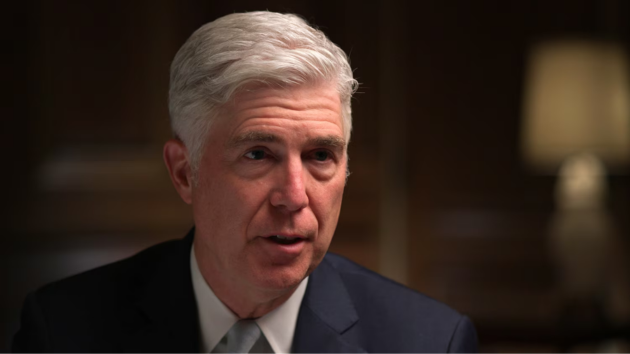
Supreme Court Justice Neil Gorsuch speaks with ABC News Live anchor Linsey Davis on ‘All Access.’ (ABC News)
(WASHINGTON) — Supreme Court Justice Neil Gorsuch responded publicly to personal attacks by President Donald Trump in an interview with ABC News Live Prime anchor Linsey Davis, suggesting he is determined to remain “independent” and “fearless” in fulfilling his duty despite harsh criticism from the president who appointed him.
After Gorsuch voted with Chief Justice John Roberts, Justice Amy Coney Barrett and the court’s three liberals to invalidate Trump’s sweeping global tariffs in February, the president lashed out at his nominees Gorsuch and Barrett, calling them a “disgrace,” “disloyal,” “unpatriotic,” “fools and lapdogs,” and “an embarrassment to their families.”
Gorsuch told Davis the comments prompted him to reflect on the ideals enshrined in the Declaration of Independence.
“We want independent judges, people who are fearless and able to apply the law without respect to persons, as our judicial oath says, right? That’s why we’re giving life [tenure] to anybody, and it’s quite an honor,” Gorsuch said when asked for his reaction to Trump. “It’s a humbling privilege to be able to serve in this capacity, and I’m just one link in a long chain.”
Gorsuch, who rarely does media interviews, spoke with ABC News ahead of publication of a new children’s book, “Heroes of 1776: The Story of the Declaration of Independence,” officially released Tuesday.
“We tell the story about the debate that led up to [the Declaration]. It almost didn’t go through,” the justice said of the nation’s founding charter, penned 250 years ago this year. “None of this is inevitable, and it isn’t inevitable that it will survive. America’s biggest enemy is itself. I believe we have to recommit every generation … if we’re going to carry those ideals forward.”
Even before he was confirmed in 2017, Gorsuch was forced to respond to extraordinary attacks on the federal judiciary by a sitting president, after Trump in his first term targeted judges who blocked controversial policies. Then-Judge Gorsuch described Trump’s behavior as “disheartening” and “demoralizing.”
Now, the conservative justice, 58, who will mark a decade on the high court bench next year, said he shares Roberts’ concern that a surge in personal attacks against judges is “dangerous,” even if intense criticism can be fair game.
“Part of the job of the judge is to accept criticism. Right? Everybody’s got a right to free speech,” Gorsuch said. “It’s a raucous thing in democracy, and that’s good. That’s great. And part of that is part of our story. Part of our story too, is realizing, again, that the person sitting across from you probably loves his country every bit as much as he did.”
Gorsuch said he was “heartbroken” by the recent attempted assassination of Trump at the White House Correspondents’ Dinner and that the episode appeared to be part of a broader deterioration of civility in politics.
“What keeps me up at night is disagreements that we have, and our sometimes incapacity to realize the humanity of the people we disagree with,” he said.
Gorsuch has publicly maintained a friendly personal relationship with senior liberal Justice Sonia Sotomayor, making several joint appearances in an effort to promote civics education and attempt to shore up faith in the Court as an institution.
“When I disagree with my colleagues … I never question that the person sitting across from me loves this country every bit as much as I do, that they love the Constitution and Declaration [of Independence], and that they’re doing their best.”
Construction work continues on President Trump’s White House Ballroom on the site of the former East Wing of the White House, seen from the Washington Monument on March 8, 2026 in Washington, DC. (Aaron Schwartz/Getty Images)
(WASHINGTON) — President Donald Trump on Wednesday defended the cost increase of his massive White House ballroom construction project, the price tag of which has jumped from $200 million to nearly $400 million.
“The only reason the cost has changed is because, after deep rooted studies, it is approximately twice the size, and a far higher quality, than the original proposal, which would not have been adequate to handle the necessary events, meetings, and even future Inaugurations,” Trump wrote in a post to his social media platform.
“The original price was 200 Million Dollars, the double sized, highest quality completed project will be something less than 400 Million Dollars. It will be magnificent, safe, and secure!” the president added.
Trump’s defense comes after his relentless criticism of Federal Reserve Chair Jerome Powell’s oversight of a multi-billion-dollar renovation of the central bank’s headquarters in Washington, D.C. The cost of the Fed renovation increased, which the central bank said was due to rising costs of labor and material as well as unforeseen damage to the property.
The White House previously said it aimed to raise the $400 million through private donations, and Trump himself repeatedly promised no taxpayer money would be used to build the ballroom.
“So we did this, no charge to the taxpayer whatsoever,” Trump said about the ballroom in February. “This was all donations made by friends of mine and people that are — that love our country.”
But now, Republicans in Congress are proposing $1 billion for security-related aspects of the construction project.
On Tuesday, Senate Republicans said that they are aiming to secure $1 billion in funding for the Secret Service for security-related aspects of the East Wing renovation, including the ballroom project, as part of a broader funding package for immigration enforcement.
Trump’s social media post on Wednesday defending the higher costs made no mention of the proposed $1 billion infusion from Congress.
It’s unclear exactly how the Secret Service would spend the money — and the public may never know given that much of the agency’s spending related to White House security is classified.
But in federal court and in the president’s own social media posts, the administration has offered some examples of the security features that Trump has in mind.
In a filing in the ballroom lawsuit last month, the Justice Department said the protective enhancements to the East Wing project would include “missile resistant steel columns, Military-grade venting, drone-proof ceilings and bullet, ballistic, and blast proof glass,” all aimed at forming a “fortified structural buffer” on the east side of the complex that would gird not only the ballroom, but also the main White House residence and the offices in the West Wing.
That April 27 filing also said the upgrades would include “bomb shelters, a state of the art hospital and medical facilities, Top Secret military installations, structures, and equipment, protective partitioning, and other features.”
Welcoming the proposed help from Republican lawmakers, a White House spokesman said on Monday that they “rightly recognized the need for these funds.”
Several Democrats criticized the Republican plan to allocate $1 billion toward the project.
“Donald Trump promised that ZERO taxpayer dollars will be used for his ballroom. He lied,” House Minority Whip Katherine Clark, the No. 2 House Democrat, wrote on X.
Democratic Sen. Dick Durbin, the ranking member of the Senate Judiciary Committee, called it a “vanity project.”
“While Americans are struggling to make ends meet as a result of President Trump’s failed policies, Republicans are focused on providing tens of billions of dollars for the President’s vanity ballroom project and cruel mass deportation campaign,” Durbin said in a statement. “Republicans are in danger of losing control of Congress in November, so they are going outside the usual bipartisan appropriations process to fund these unpopular policies through the end of the Trump Administration.”
ABC News’ Benjamin Siegel contributed to this report.
U.S. Commerce Secretary Howard Lutnick attends an event on advancing health care affordability in the Oval Office of the White House on April 23, 2026 in Washington, DC. (Photo by Alex Wong/Getty Images)
(WASHINGTON) — Commerce Secretary Howard Lutnick is set to testify behind closed doors on Wednesday about his relationship with Jeffrey Epstein, making him the first Trump Cabinet official to face questions as part of the House Oversight Committee investigation.
Lutnick agreed to the voluntary transcribed interview after months of criticism over his relationship with Epstein — who was once Lutnick’s neighbor — and past statements distancing himself from the notorious sex offender.
During an interview last year with The New York Post, Lutnick described Epstein as “gross” and claimed that he said in 2005 he would “never be in the room with that disgusting person ever again” after touring Epstein’s New York City mansion.
However, documents released by the Department of Justice showed that Lutnick planned a visit to Epstein’s private island in 2012 — years after Epstein pleaded guilty to two prostitution-related charges in 2008.
“We are looking forward to visiting you,” Lutnick’s wife emailed Epstein’s assistant. “We would love to join you for lunch.”
When asked about the documents in February, Lutnick acknowledged he visited the island and said that he did not see anything inappropriate during his visit.
“I did have lunch with him, as I was on a boat going across on a family vacation. My wife was with me, as were my four children and nannies,” Lutnick testified on Capitol Hill in February.
While the DOJ’s Epstein files included a photo from that trip, the Department of Justice acknowledged they temporarily removed the photo before restoring it following backlash. A DOJ official claimed that the photo was temporarily removed with a “batch of files that were flagged for nudity,” though the photo did not contain any nudity and did not include any redactions when it was restored.
Lutnick also appeared to enter a business deal with Epstein in 2012, according to documents released by the Department of Justice. Both men signed business documents in 2012 to acquire an advertising company called Adfin.
Other documents released by the DOJ showed Epstein agreed to donate $50,000 in 2017 related to a dinner hosted in Lutnick’s honor.
During his New York Post interview last year, Lutnick said he believed that Epstein may have used blackmail to get the “sweetheart deal” he received during his first criminal case in 2008.
“I assume, way back when, they traded those videos in exchange for him getting that 18-month sentence, which allowed him to have visits and be out of jail. I mean, he’s a serial sex offender. How could he get 18 months and be able to go to his office during the day and have visitors and stuff? There must have been a trade,” Lutnick said.
But those allegations contrast with statements from multiple Trump administration officials who have insisted that Epstein neither trafficked young women for people beyond himself nor held compromising information about high-profile individuals,
“There is no credible information. None. If there were, I would bring the case yesterday that he trafficked to other individuals,” FBI Director Kash Patel said last year.
When asked about Lutnick’s relationship with Epstein in February, President Trump described Lutnick as a “very innocent guy” and suggested he would be willing to testify.
“Well, Howard would go in and do whatever he has to say,” Trump said. “He’s a very innocent guy, doing a good job.”
Demolition of the East Wing of the White House, during construction on the new ballroom extension of the White House in Washington, DC, US, on Tuesday, Dec. 9, 2025. (Aaron Schwartz/Bloomberg via Getty Images)
(WASHINGTON) — Senate Republicans are aiming to secure $1 billion in funding for security-related aspects of the White House ballroom project as part of a broader, roughly $70 billion funding package for immigration enforcement, which they aim to pass with little-to-no support from Democrats.
Republicans began unveiling aspects of their reconciliation package late Monday night. Included within the bill is a $1 billion allocation to the Secret Service for “the purposes of security adjustments and upgrades … relating to the East Wing Modernization Project, including above-ground and below-ground security features.”
The funding can only be used for security-related aspects of the project, according to the bill text.
The Trump administration has previously said it aims to raise $400 million in private donations to pay for the ballroom, and has said it will cost the taxpayer nothing.
President Donald Trump said in October that the ballroom would be “paid for 100% by me and some friends of mine,” referencing donors.
“The government is paying absolutely nothing,” Trump said.
Democratic lawmakers have introduced legislation that they have titled “The Stop Ballroom Bribery Act” to regulate the project and impose restrictions on donations.
A group of GOP senators led by Sen. Lindsey Graham introduced separate legislation that would provide $400 million in funding. The senators on that bill say their proposal is to offset the cost of the ballroom by using customs fees. Because it is not in a reconciliation bill, it will almost certainly fail to pass if it even gets a vote on the Senate floor.
Republican Sen. Rand Paul put forward a separate bill that would authorize the ballroom but not fund it. He attempted to pass that by unanimous consent last week and it failed.
This bill text comes as Republicans have increasingly called for the construction of the ballroom following the shooting at the White House Correspondents’ Association Dinner last month. They say a secure facility is necessary for the president and Cabinet members to gather with large groups on the White House grounds.
The White House said Tuesday that “Congress has rightly recognized the need for these funds.”
“Due in part to the recent assassination attempt on President Trump at the White House Correspondents’ Dinner, the proposal would provide the United States Secret Service with the resources they need to fully and completely harden the White House complex, in addition to the many other critical missions for the USSS,” White House spokesman Davis Ingle said in a statement. “As President Trump has repeatedly said, the White House must be a safe and secure complex that generations of future presidents and visitors to the People’s house can enjoy.”
In a statement to ABC News on Tuesday, a spokesperson for Senate Judiciary Committee Chairman Chuck Grassley said the bill does “does not fund ballroom construction,” but “provides funds for Secret Service enhancements that will ensure all presidents, their families and their staffs are adequately protected.”
The ballroom has been the target of a lawsuit filed late last year by historic preservationists, with a federal judge finding it to be illegal without the approval of lawmakers.
In a filing in the case last month, the Trump administration said that the security enhancements to the East Wing project would include “missile resistant steel columns, Military-grade venting, drone-proof ceilings and bullet, ballistic, and blast proof glass,” all aimed at forming a “fortified structural buffer” to protect not only the ballroom, but also the main White House residence and the offices in the West Wing.
That April 27 Justice Department filing, which read in part like a social media post written in the president’s own voice, also said the upgrades would include “bomb shelters, a state of the art hospital and medical facilities, Top Secret military installations, structures, and equipment, protective partitioning, and other features.”
District Judge Richard Leon ruled in late March that building the ballroom without congressional authorization violated the law. While Leon carved out an exception for work that would be necessary to ensure the “safety and security of the White House,” he later clarified his decision to allow for “below-ground construction” on the project, as well as anything above ground that would be “strictly necessary” to secure and protect that work.
Leon’s injunction has been administratively stayed by a three-judge panel of the D.C. Circuit Court of Appeals, pending oral argument at a hearing set for next month. The appeals court’s order means that, for now, work on both the ballroom and the project’s security-related features can continue.
For weeks, Republicans have been working to put forward a funding package in response to political gridlock that left Immigration and Customs Enforcement and the U.S. Border Patrol without their regular annual appropriations. Though these agencies received funding through the previously passed One Big Beautiful Bill, Republicans say more funding is needed, and they’re looking to secure $26 billion for U.S. Customs and Border Protection and $38 billion for ICE in this just-released bill.
Republicans are aiming to pass the funding using a budgeting tool called reconciliation, which, if successful, would allow Republicans to send this funding to Trump’s desk without the support of a single Democrat and without the possibility of a filibuster. But there are rules governing this process, and it’s not yet clear whether the Senate parliamentarian, who must determine whether items in a reconciliation package are “substantive to the budget,” will green light the ballroom security funding or other items in the bill.
Senate Minority Leader Chuck Schumer said Tuesday that Republicans are “on a different planet” than American families with their spending priorities.
“Republicans looked at families drowning in bills and decided what they really needed was more raids and a Trump ballroom,” Schumer wrote in a post on X Tuesday.