
Melania Trump announces push to woo gay conservatives during Mar-a-Lago fundraiser, organizer says

Melania Trump announces push to woo gay conservatives during Mar-a-Lago fundraiser, organizer says
Eva Marie Uzcategui/Bloomberg via Getty Images, FILE

(WASHINGTON) — Former first lady Melania Trump at a fundraiser on Saturday announced a major voter outreach initiative to garner conservative gay and lesbian support for former President Donald Trump’s 2024 bid — in an effort to boost his standing with a group that, more broadly, voted against him in 2020 — organizers of the fundraiser told ABC News.

After having mostly stayed away from her husband’s campaign trail this cycle, Melania Trump made a rare appearance at a political event Saturday night, speaking as a guest of honor at the fundraiser at the Trumps’ Mar-a-Lago Club for Log Cabin Republicans, the largest conservative LGBTQ+ organization in the United States.

Addressing conservative LGBTQ+ supporters at the sold-out fundraiser, Melania Trump said money raised that night — more than $1 million, according to organizers — would go toward an effort to deploy resources to key swing states in educating voters about conservative LGBTQ+ causes and delivering pro-Trump messages among gay and lesbian communities, said Bill White, one of the co-hosts and a longtime friend of Donald Trump.

Richard Grenell, a former U.S. ambassador to Germany and former acting director of national intelligence under Trump, becoming the first openly gay person to hold a Cabinet-level position in the U.S., will be spearheading the new Log Cabin Republicans initiative with help from White, a former president of the Intrepid Sea, Air and Space Museum, and White’s husband, Bryan Eure, a senior vice president at insurance brokerage firm Willis Towers Watson.

This initiative is expected to be one of Melania Trump’s top priorities, White said, and she is set to support it with “upcoming activities” — which would mark a notable contrast given how little Melania Trump has campaigned on behalf of her husband in either 2016 or 2020. (The Trump campaign did not provide more details about possible events for conservative gay and lesbian voters.)

“They hear us, they see us, and they love us,” White said of the Trumps’ message to Log Cabin Republicans on Saturday night.

The announcement of Melania Trump’s involvement with the Log Cabin Republicans initiative comes after months of her staying away from the public spotlight as her husband’s third presidential bid heats up. She has, however, maintained some of her own initiatives — speaking at a naturalization ceremony for new U.S. citizens in December; some charity work like with a local foster care organization in 2021; and launching a line of digital collectibles, a line of Christmas ornaments and, more recently, a Mother’s Day-themed necklace for $245.

The last two times she was seen publicly on the trail were at a major Palm Beach, Florida, fundraiser for Donald Trump and Republicans earlier this month, where organizers said they raised more than $50 million; and last month at a Palm Beach polling location where the former president voted in the Florida Republican primary.

White told ABC News the initiative for gay Republicans is expected to involve “digital footprints in all of the key swing states,” as well as “extensive research and development into who we need to be communicating with and how we will communicate with them” — an effort to persuade the gay and lesbian community in America that “Donald Trump is the best choice for all of us.”

Polling shows that he has notably lagged with those voters in the past. Rival Joe Biden won self-identified members of the LGBTQ+ community over Trump, 64-27%, exit polls showed. But that was a slight improvement for Trump compared with 2016, when he got only 14%.

While the former president differentiated himself from some other leading conservatives in embracing gay people, his anti-trans positions have drawn broader outcry from the LGBTQ+ community.

White claimed the pro-Trump voices within the LGBTQ+ community have grown exponentially since Donald Trump’s first presidential bid, noting efforts by national-level pro-Trump LGBTQ+ coalitions.

“We are gay Republicans and we are voting for Trump,” he said. “He is the best and only choice in this election for our health, prosperity, safety and security.”

Parts of Melania Trump’s speech at the fundraiser Saturday night will be put out in Log Cabin Republicans’ digital ads, White said.

“We are so grateful to Mrs. Trump for her strategic leadership and making this initiative one of her top priorities for the 2024 presidential campaign and for the successful election of her husband,” he said.

Ahead of the fundraiser on Saturday morning, Grenell, another gay conservative ally, on X threw support behind Donald Trump as “the best candidate for our safety, security and prosperity.”

“He sees you as 100% equal – it’s up to you to be responsible, hardworking and successful,” he continued. “Anyone telling you that you are oppressed in America or that you need special side agreements because you’re gay is only seeking to control you.”

Over the years, both Melania and Donald Trump have maintained a close relationship with Log Cabin Republicans. In 2021, Melania Trump headlined their annual gala at Mar-a-Lago and received the group’s Spirit of Lincoln award for her role in “helping children reach their full potential” and “championing a more inclusive Republican Party.”

In 2022, Donald Trump headlined Log Cabin Republicans’ Spirit of Lincoln gala held at Mar-a-Lago, where he told the audience, “We are fighting for the gay community, and we are fighting and fighting hard.”

Copyright © 2024, ABC Audio. All rights reserved.

Supreme Court appears to favor Oregon city in dispute over homeless camping ban

Supreme Court appears to favor Oregon city in dispute over homeless camping ban
joe daniel price/Getty Images

(WASHINGTON) — A majority of Supreme Court justices on Monday appeared sympathetic to an Oregon city making it a crime for anyone without a permanent residence to sleep outside in an effort to crack down on homeless encampments across public properties.

The case, City of Grants Pass v. Johnson, carries enormous stakes nationwide as communities confront a growing tide of unhoused residents and increasingly turn to punitive measures to try to incentivize people to take advantage of social services and other shelter options.

“These generally applicable laws prohibit specific conduct and are essential to public health and safety,” argued the city’s attorney Theane Evangelis during oral arguments, which stretched more than two and a half hours.

The Ninth Circuit Court of Appeals said in a decision last year that a homeless camping ban amounts to “cruel and unusual punishment” under the 8th Amendment. But several members of the high court’s conservative majority took a critical view of that conclusion.

“Have we ever applied the Eighth Amendment to civil penalties?” asked a skeptical Justice Clarence Thomas.

Justice Amy Coney Barrett worried about where to draw the line, wondering aloud whether the Eighth Amendment could reasonably be invoked to prohibit punishment for hungry people who steal food or engage in other behaviors necessary for survival.

“How do we draw these difficult lines about, you know, public urination and those sorts of things?” she said.

Many appeared to reject claims that the Grants Pass ordinance and others like it criminalize a person based their experience of involuntary homelessness, rather than for a concrete action. Supreme Court precedent has said it’s unconstitutional to punish someone for a relatively immutable quality, like drug addiction.

“What if the person finds that person in a homeless state because of prior life choices or their refusal to make future life choices?” asked Justice Samuel Alito.

Some conservative justices, while empathetic to the plight of the unhoused, suggested that local officials — not courts — are best positioned to grapple with the complicated issue of homelessness.

“This is a serious policy problem,” said Chief Justice John Roberts, “and it’s a policy problem because the solution, of course, is to build shelter to provide shelter for those who are otherwise harmless. But, municipalities have competing priorities … Why would you think this these nine people are the best people to judge and weigh those policy judgments?”

The court’s three liberal justices — clearly breaking with the majority of justices — forcefully defended the rights of homeless people to camp in public places, likening the Grants Pass law to cruelly punishing someone’s basic need.

“Sleeping is a biological necessity,” noted Justice Elena Kagan. “Presumably, you would not think it’s okay to criminalize breathing in public.”

“Sleeping that is universal, that is a basic function,” echoed Justice Ketanji Brown Jackson. “What I don’t understand is in this circumstance why that particular state is being considered ‘conduct’ for the purpose of punishment.”

“Where do we put them if every city, every village, every town lacks compassion and passes a law identical to this?” asked Justice Sonia Sotomayor. “Where are they supposed to sleep? Are they supposed to kill themselves not sleeping?”

Backers of the law say many individuals who’ve camped in city parks have chosen not to take an available bed in the town’s Gospel Rescue Mission — a private shelter in city limits — which is only half full but requires residents to attend worship services, give up pets and pledge not to smoke or drink.

The lead plaintiff in the case refused a shelter bed because she wanted to remain outside with her dog. Grants Pass has no public homeless shelters.

Chief Roberts asked whether a nearby town’s shelter capacity, or whether a person’s decision to decline a bed, should be taken into consideration.

“Let’s say there are five cities all around Grants Pass and they all have homeless shelters, and yet the person wants to stay [in the camp]?” Roberts asked. “Can that person be given a citation?”

Justice Alito questioned the practicality of determining the number available beds before a citation is issued to a person sleeping in a park, suggesting the lower court decision created an unworkable situation for law enforcement.

“What is an individual police officer supposed to do?” he asked. “Count the number of people who are getting ready to sleep outside for the night, and then ask each one of them whether you’ve tried to find a bed at a shelter?”

Pressing the limits of the constitutional argument against the Oregon city’s ordinance, Justice Neil Gorsuch asked if there might be a right to defecate and urinate in public if bathrooms aren’t available to the homeless.

Key to the argument is whether Grants Pass treats homelessness as a “status.” Doing so could run afoul of a 1962 case, Robinson v. California, which held that it violated the Eighth Amendment to make drug addiction as a “status” illegal.

“Homelessness is not something that you do. It’s just something that you are,” argued attorney Kelsi Corkran, representing the homeless plaintiffs.

The Oregon law’s defenders say the ordinance merely criminalizes the conduct of camping in public, not the fact that the camper has no home. They also argue that the state allows for a “necessity” defense, which those charged with violating the city’s ordinance could pursue if they could show they truly had nowhere else to go.

The Biden administration is asking the court to remand the case for further evidentiary findings before a final ruling is made.

A decision is expected by the end of June.

Copyright © 2024, ABC Audio. All rights reserved.

Congress seems poised to pass potential TikTok ban in US. How would it work?

Congress seems poised to pass potential TikTok ban in US. How would it work?
Anna Moneymaker/Getty Images

(WASHINGTON) — A potential ban of TikTok in the United States sailed through the House of Representatives over the weekend as part of a $95 billion foreign aid package that garnered bipartisan support.

The social media crackdown may stand poised to become law, since President Joe Biden has vowed to sign it if it passes the Senate and reaches his desk.

​​The TikTok measure could still be removed from the foreign aid legislation in the Senate, but that would require the entire package to be sent back to the House for another vote — at the same time that lawmakers on both sides of the aisle have stressed urgency for acting on the additional money for Ukraine and Israel.

If enacted, the measure would force a sale of the popular social media app by its Chinese parent company, ByteDance. In the absence of a sale, the app would be banned.

A TikTok ban is wrapped in Speaker Johnson’s foreign aid package: What happens next?
TikTok did not immediately respond to ABC News’ request for comment. In a previous statement, TikTok slammed the renewed efforts behind divestment.

“It is unfortunate that the House of Representatives is using the cover of important foreign and humanitarian assistance to once again jam through a ban bill that would trample the free speech rights of 170 million Americans, devastate 7 million businesses, and shutter a platform that contributes $24 billion to the U.S. economy, annually,” the platform said.

Here’s what to know about whether the ban would ever take effect, what it means for users and how people may seek to bypass it:

Will TikTok ultimately get banned?
Even if the measure becomes law, TikTok may still avoid a ban.

ByteDance could opt to sell TikTok, ensuring the continued availability of the app for U.S. users. The bill passed in the House grants ByteDance nine months to sell, with the potential for a three-month extension.

Regardless of a possible sale, the measure would likely elicit a legal challenge on First Amendment grounds that could nullify the law entirely, according to experts.

TikTok and its users could challenge the law as an infringement upon constitutionally protected freedom of speech, Anupam Chander, a professor of law and technology at Georgetown University, previously told ABC News. In opposition, the U.S. government would likely argue that national security concerns should outweigh First Amendment protections, Chander said.

Last May, TikTok sued Montana in federal court over a ban of the app enacted by the state, saying the law violated the First Amendment rights of users. Months later, in November, a federal judge ruled in favor of TikTok and blocked the law before it took effect.

However, the measure in Montana may offer little insight into the legal outcome of a federal ban, Sarah Kreps, director of Cornell University’s Tech Policy Institute, told ABC News. In Montana, lawmakers banned TikTok on privacy and child safety grounds, while the federal statute draws on national security considerations.

“This is apples and oranges,” Kreps said.

Still, if the U.S. enacts a law banning TikTok, a federal judge may order a temporary pause while the legal challenge makes its way through the court system due to the wide-reaching ramifications of such a measure.

How would a potential ban work?
The measure would ban TikTok by removing it from U.S. app stores, including popular platforms on iPhone and Android.

New customers would be unable to download the app, while current users would lose access to vital updates, experts told ABC News.

“Users can still keep the app on their mobile devices, but they won’t be able to get the updates and eventually it’s going to become outdated,” Qi Liao, a professor of computer science at Central Michigan University, told ABC News.

Users may be able to use the app for up to one year after the ban goes into effect, Liao added, but the app would deteriorate and eventually become inoperable.

The potential decline of the app, Kreps said, would amount to a “slow fizzle.”

“The reasons why people have wanted to use TikTok are that it’s easy, it’s fun, it has a nice user interface,” Kreps added. “Without updates over time, it would not have those same qualities that users have liked.”

Will users find ways to get around the ban?
Some users would likely be able to circumvent the ban, but it would prove too difficult or inconvenient for many, experts said.

“For the majority of people, it will be lots of trouble,” Liao said. “For someone who is tech-savvy and motivated, they can do it.”

For instance, individuals could pursue offline app installation that bypasses the app store, Liao said. To do this, he added, an individual could download an installation package from the internet, move it to a USB drive and transfer it to their phone.

Individuals could also use a Virtual Private Network, or VPN, which allows one to pose as a user logging on from a location abroad, thereby circumventing the U.S.-specific ban, experts said.

Some users would circumvent the ban but over time, the difficulty and annoyance would likely drive them to a competing service, Kreps said.

“It’s not going to be an on/off switch,” she added. “But people will prefer the path of least resistance.”

ABC News’ Lauren Peller, Alex Ederson and Jay O’Brien contributed to this report.
 

Copyright © 2024, ABC Audio. All rights reserved.

Supreme Court will take up ‘ghost guns’ case next term

Supreme Court will take up ‘ghost guns’ case next term
Ryan McGinnis/Getty Images

(WASHINGTON) — The Supreme Court said Monday it would take up the issue of “ghost guns” next term and the Biden administration’s appeal seeking to regulate the self-assemble weapons kits as any other firearm.

The 5th Circuit struck down a 2022 ATF regulation determining the sale of weapons kits requires a background check and serialization of the parts for law enforcement tracking.

Story developing…

Copyright © 2024, ABC Audio. All rights reserved.

Congress gets closer to forcing TikTok to be sold or face US ban: What’s next

Congress gets closer to forcing TikTok to be sold or face US ban: What’s next
ABC News

The $95 billion foreign aid package that passed the House on Saturday included legislation to force a sale of TikTok by its Chinese parent company, ByteDance.

If the measure becomes law and if that sale then doesn’t occur within a year, the app would be banned in the U.S. amid widespread data-sharing and foreign influence fears — which TikTok says are baseless.

So, what’s next for the push to divest or ban the hugely popular social media platform in the U.S.?

The future in the Senate and beyond

The Senate plans to take up the foreign aid package next week, starting Tuesday, putting it on track for final passage by midweek.

The campaign to force TikTok to be divested or be banned has earned broad bipartisan support, with lawmakers echoing worries that TikTok could harvest Americans’ user data for Beijing — or be used as a vehicle to spread Chinese propaganda.

House Speaker Mike Johnson hailed an earlier version of the sell-or-ban bill that passed the House in March, saying it “demonstrates Congress’ opposition to Communist China’s attempts to spy on and manipulate Americans, and signals our resolve to deter our enemies.”

Some supporters of divestment also note that China already restricts hugely popular American platforms like YouTube in their country.

TikTok has defended its data management at length, saying U.S. user traffic flows through a third party within the U.S., along with additional oversight protections.

ByteDance is “not owned or controlled by any government or state entity,” TikTok says, though skeptics believe ByteDance could hypothetically be forced under Chinese law to comply with the government there.

While there are some critics on Capitol Hill of the push against TikTok, the divestment-or-ban legislation continues to gain steam, and the White House said President Joe Biden would sign the earlier version of the bill.

High-profile Democrats like Senate Commerce Committee Chair Maria Cantwell of Washington have now signaled support for the TikTok provision, too.

Cantwell was an obstacle to the House’s previous bill to force a sale or ban of TikTok, which passed in March and then stalled in the Senate. But she’s since come around, saying last week that House Republicans earned her support by amending their legislation to extend the deadline for when ByteDance would be required to sell the app from six months to a year after the law were to go into effect.

The TikTok measure could still be stripped out of the foreign aid legislation in the Senate, but that would require the entire package to be sent back to the House for another vote — at the same time that lawmakers on both sides of the aisle have stressed urgency for acting on the additional money for Ukraine and Israel.

The app is working to “educate lawmakers,” a source told ABC News. The company has mounted aggressive efforts to sway lawmakers to their position, but it’s unclear what their strategy is now.

In a statement, TikTok slammed the renewed efforts behind divestment. “It is unfortunate that the House of Representatives is using the cover of important foreign and humanitarian assistance to once again jam through a ban bill that would trample the free speech rights of 170 million Americans, devastate 7 million businesses, and shutter a platform that contributes $24 billion to the U.S. economy, annually,” the platform said.

TikTok would likely sue to block the divestment legislation from going into effect at the end of the one-year sale window.

Rep. Ro Khanna, a progressive Democrat from California, didn’t support the legislation in the House and predicted Sunday on ABC News’ “This Week” that “I don’t think it’s going to pass First Amendment scrutiny [by the courts] because I think there are less restrictive alternatives.”

What would China do?

In March, China’s Commerce Minister Wang Wentao indicated officials would seek to block any transfer of the app’s technology, saying the country would “firmly oppose” a forced sale.

Of perhaps the greatest concern is the app’s algorithm, seen as essential to its popularity in surfacing viral video content.

Users are already familiar with the algorithm’s success, even if they don’t realize that’s what allows the app to feed users a never-ending stream of videos related to their interests. Selling TikTok without that technology would be like selling a car without an engine.

What are TikTokers saying?

Many TikTokers say they oppose the legislation, which could upend their digital media careers and businesses, and they are making their voices heard. A group of about 50 held a demonstration in front of the Capitol while the House voted on the package on Saturday.

A group of 30-plus creators also recently signed an open letter to President Joe Biden warning him that taking action against the app would be a “serious error” that could be “alienating young voters” in this election year.

Another group of TikTok creators are planning to rally outside the Capitol on Tuesday.

Copyright © 2024, ABC Audio. All rights reserved.

Mike Johnson earns bipartisan praise for backing Ukraine aid, suggesting his speakership is safe

Mike Johnson earns bipartisan praise for backing Ukraine aid, suggesting his speakership is safe
ABC News

Speaker Mike Johnson earned praise from both a top Republican and a progressive Democrat on Sunday for allowing votes on a $95 billion foreign aid package, suggesting he’ll be able to hold onto his job if conservative hard-liners make good on their threat to force a vote to remove him as the leader of the House.

“I am so proud of the speaker, Mike Johnson. He went through a transformation,” House Foreign Affairs Committee Chairman Michael McCaul, a Texas Republican, said on ABC News’ “This Week.” “At the end of the day, a profile in courage is putting the nation above yourself — and that’s what he did. He said, ‘At the end of the day, I’m going to be on the right side of history, irrespective of my job,’ and I think that was what I admired so much.”

Rep. Ro Khanna, a Democrat from California, agreed.

“I disagree with Speaker Johnson on many issues, and I’ve been very critical of him,” Khanna told “This Week” co-anchor Jonathan Karl in a separate interview. “But he did the right thing here and he deserves to keep his job ’til the end of his term.”

Georgia Republican Rep. Marjorie Taylor Greene, one of Johnson’s loudest critics within their party, has proposed but not yet acted on a motion to vacate the speakership over his support for the foreign aid bills — in particular $60.8 billion to help Ukraine in its fight against Russia’s invasion.

More Republicans, including House Republican Conference Chair Elise Stefanik, voted against the Ukraine aid bill than for it over the weekend.

Greene would need only one other Republican to join her in ousting Johnson, as happened last year to Kevin McCarthy, unless enough Democrats side with him. Khanna suggested on Sunday that they will — even absent additional concessions.

“Would you and fellow Democrats that will protect him at this moment — ask for anything in return?” Karl pressed.

“I’ll leave the negotiations to … [Minority Leader Hakeem] Jeffries, but I don’t think everything in politics needs to be transactional,” Khanna said. “I think here you have Speaker Johnson, who not only put this up for a vote but he also separated the bills, which I thought was courageous. He let people vote their conscience on Taiwan, on the offensive aid to Israel, on Ukraine. And I give him credit for that.”

The House votes on Saturday — advancing the four foreign aid bills for Ukraine, Israel, Taiwan and other Indo-Pacific allies — marked a dramatic reversal for Republican leaders like Johnson, who for months have said additional funds to Ukraine must be tied to a tightening of U.S. border and immigration laws.

But efforts to broker compromise on that point failed to win over enough conservatives. A high-profile agreement in the Senate to overhaul border policy was quickly rejected by Johnson and others as insufficient after opposition from former President Donald Trump.

And then, earlier this month, Johnson announced his support for individual votes on additional aid, including to Ukraine as well as to Israel, currently at war with Hamas.

“To put it bluntly, I would rather send bullets to Ukraine than American boys,” Johnson said last week, invoking his own son, who is going to the Naval Academy.

On “This Week,” McCaul was pressed by Karl over Johnson’s changing views — and the lengthy delay involved in the legislative process, to ultimately end up with Congress backing a similar amount of aid as the White House first proposed last year.

McCaul said that Johnson initially supported the position of hard-line Republicans but recognized that with the government divided, another path had to be chosen.

“He tried to do what the, you know, say the Freedom Caucus wanted him to do. It wasn’t going to work in the Senate or the White House,” McCaul said. “At the end of the day, we were running out of time. Ukraine’s getting ready to fall.”

Johnson’s classified briefings and hearing from Republican leaders on the issue like House Intelligence Chairman Mike Turner had influenced his thinking, McCaul said.

He suggested that, essentially, Johnson, once a little-known legislator, had to learn on the job after being thrust into the speakership in the fall amid a chaotic power struggle within the GOP’s House conference.

“He became the man that went from a district in Louisiana to the speaker of the United States to also someone who had to look at the entire world and had to carry the burden of that and make the right decision,” McCaul said.

“The stock in Mike Johnson’s gone way up. I think the respect for him’s gone way up because he did the right thing irrespective of his job. That garnered a lot of respect,” McCaul continued. “And also from the Democrat side.”

Beyond just the foreign aid bills that were approved on Saturday, Johnson has had to repeatedly use the votes of the Democratic minority in order to move forward on some key legislation, like government funding.

That’s because Republicans hold only a very narrow majority of a few votes but have been unable to reach consensus among themselves on various bills.

Asked on “This Week” if such a dynamic indicates the House is actually now in some kind of “coalition government,” McCaul replied, “I don’t know, maybe some people like that.”

He then dinged lawmakers like Greene for her ultimatum against Johnson.

“When the motion gets threatened every week in the Congress, that is being abused,” McCaul said. “And I think we need to fix that. That is a tool that’s being abused by a minority when the majority of my conference don’t agree with them.”

He said that on the issue of Ukraine aid, Republican colleagues like Greene, who decry more aid as a waste over major domestic problems, “bought into this notion that it’s an either/or proposition. … You can’t support Ukraine without the border. We can do both. We’re a great nation. Now we are stuck in a political issue here.”

“The eyes of the world are watching and our adversaries are watching and history is watching,” he went on to say. “And that’s what I kept telling my colleagues.”

Rep. Khanna, in his separate interview, expanded on his views on another big part of the aid votes this weekend: more money for Israel as it fights Hamas in Gaza after Hamas’ Oct. 7 terror attack sparked a war.

Khanna was one of 37 Democrats who voted against the individual aid bill for Israel, but he sought to draw a contrast between his opposition for offensive funds versus defensive funds to allow Israel to protect itself.

“It was a hard vote. I mean, look, it — this was a stance against a blank check for [Israeli Prime Minister Benjamin] Netanyahu and offensive weapons unconditionally while he’s talking about going into Rafah … when we know more women and children are going to die,” Khanna said, echoing the increasing criticism that Israel’s bombardment of Gaza cities has killed far too many civilians. (Israel insists it takes steps to protect civilians.)

“We wanted to make it clear that there has to be a change in strategy and no more famine and suffering in Gaza,” Khanna said, continuing: “So why are we giving this unconditionally to Netanyahu when the entire world is saying that there’s famine there, that we need a new strategy, that we need release of the hostages [thought to be held by Hamas] and peace?”

Pressed by Karl on his vote against funding for Israel in the wake of Iran’s direct strikes on the country this month — marking a new phase in what has long been seen as a shadow war between them — Khanna said he would have supported strictly defense-related monies.

The goal, however, should be an end to the fighting through coalition building in the region, he said.

“The reality is, until we have a security cooperation effort, a diplomatic architecture in the Middle East, with Iran, with Saudi Arabia, with Israel, you’re never going to get peace,” he said.

Khanna also took a skeptical view of the legislative push to force TikTok’s Chinese parent company to sell it or face a ban in the U.S. amid data security and foreign influence concerns, which TikTok calls baseless.

“I don’t think it’s going to pass First Amendment scrutiny because I think there are less restrictive alternatives. … I doubt it survives scrutiny in the Supreme Court,” Khanna predicted.

Copyright © 2024, ABC Audio. All rights reserved.

Stephen Breyer insists politics don’t play a role in Supreme Court’s decisions

Stephen Breyer insists politics don’t play a role in Supreme Court’s decisions
ABC News

Former U.S. Supreme Court Justice Stephen Breyer is pushing back on claims that the institution has become increasingly political, reflecting the partisan divides in America at large as the high court weighs in on Donald Trump’s candidacy, abortion access and more.

“I’ve not seen politics in the court, and I’ve been a judge for 40 years,” Breyer told ABC “This Week” co-anchor Jonathan Karl in an interview that aired Sunday. “Not politics in the sense in which I understood that word when I worked for Sen. [Ted] Kennedy. … No, that isn’t there. That just isn’t there.”

Breyer, who retired in 2022, is the author of the new book “Reading the Constitution: Why I Chose Pragmatism, Not Textualism.”

Over his nearly three decades on the high court, Breyer saw its ideological balance shift more to the right and the justices now split 6-3 between conservatives and liberals.

But the judges’ decisions don’t match the ideological divides seen in the White House and in Congress, Breyer said.

Rather, the justices are driven by their interpretations of the law and Constitution, their relationships with each other — and, to some extent, an awareness of how they are seen by the public.

Appearing on “This Week,” he addressed some of the broad dynamics at the court but avoided commenting directly on its decisions, including overruling Roe v. Wade’s guarantees to national abortion access in 2022 or, earlier this year, unanimously ruling that former President Trump can remain on the 2024 ballot following challenges to his candidacy under the Constitution’s “insurrection clause.”

That case thrust the Supreme Court into the middle of a presidential election in a way that it hadn’t been for nearly a quarter of a century, since the landmark Bush v. Gore ruling settled the 2000 presidential election.

Breyer wrote in his dissent at the time that he didn’t believe the court should have taken up the matter. He said on “This Week” that dissents have real value — but that unanimous rulings, as happened in the Trump ballot challenge, carry weight, too.

“I always thought, well, it doesn’t hurt to publish these things [dissents]. It puts out another point of view. It shows people, which they would believe anyway, that not everybody’s in agreement,” he said. “But there’s also something to be said to try to keep down the extent to which you publicly reveal the disagreement.”

The Supreme Court this week will take up another Trump case with potentially vast legal and political ramifications: whether presidents have immunity from prosecution for conducting their official duties — and whether Trump’s challenges to his 2020 election loss fell within his official duties.

If the justices side with Trump, that could upend two of the four criminal cases against him, though prosecutors maintain that his alleged criminal acts should fall outside of any immunity.

He denies all wrongdoing.

On “This Week,” Breyer was firm in his view when Karl questioned whether or not the court wanted to add to the political divide within the country: “No, God of course not. But you’re looking for an easy answer when — I’m not being coy, [but I’m] saying, ‘No, there aren’t easy answers.'”

Pressed by Karl about whether the justices privately weigh strategically ruling as a bloc on some cases, like on Trump’s ballot access or the immunity question, in order to present a bipartisan consensus to the public, Breyer demurred.

He said that there are certainly delicate deliberations among the justices: “It may be that you can find a compromise in the conference or a way of approaching things in the conference that will, in fact, solve a number of problems. And that could be one of the problems.”

But he insisted there wasn’t the kind of horse-trading Karl referenced.

“[Former Justice] Sandra O’Connor used to say this: The first unwritten rule is nobody speaks twice ’til everyone speaks once. Second unwritten rule: Tomorrow is another day. You and I were the greatest of allies on case one. Case two, we’re absolutely at loggerheads,” he said.

Breyer also challenged the idea, increasingly prevalent among the conservative-leaning justices, that the courts should only focus on the text of statutes and the Constitution to determine the outcomes of cases, a legal theory known as textualism.

As he highlights in his book, Breyer believes that judges must consider other factors when interpreting laws, too, including who wrote them, why they were written, how they reflect the values of the Constitution and the practical consequences of court decisions.

“Who wrote those words and what did they have in mind? What was Congress trying to do? What are the consequences if you go one way rather than another way? How does it fit into a set of values that begins with the Constitution?” Breyer said. “Judges have always done that kind of thing.”

That ideology is directly at odds with the textualist approach highlighted in the 2022 overruling of Roe in the Dobbs v. Jackson Women’s Health Organization case.

In the majority ruling, Associate Justice Samuel Alito wrote that, “We do not pretend to know how our political system or society will respond to today’s decision overruling Roe and Casey. And even if we could foresee what will happen, we would have no authority to let that knowledge influence our decision.”

Despite acknowledging that the court’s decisions will directly impact society at large, Breyer said that factor doesn’t lead the decision-making process for justices.

“I would say that’s in your mind,” he said. “When you say — does that lead to your deciding X rather than not X? Well, I can never say never, but rarely.”

He quoted the late constitutional law professor Paul Freund.

“No judge should or will be moved by the temperature of the day, but every judge will be aware of the climate of the season.”

Copyright © 2024, ABC Audio. All rights reserved.
Climate advocates want to solve their ‘biggest problem’ in the US: Turning out voters

Climate advocates want to solve their ‘biggest problem’ in the US: Turning out voters
ABC News

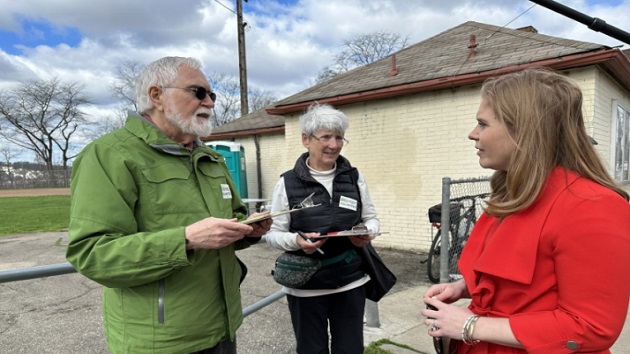
In battleground states across the country, environmental activists like Dr. Emily Church are canvassing on behalf of an organization called the Environmental Voter Project in an effort to turn out people who care the most about climate change — but who haven’t shown up for past elections.

During a recent effort in Pittsburgh, Church, a biology professor who leads local canvasses for the project, recalled to ABC News how she used to lobby lawmakers directly to take action on climate change, but they told her voters don’t care about the issue.

She said she’s now trying to prove them wrong.

“The people who prioritize climate and the environment need to show up,” Church said. “That’s how we’re going to get anything done.”

The Environmental Voter Project, or EVP, is targeting very specific individuals: registered voters who list climate change as their No. 1 issue but who are unlikely to cast ballots in November’s election based on their voting history.

“Our biggest problem in the climate movement right now [is] we don’t have enough voting power,” EVP founder and executive Nathaniel Stinnett said.

EVP takes a targeted approach to door knocking, Stinnett explained. Using polling, the group first determines which registered voters in a particular area, like Pittsburgh, would rank climate as their top voting issue. They then cross-reference profiles with voting records to find people who have not come out to the polls recently or regularly.

By Stinnett’s accounting, the group has been successful across general elections, primaries and even in local races.

“We’ve sometimes increased turnout by as much as 1.8 percentage points in general elections, 3.6 points in primaries and 5.7 points in local elections,” he said, noting that while 1.8 percentage points might sound small, it could determine an election. Pennsylvania, for example, was only won by President Joe Biden in 2020 by 1.17%.

For the canvassing effort in Pittsburgh, Stinnett said EVP targeted people who didn’t vote in the 2020 election or elections in the years since. He added that they identified 22,135 voters in the city who are highly likely to rank climate as their top priority but unlikely to vote in November.

The group claims nonpartisanship but acknowledges that right now it’s Democrats working on climate change almost exclusively. One of their hopes is to bring more Republicans to the table, too.

“We want to scare the bejesus out of as many politicians as possible, no matter what side of the aisle they’re on, until they think, ‘You know what, the only way I can win elections is if I start recognizing the biggest crisis,'” Stinnett said.

Over time, climate change has become a more salient voting issue. In 2010, only a slim majority of Americans agreed that global warming was occurring, according to polling by the Yale Program on Climate Change Communication. Now, 72% of Americans agree.

But climate is currently not one of the biggest motivators for people this election cycle, surveys have indicated — though climate advocates hope to change the electorate by encouraging turnout of climate-concerned voters.

According to a February poll by the Wall Street Journal, registered voters listed immigration (20%), the economy (14%), abortion (8%) and democracy (8%) as their top issues. Climate change ranked 11th, with 2% of voters choosing it as their top issue.

More broadly, Gallup’s tracking of what Americans say is the country’s most important problem over time shows climate, pollution and the environment at 2% in March, far below economic issues and immigration.

Polling has also shown that in addition to a partisan divide on the issue, a generational shift may be at play.

“Young voters in general tend to be more Democratic, and that is kind of tied up inextricably with their belief that climate is really important,” said Nathaniel Rakich, a senior editor and senior elections analyst at 538. “So if Republicans don’t want to basically be losing this upcoming electorate by large margins for decades to come, they’re going to have to eat into that Democratic support by at least proposing some solutions and addressing climate change.”

Even the Biden administration, which has prioritized fighting climate change, is being pushed by progressives to do more on the issue.

Twenty-one activists with the environmental advocacy group Sunrise Movement were arrested outside of Biden campaign headquarters in Wilmington, Delaware, in February. That group and other advocates have additional demonstrations planned in the run-up to the November election.

“I think there were some missteps by the administration — permitting the Willow project in Alaska was a step backwards. That was unfortunate,” Evergreen Action Executive Director Lena Moffitt said, referring to a large-scale oil drilling initiative backed by Alaska lawmakers and others in the state for its economic value, but which environmentalists criticized as undercutting the White House’s climate goals.

“We know that we need to move away from fossil fuels and, at the same time, the administration is doing a lot to hasten that move away from fossil fuels,” Moffitt said.

The choice for voters in November, on the issue of climate, is stark. President Biden has spoken urgently of the dangers of not slowing climate change and has pushed renewable energy solutions, backed electric vehicle infrastructure and created a new Climate Corps to train and expand the environmental workforce.

Biden last week finalized new protections against oil and gas production for some13 million acres of land in Alaska and, through the Environmental Protection Agency, has imposed aggressive emissions standards for vehicles to cut future greenhouse gases.

Meanwhile, former President Donald Trump, who has long questioned climate science, without evidence, has opposed Biden’s clean energy policies and promised to roll them back — arguing they are a drag on the economy and make the U.S. less competitive and independent.

“The fact is President Biden has done more to address climate change than any president in U.S. history. And there’s a lot more to be done,” Moffitt said. “Scientists have said that we still can avoid the worst of the worst of the climate crisis. But what we do in these next few years is essential to which path we choose.”

Stinnett agreed, telling ABC News that too often Americans have been told to focus on their own individual habits rather than government policy.

“[Politicians say,] ‘Hey, don’t pay attention to that coal-fired power plant back there. Instead, it’s all your fault for having a plastic water bottle in your hand.’ And we bought it. We bought it hook, line and sinker,” he said. “In truth, it is far more of a political and a systemic problem that needs political and systemic solutions.”

In Pittsburgh, Church said that despite the difficulty in getting new, environmentally minded voters to the polls, she thinks the challenge is worth it.

“The science is very clear. So we know what we need to do,” she said, “it’s just a matter of getting it done.”

Copyright © 2024, ABC Audio. All rights reserved.

State law takes US a step closer to popular vote deciding presidential elections

State law takes US a step closer to popular vote deciding presidential elections
ABC News

After much public debate, a Maine law has brought the country closer to having the popular vote determine the winner of national presidential elections — but it’s unlikely that will happen before November or even at all.

Earlier this week, Maine Gov. Janet Mills allowed a bill to become law without her signature that would take effect once the National Popular Vote Interstate Compact is able to gather pledges for at least 270 electoral votes — the number of delegate votes needed to elect a president.

The movement has now gathered pledges from 17 states and Washington, D.C. — accounting for a total of 209 electoral votes.

The movement seeks to change the way a president is chosen, without a constitutional amendment, but experts say it’s unclear what happens when enough states have signed on. It’s unlikely this would happen before the 2024 election.

The National Popular Vote Interstate Compact seeks to guarantee that the candidate who receives the most popular votes in all 50 states and the District of Columbia wins the presidency.

When there are enough states pledging their popular votes to meet the 270 Electoral College vote threshold, all the votes in those states will be added up to a national count that determines the winner of the election. The National Popular Vote Interstate Compact says that will give each vote equal weight regardless of where a voter lives.

Five of the 46 presidents who came into office lost the popular vote, including Donald Trump most recently in 2016. The compact argues that not every vote is equal under the current system.

“Under the current system, a small number of votes in a small number of states regularly decides the Presidency. All-or-nothing payoffs fuel doubt, controversy over real or imagined irregularities, hair-splitting post-election litigation, and unrest,” the compact says on its website.

“In 2020, if 21,461 voters had changed their minds, Joe Biden would have been defeated, despite leading by over 7 million votes nationally.  Each of these 21,461 voters (5,229 in Arizona, 5,890 in Georgia, and 10,342 in Wisconsin) was 329 times more important than the 7 million voters elsewhere,” the compact says.

One expert says that everything that has to do with the Electoral College is controversial these days with a partisan divide on the issue. Many Democrats want to get rid of it, while more Republicans support it.

“If you look at all the presidential elections from 1992 through 2020, Republicans have won the presidential popular vote only once — and that was in 2004 when [George W.] Bush beat John Kerry in the popular vote. In every other election over the last 30 years, Democrats have won the popular vote, but because of the Electoral College, Republicans have gotten the presidency a couple of times despite losing the popular vote,” Darrell West, a Douglas Dillon chair in governmental studies at the Brookings Institute, told ABC News in an interview.

“Republicans feel the Electoral College advantages them now and so they don’t want to get rid of it,” West said.

West said the country currently only has a handful of swing states because of the Electoral College, so candidates spend most of their money on that small number of states.

“If we got rid of the Electoral College, candidates actually would campaign more broadly. They would visit more states because a vote in Illinois is the same as a vote in California,” West said.

Could this work?

Experts say the most direct way to change how presidents are elected is to amend the U.S. Constitution, but there doesn’t currently seem to be a feasible pathway without a consensus between both parties.

“Ultimately, there probably is going to have to be a constitutional amendment to get rid of the Electoral College, but everyone knows that’s not possible now for political reasons. It takes a very large majority in Congress as well as in the states to make any change to the Constitution. So what states are trying to figure out is, ‘Short of a constitutional amendment, are there ways to improve the Electoral College?'” West said.

But it remains unclear what happens when enough states pledge their delegates.

“There’s a lot of deep legal contestation over what happens next. I mean, in my judgment, I think it needs congressional consent,” Derek Muller, a law professor at Notre Dame Law School, told ABC News.

“If Congress fails to do that, I’m sure there will be litigation,” Muller said.

There are other legal questions, such as whether it would violate equal protections if the U.S. were to have different states with different rules for their elections and questions about whether a state has the authority to do this, Muller said.

“There are lots of open, contested questions … where I think the national popular vote, if it does hit 270, will immediately face a series of legal challenges,” Muller said.

West agreed that the legal situation is unclear.

“It’s not obvious what the status would be of these laws. States do have the authority to set election laws. But according to the Constitution, the electors to the Electoral College actually are free to vote the way they want,” West said.

“And so states can pass laws, but there haven’t been a lot of cases testing these provisions. And so it’s not clear how the Supreme Court would rule on this issue,” West added.

Muller said if a state sues another state, that case would go directly before the U.S. Supreme Court.

“It’s really unclear who would bring the challenge or where they would bring it. One of the more interesting wrinkles is that there is the possibility, when you’re dealing with a compact, you file directly in the United States Supreme Court so that could be a place where it goes. But again, I think there’s a lot of possibilities about the litigation strategy if it does hit 270 [pledges],” Muller said.

Has something like this happened before?

About 100 years ago, before the 17th Amendment was passed — which allows for the direct election of senators — states had begun shifting from legislatures choosing members sent by the state to the U.S. Senate to having “preference polls” for the public where they would signal who they wanted to represent the state.

“Some states — I think Oregon was one of the leaders among some others — would institute preference polls for the people for their senators. So they would hold an election that wasn’t binding, but it would just request, ‘Who do you want us to vote for?’ And then you got a sentiment from the people and the legislature could or could not follow that,” Muller said.

Later, those states — including Oregon — began binding themselves to the results of the preference polls, Muller said. He pointed to this as an analogy in which the states were trying to “convert legislative elections into a popular vote, even though there was no formal mechanism to do so.”

Eventually, the Constitution was amended to make Senate seats elected by popular vote.

West argues that the direct election of senators did require the constitutional amendment to go into effect.

“And that was 100 years ago, when the political times were less polarized than what we have today,” West said.

Some states unsuccessfully tried to implement term limits for members of Congress about 20 or 30 years ago, Muller said. The Supreme Court said that was unconstitutional in 1995.

“So Missouri tried something a little more creative, which was to say, ‘OK, we’re going to ask all candidates to take a term-limits pledge, and we’re gonna print if they violated their pledge, we’re gonna put that on the ballot, or if they declined to support the term-limits pledge … we’re gonna print that on the ballot,'” Muller said.

“The goal was to say, ‘Well, we’re not keeping you off the ballot, we’re just telling everyone whether or not you’re adhering to term limits,'” Muller said. “And the Supreme Court said, ‘Well you can’t do that either.'”

Copyright © 2024, ABC Audio. All rights reserved.

House approves $95 billion in aid to Ukraine, Israel and Taiwan

House approves  billion in aid to Ukraine, Israel and Taiwan
House approves $95 billion in aid to Ukraine, Israel and Taiwan
Kent Nishimura/Getty Images

(WASHINGTON) — The House of Representatives on Saturday passed a series of foreign aid bills that include $60.8 billion in aid to Ukraine, $26.38 billion in aid to Israel, $8 billion in aid to the Indo-Pacific region, including Taiwan, and a foreign aid bill that includes a TikTok ban provision.

The four bills will now be sent to the Senate as a package.

An amendment to the TikTok ban provision bill also passed 249-267, which requires the Treasury Department to submit a report on Iranian assets and sanction exemptions.

A bill which provides $8 billion in military aid for the Indo-Pacific region, including Taiwan, passed overwhelmingly in the House by a vote of 385-34-1. Democratic Rep. Rashida Tlaib of Michigan was the only member who voted present.

The House passed the Ukraine foreign aid bill by a vote of 311-112-1.

The House passed the Israel Security Supplemental Appropriations Act by a vote of 366-58.

Democrats briefly waved Ukrainian flags during the vote, an action that prompted House Speaker Mike Johnson to remind them it was a violation for members to wave flags on the floor.

Earlier, a GOP border security bill failed by a vote of 215-199. It was considered under suspension and did not reach a two-thirds majority. This bill was separate from the four foreign aid bills.

After Democrats helped Speaker Mike Johnson avoid defeat and advance the legislation on Friday, lawmakers considered amendments and held debate on Saturday before voting on final passage.

President Joe Biden thanked House members for passing foreign aid package for Ukraine and Israel and said that the package comes at a “critical inflection point” for those nations.

“It comes at a moment of grave urgency, with Israel facing unprecedented attacks from Iran, and Ukraine under continued bombardment from Russia,” Biden said in a statement Saturday.

Biden also pointed to the “desperately needed humanitarian aid to Gaza, Sudan, Haiti” included in the funding. Biden hailed the work of leaders in the House and the bipartisan group of lawmakers who he said “voted to put our national security first,” and called on the Senate to get the package to his desk.

“I urge the Senate to quickly send this package to my desk so that I can sign it into law and we can quickly send weapons and equipment to Ukraine to meet their urgent battlefield needs,” Biden added.

Johnson’s push to get the aid across the finish line has angered some of his conference’s far-right members, causing a growing threat to his speakership.

A third Republican, Rep. Paul Gosar of Arizona, announced Friday he was joining a looming motion to oust Johnson just after the aid bills advanced.

Georgia’s Marjorie Taylor Greene introduced the motion last month, accusing Johnson of “standing with the Democrats” after he worked across the aisle to avoid a government shutdown.

After Johnson unveiled his plan to forge ahead on foreign aid, Rep. Thomas Massie of Kentucky became the second hard-liner to back Greene’s cause. Massie called on Johnson to resign, a suggestion Johnson flatly rejected.

All three lawmakers have expressed frustration on Johnson moving ahead with foreign aid without addressing immigration. Though earlier this year, a bipartisan border deal was produced by a group of senators but was quickly deemed dead on arrival by former President Donald Trump and Johnson.

“Our border cannot be an afterthought,” Gosar said in a statement. “We need a Speaker who puts America first rather than bending to the reckless demands of the warmongers, neo-cons and the military industrial complex making billions from a costly and endless war half a world away.”

Johnson said Friday that the bills are “not the perfect legislation” but are “the best possible product” under the circumstances.

It remains to be seen when, or if, the hard-liners force a vote on the motion to vacate the speaker’s chair. If they do, Democrats would potentially need to step in to save Johnson’s job.

Several Democrats told ABC News Saturday that they’re open to saving Speaker Johnson — if Greene makes good on her threat to call for a vote to oust him — if Minority Leader Hakeem Jeffries gave them the okay, or at minimum didn’t oppose the move.

ABC News White House correspondent MaryAlice Parks asked the administration if President Joe Biden discussed that possibility with Speaker Johnson in their phone call earlier this week.

“We do not get involved when it comes to leadership in, whether it’s the Senate or in the House,” White House press secretary Karine Jean-Pierre responded. “We’re very mindful. That is something that the members, in this case the members in Congress, have to decide on.”

ABC News’ Jay O’Brien contributed to this report.

Copyright © 2024, ABC Audio. All rights reserved.