(NEW YORK) — A bill aimed at furthering restrictions on discussions of “gender identity or sexual orientation” in public schools is progressing in the Alabama legislature, passing the state House on Tuesday.
Current law states that classrooms in kindergarten through the fifth grade “shall not engage in classroom discussion or provide classroom instruction regarding sexual orientation or gender identity in a manner that is not age appropriate or developmentally appropriate for students in accordance with state standards.”
The bill would expand this restriction to eighth grade and prohibit flags symbolizing sexual orientations or gender identities in K-12 schools.
Gender identity, as defined by the Centers for Disease Control and Prevention, is “an individual’s sense of their self as man, woman, transgender, or something else.”
Sexual orientation refers to “a person’s sexual and emotional attraction to another person and the behavior and/or social affiliation that may result from this attraction,” according to the CDC.
State Rep. Mack Butler, the bill’s sponsor, said in a March hearing the bill is a response to “some indoctrination going on.” He said the bill seeks to “purify the schools.”
“It is a component of Marxism where we’re — you know — destroying the family and teaching some of these things,” said Butler. “Let it happen somewhere else other than our schools.”
Critics argue that these restrictions, dubbed “Don’t Say Gay,” could broadly restrict conversation about gender and sexuality –including both non-LGBTQ and LGBTQ identities.
They also argue that the bill violates students’ and teachers’ First Amendment rights, and could silence LGBTQ students and teachers in classrooms.
“If HB130 passes, it will rid classrooms and students in the state of Alabama of inclusive discussion that is essential at all stages of life,” the ACLU of Alabama said in a statement against the legislation.
A similar law in Florida sparked controversy for its restrictions and inspired almost identical policies across the country. However, a settlement was reached in a lawsuit against the legislation.
A judge decided that students and educators can discuss LGBTQ topics or write about such topics in their work, as long as those conversations are not part of formal curriculum, with both sides of the debate claiming the decision as a win.
Speaker of the House Mike Johnson (R-LA) pauses as he speaks during a press conference at Columbia University on April 24, 2024 in New York City. (Michael M. Santiago/Getty Images)
(NEW YORK) — During a visit to Columbia University on Wednesday, Speaker Mike Johnson joined his New York House Republican colleagues in calling on the school’s president, Minouche Shafik, to resign unless she can improve what he called her failure to handle the anti-Israel protests on campus.
In a news conference on the university’s campus, Johnson said Shafik should step down “if she can’t immediately bring order to this chaos.”
“As speaker of the House, I am committing today that the Congress will not be silent as Jewish students are expected to run for their lives and stay home from their classes — fighting in fear,” Johnson said.
The scene at the news conference was rowdy itself, as Johnson and other House Republicans got booed and heckled throughout — sometimes nearly drowned out by shouting from the crowd.
“The cherished traditions of this university are being overtaken right now by radical and extreme ideologies. They place a target on the backs of Jewish students in the United States and here on this campus,” Johnson said.
He said he planned to speak to President Joe Biden, whose administration has also condemned any antisemitic demonstrations, once he departed the campus to “share with him what we have seen with our own two eyes and demand that he take action.”
“There is executive authority that would be appropriate,” Johnson said.
“If this is not contained quickly, and if these threats and intimidation are not stopped — there is an appropriate time for the National Guard. We have to bring order to these campuses. We cannot allow this to happen around the country. We are better than this. We are better than this. And I will ask the president to do that, and I will tell him the very same thing,” Johnson said.
Last week, more than 100 pro-Palestinian protesters were arrested at Columbia as they called for the divestment of college and university funds from Israeli military operations.
Other participants in Columbia’s ongoing, encampment-style protests were suspended and removed from campus.
The demonstrations, which began on April 17, followed Shafik’s testimony to the House Committee on Education and the Workforce about antisemitism on college campuses. New York Rep. Elise Stefanik, a leading conservative, called for Shafik’s resignation days later, writing in a post on X that Columbia “failed to enforce their own campus rules and protect Jewish students on campus.”
Testifying before the congressional committee last week, Shafik said she has taken actions to combat antisemitism on campus since a terror attack on Oct. 7 sparked Israel’s war with Hamas, including enhancing Columbia’s reporting channels, hiring staff to investigate complaints and forming an antisemitism task force.
“Safety is paramount and we would do whatever is necessary to ensure the safety of our campus,” Shafik said. “We must uphold freedom of speech because it’s essential to our academic mission, but we cannot and shouldn’t tolerate abuse of this privilege to harass and discriminate.”
The presidents of Harvard University and the University of Pennsylvania resigned from their positions after testifying about campus culture and antisemitism before the House Committee on Education and the Workforce earlier this year.
Shafik, who met with Johnson on Wednesday, and the rest of the university administration are committed to ensuring the safety of the campus community and ending the encampment, Columbia spokesman Ben Chang said in a briefing with reporters later on Wednesday.
The student encampment on campus has raised serious safety concerns, Chang said.
The university and some of its representatives have been in dialogue with students on ending the encampment and Chang said the university believes those discussions will ultimately be “successful.”
Following the arrests at Columbia, student protests have appeared elsewhere in the U.S., including at Yale University, New York University, Harvard University, the Massachusetts Institute of Technology, Tufts University and across the country — at the University of Texas at Austin and the University of Southern California.
Criticism of Israel in the U.S. and internationally has been mounting as a humanitarian crisis unfolds in Gaza amid Israel’s attempt to destroy Hamas terrorists.
Johnson, who also met with Jewish students at Columbia, said “their bravery is inspiring, much more inspiring than some of the activities we’re seeing here. They should never have to confront such hate on an American college campus instead of such a revered institution.”
His visit comes as the Israel-Hamas war continues to be highly politicized. Johnson earned bipartisan praise for his reversal on a foreign aid package that Biden signed into law Wednesday that included roughly $26 billion for Israel as its war with Hamas rages on in Gaza.
Hamas is thought to still be holding dozens of hostages taken in its October terror attack, which killed 1,200.
More than 34,000 people have died in Gaza since the war began, according to the Hamas-run health ministry there.
The protests on U.S. campuses have been largely peaceful, according to school administrators, with some, including New York police, as well as protesters blaming individuals not affiliated with the schools for instances of violence and offensive or antisemitic rhetoric.
(WASHINGTON) — In the summer of 2019, only hours after an Iranian rocket accidentally exploded at one of Iran’s own launch sites, senior U.S. officials met with then-president Donald Trump and shared a sharply detailed, highly classified image of the blast’s catastrophic aftermath.
The image was captured by a U.S. satellite whose true capabilities were a tightly guarded secret. But Trump wanted to share it with the world — he thought it was especially “sexy” because it was marked classified, one of his former advisers later recalled to special counsel Jack Smith’s investigators, according to sources familiar with the former adviser’s statements.
Worried that the image becoming public could hurt national security efforts, intelligence officials urged Trump to hold off until more knowledgeable experts were able to weigh in, the sources said. But less than an hour later, while at least one of those intelligence officials was in another building scrambling to get more information, Trump posted the image to Twitter.
“It was so upsetting, and people were really angry,” one of Trump’s former advisers told investigators, sources said.
The public pushback to Trump’s post was immediate: Intelligence experts and even international media questioned whether U.S. interests had just been endangered by what Trump did. When pressed about it at the White House, Trump insisted he hadn’t released classified information because he had an “absolute right to do” it.
While much of Smith’s sprawling classified documents investigation has focused on how Trump handled classified materials after leaving the White House, a wide array of former aides and advisers — including personal valets, press assistants, senior national security officials, and even Trump’s briefers from the Office of the Director of National Intelligence — have provided Smith with firsthand accounts about how Trump allegedly handled and used intelligence while still in office.
Those firsthand accounts, as relayed to ABC News by sources, underscore what could be at stake as Trump seeks a return to the White House, and they are coming to light as he is likely on the verge of receiving formal government briefings again as the Republican Party’s official nominee in the 2024 presidential election.
In interviews with investigators last year, former aides and national security officials who were close to Trump in the White House described a president who could erupt in anger when presented with intelligence he didn’t want to hear, who routinely reviewed and stored classified information in unsecured locations, and who had what some former officials described as “a cavalier attitude” toward the damage that could be done by its disclosure, according to sources.
A book published on the CIA’s website, describing the intelligence community’s experience with Trump during his transition to the presidency and then his time in the White House, said that while Trump was “suspicious and insecure about the intelligence process,” he still “engaged with it,” even as he publicly attacked it.
The book also noted that Trump was “unique” among presidents in that, before taking over the White House, “he had no experience handling classified information or working with military, diplomatic, or intelligence programs and operations.”
‘Hand in the woodchipper’
As former officials described meetings with Trump to Smith’s team, Trump only wanted to listen to new information about certain parts of the world, according to sources.
In particular, the sources said, Smith’s team was told that Trump was uninterested in hearing about Latin America or countries that he similarly thought were not essential. The sources said witnesses confirmed previous public reporting that Trump referred to such places as “s—hole countries” and suggested the United States should stop welcoming migrants from them.
Today, on the presidential campaign trail, Trump continues to rail against migrants from Latin American countries and others who reached the southern border through parts of Latin America.
Sources said former officials also told Smith’s team that Trump refused to listen to certain briefings related to Russia, saying Trump “absolutely” didn’t want to hear about Russian influence operations, and he couldn’t be convinced that Russian troops were already operating inside Ukraine — even as his own administration was publicly calling out their routine incursions into the country’s eastern region to support Russian-backed separatists.
On the campaign trail, Trump recently insisted that he would have prevented Russia’s all-out invasion of Ukraine in February 2022 if he were still commander-in-chief.
Family of man killed when Chicago police fired 96 times during traffic stop file wrongful death suit According to the sources, one of Trump’s former advisers joked with Smith’s team last year that bringing up Russia during a meeting with Trump was like “stick[ing] my hand in the woodchipper again.”
In its most recent worldwide assessment, the Office of the Director of National Intelligence concluded that Russia continues to pose a significant threat to U.S. national security and, more broadly, to “rules-based international order.”
As he has done in public, Trump often privately disagreed with conclusions reached by the U.S. intelligence community, especially related to Russia and Ukraine, choosing instead to rely on unverified claims from other people, sources said that Smith’s investigators were told.
And sources said former aides confirmed to Smith’s investigators previous media reports that Trump almost never read the President’s Daily Brief, a report summarizing classified intelligence and analysis on the day’s most pressing issues.
Trump preferred to receive such summaries verbally, according to sources.
Reached for comment, a spokesperson for Trump referred ABC News to a statement by the former president in which he called the classified documents case a “two-tiered system of justice and unconstitutional selective prosecution.”
A spokesperson for the special counsel declined to comment to ABC News.
‘Like a junk drawer’
Throughout Trump’s presidency, many of those who interacted with Trump every day saw him bring classified documents to unsecured locations, raising concerns among some of them, several witnesses told Smith’s team, the sources said.
As early as 2018, the Office of the Staff Secretary, which manages the documents flowing to the Oval Office, began asking personnel in the White House about documents that had gone missing, including some classified ones, one of Trump’s personal valets told investigators, sources said.
And at one point, sources said the valet recalled, he even warned the staff secretary’s office that classified documents were being taken out of secure locations in white boxes and ending up in all sorts of potentially concerning places.
According to the sources, several witnesses told Smith’s team that they routinely saw classified documents or classified folders in Trump’s White House residence, and that Trump would sometimes store as many as 30 boxes in his bedroom, which one valet said Trump treated “like a junk drawer.”
While it’s not clear how many boxes at any given time in Trump’s residence contained documents with classification markings, witnesses said they frequently observed boxes and papers traveling from the Oval Office to his residence that contained classified documents, according to sources familiar with what witnesses have told the special counsel.
“I did not think that he respected what classified information was,” sources quoted one former official as telling investigators.
In Trump’s first year in office, several media reports described how Trump had allegedly exposed sensitive information: In February 2017, he and Japan’s then-prime minister reportedly discussed a response to North Korea’s latest ballistic missile test over dinner in a crowded dining room at Trump’s Mar-a-Lago estate in Florida, and then two months later Trump told the Philippines president on a phone call that the U.S. military had positioned two nuclear submarines near North Korea.
The following month, Trump reportedly shared highly-sensitive intelligence about ISIS with Russian officials visiting the White House.
Some witnesses who spoke with Smith’s team, however, said they were not concerned by what they saw while Trump was president.
Robert O’Brien, who served as Trump’s national security adviser at the end of his presidency, told Smith’s team that Trump “consistently” handled classified information appropriately, sources said.
‘The Hunger Games’
As some former officials described it to Smith’s investigators, discussing the latest intelligence with Trump could be an unpredictable task, sources said.
At times he would become so upset over what senior national security or intelligence officials were telling him that it would derail entire meetings, according to sources familiar with what witnesses told investigators.
In one series of meetings, ahead of an international summit in Europe, Trump met with then-CIA director Gina Haspel, then-Treasury Secretary Steve Mnuchin and others to help plan for the summit. But when Trump was told positive things about one of the people he would likely meet at the summit, Trump “lost it,” insisting that he didn’t care, then he “lost it” again when he was being updated on a tax-related negotiation involving Mnuchin, sources said.
The sources said Trump then pitted one of his top aides against Mnuchin in front of everyone else, escalating the tension so much that it reminded one of those present of the movie “The Hunger Games,” with its dystopian death match broadcast live on national TV.
The book published on the CIA’s website quoted former President Barack Obama’s director of national intelligence, James Clapper, as saying that Trump was prone to “fly off on tangents; there might be eight or nine minutes of real intelligence in an hour’s discussion.”
And while the intelligence community worked with evidence, Trump “was ‘fact-free’ — evidence doesn’t cut it with him,” according to Clapper.
Still, Clapper said Trump could be “courteous, affable, and complimentary” when he engaged with or referred to members of the U.S. intelligence community.
‘People were really angry’
Sources said that, as one former official described it to Smith’s team, Trump’s posting of the image from Iran’s failed rocket launch revealed how the then-president “just didn’t care” about protecting classified information.
In 2021, Yahoo! News described how, during his briefing with intelligence officials, Trump thought the image “was very neat, and asked if he could keep it,” which made some of the intelligence officials nervous, according to an administration official. But that news report didn’t offer the same detailed account provided to Smith by witnesses last year.
Sources told ABC News that while speaking with Smith’s team, former aides and officials said Trump was specifically warned at the time that while he had the authority to declassify the image of Iran’s botched launch, there were also potential risks associated with doing that.
Trump initially agreed to wait while intelligence officials were then consulted, sources said, but the intelligence officials apparently took too long; about an hour later, Trump posted the image online.
“I was so appalled,” one former national security official told Smith’s team, according to the sources.
The former official noted that Trump may have believed it wasn’t a big deal — but only an expert would know if releasing such classified information could reveal “how we got it” it and whether it could “compromise our ability to get [it] in the future,” the former official explained to Smith’s team, according to the sources.
(WASHINGTON) — It was maybe the most memorable moment so far in Donald Trump’s case for “absolute presidential immunity” — and it could come up again at the U.S. Supreme Court in historic arguments on Thursday.
The arresting question: Could a commander in chief order SEAL Team 6 to assassinate a political rival and not face criminal prosecution?
His lawyer suggested he could, under certain circumstances.
The exchange took place at the U.S. Court of Appeals in Washington in January, where Trump took his immunity fight after the theory was flatly rejected by U.S. District Judge Tanya Chutkan, who is overseeing his federal election subversion case.
“I asked you a yes-or-no question,” Judge Florence Pan said during the arguments. “Could a president who ordered SEAL Team 6 to assassinate a political rival [and] who was not impeached, would he be subject to criminal prosecution?”
“If he were impeached and convicted first,” Trump attorney John Sauer responded.
“So your answer is no,” Pan said.
Sauer, attempting to avoid a straight yes or no, said his answer was a “qualified yes” as he maintained a House impeachment and Senate conviction needed to occur before criminal liability can come into play. He also predicted that if a president did order an assassination, he would be “speedily” impeached.
Special counsel attorney James Pearce, arguing for the government, called such a theory “frightening.”
“I mean, what kind of world are we living in?” Pearce argued. “If, as I understood my friend on the other side to say here, a president orders SEAL team to assassinate a political rival and resigned, for example before an impeachment, it’s not a criminal act … I think that is extraordinarily frightening future.”
The three-judge panel went on to strike down Trump’s immunity argument in a unanimous decision, stating they could not accept his assertion that a president has “unbounded authority to commit crimes.” Such a stance, they warned, would “collapse our system of separated powers.”
The former president appealed that ruling to the U.S. Supreme Court.
The fallout from Sauer’s response was swift, and continues to feature predominately in amicus briefs filed to the high court as it weighs the case. When justices hear arguments in the case on Thursday, Sauer will again be representing Trump.
In a filing in support of Trump, a trio of former military leaders said regardless of the question of immunity, a president has no authority to order the military to kill a political rival and even if he did, the military would not carry it out.
But other national security experts, in a brief in support of special counsel Jack Smith, were less certain subordinates would refuse a presidential order.
“The rule of law will be threatened unless federal courts have protection against intimidation by a criminal president in command of Seal Team 6 or any other unit of the U.S. Armed Forces,” the brief read.
The immunity question presents an unprecedented constitutional quandary for the Supreme Court. Trump is the first ever president — current or former — to face criminal charges.
The Supreme Court’s decision will determine whether Trump stands trial before the November election on four felony counts, including conspiracy to defraud the U.S. and conspiracy against rights, for his efforts to overturn his 2020 election loss. Trump has denied any wrongdoing and pleaded not guilty to the counts.
(PHOENIX) — Three Republicans on Wednesday joined Democrats in the Arizona House to vote to repeal the state’s controversial 1864 ban on nearly all abortions, which was revived by a court ruling earlier this month and which only includes exceptions to save the life of the pregnant woman.
The final vote was 32-28.
The repeal bill, pushed by Democrats, next heads to the state Senate where it could be taken up next week.
The chamber on Wednesday separately conducted a second read of its own abortion ban repeal bill, without objection, setting up a parallel vote — though that is likely moot now because the House bill has been approved.
Two Republican senators have already said they will support the repeal effort, signaling the House bill should pass that chamber and then head to Gov. Katie Hobbs’ desk to be signed into law.
The repeal of the ban would then take effect 90 days after the end of the legislative session, which must be before June 30.
“This is a stain on history that this ban even exists — from a time when the age of consent was 10, from a time when women didn’t have the right to vote,” Arizona state Sen. Eva Burch, a Democrat, told ABC News’ Elizabeth Schulze amid an earlier, failed effort to approve the repeal bill in the state House.
Many Republicans sharply objected on Wednesday to the push to undo the Civil War-era ban that has roiled the politics of the state after the Arizona Supreme Court ruled that it is enforceable.
Leading conservatives like Trump, former Arizona Gov. Doug Ducey and Senate candidate Kari Lake have touted their general support for abortion restrictions but said the 1864 ban goes too far.
“This total ban on abortion that the Arizona Supreme Court has ruled on is out of line with where the people of this state are,” Lake said in a video statement on social media earlier this month.
House Speaker Ben Toma rose to object to the vote on the House floor on Wednesday. The leader has been a vocal opponent of “rushing” any repeal legislation.
GOP Rep. Alexander Kolodin likewise accused the body, including the Republicans joining with Democrats, of moving forward because of political pressures and likened abortion to the killing of “infants.”
“At the end of the day, your politics is important but it is not worth our souls,” he said.
The issue is likely to be put directly before voters in November’s election.
The Arizona for Abortion Access campaign has been working to get a potential constitutional amendment on the state’s ballot to enshrine abortion access. Democrats believe that could boost voter enthusiasm and turnout for their candidates, given how abortion access has succeeded in previous elections since Roe v. Wade’s nationwide protections were overruled in 2022.
Family of man killed when Chicago police fired 96 times during traffic stop file wrongful death suit The campaign has said that they have gathered more than 500,000 signatures — surpassing the necessary threshold, but will continue to gather signatures “until the wheels fall off,” a spokesperson told ABC News.
ABC News’ Oren Oppenheim contributed to this report.
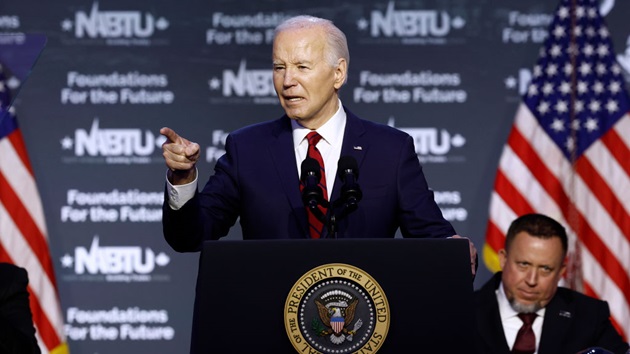
(WASHINGTON) — President Joe Biden on Wednesday needled rival Donald Trump, laying into the former president as he welcomed the North America’s Building Trades Union’s endorsement.
“You’re the best in the world,” Biden said while addressing the NABTU’s legislative conference in Washington, D.C. “You know, you had my back in 2020 and because of you, I’m standing here as president of the United States of America. … Because of you, in 2024 we’re going to make Donald Trump a loser again! Are you ready?”
“So, it’s either Scranton values or Mar-a-Lago values,” Biden went on to say, drawing a contrast between his background and Trump’s as he repeated an economic argument rolled out during campaign stops in Pennsylvania last week. “These are competing visions of the economy at the heart of this election.”
Polling shows that economic issues are top of mind for many voters in what is expected to be a close race, though surveys have found Trump getting more favorable marks than Biden on the economy.
The president doubled down on his differences with Trump later in his speech on Wednesday and said working-class voters are probably familiar with the kind of elites that Biden argued Trump represents.
“Folks, the choice is clear: Donald Trump’s vision of America is one of revenge and retribution, a defeated former president who sees the world from Mar-a-Lago and bows down to billionaires, who looks down on American union workers,” Biden said.
“Think about the guys you grew up with [that] you’d like to get into the corner and just give them a straight left,” Biden said. “I’m not suggesting we hit the president.”
Biden — who has been hammered by Trump and Republicans over high inflation and cost of living issues — said Trump repeatedly promised to focus on so-called infrastructure week when he was president but in four years “he never built a damn thing,” compared with the Biden White House’s successful push for new infrastructure investment.
Biden also slammed his predecessor for Trump’s alleged treatment, as a businessman, of contractors: “He didn’t keep his word.”
“The guy has never worked a day in working man’s boots,” he said of Trump.
Biden also sarcastically took shots at Trump’s history of outlandish comments — reversing a frequent attack from Trump on Biden’s own well-known habit of verbal gaffes and misstatements.
“Donald Trump still thinks windmills cause cancer,” Biden said to laughter as he made the sign of the cross. “That’s what he said. And by the way, remember when he was trying to deal with COVID, he suggested just inject a little bleach in your veins? He missed it — it all went to his hair. Look, I shouldn’t have said that.”
In the audience, many members wore T-shirts that read “Joe walks the line,” with a depiction of the president wearing his signature aviator sunglasses.
NABTU President Sean McGarvey praised Biden in a statement on Wednesday announcing the union’s endorsement, which adds to the list of labor groups backing Biden.
NABTU also endorsed Biden over Trump in the 2020 election. Trump has been supported by some other high-profile unions, including those representing Border Patrol agents and police.
Family of man killed when Chicago police fired 96 times during traffic stop file wrongful death suit “Joe Biden has proven to be the perfect leader at the perfect time for this country and the working men and women who have built it,” McGarvey said in his statement.
He said NABTU, a coalition of unions that boasts 3 million members, plans to mobilize its members to vote for Biden in the fall.
(NEW YORK) — Former President Donald Trump, his former chief of staff Mark Meadows, and Rudy Giuliani are unindicted co-conspirators in the Michigan attorney general’s case against the state’s so-called “fake electors” in the 2020 election, a state investigator revealed in court on Wednesday.
Michigan Attorney General Dana Nessel charged 16 Republicans last year with forgery and conspiracy to commit election forgery for allegedly attempting to replace Michigan’s electoral votes for Joe Biden with electoral votes for Trump at the certification of the vote on Jan. 6, 2021.
During Wednesday’s hearing, which was part of preliminary examinations for the so-called fake electors, Howard Shock, a special agent for the attorney general’s office, also testified that former Trump attorney Jenna Ellis is also an unindicted co-conspirator.
Shock’s revelation was in response to questions from Duane Silverthorn, an attorney for Michele Lundgren, one of the so-called fake electors.
“Finally, former President Donald Trump?” asked Silverthorn.
“Yes,” Shock testified.
Nessel dismissed the charges against one of the alleged fake electors in October in exchange for cooperating with the case. The state is still pursuing charges against the other 15 defendants.
(WASHINGTON) — President Joe Biden said on Wednesday the U.S. will begin sending military equipment to Ukraine within “a few hours.”
Biden, in remarks from the White House, announced he signed the $95 billion foreign aid package that passed the House and Senate with bipartisan support.
“It was a difficult path [to my desk] and should have been easier and it should have gotten there sooner,” Biden said of the legislation, which was first requested by the administration and seemed all but dead due to GOP-led opposition in the House before the sudden reversal of Speaker Mike Johnson.
“But in the end, we did what America always does: we rose to the moment, came together and we got it done,” he continued. “Now, we need to move fast and we are.”
The package will provide roughly $61 billion for Ukraine in its fight against Russian invaders, marking the first time in over a year Congress has approved new aid for the war-torn ally.
In anticipation of the legislation passing, the Biden administration worked up a roughly $1 billion military assistance package for Ukraine with the first shipment arriving within days of approval, a U.S. official told ABC News on Tuesday.
The package will include artillery rounds, air defense ammunition and armored vehicles, according to the official. The weapons and equipment will be drawn from existing U.S. stockpiles under presidential drawdown authority (PDA).
Ukrainian President Volodymyr Zelenskyy thanked Congress for the approval of the “vital aid,” and emphasized how urgent the issue is.
“The key now is speed,” he wrote in a statement posted to X. “The speed of implementing agreements with partners on the supply of weapons for our warriors. The speed of eliminating all Russian schemes to circumvent sanctions. The speed of finding political solutions to protect lives from Russian terror. Every leader who does not waste time is a life saver.”
The legislation also includes $26 billion for Israel, currently at war with Hamas in Gaza, and $8 billion for allies in the Indo-Pacific. Plus, it includes sanctions on Russia, China and Iran as well as a provision to seize Russian assets to assist Ukraine in rebuilding after the war.
Also tucked into the package is a measure to force a U.S. ban of TikTok if its Chinese parent company doesn’t divest from the app within a year, though the company is likely to sue to try to block the law.
This is a developing story. Please check back for updates.
Former president Donald Trump speaks to the press during his trial at Manhattan Criminal Court in New York City, Apr. 22, 2024. (Angela Weiss/POOL/AFP via Getty Images)
(WASHINGTON) — Against the backdrop of a divisive 2024 presidential campaign, the U.S. Supreme Court on Thursday will take up the monumental question of whether a former president turned presumptive GOP nominee can be criminally prosecuted for his efforts to stay in power after the last election.
The case, Donald J. Trump v. United States, presents an unprecedented constitutional quandary for the court brought about by equally unprecedented actions by former President Donald Trump in the aftermath of the 2020 presidential election, which he lost to Joe Biden by a margin of seven million popular votes.
The outcome could determine whether Trump faces a federal trial this year on four felony counts pressed by special counsel Jack Smith, including conspiracy to defraud the U.S. and obstruction of an official proceeding, for his attempts to overturn the electoral vote count certifying Biden’s victory.
Trump, who has pleaded not guilty, is seeking to quash the case on the claim that as a former president he enjoys “absolute immunity” from criminal prosecution for any “official acts” during his tenure. He is the first American president — current or former — to ever face criminal charges.
“The President cannot function, and the Presidency itself cannot retain its vital independence, if the President faces criminal prosecution for official acts once he leaves office,” Trump’s attorneys wrote in their opening brief to the high court.
“Denial of criminal immunity would incapacitate every future President with de facto blackmail and extortion while in office, and condemn him to years of post-office trauma at the hands of political opponents,” they argued.
Two courts have resoundingly rejected the former president’s immunity arguments, including a unanimous three-judge panel of the U.S. Court of Appeals for the District of Columbia.
“Former President Trump has become citizen Trump, with all of the defenses of any other criminal defendant,” the panel wrote. “Former President Trump lacked any lawful discretionary authority to defy federal criminal law and he is answerable in court for his conduct.”
The appeals court warned that if Trump’s constitutional theory were accepted, it would “collapse our system of separated powers” by putting a president above the law.
Smith, the special counsel, argues in his brief to the high court that Trump’s assertion lacks any historical precedent and undermines the founders’ vision of a presidency restrained in power.
“The effective functioning of the presidency does not require that a former president be immune from accountability for these alleged violations of federal criminal law,” he wrote the justices. “To the contrary, a bedrock principle of our constitutional order is that no person is above the law — including the President.”
A trial date in Smith’s federal election case against Trump was initially set for March 4 in U.S. District Court but was delayed awaiting a final decision by the Supreme Court. A ruling on the immunity claim is expected before July, as soon as mid-May.
The justices could uphold the appeals court decision in its entirety, clearing the way for a trial this summer, or they could take a middle-road approach, spelling out what actions qualify for immunity and which do not, sending the case back to lower courts for further proceedings. Such an outcome could rule out a trial before the November election.
Most legal analysts say it’s highly unlikely the Supreme Court — with its conservative majority and three Trump appointees — will endorse Trump’s sweeping assertion of “absolute immunity.” In a 2020 decision, the same court rejected a similar immunity claim by Trump in his attempt to reject a grand jury subpoena for his tax returns.
A majority of Americans (51%) think the federal indictment of Trump related to Jan. 6 and his efforts to overturn the 2020 election is very serious, according to an ABC News/Ipsos poll from late last year.
Just over half of respondents — 52% — think Trump should have been charged with a crime in this case, while 32% said he should not have been. At the same time, 46% think the charges against Trump are politically motivated, while 40% do not, per the poll conducted using Ipsos’ KnowledgePanel.
Trump’s legal team has argued that the impeachment process is the only check on a president’s conduct allowed by the Constitution, even as they concede that a president who is impeached, convicted and removed from office could subsequently face criminal prosecution for the same acts.
Trump was impeached by the House in 2021 over his efforts to overturn results of the 2020 election but later acquitted by the Senate after he had left office. The former president argues that his actions were part of a legally legitimate effort to ensure election integrity.
Smith insists former presidents have never been immune from prosecution and have always been aware of the potential for prosecution. He cites in court briefs the case of former President Richard Nixon accepting a pardon from President Gerald Ford as evidence that Nixon believed prosecution was possible after he had resigned.
While Supreme Court precedent has limited civil litigation against presidents, the special counsel contends criminal matters are different — and that there are layers of legal safeguards in the system to prevent partisan harassment and protect due process.
“Even if liability could not be premised on official acts,” Smith wrote the justices in his brief, “the case should be remanded for trial, with the district court to make evidentiary and instructional rulings in accordance with this Court’s decision. Petitioner [Trump] could seek appellate review of those rulings, if necessary, following final judgment.”
After oral arguments on Thursday, the justices will vote during their weekly private conference and begin drafting opinions. They are expected to be released before the court’s term ends in June.
(WASHINGTON) — The U.S. Supreme Court on Wednesday, for the first time since overruling Roe v. Wade, will consider the scope of a state abortion ban and whether a federal law governing emergency care protects access to abortion at hospitals when a woman’s health is at risk.
Idaho’s Defense of Life Act, which took effect in August 2022, prohibits nearly all abortions, with exceptions for reported cases of rape or incest or when “necessary to prevent the death of the pregnant woman.”
The Biden administration sued the state, claiming its law conflicts with the Emergency Medical Treatment and Labor Act (EMTALA) of 1986, which requires emergency room physicians at hospitals that receive Medicare funds to offer “stabilizing treatment” to all patients whose health is in jeopardy.
The justices will decide whether EMTALA, which does not specifically address abortion, preempts Idaho’s abortion ban and similar measures in 20 other states, protecting a doctor’s ability to terminate a pregnancy in an emergency situation if care requires it.
The administration argues the federal law explicitly makes clear that state laws are overridden to the extent they “directly conflict with a requirement” of EMTALA.
“EMTALA requires us as physicians to act in an emergency to preserve health – even the health of an organ system, like the reproductive system, as one example,” said Dr. Jim Souza, chief physician executive at Idaho’s St. Luke’s Health System. “Idaho’s law only allows action to save life, not preserve health.”
Idaho contends that Congress enacted EMTALA solely to prevent hospitals from turning away indigent patients or otherwise discriminating against patients on the basis of their condition or status.
“EMTALA leaves the question of specific treatments for stabilizing care to state law,” Idaho told the Court in its brief. “Indeed, EMTALA treats medical emergencies faced by the unborn child of a pregnant woman no differently than emergencies faced by the mother herself.”
The state also argues that the Supreme Court’s 2022 decision in Dobbs v. Jackson Women’s Health — overturning constitutional protection for abortion — explicitly returned the issue to the states. It accuses the administration of trying to “reimpose a federal abortion requirement.”
“The purpose of the law is to protect the life of mothers and their unborn children,” said Dr. Ingrid Skop, a Texas-based OBGYN and vice president of the Charlotte Lozier Institute, an anti-abortion group. “All states allow doctors to use reasonable and good faith judgment on when to intervene. Abortion is rare, if ever, necessary” in an emergency.
The stakes in the case are significant.
“If the Court sides with Biden, it would be incredibly troubling and a sweeping precedent for them to set,” said Katie Daniel, state policy director for SBA Pro-Life America.
Major American medical organizations have warned that state abortion bans without exceptions for a pregnant woman’s health could lead some women to experience lasting harm.
“Before the law, we practiced medicine to preserve the mom’s health and future reproductive capability. Since then, there’s been a lot of second-guessing and hand wringing,” said Souza, “Is she sick enough? Is she bleeding enough? Is she septic enough for me to do an abortion and not go to jail or lose my license?”
Hospital groups have reported increased difficulty hiring OBGYNs and emergency room physicians in states like Idaho because of potential liability from strict abortion laws with few exceptions.
“This case could radically alter how emergency medicine is practiced in this country,” said Alexa Kolbi-Molinas, an ACLU attorney supportive of abortion rights.
“For nearly 40 years, EMTALA has required every hospital with an emergency department that takes Medicaid funds to provide stabilizing treatment to any individual who needs it regardless of where they live,” she said. “No state law can force hospitals to provide a lesser standard of care. But now the court is deciding whether states can override that.”