(WASHINGTON) — Tributes are pouring in for former President Jimmy Carter, who died Sunday at the age of 100. His life and legacy will be celebrated in Washington, D.C., Atlanta and in Carter’s hometown of Plains, Georgia, over the coming days.
Atlanta Journal-Constitution reporter Ernie Suggs covered Carter and the work of the Carter Center — which Jimmy Carter and his wife Rosalynn Carter founded after his defeat in the 1980 election — in advancing human rights and alleviating human suffering.
On Monday, ABC News’ Stephanie Ramos spoke to Suggs about the former president’s work, his character and his relationship with the people of Georgia.
ABC NEWS: Now we want to turn to someone who knew Carter well. Atlanta Journal-Constitution reporter Ernie Suggs covered Carter and developed a close personal relationship with the former president. Sir, thank you so much for speaking with us as we bid farewell today. What are some of your personal memories that you’re remembering the most?
SUGGS: Well, thank you for having me, for one. Personally, he was the person that I have always looked up to. I always told a story about, in 1976, my mother voted for Jimmy Carter. She campaigned for him in Brooklyn, New York. And we voted in PS 241 in Brooklyn, New York. And I always told him that story.
So one of the last times we talked, I didn’t mention it, you know. For some reason, I just didn’t mention it, I don’t know what we were talking about. And he mentioned it. He said “How’s your mother doing? How’s she doing?” And I said — at the time my mother wasn’t doing too well — “She’s sick.” She had been battling dementia.
And he told me about, you know, he reiterated the work that Rosalynn Carter was doing with mental health. And he asked me if my mother could talk on the phone. And I said, sure, you know, she could talk. And he called my mother and he called my mother out of the blue to talk to her, just to kind of give her some words of encouragement as she was dealing with this illness and an illness that eventually his wife Rosalynn had.
So I think that’s the kind of example of a person who’s compassionate, who loves humanity, who loves people. And I tell that story as if it’s unique, but it’s not because he has done that kind of work and he’s done those kind of things for so many people, for so many, for 100 years. And for that I’m proud.
ABC NEWS: Absolutely. Such a wonderful example of what type of man he was and what type of life he led. You touched on this a bit, that in the decades after he left office, Jimmy Carter continued to carry so much influence around the world and he continued to do so much work.
As you covered him in those years, what else stood out to you from that work that he was able to do over, over really decades?
SUGGS: One of the things that he said he wanted to see before he died was the eradication of the Guinea worm disease. And that disease is down to about four people now. And when he started this, thousands of people were suffering from this horrible disease. Now it’s down to four, about four people. So it’s going to be eradicated in a couple of years. So this is the kind of work that Jimmy Carter did post-presidency.
The first line of his obituary that I wrote says that he was the 39th president of the United States. I’m sure that’s the first line that you wrote in your obituary. But I think that if you ask him, his most enduring legacy is what he did after the presidency and what he continued to do up until his 100th birthday to kind of promote humanity and to promote decency and to give to others.
ABC NEWS: And on that list of achievements, and you’ve written about some of those achievements, you’ve written that Carter grew up or grew into a politician who shaped race relations, but before that, he was shaped by, by then growing up in the Jim Crow South.
So how do you think those early experiences shaped his worldview and his approach to others throughout his life?
SUGGS: I think that had a tremendous effect. He was born in 1924. We have to understand that. So he was born prior to the Great Depression. He was born in the segregated South.
One perfect example was in 1954 when he left the Navy to return to Plains to take over his father’s business. He was the only white businessman in Plains, Georgia, who was not a member of the Citizens’ Council. We know what the Citizens’ Council is — it’s basically the Ku Klux Klan.
They came to his store and said, “Hey, we’re going to boycott you unless you join the Citizens’ Council. We will even pay your $5.” And he said, “I’d rather throw my $5 down the toilet then give you $5 to join this racist organization.”
So even in 1954, even owning a business in that rural, tiny Plains, Georgia, he rebuked the temptation to join basically the klan or the Citizens’ Council because of who he was and how he grew up and the people who was around him when he grew up.
ABC NEWS: And after a hundred years, we’re hearing so many stories, so many new stories in the last 24 hours about his life — that’s a story I hadn’t heard before. So thank you for sharing that. Since news of his passing last night, you’ve been speaking with people in Plains, Georgia, where Jimmy Carter is from and in other parts of Georgia. What are you hearing from them? What are they sharing with you?
SUGGS: People in Plains, Georgia, if you come by this town, they love him. If you go to anyone’s house in Plains, Georgia, they have a story about Jimmy Carter or “Mr. Jimmy,” as they called him.
Everyone’s house you go to has a photograph of Jimmy Carter, and it’s not a photograph of him from the White House or it’s not a standard portrait. It’s a photograph that they’ve taken with their Polaroid cameras or their selfies of him on their porch, eating peanuts and laughing and joking around, shucking corn.
So that’s who he was. He was Mr. Jimmy. He was truly a man of the people, who happened to one day have served as the 39th president of the United States.
ABC NEWS: He really was a man of the people. What a remarkable life and what an impact Jimmy Carter had on this country and those who had the pleasure of meeting him and knowing him. Ernie Suggs, thank you so much for speaking with us today. Thank you so much for your insights.
(WASHINGTON) — Special counsel Jack Smith’s team has withdrawn from their appeal of the classified documents case against President-elect Donald Trump’s co-defendants and referred the case to the United States Attorney’s Office for the Southern District of Florida, according to a court filing Monday afternoon.
Smith last month dropped his appeal against Trump due to a longstanding Department of Justice policy prohibiting the prosecution of a sitting president, but his team continued to pursue their appeal against Trump’s two co-defendants in the case, longtime Trump aide Walt Nauta and Mar-a-Lago employee Carlos De Oliveira.
Trump pleaded not guilty last June to 37 criminal counts related to his handling of classified materials, after prosecutors said he repeatedly refused to return hundreds of documents containing classified information ranging from U.S. nuclear secrets to the nation’s defense capabilities, and took steps to thwart the government’s efforts to get the documents back.
The former president, along with Nauta and De Oliveira, also pleaded not guilty to allegedly attempting to delete surveillance footage at Trump’s Mar-a-Lago estate.
Smith’s appeal, to the Atlanta-based Eleventh Circuit Court of Appeals, came after U.S. District Judge Aileen Cannon dismissed Smith’s case in July, citing the constitutionality of his appointment as special counsel.
With the appeal ongoing, Smith’s team on Monday withdrew from the case and passed the case to federal prosecutors in Florida. In a separate filing, U.S. Attorney for the Southern District of Florida, Markenzy Lapointe, entered his appearance in the case.
A representative for the office of the U.S. Attorney for the Southern District of Florida did not immediately respond to a request for comment from ABC News.
Smith has also been winding down his federal election interference case against Trump following Trump’s reelection, and is expected to issue a report on his investigations to Attorney General Merrick Garland in the coming weeks.
(WASHINGTON) — President-elect Donald Trump on Monday threw his support behind Speaker Mike Johnson amid a fight over the House gavel that will culminate in a vote at the end of the week.
“Speaker Mike Johnson is a good, hard working, religious man,” Trump wrote at the end of a lengthy social media post. “He will do the right thing, and we will continue to WIN. Mike has my Complete & Total Endorsement.”
In the same post, Trump boasted about his successful 2024 White House run, praising Republicans for running a “legendary” campaign while railing against President Joe Biden and Vice President Kamala Harris.
He urged Republicans to “not blow” an opportunity for a “relief” from the outgoing administration — calling for Republicans to support Johnson.
Johnson, who faced pushback from members of his own party over his leadership during the recent government shutdown fight, thanked Trump for his endorsement.
“I’m honored and humbled by your support, as always,” Johnson wrote on X. “Together, we will quickly deliver on your America First agenda and usher in the new golden age of America. The American people demand and deserve that we waste no time. Let’s get to work.”
This is a developing story. Please check back for updates.
(WASHINGTON) — The funeral for former President Jimmy Carter, who died on Sunday at the age of 100, will be held on Jan. 9 at Washington National Cathedral.
Carter, the son of a peanut farmer who was elected the nation’s 39th president, passed away surrounded by family at his home in Plains, Georgia, just months after he became the longest-lived former chief executive in U.S. history.
President Joe Biden, who praised Carter as a “man of principle, faith, and humility,” has also marked Jan. 9 as a National Day of Mourning for the former Democratic president.
Biden said in March 2023 that Carter had asked him to deliver his eulogy. Their relationship spans decades, back to when Biden endorsed Carter for the presidency during Biden’s first term as a senator in 1976.
In remarks on Sunday evening, Biden spoke about Carter’s support for him and his family after his son Beau died of cancer. Carter was later diagnosed with metastatic melanoma.
“I think that what Jimmy Carter is an example of is just simple decency, simple decency,” Biden said as he reflected on that time in his life. “And I think that’s what the rest of the world looks to America for.”
Washington National Cathedral, situated just miles north of the White House, has been the site of several state funerals for former presidents, including Dwight Eisenhower, Ronald Reagan, Gerald Ford and George H. W. Bush.
Carter is expected to be buried in Georgia next to his wife of 77 years, Rosalynn Carter, who died last year at the age of 96. Carter, who had been in hospice care, made a rare public appearance to attend his wife’s memorial service.
The couple previously spoke about being laid to rest together at their family residence, near the edge of a pond on the property where they fished together.
This is a developing story. Please check back for updates.
Hum Images/Universal Images Group via Getty Images
(WASHINGTON) — Jimmy Carter, the former U.S. president known as a champion of international human rights both during and after his White House tenure and who won the Nobel Peace Prize in 2002 for his lifetime of dedication to that cause, has died at 100, ABC News has learned.
Carter’s death was also announced by the Carter Center on X, which posted “Our founder, former U.S. President Jimmy Carter, passed away this afternoon in Plains, Georgia.”
Carter, whose wife of 77 years, Rosalynn, died on Nov. 19, 2023, at age 96, is survived by the couple’s children — John William (Jack), James Earl III (Chip) and Donnel Jeffrey (Jeff); and their daughter, Amy Lynn.
Carter had endured several health challenges in recent years. In 2019, he underwent surgery after breaking his hip in a fall. Four years earlier, Carter was diagnosed with metastatic melanoma that had spread to his brain, though just months later, he announced that he no longer needed treatment due to a new type of cancer therapy he’d been receiving.
In February of 2023, the Carter Center, the organization founded by the former president to promote human rights worldwide, announced that Carter, with “the full support of his family and his medical team,” would begin receiving hospice care at home.
“After a series of short hospital stays, former U.S. President Jimmy Carter today decided to spend his remaining time at home with his family and receive hospice care instead of additional medical intervention,” the Carter Center said in a statement.
Carter attended the public memorial service for his late wife on Nov. 28, 2023, some nine months after the announcement that he’d entered hospice care. Frail and in a wheelchair, he didn’t speak at the memorial. Instead, his daughter, Amy, spoke on his behalf, reading from a letter Carter sent to Rosalynn some 75 years earlier, when he was away serving in the Navy.
“My darling, every time I have ever been away from you, I have been thrilled when I returned to discover just how wonderful you are,” the letter read, in part. “While I am away, I try to convince myself that you really are not, could not be, as sweet and beautiful as I remember. But when I see you, I fall in love with you all over again.”
Carter turned 100 years old on Oct. 1, 2024, an occasion that was celebrated with events both at the Carter Center in Atlanta, and in Carter’s Plains, Georgia hometown, though Carter himself was by that time too frail to attend them. Just 16 days later, the Carter Center announced that the former president had cast his ballot by mail in the presidential election. Carter’s grandson, Jason, previously told ABC News that his grandfather would vote for Vice President Kamala Harris.
The son of a Georgia peanut farmer, Jimmy Carter first appeared on the national political scene in 1976 with a toothy grin and the simple words that would become his trademark: “My name is Jimmy Carter, and I’m running for president.”
Among his administration’s most notable achievements were the Camp David Accords, which Carter brokered between Israeli Prime Minister Menachem Begin and Egyptian President Anwar Sadat in 1978, and that led to the Egypt-Israel Peace Treaty the following year. Carter’s time in office also saw the first efforts toward developing a U.S. policy for energy independence.
However, the Iran hostage crisis, in which 52 Americans were held hostage in Iran for a total 444 days, beginning Nov. 4, 1979, battered Carter’s 1980 reelection campaign. He won just six states and the District of Columbia, for a total of 49 electoral votes compared to Republican challenger Ronald Reagan’s 489 electoral votes. Reagan also defeated Carter by more than eight million ballots in the popular vote.
Though political pundits of the era predicted he would be remembered as an average, one-term president, it’s often been observed that Carter’s reputation became more distinguished after he left the White House. He continued to champion international human rights and peace efforts, prompting Time magazine to declare in 1989, just eight years after the end of his presidency, that Carter “may be the best former president America has ever had.”
Carter “redefined the meaning and purpose of the modern ex-presidency,” Time wrote. “While Reagan peddles his time and talents to the highest bidder and Gerald Ford perfects his putt, Carter, like some jazzed superhero, circles the globe at 30,000 feet, seeking opportunities to Do Good.”
Carter was the third U.S. president, following Theodore Roosevelt and Woodrow Wilson, to be awarded the Nobel Peace Prize, which he received in 2002 after creating the Carter Center. Barack Obama became the fourth, in 2009. In selecting Carter for the honor, the Nobel Committee cited “his decades of untiring effort to find peaceful solutions to international conflicts, to advance democracy and human rights, and to promote economic and social development.”
Peanut farmer to politician
James Earl Carter Jr. was born in Plains, Georgia, on Oct. 1, 1924, to James Earl Carter Sr., a peanut farmer and businessman, and Lillian Gordy Carter, a registered nurse who famously became known as ‘Miss Lillian.’ Though he was the first American president born in a hospital, Carter was raised in a farmhouse without indoor plumbing or electricity.
Carter graduated from the Naval Academy in Annapolis, Maryland, in 1946 and after spending seven years as an officer — he volunteered for submarine duty and was honorably discharged in 1953 — he returned to farming. He began his political career in 1962 when he was elected to the first of two terms as a state senator in Georgia. During his tenure, he promised to read every bill that came to a vote, even taking a speed-reading class to keep up.
After an unsuccessful bid for the Democratic gubernatorial primary in 1966, Carter fell into a spiritual crisis, emerging as a born-again Christian. He later recalled this period as one that changed his life dramatically, saying on the campaign trail: “Since then, I’ve had an inner peace and inner conviction and assurance that transformed my life for the better.”
Armed with this renewed energy, Carter launched an aggressive gubernatorial campaign and won the office in 1970.
Carter announced his bid for the presidency in December 1974 as his term as governor of Georgia was ending. A relative unknown, Carter won early victories in the Iowa caucuses and the New Hampshire primary. He became more well-known as he steadily picked up delegates and beat back challenges from Rep. Morris ‘Mo’ Udall and U.S. Sen. Henry M. Jackson to secure the nomination.
The deeply religious candidate caused controversy late in his campaign when he told an interviewer from Playboy magazine, “I’ve looked on a lot of women with lust. I’ve committed adultery in my heart many times.” While there was considerable criticism of that line and some of the other language Carter used in the interview, then-U.S. Rep. Andrew Young, whom Carter later appointed as U.S. ambassador to the United Nations, told The Atlanta Journal-Constitution that Carter had “taken care of his religion problem once and for all.”
In November 1976, Carter defeated President Gerald Ford with 297 electoral votes to Ford’s 241 to become the 39th president.
Energy and economy
From the moment of his inauguration, Carter set a different tone in Washington. He avoided formality, taking the oath of office as ‘Jimmy’ instead of ‘James Earl’ Carter. He and the first lady even walked the mile-and-a-half inaugural parade route to the White House, rather than ride in a limousine.
Once in the Oval Office, Carter continued to bring a common touch to the presidency. He discontinued limousine service for presidential staff and even personally controlled the schedule of the White House tennis courts. As America weathered an energy crisis, Carter ordered his staff to turn the White House thermostats down in the winter and up in the summer, an energy-conscious practice he continued throughout his public career.
Focus on foreign policy
Carter struggled with domestic policies, fighting near-record highs in inflation and unemployment. Among his few victories was the establishment of the Department of Education and the Department of Energy, the latter in response to a continued energy shortage at the time.
Yet, while his domestic policies drew criticism, Carter found widespread success in foreign affairs. His administration attracted worldwide praise for distinguishing itself with a firm commitment to international human rights. Unlike his predecessors, Carter did not hesitate to criticize repressive right-wing regimes, saying in a 1977 commencement speech at Notre Dame, “Because we know that democracy works, we can reject the arguments of those rulers who deny human rights to their people.”
The Iran Hostage Crisis and the end of an administration
The largest stain on Carter’s foreign policy record came in November 1979, when a group of Iranian militants seized the U.S. Embassy in Tehran and took hostage 52 American citizens. The militants demanded the return to Iran of the deposed Shah Mohammad Reza Pahlavi from the U.S., where he was seeking medical attention, to stand trial.
Carter initially responded to the crisis by cutting diplomatic ties with Iran and blocking imports from the country. But when those measures failed, in April 1980, he ordered a secret armed rescue mission. It ended in disaster when several American helicopters malfunctioned and two aircraft collided, killing eight U.S. servicemen.
The hostages were freed Jan. 20, 1980, after 444 days in captivity. Perhaps as a final insult to Carter, Iran released the hostages just minutes after President Ronald Reagan had been sworn in. The new president sent Carter to Germany to greet the hostages.
Post-presidency legacy of public service
It wasn’t until years after he left the White House that many came to appreciate Carter. The former president embarked on a new phase of his career in public service, devoting his days to peacemaking and humanitarian efforts.
“He has made the post-presidency an institution that it had never been before,” said historian and author Steve Hochman, who helped establish the Carter Center. “He has been the most successful, most influential former president in American history.”
Among the organization’s many efforts, the Carter Center helped spearhead a successful campaign to eradicate Guinea worm disease, a debilitating parasitic infection spread by drinking water contaminated with the worm’s larvae. In 1986, the disease affected 3.5 million people per year in 21 African countries, but by 2017, it had been reduced by 99.99%, to just 30 cases, according to the Carter Center.
Carter told ABC News in 2015 that his goal was to eradicate the disease entirely. “I think this is going to be a great achievement for — not for me — but for the people that have been afflicted and for the entire world to see diseases like this eradicated,” Carter said.
Carter also became the highest-profile supporter of Habitat for Humanity, the nonprofit devoted to creating affordable housing. The Carters personally helped to build, renovate and repair 4,390 homes in 14 countries, according to the organization, which also called Carter and wife Rosalynn “two of the world’s most distinguished humanitarians.”
Guided by ‘deep Christian faith’
In addition to his extensive humanitarian work, Carter wrote more than two dozen books after leaving the White House, including “Keeping the Faith: Memoirs of a President” (1982), “An Hour Before Daylight: Memoirs of My Rural Boyhood” (2001), “The Personal Beliefs of Jimmy Carter” (2002), and “Faith: A Journey for All,” (2018). He also wrote poetry collections, as well as a fictional work about the Revolutionary War, titled “The Hornet’s Nest” (2003).
Carter referenced his Christian faith in the opening lines of his presidential inaugural address on Jan. 20, 1977, quoting the biblical Old Testament call “to do justly, and to love mercy, and to walk humbly with thy God.”
Carter’s faith and seemingly limitless energy manifested themselves as he taught at his church’s Sunday school in his Plains, Georgia hometown, where congregants lined up to attend. He was also known for walking the length of every plane on which he traveled – he always flew commercial – to shake hands with every passenger.
Yet behind Carter’s easygoing Southern manner was an iron will and inexhaustible determination. Biographer Douglas Brinkley recalled the 39th president as “a kind of military man” who never seemed to get tired.
“I mean,” Brinkley noted, “the Secret Service nickname for him was ‘Dasher’ because he could move around so much.”
Jimmy Carter’s commitment to the principles that defined his life was, again, expressed in his presidential inaugural address: “Our commitment to human rights must be absolute, our laws fair, our natural beauty preserved,” Carter declared. “The powerful must not persecute the weak, and human dignity must be enhanced.”
ABC News’ Patricio Chile and Christopher Watson contributed to this report.
This is a developing story. Check back for updates.
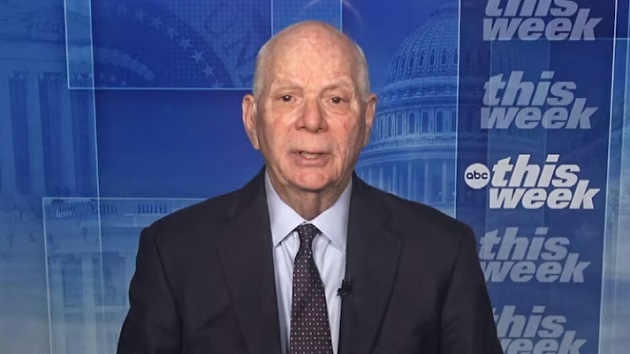
The outgoing chairman of the Senate Foreign Relations Committee said on ABC’s “This Week” that President-elect Donald Trump’s threats to seize the Panama Canal could drive allies of the United States toward Russia and China.
In an interview Sunday with “This Week” co-anchor Jonathan Karl, Sen. Ben Cardin, D-Maryland, said Trump’s recent statements about taking over the Panama Canal, buying Greenland and making Canada the 51st U.S. state, are affecting “America’s credibility globally.”
“Our allies don’t know whether we are reliable partners or not,” said Cardin, who is retiring from the Senate at the end of this term.
Cardin’s comments came after Trump recently criticized as “ridiculous” and “highly unfair” the fees Panama charges American shipping companies to use the vital link between the Atlantic and Pacific oceans. He said the shipping fees were a “complete ripoff of our country” and vowed to put an end to them once he takes office, or he will demand that Panama cede control of the canal to the United States.
“If the principles, both moral and legal, of this magnanimous gesture of giving are not followed, then we will demand that the Panama Canal be returned to the United States of America, in full, quickly and without question,” Trump said during his Dec. 22 speech to supporters at Turning Point USA’s AmericaFest in Arizona. “The United States has a big invested interest in the secure, efficient and reliable operation of the Panama Canal.”
Panama President José Raúl Mulino, who was elected in May, called Trump’s statements an affront to his country’s sovereignty and said the fees for ships crossing the canal are set by experts who take into account operational costs, and supply and demand factors.
“The tariffs are not set on a whim,” Mulino said.
Cardin noted on “This Week” that the obligations of the U.S. and Panama were established by the Panama Canal and Neutrality Treaty of 1977 and ratified by Congress.
“I don’t know what the president-elect is saying in regards to how sincere he is, but I can tell you, it does raise questions globally as to whether we’re a reliable partner,” Cardin said. “And it really feeds into Russia and China appeal to other countries as to whether they need to make alliances with — with Russia and China, whether America will be there for them globally.”
Pressed by Karl on other statements Trump has recently made, including buying Greenland from the Danish government and making Canada the 51st U.S. state — even mocking Canadian Prime Minister Justin Trudeau as “Governor” — Cardin said such talk is not helpful.
“Globally, we saw the same type of statements made during his previous administration, when he threatened to pull out of NATO,” Cardin said of Trump. “These are treaty obligations which our allies rely upon, and it raises serious concerns about whether America will be there for them.”
Asked by Karl about Ukraine’s future during a second Trump administration, Cardin said that while there continues to be bipartisan support in Congress, he described Trump’s comments on Ukraine as “very disturbing.”
Trump recently suggested that he may reverse President Joe Biden’s decision to allow Ukrainian forces to use American long-range weapons to strike deeper into Russian territory, calling the decision “stupid.”
Cardin said Ukraine is the “front line of defense for democracy.”
“We know that Russia will not stop with Ukraine. We know many other countries feel at risk if Ukraine is not able to defend its sovereignty… I know some of the president-elect’s comments are very disturbing. I’ve talked to the Ukrainians. I’ve talked to the Europeans several times, I think they question whether America’s resolve will be there,” he said. “I can tell you we have bipartisan support in the United States Congress to stand with Ukraine because we recognize the importance to our national security.”
Republican Rep. Mike Lawler argued Sunday that Rep. Mike Johnson should be reelected as speaker of the House despite Republican infighting on whether he should keep the position after how he handled a spending bill that prevented a government shutdown last week.
“Mike Johnson inherited a disaster when [former Rep.] Matt Gaetz and several of my colleagues teamed up with 208 Democrats to remove Kevin McCarthy, which will go down as the single stupidest thing I’ve ever seen in politics,” the New York lawmaker told ABC’s “This Week” co-anchor Jonathan Karl.
“With that said, removing Mike Johnson would equally be as stupid. The fact is that these folks are playing with fire, and if they think they’re somehow going to get a more conservative speaker, they’re kidding themselves,” he said, pointing out that Johnson was successful in keeping a Republican majority in the House.
Republicans are expected to hold 219 seats when the new Congress convenes on Friday. Electing the speaker of the House will be the first order of business, and the House cannot move on to other business until that happens. If all Democrats are present and vote against Johnson, the Louisiana Republican can only afford to lose one Republican vote. One Republican, Rep. Thomas Massie, has already said he will not support Johnson while other GOP hardliners have yet to commit to backing him.
“I’m not going to bend to their will,” Lawler said of his hardline colleagues. “So if they think somehow that they are going to end up in a stronger position by removing Mike Johnson, they’re not.”
Republicans have also been feuding over H-1B work visas, which allow highly skilled foreign workers into the Unites States to fill specialty occupations.
Trump’s “Department of Government Efficiency” leaders, Elon Musk and Vivek Ramaswamy, support increasing the amount of the visas awarded annually, arguing they will bring more talent into the country. But other Trump supporters say those job opportunities should be for Americans.
In a post on X this week, Musk said “OF COURSE my companies and I would prefer to hire Americans and we DO, as that is MUCH easier than going through the incredibly painful and slow work visa process. HOWEVER, there is a dire shortage of extremely talented and motivated engineers in America.”
Ramaswamy criticized the American workforce, writing on X that “American culture has venerated mediocrity over excellence for way too long (at least since the 90s and likely longer). That doesn’t start in college, it starts YOUNG.”
After Musk went after critics of his position in a series of X posts, writing at one point, “I will go to war on this issue the likes of which you cannot possibly comprehend,” former Trump adviser Steve Bannon called him a “toddler.”
Lawler voiced his support for the H-1B program, telling Karl that it is critical to the economy.
“As President Trump said, it’s a program he’s used over the years for his businesses, and it’s something that has obviously been beneficial to our economy,” he said. “The United States has been built on immigration and it is vital to the continued growth within our economy.”
Pressed by Karl about why some Trump supporters are strongly against the visas, Lawler expressed his desire for Americans to fill needed jobs, “but the fact is, India is producing a significant number more of engineers than we are. So it’s both a function of fixing our education system and having a legal immigration system that works.”
“You cannot have no immigration at all. It will cripple the economy long-term,” he said.
(WASHINGTON) — The only man to lead both the FBI and the CIA urged caution to senators who might vote to confirm former Rep. Tulsi Gabbard as director of national intelligence and Kash Patel to lead the FBI, according to a letter sent to senators this week.
“I am deeply concerned about the potential nominations of Mr. Kash Patel to lead the FBI and the inclusion of Former Congresswoman Tulsi Gabbard as DNI in intelligence roles,” William Webster, who led the FBI during the Carter and Reagan administrations and the CIA after that, said in a letter to senators on Thursday.
Webster wrote that Patel’s loyalty to Trump may cause problems.
“Statements such as ‘He’s my intel guy’ and his record of executing the president’s directives suggest a loyalty to individuals rather than the rule of law — a dangerous precedent for an agency tasked with impartial enforcement of justice,” said Webster, who turns 101 in March.
He said that during his tenure at the FBI, he was contacted by the president only twice — once by President Jimmy Carter, who asked him to investigate an issue, and once when President Ronald Reagan had a question about Nancy Reagan’s security.
Webster added that Gabbard’s “profound lack of intelligence experience and the daunting task of overseeing 18 disparate intelligence agencies further highlight the need for seasoned leadership.”
“History has shown us the dangers of compromising this independence. When leaders of these organizations become too closely aligned with political figures, public confidence erodes and our nation’s security is jeopardized,” he wrote. “Every president deserves appointees they trust, but the selection process must prioritize competence and independence to uphold the rule of law.”
The letter was first reported by Politico.
The Trump transition team defended both Patel and Gabbard to Fox News.
“Kash Patel is loyal to the Constitution. He’s worked under Presidents Obama and Trump in key national security roles,” said Alex Pfeiffer, a Trump transition team spokesman.
Alexa Henning, a Trump transition official, also defended Gabbard.
“Lt. Col. Gabbard is an active member of the Army and has served in the military for over two decades and in Congress. As someone who has consumed intelligence at the highest levels, including during wartime, she recognizes the importance of partnerships with allies to ensure close coordination to keep the American people safe,” she told Fox News.
(WASHINGTON) — Elon Musk and Vivek Ramaswamy, the leaders of Trump’s new “Department of Government Efficiency,” have found themselves at odds with some of Trump’s far-right supporters over their support for H-1B visas, which allow foreign skilled professionals to work in America.
The debate was sparked over the Christmas holiday when Laura Loomer, a conservative social media figure who faced criticism when she traveled with President-Elect Donald Trump on some campaign stops, criticized Trump’s appointment of Silicon Valley entrepreneur Sriram Krishnan as his senior policy adviser for artificial intelligence.
Criticizing a post from Krishnan where he advocated the removal of country caps for green cards, Loomer called the appointment “deeply disturbing,” prompting an online battle between the business leaders who say the work visas are essential to employing high-qualified foreign workers and Trump supporters who argued it was a way for business leaders to have cheap labor rather than provide job opportunities for Americans.
Both Ramaswamy and Musk made numerous posts on X claiming H-1B visas are essential because American culture doesn’t prioritize success in science and engineering careers compared to other countries.
“Our American culture has venerated mediocrity over excellence for way too long (at least since the 90s and likely longer). That doesn’t start in college, it starts YOUNG,” Ramaswamy posted on X.
“A culture that celebrates the prom queen over the math olympiad champ, or the jock over the valedictorian, will not produce the best engineers,” he added.
Musk, who has said he once worked in the United States on an H-1B visa, said he has depended on these work visas for the operation of his tech companies and that they are essential due to the number of skilled workers needed to handle the rise of new technologies.
“OF COURSE my companies and I would prefer to hire Americans and we DO, as that is MUCH easier than going through the incredibly painful and slow work visa process,” he posted. “HOWEVER, there is a dire shortage of extremely talented and motivated engineers in America.” Loomer and other far-right conservatives have also argued that the expansions of such programs would go against Trump’s immigration crackdown.
While she and others have accused Musk and Ramaswamy of hindering Trump’s aggressive immigration proposals, the business leaders have argued that any such reforms would not hinder the program’s extensive vetting process.
“Maybe this is a helpful clarification: I am referring to bringing in via legal immigration the top ~0.1% of engineering talent as being essential for America to keep winning,” Musk wrote on X.
“This is like bringing in the Jokic’s or Wemby’s of the world to help your whole team (which is mostly Americans!) win the NBA,” he said, referencing two foreign-born basketball stars.
Now, the business leaders are being accused of using Trump for their own personal gain.
“We are substituting a third world migrant invasion for a third world tech invasion. Same shit,” Loomer posted on X. “Except this invasion won’t be done by rapist foreigners who look and smell like garbage. It will be done by career leftist tech billionaires who hate Trump deep down inside.”
Further showing a divide among conservatives over the issue, former Republican presidential candidate Nikki Haley also weighed in, pushing back on a post from Ramaswamy and arguing American workers should be prioritized over foreigners.
“There is nothing wrong with American workers or American culture,” she said. “All you have to do is look at the border and see how many want what we have. We should be investing and prioritizing in Americans, not foreign workers.”
In June, David Sacks, who will be the president-elect’s AI and crypto czar, interviewed Trump for his “All In” podcast and asked Trump if he would expand H-1B work visas for tech workers after fixing the border — to which Trump said “yes.”
In that same episode, Trump also promised to award all international graduates with green cards, saying, “I want to do, and what I will do, is you graduate from a college, I think you should get, automatically as part of your diploma, a green card to be able to stay in this country. That includes junior colleges, too.”
His campaign later walked back that promise, saying there would be a vetting process.
“He believes, only after such vetting has taken place, we ought to keep the most skilled graduates who can make significant contributions to America,” Karoline Leavitt, incoming White House press secretary, said in a statement to ABC News at the time. “This would only apply to the most thoroughly vetted college graduates who would never undercut American wages or workers.”
ABC News’ Zohreen Shah contributed to this report.
(WASHINGTON) — Marianne Williamson, spiritual leader and author who ran two longshot Democratic presidential campaigns in 2020 and 2024, is running for chair of the Democratic National Committee, framing her run as a way to reimagine the Democratic Party as the party regroups and takes stock of its losses during the 2024 election cycle.
“I feel that in order for the Democrats to rise like a phoenix on the ashes of our electoral defeat, we need to look at more than just the outer issues, such as data analysis and field organizing and fundraising,” Williamson said. “We need to transform — in a way, we need to reinvent the Democratic Party in order to counter what MAGA is bringing to the table.”
In an accompanying blog post, Williamson stressed Democrats must better understand President-elect Donald Trump’s appeal and strategy to better counter it, adding that she wants to “reinvent the party from the inside out.”
“President Trump has ushered in an age of political theater — a collective adrenaline rush that has enabled him to not only move masses of people into his camp, but also masses of people away from ours. It does not serve us to underestimate the historic nature of what he has achieved,” Williamson wrote. “In fact, it’s important that we recognize the psychological and emotional dimensions of Trump’s appeal. We need to understand it to create the energy to counter it.”
“As Chairwoman, I will work to reinvent the party from the inside out. For if we want a new President in four years, and a new Congress in two, then we must immediately get about the task of creating a new party,” she added later.
Williamson also said that she would have a “a 365-days-of-the-year strategy” to allow Americans to be politically involved yearround and that she wants the party to inspire Americans.
Williamson was unable to generate a groundswell of support in either of her bids for president, although she stayed in the race until the Democratic presidential primaries concluded and she gained some traction with Democrats who wanted to protest the White House on the Israel-Hamas war.
“We have a very frayed bond of affection with millions of Americans particularly working people in the United States. We have to address the problem on that level. On the level of the heart. On the level of the mind,” Williamson told ABC News Live anchor Kyra Phillips on Thursday afternoon. “People aren’t feeling it about Democrats anymore. At least not enough of them to make for the kind of victory we need in ’26 and ’28.”
Williamson needs to get the support of at least 40 DNC members to qualify for the first DNC candidate forum in early January. The DNC plans on hosting four moderated forums before the election.
She joins a handful of other declared candidates for DNC chair, including Wisconsin Democratic Party chair Ben Wikler and Minnesota Democratic-Farmer-Labor Party chair Ken Martin and former Maryland Gov. Martin O’Malley. Jamie Harrison, the current chairman, isn’t running for reelection.
DNC leadership elections will be held at National Harbor outside Washington on Feb. 1.