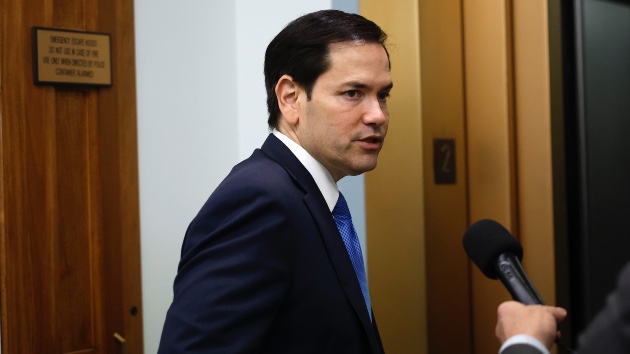
(WASHINGTON) — Florida Republican Sen. Marco Rubio is no stranger to grilling nominees during confirmation hearings, but on Wednesday he is the one in the hot seat as President-elect Donald Trump’s pick to be the top U.S. diplomat moves forward.
Rubio is appearing before the Senate Foreign Relations Committee on which he’s served since 2011 and is expected to sail through the confirmation process with bipartisan backing, potentially becoming the 72nd secretary of state as soon as Inauguration Day.
But that doesn’t mean his testimony and questioning before his colleagues in the Senate won’t produce any fireworks.
Here’s what to watch for:
New territory
Rubio’s well-documented public record, along with support from colleagues on both sides of the aisle, may clear the way for lawmakers to ask the nominee more targeted questions about the foreign policy of the president he’ll serve under.
Wednesday’s hearing is set to be the first time Rubio faces extensive questioning about Trump’s territorial ambitions — and whether he would work to make them a reality as secretary of state.
“I would imagine he’s going to be deferential to the president-elect,” said Richard Goldberg, a former official at the National Security Council and Senate foreign policy adviser. “These are his policy decisions, these are the president-elect’s statements.”
“[Rubio] will hopefully articulate what the American interest is in all of these places in a circumspect way,” Goldberg, who is also a senior advisor at the Foundation for the Defense of Democracies, added.
On the Panama Canal, Trump has used overblown claims about China’s involvement in its operations to justify his interest in overtaking it — falsely claiming earlier this month that the waterway, which is operated by the Panamanian government, is actually run by Beijing.
But Rubio — a son of Cuban immigrants who has paid close attention to Latin America during his political career — has expressed fact-based concerns about the Chinese Communist Party’s (CCP) influence over the Panama Canal that may resurface during the hearing.
“The Panama Canal is as an important transit route to intercept illicit activities, yet the canal is surrounded by #CCP enterprises,” he tweeted in 2022. “We must continue to make clear that Panama is an important partner & warn against CCP attempts to establish a foothold in our region.”
In early 2024, Rubio also led a bipartisan group of senators in urging the government of Panama to investigate tankers accused of smuggling Iranian through the canal.
“I think he has the experience, the depth of knowledge, and the political expertise to take any question and handle it pretty well,” Goldberg said.
Converging and contrasting views
Rubio — long known as a Russia and China hawk in the Senate — has been accused of dialing back his interventionist foreign policy approach to align with Trump’s positions and may face fresh criticism from opponents who believe he might prioritize serving as a yes man to president over serving the country.
However, on Wednesday he painted a dark picture of the future he says the U.S. is facing if Beijing goes unchecked.
“Virtually everything that matters to us in life will depend on whether China will allow us to have it or not,” he said during the hearing, noting that if the U.S. doesn’t change course on China, “we are going to live in a world where much of what matters to us on a daily basis, from our security to our health, will be dependent on whether the Chinese allow us to have it or not. That’s an unacceptable outcome.”
In the early phase of the Russian invasion of Ukraine, Rubio was a staunch supporter of Kyiv’s war efforts. But over time, as Trump became a more outspoken critic of continuing American aid to Ukraine, Rubio appeared to change his position — eventually calling for a negotiated settlement to end the conflict.
“I think it should be the official position of the United States that this war should be brought to an end,” he said Wednesday. “And the question becomes, what role can we play?”
He added that there is “no way Russia takes all of Ukraine” but said it is “unrealistic” to think Kyiv can fully defeat Moscow, pointing to the dearth of Ukrainian soldiers on the front lines of the fight.
There are still many foreign policy topics where there’s still plenty of distance between Rubio and Trump. While the president-elect is a near-constant critic of NATO, Rubio co-sponsored legislation with Virginia Democratic Sen. Tim Kaine aimed at preventing any commander in chief from exiting the alliance.
“First, let me say that President Trump has appointed an ambassador nominee for NATO, which clearly indicates his role to engage in that,” Rubio responded. “Second is — the law is what it is. So it’s tough to say I’m not in support of a law that I helped to pass.”
But ultimately, Goldberg said, Rubio’s role in the incoming administration will be advising the president on foreign policy matters and then carrying out what Trump decides.
“That’s the job he’s signing up for,” Goldberg said. “Ultimately, this President Trump’s secretary of state — no one else’s.”
In his prepared opening statement, Rubio says, “Ultimately, under President Trump, the top priority of the United States Department of State must be and will be the United States.
“The direction he has given for the conduct of our foreign policy is clear. Every dollar we spend, every program we fund, and every policy we pursue must be justified with the answer to three simple questions: Does it make America safer? Does it make America stronger? Does it make America more prosperous?” he’s expected to say.
The ‘deep State’ Department?
Rubio’s confirmation may also present an opportunity to gain insight into how he intends to lead the State Department’s roughly 77,000 employees — and whether he might attempt to purge its ranks of those he or the president-elect view as political enemies, as incoming national security Adviser Mike Waltz reportedly plans to do at the National Security Council.
In an opinion piece published in The Federalist in April 2024, Rubio said there were many government employees who “do good work, day in and day out, but expressed concern about “others who act as self-appointed “protectors” of institutions against politicians they don’t like.”
“Looking ahead to another Trump administration, it’s clear why liberal elites want to protect the ‘deep state.’ They hate Donald Trump and everything he stands for,” Rubio wrote.
(WASHINGTON) — President-elect Donald Trump’s choice to head the Justice Department — former Florida attorney general Pam Bondi — faces questions before the Senate Judiciary Committee on Wednesday.
Democrats want to ask her about her vow to “prosecute the prosecutors — the bad ones” — referring to special counsel Jack Smith and other DOJ lawyers who investigated Trump.
Durbin raises concerns Bondi’s connections to Trump cases Durbin said he had concerns about Bondi’s work for Trump in his attempts to cast doubt on his 2020 election loss.
“You repeatedly described investigations and prosecutions of Mr. Trump, Trump as a witch hunt, and you have echoed his calls for investigating and prosecuting his political opponents. This flies in the face of evidence,” he said.
Durbin also as said he had concerns about Bondi’s controversial move to not investigate fraud claims against Trump University in 2016 when she was Florida’s attorney general.
“I also have questions whether you will focus on the needs of the American people rather than the wealthy special interests,” he said.
Durbin to challenge Bondi as hearing gets underway
In his prepared opening statement, top committee Democrat Dick Durbin will tell Bondi, “Ms. Bondi, you have many years of experience in law enforcement, including nearly a decade of service as attorney general in one of the largest states in the nation. But I need to know you would tell President Trump ‘No’ if you are faced with a choice between your oath to the Constitution and your loyalty to Mr. Trump.”
Trump says Bondi will end alleged ‘weaponization’ of DOJ
“For too long, the partisan Department of Justice has been weaponized against me and other Republicans – Not anymore,” Trump wrote in his announcement of Bondi for attorney general.
Bondi boosted Trump’s false claims of 2020 election fraud
Pam Bondi has developed a reputation as one of President-elect Donald Trump’s most loyal defenders — a vocal political and legal advocate who represented Trump during his first impeachment, boosted his efforts to sow doubts about his 2020 election loss, and stood by him during his New York criminal trial. Read more about her background here.
Democrats to grill Pam Bondi over loyalty to Trump Bondi – Trump’s pick to head the Justice Department – has vowed, in a 2023 interview on Fox News, to ‘’prosecute the prosecutors – the bad ones’’ who investigated Donald Trump.
Dick Durbin, the ranking Democrat on the Senate Judiciary Committee — whose members will question Florida’s former attorney general – has said ‘’she has echoed the President[-elect]’s calls for prosecuting his political opponents, and she has a troubling history of unflinching loyalty to the President-elect.”
(WASHINGTON) — Florida Republican Sen. Marco Rubio is no stranger to grilling nominees during confirmation hearings, but on Wednesday he’ll be the one in the hot seat as President-elect Donald Trump’s pick to be the top U.S. diplomat moves forward.
Rubio is appearing before the Senate Foreign Relations Committee on which he’s served since 2011 and is expected to sail through the confirmation process with bipartisan backing, potentially becoming the 72nd secretary of state as soon as Inauguration Day.
But that doesn’t mean his testimony and questioning before his colleagues in the Senate won’t produce any fireworks.
Here’s what to watch for:
New territory
Rubio’s well-documented public record, along with support from colleagues on both sides of the aisle, may clear the way for lawmakers to ask the nominee more targeted questions about the foreign policy of the president he’ll serve under.
In recent weeks, Trump has made international waves by refusing to rule out using the U.S. military to fulfill his goals of acquiring Greenland and the Panama Canal and saying he’ll use economic force to make Canada the 51st state.
Wednesday’s hearing is set to be the first time Rubio faces extensive questioning about Trump’s territorial ambitions — and whether he would work to make them a reality as secretary of state.
“I would imagine he’s going to be deferential to the president-elect,” said Richard Goldberg, a former official at the National Security Council and Senate foreign policy adviser. “These are his policy decisions, these are the president-elect’s statements.”
“[Rubio] will hopefully articulate what the American interest is in all of these places in a circumspect way,” Goldberg, who is also a senior advisor at the Foundation for the Defense of Democracies, added.
On the Panama Canal, Trump has used overblown claims about China’s involvement in its operations to justify his interest in overtaking it — falsely claiming earlier this month that the waterway, which is operated by the Panamanian government, is actually run by Beijing.
But Rubio — a son of Cuban immigrants who has paid close attention to Latin America during his political career — has expressed fact-based concerns about the Chinese Communist Party’s (CCP) influence over the Panama Canal that may resurface during the hearing.
“The Panama Canal is as an important transit route to intercept illicit activities, yet the canal is surrounded by #CCP enterprises,” he tweeted in 2022. “We must continue to make clear that Panama is an important partner & warn against CCP attempts to establish a foothold in our region.”
In early 2024, Rubio also led a bipartisan group of senators in urging the government of Panama to investigate tankers accused of smuggling Iranian through the canal.
“I think he has the experience, the depth of knowledge, and the political expertise to take any question and handle it pretty well,” Goldberg said.
Converging and contrasting views
Rubio — long known as a Russia and China hawk in the Senate — has been accused of dialing back his interventionist foreign policy approach to align with Trump’s positions and may face fresh criticism from opponents who believe he might prioritize serving as a yes man to president over serving the country.
In the early phase of the Russian invasion of Ukraine, Rubio was a staunch supporter of Kyiv’s war efforts. But over time, as Trump became a more outspoken critic of continuing American aid to Ukraine, Rubio appeared to change course — eventually calling for a negotiated settlement to end the conflict.
There are still many foreign policy topics where there’s still plenty of distance between Rubio and Trump. While the president-elect is a near-constant critic of NATO, Rubio co-sponsored legislation with Virginia Democratic Sen. Tim Kaine aimed at preventing any commander in chief from exiting the alliance.
But ultimately, Goldberg says, Rubio’s role in the incoming administration will be advising the president on foreign policy matters and then carrying out what Trump decides.
“That’s the job he’s signing up for,” Goldberg said. “Ultimately, this President Trump’s secretary of state — no one else’s.”
In his prepared opening statement, Rubio says, “Ultimately, under President Trump, the top priority of the United States Department of State must be and will be the United States.
“The direction he has given for the conduct of our foreign policy is clear. Every dollar we spend, every program we fund, and every policy we pursue must be justified with the answer to three simple questions: Does it make America safer? Does it make America stronger? Does it make America more prosperous?” he’s expected to say.
The ‘deep State’ Department?
Rubio’s confirmation may also present an opportunity to gain insight into how he intends to lead the State Department’s roughly 77,000 employees — and whether he might attempt to purge its ranks of those he or the president-elect view as political enemies, as incoming national security Adviser Mike Waltz reportedly plans to do at the National Security Council.
In an opinion piece published in The Federalist in April 2024, Rubio said there were many government employees who “do good work, day in and day out, but expressed concern about “others who act as self-appointed “protectors” of institutions against politicians they don’t like.”
“Looking ahead to another Trump administration, it’s clear why liberal elites want to protect the “deep state.” They hate Donald Trump and everything he stands for,” Rubio wrote.
(WASHINGTON) — With online access to pornography and other sexually explicit content easier than ever before, the U.S. Supreme Court on Wednesday will take a fresh look at government efforts to impose new safeguards for children by requiring adult websites to conduct electronic age verification.
The case, brought by an adult entertainment industry trade group and several content creators, challenges a 2023 Texas law that says sites containing more than one-third of “sexual material harmful to minors” must verify that a user is at least 18 years old or face civil penalties up to $10,000 per day.
The law, HB 1181, mandates that adult sites implement a system to check a user’s digital identification or government-issued ID using a “commercially reasonable method.” They are not allowed to retain personal information, but the law offers no other requirements for data security and privacy.
Content platforms like Pornhub, one of the most popular websites in the world, have chosen to stop operating in Texas rather than comply with the law. They argue it violates the First Amendment and unfairly targets the porn industry since search engines and social media apps are exempt.
The case, Free Speech Coalition v. Paxton, pits a growing nationwide effort to strengthen protections for minors online against long-standing constitutional protections for sexual material that have helped bolster the rise of a booming multi-billion dollar business.
“More people watch porn and view porn each year than vote and read the newspaper,” said Lisa Blatt, a veteran Supreme Court litigator with Williams & Connolly LLP. A 2016 study in the Journal of Sexual Medicine found that up to 70% of men and 40% of women have consumed pornography within the past year in the U.S.
American teenagers have reported similar levels of exposure to pornography in a number of studies conducted over the past three years. Public health experts say young people who view sexually explicit content are more likely to start having sex earlier, engage in unsafe sex, and have multiple partners.
Texas is among nineteen states that have recently enacted age-verification requirements for adult content online, according to the Age Verification Providers Association.
The state has said that online age verification should be no more controversial or unconstitutional than the common practice of verifying a customer’s age before the purchase of an adult magazine at a newsstand or purchasing liquor at a bar.
Supreme Court precedent has set a high bar for laws that infringe on individual free speech rights even if they are meant to advance another compelling public interest, such as protecting kids.
Twenty years ago in a remarkably similar case — Ashcroft v. ACLU — the court struck down federal legislation that would have required age verification to view sexually explicit material. The decision instead put the onus on parents and technology companies to utilize less burdensome content-filtering software.
Supporters of the Texas law say those tools have proven ineffective and that evolving technology has changed the constitutional calculus for whether asking porn producers to act as gatekeepers violates the First Amendment.
“It’s time to think again about what is a mechanism that can achieve a legitimate objective of states protecting children from what is increasingly violent and misogynistic pornography online,” said Iain Corby, executive director of the Age Verification Providers Association, an international trade group made up of technology companies. “It’s possible to prove your age entirely on your own cell phone, so no personal data need ever leave the palm of your hand.”
An rapidly evolving industry of third-party age verification services and apps, Corby said, has made the process quick, secure, and free — a far cry from more cumbersome options of two decades ago.
“Because no one disputes that Texas can prevent kids from accessing hardcore pornography, this case is about means, not ends,” the state told the Court in its legal briefing. “And the means Texas has chosen is appropriate.”
Civil liberties groups argue that the constitutionality question remains clear cut.
“The government cannot make it illegal to publish certain sexual content online without verifying the age of users first, and yet that’s exactly what states are now doing,” said Vera Eidelman, an ACLU attorney who focuses on free speech litigation.
Eidelman argues that the Texas law robs adults who want to legally view sexually-explicit material the right to anonymity, and potentially puts their private information at risk of abuse.
“It’s really different to show your ID in person than it is to have to offer up personal identifying information online, creating potential targets for data breaches, hackers potentially creating much more of a record of what you are looking at,” Eidelman said.
She also claims that the Texas law could ensnare a much wider range of websites than those selling pornography, such as those hosting sexual health education resources or R-rated content.
“Young people certainly deserve our protection, but whenever the government is passing a law in the name of protecting kids, I think there are serious questions to be asked about whether what it’s really doing is saying the [content] is bad for everyone,” said Eidelman. “That’s exactly what the First Amendment exists to protect against.”
The court is expected to deliver a decision in the case by the end of June.
(WASHINGTON) — Pam Bondi has developed a reputation as one of President-elect Donald Trump’s most loyal defenders — a vocal political and legal advocate who represented Trump during his first impeachment, boosted his efforts to sow doubts about his 2020 election loss, and stood by him during his New York criminal trial.
After more than a decade of defending him, Bondi is now the president-elect’s nominee to be the country’s top prosecutor and reform the Department of Justice as his nominee for attorney general.
The role of the country’s top law enforcement officer gives Bondi an opportunity to fulfill Trump’s campaign promise to transform the DOJ that has investigated and prosecuted him for the last two years, with Bondi vowing to “clean house” prosecute members of the so-called “deep state.”
“When Republicans take back the White House, and we will be back in there in 18 months or less, you know what’s going to happen? The Department of Justice, the prosecutors will be prosecuted — the bad ones — the investigators will be investigated,” Bondi said on Fox News in 2023.
On Wednesday, Bondi will kick off two days of hearings to secure confirmation as the next attorney general, as lawmakers prepare to question her over her extensive legal, political and lobbying background — and whether her longtime loyalty to Trump will impact her oversight of the nation’s top law enforcement agencies.
If confirmed, Bondi would lead a Department of Justice staffed at the highest levels by Trump’s former defense attorneys and facing a potential morale and resignation crisis by the career prosecutors who carry the bulk of the department’s workload.
“For too long, the partisan Department of Justice has been weaponized against me and other Republicans – Not anymore,” Trump wrote in his announcement of Bondi for attorney general.
What is Bondi’s law enforcement background?
While Bondi lacks any federal prosecutorial experience, she was a county prosecutor in Florida before serving two terms as Florida’s attorney general between 2011 and 2019 — the state’s first female AG — where she fought in court to challenge Obamacare and uphold Florida’s constitutional ban on same-sex marriage.
In his announcement, Trump touted Bondi’s work combating the trafficking of fentanyl and reducing overdose deaths. Bondi’s office sued multiple drug manufacturers as well as pharmacy chains Walgreens and CVS for their role in the opioid crisis, alleging the companies worked together to increase the supply and demand for the drugs while downplaying the risk of addiction. Her office claimed that efforts to shut down pill mills led to a 52% decline in oxycodone deaths statewide.
Bondi’s time as Florida attorney general was not without controversy, garnering criticism for her attempt to delay the execution of a man convicted of murder because of a conflict with a campaign fundraiser. Both Bondi and Trump also attracted criticism during the 2016 race over a $25,000 contribution that the Trump Foundation made in 2013 to a political group backing Bondi’s reelection campaign.
The contribution came days after New York Attorney General Eric Schneiderman announced a lawsuit against Trump University, which Bondi’s office considered joining. The office had received at least 22 complaints regarding Trump University and related entities between 2008 and 2011, according to Citizens for Responsibility and Ethics in Washington, which filed a complaint that the donation was a violation of rules prohibiting nonprofit foundations from making political donations.
One month after the donation, Bondi’s office declined to join New York’s lawsuit, justifying the decision by noting that Florida consumers would still be compensated if Schneiderman won his lawsuit.
Both Trump and Bondi have denied that the donation was related to the lawsuit. The Trump Foundation eventually paid a $2,500 penalty to the IRS for improperly reporting the donation.
Trump University and the Trump Foundation were closed following multiple lawsuits, and a judge ordered Trump to pay $2 million for misusing his foundation.
What has she done in the private sector?
After leaving office in 2019, Bondi joined the lobbying firm Ballard Partners – the same firm that once employed Trump’s chief of staff Susie Wiles – where she represented major corporate clients like Amazon, General Motors, Uber and the private prison company the GEO Group, among others.
On her Senate questionnaire, Bondi also listed several foreign governments she lobbied on behalf of while at Ballard, including the Dominican Republic, Qatar, Zimbabwe and Kosovo. Senate Democrats have pushed for more information over Bondi’s foreign lobbying work to determine any potential conflicts of interest that might surface should she be confirmed as attorney general.
Beyond her work as a lobbyist, Bondi solidified her reputation as a Trump loyalist by defending him on the floor of the Senate during his first impeachment and helping his efforts to discredit the 2020 election results.
Hired by the Trump administration in November 2019 during his first impeachment, Bondi used her role to raise doubts about then-Vice President Joe Biden’s son Hunter Biden’s role with the Ukrainian natural gas company Burisma, alleging it was a conflict of interest with his father’s position in the Obama administration.
Bondi served as an adviser on Trump’s 2020 campaign, helping file a string of unsuccessful lawsuits alleging voter fraud and pushing to delegitimize vote counting in Pennsylvania.
“We do have evidence of cheating,” Bondi told Fox News. “We are still on the ground in Pennsylvania. I am here right now, and we are not going anywhere until they declare that we won Pennsylvania.”
Despite her legal efforts, Trump lost the state and the 2020 election to Biden.
What will Bondi inherit at the Department of Justice?
Trump announced Bondi as his nominee for attorney general almost immediately after former Rep. Matt Gaetz announced he was withdrawing his nomination for the position amid increasing questions about sexual misconduct and other allegations that were later detailed in a report from the House Ethics Committee.
Several career officials who spoke to ABC News following the initial announcement of Gaetz’s nomination, however, said it put on full display Trump’s intentions for the Justice Department after years of battling prosecutors from Special Counsel Jack Smith’s office. Nearly every other major nominee put forward thus far by Trump for a leadership position at DOJ served as his defense attorney in at least one of the criminal cases he faced after leaving the White House.
Trump has repeatedly vowed to use the DOJ to target his political opponents while issuing sweeping pardons for the rioters who attacked the U.S. Capitol in an attempt to overturn his 2020 election loss.
The career officials who spoke to ABC News described such actions as nightmare scenarios directly compromising the traditional independence of the Justice Department, which could prompt many career officials to resign.
Attorney General Merrick Garland in recent weeks has repeatedly messaged to DOJ’s career workforce that they should remain and carry out their duties in accordance with the Constitution and longstanding department norms of political independence.
The overt threats by Trump and his allies to clean house of any officials who had significant involvement in the investigations led by Special Counsel Jack Smith, however, have already led some career officials to head to the exits — including some who have reached out to attorneys in recent weeks for potential legal representation should they ultimately be targeted by the incoming administration.
(WASHINGTON) — President Joe Biden on Wednesday will give his last Oval Office address as he prepares to hand over power to President-elect Donald Trump and exit politics after a decadeslong career.
Biden is delivering his farewell address to the nation in prime time. He is set to begin at 8 p.m. ET.
Biden is leaving the White House after four years with a complex legacy bookended by Trump’s historic return to Washington.
The speech comes just five days before Trump’s inauguration. Biden will be in attendance as his successor is sworn in, resuming a tradition of American democracy that Trump himself sidestepped in 2021.
In a letter released Wednesday morning, Biden reflected on where his administration started in the shadows of COVID and the Jan. 6 attack by a pro-Trump mob on the U.S. Capitol.
“I ran for president because I believed that the soul of America was at stake. The very nature of who we are was at stake. And, that’s still the case,” he said as he reflected his time in office.
Biden has been taking time in the final weeks of his administration to try to cement his legacy.
On Monday, in remarks delivered at the State Department, Biden asserted the U.S. was better positioned on the world stage and with its key partners now than during Trump’s first term.
“A new challenge will certainly emerge in the months and years ahead, ” Biden said. “But even so, it’s clear my administration is leaving the next administration with a very strong hand to play, and we’re leaving them and America with more friends and stronger alliances whose adversaries are weaker and under pressure.”
Biden specifically touted his administration’s support for Ukraine amid Russia’s invasion and steps taken to diminish Iran. He also defended the removal of troops from Afghanistan, though the chaos that accompanied the withdrawal cast a pall on his presidency.
Last Friday, after closing out his presidency with another positive jobs report, Biden said he believed he was leaving behind an economy that is “stronger than ever.”
Biden also spoke about his cornerstone legislation he credited with helping the economy rebound: the American Rescue Plan, a coronavirus relief bill that provided stimulus checks to Americans and billions in aid for small businesses; the Inflation Reduction Act, a massive climate, health and tax law; and the CHIPS Act, a multibillion-dollar law to boost domestic computer chip manufacturing.
But record high inflation earlier in his term, paired with high interest rates, contributed to deep economic discontent that plagued his own reelection bid and later Vice President Kamala Harris in the 2024 campaign against Trump.
Biden was questioned during the event if he regretted his decision to drop out of the race.
“I think I would have beaten Trump, could have beaten Trump, and I think that Kamala could have beaten Trump,” Biden said, adding the choice to step aside was made to help unify the Democratic Party.
In fact, the last time Biden spoke to Americans from behind the Resolute desk was in July 2024 on ending his bid for a second term. Then, he was surrounded by family members as he said being commander in chief was the honor of his life but that it was time to “pass the torch” to the next generation.
Biden, 82, is departing Washington after arriving on the scene in 1972 as one of the nation’s youngest senators. After 36 years on Capitol Hill, he became vice president of the United States when Americans elected Barack Obama in 2008.
Then in 2020, Biden reached the pinnacle of American political power when he clinched the Democratic nomination for president after two previous failed attempts and went on to trounce Trump in the general election.
When asked recently about what to expect from him after his presidency comes to a close, Biden smiled and indicated he wouldn’t be going quiet.
“I’m not going to be out of sight or out of mind,” Biden said.
ABC News’ Michelle Stoddart and Molly Nagle contributed to this report.
(WASHINGTON) — Pete Hegseth told senators on the committee investigating his qualifications to be secretary of defense on Tuesday that “restrictive rules of engagement” have “made it more difficult to defeat our enemies” as Democrats on the panel suggested he undervalued the laws of war.
Hegseth, President-elect Donald Trump’s pick to lead the Department of Defense, told Sen. Jack Reed, the top Democrat on the committee, that it would be his priority “that lawyers aren’t the ones getting in the way” of military effectiveness.
Reed said Hegseth’s advocacy for pardons for convicted war criminals when he was a Fox News host raised questions about his respect for the military judicial process as the members of the committee questioned the nominee.
Reed referenced three acts of clemency Trump took at the end of his first administration and for which Hegseth made a public case for, including two convictions by courts martial, saying that in “two of these cases, the military personnel who served in combat with these convicted service members were not supportive of the pardons.”
“They did their duty as soldiers to report war crimes,” Reed said. “Your definition of lethality seems to embrace those people who do commit war crimes, rather than those who stand up and say, ‘This is not right.'”
Shortly before Trump’s pardons in November 2019, Hegseth said the president could take “imminent action” on the convictions of Army Lt. Clint Lorance and Green Beret Maj. Matt Golsteyn for war crimes and the demotion in rank of Navy SEAL Eddie Gallagher, who was acquitted of killing a wounded Islamic State captive but sentenced to four months confinement and a reduction in rank for posing with a corpse during a 2017 deployment to Iraq.
“I’ve thought very deeply about the balance between legality and lethality,” Hegseth told Reed in Wednesday’s confirmation hearing, “ensuring that the men and women on the frontlines have the opportunity to destroy…the enemy, and that lawyers aren’t the ones getting in the way.”
Pressed later by independent Sen. Angus King, Hegseth agreed that the Geneva Convention was the “law of the land,” but that such laws of war existed “above reality” and there was a “tactical distinction” between international laws and fighting on the ground.
“By the time it trickles down to a company or a platoon or a squad level, you have a rules of engagement that nobody recognizes. And then it makes you incredibly difficult to actually do your job on the battlefield,” the combat veteran said.
“We follow rules. But we don’t need burdensome rules of engagement [that] make it impossible for us to win these wars,” he said.
Reed, also an Army veteran, asked Hegseth, “You’ve already disparaged in writing the Geneva Convention, the rules of law, all of these things. How you be able to effectively lead a military in which one of the principal elements is discipline, respect for lawful authority?”
The senator also demanded a derogatory term Hegseth used to describe Army lawyers in the Judge Advocate General’s Corps, or JAGs, whom he called “jagoffs” in his book “War on Warriors.” “No infantrymen like Army lawyers,” Hegseth wrote at the time.
Hegseth first refused to elaborate when asked, but, pressed a second time by Reed, offered the term referred to “a JAG officer who puts his or her own priorities in front of the warfighters, their promotions, their medals, in front of having the backs of those are making the tough calls on the front lines. Reed replied sarcastically, “Interesting.”
Hegseth acknowledged that the Uniform Code of Military Justice is formed by “laws … set by Congress” when Sen. Elissa Slotkin asked if he’d seek to change them.
Slotkin noted Sen. Lindsey Graham, a South Carolina Republican, was a “JAG officer for most of his life.”
Hegseth said he was only “speaking about particular JAG officers I’ve had to deal with” in his earlier writing.
(WASHINGTON) — The House passed the “Protection of Women and Girls in Sports Act,” which could change Title IX protections and ensure only “biological females” participate versus biological females in athletics, on Tuesday on a vote of 218-206-1.
Two Democrats voted in favor of the House GOP’s signature legislation: Reps. Henry Cuellar and Vicente Gonzalez. North Carolina Rep. Don Davis, a Democrat, voted present. The three bucked House Democratic leadership in doing so.
Republicans are now touting this bill as bipartisan even though only two Democrats crossed the aisle to vote in favor of the bill.
“Today was an improvement. It’s bipartisan,” Johnson said about the bill at his victory presser. “We had two Democrats join us.”
Title IX is a federal law that prohibits sex discrimination in education programs. The landmark legislation led by Rep. Greg Steube, R-Fla., ensures that biological females are protected in women’s sports that are operated, sponsored or facilitated by a recipient of federal funding.
“Men have no place in women’s sports,” Steube wrote in a statement. “Republicans have promised to protect women’s sports, and under President Trump’s leadership, we will fulfill this promise.”
Steube’s bill aims to ensure schools comply with a person’s “reproductive” biology and genetics at birth, according to the bill. Therefore, if signed into law, it will be a violation for a man to participate in an athletic program that is intended for women or girls. If the House bill passes tomorrow, it could make its way to the Republican-held Senate and be ready to sign for President-elect Donald Trump when he returns to office this month. However, its unclear if the Senate will have the votes to pass the bill, even with its slim majority.
Critics have said they believe the GOP has undertaken an anti-transgender agenda fueling culture wars in American education. Twenty-five states already have laws banning transgender student-athletes from participating in sports consistent with their gender identity, according to the Movement Advancement Project.
The bill was a pipe dream for years when Democrats were in control of Washington. In 2023, under Republican control in the House, the same bill passed 219-203 on a party-line vote — but was never taken up in the Senate. The House then passed Rep. Mary Miller’s Congressional Review Act in 2024 as conservatives pledged to “roll back” President Joe Biden’s expansions to Title IX, which ensured protections for transgender people. The resolution would have nullified the Biden-Harris administration’s Title IX rule.
Meanwhile, protecting women and girls in sports, parents’ rights and other education policies taken up in the House became winning issues on Trump’s legislative agenda during the 2024 election cycle. Taking after former House Education and the Workforce Committee Chairwoman Virginia Foxx, newly elected Chairman Tim Walberg said men competing against women in sports “jeopardizes competition and fair play.”
“Rep. Steube’s Protection of Women and Girls in Sports Act will help stop attempts to include biological males in girls’ and women’s sports, ensuring fairness and a level playing field,” Walberg wrote in a statement championing the bill.
(WASHINGTON) — Pete Hegseth, President-elect Donald Trump’s embattled pick for defense secretary, faced senators on Tuesday for a contentious confirmation hearing.
Hegseth was grilled by members of the Armed Services Committee on allegations of misconduct and sexual impropriety he’s denied — as well as his position on military policy issues, including women in combat and diversity goals.
Hearing wraps after 4.5 hours
The Armed Services Committee gaveled out at 1:45 p.m., after hours of questions posed to Hegseth.
The hearing largely centered on allegations of sexual assault and misconduct, excessive drinking and financial mismanagement that Hegseth’s faced. Hegseth has denied those accusations, bemoaning them as a “coordinated smear campaign.”
Senators also debated Hegseth’s qualifications and whether he is experienced enough to lead an agency as large as the Department of Defense.
Relatively little time was spent discussing foreign policy or Trump’s military objectives in a second term.
Hegseth pressed on if he would carry out a potentially illegal order
Democratic Sen. Elissa Slotkin of Michigan asked Hegseth multiple times if he would push back should he ever be asked to carry out an illegal order as defense secretary.
“I reject the premise that President Trump is going to be giving illegal order,” Hegseth said.
Mark Kelly grills Hegseth on allegations of public intoxication
Sen. Mark Kelly brought up specific allegations of public intoxication made against Hegseth during his time at a veterans nonprofit.
The Arizona Democrat and veteran asked Hegseth to respond “true or false” to the allegations, which included having to be carried out from functions drunk.
Hegseth responded repeatedly only by calling them “anonymous smears.”
Kelly concluded his time by accusing Hegseth of misleading the committee and the country about his self-proclaimed personal challenges.
“It’s hard to square this circle,” Kelly said. “Which is it? Have you overcome personal issues or are you the target of a smear campaign? It can’t be both. It’s clear to me that you’re not being honest with us or the American people because you know the truth would be disqualifying for the job.”
Republican Schmitt argues Americans are ‘tired of woke ideology’
Sen. Eric Schmitt, a Missouri Republican, argued Americans are “tired of woke ideology” as he questioned Hegseth on DEI programs and other military policy initiatives.
Schmitt also had a message for Democrats: “If you haven’t picked up on that, you missed the plot, because that’s what Nov. 5 partially was about.”
Schmitt praised Hegseth as a “disrupter” of the ilk that Americans who voted for Trump want in Washington.
Tammy Duckworth, an Iraq war veteran, displays copy of Soldier’s Creed
Illinois Democrat Tammy Duckworth, a former helicopter pilot who lost both of her legs when her aircraft was hit with a rocket-propelled grenade, also criticized Hegseth as unqualified for the job.
As she spoke, she displayed a copy of the U.S. Army Soldier’s Creed behind her and recited some of it out loud.
“Every single day that I woke up and fought my way back because I wanted to go back and serve next to my buddies who saved my life, this same copy, these words, I repeated over and over and over again,” she said.
“Mr. Hegseth, our troops follow these words every single day and they man up and they pack their rucksacks and they go to war and they deserve a leader who can lead them,” Duckworth added.
Mullin blasts Democrats over alleged ‘hypocrisy’
Sen. Markwayne Mullin, R-Okla., took aim at Senate Democrats, claiming hypocrisy over their attacks on Hegseth.
“You guys aren’t any more qualified to be the senator than I’m qualified to be,” he said.
Mullin took shots, even asking, “How many senators have showed up drunk to vote at night? How many senators do you know have got a divorce before cheating on their wives? Did you ask them to step down?”
“You guys make sure you make a big show and point out the hypocrisy because a man’s made a mistake and you want to sit there and say that he’s not qualified,” said Mullin, who claimed his wife had to forgive him “more than once.”
Democrat Gary Peters says he’s not ‘convinced’ Hegseth can manage Pentagon
Michigan Democrat Gary Peters called out Hegseth’s lack of management experience as a potential problem for an agency the size of the Pentagon.
“You have not convinced me that you are able to take on this tremendous responsibility with this complex organization with little or no management experience,” Peters said.
After his remarks, Republican chairman Roger Wicker briefly chimed in.
“You’ve managed more people than the average United States senator,” Wicker told Hegseth. The remark prompted some laughter among attendees.
Several Democrats say Hegseth ignored requests for meetings
Several Democratic senators have said Hegseth did not respond to their requests for one-on-one meetings ahead of Tuesday’s hearings.
Hegseth spent a notable amount of time on Capitol Hill since his nomination as he looked to shore up support amid the allegations of misconduct.
“I was ready,” Sen. Gary Peters, a Michigan Democrat, told Hegseth as he asked him if he was “afraid” to meet with some of his colleagues.
Tuberville praises Hegseth
Sen. Tommy Tuberville spent most of his questioning praising Hegseth.
The Alabama Republican and former Auburn University football coach made an analogy to football to the confirmation process.
“I came from a team sport where you were the people, the players actually won the games. And that’s what’s going to happen here. You’re not going to win the game now. You’re going to set the precedent,” he said.
Tuberville continued the Republican questioning about the “woke” military and Hegseth again committed to focusing on leadership that focused on military values.
‘I’ve dedicated my life to the warfighters,’ Hegseth says on what drives him
Florida Republican Sen. Rick Scott asked Hegseth why he wanted the job and what drives him.
Hegseth took a few seconds to collect his thoughts and responded that he loved his country and was “dedicated my life to the warfighters.”
“People that really know me know where my heart’s at. It’s with the guys in this audience who’ve had my back, and I’ve had theirs,” he said.
Senator tries to pin down Hegseth’s view on the Geneva Conventions
Independent Sen. Angus King of Maine pressed Hegseth several times on whether he would abide by the Geneva Conventions, a 1949 set of agreements regulating the use of force during wartime that forbids torture.
Hegseth argued the applications of the Geneva Conventions are “incredibly important” but that the rules of engagement have changed for troops since then.
“The Geneva Conventions are what we base our — but what an “American First” national security policy is not going to do is hand its prerogatives over to international bodies that make decisions about how our men and women make decisions on the battlefield,” Hegseth said.
Hegseth defends controversial tattoo
Republican Sen. Kevin Cramer began his questioning by praising Hegseth’s vocal devotion to Christianity.
He stayed on topic and asked Hegseth to explain why he says he was not allowed to serve with the National Guard during the 2020 Biden inauguration. Hegseth claims that it was because of his tattoo of the Jerusalem Cross on his chest, which has been linked to white nationalists.
Hegseth claimed it was a “historic Christian symbol,” and denied he was an “extremist.”
However, the National Guardsman who in 2021 pegged him as a potential “insider threat” clarified in an interview with ABC News in November that his complaint targeted a “Deus Vult” tattoo on his forearm. The term is used by far-right militants.
Sgt. DeRicko Gaither told ABC News “this wasn’t then and isn’t now a personal attack towards Pete Hegseth.”
“The protocol was followed and would be followed again if this issue involved any other service member, myself included,” he said.
Hegseth did not mention his arm tattoo during his questioning.
Hegseth and Democrat Kaine have contentious exchange on sexual misconduct allegations
Democratic Sen. Tim Kaine tore into Hegseth over the sexual assault and misconduct allegations made against him, which Hegseth has denied.
The contentious back-and-forth saw Kaine ask Hegseth if he would respect his oath as defense secretary the same as he did for his marriages.
“I have failed in things in my life, and thankfully I’m redeemed by my Lord and Savior, Jesus,” Hegseth said.
Kaine also pushed back on Hegseth’s claim that the allegations were all from anonymous sources.
“We have seen records with names attached to all of these, including the name of your own mother,” Kaine said.
Hegseth’s mother, Penelope, has defended her son since his nomination but had previously sent an email to him amid his divorce in 2018 in which she wrote that he was an “abuser of women.” The New York Times first reported the email.
Hegseth commits to ‘get woke out of the military’
Alsaka Republican Sen. Dan Sullivan questioned Hegseth and brought up his concerns and criticism of the Biden administration over what he called “woke” issues such as climate change research and investigating racism in the armed services.
He asked Hegseth if that would be the military’s priority under his command.
“My secretary of the Navy, should I be confirmed, sir, will not be focused on climate change,” Hegseth said with a big grin. “Just like the secretary of the Air Force won’t be focused on LG-powered fighter jets. or the secretary of the Army will not be focused on electric-powered tanks.”
“I say we’re going to be focused on lethality, defeating our enemy,” Hegseth added.
Hegseth on whether he would use military to seize Panama Canal, Greenland
Democratic Sen. Mazie Hirono pressed Hegseth if he would use the military to seize control of the Panama Canal and Greenland.
“One of the things that President Trump is so good at is never strategically tipping his hand,” Hegseth said. “And so I would never in this public forum give one way or another what orders the president would give me in any context.”
Hegseth questioned about sexual assault allegations, alcohol use
Hegseth came under fire when questioned by Democratic Sen. Mazie Hirono about his past allegations of sexual assault, and alcohol use.
Hegseth pushed back against Hirono about the sexual assault allegation made by a woman in October 2017 claiming “it was fully investigated and I was completely cleared.”
The police did file a report about the incident but while no charges were filed it also did not state he was “cleared.” Hegseth later entered a confidential settlement with the woman in 2020.
“As secretary, you will be in charge of maintaining good order and discipline by enforcing the Uniform Code of Military Justice, UCMJ. In addition to the sexual assault allegations. By the way, the answer to my second question should have been yes,” the senator said.
Ernst, a veteran herself, presses him on women in combat view
Ernst mentioned her own military experience as she questioned Hegseth, saying she was denied an opportunity to serve in a combat role because she had gray hair but standards have since changed.
“Will you support women continuing to have the opportunity to serve in combat roles?” she asked, stressing she believed they needed to meet standards set out by the military.
“My answer is yes, exactly the way you caveated it,” Hegseth responded.
Ernst, a sexual assault victim, also asked Hegseth if he would commit to having a senior-level military official dedicated to sexual assault response and prevention, to which he responded yes.
Ernst says she ‘had frank conversations’ with Hegseth
Sen. Joni Ernst, a closely-watched GOP vote, began her questioning by talking about her “frank conversations” with Hegseth during her meetings last month.
The Iowa Republican said she had some concerns about wasteful spending but also women in the military and sexual assault allegations in the military.
“I do appreciate you sitting down and allowing me the opportunity to question you thoroughly on those issues that are of great importance to me,” she said.
“I think previous secretaries of Defense, with all due respect, haven’t necessarily emphasized the strategic prerogative of an audit,” Ernst said.
Hegseth said an audit would be his priority.
Gillibrand grills Hegseth on his claims about quotas
Hegseth has claimed military readiness has been eroded due to “quotas” on racial or gender diversity.
Sen. Kirsten Gillibrand, a New York Democrat, heatedly pushed back.
“Commanders do not have to have a quota for women in the infantry. That does not exist,” she said. “It does not exist.”
“Everything you’ve said in these public statements is politics,” she continued. “I don’t want women. I don’t want moms. What’s wrong with a mom?”
Hegseth defends comments about women in combat
Democratic Sen. Jeanne Shaheen grilled Hegseth on his past comments about women serving in the military, including his previous comments that women should not serve in some combat roles.
“Senator, I would like to clarify, when I’m talking about that issue, it’s not about the capabilities of men and women, it’s about standards,” Hegseth said. “And this committee has talked a lot about standards, standards that we unfortunately, over time, have seen eroded in certain duty positions, certain schools, certain places, which affects readiness, which is what I care about the most, readiness.”
During the exchange, Shaheen asked Hegseth for his message to the almost 400,000 women serving today who she said now may wonder whether they can rise to the highest ranks of the military.
“I would say I would be honored to have the opportunity to serve alongside you, shoulder to shoulder, men and women, Black, white, all backgrounds with a shared purpose,” Hegseth said. “Our differences are not what define us. Our unity and our shared purpose is what define us. And you will be treated fairly and with dignity, honor and respect, just like every man and woman in uniform.”
After a tense back and forth, Shaheen said to Hegseth: “I appreciate your eleventh-hour conversion.”
Hegseth says US has to modernize nuclear arsenal
Sen. Deb Fischer, a Nebraska Republican, questioned Hegseth about investing in the United States nuclear arsenal and whether he agreed with Trump’s posture during his first administration — that preventing attacks from adversaries was the “highest priority.”
“Yes, I do, because ultimately, our deterrence, our survival is reliant upon the capability, the perception and the reality of the capability of our nuclear triad,” Hegseth responded. “We have to invest in its modernization for the defense of our nation.”
Hegseth rails against media when asked to respond to allegations
Committee chairman Sen. Roger Wicker, R-Miss., in the first question of the hearing, asked Hegseth to respond to the allegations against him.
“Let’s get into this allegation about sexual assault, inappropriate workplace behavior, alcohol abuse and financial mismanagement during your time as a nonprofit executive,” Wicker said.
Hegseth, who has denied the accusations, railed against what he claimed was a “coordinated smear campaign” by the news media. “All they were out to do, Mr. Chairman, was to destroy me,” Hegseth said. “And why do they want to destroy me? Because I’m a change agent and a threat to them. Because Donald Trump was willing to choose me, to empower me to bring the Defense Department back to what it really should be, which is war fighting.”
Hegseth then turned personal, saying he’s not “perfect” but is now ready to lead the Pentagon.
“I’m not a perfect person, but redemption is real,” he said. “And God forged me in ways that I know I’m prepared for.”
Hegseth opening statement interrupted by outbursts
Hegseth is now speaking for the first time before the committee.
His opening statement is being interrupted by hecklers, who were then escorted out of the room.
Chairman Roger Wicker thanked authorities for their “swift reaction” to the first incident.
“Let me just say this, the Capitol Police are going to remove immediately individuals who are interrupting the hearing,” Wicker said.
Rep. Mike Waltz, Trump’s pick for national security adviser, endorses Hegseth
Trump’s pick for national security adviser, Rep. Mike Waltz, introduced and endorsed Hegseth.
Waltz was recognized by Sen. Roger Wicker, the chairman of the committee, who noted Waltz was still a member of Congress for several more days.
“He will bring the perspective of being the first secretary of defense to have served as a junior officer on the front lines, not in the headquarters on the front lines in the War on Terror, and recognizes the human costs, the financial costs and the policy drift that was discussed often in this very room that led us to decades and decades of war,” Waltz said of Hegseth.
Waltz is also a retired Army National Guard officer and war veteran.
Charged scene inside the room as confirmation hearing begins
Dozens of veterans — some wearing service badges — filled the hearing room in the Dirksen Building in support of Hegseth, wearing pins with the nominee’s name. A number of them are wearing black baseball caps with the nominee’s name and the bone frog logo associated with the Navy SEALs.
Spotted in the crowd were Sean Parnell, a former Army Ranger and conservative media personality, and Tim Kennedy, an ex-UFC fighter and former Green Beret.
The group, which was buzzing with excitement ahead of the hearing, appeared to cheer for Hegseth and shout “USA!” as the hearing got underway.
There are also a small group of Code Pink antiwar protestors in the room, with signs reading “No Hegseth No Crusade” and “No Hegseth No Christian Jihad.”
ABC News’ Benjamin Siegel, Lauren Peller, Arthur Jones and Olivia Rubin
Panel’s top Democrat to say Hegseth is not qualified for the job
Sen. Jack Reed will tell Hegseth in no uncertain terms that he does not believe he is qualified for the job of Secretary of Defense.
“I do not believe that you are qualified to meet the overwhelming demands of this job,” Reed will say, according to his opening statement.
Reed will also address the allegations against Hegseth, which Hegseth has denied.
“We must acknowledge the concerning public reports against you. A variety of sources — including your own writings — implicate you with disregarding laws of war, financial mismanagement, racist and sexist remarks about men and women in uniform, alcohol abuse, sexual assault, sexual harassment, and other troubling issues. I have reviewed many of these allegations, and find them extremely alarming,” Reed will say.
He also alleges that Hegseth’s comments suggest he will politicize the military.
“Indeed, the challenge of the Secretary of Defense is to remove partisan politics from the military. You propose to inject it. This would be an insult to the men and women who have sworn to uphold their own apolitical duty to the Constitution,” the statement says.
-ABC News’ Allison Pecorin
FBI didn’t interview woman who accused Hegseth of sexual assault in 2017
The FBI’s probe of Hegseth did not include an interview with a woman who accused him of sexual assault years ago, sources familiar with the situation told ABC News.
Top senators on the Armed Services Committee were briefed on the FBI’s background investigation last week but sources said investigators did not speak to the accuser. The circumstances around the lack of an interview with the woman are unclear.
A police report stated that a woman, identified only as Jane Doe, told investigators in 2017 she had encountered Hegseth at an event afterparty at a California hotel where both had been drinking and claimed that he sexually assaulted her. Hegseth had told authorities that the encounter was consensual.
No charges were filed, although Hegseth subsequently paid the woman as part of a settlement agreement, which Hegseth’s attorney said was only because he feared his career would suffer if her allegations were made public.
Read more about the police report and alleged altercation here.
-ABC News’ Rachel Scott, Katherine Faulders and Luke Barr
Trump reiterates support for Hegseth
In a post on his social media platform, Trump wrote Hegseth will make a GREAT Secretary of Defense.
“He has my Complete and Total support. Good luck today, Pete!” Trump wrote.
Plus, Trump senior adviser Jason Miller did a morning show blitz praising Hegseth.
“I think Pete Hegseth is going to kill them with kindness,” Miller said on CNN, previewing Hegseth’s strategy ahead of the hearing.
On Fox News, Miller said he believed Hegseth was the war hero the United States needs and highlighted support from veterans for his nomination.
“I don’t see it so much of a challenge. I think it’s an opportunity to talk about restoring that warrior ethos, that warrior spirit, back into the military,” Miller said as he avoided any concerns of Hegseth’s past.
-ABC News Oren Oppenheim and Kelsey Walsh
Hegseth to pitch himself as ‘change agent’
In his opening statement, obtained by ABC News, Hegseth does not mention the allegations against him but vows to be a “change agent” and bring a “warrior culture” back to the Defense Department.
“I want to thank President Trump for his faith in me, and his selfless leadership of our great Republic,” Hegseth will say, according to the prepared remarks. “The troops could have no better Commander-in-Chief than Donald Trump.”
“He, like me, wants a Pentagon laser-focused on warfighting, lethality, meritocracy, standards, and readiness,” Hegseth will say. “That’s it. That is my job.”
Hegseth will go on to address his lack of experience compared to previous Pentagon chiefs.
“It is true that I don’t have a similar biography to Defense Secretaries of the last 30 years. But, as President Trump also told me, we’ve repeatedly placed people atop the Pentagon with supposedly ‘the right credentials’ — whether they are retired generals, academics, or defense contractor executives — and where has it gotten us? He believes, and I humbly agree, that it’s time to give someone with dust on his boots the helm. A change agent. Someone with no vested interest in certain companies or specific programs or approved narratives,” the prepared statement reads.
-ABC News’ Rachel Scott
How Hegseth could overhaul the military
Hegseth, if confirmed, would be in charge of a massive organization of more than 1 million active-duty service members and nearly 1 million civilian workers.
Hegseth has previously discussed going after alleged “wokeness” in the military by firing certain generals, taking aim at DEI initiatives and other programs. He’s also said he is generally against women serving in certain combat roles unless they pass high standards men do.
Read more about the police report and alleged altercation here.
Hegseth’s rocky nomination
Hegseth, a former Fox News host who had served in Iraq and Afghanistan as an infantry officer in the U.S. Army Reserve and the National Guard, was nominated by Trump in mid-November.
He quickly faced scrutiny from some lawmakers over his lack of management experience. Then came reports of alleged sexual misconduct and financial mismanagement, which he’s denied.
At one point, ABC News reported Trump was looking at possible replacements to Hegseth.
But Hegseth’s spent many days on Capitol Hill looking to shore up support, vowing to fight and telling lawmakers he’s a “changed man.” It appeared he was gaining some Republican support back after his one-on-one meetings with lawmakers, and Trump has since doubled down on his support for his Pentagon pick.
Still, the Senate panel that will question him on Tuesday had quietly sought additional information on some of the allegations before the hearing.
(WASHINGTON) — Former first lady Michelle Obama will not attend President-elect Donald Trump’s inauguration on Monday, her office confirmed to ABC News.
“Former President Barack Obama is confirmed to attend the 60th Inaugural Ceremonies. Former First Lady Michelle Obama will not attend the upcoming inauguration,” the Office of Barack and Michelle Obama said in a statement.
This is the second presidential event in two weeks that the former first lady will have missed. She was noticeably absent from former President Jimmy Carter’s funeral on Thursday, Jan. 9, at Washington National Cathedral, where she would have been assigned to sit next to Trump.
Michelle Obama’s planned absence was first reported by the Associated Press.
Michelle Obama has attended every inauguration since 2009, including Trump’s first swearing-in ceremony in 2017.
Former Presidents Barack Obama, George W. Bush and Bill Clinton will attend the inauguration, as will former first ladies Laura Bush and Hillary Clinton. They all also attended Carter’s funeral service.