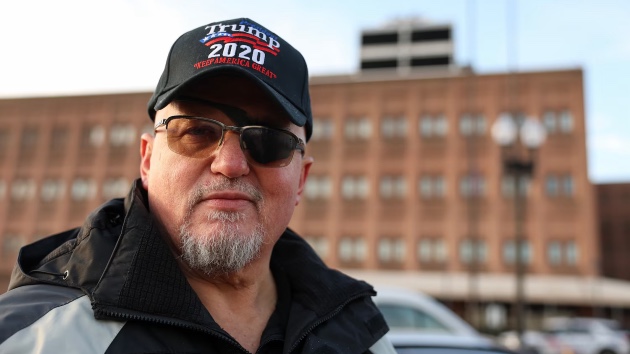
(WASHINGTON) — Enrique Tarrio, the former head of the Proud Boys, and Stewart Rhodes, the head of the Oath Keepers, were released Tuesday from prison following President Donald Trump’s sweeping pardon of those convicted in connection with the Jan. 6 Capitol riot.
They were serving 22- and 18-year sentences, respectively, for their roles in the riot.
Four years after they raided the Capitol, threatened Congress members and assaulted police officers, a group of some of the Jan. 6 rioters convicted of the most violent incidents that day are now free men thanks to Trump.
Other convicted members were scheduled to be released throughout the day from Washington, D.C. area, jails and prisons.
Of the nearly 1,600 individuals who have faced charges associated with the Capitol attack, according to figures released by the U.S. Attorney’s Office, 608 individuals faced charges for assaulting, resisting or interfering with law enforcement trying to protect the complex that day, the office said. Approximately 140 law enforcement officers were injured during the riot, the Department of Justice has said.
A federal judge sentenced Rhodes in May 2023 after he was convicted of seditious conspiracy the year prior for his and his group’s role in the riot. The Oath Keepers had stockpiled weapons at a D.C. hotel and organized the attack, according to prosecutors.
Rhodes himself did not enter the Capitol on Jan. 6 and maintained that his group only intended to provide security and medical aid to those attending multiple pro-Trump demonstrations in the area, prosecutors said.
Tarrio was sentenced in September 2023 for his conviction on seditious conspiracy and given the longest sentence of all of the convicted Jan. 6 rioters, though he was not at the Capitol on Jan. 6.
During his sentencing, prosecutors pointed to a nine-page strategic plan to “storm” government buildings in Washington on Jan. 6 that was found in Tarrio’s possession after the riot, as well as violent rhetoric they say he routinely used in messages with other members of the group about what they would do if Congress moved forward in certifying President Joe Biden’s election win.
As more of the rioters were released from jails and prisons, a group of Trump supporters, Proud Boys members and others gathered and cheered them on as they were released.
The group carried large flagpoles with Trump and American flags attached and signage that read, “no man left behind” and “pardon all j6 hostages day one.”
Current and former DOJ officials have expressed alarm over the potential that Trump would hand down pardons — or otherwise free — violent offenders, citing the potential risk they could seek to target the prosecutors who oversaw their cases, the judges who sentenced them to periods of incarceration, or witnesses who may have testified against them.
(WASHINGTON) — After taking the oath of office to be sworn in as the nation’s 72nd secretary of state, Rubio promised that every action taken by the State Department will be determined by the answers to three questions: “Does it make us stronger? Does it make us safer? And does it make us more prosperous?”
The Senate unanimously confirmed Rubio’s appointment to secretary of state Monday evening, making Rubio the first confirmed Cabinet member of the second Trump administration.
Rubio also gave remarks in Spanish, giving thanks to God and his family members both present and not present — including his parents, who he said came to the United States in 1956 and that the purpose of their lives was that their children could realize dreams that were not possible for them.
Rubio, a Cuban American son of refugees, is the first Hispanic American ever to hold this position.
“It’s an incredible honor to be the secretary of state of the most powerful, best country in the world,” he continued in Spanish, thanking President Donald Trump for the opportunity.
Switching back to English, Rubio joked, “I just said I saved a bunch of money by switching to Geico — that’s what I said.”
The former senator also echoed themes from Trump’s inaugural address and reiterated the president’s platform.
“[Trump’s] primary promise when it comes to foreign policy is that the priority of the United States Department of State will be the United States. It will be furthering the national interest of this country,” Rubio said.
“We will work hard every second of the day to help him achieve the agenda the American people have given him to achieve,” he added.
In addition to thanking his former colleagues, including Vice President J.D. Vance and Idaho Sen. James Risch, Rubio expressed gratitude to his family and emphasized that “the most important job I’ll ever have is that of a father and husband.”
Ahead of the swearing-in ceremony Tuesday morning, Rubio spoke with CBS and was asked about Trump’s statement that he is “not confident” the ceasefire in Gaza will hold.
“Well, I’m hoping and praying it will hold — but remember, on Oct. 6 there was a ceasefire in place between Israel and Hamas. Oct. 7 was a violation of that,” Rubio said. “So when you’re dealing with a terrorist organization that has committed atrocities, motivated by all kinds of evil, I don’t think you can go into it very confident that things will hold in the long term.
“We want it to work out. We think there is the broader hope of a peace in the region,” he added. “So we’re hopeful, but I think we need to be realistic about what we’re dealing with here.”
Rubio also spoke with ABC’s “Good Morning America” and discussed Trump’s pardons for Jan. 6 rioters, TikTok and the Russia-Ukraine war.
Rubio sidestepped directly weighing on the pardons, saying his “focus needs to be 100% on how I interact with our counterparts, our adversaries, our potential enemies around the world to keep this country safe, to make it prosperous.”
When asked about Trump’s campaign pledge to end the conflict between Russia and Ukraine on Day One, Rubio contended the matter is more complex and that negotiations will not be played out in public.
“Look, this is a complex, tragic conflict, one that was started by Vladimir Putin that’s inflicted a tremendous amount of damage on Ukraine and also on Russia, I would argue, but also on the stability of Europe,” Rubio said. “So the only way to solve these things, we got to get back to pragmatism, but we also get back to seriousness here, and that is the hard work of diplomacy. The U.S. has a role to play here. We’ve been supportive of Ukraine, but this conflict has to end.”
(WASHINGTON) — President Donald Trump kicked off his second term with a flurry of executive actions on immigration, Jan. 6, health policy and more.
More orders are expected Tuesday amid fallout from his first moves, including his issuing pardons for more than a thousand rioters convicted in connection with the violent Jan. 6 attack on the U.S. Capitol and his effort to end birthright citizenship.
Meanwhile, lawmakers will continue to question and process the president’s Cabinet picks. Secretary of State Marco Rubio has been sworn in as other nominees, including Elise Stefanik for ambassador to the United Nations, face confirmation hearings.
Rubio is sworn in by JD Vance as secretary of state
After being unanimously confirmed by the Senate on Monday night, Secretary of State Marco Rubio was officially sworn in by Vice President JD Vance on Tuesday morning.
Rubio joined ABC’s “Good Morning America” ahead of the ceremony, where he discussed Trump’s pardons for Jan. 6 rioters, TikTok and the Russia-Ukraine war.
Rubio sidestepped directly weighing on the pardons, saying his “focus needs to be 100% on how I interact with our counterparts, our adversaries, our potential enemies around the world to keep this country safe, to make it prosperous.”
When asked about Trump’s campaign pledge to end the conflict between Russia and Ukraine on Day 1, Rubio contended the matter is more complex and that negotiations would not be played out in public.
“Look this is a complex, tragic conflict, one that was started by Vladimir Putin that’s inflicted a tremendous amount of damage on Ukraine and also on Russia, I would argue, but also on the stability of Europe,” Rubio said. “So the only way to solve these things, we got to get back to pragmatism, but we also get back to seriousness here, and that is the hard work of diplomacy. The U.S. has a role to play here. We’ve been supportive of Ukraine, but this conflict has to end.”
White House signals Trump will make announcement on infrastructure
White House press secretary Karoline Leavitt said this morning that Trump will be making a a major announcement on infrastructure at 4 p.m. ET.
“I can confirm that the American people won’t be hearing from me today,” she wrote, indicating she would not hold a press briefing. “They’ll be hearing from the leader of the free world,” Leavitt said during an appearance on “Fox & Friends.”
“Once again, President Trump will be speaking to the press later this afternoon at the White House, and we will have a big infrastructure announcement,” she added.
(WASHINGTON) — At noon today, Donald Trump took the presidential oath for a second time, capping a historic political comeback to the White House.
As he did on the campaign trail, Trump painted a dark picture of America and took aim at President Joe Biden’s leadership as his predecessor sat just steps away.
“My recent election is a mandate to completely and totally reverse a horrible betrayal, and all of these many betrayals that have taken place, and to give the people back their faith, their wealth, their democracy, and indeed their freedom,” Trump said, promising a “golden age of America.”
White House confirms Vivek Ramaswamy is leaving DOGE
The White House confirmed to ABC News that Vivek Ramaswamy, who Trump had picked to help lead his Department of Government Efficiency (DOGE) alongside Elon Musk, will now step aside to focus on running for governor of Ohio.
“Vivek Ramaswamy played a critical role in helping us create DOGE,” Trump-Vance transition spokesperson Anna Kelly told ABC News in a statement. “He intends to run for elected office soon, which requires him to remain outside of DOGE based on the structure that we announced today. We thank him immensely for his contributions over the last 2 months and expect him to play a vital role in making America great again!”
An Ohio operative told ABC News last week that Ramaswamy would announce his gubernatorial run soon.
“Vivek’s base plan remains [the] same: to get accomplishments at DOGE and then announce a run for governor shortly,” the operative said.
-ABC News’ Hannah Demissie
Trump enters arena to boisterous applause
Trump and Melania Trump walked into Capital One Arena together as “Hail to the Chief” was played by a military band.
The atmosphere is similar to that of Trump’s campaign rallies, with attendees clad in red “Make America Great Again” hats.
Trump shook hands with supporters in the crowd, many of whom held up their cellphones to film his entrance.
DeSantis refers to Gulf as ‘Gulf of America’ in executive order
Florida Gov. Ron DeSantis issued an executive order on an approaching winter storm on Monday that refers to the Gulf of Mexico as the “Gulf of America.”
Among the first executive orders set to be signed by Trump is one that would rename the Gulf of Mexico to the “Gulf of America.”
Amy Klobuchar discusses Trump and Biden limo ride to the Capitol
Sen. Amy Klobuchar, chair of the congressional inaugural committee, called into ABC News and spoke with anchor David Muir after the ceremonies on Capitol Hill.
Klobuchar was in the motorcade with Trump and Biden as they rode together from the White House to the swearing-in the Capitol Rotunda.
“I’m not going to reveal every detail, except to say maybe we did discuss football just a little bit, and some of the games yesterday,” she said about what was discussed on the short trip. “And we also talked about the now-president’s upcoming trip to Los Angeles, and I talked to him privately about that with the Olympics coming, and how important that is.”
Kash Patel, Trump’s FBI director nominee, addresses crowd
Kash Patel, Trump’s nominee for FBI director, which is a non-partisan position, addressed Trump supporters at Capital One Arena ahead of his arrival.
“It’s pretty cool to be speaking in Capital One Arena right before the boss,” Patel said, as the crowd cheered.
“We are not only the beacon of hope, but we are the land of constitutional justice. We are the land under Donald J. Trump and JD Vance where we are going to end the two-tier system of justice. We are going to remove the weaponization of the intelligence community for political purposes, and we are going to put the men and women of America first.”
Inaugural parade taking place at Capital One Arena
Normally, the president and his entourage would walk down Pennsylvania Avenue to the White House after taking the oath of office.
But because of frigid temperatures in Washington, the events have been moved indoors to Capital One Arena.
The venue has the capacity to hold roughly 20,000 people. A desk has been set up on stage for Trump to sign some of the first executive orders of his administration.
Brian Driscoll named acting FBI director
Brian Driscoll has been named acting director of the FBI by the incoming administration, days after Driscoll was tapped as the new head of the FBI’s Newark field office.
FBI Deputy Director Paul Abbate resigned this morning, as did most of the executive staff, according to sources.
-ABC News’ Luke Barr
Focus will soon shift to Capital One Arena
The inaugural luncheon has ended and Trump is about to participate in the First Honors Ceremony at the Capitol.
His next stop will be Capital One Arena for remarks to a waiting crowd and the signing of executive orders.
Some Trump allies and officials have already spoken ahead of his arrival, including Tesla CEO Elon Musk and Arkansas Gov. Sarah Huckabee Sanders. Also speaking was Kash Patel, Trump’s pick for FBI director.
Milley’s official portrait was removed from Pentagon hallway
Gen. Mark Milley’s official portrait as chairman of the Joint Chiefs of Staff was taken down this afternoon from the hallway where it hung along with those of previous chairmen.
Two U.S. officials confirmed that Milley’s portrait was taken down from that hallway and referred questions to the White House.
One official told ABC News that the whereabouts of the portrait is unknown.
The portrait was officially unveiled on Friday, Jan. 10, at a ceremony in that hallway where both Milley and Defense Secretary Lloyd Austin were present.
The portrait’s disappearance was first noted by reporters at the Pentagon who have posted uncleared photos of the empty space where the portrait was hung.
-ABC News’ Luis Martinez and Matt Seyler
Acting leaders named for Homeland Security, Defense departments
While awaiting the Senate confirmation hearing for South Dakota Gov. Kristi Noem, Trump’s pick to lead the Department of Homeland Security, Benjamine Carry Huffman has been appointed acting secretary.
Huffman is currently the director of the Federal Law Enforcement Centers, the training arm for federal law enforcement.
Department of Defense official Robert Salesses was also named acting defense secretary until the Senate confirmation hearing is held for Trump’s pick, Pete Hegseth.
Salesses is the current deputy director of the Washington Headquarters Service.
-ABC News’ Luke Barr and Luis Martinez
Plans for Rubio’s 1st day at the State Department
The State Department is charging full steam ahead with preparations for Sen. Marco Rubio’s first full day as America’s top diplomat.
Assuming all goes to plan, two State Department officials say that Rubio — Trump’s nominee to be secretary of state — will give a speech to mark his arrival on Tuesday. He will also meet both one-on-one and as a group with the foreign ministers of India, Australia, and Japan — the three countries that, along with the U.S., make up the Quad, a diplomatic partnership seen as critical to countering China’s influence in the Pacific.
The Senate is expected to begin working to formally install as many of Trump’s nominees as possible and Rubio is expected to come up first. He could be confirmed as soon as this evening.
-ABC News’ Shannon K. Kingston
White House raises flag to full staff after Trump signs proclamation
The flag at the White House has been raised after Trump signed a proclamation for flags to be flown at full staff on all inauguration days.
The flag had been at half-staff following President Jimmy Carter’s death on Dec. 29. Trump is ordering the flag to return to half-staff on Tuesday for the remainder of the 30-day period, which began the day of 100-year-old Carter’s death.
Last week, House Speaker Mike Johnson ordered that the flags at the Capitol be raised for the inauguration.
-ABC News’ Justin Ryan Gomez
Trump advisers, DOJ prepare for legal challenges
With a flurry of executive orders expected today, President Donald Trump’s top advisers, including his incoming Department of Justice leadership, are preparing for a storm of legal challenges to some of the most controversial ones.
“We’re going to get sued on all of these things,” one top Trump adviser said, adding that the volume of litigation is expected to be a full-time job for Trump’s DOJ.
Trump has privately told advisers that he believes flooding the zone with executive orders will lead to lawsuits that may be less effective given the volume of actions he plans to take.
During Trump’s first administration, he faced upwards of 400 lawsuits challenging his actions. His advisers anticipate more than that this time.
There will be a team inside the Justice Department that is dedicated just to defending Trump’s actions in court, sources said.
-ABC News’ Katherine Faulders
White House décor transitions from Biden to Trump
The transition from the Biden White House to the Trump White House is well underway and crews are working quickly to make the changes before Trump arrives later this afternoon, but the choices are nearly identical to his first term.
In the Oval Office, gold curtains have returned behind the Resolute Desk, as well as the red-and-beige carpet with green leaves that covered the wood floor.
As Trump sits at his desk, the portrait of President Andrew Jackson returned to the wall on his left side, just as it was during his first term. Biden had a portrait of Benjamin Franklin.
To Trump’s right, where Biden hung a 1917 flag-decorated Childe Hassam painting, President Abraham Lincoln is now back on display.
Other areas of the West Wing still need to be unboxed. In the Cabinet Room is a cardboard box with “DJT Office Bibles” written on the side.
-ABC News’ Justin Ryan Gomez
Politicians attend inauguration luncheon
Members of Congress, officials joining the new administration and tech leaders including Meta CEO Mark Zuckerberg have congregated for an inauguration luncheon at the Capitol.
Pelosi criticizes Trump’s inaugural speech
Former House Speaker Nancy Pelosi was critical of Trump’s inaugural speech, pointing out that he didn’t mention his plan to cut taxes on the wealthy.
“In the President’s first term, his only accomplishment was enacting tax cuts that gave eighty-three percent of the benefits to the top one percent while increasing the national debt by $2 trillion,” she said in a statement.
“While he didn’t say it in his speech, the President campaigned on an extension of those tax cuts being his first priority in the new Congress,” Pelosi said. “The American people want us to build an economy from the middle out — not from the top down.”
Pelosi’s statement came as Trump slammed the former speaker in remarks to his supporters at Emancipation Hall.
“She’s guilty as hell,” Trump said of Pelosi over her response to the attack on the U.S. Capitol.
Trump again airs grievances against Nancy Pelosi, Liz Cheney after pledging ‘unity’
After promising ‘unity’ in his inaugural address, Trump is reverting back to bulldozing political opponents like Nancy Pelosi and Liz Cheney.
“She’s guilty as hell,” he said of Pelosi over her response to the attack on the U.S. Capitol — where he was speaking — buy a pro-Trump mob.
He called Liz Cheney, a Republican who endorsed Kamala Harris over Trump because of his actions after the 2020 election, a “disaster.”
“She’s a crying lunatic and crying, crying Adam Kinzinger, he’s a super crier,” Trump said.
Trump talks about Jan. 6 ‘hostages’
In more off-the-cuff remarks inside the Capitol’s Emancipation Hall after his address, Trump spoke about people who have been convicted for their roles in the Jan. 6 attack on the Capitol as “hostages.”
“I was going to talk about the J6 hostages,” Trump said. “But you’ll be happy because, you know, it’s action not words that count.”
Trump previously promised to pardon some Jan. 6 rioters on Day 1.
He also went after former Reps. Liz Cheney and Adam Kinzinger, two Republican members of the House Jan. 6 Committee who are outspoken critics of Trump because of his actions after the 2020 election.
“And I was going to talk about the things that Joe did today with the pardons of people that were, very, very guilty of very bad crimes, like the Unselect Committee of political thugs,” Trump said.
Biden’s legacy: How will he be remembered?
Surveys show Americans have mixed views on Biden’s four years at the pinnacle of power.
Historians told ABC News it will take years to fully assess his stamp on American politics, but that likely to be included are his legislative achievements while leading the country out of the COVID-19 pandemic and his foreign policy footprint.
But many said his 2024 campaign decisions — first to run for reelection and later to drop out — may overshadow his record while in office.
Biden departs the Capitol
Joe Biden, now the former president, left the Capitol on a Marine helicopter that will bring him to Joint Base Andrews for a final farewell to Washington.
The Bidens and Trumps walked together to the helicopter. Both couples were holding hands.
Biden smiled and appeared to laugh as he spoke to Trump. Jill Biden and Melania Trump hugged as they said goodbye.
This is an exit for Biden after five decades in politics.
Just before he left, Kamala Harris and Doug Emhoff entered their own motorcade. She is traveling home to Los Angeles, her office confirmed to ABC News.
Inaugural ceremony comes to an end
After Trump’s speech, there were remarks from Rabbi Ari Berman, Pastor Lorenzo Sewell and Reverend Frank Mann. Christopher Macchio performed the national anthem.
Trump and Melania Trump left the Capitol Rotunda together.
Next, the Trumps will see off President Biden and Vice President Kamala Harris.
Room joins in as Carrie Underwood sings ‘America the Beautiful’
In a unifying moment, Carrie Underwood sang “America the Beautiful” after Trump’s defiant inauguration speech.
The country star, who was standing in front of Biden, performed a capella after technical difficulties, and the crowd joined in. Biden, Hillary Clinton and Doug Emhoff were among those singing with her.
Trump celebrates his comeback: ‘Here I am’
“Many people thought it was impossible for me to stage such a historic political comeback. But as you see today, here I am,” he said. “The American people have spoken.”
Trump’s long road back to the White House included four indictments, one conviction, two assassination attempts and a campaign of ups and downs.
Trump references legal troubles: ‘Never again’
Trump, who has been convicted by a jury of his peers and was indicted four times after his first term, again contended he was politically prosecuted.
“Never again will the immense power of the state be weaponized to persecute political opponents,” he said. “Something I know something about. We will not allow that to happen. It will not happen again. Under my leadership, we will restore fair, equal and impartial justice under the constitutional rule of law.”
The two cases against him were dropped after he won reelection, with prosecutors citing longstanding Justice Department policy that a sitting president cannot be charged with a crime.
Trump lays out Day 1 executive actions
Trump is now highlighting some of the executive actions he will take.
They include declaring a national emergency at the southern border and a national energy emergency.
He said he would send troops to the U.S.-Mexico border, reinstate “Remain in Mexico” policy and other immigration policies.
Trump takes aim at Biden in address: ‘A horrible betrayal’
Trump is taking aim at Biden’s leadership these past four years, specifically on immigration and on recent natural disasters, though he didn’t mention his predecessor by name.
“My recent election is a mandate to completely and totally reverse a horrible betrayal, and all of these many betrayals that have taken place, and to give the people back their faith, their wealth, their democracy, and indeed their freedom,” Trump said.
Like he did on the 2024 campaign trail, Trump’s painting a dark picture of America.
“From this moment on, America’s decline is over,” he said. “Our liberties and our nation’s glorious destiny will no longer be denied, and we will immediately restore the integrity, competency, and loyalty of America’s government.”
Trump: ‘The golden age of America begins right now’
Trump began his inaugural remarks with a line he’s said repeatedly since his election.
“The golden age of America begins right now,” he said.
“Our sovereignty will be reclaimed, our safety will be restored, the scales of justice will be rebalanced.”
Cheers erupted in the freezing cold in the line outside the Capital One Arena as Trump supporters huddled together, glued to their phones watching Trump take the oath of office.
Trump is sworn into office for a 2nd term, capping historic comeback
Trump just took the oath for a second time. Melania Trump and their children surrounded him as he did so.
Trump and Biden shook hands after he took the oath. Kamala Harris, who was standing next to Biden, clapped quietly.
JD Vance takes oath of office
JD Vance just took the oath of office with his wife, Usha, and their three children by his side.
Theme for inauguration is ‘our enduring democracy’ Democratic Sen. Amy Klobuchar and Republican Sen. Deb Fischer, who sit on the Joint Congressional Committee on Inaugural Ceremonies, are speaking on the importance of democracy.
“Our theme this year is our enduring democracy, the presence of so many presidents and vice presidents here today is truly a testament to that endurance,” Klobuchar said in her opening remarks.
Fischer noted the past several years have been a “trying” time for the nation but today’s events marks its 60th inauguration ceremony.
“Endurance through the years is the ultimate test,” she said. “To persevere through time is the truest measure of an idea.”
Biden announces preemptive pardons of family members minutes before Trump takes oath
President Joe Biden issued preemptive pardons to his siblings and their spouses in the final minutes of his presidency.
“My family has been subjected to unrelenting attacks and threats, motivated solely by a desire to hurt me — the worst kind of partisan politics. Unfortunately, I have no reason to believe these attacks will end,” Biden said in a statement.
He pardoned his siblings, Valerie Biden Owens, Francis Biden and James Biden, as well as Owens’ husband, John Owens, and James Biden’s wife, Sara Jones Biden.
“The issuance of these pardons should not be mistaken as an acknowledgment that they engaged in any wrongdoing, nor should acceptance be misconstrued as an admission of guilt for any offense,” Biden said.
Trump enters Capitol Rotunda for transfer of power Trump walked into the Capitol Rotunda solo as he prepares to be sworn in for another four years.
It is a historic moment, as he is the first president in more than a century to win non-consecutive terms. He will also be the first convicted felon to serve as president.
Trump’s children at his side but won’t join his administration
Trump’s five children were seen entering the Capitol, moments before he is set to be sworn in for a second term.
Unlike his first term, none will serve in his administration.
Ivanka Trump and her husband, Jared Kushner, were advisers in the West Wing during his first presidency. But neither are returning this time around. Eric Trump and Donald Trump Jr. are currently leading the Trump Organization.
Omar rips Dems for attending Trump’s inauguration after calling him a ‘threat to democracy’
Rep. Ilhan Omar, D-Minn. sent out a blistering X post criticizing fellow Democrats who called Trump a threat to democracy and are now “willing to be there and clap for him.”
“People are more upset at performers/artists attending Trump’s inaugural events but not upset at all the politicians who told them he was a ‘threat to democracy’ going to these events are not serious,” she wrote.
“Performers at least know they are there to perform and get paid, but these politicians who ran their mouth for 4 yrs and are now willing to be there and clap for him, that’s who they should be mad at,” she added. “They lied to you and your criticism/anger should be rightfully directed at them.
— ABC News’ Benjamin Siegel
Clintons, Bushes, Obama arrive at Capitol
Former President Bill Clinton and former Secretary of State Hillary Clinton, who lost the 2016 election to President-elect Donald Trump, have arrived at Trump’s second inauguration. Trump supporters gathered at Capital One Arena in Washington, D.C., booed as the Clintons walked in.
Former Vice President Mike Pence was also not accompanied by his wife, Karen Pence.
Trump’s Cabinet picks are in the Capitol. One could be confirmed tonight
Hundreds of people are gathered inside the Capitol Rotunda, including several of Trump’s Cabinet picks: Tulsi Gabbard, tapped for director of national intelligence; Robert F. Kennedy Jr., chosen to lead Health and Human Services; and Pete Hegseth, his pick to lead the Pentagon.
His pick for secretary of state, Marco Rubio, could be confirmed as soon as Monday night. Rubio is considered one of Trump’s least controversial picks.
A number of Senate committees that will vote on different nominees have scheduled meetings for later this week.
Chants, music, and a watch party inside Capital One Arena
With a sea of red hats and the campaign soundtrack blasting, Capital One Arena emulates the environment of a campaign rally.
Notably, a desk sits at the end of the stage across the podium. Trump is expected to sign executive orders from here.
There is a feed of Trump’s movements being streamed live on the Jumbotrons as well. As the president-elect departed St. John’s church, the crowd here burst into applause and chanted “USA.”
There were also chants of “JD-48” as they watched the vice president-elect and his wife arrived at the White House.
ABC News Senior Political Correspondent Rachel Scott spoke to one couple from Alabama who arrived at 2:30 a.m. and said there were still “thousands” of people ahead of them.
EMS first responders from Butler, Pennsylvania — the site of that first assassination attempt — are expected to be present as well.
— ABC News’ Rachel Scott and Benjamin Siegel
What happens when Trump and Biden get to Capitol
According to the presidential inauguration committee, here is what will happen when Trump gets to the Capitol:
First, he will be sworn in around noon.
After, Trump will bid farewell to President Joe Biden and Vice President Kamala Harris. Biden is leaving the Capitol via helicopter to go to Joint Base Andrews, where he will hold a farewell event with his staff.
Trump will then visit the overflow crowd gathered at Emancipation Hall to watch the swearing in and later participate in a ceremony in the presidents signing room. He will eventually return to Emancipation Hall for a review of the troops.
Biden and Trump depart White House together for Capitol
President Joe Biden and President-elect Trump are riding together to the U.S. Capitol for Trump’s swearing-in.
Democratic Sen. Amy Klobuchar, who chairs the congressional inaugural committee, walked them out of the White House.
First lady Jill Biden and Melania Trump rode to the ceremony separately, as did Vice President Kamala Harris and Vice President-elect JD Vance.
Biden sees to peaceful transition of power Trump denied him four years ago
The peaceful transition of power is a hallmark of American democracy.
It’s currently on display as Biden hosts Trump at the White House before they attend the inauguration together.
But four years ago, Trump denied Biden such a welcome. Instead, he bitterly left Washington hours before the inauguration while still refusing to concede he lost the 2020 election.
“The only president ever to avoid an inauguration is the guy that’s about to be inaugurated,” Biden had said when he confirmed he would be in attendance for Monday’s events.
Biden leaves letter for Trump
As President Joe Biden prepared to pass the baton to President-elect Donald Trump, he’s followed the tradition of leaving his successor a note.
While Biden confirmed that he wrote Trump a letter, he did not say what his message was.
President Ronald Reagan started the ritual of leaving his successor a letter in 1989. Every president since has taken part in the tradition. But since Reagan’s letter to Bush, each handover has been from a Democrat to a Republican or vice versa.
Mike Pence to attend inauguration
Former Vice President Mike Pence announced his plans to attend the inauguration.
“Today, I will attend the Inauguration of President Donald Trump and Vice President J.D. Vance at the U. S. Capitol,” Pence wrote on X. “This is a day when every American does well to celebrate our democracy and the peaceful transfer of power under the Constitution of the United States.”
Pence was seen arriving at the U.S. Capitol at around 9:30 a.m.
Trump and Vance have had a contentious relationship and did not interact publicly for four years after Pence broke with Trump by refusing to reject the 2020 election results.
Biden tells Trump: ‘Welcome home’
As Trump exited his limousine, Biden said to him: “Welcome home.”
Trump walked up the steps with Melania Trump and they shook hands with the Bidens.
Trump is now at the White House
Trump has arrived at the White House, where he will have tea with President Biden.
The two men will later ride together to the U.S. Capitol for Trump’s swearing in.
Trump’s return caps what has been a remarkable political comeback unlike anything in American history.
This isn’t Trump’s first time back at the White House. Biden invited him for an Oval Office meeting days after his victory in November.
Hundreds available to attend inauguration from inside the Capitol Rotunda
Guests will attend the inauguration from the Capitol Rotunda and overflow areas, with 800 able to attend from inside the Rotunda.
About 1,300 can attend in the Emancipation Hall, and 500 can watch from the theater in the Capitol Visitor Center.
— ABC News’ Justin Gomez and Allison Pecorin
Trump will rename Gulf of Mexico the ‘Gulf of America’ among 1st actions
Among the first executive orders set to be signed by President-elect Donald Trump will be an order to rename the Gulf of Mexico as the “Gulf of America.”
During his January press conference at Mar-A-Lago, Trump declared he would change the name, saying it’s currently run by cartels and that “it’s ours.”
“We’re going to be changing the name of the Gulf of Mexico to the Gulf of America, which has a beautiful ring that covers a lot of territory, the Gulf of America,” Trump said. “What a beautiful name. And it’s appropriate. It’s appropriate. And Mexico has to stop allowing millions of people to pour into our country.”
Presidents have the authority to rename geographic regions and features via executive order.
-ABC News’ John Santucci and Kelsey Walsh
Biden takes selfie with first lady at White House
President Joe Biden snapped a selfie with first lady Jill Biden outside the White House, documenting their final morning in office.
The Bidens will soon host the Trumps for tea and coffee at the White House.
Bidens greet Harris at the White House Vice President Kamala Harris and second gentleman Doug Emhoff have arrived at the White House.
They exchanged handshakes with President Joe Biden and first lady Jill Biden.
The Trumps will soon join Biden at the White House for tea. They have just exited St. John’s Episcopal Church.
Supporters line up outside Capital One Arena before dawn, despite sub-freezing temps
Temperatures in the high teens and low 20s did little to stop Trump supporters from lining up early to attend inauguration events at Capital One Arena.
Those at the front of the line arrived at 3 a.m., despite the fact that Trump was eight hours away from taking the oath, and doors were four hours away from opening.
Thousands were lined up by the time doors opened at 7 a.m.
ABC News spoke with supporters from all over the nation including southern California, Florida, and New York. Many arrived with family members that spanned generations.
ABC News’ Meghan Mistry
Trumps arrive for church service
Donald Trump and Melania Trump have arrived for a church service at St. John’s in Washington, a tradition for presidential inaugurations.
Trump said he’s feeling “great.”
After church, President Biden and first lady Jill Biden will welcome the Trumps to the White House — an invitation that Trump did not offer the Bidens four years ago when he skipped the inaugural events entirely.
First to ABC: Sarah Huckabee Sanders, Tom Homan and Kellyanne Conway to speak at Capital One Arena, per sources
Arkansas Gov. Sarah Huckabee Sanders, “border czar” Tom Homan and Kellyanne Conway will speak at Capital One Arena, per sources familiar with the planning.
Elon Musk will join the speakers list as well.
The president will also swing by the Capital One Arena for the 60th Presidential Inaugural Ceremony Viewing & Parade.
The evening will include the Oval Office Signing Ceremony, followed by the Commander and Chief Ball, Liberty Ball, and Starlight Ball.
— ABC News’ Kelsey Walsh
Members of Trump’s family arrive at St. John’s
Trump is about to leave Blair House for the first event of the day: a service at St. John’s Episcopal Church.
Members of his family, including his children Ivanka Trump and Eric Trump, were seen arriving for the service.
Senior Trump adviser dismisses significance of Biden pardons
Jason Miller, a senior adviser to President-elect Donald Trump, dismissed the significance of President Joe Biden’s preemptive pardons for prominent political figures in an interview with “Good Morning America” on Monday.
“Today is about President Trump and starting to undo some of the disasters from the past four years,” Miller said shortly after the news of Biden’s inauguration day pardons broke.
“I really don’t care about Joe Biden anymore,” Miller added. “This is about the plan of action President Trump is going to start implementing, starting today.”
A preview of Trump’s inaugural address
Excerpts of Trump’s inaugural address, obtained by ABC News, show Trump will call for a “revolution of common sense.”
“I return to the presidency confident and optimistic that we are at the start of a thrilling new era of national success. A tide of change is sweeping the country,” he will say.
Trump will also hint at the sweeping executive action he will take, with as many as 200 orders prepared for Day 1.
“Today, I will sign a series of historic executive orders,” he’ll say. “With these actions, we will begin the complete restoration of America and the revolution of common sense.”
“My message to Americans today is that it is time for us to once again act with courage, vigor, and the vitality of history’s greatest civilization.”
What Trump has said he’ll do on Day 1
Mass deportations, Jan. 6 pardons and tariffs on trade partners. That’s just some of what Trump repeatedly vowed to do immediately after he is sworn into office.
Sources told ABC News Trump is likely to sign executive orders at the U.S. Capitol after his swearing-in and then additional ones later at Capital One Arena.
Separately, top Trump officials told ABC News he is preparing to take more than 200 executive actions on his first day in office.
While plans are still being finalized, sources said they could include declaring a national emergency on the U.S.-Mexico border, rescinding any DEI directives from the Biden administration and offsetting limits for offshore drilling on federal land.
Biden’s attendance restores hallmark of American democracy
After a bitter 2024 campaign, Biden will put politics aside and stand near his successor as he takes the presidential oath spelled out in the Constitution.
The gesture is a tradition of American democracy, but especially notable given that Trump skipped Biden’s inauguration four years ago after refusing to concede.
Still, Biden made sure to issue a final warning to Americans before he left office to be vigilant against potential abuses of power ahead.
“Today, an oligarchy is taking shape in America of extreme wealth, power, and influence that literally threatens our entire democracy, our basic rights and freedoms, and a fair shot for everyone to get ahead,” he said in his farewell address. “We see the consequences all across America.”
How to watch Trump’s inauguration
ABC News will have comprehensive coverage of the inauguration throughout the day.
Trump is expected to begin his day with a service at St. John’s Episcopal Church and a private tea at the White House before his swearing-in ceremony at noon in the Capitol Rotunda.
The network’s coverage will begin with a special edition of “Good Morning America” at 7 a.m. EST, followed by a day-long special report beginning at 9 a.m. EST and led by “World News Tonight” anchor and managing editor David Muir from Washington.
Inauguration coincides with MLK Day
Trump’s second swearing in is occurring on Martin Luther King Jr. Day.
The last time that happened was former President Barack Obama’s second inauguration in 2013. Obama, the nation’s first Black president, took the oath of office that year using two Bibles, one that belonged to King and one that belonged to Abraham Lincoln.
The overlap isn’t expected to happen again until 2053.
Fauci, Milley react to preemptive pardons from Biden
Following Biden’s announcement of preemptive pardons to potential targets of the incoming Trump administration, the recipients express their gratitude to the outgoing president.
“I really truly appreciate the action President Biden has taken today on my behalf,” Dr. Anthony Fauci told ABC News Chief Washington Correspondent Jonathan Karl. “Let me be perfectly clear, Jon, I have committed no crime, you know that, and there are no possible grounds for any allegation or threat of criminal investigation or prosecution of me.”
Retired Gen. Mark Milley also expressed that he was “deeply grateful for the President’s action.”
“After forty-three years of faithful service in uniform to our Nation, protecting and defending the Constitution, I do not wish to spend whatever remaining time the Lord grants me fighting those who unjustly might seek retribution for perceived slights. I do not want to put my family, my friends, and those with whom I served through the resulting distraction, expense, and anxiety.”
“I wish this pardon weren’t necessary, but unfortunately, the political climate we are in now has made the need for one somewhat of a reality,” said Harry Dunn, former Capitol Police officer. “I, like all of the other public servants, was just doing my job and upholding my oath, and I will always honor that.”
(WASHINGTON) — President Joe Biden has sparked outrage after commuting the sentence of Leonard Peltier in a last-minute move before leaving office Monday.
Peltier, 80, has spent nearly 50 years in prison after being convicted of the murder of two FBI agents on South Dakota’s Pine Ridge Reservation in 1975. He also escaped from federal prison in 1979 while serving his sentence for the two murders and had five years tacked onto his sentence.
Peltier, a prominent Native American activist before his arrest, has always proclaimed his innocence in the crime.
“This commutation will enable Mr. Peltier to spend his remaining days in home confinement but will not pardon him for his underlying crimes,” Biden wrote in a statement announcing the move.
The commutation came in the same release, issued while now-President Donald Trump’s inauguration ceremony was getting underway at the U.S. Capitol Rotunda, that granted preemptive pardons to five of Biden’s family members, including his brother James Biden, a target of congressional Republicans.
Peltier suffers from significant health issues, according to the release.
Former FBI Director Christopher Wray recently penned a letter to Biden, warning him against commuting Peltier’s sentence. The letter was written on Jan. 10, just days before Wray and Biden left office.
“Mr. President, I urge you in the strongest terms possible: Do not pardon Leonard Peltier or cut his sentence short,” Wray wrote. “It would be shattering to the victims’ loved ones and undermine the principles of justice and accountability that our government should represent.”
On June 26, 1975, FBI agents Jack Coler and Ronald Williams were killed by Peltier in a shootout while they were on the Pine Ridge Reservation.
“Peliter is a remorseless killer, who brutally murdered two of our own–Special Agents Jack Coler and Ronald Williams,” Wray wrote. “Granting Peltier any relief from his conviction or sentence is wholly unjustified and would be an affront to the rule of law.”
Wray said Peliter fled to Canada after he “executed” the two agents “at close range.” Peltier was arrested in Alberta in 1976, before standing trial for the murders.
“In the aftermath of the murders, Peltier engaged in a violent flight from justice, firing shots at police officers as he eluded arrest and burglarizing a home,” Wary wrote. “Following his apprehension months later in Canada, Peltier said that if he had known law enforcement officers were approaching, he would have “blow[n] [them] out of [their] shoes.”
After his trial and conviction for first-degree murder, Peltier participated in a violent escape from federal prison, during which he and others opened fire on prison employees,” Wray wrote. One of the escapees was killed in the shootout.
Wray also wrote a similarly strongly worded letter to the parole board in June 2024, asking that Peltier not be let out. The parole was denied. Then-President Barack Obama denied a clemency request for Peltier in 2017, according to The Associated Press.
“This last-second, disgraceful act by then-President Biden, which does not change Peltier’s guilt but does release him from prison, is cowardly and lacks accountability,” Natalie Bara, president of The FBI Agents Association, said in a statement. “It is a cruel betrayal to the families and colleagues of these fallen Agents and is a slap in the face of law enforcement.”
Kevin Sharp, Peltier’s attorney, told The Associated Press before the parole hearing last year that evidence against Peltier had been falsified.
“You’ve got a conviction that was riddled with misconduct by the prosecutors, the U.S. Attorney’s office, by the FBI who investigated this case and, frankly the jury,” Sharp told the AP. “If they tried this today, he does not get convicted.”
Amnesty International, which has long campaigned for Peltier’s release noted that former U.S. Attorney James Reynolds, who prosecuted the case, has said Peltier should be freed as well. The judge who oversaw his 1986 appeal, Gerald Heany, has also called for Peltier’s release.
Dozens of members of Congress wrote a letter urging for Peltier’s release in October 2023, citing what they said were the “prosecutorial misconduct” and “constitutional violations” that took place during Peltier’s trial.
“President Biden was right to commute the life sentence of Indigenous elder and activist Leonard Peltier given the serious human rights concerns about the fairness of his trial,” Amnesty International said in a statement. “Amnesty International has advocated for the U.S. government to grant Leonard Peltier clemency for years, following the leadership of Tribal Nations and Indigenous Peoples.”
(WASHINGTON) — Former President Joe Biden told his staffers, “We’re not leaving the fight,” during farewell remarks following Trump’s inauguration on Monday.
Biden referenced President Donald Trump’s inauguration remarks, which offered a scathing rebuke of the Biden administration while laying out Trump’s immediate plans upon returning to office.
“We have a lot more to do. We heard the inaugural address today,” Biden said in his remarks at Joint Base Andrews before getting on a plane with former first lady Jill Biden.
“We’ve got a lot more to do,” Biden continued, before making the sign of the cross to laughs.
The former president urged his staffers to stay “engaged,” whether that’s in the public or private sector, academia or running for office themselves.
“We’re leaving office, but we’re not leaving the fight,” Biden said. “You’re smart, you’re skilled, you’re passionate and the country needs you again.”
He said his dad taught him that a measure of a person is how quickly they get back up after getting knocked down.
“That’s what we have to do right now. We’ve always done our best as Americans. We never, never, never give up, ever,” he said.
He said he hopes his staffers look back on the past four years with “the same pride I have of all you’ve done.”
“You did it upholding core values of honesty, decency, integrity,” he said. “You represent the best of who we are as Americans. And that’s not a joke. That’s real.”
Biden also expressed optimism that their term wouldn’t be undone.
“Just as I’ve said of the laws we’ve enacted, our seeds are gonna grow and bloom for decades to come,” he said.
He closed by expressing his gratitude for his staffers and their families and the chance to serve with them.
“I’ve been doing this for 50 years, you’re the best group of people,” Biden said to cheers. “It’s been the honor of my life to serve as your president.”
He also quoted from the Seamus Heaney poem, “The Cure at Troy,” saying, “Once in a lifetime, the longed-for tidal wave of justice will rise up and hope and history rhyme.”
“You made it rhyme louder than it’s rhymed in a long time,” he said. “We’re on the cusp of real change, so let’s help hope and history rhyme.”
(WASHINGTON) — President Donald Trump did not place his hand on the Bible as he took the oath of office during his inauguration on Monday.
First lady Melania Trump stood next to the president holding two Bibles, but the 47th president of the United States didn’t place his hand on either as he raised his right hand to take the presidential oath, which Chief Justice John Roberts issued.
There is no legal requirement for the president to place his hand on the Bible. According to Article VI, Clause 3, of the U.S. Constitution, which covers oaths of office, members of Congress, state legislatures, and executive and judicial officers throughout the country are bound “by oath or affirmation” to support the Constitution.
“But,” it continues, “no religious Test shall ever be required as a Qualification to any Office or public Trust under the United States.”
During his first inauguration on Jan. 20, 2017, Trump placed his right hand atop two Bibles held by the first lady as Roberts swore him in as the 45th president.
Trump took the oath of office on Monday immediately after Vice President JD Vance was sworn in by Associate Supreme Court Justice Brett Kavanaugh. As Vance took the oath of office, he placed his right hand on a Bible that was held by his wife, Usha Vance, as she also held one of their three children.
During his presidential campaign, Trump endorsed the “God Bless the USA Bible” that, according to its website, was “inspired by” country singer Lee Greenwood’s patriotic ballad.
“Happy Holy Week! Let’s Make America Pray Again. As we lead into Good Friday and Easter, I encourage you to get a copy of the God Bless the USA Bible,” Trump wrote at the time, directing his supporters to a website selling the Bibles for $59.99.
During his inauguration speech on Monday, Trump spoke of God protecting his life when he was shot in the ear in an assassination attempt at a July 2024 campaign rally in Butler, Pennsylvania.
“Just a few months ago, in that beautiful Pennsylvania field, an assassin’s bullet ripped through my ear,” Trump said. “But I felt then, and believe even more so now, that my life was saved for a reason. I was saved by God to make America great again.”
(WASHINGTON) — President Donald Trump is preparing to issue a sweeping series of pardons for defendants charged in the Jan. 6, 2021, attack on the U.S. Capitol, including commuting the prison sentences of hundreds of his supporters who have been convicted of violent attacks against law enforcement, sources familiar with the matter told ABC News.
The planned commutations for those who attacked police goes well beyond what many of his allies anticipated he would be prepared to extend to the Jan. 6 defendants — and paves the way for potentially hundreds of supporters, some sentenced to years behind bars for vicious assaults on police — to be released in the coming days.
An incoming senior White House official did not immediately respond to a request for comment from ABC News.
In addition to the commutations, Trump plans to extend full pardons to his supporters who were not charged with engaging in violence on Jan. 6. Sources tell ABC News that some of Trump’s top advisers have been pushing him for days to issue these sweeping pardons.
Sources also caution that until Trump formally signs the pardon paperwork, it’s possible that the expected language could change or be scaled back.
Sources tell ABC News that hundreds of individuals currently serving prison time for violent offenses they committed on Jan. 6 will be freed as a result — and the commutations will likely extend to two of the most high-profile defendants charged in connection with the attack, Oath Keepers Founder Stewart Rhodes and Proud Boys leader Enrique Tarrio.
The two received prison sentences of 18 years and 22 years, respectively, following their convictions for leading members of their respective groups in a seditious conspiracy to thwart the lawful transfer of power.
Trump is expected to further direct the incoming attorney general to move to dismiss all pending indictments against Jan. 6 defendants who have not yet had their cases fully adjudicated, which would shutter roughly 470 ongoing cases, according to recently released numbers by the District of Columbia U.S. Attorney’s Office.
Current and former DOJ officials have expressed alarm over the potential that Trump would hand down pardons — or otherwise free — violent offenders, citing the potential risk they could seek to target the prosecutors who oversaw their cases, the judges who sentenced them to periods of incarceration, or witnesses who may have testified against them.
Trump teased the pardons Sunday at his victory rally at Capital One Arena, telling his supporters that they will be “very happy” with his decision.
“Tomorrow, everybody in this very large arena will be very happy with my decision on the J6 hostages,” Trump said “Very happy. I think you’ll be very, very happy. I would say about 99.9% in this beautiful arena.”
A violent mob of pro-Trump protesters stormed the Capitol on Jan. 6, fighting with officers, breaking into offices and destroying property.
After the attack on the U.S. Capitol by rioters seeking to overturn the 2020 election, more than 1,580 people were charged criminally in federal court, according to the Department of Justice. Over 1,000 have pleaded guilty.
Trump’s team had drafted a list of potential pardons for Jan. 6 defendants to issue on Day 1, sources familiar with the matter told ABC News on Sunday.
Of the nearly 1,600 individuals have faced charges associated with the Capitol attack, according to figures released by the U.S. Attorney’s Office, 608 individuals have faced charges for assaulting, resisting or interfering with law enforcement trying to protect the complex that day, the office said. Approximately 140 law enforcement officers were injured during the riot, the DOJ has said.
The U.S. Attorney’s Office said it is evaluating whether to bring charges in roughly 200 cases that have been referred to them by the FBI, about 60 of which involve potential felony charges involving allegations of assault or impeding law enforcement.
Trump said last March that he was “inclined to pardon many” of the rioters.
At least 221 individuals have been found guilty at contested trials in U.S. District Court, the DOJ said. Another 40 individuals have been convicted following an agreed-upon set of facts presented to and accepted by the Court.
President Joe Biden on Monday issued preemptive pardons to potential targets of the incoming Trump administration, including lawmakers who served on the House Jan. 6 Committee.
Trump, in his 2024 campaign, repeatedly vowed “retribution” on his political enemies, specifically singling out lawmakers like Liz Cheney, who investigated the attack on the Capitol. Trump said Cheney and other committee members should be put in jail.
ABC News’ Meredith Deliso and Katherine Faulders contributed to this report.
(WASHINGTON) — At noon today, Donald Trump took the presidential oath for a second time, capping a historic political comeback to the White House.
As he did on the campaign trail, Trump painted a dark picture of America and took aim at President Joe Biden’s leadership as his predecessor sat just steps away.
“My recent election is a mandate to completely and totally reverse a horrible betrayal, and all of these many betrayals that have taken place, and to give the people back their faith, their wealth, their democracy, and indeed their freedom,” Trump said, promising a “golden age of America.”
Trump again airs grievances against Nancy Pelosi, Liz Cheney after pledging ‘unity’
After promising ‘unity’ in his inaugural address, Trump is reverting back to bulldozing political opponents like Nancy Pelosi and Liz Cheney.
“She’s guilty as hell,” he said of Pelosi over her response to the attack on the U.S. Capitol — where he was speaking — buy a pro-Trump mob.
He called Liz Cheney, a Republican who endorsed Kamala Harris over Trump because of his actions after the 2020 election, a “disaster.”
“She’s a crying lunatic and crying, crying Adam Kinzinger, he’s a super crier,” Trump said.
Trump talks about Jan. 6 ‘hostages’
In more off-the-cuff remarks inside the Capitol’s Emancipation Hall after his address, Trump spoke about people who have been convicted for their roles in the Jan. 6 attack on the Capitol as “hostages.”
“I was going to talk about the J6 hostages,” Trump said. “But you’ll be happy because, you know, it’s action not words that count.”
Trump previously promised to pardon some Jan. 6 rioters on Day 1.
He also went after former Reps. Liz Cheney and Adam Kinzinger, two Republican members of the House Jan. 6 Committee who are outspoken critics of Trump because of his actions after the 2020 election.
“And I was going to talk about the things that Joe did today with the pardons of people that were, very, very guilty of very bad crimes, like the Unselect Committee of political thugs,” Trump said.
Biden’s legacy: How will he be remembered?
Surveys show Americans have mixed views on Biden’s four years at the pinnacle of power.
Historians told ABC News it will take years to fully assess his stamp on American politics, but that likely to be included are his legislative achievements while leading the country out of the COVID-19 pandemic and his foreign policy footprint.
But many said his 2024 campaign decisions — first to run for reelection and later to drop out — may overshadow his record while in office.
Biden departs the Capitol
Joe Biden, now the former president, left the Capitol on a Marine helicopter that will bring him to Joint Base Andrews for a final farewell to Washington.
The Bidens and Trumps walked together to the helicopter. Both couples were holding hands.
Biden smiled and appeared to laugh as he spoke to Trump. Jill Biden and Melania Trump hugged as they said goodbye.
This is an exit for Biden after five decades in politics.
Just before he left, Kamala Harris and Doug Emhoff entered their own motorcade. She is traveling home to Los Angeles, her office confirmed to ABC News.
Inaugural ceremony comes to an end
After Trump’s speech, there were remarks from Rabbi Ari Berman, Pastor Lorenzo Sewell and Reverend Frank Mann. Christopher Macchio performed the national anthem.
Trump and Melania Trump left the Capitol Rotunda together.
Next, the Trumps will see off President Biden and Vice President Kamala Harris.
Room joins in as Carrie Underwood sings ‘America the Beautiful’
In a unifying moment, Carrie Underwood sang “America the Beautiful” after Trump’s defiant inauguration speech.
The country star, who was standing in front of Biden, performed a capella after technical difficulties, and the crowd joined in. Biden, Hillary Clinton and Doug Emhoff were among those singing with her.
Trump celebrates his comeback: ‘Here I am’
“Many people thought it was impossible for me to stage such a historic political comeback. But as you see today, here I am,” he said. “The American people have spoken.”
Trump’s long road back to the White House included four indictments, one conviction, two assassination attempts and a campaign of ups and downs.
Trump references legal troubles: ‘Never again’
Trump, who has been convicted by a jury of his peers and was indicted four times after his first term, again contended he was politically prosecuted.
“Never again will the immense power of the state be weaponized to persecute political opponents,” he said. “Something I know something about. We will not allow that to happen. It will not happen again. Under my leadership, we will restore fair, equal and impartial justice under the constitutional rule of law.”
The two cases against him were dropped after he won reelection, with prosecutors citing longstanding Justice Department policy that a sitting president cannot be charged with a crime.
Trump lays out Day 1 executive actions
Trump is now highlighting some of the executive actions he will take.
They include declaring a national emergency at the southern border and a national energy emergency.
He said he would send troops to the U.S.-Mexico border, reinstate “Remain in Mexico” policy and other immigration policies.
Trump takes aim at Biden in address: ‘A horrible betrayal’
Trump is taking aim at Biden’s leadership these past four years, specifically on immigration and on recent natural disasters, though he didn’t mention his predecessor by name.
“My recent election is a mandate to completely and totally reverse a horrible betrayal, and all of these many betrayals that have taken place, and to give the people back their faith, their wealth, their democracy, and indeed their freedom,” Trump said.
Like he did on the 2024 campaign trail, Trump’s painting a dark picture of America.
“From this moment on, America’s decline is over,” he said. “Our liberties and our nation’s glorious destiny will no longer be denied, and we will immediately restore the integrity, competency, and loyalty of America’s government.”
Trump: ‘The golden age of America begins right now’
Trump began his inaugural remarks with a line he’s said repeatedly since his election.
“The golden age of America begins right now,” he said.
“Our sovereignty will be reclaimed, our safety will be restored, the scales of justice will be rebalanced.”
Cheers erupted in the freezing cold in the line outside the Capital One Arena as Trump supporters huddled together, glued to their phones watching Trump take the oath of office.
Trump is sworn into office for a 2nd term, capping historic comeback
Trump just took the oath for a second time. Melania Trump and their children surrounded him as he did so.
Trump and Biden shook hands after he took the oath. Kamala Harris, who was standing next to Biden, clapped quietly.
JD Vance takes oath of office
JD Vance just took the oath of office with his wife, Usha, and their three children by his side.
Theme for inauguration is ‘our enduring democracy’ Democratic Sen. Amy Klobuchar and Republican Sen. Deb Fischer, who sit on the Joint Congressional Committee on Inaugural Ceremonies, are speaking on the importance of democracy.
“Our theme this year is our enduring democracy, the presence of so many presidents and vice presidents here today is truly a testament to that endurance,” Klobuchar said in her opening remarks.
Fischer noted the past several years have been a “trying” time for the nation but today’s events marks its 60th inauguration ceremony.
“Endurance through the years is the ultimate test,” she said. “To persevere through time is the truest measure of an idea.”
Biden announces preemptive pardons of family members minutes before Trump takes oath
President Joe Biden issued preemptive pardons to his siblings and their spouses in the final minutes of his presidency.
“My family has been subjected to unrelenting attacks and threats, motivated solely by a desire to hurt me — the worst kind of partisan politics. Unfortunately, I have no reason to believe these attacks will end,” Biden said in a statement.
He pardoned his siblings, Valerie Biden Owens, Francis Biden and James Biden, as well as Owens’ husband, John Owens, and James Biden’s wife, Sara Jones Biden.
“The issuance of these pardons should not be mistaken as an acknowledgment that they engaged in any wrongdoing, nor should acceptance be misconstrued as an admission of guilt for any offense,” Biden said.
Trump enters Capitol Rotunda for transfer of power Trump walked into the Capitol Rotunda solo as he prepares to be sworn in for another four years.
It is a historic moment, as he is the first president in more than a century to win non-consecutive terms. He will also be the first convicted felon to serve as president.
Trump’s children at his side but won’t join his administration
Trump’s five children were seen entering the Capitol, moments before he is set to be sworn in for a second term.
Unlike his first term, none will serve in his administration.
Ivanka Trump and her husband, Jared Kushner, were advisers in the West Wing during his first presidency. But neither are returning this time around. Eric Trump and Donald Trump Jr. are currently leading the Trump Organization.
Omar rips Dems for attending Trump’s inauguration after calling him a ‘threat to democracy’
Rep. Ilhan Omar, D-Minn. sent out a blistering X post criticizing fellow Democrats who called Trump a threat to democracy and are now “willing to be there and clap for him.”
“People are more upset at performers/artists attending Trump’s inaugural events but not upset at all the politicians who told them he was a ‘threat to democracy’ going to these events are not serious,” she wrote.
“Performers at least know they are there to perform and get paid, but these politicians who ran their mouth for 4 yrs and are now willing to be there and clap for him, that’s who they should be mad at,” she added. “They lied to you and your criticism/anger should be rightfully directed at them.
— ABC News’ Benjamin Siegel
Clintons, Bushes, Obama arrive at Capitol
Former President Bill Clinton and former Secretary of State Hillary Clinton, who lost the 2016 election to President-elect Donald Trump, have arrived at Trump’s second inauguration. Trump supporters gathered at Capital One Arena in Washington, D.C., booed as the Clintons walked in.
Former Vice President Mike Pence was also not accompanied by his wife, Karen Pence.
Trump’s Cabinet picks are in the Capitol. One could be confirmed tonight
Hundreds of people are gathered inside the Capitol Rotunda, including several of Trump’s Cabinet picks: Tulsi Gabbard, tapped for director of national intelligence; Robert F. Kennedy Jr., chosen to lead Health and Human Services; and Pete Hegseth, his pick to lead the Pentagon.
His pick for secretary of state, Marco Rubio, could be confirmed as soon as Monday night. Rubio is considered one of Trump’s least controversial picks.
A number of Senate committees that will vote on different nominees have scheduled meetings for later this week.
Chants, music, and a watch party inside Capital One Arena
With a sea of red hats and the campaign soundtrack blasting, Capital One Arena emulates the environment of a campaign rally.
Notably, a desk sits at the end of the stage across the podium. Trump is expected to sign executive orders from here.
There is a feed of Trump’s movements being streamed live on the Jumbotrons as well. As the president-elect departed St. John’s church, the crowd here burst into applause and chanted “USA.”
There were also chants of “JD-48” as they watched the vice president-elect and his wife arrived at the White House.
ABC News Senior Political Correspondent Rachel Scott spoke to one couple from Alabama who arrived at 2:30 a.m. and said there were still “thousands” of people ahead of them.
EMS first responders from Butler, Pennsylvania — the site of that first assassination attempt — are expected to be present as well.
— ABC News’ Rachel Scott and Benjamin Siegel
What happens when Trump and Biden get to Capitol
According to the presidential inauguration committee, here is what will happen when Trump gets to the Capitol:
First, he will be sworn in around noon.
After, Trump will bid farewell to President Joe Biden and Vice President Kamala Harris. Biden is leaving the Capitol via helicopter to go to Joint Base Andrews, where he will hold a farewell event with his staff.
Trump will then visit the overflow crowd gathered at Emancipation Hall to watch the swearing in and later participate in a ceremony in the presidents signing room. He will eventually return to Emancipation Hall for a review of the troops.
Biden and Trump depart White House together for Capitol
President Joe Biden and President-elect Trump are riding together to the U.S. Capitol for Trump’s swearing-in.
Democratic Sen. Amy Klobuchar, who chairs the congressional inaugural committee, walked them out of the White House.
First lady Jill Biden and Melania Trump rode to the ceremony separately, as did Vice President Kamala Harris and Vice President-elect JD Vance.
Biden sees to peaceful transition of power Trump denied him four years ago
The peaceful transition of power is a hallmark of American democracy.
It’s currently on display as Biden hosts Trump at the White House before they attend the inauguration together.
But four years ago, Trump denied Biden such a welcome. Instead, he bitterly left Washington hours before the inauguration while still refusing to concede he lost the 2020 election.
“The only president ever to avoid an inauguration is the guy that’s about to be inaugurated,” Biden had said when he confirmed he would be in attendance for Monday’s events.
Biden leaves letter for Trump
As President Joe Biden prepared to pass the baton to President-elect Donald Trump, he’s followed the tradition of leaving his successor a note.
While Biden confirmed that he wrote Trump a letter, he did not say what his message was.
President Ronald Reagan started the ritual of leaving his successor a letter in 1989. Every president since has taken part in the tradition. But since Reagan’s letter to Bush, each handover has been from a Democrat to a Republican or vice versa.
Mike Pence to attend inauguration
Former Vice President Mike Pence announced his plans to attend the inauguration.
“Today, I will attend the Inauguration of President Donald Trump and Vice President J.D. Vance at the U. S. Capitol,” Pence wrote on X. “This is a day when every American does well to celebrate our democracy and the peaceful transfer of power under the Constitution of the United States.”
Pence was seen arriving at the U.S. Capitol at around 9:30 a.m.
Trump and Vance have had a contentious relationship and did not interact publicly for four years after Pence broke with Trump by refusing to reject the 2020 election results.
Biden tells Trump: ‘Welcome home’
As Trump exited his limousine, Biden said to him: “Welcome home.”
Trump walked up the steps with Melania Trump and they shook hands with the Bidens.
Trump is now at the White House
Trump has arrived at the White House, where he will have tea with President Biden.
The two men will later ride together to the U.S. Capitol for Trump’s swearing in.
Trump’s return caps what has been a remarkable political comeback unlike anything in American history.
This isn’t Trump’s first time back at the White House. Biden invited him for an Oval Office meeting days after his victory in November.
Hundreds available to attend inauguration from inside the Capitol Rotunda
Guests will attend the inauguration from the Capitol Rotunda and overflow areas, with 800 able to attend from inside the Rotunda.
About 1,300 can attend in the Emancipation Hall, and 500 can watch from the theater in the Capitol Visitor Center.
— ABC News’ Justin Gomez and Allison Pecorin
Trump will rename Gulf of Mexico the ‘Gulf of America’ among 1st actions
Among the first executive orders set to be signed by President-elect Donald Trump will be an order to rename the Gulf of Mexico as the “Gulf of America.”
During his January press conference at Mar-A-Lago, Trump declared he would change the name, saying it’s currently run by cartels and that “it’s ours.”
“We’re going to be changing the name of the Gulf of Mexico to the Gulf of America, which has a beautiful ring that covers a lot of territory, the Gulf of America,” Trump said. “What a beautiful name. And it’s appropriate. It’s appropriate. And Mexico has to stop allowing millions of people to pour into our country.”
Presidents have the authority to rename geographic regions and features via executive order.
-ABC News’ John Santucci and Kelsey Walsh
Biden takes selfie with first lady at White House
President Joe Biden snapped a selfie with first lady Jill Biden outside the White House, documenting their final morning in office.
The Bidens will soon host the Trumps for tea and coffee at the White House.
Bidens greet Harris at the White House Vice President Kamala Harris and second gentleman Doug Emhoff have arrived at the White House.
They exchanged handshakes with President Joe Biden and first lady Jill Biden.
The Trumps will soon join Biden at the White House for tea. They have just exited St. John’s Episcopal Church.
Supporters line up outside Capital One Arena before dawn, despite sub-freezing temps
Temperatures in the high teens and low 20s did little to stop Trump supporters from lining up early to attend inauguration events at Capital One Arena.
Those at the front of the line arrived at 3 a.m., despite the fact that Trump was eight hours away from taking the oath, and doors were four hours away from opening.
Thousands were lined up by the time doors opened at 7 a.m.
ABC News spoke with supporters from all over the nation including southern California, Florida, and New York. Many arrived with family members that spanned generations.
ABC News’ Meghan Mistry
Trumps arrive for church service
Donald Trump and Melania Trump have arrived for a church service at St. John’s in Washington, a tradition for presidential inaugurations.
Trump said he’s feeling “great.”
After church, President Biden and first lady Jill Biden will welcome the Trumps to the White House — an invitation that Trump did not offer the Bidens four years ago when he skipped the inaugural events entirely.
First to ABC: Sarah Huckabee Sanders, Tom Homan and Kellyanne Conway to speak at Capital One Arena, per sources
Arkansas Gov. Sarah Huckabee Sanders, “border czar” Tom Homan and Kellyanne Conway will speak at Capital One Arena, per sources familiar with the planning.
Elon Musk will join the speakers list as well.
The president will also swing by the Capital One Arena for the 60th Presidential Inaugural Ceremony Viewing & Parade.
The evening will include the Oval Office Signing Ceremony, followed by the Commander and Chief Ball, Liberty Ball, and Starlight Ball.
— ABC News’ Kelsey Walsh
Members of Trump’s family arrive at St. John’s
Trump is about to leave Blair House for the first event of the day: a service at St. John’s Episcopal Church.
Members of his family, including his children Ivanka Trump and Eric Trump, were seen arriving for the service.
Senior Trump adviser dismisses significance of Biden pardons
Jason Miller, a senior adviser to President-elect Donald Trump, dismissed the significance of President Joe Biden’s preemptive pardons for prominent political figures in an interview with “Good Morning America” on Monday.
“Today is about President Trump and starting to undo some of the disasters from the past four years,” Miller said shortly after the news of Biden’s inauguration day pardons broke.
“I really don’t care about Joe Biden anymore,” Miller added. “This is about the plan of action President Trump is going to start implementing, starting today.”
A preview of Trump’s inaugural address
Excerpts of Trump’s inaugural address, obtained by ABC News, show Trump will call for a “revolution of common sense.”
“I return to the presidency confident and optimistic that we are at the start of a thrilling new era of national success. A tide of change is sweeping the country,” he will say.
Trump will also hint at the sweeping executive action he will take, with as many as 200 orders prepared for Day 1.
“Today, I will sign a series of historic executive orders,” he’ll say. “With these actions, we will begin the complete restoration of America and the revolution of common sense.”
“My message to Americans today is that it is time for us to once again act with courage, vigor, and the vitality of history’s greatest civilization.”
What Trump has said he’ll do on Day 1
Mass deportations, Jan. 6 pardons and tariffs on trade partners. That’s just some of what Trump repeatedly vowed to do immediately after he is sworn into office.
Sources told ABC News Trump is likely to sign executive orders at the U.S. Capitol after his swearing-in and then additional ones later at Capital One Arena.
Separately, top Trump officials told ABC News he is preparing to take more than 200 executive actions on his first day in office.
While plans are still being finalized, sources said they could include declaring a national emergency on the U.S.-Mexico border, rescinding any DEI directives from the Biden administration and offsetting limits for offshore drilling on federal land.
Biden’s attendance restores hallmark of American democracy
After a bitter 2024 campaign, Biden will put politics aside and stand near his successor as he takes the presidential oath spelled out in the Constitution.
The gesture is a tradition of American democracy, but especially notable given that Trump skipped Biden’s inauguration four years ago after refusing to concede.
Still, Biden made sure to issue a final warning to Americans before he left office to be vigilant against potential abuses of power ahead.
“Today, an oligarchy is taking shape in America of extreme wealth, power, and influence that literally threatens our entire democracy, our basic rights and freedoms, and a fair shot for everyone to get ahead,” he said in his farewell address. “We see the consequences all across America.”
How to watch Trump’s inauguration
ABC News will have comprehensive coverage of the inauguration throughout the day.
Trump is expected to begin his day with a service at St. John’s Episcopal Church and a private tea at the White House before his swearing-in ceremony at noon in the Capitol Rotunda.
The network’s coverage will begin with a special edition of “Good Morning America” at 7 a.m. EST, followed by a day-long special report beginning at 9 a.m. EST and led by “World News Tonight” anchor and managing editor David Muir from Washington.
Inauguration coincides with MLK Day
Trump’s second swearing in is occurring on Martin Luther King Jr. Day.
The last time that happened was former President Barack Obama’s second inauguration in 2013. Obama, the nation’s first Black president, took the oath of office that year using two Bibles, one that belonged to King and one that belonged to Abraham Lincoln.
The overlap isn’t expected to happen again until 2053.
Fauci, Milley react to preemptive pardons from Biden
Following Biden’s announcement of preemptive pardons to potential targets of the incoming Trump administration, the recipients express their gratitude to the outgoing president.
“I really truly appreciate the action President Biden has taken today on my behalf,” Dr. Anthony Fauci told ABC News Chief Washington Correspondent Jonathan Karl. “Let me be perfectly clear, Jon, I have committed no crime, you know that, and there are no possible grounds for any allegation or threat of criminal investigation or prosecution of me.”
Retired Gen. Mark Milley also expressed that he was “deeply grateful for the President’s action.”
“After forty-three years of faithful service in uniform to our Nation, protecting and defending the Constitution, I do not wish to spend whatever remaining time the Lord grants me fighting those who unjustly might seek retribution for perceived slights. I do not want to put my family, my friends, and those with whom I served through the resulting distraction, expense, and anxiety.”
“I wish this pardon weren’t necessary, but unfortunately, the political climate we are in now has made the need for one somewhat of a reality,” said Harry Dunn, former Capitol Police officer. “I, like all of the other public servants, was just doing my job and upholding my oath, and I will always honor that.”
(WASHINGTON) — At noon today, Donald Trump took the presidential oath for a second time, capping a historic political comeback to the White House.
The ceremony was moved inside to the U.S. Capitol Rotunda because of frigid weather for only the first time since Ronald Reagan’s second inauguration 40 years ago.
Inaugural ceremony comes to an end
After Trump’s speech, there were remarks from Rabbi Ari Berman, Pastor Lorenzo Sewell and Reverend Frank Mann. Christopher Macchio performed the national anthem.
Trump and Melania Trump left the Capitol Rotunda together.
Next, the Trumps will see off President Biden and Vice President Kamala Harris.
Room joins in as Carrie Underwood sings ‘America the Beautiful’
In a unifying moment, Carrie Underwood sang “America the Beautiful” after Trump’s defiant inauguration speech.
The country star, who was standing in front of Biden, performed a capella after technical difficulties, and the crowd joined in. Biden, Hillary Clinton and Doug Emhoff were among those singing with her.
Trump celebrates his comeback: ‘Here I am’
“Many people thought it was impossible for me to stage such a historic political comeback. But as you see today, here I am,” he said. “The American people have spoken.”
Trump’s long road back to the White House included four indictments, one conviction, two assassination attempts and a campaign of ups and downs.
Trump references legal troubles: ‘Never again’
Trump, who has been convicted by a jury of his peers and was indicted four times after his first term, again contended he was politically prosecuted.
“Never again will the immense power of the state be weaponized to persecute political opponents,” he said. “Something I know something about. We will not allow that to happen. It will not happen again. Under my leadership, we will restore fair, equal and impartial justice under the constitutional rule of law.”
The two cases against him were dropped after he won reelection, with prosecutors citing longstanding Justice Department policy that a sitting president cannot be charged with a crime.
Trump lays out Day 1 executive actions
Trump is now highlighting some of the executive actions he will take.
They include declaring a national emergency at the southern border and a national energy emergency.
He said he would send troops to the U.S.-Mexico border, reinstate “Remain in Mexico” policy and other immigration policies.
Trump takes aim at Biden in address: ‘A horrible betrayal’
Trump is taking aim at Biden’s leadership these past four years, specifically on immigration and on recent natural disasters, though he didn’t mention his predecessor by name.
“My recent election is a mandate to completely and totally reverse a horrible betrayal, and all of these many betrayals that have taken place, and to give the people back their faith, their wealth, their democracy, and indeed their freedom,” Trump said.
Like he did on the 2024 campaign trail, Trump’s painting a dark picture of America.
“From this moment on, America’s decline is over,” he said. “Our liberties and our nation’s glorious destiny will no longer be denied, and we will immediately restore the integrity, competency, and loyalty of America’s government.”
Trump: ‘The golden age of America begins right now’
Trump began his inaugural remarks with a line he’s said repeatedly since his election.
“The golden age of America begins right now,” he said.
“Our sovereignty will be reclaimed, our safety will be restored, the scales of justice will be rebalanced.”
Cheers erupted in the freezing cold in the line outside the Capital One Arena as Trump supporters huddled together, glued to their phones watching Trump take the oath of office.
Trump is sworn into office for a 2nd term, capping historic comeback
Trump just took the oath for a second time. Melania Trump and their children surrounded him as he did so.
Trump and Biden shook hands after he took the oath. Kamala Harris, who was standing next to Biden, clapped quietly.
JD Vance takes oath of office
JD Vance just took the oath of office with his wife, Usha, and their three children by his side.
Theme for inauguration is ‘our enduring democracy’ Democratic Sen. Amy Klobuchar and Republican Sen. Deb Fischer, who sit on the Joint Congressional Committee on Inaugural Ceremonies, are speaking on the importance of democracy.
“Our theme this year is our enduring democracy, the presence of so many presidents and vice presidents here today is truly a testament to that endurance,” Klobuchar said in her opening remarks.
Fischer noted the past several years have been a “trying” time for the nation but today’s events marks its 60th inauguration ceremony.
“Endurance through the years is the ultimate test,” she said. “To persevere through time is the truest measure of an idea.”
Biden announces preemptive pardons of family members minutes before Trump takes oath
President Joe Biden issued preemptive pardons to his siblings and their spouses in the final minutes of his presidency.
“My family has been subjected to unrelenting attacks and threats, motivated solely by a desire to hurt me — the worst kind of partisan politics. Unfortunately, I have no reason to believe these attacks will end,” Biden said in a statement.
He pardoned his siblings, Valerie Biden Owens, Francis Biden and James Biden, as well as Owens’ husband, John Owens, and James Biden’s wife, Sara Jones Biden.
“The issuance of these pardons should not be mistaken as an acknowledgment that they engaged in any wrongdoing, nor should acceptance be misconstrued as an admission of guilt for any offense,” Biden said.
Trump enters Capitol Rotunda for transfer of power Trump walked into the Capitol Rotunda solo as he prepares to be sworn in for another four years.
It is a historic moment, as he is the first president in more than a century to win non-consecutive terms. He will also be the first convicted felon to serve as president.
Trump’s children at his side but won’t join his administration
Trump’s five children were seen entering the Capitol, moments before he is set to be sworn in for a second term.
Unlike his first term, none will serve in his administration.
Ivanka Trump and her husband, Jared Kushner, were advisers in the West Wing during his first presidency. But neither are returning this time around. Eric Trump and Donald Trump Jr. are currently leading the Trump Organization.
Omar rips Dems for attending Trump’s inauguration after calling him a ‘threat to democracy’
Rep. Ilhan Omar, D-Minn. sent out a blistering X post criticizing fellow Democrats who called Trump a threat to democracy and are now “willing to be there and clap for him.”
“People are more upset at performers/artists attending Trump’s inaugural events but not upset at all the politicians who told them he was a ‘threat to democracy’ going to these events are not serious,” she wrote.
“Performers at least know they are there to perform and get paid, but these politicians who ran their mouth for 4 yrs and are now willing to be there and clap for him, that’s who they should be mad at,” she added. “They lied to you and your criticism/anger should be rightfully directed at them.
— ABC News’ Benjamin Siegel
Clintons, Bushes, Obama arrive at Capitol
Former President Bill Clinton and former Secretary of State Hillary Clinton, who lost the 2016 election to President-elect Donald Trump, have arrived at Trump’s second inauguration. Trump supporters gathered at Capital One Arena in Washington, D.C., booed as the Clintons walked in.
Former Vice President Mike Pence was also not accompanied by his wife, Karen Pence.
Trump’s Cabinet picks are in the Capitol. One could be confirmed tonight
Hundreds of people are gathered inside the Capitol Rotunda, including several of Trump’s Cabinet picks: Tulsi Gabbard, tapped for director of national intelligence; Robert F. Kennedy Jr., chosen to lead Health and Human Services; and Pete Hegseth, his pick to lead the Pentagon.
His pick for secretary of state, Marco Rubio, could be confirmed as soon as Monday night. Rubio is considered one of Trump’s least controversial picks.
A number of Senate committees that will vote on different nominees have scheduled meetings for later this week.
Chants, music, and a watch party inside Capital One Arena
With a sea of red hats and the campaign soundtrack blasting, Capital One Arena emulates the environment of a campaign rally.
Notably, a desk sits at the end of the stage across the podium. Trump is expected to sign executive orders from here.
There is a feed of Trump’s movements being streamed live on the Jumbotrons as well. As the president-elect departed St. John’s church, the crowd here burst into applause and chanted “USA.”
There were also chants of “JD-48” as they watched the vice president-elect and his wife arrived at the White House.
ABC News Senior Political Correspondent Rachel Scott spoke to one couple from Alabama who arrived at 2:30 a.m. and said there were still “thousands” of people ahead of them.
EMS first responders from Butler, Pennsylvania — the site of that first assassination attempt — are expected to be present as well.
— ABC News’ Rachel Scott and Benjamin Siegel
What happens when Trump and Biden get to Capitol
According to the presidential inauguration committee, here is what will happen when Trump gets to the Capitol:
First, he will be sworn in around noon.
After, Trump will bid farewell to President Joe Biden and Vice President Kamala Harris. Biden is leaving the Capitol via helicopter to go to Joint Base Andrews, where he will hold a farewell event with his staff.
Trump will then visit the overflow crowd gathered at Emancipation Hall to watch the swearing in and later participate in a ceremony in the presidents signing room. He will eventually return to Emancipation Hall for a review of the troops.
Biden and Trump depart White House together for Capitol
President Joe Biden and President-elect Trump are riding together to the U.S. Capitol for Trump’s swearing-in.
Democratic Sen. Amy Klobuchar, who chairs the congressional inaugural committee, walked them out of the White House.
First lady Jill Biden and Melania Trump rode to the ceremony separately, as did Vice President Kamala Harris and Vice President-elect JD Vance.
Biden sees to peaceful transition of power Trump denied him four years ago
The peaceful transition of power is a hallmark of American democracy.
It’s currently on display as Biden hosts Trump at the White House before they attend the inauguration together.
But four years ago, Trump denied Biden such a welcome. Instead, he bitterly left Washington hours before the inauguration while still refusing to concede he lost the 2020 election.
“The only president ever to avoid an inauguration is the guy that’s about to be inaugurated,” Biden had said when he confirmed he would be in attendance for Monday’s events.
Biden leaves letter for Trump
As President Joe Biden prepared to pass the baton to President-elect Donald Trump, he’s followed the tradition of leaving his successor a note.
While Biden confirmed that he wrote Trump a letter, he did not say what his message was.
President Ronald Reagan started the ritual of leaving his successor a letter in 1989. Every president since has taken part in the tradition. But since Reagan’s letter to Bush, each handover has been from a Democrat to a Republican or vice versa.
Mike Pence to attend inauguration
Former Vice President Mike Pence announced his plans to attend the inauguration.
“Today, I will attend the Inauguration of President Donald Trump and Vice President J.D. Vance at the U. S. Capitol,” Pence wrote on X. “This is a day when every American does well to celebrate our democracy and the peaceful transfer of power under the Constitution of the United States.”
Pence was seen arriving at the U.S. Capitol at around 9:30 a.m.
Trump and Vance have had a contentious relationship and did not interact publicly for four years after Pence broke with Trump by refusing to reject the 2020 election results.
Biden tells Trump: ‘Welcome home’
As Trump exited his limousine, Biden said to him: “Welcome home.”
Trump walked up the steps with Melania Trump and they shook hands with the Bidens.
Trump is now at the White House
Trump has arrived at the White House, where he will have tea with President Biden.
The two men will later ride together to the U.S. Capitol for Trump’s swearing in.
Trump’s return caps what has been a remarkable political comeback unlike anything in American history.
This isn’t Trump’s first time back at the White House. Biden invited him for an Oval Office meeting days after his victory in November.
Hundreds available to attend inauguration from inside the Capitol Rotunda
Guests will attend the inauguration from the Capitol Rotunda and overflow areas, with 800 able to attend from inside the Rotunda.
About 1,300 can attend in the Emancipation Hall, and 500 can watch from the theater in the Capitol Visitor Center.
— ABC News’ Justin Gomez and Allison Pecorin
Trump will rename Gulf of Mexico the ‘Gulf of America’ among 1st actions
Among the first executive orders set to be signed by President-elect Donald Trump will be an order to rename the Gulf of Mexico as the “Gulf of America.”
During his January press conference at Mar-A-Lago, Trump declared he would change the name, saying it’s currently run by cartels and that “it’s ours.”
“We’re going to be changing the name of the Gulf of Mexico to the Gulf of America, which has a beautiful ring that covers a lot of territory, the Gulf of America,” Trump said. “What a beautiful name. And it’s appropriate. It’s appropriate. And Mexico has to stop allowing millions of people to pour into our country.”
Presidents have the authority to rename geographic regions and features via executive order.
-ABC News’ John Santucci and Kelsey Walsh
Biden takes selfie with first lady at White House
President Joe Biden snapped a selfie with first lady Jill Biden outside the White House, documenting their final morning in office.
The Bidens will soon host the Trumps for tea and coffee at the White House.
Bidens greet Harris at the White House Vice President Kamala Harris and second gentleman Doug Emhoff have arrived at the White House.
They exchanged handshakes with President Joe Biden and first lady Jill Biden.
The Trumps will soon join Biden at the White House for tea. They have just exited St. John’s Episcopal Church.
Supporters line up outside Capital One Arena before dawn, despite sub-freezing temps
Temperatures in the high teens and low 20s did little to stop Trump supporters from lining up early to attend inauguration events at Capital One Arena.
Those at the front of the line arrived at 3 a.m., despite the fact that Trump was eight hours away from taking the oath, and doors were four hours away from opening.
Thousands were lined up by the time doors opened at 7 a.m.
ABC News spoke with supporters from all over the nation including southern California, Florida, and New York. Many arrived with family members that spanned generations.
ABC News’ Meghan Mistry
Trumps arrive for church service
Donald Trump and Melania Trump have arrived for a church service at St. John’s in Washington, a tradition for presidential inaugurations.
Trump said he’s feeling “great.”
After church, President Biden and first lady Jill Biden will welcome the Trumps to the White House — an invitation that Trump did not offer the Bidens four years ago when he skipped the inaugural events entirely.
First to ABC: Sarah Huckabee Sanders, Tom Homan and Kellyanne Conway to speak at Capital One Arena, per sources
Arkansas Gov. Sarah Huckabee Sanders, “border czar” Tom Homan and Kellyanne Conway will speak at Capital One Arena, per sources familiar with the planning.
Elon Musk will join the speakers list as well.
The president will also swing by the Capital One Arena for the 60th Presidential Inaugural Ceremony Viewing & Parade.
The evening will include the Oval Office Signing Ceremony, followed by the Commander and Chief Ball, Liberty Ball, and Starlight Ball.
— ABC News’ Kelsey Walsh
Members of Trump’s family arrive at St. John’s
Trump is about to leave Blair House for the first event of the day: a service at St. John’s Episcopal Church.
Members of his family, including his children Ivanka Trump and Eric Trump, were seen arriving for the service.
Senior Trump adviser dismisses significance of Biden pardons
Jason Miller, a senior adviser to President-elect Donald Trump, dismissed the significance of President Joe Biden’s preemptive pardons for prominent political figures in an interview with “Good Morning America” on Monday.
“Today is about President Trump and starting to undo some of the disasters from the past four years,” Miller said shortly after the news of Biden’s inauguration day pardons broke.
“I really don’t care about Joe Biden anymore,” Miller added. “This is about the plan of action President Trump is going to start implementing, starting today.”
A preview of Trump’s inaugural address
Excerpts of Trump’s inaugural address, obtained by ABC News, show Trump will call for a “revolution of common sense.”
“I return to the presidency confident and optimistic that we are at the start of a thrilling new era of national success. A tide of change is sweeping the country,” he will say.
Trump will also hint at the sweeping executive action he will take, with as many as 200 orders prepared for Day 1.
“Today, I will sign a series of historic executive orders,” he’ll say. “With these actions, we will begin the complete restoration of America and the revolution of common sense.”
“My message to Americans today is that it is time for us to once again act with courage, vigor, and the vitality of history’s greatest civilization.”
What Trump has said he’ll do on Day 1
Mass deportations, Jan. 6 pardons and tariffs on trade partners. That’s just some of what Trump repeatedly vowed to do immediately after he is sworn into office.
Sources told ABC News Trump is likely to sign executive orders at the U.S. Capitol after his swearing-in and then additional ones later at Capital One Arena.
Separately, top Trump officials told ABC News he is preparing to take more than 200 executive actions on his first day in office.
While plans are still being finalized, sources said they could include declaring a national emergency on the U.S.-Mexico border, rescinding any DEI directives from the Biden administration and offsetting limits for offshore drilling on federal land.
Biden’s attendance restores hallmark of American democracy
After a bitter 2024 campaign, Biden will put politics aside and stand near his successor as he takes the presidential oath spelled out in the Constitution.
The gesture is a tradition of American democracy, but especially notable given that Trump skipped Biden’s inauguration four years ago after refusing to concede.
Still, Biden made sure to issue a final warning to Americans before he left office to be vigilant against potential abuses of power ahead.
“Today, an oligarchy is taking shape in America of extreme wealth, power, and influence that literally threatens our entire democracy, our basic rights and freedoms, and a fair shot for everyone to get ahead,” he said in his farewell address. “We see the consequences all across America.”
How to watch Trump’s inauguration
ABC News will have comprehensive coverage of the inauguration throughout the day.
Trump is expected to begin his day with a service at St. John’s Episcopal Church and a private tea at the White House before his swearing-in ceremony at noon in the Capitol Rotunda.
The network’s coverage will begin with a special edition of “Good Morning America” at 7 a.m. EST, followed by a day-long special report beginning at 9 a.m. EST and led by “World News Tonight” anchor and managing editor David Muir from Washington.
Inauguration coincides with MLK Day
Trump’s second swearing in is occurring on Martin Luther King Jr. Day.
The last time that happened was former President Barack Obama’s second inauguration in 2013. Obama, the nation’s first Black president, took the oath of office that year using two Bibles, one that belonged to King and one that belonged to Abraham Lincoln.
The overlap isn’t expected to happen again until 2053.
Fauci, Milley react to preemptive pardons from Biden
Following Biden’s announcement of preemptive pardons to potential targets of the incoming Trump administration, the recipients express their gratitude to the outgoing president.
“I really truly appreciate the action President Biden has taken today on my behalf,” Dr. Anthony Fauci told ABC News Chief Washington Correspondent Jonathan Karl. “Let me be perfectly clear, Jon, I have committed no crime, you know that, and there are no possible grounds for any allegation or threat of criminal investigation or prosecution of me.”
Retired Gen. Mark Milley also expressed that he was “deeply grateful for the President’s action.”
“After forty-three years of faithful service in uniform to our Nation, protecting and defending the Constitution, I do not wish to spend whatever remaining time the Lord grants me fighting those who unjustly might seek retribution for perceived slights. I do not want to put my family, my friends, and those with whom I served through the resulting distraction, expense, and anxiety.”
“I wish this pardon weren’t necessary, but unfortunately, the political climate we are in now has made the need for one somewhat of a reality,” said Harry Dunn, former Capitol Police officer. “I, like all of the other public servants, was just doing my job and upholding my oath, and I will always honor that.”