
Top Republicans and Democrats concerned about VA plan to cut 15% of its workforce

Top Republicans and Democrats concerned about VA plan to cut 15% of its workforce
Al Drago/Bloomberg via Getty Images

(WASHINGTON) — The Department of Veterans Affairs is preparing to lay off as many as 80,000 workers in the coming weeks in the latest phase of the Trump administration’s efforts to reshape the federal workforce, according to an internal memo obtained by ABC News.

VA Secretary Doug Collins later confirmed the planned cuts in a video posted to X, saying the agency is aiming for a 15% workforce cut that could begin in the coming months.

Collins said the VA will continue to hire for open “mission critical” positions while the agency downsizes in other areas, so that “health care and benefits for VA beneficiaries are not impacted.”

“We regret anyone who loses their job, and it’s extraordinarily difficult for me as a VA leader, and your secretary, to make these types of decisions. But the federal government does not exist to employ people. It exists to serve people,” Collins said.

Top Republicans and Democrats raised concerns with the plans and how they might be implemented.

Senate Veterans Affairs Committee Chairman Jerry Moran, R-Kansas, said on X that that “the Department of Veterans Affairs is in need of reform but current efforts to downsize the department and increase efficiency must be done in a more responsible manner.”

“I expect the VA to work with Congress to right size the VA workforce and allow us to legislate necessary changes,” he added.

Sen. Richard Blumenthal, D-Conn., the top Democrat on the panel, criticized the announcement, saying the “plan prioritizes private sector profits over veterans’ care, balancing the budget on the backs of those who served.”

In a March 4 memo to senior agency leaders, chief of staff Christopher Syrek said the VA’s “initial objective is to return to our 2019-end strength numbers of 399,957 employees” as part of the Department of Government Efficiency-led wave of large-scale firings and reorganization of agencies.

“VA, in partnership with our DOGE leads, will move out aggressively, while taking a pragmatic and disciplined approach to identify and eliminate waste, reduce management and bureaucracy, reduce footprint, and increase workplace efficiency,” Syrek said in the memo obtained by ABC News.

Already, the VA has said it has dismissed 2,400 probationary workers — although some were subsequently hired back to the agency, workers and lawmakers told ABC News.

Agencies are required to submit the first piece of their reorganization plans — with proposals for potential layoffs — to the Office of Personnel Management by March 13.

The VA did not immediately respond to a message seeking comment.

Even as the VA prepares to trim its workforce, the agency has faced setbacks in other cost-cutting efforts.

On Wednesday, Collins announced that the agency had saved $900 million by canceling more than 500 “non mission critical and duplicative” contracts, after initially claiming the agency had identified $2 billion in contracts for potential savings.

The agency has faced internal resistance to the contract cuts — some of which directly support medical care and facilities — and has reversed the cancellation of many of the initial batch of more than 800 originally identified for cuts.

Copyright © 2025, ABC Audio. All rights reserved.

Screaming match breaks out in House after vote to censure Democrat Al Green

Screaming match breaks out in House after vote to censure Democrat Al Green
Chip Somodevilla/Getty Images

(WASHINGTON) — The House voted on Thursday to censure Democrat Al Green over his outburst at President Donald Trump’s speech to Congress on Tuesday night.

The Republican-led effort passed 224-198 with two members voting present, one of them being Green. Ten Democrats voted on the resolution to censure Green.

The Texas Democrat was immediately called to the well for a public reading of the resolution by Speaker Mike Johnson. Green and other Democrats surrounding him there began singing the civil rights anthem “We Shall Overcome.”

After Johnson read the censure resolution, a screaming match between House Democrats and Republicans broke out and is still ongoing.

Green was ejected from the joint session on Tuesday after interrupting the president’s speech and refusing to sit down despite warnings from Johnson.

By Wednesday morning, several members of the GOP conference were circulating different resolutions to censure Green. Republican Rep. Dan Newhouse was the first to formally introduce a resolution on the House floor.

“Decorum and order are the institutional grounds for the way we do business in the United States Congress, and the sheer disregard for that standard during President Trump’s address by the gentleman from Texas is unacceptable,” Newhouse said in a statement. “A Member’s refusal to adhere to the Speaker’s direction to cease such behavior, regardless of their party, has and will continue to be reprimanded in the people’s House.”

Democrats tried and failed on Wednesday evening to block the censure measure.

A censure resolution is a formal reprimand by the House for violations of the chamber’s code of conduct. A vote to censure a member of the House does not hold any power beyond a public condemnation of the member’s behavior and it does not deny the member privileges.

Censuring House members has been historically rare, but in the last few years we’ve seen members from both political parties use this as a political tool. Green is the fifth member of Congress to be censured in this decade.

Green on Wednesday defended his actions, saying, “I would do it again.”

“I am not angry with the speaker. I am not angry with the officers. I am not upset with the members who are going to bring the motions or resolutions to sanction. I will suffer the consequences,” he said.

Green’s outburst happened within minutes of Trump’s address, when the president called his electoral victory a “mandate.”

Green, an 11-term Democrat representing the Houston area, stood up and pointed his cane as he shouted, “You have no mandate to cut Medicaid.”

Johnson slammed his gavel and gave a warning to lawmakers assembled to maintain decorum, telling Green several times to take his seat. As Green continued to protest, Johnson called for him to be removed.

Green is not the only lawmaker to interrupt a presidential address to Congress. In 2022, Republican Rep. Marjorie Taylor Greene and Lauren Boebert repeatedly interrupted then-President Joe Biden’s speech. Greene did it again during Biden’s 2024 State of the Union address.
On “Good Morning America” on Wednesday, Johnson defended his decision to have Green removed.

“Al Green was trying to interrupt the entire proceeding. But look, I’ll just say this. If the Democrats want a 77-year-old congressman to be the face of their resistance, heckling the president, then bring it on,” he said.

Green told ABC News late Tuesday night he was “following the wishes of conscience.”

“There are times when it it better to stand alone than not stand at all,” Green said. He added, “At some point, we’re all going to have to stand up.”

Copyright © 2025, ABC Audio. All rights reserved.

Trump administration hit with over 100 lawsuits since inauguration

Trump administration hit with over 100 lawsuits since inauguration
ABC News

As Donald Trump seeks to reshape the federal government at breakneck speed, his administration has encountered a flood of litigation challenging the legality of its early actions in office.

With more than 100 federal lawsuits filed since the inauguration, Trump and his administration have effectively been sued three times for every business day he has occupied the Oval Office.

Approximately 30 of the 100 lawsuits relate to Trump’s immigration policies, while more than 20 of the cases directly challenge the actions of Elon Musk’s Department of Government Efficiency. Ten of the cases challenge Trump policies relating to transgender people, and more than 20 cases oppose the president’s unilateral changes to federal funding, government hiring and the structure of agencies like the U.S. Agency for International Development and the Consumer Financial Protection Bureau.

With Trump signing more than 75 executive orders since taking office, the unprecedented flood of litigation has yielded mixed results in blocking the president’s unilateral efforts to reshape the federal government. His attempts to freeze funding or rewrite longstanding laws have generally been blocked, but some federal judges have implicitly given him the green light to carry out part of his plan to reshape the federal workforce.

U.S. District Judge John Coughenour — who was nominated to the bench by Ronald Reagan — handed the Trump administration one of its first legal defeats by blocking Trump’s executive order on birthright citizenship and offered one of the fiercest criticisms of his presidency’s early actions.

“It has become ever more apparent that to our president, the rule of law is but an impediment to his policy goals,” Judge Coughenour said. “There are moments in the world’s history when people look back and ask, ‘Where were the lawyers, where were the judges? In these moments, the rule of law becomes especially vulnerable. I refuse to let that beacon go dark today.”

But other judges have stopped short of fully blocking policies they believe might be unlawful, demonstrating how a slower-moving judiciary can be outpaced by a rapidly moving administration. In a case challenging the Trump administration’s effort to fire thousands of probationary employees, U.S. District Judge William Alsup rebuked the administration’s actions but did not step in to stop the indiscriminate firing of employees, despite acknowledging its ongoing harm.

“That’s just not right in our country – that we run our agencies with lies like that and stain somebody’s record for the rest of their life? Who is going to want to work in a government that would do that to them? Probationary employees are the lifeblood of our government,” he said.

The number of lawsuits appear to have tested the limits of the court’s ability to hear emergency applications, particularly in the District Court in D.C., where 51 of the cases have been brought. During one contentious hearing, U.S. District Judge Ana Reyes threatened to sanction a lawyer who pushed the court to accept an emergency appeal while court staff had been “working around the clock on really monumental time sensitive issues,” Reyes said.

“Why on earth could you not have figured that out with the defendants before coming and burdening me and burdening the defendants and burning my staff on this issue?” Reyes told Seth Waxman, a former U.S. Solicitor General under President Bill Clinton who is now representing eight former inspectors general fired by Trump.

Lawsuits challenging the Trump administration have reached the Supreme Court twice, and the Department of Justice has begun their appeals to the Circuit Court in approximately a dozen cases.

While no judge has found that the president has openly defied a court order, the Trump administration has found itself in hot water for failing to comply with multiple court orders, including orders to stop unilaterally freezing funding to states and holding back more than $1.9 billion in foreign aid.

On Wednesday, the Supreme Court narrowly denied the Trump administration’s request to block that payment, marking the first time during this administration that the Supreme Court ruled against the president who nominated three of the court’s nine justices. In a dissenting opinion, Justice Samuel Alito remarked that he was “stunned” by the decision.

“Does a single district-court judge who likely lacks jurisdiction have the unchecked power to compel the Government of the United States to pay out (and probably lose forever) 2 billion taxpayer dollars? The answer to that question should be an emphatic ‘No,’ but a majority of this Court apparently thinks otherwise,” Alito said.

Alito’s criticism comes as Trump’s allies including Vice President JD Vance and Elon Musk have criticized the power of judiciary to slow some of the administration’s agenda. Vance publicly suggested defying a court order, and Musk is increasingly calling for the judges who block the administration to be impeached.

“The only way to restore rule of the people in America is to impeach judges. No one is above the law, including judges,” Musk said in a recent post on X.

While the first two months of the Trump administration has yielded a torrent of lawsuits, the cases themselves are expected to take months and potentially years to play out as the courts weigh the limits of Trump’s authority.

Copyright © 2025, ABC Audio. All rights reserved.

‘Blood on your hands’: Mayors from ‘sanctuary cities’ grilled during House hearing

‘Blood on your hands’: Mayors from ‘sanctuary cities’ grilled during House hearing
Al Drago/Bloomberg via Getty Images

(WASHINGTON) — The Democratic mayors of Boston, Chicago, Denver and New York City on Wednesday pushed back against House Republicans’ claims that they are harboring dangerous immigrants and violating immigration laws as so-called “sanctuary cities.”

During a House Oversight Committee hearing on Wednesday, Boston Mayor Michelle Wu, Chicago Mayor Brandon Johnson, Denver Mayor Mike Johnston and New York City Mayor Eric Adams all defended their actions on immigration enforcement in their respective cities as Republicans on the committee accused them of increasing crime and impeding on law enforcement actions.

Chairman James Comer, a Republican, said these mayors lead towns that have policies that only create “sanctuary for criminals” and promised to hold them accountable for “their failure to follow the law and protect the American people.” Comer and other Republicans on the committee suggested that the mayors should be doing more to cooperate with the Trump administration and its deportation efforts.

Sanctuary cities still enforce U.S. federal immigration laws, but the term often refers to a limited collaboration with U.S. Immigration and Customs Enforcement while enacting policies that are more favorable to undocumented people.

“As mayor, I do not control who enters or remains in our country, but I do have to manage the population that is within our city,” said Adams, who said as New York City mayor he is working with the Trump administration on immigration aid. “In order to carry out this function without having long term negative ramification, I must create an atmosphere that allows every law-abiding resident, documented or not, to access vital services without fear of being turned over to federal authorities.”

Wu said that the Trump administration is making “hard-working, tax-paying, God-fearing residents afraid to live their lives.”

“A city that scared is not a city that’s safe. A land ruled by fear is not the land of the free,” Wu said.

Democrats immediately criticized the Trump administration, arguing the overreach of federal officials has led to unlawful detentions and created fear in communities.

“Let’s be clear, the state and local laws that Republicans have issue with today are in full compliance with federal law. They do not obstruct ICE from carrying out its duties, and they are backed by evidence demonstrating that they keep people safe,” Ranking Member Gerry Connolly said.

Wednesday’s committee hearing comes as President Donald Trump’s administration officials have ramped up their immigration enforcement efforts with Attorney General Pam Bondi shutting down federal grants to sanctuary cities and multiple threats from “border czar” Tom Homan toward these mayors if they refuse to comply.

At the Conservative Political Action Conference last month, Homan criticized Boston and its police commissioner, saying he’ll be “bringing hell” to the city over its sanctuary city policy.

“Let’s talk about Tom Homan,” Wu said Wednesday. “Shame on him for lying about my city, for having the nerve to insult our police commissioner who has overseen the safest Boston’s been in anyone’s lifetime. Bring him here under oath, and let’s ask him some questions.”

The mayors pushed back heavily on assertions from Republicans that they are welcoming criminals into their cities, blaming the Trump administration for labeling immigrants as criminals and pushing misleading crime statistics.

“If you wanted to make us safe, pass gun reforms,” Wu later added. “Stop cutting Medicaid. Stop cutting cancer research. Stop cutting funds for veterans. That is what will make our cities safe.”

Many Republican lawmakers pointed to specific incidents in each of the mayor’s cities about U.S. citizens getting injured or killed at the hands of undocumented people, attempting to dispel the mayors’ arguments.

Republican Rep. Jim Jordan got in a contentious back-and-forth with Johnston involving a Venezuelan gang member who injured officers during an arrest. Due to the state’s sanctuary city policy, police were forced to arrest the man in public rather than travel into the jail to detain him, something the Republicans criticized.

Republican Rep. Nancy Mace had harsh words for the mayors, saying “you all have blood on your hands” over deaths and injuries at the hands of these undocumented people.

“All of the mayors here today are actively working to harm the American people you represent,” Mace said. “You all have blood on your hands.”

Copyright © 2025, ABC Audio. All rights reserved.
Lawyers use Trump’s speech before Congress in suit against DOGE

Lawyers use Trump’s speech before Congress in suit against DOGE
Saul Loeb/AFP via Getty Images

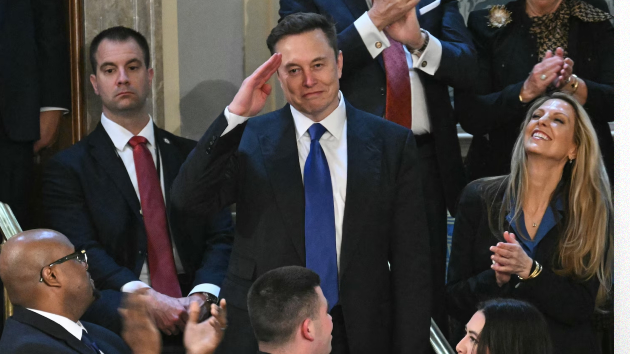
(WASHINGTON) — Less than an hour after President Donald Trump finished his joint address to Congress on Tuesday, lawyers cited his words as evidence in a lawsuit challenging Elon Musk’s role in the administration’s drastic cuts to federal spending, workers and services.

Lawyers representing a group of nonprofits and unions that are challenging the legality of the Department of Government Efficiency, or DOGE, included an excerpt from the speech in their filing Tuesday with the U.S. District Court for Washington, D.C., to argue that more information is “urgently needed to ascertain the nature” of the budget-slashing group.

The White House has represented that DOGE is run by acting administrator Amy Gleason, rather than by Musk. However, during his address before a joint session of Congress Tuesday, Trump clearly identified Musk as the person running DOGE, seemingly contradicting his own administration.

“To further combat inflation, we will not only be reducing the cost of energy, but will be ending the flagrant waste of taxpayer dollars. And to that end, I have created the brand new Department of Government Efficiency, DOGE. Perhaps you’ve heard of it. Perhaps. Which is headed by Elon Musk, who is in the gallery tonight,” Trump said during his address, with Musk himself present and watching the speech.

Musk was seen accepting the praise and thanking the president.

The Tuesday-night filing was submitted in a case challenging the legality of DOGE by arguing it had not complied with the terms of the Federal Advisory Committee Act, which governs how the government runs advisory commissions.

As DOGE’s influence grows throughout the federal government, its exact nature and its relationship with Musk remains vague. The Trump administration insists that Musk is merely a senior advisor to the president and that DOGE should be exempt from the Freedom of Information Act.

In a separate filing Wednesday morning, the plaintiffs’ attorneys asked a federal judge to fast-track their case this week by expediting discovery – the process by which the parties in a legal matter exchange evidence.

“The factual background of this case is in a constant state of flux, all due to the Government’s inconsistent positions regarding the nature of the work Elon Musk performs,” they wrote in the filing.

Lawyers representing DOGE oppose the request to fast-track the case, according to the plaintiff’s attorneys.

While Trump’s remarks during his address before Congress on Tuesday are unlikely to dramatically change the trajectory of the court case, the filing demonstrates the growing and complicated entanglement between the president’s claims, the arguments made by Department of Justice lawyers in court, and the nearly one hundred lawsuits challenging the Trump administration.

Copyright © 2025, ABC Audio. All rights reserved.

Republicans move to censure Democrat Al Green after he disrupted Trump’s address

Republicans move to censure Democrat Al Green after he disrupted Trump’s address
ALLISON ROBBERT/AFP via Getty Images

(WASHINGTON) — House Republicans are moving to censure Democratic Rep. Al Green after his disruptions during President Donald Trump’s speech to a joint session of Congress Tuesday night.

By Wednesday morning, several members of the GOP conference have been circulating different resolutions to censure Green, who was ejected from the House chamber on Tuesday night after interrupting Trump’s remarks multiple times.

Republican Rep. Dan Newhouse was the first to formally introduce a resolution on the House floor on Wednesday. His measure was introduced as privileged, meaning the House must take it up within two legislative days.

“Decorum and order are the institutional grounds for the way we do business in the United States Congress, and the sheer disregard for that standard during President Trump’s address by the gentleman from Texas is unacceptable,” Newhouse said in a statement. “A Member’s refusal to adhere to the Speaker’s direction to cease such behavior, regardless of their party, has and will continue to be reprimanded in the people’s House.”

The House Freedom Caucus also said on Wednesday that it plans to introduce a censure resolution against Green.

Green’s outburst happened within minutes of Trump’s address, when the president called his electoral victory a “mandate.”

Green, an 11-term Democrat representing the Houston area, stood up and pointed his cane as he shouted, “You have no mandate to cut Medicaid.”

Speaker Mike Johnson slammed his gavel and gave a warning to lawmakers assembled to maintain decorum, telling Green several times to take his seat. As Green continued to protest, Johnson called for him to be removed.

Johnson said after Trump’s address that Green should be censured and that he would “absolutely” put a resolution on the floor after its introduction. He told reporters, “it’s a spectacle that was not necessary. He’s made history in a terrible way. And I hope he enjoys it.”

On “Good Morning America” on Wednesday morning, Johnson also defended his decision to have Green removed.

“Al Green was trying to interrupt the entire proceeding. But look, I’ll just say this. If the Democrats want a 77-year-old congressman to be the face of their resistance, heckling the president, then bring it on,” he said.

Green told ABC News late Tuesday night he’d accept any “punishment” from his heckling as he was “following the wishes of conscience.”

“There are times when it it better to stand alone than not stand at all,” Green said.

“At some point, we’re all going to have to stand up,” he added.

Alexandra Hutzler contributed to this report.

Copyright © 2025, ABC Audio. All rights reserved.

Ontario Premier Doug Ford reacts to Trump’s tariffs, plans to remove American liquor and implement surcharge on electricity

Ontario Premier Doug Ford reacts to Trump’s tariffs, plans to remove American liquor and implement surcharge on electricity
ABC News

(TORONTO) — Ontario Premier Doug Ford said Wednesday that President Donald Trump’s tariffs against Canada are the “craziest idea.”

The premier spoke with ABC News Live to share his reaction to Trump slapping a 25% tariff on goods coming from Canada on Tuesday, which Ford said “caught everyone off guard.”

Ford first responded to the tariffs on Tuesday, saying he will implement a 25% export tax on electricity powering homes in the United States and will remove American liquor and beer off Canadian shelves.

“That’s the last thing I want to do. I want to put more alcohol on the shelves. I want to give you more electricity. I want to do everything I can to have a great relationship with our closest friends that we absolutely love,” Ford told ABC News.

Ford said on Tuesday his government would end a contract with Elon Musk-owned satellite internet service Starlink and shut off power to the U.S., impacting millions on homes in Minnesota, Michigan and New York.

“It’s not the people of America, it’s not the elected officials, it’s one person that has caused this issue, and that was President Trump,” Ford said. “We have to retaliate — as much as we don’t want to — to our closest friends and allies.”

Ontario sends a “tremendous amount of electricity” to the United States, Ford said, adding he must “protect our country” after Trump’s attacks on their economy.

“We look at the U.S. as a family member,” Ford told ABC News. “It’s like we’re their little brother or little sister and it’s been going on for 200 years. Now we have to protect our country against our great ally.”

Ford said he met with the U.S. Commerce Secretary Howard Lutnick on Tuesday, calling him a “super bright individual.” Ford told Lutnick to not “attack your closest friend and ally,” and that he wants to have a “fair trade agreement.”

“We help each other,” Ford said. “We send lumber, aluminum, steel and high-grade nickel to keep your manufacturing going. Along with electricity and oil, the list just keeps going on and on. That’s the way it’s been for over a century. We want to continue doing that.”

Canadian Prime Minister Justin Trudeau also spoke out against the tariff decision on Tuesday, calling it a “dumb” policy that does not “make sense.”

During Trump’s joint session of Congress on Tuesday night, he said he would implement additional reciprocal tariffs starting in April, a decision that Ford said will “hurt Canadians and Americans” and will cause inflation on both sides of the country.

“You’ll see plants close in the U.S., possibly assembly lines in the auto sector will close in the next five days, and for what reason? I do not understand, I think it’s the craziest idea someone could ever come up with,” Ford said.

Ford reaffirmed his love for Ontario’s American neighbors, calling them the “best in the world,” and that this retaliation to the tariffs is not directed toward them.

On Feb. 27, Trump alleged fentanyl had continued to enter the U.S. through Mexico and Canada despite agreements reached last month to address the issue. However, only 1% of the fentanyl confiscated by U.S. Customs and Border Protection actually enter through the Canadian border.

“We cannot allow this scourge to continue to harm the USA, and therefore, until it stops, or is seriously limited, the proposed TARIFFS scheduled to go into effect on MARCH FOURTH will, indeed, go into effect, as scheduled,” Trump said in a post on Truth Social.

“They misjudged the will of the Canadian people and the strength of the Canadian people,” Ford said. “Let’s get through this.”

Copyright © 2025, ABC Audio. All rights reserved.

Judge weighing whether to compel Trump administration to unfreeze FEMA funds

Judge weighing whether to compel Trump administration to unfreeze FEMA funds
Ricky Carioti/The Washington Post via Getty Images

(WASHINGTON) — A federal judge is weighing whether to compel the Trump administration to unfreeze millions of dollars in previously allocated FEMA funds.

A coalition of 22 Democratic attorneys general says the administration is illegally withholding the funds despite a court order requiring their payment.

The attorneys general have asked the judge to compel the Trump administration to unfreeze the payments, alleging that at least 16 states have been unable to access money from 140 FEMA grants.

According to their motion filed in federal court on Friday, programs whose funds have been frozen include wildfire prevention, emergency management, terrorism prevention, cybersecurity, and flood mitigation.

“The safety of our residents is not a game and should not be subject to partisan politics and retribution from the President and his appointees,” said New Jersey Attorney General Matt Platkin, one of the 22 attorneys general who filed the motion.

In January, a federal judge in Rhode Island prohibited the Trump administration from unilaterally freezing federal funding. While the Trump administration unfroze some of the funds, the attorneys general allege that the federal government continues to withhold millions in FEMA funding.

Their court filing included multiple examples of FEMA’s payment system showing the grants continuing to be frozen.

The dispute about the FEMA funds comes as the Trump administration is considering reshaping or abolishing FEMA. In January, Trump signed an executive order to begin the process to reform or consider “getting rid of” the agency tasked with disaster relief.

Copyright © 2025, ABC Audio. All rights reserved.

Mayors from ‘sanctuary cities’ grilled during House hearing

‘Blood on your hands’: Mayors from ‘sanctuary cities’ grilled during House hearing
Al Drago/Bloomberg via Getty Images

(WASHINGTON) — The mayors of Boston, Chicago, Denver and New York City faced a fiery House Oversight Committee during a blockbuster hearing on sanctuary cities on Wednesday.

Boston Mayor Michelle Wu, Chicago Mayor Brandon Johnson, Denver Mayor Mike Johnston, and New York City Mayor Eric Adams all defended their actions on immigration enforcement in their respective cities as Republicans on the committee accused them of increasing crime and impeding on law enforcement actions.

“The mayors here today each lead so-called ‘sanctuary cities,’ and let’s be clear, these policies only create sanctuary for criminals,” Chairman James Comer, a Republican, said in his opening remarks.

“Today, mayors Wu, Johnson, Johnston and Adams will be publicly accountable for their failure to follow the law and protect the American people.”

Sanctuary cities still enforce U.S. federal immigration laws, but the term often refers to a limited collaboration with U.S. Immigration and Customs Enforcement while enacting policies that are more favorable to undocumented people.

Democrats immediately criticized the Trump administration, arguing the overreach of federal officials has led to unlawful detentions and created fear in communities.

“Republicans have hauled before us the mayors of four major American cities to frame them as lawless, because those cities have some limits on how intrusively and aggressively their own officials can conduct federal immigration operations and responsibilities,” Ranking Member Gerry Connolly said.

“Let’s be clear, the state and local laws that Republicans have issue with today are in full compliance with federal law. They do not obstruct ICE from carrying out its duties, and they are backed by evidence demonstrating that they keep people safe.”

Throughout the hearing, the mayors took turns defending their status, describing how they work with law enforcement on arrests while also creating policies that make their cities more safe.

“As mayor, I do not control who enters or remains in our country, but I do have to manage the population that is within our city,” said Adams, who said as New York City mayor he is working with the Trump administration on immigration aid. “In order to carry out this function without having long term negative ramification, I must create an atmosphere that allows every law abiding resident, documented or not to access vital services without fear of being turned over to federal authorities.”

Wu said that the Trump administration is making “hard-working, tax-paying, God-fearing residents afraid to live their lives.”

“A city that scared is not a city that’s safe. A land ruled by fear is not the land of the free,” Wu said.

Wednesday’s committee hearing comes as President Donald Trump’s administration officials have ramped up their immigration enforcement efforts with Attorney General Pam Bondi shutting down federal grants to sanctuary cities and multiple threats “border czar” Tom Homan has issued toward these mayors if they refuse to comply.

On Tuesday, Bondi said efforts to crack down on immigration enforcement would increase in Boston, citing a lack of effort from Wu to prosecute undocumented immigrants.

“As a result of the Mayor’s decision to side with public safety threats over law-abiding citizens, DOJ will have no choice but to increase efforts in the city of Boston. Criminals will be prosecuted, illegal aliens will be arrested, and justice will be served,” Bondi posted on X.

Copyright © 2025, ABC Audio. All rights reserved.

Mayors from ‘sanctuary cities’ testify before Congress

‘Blood on your hands’: Mayors from ‘sanctuary cities’ grilled during House hearing
Al Drago/Bloomberg via Getty Images

(WASHINGTON) — The Mayors of Boston, Chicago, Denver and New York City are testifying on Wednesday in front of the House Oversight Committee during a blockbuster hearing on sanctuary cities.

Boston Mayor Michelle Wu, Chicago Mayor Brandon Johnson, Denver Mayor Mike Johnston and New York City Mayor Eric Adams are all set to defend their actions on immigration enforcement in their respective cities as Republicans on the committee have already warned they won’t be holding back.

“The mayors here today each lead so-called ‘sanctuary cities,’ and let’s be clear, these policies only create sanctuary for criminals,” Chairman James Comer, a Republican, said in his opening remarks.

“Today, mayors Wu, Johnson, Johnston and Adams will be publicly accountable for their failure to follow the law and protect the American people.”

Sanctuary cities often have limited cooperation with U.S. Immigration and Customs Enforcement, which enforces U.S. immigration laws around the country. Sanctuary cities often have policies that are welcoming to illegal immigrants.

Wednesday’s committee hearing comes as President Donald Trump’s administration officials have ramped up their immigration enforcement efforts with Attorney General Pam Bondi shutting down federal grants to sanctuary cities and multiple threats “border czar” Tom Homan has issued toward these mayors if they refuse to comply.

On Tuesday, Bondi said efforts to crack down on immigration enforcement would increase in Boston, citing a lack of effort from Wu to prosecute undocumented immigrants.

“As a result of the Mayor’s decision to side with public safety threats over law-abiding citizens, DOJ will have no choice but to increase efforts in the city of Boston. Criminals will be prosecuted, illegal aliens will be arrested, and justice will be served,” Bondi posted on X.

Democrats immediately criticized the Trump administration, arguing the overreach of federal officials has led to unlawful detentions and created fear in communities.

“Republicans have hauled before us the mayors of four major American cities to frame them as lawless, because those cities have some limits on how intrusively and aggressively their own officials can conduct federal immigration operations and responsibilities,” Ranking Member Gerry Connolly said.

“Let’s be clear, the state and local laws that Republicans have issue with today are in full compliance with federal law. They do not obstruct ICE from carrying out its duties, and they are backed by evidence demonstrating that they keep people safe.”

Copyright © 2025, ABC Audio. All rights reserved.