(WASHINGTON) — President Donald Trump denied early on Tuesday having had contact with leaders in Iran, saying he hadn’t reached out about a potential ceasefire and that he was “not too much in the mood” to negotiate with Iran.
“I’ve been negotiating. I told them to do the deal,” Trump said. “They should have done the deal. The cities have been blown to pieces, lost a lot of people. They should have done the deal. I told them do the deal, so I don’t know. I’m not too much in the mood to negotiate.”
The comments came as Trump returned early Tuesday to the White House, where he’d asked his top national security staff to assemble in the Situation Room, after he departed the Group of Seven leadership summit in Canada early.
He also seemed to dismiss a recent assessment from Director of National Intelligence Tulsi Gabbard, who had said Iran wasn’t working on a nuclear weapon. Trump said on Tuesday he thought Iran was “very close” to having such a weapon.
Trump in a post on his Truth Social network also said that he hadn’t reached out to Iran “in any way, shape or form,” calling reports that he had done so “fabricated.”
“If they want to talk, they know how to reach me,” Trump said in a post early on Tuesday. “They should have taken the deal that was on the table — Would have save a lot of lives!!!”
Israel on Friday began an attack on Iran, launching a series of aerial strikes that Israeli officials described as a preemptive strike. Israeli leaders and Trump have separately called for Tehran to put an end to efforts to create nuclear weapons.
Diplomats from the United States and Iran held a series of talks in Muscat, Oman, beginning in April, with the sixth round due to begin last Sunday. Those talks were cancelled as the conflict between Israel and Iran began.
Trump was asked on Tuesday about Gabbard’s testimony in March in front of the Senate Intelligence Committee, where she said Iran was not building a nuclear weapon.
When pressed about Gabbard’s comments, Trump dismissed them.
“I don’t care what she said, I think they were very close to having one,” Trump said.
Trump has not ruled out American participation in the conflict, although the U.S. has remained on the sidelines so far. Trump has issued, however, a stern warning to Iran on Tuesday over U.S. troops and assets in the region, instructing Tehran “not to touch our troops.”
“We’ll come down so hard if they do anything to our people,” Trump told reporters aboard Air Force One.
This is a developing story. Please check back for updates.
(WASHINGTON) — Senators will be briefed by law enforcement on Tuesday on safety and security after the murder of a Minnesota lawmaker and her husband and the wounding of another and his wife on Saturday.
House Republicans held a conference call, which was described as “tense,” on Saturday with the House sergeant at arms and U.S. Capitol Police to discuss their concerns, multiple sources familiar with the call told ABC News. Several Republicans said on the one-hour call that they feel unsafe in their home districts and want more protection, sources said.
The key source of contention in particular was the request of police outside their homes at all times and law enforcement authorities saying they need more funding from Congress to provide that.
Senators will be briefed by the Senate sergeant at arms and Capitol Police on Tuesday morning, two sources familiar told ABC News, after it was requested by Majority Leader John Thune and Minority Leader Chuck Schumer.
House Democrats are expected to have a similar call in the coming days. Minority Leader Hakeem Jeffries said in a statement Saturday that he asked the sergeant at arms and Capitol Police to “ensure the safety” of the Minnesota delegation and members of Congress “across the country.”
While House and Senate leadership are provided with a security detail, rank-and-file members are not routinely protected unless there is a specific threat.
Minnesota Sen. Amy Klobuchar told ABC News’ “This Week” on Sunday that political violence is a “rampant problem.” Fellow Minnesota Sen. Tina Smith told NBC News on Sunday, “I don’t want to think that I have to a personal security detail everywhere I go, but I think we really have to look at the situation that we’re in.
“This is no way for our government to work when people, any number of us, feel this kind of threat,” she said.
Rep. Jared Moskowitz said he might force a vote on a “secret session” in the House to discuss security and so that “members can handle this ourselves.”
Vance Boelter, 57, faces multiple federal charges in the killing of Democratic Minnesota state Rep. Melissa Hortman and her husband, Mark, and wounding Democratic state Sen. John Hoffman and his wife, Yvette, in “political assassinations,” acting U.S. Attorney for the District of Minnesota Joseph Thompson said Monday.
In a 20-page affidavit, prosecutors outlined how they say Boelter “embarked on a planned campaign of stalking and violence, designed to inflict fear, injure and kill members of the Minnesota state legislature and their families.” He allegedly had firearms and a list of 45 elected officials, “mostly or all Democrats,” according to prosecutors. Authorities say Boelter traveled to the homes of at least four public officials during the early morning hours of Saturday before the killings.
The number of threats and “concerning statements” against members of Congress, their families and staffs has risen for the past two years, according to Capitol Police, which pointed out that threats tend to increase during election years. The Capitol Police’s Threat Assessment Section investigated 9,474 threats and statements in 2024 and 8,008. It investigated 3,939 cases in 2017.
ABC News’ Isabella Murray contributed to this report.
(WASHINGTON) — President Donald Trump on Monday doubled down on his goal to conduct mass deportations in some of the country’s biggest cities, specifically those run by Democrats.
As he met with Canadian Prime Minister Mark Carney at the G7 summit in Alberta on Monday, Trump said Immigration and Customs Enforcement should turn its attention to New York and Chicago in addition to Los Angeles.
“I want them to focus on the cities because the cities are where you really have what’s called ‘sanctuary cities,'” Trump told reporters. “And that’s where the people are.”
The comments came after Trump’s lengthy social media post on Sunday in which said he was ordering ICE to do “all in their power” to oversee the largest mass deportation program in history.
“In order to achieve this, we must expand efforts to detain and deport Illegal Aliens in America’s largest Cities,” Trump wrote.
The president said those cities are “the core of the Democrat Power Center” and accused Democrats of using illegal immigration to influence elections — despite the fact that noncitizens can’t vote in federal or state elections and instances where it occurs are rare. He also claimed without evidence that illegal immigrants were being used to “grow the Welfare State.”
“To ICE, FBI, DEA, ATF, the Patriots at Pentagon and the State Department, you have my unwavering support. Now go, GET THE JOB DONE!” Trump wrote in the post.
Trump’s determination on deportations follows protests in LA and in other areas around the country last week to his administration’s immigration crackdown. This past Saturday, immigration was one focus of nationwide “No Kings Day” demonstrations against Trump and his policies that drew thousands of people.
Amid the pushback, Trump last week shifted his stance on undocumented immigrants who work in the farming and hospitality industries.
Trump acknowledged on social media that his “aggressive policy” was “taking very good, long time workers away.” The Department of Homeland Security later confirmed they received new guidance to pause most raids on farms, restaurants and hotels.
“Our farmers are being hurt badly, they have good workers that have worked for them for 20 years. They are not citizens, but turned out to be great. We will do something about that,” Trump said at a White House event last week.
Such comments undercut what he and his top officials have said would be a focus on the “worst of the worst” violent or criminal offenders in their deportation efforts.
ABC News’ Hannah Demissie contributed to this report.
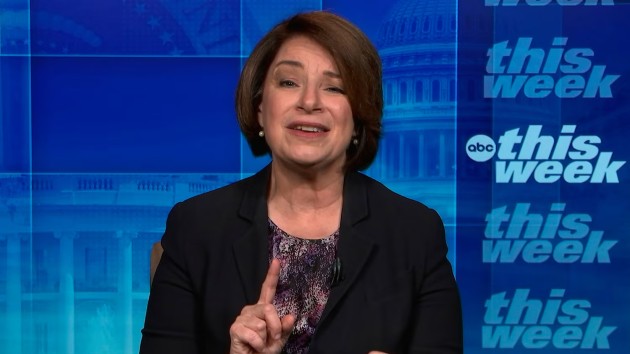
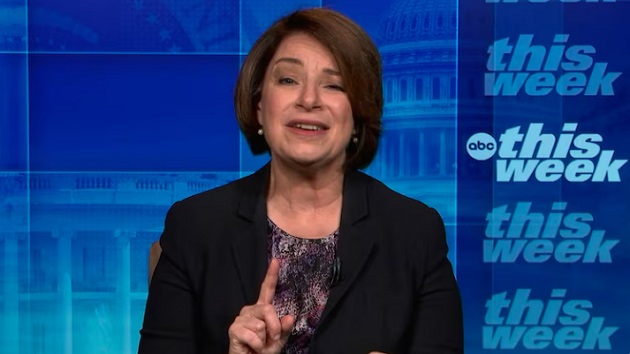
Sen. Amy Klobuchar speaks with ABC News while appearing on This Week, June 15, 2025. ABC News
(WASHINGTON) — The killing of a Minnesota lawmaker and her husband sent shockwaves through the political world and appeals from elected officials to turn down heated rhetoric.
Democratic State Rep. Melissa Hortman and her husband were killed on Saturday by a masked gunman disguised as a police officer. Hours before, Minnesota State Sen. John Hoffman, also a Democrat, and his wife had been both shot multiple times at their home.
The back-to-back attacks are part of a disturbing trend of violence against public officials at the state and local level.
The tragedies prompted swift condemnation from Democrats and Republicans on Capitol Hill and around the country.
The entire Minnesota delegation, led by House Majority Whip Tom Emmer and Minnesota Sen. Amy Klobuchar, released a joint statement in response to the targeting of Hortman and Hoffman.
“Today we speak with one voice to express our outrage, grief, and condemnation of this horrible attack on public servants,” they said. “There is no place in our democracy for politically-motivated violence. We are praying for John and Yvette’s recovery and we grieve the loss of Melissa and Mark with their family, colleagues, and Minnesotans across the state. We are grateful for law enforcement’s swift response to the situation and continued efforts.”
On PBS News on Sunday, the Minnesota senator added, “This is a very bad environment, and we need to bring the tone down.”
Senate Minority Leader Chuck Schumer said he requested increased protection for Klobuchar and Sen. Tina Smith, another Minnesota Democrat. Schumer, a New York Democrat, said he urged “everyone to stay safe, stay vigilant, and reject political violence in all its forms.”
“But condemning violence while ignoring what fuels it is not enough,” Schumer added in a statement. “We must confront the toxic forces radicalizing individuals and we must do more to protect one another, our democracy, and the values that bind us as Americans.”
House Minority Leader Hakeem Jeffries similarly said he’s asked the Sergeant at Arms and Capitol Police to “ensure the safety” of the Minnesota delegation and members of Congress “across the country.”
“Our country is on edge like never before. We need leadership that brings America together, instead of tearing us apart. Violence is never the answer,” Jeffries said in a statement.
Republican leadership, too, spoke out against the shootings.
“Such horrific political violence has no place in our society, and every leader must unequivocally condemn it,” House Speaker Mike Johnson wrote on X.
Former House Speaker Nancy Pelosi, whose husband was struck in the head with a hammer in their California home in 2022, called the Minnesota shootings “a shocking and abhorrent manifestation of political violence in our country.”
“Unfortunately, we know the tragedy of when political violence hits home very well. All of us must remember that it’s not only the act of violence, but also the reaction to it, that can normalize it. This climate of politically-motivated violence must end,” Pelosi wrote on X.
Sen. Adam Schiff, a California Democrat, on NBC’s “Meet the Press” on Sunday said “coarsening of the political dialogue” and “the flirtation with violence” has to stop.
“We all have to acknowledge on both sides of the aisle the need to bring about a more civil discourse, but the need to condemn political violence no matter who the target is,” Schiff said.
State lawmakers, too, said this could not become the new norm in American society.
In California, state Assembly Speaker Robert Rivas and Assembly Leader James Gallagher — a Democrat and Republican, respectively — issued a joint statement calling on “everyone to take down the temperature, respect differences of opinion and work toward peace in our society.”
Colorado’s Democratic Gov. Jared Polis and Oklahoma’s Republican Gov. Kevin Stitt, who lead the National Governors Association, called on all Americans to reject political violence and “recommit to the values of civility, respect, and peaceful democratic discourse.”
“Now more than ever, we must come together as one nation to ensure that our public square remains a place of debate, not danger,” Polis and Stitt said in a statement.
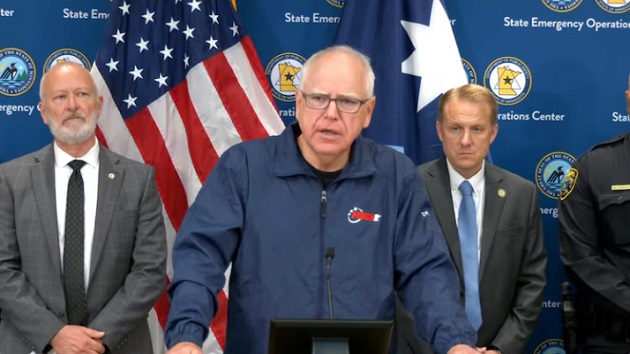
In Minnesota, Democratic Gov. Tim Walz said America is “not a country that settles our differences at gunpoint.”
“We have demonstrated again and again in our state that it is possible to peacefully disagree, that our state is strengthened by civil public debate,” Walz wrote in a statement.
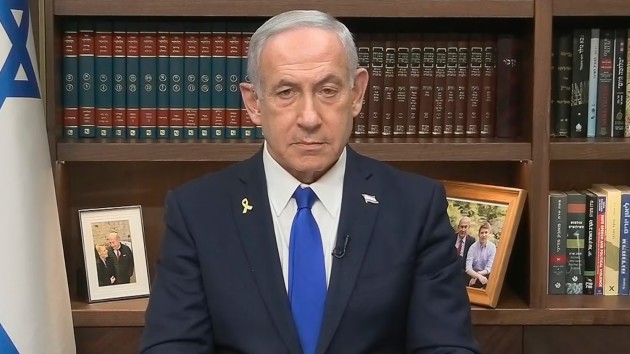
(WASHINGTON) — Israeli Prime Minister Benjamin Netanyahu told ABC News on Monday that targeting Iran’s Supreme Leader Ali Khamenei would end, not escalate, the ongoing fight between Israel and Iran that erupted late last week.
When asked by ABC News Chief Washington Correspondent Jonathan Karl about reports from ABC News and other outlets that President Donald Trump rejected an Israeli plan to assassinate Iran’s Supreme Leader, concerned that it would escalate the conflict, Netanyahu said, “It’s not going to escalate the conflict, it’s going to end the conflict.”
“We’ve had half a century of conflict spread by this regime that terrorizes everyone in the Middle East; has bombed the Aramco oil fields in Saudi Arabia; is spreading terrorism and subversion and sabotage everywhere,” Netanyahu said. “The ‘forever war’ is what Iran wants, and they’re bringing us to the brink of nuclear war. In fact, what Israel is doing is preventing this, bringing an end to this aggression, and we can only do so by standing up to the forces of evil.”
Asked if Israel would indeed target the supreme leader, Netanyahu said that Israel was “doing what we need to do.”
“I’m not going to get into the details, but we’ve targeted their top nuclear scientists,” Netanyahu told. “It’s basically Hitler’s nuclear team.”
Netanyahu said it in America’s interest to support Israel as it seeks to eliminate Iran’s nuclear program.
“Today, it’s Tel Aviv. Tomorrow, it’s New York. Look, I understand ‘America First’. I don’t understand ‘America Dead’. That’s what these people want. They chant ‘Death to America.’ So we’re doing something that is in the service of mankind, of humanity, and it’s a battle of good against evil. America does, should, and does stand with the good. That’s what President Trump is doing, And I deeply appreciate his support,” he told Karl.
Israel’s prime minister also dismissed a Wall Street Journal report that Iran has signaled to partners that it is seeking to end hostilities and resume negotiations over its nuclear program.
“I’m not surprised. I mean, they want to continue to have these fake talks in which they lie, they cheat, they string the U.S. along. And, you know, we have very solid Intel on that,” he said. “They want to keep on building their nuclear weapons and building their mass ballistic missile arsenal, which they’re firing at our people. They want to continue to create the two existential threats against Israel while they’re talking. That’s not going to happen.”
Asked to respond to some Republicans opposed to America’s military support for Israel’s strikes against Iran, including commentator Tucker Carlson, Netanyahu said Iran is a “threat to the entire world.”
“We’re not just fighting our enemy. We’re fighting your enemy. For God’s sake, they chant, “death to Israel, death to America.” We’re simply on their way. And this could reach America soon,” Netanyahu said.
In his Friday newsletter, Carlson wrote that “The United States should not at any level participate in a war with Iran. No funding, no American weapons, no troops on the ground,” and that the United States should let Israel ‘fight their own wars’.
“We’re taking the action. America is supporting us in defense. Deeply, deeply appreciated. But this is a threat to the entire world,” Netanyahu said. “It’s a threat to Israel; as I said — to our Arab neighbors; to Europe; to America. They chant ‘Death to America.’ It’s though — ‘This is not your business’? This is not myopia. This is utter blindness.”
“Sometimes you have to take a stand against evil. And that’s what the American people instinctively understand. Most of them, I have to say. And that’s what President Trump understands. We cannot let that happen,” he added.
In an updated travel advisory on Monday, the State Department appears to have classified all of Israel and the West Bank as “Level 4: Do Not Travel”—its highest advisory level.
Sen. Amy Klobuchar mourned the two Minnesota state lawmakers shot early Saturday at their homes in what leaders are calling an “act of targeted political violence,” calling them “friends” and “decent people” who were simply “trying to represent the people that they were elected to represent.”
The Minnesota Democrat told ABC News’ “This Week” co-anchor Martha Raddatz that people should “know” the victims of political violence and threats — in this case, state Rep. Melissa Hortman, who was killed alongside her husband, and state Sen. John Hoffman and his wife, who underwent surgery after the attack.
“She was a true leader, and I loved her work, but was always so grounded and such a decent person. I think that’s probably the best word to describe her. You look at her pictures and you know what she was about. So we miss her greatly, and so when you hear about statistics about political violence and threats, I just want people to know who we’re talking about,” Klobuchar said about Hortman.
“Or Senator Hoffman. Equally respected. Got into politics because his daughter has spina bifida and she couldn’t get insurance, and he wanted to advocate for her. Decent people who didn’t deserve this to happen to them,” Klobuchar continued.
Authorities have identified 57-year-old Vance Luther Boelter as the suspected gunman and are continuing to search for him.
Klobuchar described Hortman as an illustrious lawmaker and compassionate public servant, who began her career in public service as a mother with young children who had a background working at her father’s auto parts company. Hortman easily juggled teaching Sunday school, leading a Girl Scout troop and training service dogs for veterans, Klobuchar said.
The senator said she first got to know Hortman when she was a young lawmaker and she was struck with how she was able to know “practically every person in her district.”
“Melissa Hortman was a woman that I wish everyone around the country knew,” Klobuchar told Raddatz. “When you think about a true public servant who goes into it for the right reasons, it’s Melissa.”
Klobuchar said that Hortman’s ability to “juggle it all” may have contributed to the political success she’d been able to notch, especially in the past year with a divided legislature, when she worked alongside the state Senate’s Republican leader to artfully negotiate a budget and avoid government shutdown.
When she was the Speaker of the House, Hortman also spearheaded landmark legislation like paid family leave and free lunch for students, Klobuchar said.
Klobuchar called the suspect “evil,” and “smart” on Sunday.
“He’s evil. He is smart. He has killed without a second thought, and there’s a $50,000 reward,” she told Raddatz.
The Minnesota Democrat lauded the cooperation between Minnesota leaders and state law enforcement.
“We couldn’t be getting more help from law enforcement,” Klobuchar said, applauding also local police officers’ swift work on the ground, when they checked in on Hortman soon after getting called to Hoffman’s house.
“Those local police officers at that moment not only appear to have saved [Hoffman] and his wife’s life, but also had given us major leads to who he was and why he was doing this,” Klobuchar said.
Klouchar said she “hasn’t seen” the target list written by the gunman, something that law enforcement sources say had dozens of Minnesota Democrats on it.
Those on the list included Minnesota lawmakers Gov. Tim Walz, U.S. Rep. Ilhan Omar, U.S. Sen. Tina Smith and state Attorney General Keith Ellison, according to law enforcement sources familiar with the matter.
Klobuchar called political violence a “rampant problem” and said she “believes” that could have been one of the gunman’s motivations for the Minnesota lawmaker shootings.
“I believe that there’s some things in the manifesto that would lead you down that trail to believe that this was one of his motivating forces,” Klobuchar said.
She also highlighted the bipartisan statement against political violence that the Minnesota congressional delegation released after the shootings on Saturday.
“You speak with one voice to condemn this political violence. There’s no place for this politically motivated violence in our democracy,” Klobuchar said on Sunday. “This is a rampant problem that the public and all of us have to deal with — and also against judges, and all of us should condemn all of that violence,” she said.
President Donald Trump said Sunday the United States is not involved in Israel’s military strikes against Iran, but “it’s possible we could get involved.”
That comes after reports that Israel had urged the U.S. to join the conflict with Iran to eliminate its nuclear program.
In an interview with ABC News’ Rachel Scott, Trump declined to comment on whether Israeli Prime Minister Benjamin Netanyahu made a personal plea for the U.S. to get more involved.
“We’re not involved in it. It’s possible we could get involved. But we are not at this moment involved,” the president said.
Trump also shared that he had a lengthy call with Russian President Vladimir Putin on Saturday to discuss, in large part, the conflict in the Middle East.
The president told ABC News he would be “open” to Putin’s idea to serve as a mediator between Iran and Israel.
“I would be open to it. [Putin] is ready. He called me about it. We had a long talk about it. We talked about this more than his situation. This is something I believe is going to get resolved,” Trump stated.
The president’s special envoy, Steve Witkoff, was set to travel to Oman on Sunday for another round of nuclear talks with Iranian officials. But following Israel’s strikes, Iran called off the meeting. Iranian Foreign Minister Abbas Araghchi called the nuclear negotiations “unjustifiable” after the attacks, which he said were carried out with the support of the U.S.
The president, who stated he gave Iran a “60-day ultimatum” to “make a deal,” told ABC News he is not setting a new deadline.
“No, there’s no deadline. But they are talking. They’d like to make a deal. They’re talking. They continue to talk,” the president said, referring to Iran.
“Something like this had to happen because I think even from both sides, but something like this had to happen. They want to talk, and they will be talking,” the president added.
Iran’s foreign minister told a meeting of ambassadors in Tehran on Sunday that Israel’s ongoing attacks on the country could not have happened “without the agreement and support of the United States” and insisted Iranian officials do not ‘believe the U.S.’s claim’ that it had no involvement.
Despite the stalled talks over Iran’s nuclear program, the president expressed optimism that the strikes will bring Iran to the table quickly.
“May have forced a deal to go quicker, actually,” Trump said.
President Donald Trump told ABC News on Sunday that he “may” call Minnesota Gov. Tim Walz after a political assassination sent shockwaves through the state.
The president, who condemned the violence, called the Democratic governor a “terrible governor” and “grossly incompetent” in an interview with ABC News’ Rachel Scott.
“Well, it’s a terrible thing. I think he’s a terrible governor. I think he’s a grossly incompetent person. But I may, I may call him, I may call other people too,” the president told Scott.
Minnesota is reeling from two back-to-back shootings. Authorities say a masked gunman disguised as a police officer shot and killed Minnesota state Rep. Melissa Hortman, a former speaker of the state House, and her husband Mark, and wounded a state senator and his wife early Saturday.
The suspected gunman, 57-year-old Vance Luther Boelter, fled on foot and remains on the run.
Walz called the shootings an “act of targeted political violence.”
The president condemned the violence shortly after the attack.
“Such horrific violence will not be tolerated in the United States of America. God Bless the great people of Minnesota, a truly great place,” he said.
A source close the Walz told ABC News that Walz and Vice President JD Vance spoke regarding the shootings.
“The Governor expressed appreciation for the ongoing coordination between federal law enforcement and Minnesota public safety officials,” the person said.
Another source familiar with the Minnesota governor told ABC News early Sunday afternoon that Trump has not called Walz.
The source said that former President Joe Biden called Walz “right away.”
The White House said in a statement that the FBI and the attorney general’s office will investigate the shootings and “will be prosecuting anyone involved to the fullest extent of the law.”
Police say the suspected gunman allegedly had dozens of Minnesota Democrats on a target list, which was retrieved from the his vehicle.
The assassination comes amid growing concerns about political violence in the U.S. following the recent killing of two Israeli embassy staffers in Washington, the arson attack at the home of Pennsylvania Gov. Josh Shapiro, and the attempted assassination of Trump last summer.
ABC News’ Hannah Demissie contributed to this report.
(WASHINGTON) — In June 2024, Army Chief of Staff Gen. Randy George and his aides were at a Virginia military base where the service was putting on one of its live-action shows for kids and families.
The event — a decades-long tradition known as the “Twilight Tattoo” — was a spectacle. Soldiers from ceremonial units reenact the history of the Army, complete with Revolutionary War garb, music, theatrical vignettes and military pageantry, all meant to serve as a kind of salute to Army soldiers and their families.
George and his top communications adviser, Col. Dave Butler, were attending with several media executives, when one of them leaned over.
“This would make great television,” the executive said, according to Butler.
George and his staff had already been talking about how to celebrate the Army’s 250th birthday. Maybe, they thought, the National Park Service would let them host one of their live-action shows on the National Mall, the officials thought.
After President Donald Trump took office and the June 14 birthday was getting closer, the Army began to toss around more ideas. One idea was to add tanks or other iconic Army equipment to an exhibit parked on the National Mall where tourists could learn about the Army’s history of fighting the nation’s wars.
Butler said he doesn’t remember who first broached the idea of turning the Army’s show into a parade. But once the idea was floated, no one seemed to push back.
By June, the Army had a plan of what they would include: 6,700 soldiers, 150 vehicles, including dozens of tanks, 50 aircraft flying overhead including World War II-era planes and high-tech weaponry like rocket launchers.
Trump, a former media executive himself, seemed game to the idea. One official involved in the planning described it like “knocking on an unlocked door.”
“We wanted to reintroduce this nation’s Army to the American people,” Butler said. “To do that, we thought we needed to be in their living rooms and on their phones. We needed something that would catch the national eye.”
Criticism over cost
As the Army prepares for its birthday parade in downtown Washington on Saturday, not everyone is on board. About 6 in 10 Americans say that Saturday’s parade is “not a good use” of government money, according to a new poll from The Associated Press-NORC Center for Public Affairs Research.
The White House has not released an estimate of the parade’s cost, with only the Army’s portion of moving troops and equipment expected to cost up to $45 million. Security is expected to add significantly to the price tag.
Democrat Sen. Tammy Duckworth of Illinois, an Army veteran who deployed with the Illinois National Guard during the Iraq War, said the money would be better spent on helping troops pay for essentials like child care.
“Donald Trump’s birthday parade has nothing to do with celebrating the Army’s 250th birthday — it’s to stroke his own ego and make taxpayers foot the bill,” said Duckworth.
Duckworth and other Trump critics also note a military parade is often associated with countries like Russia and North Korea, where dictators march its soldiers and equipment through their streets. Advocates are organizing protests in cities other than Washington — dubbed the “No Kings” protests.
Trump, who turns 79 on Saturday, said he wants a military parade to show how great the country is. The president first pushed the idea in 2017 after attending the Bastille Day parade and celebration in France, saying he wanted to “try and top it.” That effort was canceled after price estimates topped $90 million.
When asked Thursday what he hopes the public will remember about the American parade, Trump said, “How great our country is, very simple, and how strong our military is.”
“We have the strongest military in the world,” he added.
According to Army officials involved in the planning effort, including Butler, the White House helped the Army plan the birthday celebration as an event focused on the Army’s service to the nation.
There are no plans currently, for example, to sing the president happy birthday. The president also is not expected to speak, leaving much of the festivities to the soldiers.
According to the schedule, Trump will watch the tanks and soldiers march down Constitution Avenue from a viewing stand near the White House. Toward the end of the event, he will receive a flag from a soldier who will parachute on to the White House Ellipse. After that, the president will give the oath of enlistment to some 250 soldiers.
The event concludes with fireworks over the Tidal Basin.
Still, there are some of Trump’s fingerprints on the event. In the final days leading up to the event, the White House made an unusual request. Trump, they said, wanted the Air Force to bring its fighter jets to the Army’s party. If weather allows, the Thunderbirds will now do a flyover.
White House deputy press secretary Anna Kelly defended the move to let the Air Force participate in the Army’s birthday parade.
“The President wants the Army Birthday Parade to feature the strength, talent, and creativity of all our military servicemembers,” she said in a statement. “The Thunderbirds flyover will inspire patriotism and awe for all who attend!”
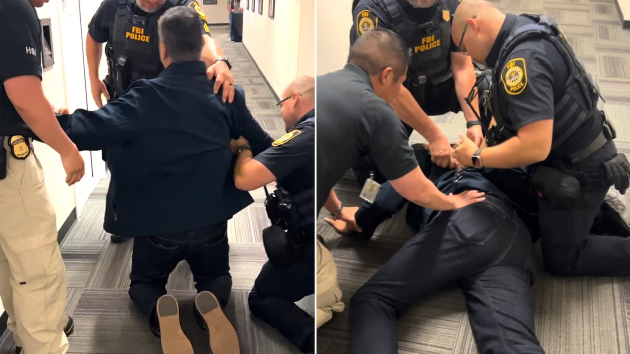
(LOS ANGELES) — California Sen. Alex Padilla has continued to defend himself and refute the claims by the Trump administration that he crashed Homeland Security Secretary Kristi Noem’s news conference before federal officers shoved him outside the room, pushed him onto the floor and handcuffed him.
Padilla, the ranking member of the Senate Judiciary Committee’s Subcommittee on Immigration, Citizenship, and Border Safety, provided more details about the incident Thursday night during an interview on MSNBC — where he said he was not a threat and merely raised his voice to ask a question.
The senator claimed he did not barge into the news conference, as alleged by Noem, but rather he was in the federal building for an approved scheduled briefing with representatives of the Northern Command. He said the meeting was delayed by Noem’s news conference, where she discussed the use of the National Guard in the city.
Padilla said he decided to go listen to the news conference and asked the National Guard and FBI agents with him if he could go.
“We’re, the whole time, being escorted in this federal building by somebody from the National Guard, somebody from the FBI. I’ve gone through screening. This is a federal building. And so, I tell them, ‘Let’s go listen to the press conference.’ They escort me over to that room,” Padilla told MSNBC.
“The folks that were escorting me in the building walked me over. I didn’t even open the door. The door was opened for me. And I spent a few minutes in the back of the room just listening in until the rhetoric, the political rhetoric got to be too much to take. So, I spoke up,” he later added.
During her news conference, Noem claimed she was going to “liberate” Los Angeles “from the socialists and the burdensome leadership this governor and mayor have placed on this country and this city.”
Padilla told MSNBC that he needed to speak out and said he introduced himself before the officers grabbed him and pushed him out of the room as onlookers filmed the incident.
Noem said law enforcement reacted because he took steps toward her without identifying himself. She told Fox News Thursday that no one knew who he was and that he was “lunging forward.”
Video of the incident captures Padilla identifying himself as he is pushed out of the room; it’s not clear from video if he said his name before the incident or as he approached the podium. Padilla was wearing a navy blue polo shirt that had the U.S. Senate logo under a navy blue jacket. He said he was not wearing a Senate pin at the time of the incident.
Padilla was not detained or arrested and he and Noem had a private conversation for “10-15 minutes” after the incident, according to both the senator and the secretary.
Noem said that Padilla will likely not be charged.
White House press secretary Karoline Leavitt on Thursday said Padilla should be “ashamed of his childish behavior.”
“He crashed the middle of an official press conference being held by a cabinet secretary, recklessly lunged toward the podium where @Sec_Noem was speaking, and then refused to leave the room and follow the directions of law enforcement officers,” Leavitt posted to X.
Democratic senators quickly came to Padilla’s defense Thursday, calling out Noem and the officers for mishandling the senator.
“This is an administration that has no respect for our democracy, for our institutions, for the separation of powers, for a co-equal branch of government Sen. Adam Schiff said.
House Speaker Mike Johnson and other Republicans chastised Padilla. Johnson claimed that censure might be needed. A vote to censure does not hold any power beyond a public condemnation of the member’s behavior and it does not deny the member privileges.
Sen. Majority Leader John Thune told reporters Thursday evening that he had spoken with Padilla and the Senate Sergeant At Arms and had attempted to reach Noem and said he was gathering facts.
“We want to get the full scope of what happened and do what we would do in any incident like this involving a senator, that is, try to gather all of the relevant information,” he said.
When asked if he thought what occurred was appropriate based on what he had so far seen, Thune said, “That’s all I’ve got to say.”