Jabin Botsford/The Washington Post via Getty Images
(WASHINGTON) — Elon Musk’s political action committee is offering Wisconsin voters $100 who sign a petition opposing “activist judges” ahead of the April 1 Wisconsin Supreme Court election, echoing the billionaire’s controversial cash giveaways during President Donald Trump’s 2024 campaign.
The petition, promoted online and at in-person events by Musk’s America PAC, asks voters in the state to reject “activist judges who impose their own views.” Wisconsin voters who sign up are eligible to receive the $100, according to the PAC.
The petition’s language mirrors recent attacks by Musk and Trump on federal judges who have ruled against the administration. It reads: “Judges should interpret laws as written, not rewrite them to fit their personal or political agendas. By signing below, I’m rejecting the actions of activist judges who impose their own views and demanding a judiciary that respects its role — interpreting, not legislating.”
The petition also allows Musk’s team to collect voter data for get-out-the-vote efforts ahead of next month’s election.
The world’s richest man has used cash giveaways in past elections, including a controversial $1 million sweepstakes to voters in swing states who signed a second amendment petition in efforts to boost Trump’s chances.
So far, two political groups aligned with Musk — America PAC and Building America’s Future — have poured nearly $20 million into supporting Republican candidate Brad Schimel.
In a memo obtained by ABC News, Building America’s Future said that internal polling showed Schimel was “within striking distance” of Democratic candidate Susan Crawford. To pull ahead, Schimel needed to “consolidate the base and present Schimel as a pro-Trump conservative,” according to the memo.
(WASHINGTON) — The Department of Government Efficiency approach’s to identifying fraud at the Social Security Administration “is tantamount to hitting a fly with a sledgehammer,” a federal judge said Thursday, blocking DOGE’s unlimited access to sensitive agency data.
In a 137-page ruling, U.S. District Judge Ellen Lipton Hollander wrote the Trump administration never justified the need to access the data — which they argued was vital to identifying alleged fraud — and likely violated multiple federal laws in doing so.
“The DOGE Team is essentially engaged in a fishing expedition at SSA, in search of a fraud epidemic, based on little more than suspicion. It has launched a search for the proverbial needle in the haystack, without any concrete knowledge that the needle is actually in the haystack,” she wrote.
The judge’s order blocks the agency from granting DOGE access to systems containing personally identifiable information and orders DOGE members to destroy any data in their possession that identifies individual taxpayers. However, the judge’s decision allows DOGE to continue to allow access anonymized data from the agency.
According to Hollander, the decision to give DOGE “unlimited access to SSA’s entire record system” endangered the sensitive and private information of millions of Americans, risking information including Social Security numbers, credit card information, medical and mental health records, hospitalization records, marriage and birth certificates, and bank information.
“The government has not even attempted to explain why a more tailored, measured, titrated approach is not suitable to the task,” she wrote. “Instead, the government simply repeats its incantation of a need to modernize the system and uncover fraud. Its method of doing so is tantamount to hitting a fly with a sledgehammer.”
The lawsuit challenging DOGE’s access was filed last month by two national unions and an advocacy group who argued DOGE’s access violated privacy laws and the Administrative Procedures Act. In a statement to ABC News, the president of the American Federation of State, County and Municipal Employees celebrated the decision as a “major win for working people and retirees across the country.”
“The court saw that Elon Musk and his unqualified lackeys present a grave danger to Social Security and have illegally accessed the data of millions of Americans,” AFSCME President Lee Saunders said in a statement.
In her decision, the judge also pointed out the irony that DOGE has accessed the sensitive information of millions of Americans while the identities of the DOGE employees working in the SSA have been concealed for privacy reasons.
“The defense does not appear to share a privacy concern for the millions of Americans whose SSA records were made available to the DOGE affiliates, without their consent,” she wrote.
(WASHINGTON) — In President Donald Trump’s escalating battle with the judiciary, he and his Republican allies have zeroed in on a similar message.
No single judge, they argue, should be able to use an injunction to block the powers of the country’s elected chief executive.
“That’s a presidential job. That’s not for a local judge to be making that determination,” Trump said on Fox News earlier this week as he railed against a judge who issued a limited injunction to stop deportation flights of alleged Venezuelan gang members to other countries after Trump invoked the Alien Enemies Act of 1798.
White House press secretary Karoline Leavitt, peppered with questions after the administration did not turn the planes around, on Wednesday preemptively offered her own rebuke of judges who’ve recently ordered injunctions taking effect nationwide.
“The judges in this country are acting erroneously,” she said. “We have judges who are acting as partisan activists from the bench. They are trying to dictate policy from the president of the United States. They are trying to clearly slow walk this administration’s agenda, and it’s unacceptable.”
The White House argues that’s especially the case when it comes to immigration matters, foreign affairs, national security and the president exercising his constitutional powers as commander in chief.
Judges have, so far, temporarily blocked Trump’s efforts to ban transgender people from serving in the military, freeze federal funding and bring an end to birthright citizenship.
Supporters of nationwide injunctions say they serve as an essential check to potentially unlawful conduct and prevent widespread harm. Critics say they give too much authority to individual judges and incentivize plaintiffs to try to evade random assignment and file in jurisdictions with judges who may be sympathetic to their point of view.
In general, legal experts told ABC News an injunction is meant to preserve the status quo while judges consider the merits of the case. (Judges also issue temporary restraining orders — with similar impact — as short-term emergency measures to prevent irreparable harm until a hearing can be held.)
“Often the nationwide injunction, or universal injunction, is put in place right at the start of a litigation,” said Amanda Frost, a professor at the University of Virginia School of Law.
“All of these can be appealed, and they are,” Frost said. “It’s appealed to a three-judge court and then the Supreme Court after that. So, when people say one district court is controlling the law for the nation, well maybe for a few weeks. The system allows for appeals, and the Trump administration has appealed.”
Chief Justice John Roberts said the same in a rare statement after Trump attacked the federal judge in the deportation flight case as a “Radical Left Lunatic” and called for him to be impeached.
In fact, Trump was handed a win when an appeals court last week lifted an injunction on his executive orders seeking to end diversity, equity and inclusion (DEI) programs in the federal government.
Nationwide injunctions are also not new, though scholars agree they’ve been used far more in recent decades.
“We saw them with Obama, we saw them with the first Trump administration, and saw them with Biden,” Frost said. “And now we’re seeing them even more with President Trump but they go in lockstep with the sweeping executive orders that seek to change and upend vast swaths of our legal structure.”
According to a study by the Harvard Law Review, President Barack Obama faced 12 injunctions, the Trump administration faced 64 and President Joe Biden 14 injunctions.
Both Democrats and Republicans have either urged the judiciary to rein in injunctions or celebrated their outcomes, depending on whether they align with their political goals.
In 2023, when a federal judge in Missouri issued an injunction limiting contact between the Biden administration and social media sites, then-candidate Trump called it a “historic ruling” and the judge “brilliant.” The U.S. Supreme Court eventually sided with the Biden administration on the issue.
Now, the Trump administration is appealing to the U.S. Supreme Court to curb injunctions after three different federal judges temporarily blocked the president’s birthright citizenship order, saying it likely violated the 14th Amendment.
“At a minimum, the Court should stay the injunctions to the extent they prohibit agencies from developing and issuing public guidance regarding the implementation of the Order. Only this Court’s intervention can prevent universal injunctions from becoming universally acceptable,” Acting Solicitor General Sarah Harris wrote in an application to the high court last week.
Neama Rahmani, a former federal prosecutor and president of West Coast Trial Lawyers, said he understands the “frustration” that can stem from nationwide injunctions but ultimately “judges are there to make sure that the government doesn’t violate the Constitution.”
“Trump is really taking a sledgehammer to everything government related,” he said. “These norms have been around for decades, so you have to allow some time for the courts, particularly the Supreme Court, to weigh in and say whether this is appropriate or not.”
The White House has said Trump will comply with the courts, but his intensifying rebukes of judges and rulings have raised the question: What happens if he doesn’t?
“That would completely undermine the integrity of our system,” Rahmani said.
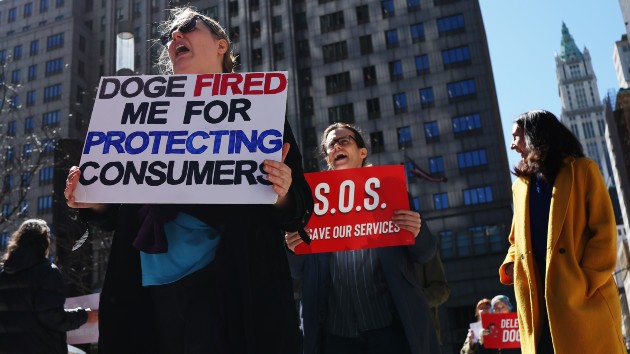
People hold signs as they hold an “informational picket” over DOGE’s reductions to the federal workforce outside the Jacob K. Javits Federal Office Building on March 19, 2025 in New York City. Federal workers and supporters from affected federal agencies, labor leaders, elected officials, and consumer advocates protested Elon Musk’s Department of Government Efficiency (DOGE) and the firings of federal workers.
(WASHINGTON) — Thousands of federal workers nationwide have been forced out of their jobs by the Trump administration as Elon Musk’s Department of Government Efficiency’s says it aims to improve the government and cut down waste.
From park rangers and Department of Veterans Affairs social workers to scientists and foreign relations experts, the workers have decades of experience and knowledge that are crucial to their fields.
With that wealth of knowledge and experience, labor and security experts told ABC News that those fired federal workers are being recruited by private firms and foreign governments, which they said raises the risk of security threats against the United States.
“From an intelligence and law enforcement perspective, the potential for foreign intelligence forces to recruit government workers is hot,” said John Cohen, an ABC News contributor and former acting undersecretary for intelligence at the Department of Homeland Security.
At the same time, state and local governments could step up to fill in their offices with that talent as President Donald Trump seeks to shift many roles and responsibilities out of the federal government.
“It would be an easy transition for them and, in the end, benefit the public, which needs their experience now,” Victor Narro, a professor of labor studies at the Labor Center at the University of California, Los Angeles, told ABC News.
Workers ripe for the picking by private sector
Narro, who has worked in Los Angeles city public boards and commissions and on a U.S. Agency for International Development project, said one of the biggest things being overlooked in DOGE’s mass firings is the fact that many of these employees had strong training from top colleges and chose to have a career in public office instead of the private sector.
“A lot of public sector employees give up jobs in the private sector because they care about being a public worker,” he said. “They all know they could have made a lot more money and had more benefits.”
What federal workers may lack in salary, they can make up in connections with policymakers and organizations, as well as access to government data and knowledge. It is common for federal workers who leave the public sector to take that knowledge to private sector jobs, such as consulting firms that specialize in the environment, national security and healthcare, Cohen said.
The unprecedented mass firing of federal workers may lead to the creation of new private sector organizations made up of those workers, Cohen said.
“It would be hard to think that those employees wouldn’t be in demand,” he said.
In fact, billionaire Mark Cuban pitched an idea in a post on March 1 that those fired workers band together and start their own consulting company.
“It’s just a matter of time before DOGE needs you to fix the mess they inevitably created. They will have to hire your company as a contractor to fix it. But on your terms. I’m happy to invest and/or help,” the Shark Tank host wrote.
There have been no public updates about Cuban’s proposal since the post as of March 18.
Foreign national threat increased
Cohen said Cuban’s proposal has some merit, but he warned that not everyone offering a helping hand will have altruistic intentions.
In fact, he warned offers could very well be ruses designed by foreign adversaries.
Cohen said counterintelligence operations throughout history have targeted disgruntled federal employees who are left in despair and with no way to pay off their expenses and debts.
Each fired worker, from those at the Social Security Administration, who have knowledge about the U.S. benefits system, to nuclear engineers, could be a perfect asset to intelligence agencies in Russia, China and other nations, Cohen said.
Additionally, general knowledge about the inner workings of federal offices, personalities of top officials and other information could be appealing to adversaries, he said.
“It’s not just classified information that is valuable,” he said.
Cohen said Trump and Musk’s belittling of the federal workers as lazy, inefficient and not useful for the government will help make it easier for foreign recruiters to make their case.
“It’s a standard recruitment tool. You find that sense of grievance, you fan the flames and you get them to cooperate because they are angry at what was done to them,” he said.
Those same operations have also found success through more shady tactics, Cohen said.
He noted that there have been cases where federal employees have unknowingly worked for foreign governments posing as private U.S. companies or have been closely working with legitimate companies already operating in the U.S., clouding evidence of foreign intervention.
“It could be something as simple as offering someone to write a research paper and pay a lot for it or give a speech at a conference,” Cohen said. “From there, it could lead to something long term.”
Massachusetts Gov. Maura Healey told reporters at news conferences this week that this is playing out in her state, saying on Wednesday, “What has happened is you have other governments, from China, from the Middle East, from around the world, coming into this country, coming into campuses in Massachusetts and basically saying, ‘Hey the federal government is going to take away your funding and take away your research come to our country. We’ll give you a lab. We’ll set you up. We’ll give you a staff. And you can pioneer the new technologies on our shores.'”
“That’s not putting America first,” she added.
Typically, the federal government prompts workers to do their due diligence and refrain from working with anyone appearing to have foreign government ties, but Cohen said it is going to be difficult to self-police this on such a massive scale.
“The government has to rely on someone’s patriotism and their sense of ethics to willingly not support a foreign intelligence service. But very often, a person may not know they are being recruited,” he said.
State, local governments to the rescue?
The recruitment efforts, however, aren’t limited to foreign entities and private companies. State and local governments are now seeking to fill their offices with the displaced talent.
Earlier this month, New York Gov. Kathy Hochul announced the “You’re Hired” campaign, which encourages fired federal workers to go to New York and apply for jobs in various state agencies. The state placed ads in Union Station that redirected them to a website with state job offerings.
“We’re looking for qualified, experienced candidates across a wide variety of fields. I need technologists, I need engineers, I need attorneys, healthcare workers, educators, public policy experts and so many more,” Hochul told reporters at a news conference on March 3.
“I’m in competition for the top attorneys, the top engineers [and] people to work at the Department of Financial Services,” she added. “In a place like New York City, there’s a lot of higher-paying jobs. So these are special people who walk away from those jobs and those opportunities and come here, and I want to let them know that we will take care of them.”
As of March 18, over 200 people have signed up for webinars hosted by the New York State Department of Labor, according to the governor’s office.
Maryland Gov. Wes Moore, a Democrat, and Virginia Gov. Glenn Youngkin, a Republican, have started similar campaigns.
Narro said it is not surprising that local governments would take the opportunity to fill their offices, given that many are now bracing for extra responsibilities following the DOGE cuts.
At the same time, there is no guarantee that those local governments can take in all of those workers, he said.
“A lot of it depends on the state. You have a better chance of getting a public job in New York versus Iowa because of the number of offices, departments and ultimately the budget,” Narro said.
Cohen and Narro added that Trump’s pledge to give more power to the states, particularly education, but no details on how they would get the funding to do so has also left many states in limbo when it comes to recruitment.
“It’s great that the states are coming up with these programs, but if they can’t commit, you’re going to have more frustrated federal workers,” Cohen said.
Can the damage be undone?
Narro noted that the situation with fired federal workers is still fluid as court cases play out and some of the firings have been stopped or reversed.
However, the uncertainty alone could be devastating to the future of the federal workforce.
“People’s families depend on stability, and if they can not keep up with the changing decisions, they may just quit altogether,” Narro said. “I suspect this is what Trump and Musk are seeking to do in their strategy.”
Narro said that even if Trump’s and Musk’s policies are reversed by a future administration, there could be long-term damage.
“In the end of the day, the public loses out the most,” he said. “It’s going to be harder for anyone to consider giving up a private job and dedicating their talents to serving the public if this is how they will be treated.”
(WASHINGTON) — President Donald Trump continued his sweeping education agenda as he signed an executive order to diminish the Department of Education at the White House on Thursday.
The president’s order directs Education Secretary Linda McMahon to take all necessary steps permitted by law to shrink the Department of Education, according to the sources.
Trump signed the order during a ceremony in the East Room of the White House while flanked on each side by schoolchildren seated at desks.
“Today we take a historic action that was 45 years in the making,” he said, noting that his order will “begin eliminating the federal Department of Education.”
“The Department of Education will be much smaller than it is today,” White House press secretary Karoline Leavitt told reporters earlier Thursday, noting the department will not be completely shut down and that it will continue to carry out “critical functions.”
“When it comes to student loans and Pell Grants, those will still be run out of the Department of Education,” she said. “But we don’t need to be spending more than $3 trillion over the course of a few decades on a department that’s clearly failing in its initial intention to educate our students.”
Trump is directing McMahon to take “all necessary steps to facilitate the closure of the Department of Education and return education authority to the States,” according to a White House summary of the order reviewed by ABC News.
The order also calls for the “uninterrupted delivery of services, programs, and benefits on which Americans rely.” It’s still unclear how the administration plans to accomplish that. Sources said the administration has been looking into how to move some of the key programs to other agencies.
Republican Govs. Ron DeSantis of Florida, Greg Abbott of Texas, Mike Braun of Indiana, Kim Reynolds of Iowa, Jeff Landry of Louisiana and Mike DeWine of Ohio were among the state leaders attending the signing ceremony.
However, several Democrats and education advocacy organizations slammed the order.
“Shutting down the Department of Education will harm millions of children in our nation’s public schools, their families and hardworking teachers,” House Minority Leader Hakeem Jeffries said in a Thursday statement. “Congress created the Department of Education and only an act of Congress can eliminate it. We will stop this malignant Republican scheme in the House of Representatives and in the Courts.”
House Education and Workforce Committee ranking member Bobby Scott, D-Va., said the order will cause “irreparable harm” to students and educators.
“By dismantling ED, President Trump is implementing his own philosophy on education which can be summed up in his own words, ‘I love the poorly educated,'” he added.
The department took the first steps to downsize last week when it laid off nearly half its employees, and it shrunk significantly in size through a massive reduction in force, deferred resignations and retirement buyouts, according to the department.
Trump is expected to continue the reforms — pledging to erase more staff from the department.
“I expect it will [be shut down entirely],” Trump said on “Full Measure” with Sharyl Attkisson earlier this month. “You’ll have a few people left just to make sure [the states are] teaching English — you know, you say reading, writing and arithmetic.”
However, congressional approval is required to abolish a federal agency, and McMahon has acknowledged she would need Congress to carry out the president’s vision to close the department she’s been tapped to lead. It would take 60 “yes” votes in the Senate to overcome the filibuster and dismantle the department that Congress created.
“Legality aside, dismantling ED will exacerbate existing disparities, reduce accountability and put low-income students, students of color, students with disabilities and rural students at risk,” Scott said.
Critics argue the department is needed for vital financial assistance and grant programs. Education experts suggested that shuttering the Department of Education could gut public education funding and disproportionately affect high-need students across the country who rely on statutorily authorized programs, such as the Individuals with Disabilities Education Act and Title 1, which provides funding for low-income families.
These programs could be housed in a reformed, shrunken-down Department of Education, and McMahon said the department will still administer those statutory programs that students from disadvantaged backgrounds rely on. In an interview on Fox News’ “The Ingraham Angle,” McMahon suggested the “good” employees who administer the statutorily mandated functions will not be harmed by staff reductions.
A statement from the department said it will “continue to deliver on all statutory programs that fall under the agency’s purview, including formula funding, student loans, Pell Grants, funding for special needs students, and competitive grantmaking.”
In more than four decades, Trump and Department of Education skeptics have said they believe the agency has had too much spending power without achieving results.
After McMahon was sworn in, she underscored that abolishing the department is rooted in allowing families the right to choose a “quality education” so America’s students aren’t “stuck in failing schools.”
“This is also, I would say, a national security issue,” Leavitt added Thursday morning. “When you look at how students around the world, particularly in China, are being educated, American students are falling behind. We’re not keeping up with our allies or our adversaries, and that’s a major problem for our country, and the president is fixing it today.”
After Trump signed the bill, House Education and Workforce Committee Chairman Tim Walberg said McMahon “understands the importance of getting the federal government out of the way.”
“Bottom line, the Department of Education has failed to deliver results for America’s students and today’s actions by the Trump administration will help ensure our nation’s youth are put first,” he added.
(WASHINGTON) — U.S. District Judge James Boasberg, the federal judge who blocked the Trump administration from deporting noncitizens — Venezuelan immigrants that it alleges are members of the gang Tren de Aragua — without due process accused the Justice Department of evading “its obligations” to comply with his order for more information on the deportation flights, per a new filing on Thursday.
Boasberg said in an order Thursday that after a noon deadline, Justice Department attorneys filed a written declaration from an acting U.S. Immigration and Customs Enforcement field officer, which repeated general information about the deportation flights and that Cabinet secretaries were still weighing whether to invoke the states secret privilege, a move that allows the head of an executive department to refuse to produce evidence in a court case on the grounds that the evidence is secret information that would harm national security or foreign relation interests if disclosed, according to the Center for Constitutional Rights.
“This is woefully insufficient,” Boasberg said in response.
Boasberg ordered more information about the deportation flights, which the administration carried out under the Alien Enemies Act, a rarely used wartime authority. Boasberg ordered that they turn around two flights the administration said were deporting the alleged migrant gang members to El Salvador. Officials failed to turn those flights around.
The Trump administration has not yet released the names of the alleged gang members who were deported.
The Department of Justice initially refused to provide more information about the flights, citing national security concerns.
Boasberg said Thursday that he is requiring the government to show cause by March 25 on why its responses thus far and the failure to return the undocumented migrants to the U.S. did not violate his temporary restraining orders.
Additionally, he asked the government to file a sworn declaration by 10 a.m. Friday by an individual involved in Trump’s Cabinet discussions over the state secrets privilege — and to say by March 25 whether they plan to invoke the privilege.
On Thursday, ABC News’ Karen Travers asked White House press secretary Karoline Leavitt why the administration wasn’t turning over the information regarding the deportation flights if they are confident that they complied with the judge’s order.
“We are confident that we’ve complied, and as I’ve said from the podium, all of the flights that were subject to the written order of the judge took off before the written order was pushed in the courtroom,” Leavitt said. “And the president is all within his article, his Article II power and his authority under the Alien Enemies Act to make these decisions.”
Earlier this week, Trump and some House Republicans called to impeach Boasberg, with Trump calling the judge “radical left.”
Chief Justice of the United States John Roberts issued a rare statement on the impeachment threat, signaling a stark difference in opinion between the judicial and executive branches.
“For more than two centuries, it has been established that impeachment is not an appropriate response to disagreement concerning a judicial decision,” Roberts said in the statement. “The normal appellate review process exists for that purpose.”
(WASHINGTON) — President Donald Trump is expected to sign an executive order to diminish the Department of Education at the White House on Thursday, multiple sources told ABC News.
The president’s order will direct Education Secretary Linda McMahon to take all necessary steps permitted by law to dissolve the Department of Education, according to the sources.
The move has been months in the making and will help the president fulfill his campaign promise of returning education power and decisions to the states.
“The Department of Education will be much smaller than it is today,” White House press secretary Karoline Leavitt told reporters Thursday morning, noting the department will not be completely shut down and that it will continue to carry out “critical functions.”
“When it comes to student loans and Pell Grants, those will still be run out of the Department of Education,” she said. “But we don’t need to be spending more than $3 trillion over the course of a few decades on a department that’s clearly failing in its initial intention to educate our students.”
Trump will direct McMahon, to take “all necessary steps to facilitate the closure of the Department of Education and return education authority to the States,” according to a White House summary of the order reviewed by ABC News.
The order also calls for the “uninterrupted delivery of services, programs, and benefits on which Americans rely.” It’s still unclear how the administration plans to accomplish that. Sources said the administration has been looking into how to move some of the key programs to other agencies.
Republican Govs. Ron DeSantis of Florida, Glenn Youngkin of Virginia, Greg Abbott of Texas and Mike DeWine of Ohio are among the state leaders expected to attend the signing ceremony at the White House, according to a White House official.
The department took the first steps to downsize and shut down last week when it laid off nearly half its employees, and it shrunk significantly in size through a massive reduction in force, deferred resignations and retirement buyouts, according to the department.
Trump is expected to continue the reforms — pledging to erase more staff from the department and gut it.
“I expect it will [be shut down entirely],” Trump said on “Full Measure” with Sharyl Attkisson earlier this month. “You’ll have a few people left just to make sure [the states are] teaching English — you know, you say reading, writing and arithmetic.”
However, congressional approval is required to abolish a federal agency, and McMahon has acknowledged she would need Congress to carry out the president’s vision to close the department she’s been tapped to lead. It would take 60 “yes” votes in the Senate to overcome the filibuster and dismantle the department that Congress created.
Critics argue the department is needed for vital financial assistance and grant programs. Education experts suggested that shuttering the Department of Education could gut public education funding and disproportionately affect high-need students across the country who rely on statutorily authorized programs, such as the Individuals with Disabilities Education Act and Title 1, which provides funding for low-income families.
McMahon said the department will still administer those statutory programs that students from disadvantaged backgrounds rely on. In an interview on Fox News’ “The Ingraham Angle,” McMahon suggested the “good” employees who administer the statutorily mandated functions will not be harmed by staff reductions.
A statement from the department said it will “continue to deliver on all statutory programs that fall under the agency’s purview, including formula funding, student loans, Pell Grants, funding for special needs students, and competitive grantmaking.”
In more than four decades, Trump and Department of Education skeptics believe the agency has had too much spending power without achieving results.
After McMahon was sworn in, she underscored that abolishing the department is rooted in allowing families the right to choose a “quality education” so America’s students aren’t “stuck in failing schools.”
“This is also, I would say, a national security issue,” Leavitt added Thursday morning. “When you look at how students around the world, particularly in China, are being educated, American students are falling behind. We’re not keeping up with our allies or our adversaries, and that’s a major problem for our country, and the president is fixing it today.”
(WASHINGTON) — George Glezmann, a U.S. citizen who was detained by the Taliban for more than two years, has been released, according to the State Department.
“Today, after two and a half years of captivity in Afghanistan, Delta Airlines mechanic George Glezmann is on his way to be reunited with his wife, Aleksandra,” Secretary of State Marco Rubio said in a statement.
Rubio thanked Qatar, which said it “facilitated” the release of Glezmann, for its “steadfast commitment and diplomatic efforts,” calling Qatari officials “instrumental in securing George’s release.”
“George’s release is a positive and constructive step,” Rubio added. “It is also a reminder that other Americans are still detained in Afghanistan. President Trump will continue his tireless work to free ALL Americans unjustly detained around the world.”
Afghanistan is classified by the State Department as a Level 4 country, meaning Americans should not travel there under any circumstances.
Glezmann, an airline mechanic for Delta Air Lines, was visiting Afghanistan as a tourist in late 2022 and intended to spend five days in the country exploring its history and culture, according to his family. He was detained by the Taliban’s intelligence service on Dec. 5 but was never charged with any crime or offense.
In September 2023, he was declared wrongfully detained by the Biden administration.
The Taliban jailed Glezmann in a 9-foot-by-9-foot cell with other detainees and sometimes held him in “solitary confinement and underground for months at a time,” according to a resolution put forward by Democratic Sens. Jon Ossoff and Raphael Warnock from Glezmann’s home state of Georgia.
While in custody, Glezmann also suffered from “from facial tumors, hypertension, severe malnutrition and other medical conditions” and experienced a rapid decline in his physical and mental health, per the senators.
Talks aimed at bringing Glezmann home have been happening on and off since shortly after his detention, according to U.S. officials.
Negotiators came close in January, when officials cut a deal to bring Americans Ryan Corbett and another U.S. national in a prisoner swap — but the Taliban rejected efforts to include Glezmann in the exchange.
“Today is a good day. We succeeded in obtaining the release of an American citizen, Georg Glezmann, after two years in detention in Kabul,” former U.S. Ambassador to Afghanistan Zalmay Khalilzad posted on X following his release. “The Taliban government agreed to free him as a goodwill gesture to @POTUS and the American people. George is on his way home to his family.”
Taliban foreign affairs office posted on X that U.S. and Taliban officials met in Afghanistan on Thursday and discussed “bilateral relations” and “positive economic relations” as they negotiated the release of Glezmann.
Glezmann has arrived in Doha, Qatar, per the Qatari government, and is travelling with Adam Boehler, the Trump administration’s special envoy for hostage response, and is likely to arrive back in the United States on Friday, according to a U.S. official, though the plans could change.
El Salvador Presidency/Handout/Anadolu via Getty Images
(WASHINGTON) — An attorney representing a migrant sent to El Salvador under the Alien Enemies Act says her client was deported due to a soccer logo tattoo, according to court declarations submitted Wednesday night.
Linette Tobin is representing Jerce Reyes Barrios, a professional soccer player from Venezuela who protested the Maduro regime in February and March 2024 and was detained and tortured after one of the demonstrations.
Barrios came to the U.S.-Mexico border legally through the CBP One app in September 2024 but has been accused of being a Tren de Aragua, or TdA, member and was detained at a facility under maximum security, Tobin said.
The Biden administration expanded the use of the CBP One phone application to allow migrants to submit some background information and schedule appointments with immigration officials at ports of entry. Officials would then determine if the person could be allowed into the country, some in order to submit an asylum claim. President Donald Trump eliminated that feature during his first days in office.
The Department of Homeland Security has accused Barrios of having a gang-affiliated tattoo and claimed a photo of him showed him displaying gang signs. ABC News has reached out to DHS.
The tattoo in question showed a crown sitting on top of a soccer ball with a rosary and the word “Dios” (God), according to Tobin. A declaration from the tattoo artist confirmed that Barrios chose it because it was similar to the Real Madrid soccer team logo, the attorney said. According to Tobin, those alleged gang signs were the hand symbol for rock and roll and “I love you” in sign language.
Tobin also said she submitted records from Venezuela that indicated Barrios had no criminal record in his home country and was employed as a professional soccer player and children’s soccer coach.
Barrios was transferred out of maximum security after submitting this evidence and had a hearing set for April 17, according to his attorney.
Around March 10 or 11, Tobin said her client was transferred to Texas without notice and was promptly deported to El Salvador on March 15.
“Counsel and family have lost all contact with him and have no information” about his whereabouts, Tobin wrote in the court documents.
Trump announced on Saturday he had signed a proclamation declaring that the Tren de Aragua gang was “conducting irregular warfare” against the United States and therefore would deport its members under the Alien Enemies Act of 1798.
U.S. District Judge James Boasberg on Saturday blocked the Trump administration from deporting noncitizens under the Alien Enemies Act and ordered that they turn around two flights the administration said were deporting alleged migrant gang members to El Salvador.
After officials failed to turn the flights around, Judge Boasberg demanded they provide more information about the flights, under seal, but Justice Department attorneys refused, citing national security concerns. According to a court filing Wednesday morning, DOJ attorneys said they are considering invoking the state secrets privilege to deny the judge that information.
(WASHINGTON) — Sen. Elizabeth Warren is urging Education Secretary Linda McMahon to reinstate former Department of Education employees who were critical to the nation’s federal student aid process or else borrowers will suffer “dire consequences,” according to a letter Warren sent to McMahon on Wednesday.
“The Department of Education (ED) appears to be abandoning the millions of parents, students, and borrowers who rely on a functioning federal student aid system to lower education costs,” Warren and a group of Democratic senators wrote in a letter to McMahon.
“ED should immediately restore all fired [Federal Student Aid] employees responsible for reviewing student aid complaints and refrain from taking any measures to deter the submission of complaints,” the senators added.
The Education Department intended to remove the “Submit a Complaint” button from FSA’s website, according to the letter. It found a senior employee at the department called the move an “overall win” as the change would decrease the volume and number of complaints. But more than 90% of the office’s complaints were submitted online last year.
“ED’s actions will hurt parents trying to understand how to submit the FAFSA correctly so that they can afford to send their child to college, veterans whose loan repayment status has been processed incorrectly due to their deployment, and students whose aid is being improperly withheld by predatory for-profit schools,” the letter said.
The letter alleges the FSA website changes — like moving the submit a complaint function — weakens FSA’s capacity to resolve complaints and puts borrowers at risk of loan scams. Warren, D-Mass., and the senators demand answers about the agency’s complaint backlog, why the department fired the civil servants, and how much influence Elon Musk and the Department of Government Efficiency had on the firings.
“Donald Trump is telling students that if you’re scammed by your student loan servicer or have a problem getting the aid you need to go to college, he doesn’t care,” Warren said in a statement to ABC News. “Secretary McMahon is helping Trump rip opportunities away from kids who just want a good education, and as a result, real people will get hurt. Democrats in the Senate are not going to roll over and give up on our kids — we’re fighting back,” Warren added.
This comes as President Donald Trump is expected to sign an executive order to gut the U.S. Department of Education at the White House on Wednesday, multiple sources familiar told ABC News. The president’s order will direct McMahon to take all necessary steps permitted by law to dissolve department, according to the sources familiar. It would take 60 votes in the Senate to dismantle the agency that Congress created.
The education department took its first steps to eliminate nearly half the agency’s workforce last week through a massive reduction in force, deferred resignations and retirement buyouts, according to the agency. After a federal judge ordered that former probationary employees be reinstated, dozens were rehired. A source familiar told ABC News that most of the reduction in force impacted the offices for Civil Rights and Federal Student Aid. FSA civil servants are tasked with helping the nation’s students achieve higher education, including overseeing a $1.6 trillion portfolio of student loans.
FSA received nearly 300,000 complaints in Fiscal Year 2024, according to the letter. The office had about 1,400 employees before the layoffs and hundreds will be lost after last week’s cuts.=
Still, the department will continue to administer its statutory functions that students from disadvantaged backgrounds rely on, including grants, formula funding and loans, McMahon stressed recently.
“We wanted to make sure that we kept all of the right people, the good people, to make sure that the outward-facing programs, the grants, the appropriations that come from Congress, all of that are being met and none of that is going to fall through the cracks,” she said on “The Ingraham Angle” on Fox News.
FSA’s operations have already been impacted, according to a source familiar. The federal student loan website was down briefly last week. Less than 24 hours after being fired, IT employees were called frantically to join an hours-long troubleshooting call, according to the source.
Throughout President Joe Biden’s tenure there were widespread issues with the Free Application for Federal Student Aid, or FAFSA, form. During a House Committee on Appropriations hearing last spring former Education Secretary Miguel Cardona said the department was working on fixing the botched rollout of the form “around the clock.” McMahon’s department touted a 50% increase on the number of FAFSA applications submitted compared to this time last year.
Warren and Sen. Bernie Sanders, the ranking member on the Senate’s Health, Education, Labor and Pensions committee, were among the 11 lawmakers who signed the letter. The deadline for the administration to respond is March 25.
A former FSA attorney, who did oversight and enforcement in the borrower defense unit, said they were heartbroken when they were let go from their dream job on Valentine’s Day.
Since the checks stopped coming in last month, the former employee said it’s been difficult living on unemployment benefits. The former employee described making about a fifth of what they brought in before being fired.
However, they said the letter to McMahon gives them renewed hope.
“If I could get my job back I would take it in a heartbeat,” the former FSA attorney told ABC News, adding, “I loved the work that we did.”