(WASHINGTON) — The Supreme Court on Wednesday upheld government regulation of self-assemble firearm kits that produce untraceable weapons known as “ghost guns.”
The 7-2 decision came from Justice Neil Gorsuch. Justices Samuel Alito and Clarence Thomas dissented.
“The Gun Control Act embraces, and thus permits ATF to regulate, some weapon parts kits and unfinished frames or receivers, including those we have discussed,” Gorsuch wrote.
In 2022, the Biden administration cracked down on the self-assemble kits with a new rule subjecting them to the same checks as traditional firearms — including background checks, age verification, serialization and more.
Challengers of the rule, which included gun manufacturers and individual gun owners, contended the 1968 Gun Control Act didn’t apply to weapon parts kits and that the administrative action was an overreach.
Justice Gorsuch, writing for the majority, made a textual case for why gun parts kits can be subject to federal regulations in the same way as any other gun.
“The [Gun Control Act] authorizes ATF to regulate “any weapon (including a starter gun) which will or is designed to or may readily be converted to expel a projectile by the action of an explosive,” Gorsuch wrote.
“A person without any specialized knowledge can convert a starter gun into a working firearm using everyday tools in less than an hour. And measured against that yardstick, the ‘Buy Build Shoot’ kit can be ‘readily converted’ into a firearm too, for it requires no more time, effort, expertise, or specialized tools to complete. If the one meets the statutory test, so must the other,” he concluded. Justices Thomas and Alito disagreed in their dissent.
“The statutory terms ‘frame’ and ‘receiver’ do not cover the unfinished frames and receivers contained in weapon-parts kits, and weapon-parts kits themselves do not meet the statutory definition of ‘firearm,'” Thomas wrote. “That should end the case. The majority instead blesses the Government’s overreach based on a series of errors regarding both the standard of review and the interpretation of the statute.”
Wednesday’s ruling from the high court is significant for gun control advocates as the number of firearms recovered from crime scenes without a serial number rose sharply in recent years: nearly 17-fold between 2017 and 2023, according to the Justice Department, with 19,000 untraceable weapons recovered in 2021 alone.
“This Supreme Court decision is great news for everyone but the criminals who have adopted untraceable ghost guns as their weapons of choice,” John Feinblatt, the president of Everytown for Gun Safety, said in a statement. “Ghost guns look like regular guns, shoot like regular guns, and kill like regular guns — so it’s only logical that the Supreme Court just affirmed they can also be regulated like regular guns.”
The court’s opinion acknowledges that the exponential proliferation of ghost guns has posed an urgent problem for law enforcement nationwide.
“Efforts to trace the ownership of these weapons, the government represents, have proven almost entirely futile,” Gorsuch wrote.
ABC News’ Alexandra Hutzler contributed to this report.
National Security Advisor Mike Waltz and Defense Secretary Pete Hegseth/ Andrew Harnik/Getty Images
(WASHINGTON) — The Trump administration is under scrutiny after The Atlantic editor Jeffrey Goldberg said he was inadvertently added to a Signal group chat that included top national security officials, including Defense Secretary Pete Hegseth, in which the officials discussed plans for a U.S. attack on Houthis in Yemen.
Goldberg revealed the mishap in a piece for the magazine on Monday and told ABC News that he was apparently added to the chat by National Security Adviser Mike Waltz.
Goldberg provided two screenshots in the magazine piece and did not provide details or quotes, only a description of the operational part of the Signal message chain.
Both the Trump administration and top officials involved have repeatedly denied that war plans or classified information were discussed, as Goldberg reported.
Below is a timeline spanning from the creation of the group chat to what has happened since.
March 11
In an interview with “ABC News Live” Monday evening, Goldberg told Linsey Davis he received a message request on the Signal app from White House national security adviser Mike Waltz, or someone “who’s purporting to be Mike Waltz” on March 11.
He said the invitation was “not an unusual thing in Washington.”
“I’m a journalist, I’ve met him in the past, so I accept it,” he told ABC News.
Goldberg said he accepted the request, with nothing occurring until several days later, when he was added to a “group of seemingly very high national security officials of the United States” including Vice President JD Vance, with Waltz apparently creating this chat.
“Mike Waltz puts this group together and says it’s a planning group for essentially upcoming action in Yemen,” Goldberg said.
Goldberg told ABC News he initially thought it was a hoax since it would be “completely absurd to me that the national security leadership of the United States would be meeting on a messaging app to discuss forthcoming military action, and that then they would also invite the editor of The Atlantic magazine to that conversation.”
March 14
Goldberg told ABC News a “long conversation” occurred between the group chat members on March 14, discussing “whether or not they should or shouldn’t take action in Yemen.”
The messages went back and forth with “a lot of resentment directed at European allies of the United States, which obviously enhanced the credibility of this chain,” Goldberg said.
He told ABC News at this point the members of the chat sounded like people he knew within the administration, but still was not sure whether or not it was a hoax.
March 15
Goldberg told ABC News he continued to track the incoming messages from the group chat, to see “who was trying to entrap me or trick me.” Then on March 15, he said it became “overwhelmingly clear” it was a legitimate group chat, he told ABC News.
At 11:44 a.m., he said he received a text in the chain from someone claiming to be Hegseth, or “somebody identified as Pete,” providing what Goldberg characterized as a war plan. The message included a “sequencing of events related to an upcoming attack on Yemen” and promised results by 1:45 p.m. Eastern time.
Goldberg told ABC News he was in his car and waiting with his phone to “see if this was a real thing.”
“Sure enough, around 1:50 [p.m.] Eastern time, I see that Yemen is under attack,” he said.
When the attacks seemed to be “going well,” Goldberg told ABC News that members of the chat began sending congratulatory messages along with fist, fire and American flag emojis.
“That was the day I realized this is possibly unbelievably the leaders of the United States discussing this on my messaging app,” Goldberg told ABC News. “My reaction was, I think I’ve discovered a massive security breach in the United States national security system.”
Goldberg told ABC News he removed himself from the group chat once the operation was completed.
“I watched this Yemen operation go from beginning to apparent end, and that was enough for me to learn that there’s something wrong in the system here that would allow this information to come so dangerously close to the open wild,” Goldberg said.
March 16
Waltz appeared on ABC’s “This Week” the day after the strikes on Yemen and said the U.S. airstrikes “took out” multiple leaders of the Iranian-backed Houthis, which he said differed from the Biden administration’s launches against the group.
“These were not kind of pinprick, back and forth — what ultimately proved to be feckless attacks,” Waltz said. “This was an overwhelming response that actually targeted Houthi leaders and took them out. And the difference here is, one, going after the Houthi leadership, and two, holding Iran responsible.”
March 24
Goldberg published a story in The Atlantic revealing the mishap, in a piece titled “The Trump Administration Accidentally Texted Me Its War Plans.”
Shortly after the story’s publication on Monday afternoon, White House National Security Council spokesman Brian Hughes shared with ABC News the statement he provided to The Atlantic confirming the authenticity of the Signal group chat.
“At this time, the message thread that was reported appears to be authentic, and we are reviewing how an inadvertent number was added to the chain. The thread is a demonstration of the deep and thoughtful policy coordination between senior officials. The ongoing success of the Houthi operation demonstrates that there were no threats to our servicemembers or our national security,” Hughes said in a statement.
Speaking to reporters Monday, Hegseth denied he sent war plans in the chat.
“I’ve heard how it was characterized. Nobody was texting war plans, and that’s all I have to say about that,” Hegseth told reporters in Honolulu while on a layover on his trip to Asia.
Hegseth called Goldberg a “deceitful and highly discredited, so-called journalist who’s made a profession of peddling hoaxes time and time again.”
“This is the guy that pedals in garbage. This is what he does,” Hegseth said about Goldberg.
During an event at the White House on Monday, President Donald Trump was asked about Goldberg’s article. “I don’t know anything about it. I’m not a big fan of The Atlantic,” he said.
Top Democrats including House Minority Leader Hakeem Jeffries voiced outrage at the administration after this mishap.
“It is yet another unprecedented example that our nation is increasingly more dangerous because of the elevation of reckless and mediocre individuals, including the Secretary of Defense,” Jeffries said in a statement on Monday.
Former Secretary of State Hillary Clinton, who faced scrutiny over her alleged use of a private email server while at the State Department, shared her reaction to the Signal group chat on X: “You have got to be kidding me.”
Senate Minority Leader Chuck Schumer also criticized this apparent breach of military intelligence, urging Senate Republicans to work with Democrats in a “full investigation” to look into how this incident occurred.
“If you were up in arms over unsecure emails years ago, you should certainly be outraged by this amateurish behavior,” Schumer said on the Senate floor, referencing the scandal over Clinton’s emails.
March 25
On Tuesday morning, White House Press Secretary Karoline Leavitt said Goldberg is “well-known for his sensationalist spin” and emphasized that “no ‘war plans’ were discussed.”
“As the National Security Council stated, the White House is looking into how Goldberg’s number was inadvertently added to the thread. Thanks to the strong and decisive leadership of President Trump, and everyone in the group, the Houthi strikes were successful and effective. Terrorists were killed and that’s what matters most to President Trump,” Leavitt shared on X.
Trump told NBC News he remains confident in Waltz even after the use of an unsecured group chat.
“Michael Waltz has learned a lesson, and he’s a good man,” Trump told NBC correspondent Garrett Haake.
Director of National Intelligence Tulsi Gabbard and CIA Director John Ratcliffe were grilled by Democratic Sen. Mark Warner on Tuesday regarding the mishap. Both officials said while testifying before the Senate Select Committee on Intelligence there was no classified information on the chain.
Ratcliffe said he believed the “national security adviser intended this to be as it should have been, a mechanism for coordinating between senior level officials, but not a substitute for using high side or classified communications for anything that would be classified.”
Speaker Mike Johnson continued to downplay the mishap but admitted the breach was a “serious” mistake on Tuesday.
“Look, they have acknowledged that there is an error, and they are correcting it. And I would’ve asked the same thing of the Biden administration,” Johnson said during a news conference Tuesday morning.
During a White House meeting with ambassadors on Tuesday afternoon, Trump said this incident is “just something that can happen” and that there was “no classified information” in the group chat.
He added that Signal is “not a perfect technology.”
“Sometimes somebody can get onto those things,” Trump said. “That’s one of the prices you pay when you’re not sitting in the Situation Room with no phones on, which is always the best, frankly.”
Waltz said the White House’s tech and legal teams are looking into the mishap.
“No one in your national security team would ever put anyone in danger,” Waltz said.
He also claimed to have never met Goldberg.
“We are looking into him, reviewing how the heck he got into this room,” Waltz said.
A spokesperson for The Atlantic released a statement on Tuesday night following the comments from Trump and his aides.
“Attempts to disparage and discredit The Atlantic, our editor and our reporting follow an obvious playbook by elected officials and other in power who are hostile to journalists and the First Amendment rights of all Americans,” the magazine said.
The statement went on to say that “any responsible national security expert would consider the information contained in this Signal chat to be of the greatest sensitivity, and would agree that this information should never be shared on non-government messaging apps.”
March 26
Schumer and other top Senate Democrats on national security committees wrote a letter to Trump seeking more information about the mishap, requesting a “complete and unredacted” transcript of the Signal group chat for the appropriate committees to review in a secure setting.
“We write to you with extreme alarm about the astonishingly poor judgment shown by your Cabinet and national security advisors,” the Senators wrote, according to a copy of the letter obtained by ABC News. “You have long advocated for accountability and transparency in the government, particularly as it relates to the handling of classified information, national security and the safety of American servicemembers. As such, it is imperative that you address this breach with the seriousness and diligence that it demands.”
The Atlantic on Wednesday published a new article detailing purported information about recent American strikes in Yemen it says was accidentally shared in the Signal group chat.
Shortly after the article was published, Leavitt said in a post on X “these were NOT ‘war plans.'”
“This entire story was another hoax written by a Trump-hater who is well-known for his sensationalist spin,” Leavitt said.
ABC News’ Fritz Farrow, Anne Flaherty, Luis Martinez, Isabella Murray, Allison Pecorin, Lauren Peller, Michelle Stoddart, Selina Wang and Kelsey Walsh contributed to this report.
(WASHINGTON) — Minority Leader Chuck Schumer and top Senate Democrats from national security committees wrote a letter to President Donald Trump seeking more information about reports that members of his cabinet used the Signal app to convene a group chat to “coordinate and share classified information about sensitive military planning operations” and mistakenly included The Atlantic Editor-in-Chief Jeff Goldberg.
“We write to you with extreme alarm about the astonishingly poor judgment shown by your Cabinet and national security advisors,” the senators wrote, according to a copy of the letter obtained by ABC News. “You have long advocated for accountability and transparency in the government, particularly as it relates to the handling of classified information, national security, and the safety of American servicemembers. As such, it is imperative that you address this breach with the seriousness and diligence that it demands.”
Committees “have serious questions about this incident, and members need a full accounting to ensure it never happens again,” the letter said. The authors requested a “complete and unredacted” transcript of the Signal chat for the appropriate committees to review in a secure setting.
The senators also called on Attorney General Pam Bondi to carry out a thorough investigation of the matter, citing concerns that “willful or negligent disclosure of classified or sensitive national security information may constitute a criminal violation of the Espionage Act or other laws.”
The letter asked Trump to preserve the chat in question, along with any other discussions of government business occurring on any messaging application, citing concerns that the Signal messages — which are set to automatically disappear after a fixed period of time — could violate both Federal Records Act and the Presidential Records Act.
“You and your Cabinet are responsible for the safety and security of the American people, as well as our military servicemembers and intelligence personnel in the field. We expect your Administration to address this dangerous lapse in security protocol—whether intended or not—with the utmost seriousness, and to uphold the ethic of accountability that our nation holds sacred,” the letter said.
The letter is signed by Judiciary Committee Ranking Member Dick Durbin, Armed Services Committee Ranking Member Jack Reed, Foreign Relations Committee Ranking Member Jeanne Shaheen, Intelligence Committee Vice Chairman Mark Warner, Appropriations Subcommittee on Defense ranking member Chris Coons, and Homeland Security and Governmental Affairs ranking member Gary Peters. It therefore represents a joint statement from the top Democrats across the committees dealing with national security matters.
In their letter to Trump, the Senators asked for answers to 10 specific questions related to the reported Signal chat, including a full list of its participants.
Those included inquiries about whether any other individuals were mistakenly added to the chat, whether any individual used a personal device to access the chat, whether anyone was out of the country while accessing the chat and whether any classified documents were transferred to unclassified systems. The senators also sought a response on whether the intelligence community has done a damage assessment of the matter.
The senators further requested an answer about whether any cabinet or White House officials are using Signal or other commercial products to discuss classified or sensitive information, or any communications subject to statutory recordkeeping requirements. If so, they asked the White House to provide details on how it is meeting record-keeping requirements.
Barry Williams/New York Daily News/Tribune News Service via Getty Images
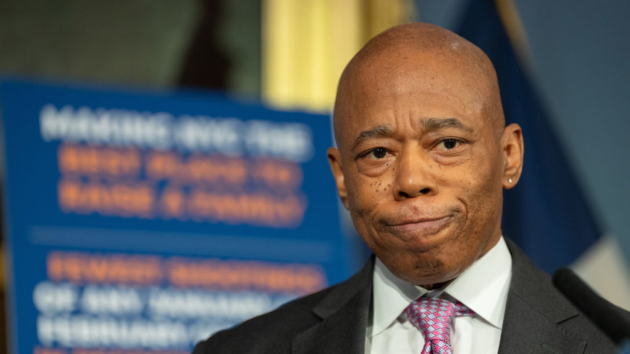
(NEW YORK) — A document unsealed Tuesday from the criminal case against New York City Mayor Eric Adams may raise questions about the testimony of Deputy Attorney General Todd Blanche during his Senate confirmation hearing.
During the hearing, Blanche was asked about the Justice Department’s decision to drop the corruption charges against Adams.
“What I just saw with the dismissal of the Adams charge, that was directed by D.C., correct?” Democratic Sen. Peter Welch asked.
“I have the same information you have,” Blanche responded. “I don’t know beyond what I’ve [seen] publicly reported.”
However, a newly unsealed draft letter from then-interim U.S. Attorney Danielle Sassoon suggests Blanche may have known more than he let on.
Sassoon, who was fighting the directive to drop the mayor’s case, wrote that she expressed concern to top DOJ official Emil Bove that such a grave decision about a high-profile case should wait until Blanche was confirmed. In response, Sassoon wrote that “Bove informed me that Todd Blanche was on the ‘same page.'”
Sassoon would later resign rather than obey Bove’s order to drop the mayor’s case.
Her draft letter to Attorney General Pam Bondi was among a tranche of materials ordered unsealed by Judge Dale Ho, who is still considering whether to dismiss the case against Adams.
The Justice Department insisted Blanche played no role in the determination to seek dismissal.
“Todd Blanche was not involved in the Department’s decision-making prior to his confirmation,” a spokesperson said in a statement provided to ABC News.
The mayor’s lawyer said the unsealed letter is further proof that the case should be tossed.
“As I’ve said from the beginning, this bogus case that needed ‘gymnastics’ to find a crime – was based on ‘political motive’ and ‘ambition’, not facts or law. The more we learn about what was really going on behind the scenes, the clearer it is that Mayor Adams should have never been prosecuted in the first place,” the mayor’s lawyer, Alex Spiro, said in a statement.
Demetrius Freeman/The Washington Post via Getty Images
(WASHINGTON) — President Donald Trump on Tuesday downplayed the use of a Signal group chat among top officials to discuss a U.S. attack on Houthis in Yemen — brought to light when a journalist, Jeffrey Goldberg of The Atlantic, was “inadvertently” added to the chat.
Peppered with questions on the reported mishap during a meeting with his ambassadors at the White House, Trump came to the defense of national security adviser Michael Waltz and touted the military operation as a success.
“There was no classified information as I understand it,” Trump claimed. “They used an app, if you want to call it an app, that a lot of people use. A lot of people in government use, a lot of people in the media use.”
When asked if anyone would be fired as a result of the firestorm, Trump responded: “We’ve pretty much looked into it. It’s pretty simple, to be honest … It’s just something that can happen. It can happen.”
Trump attacked The Atlantic as well as Goldberg and doubled down on the success of the airstrikes.
“Well, I mean, look, we look at everything and, you know, they’ve made a big deal out of this because we’ve had two perfect months,” Trump said.
Waltz said he had technical experts — rather than the FBI — looking into the matter and told Trump, “We’re going to keep everything as secure as possible. No one in your national security team would ever put anyone in danger.”
Earlier Tuesday, Democrats grilled Director of National Intelligence Tulsi Gabbard and CIA Director John Ratcliffe over the use of Signal and the information discussed on the chat.
The intelligence officials, who were testifying as part of a previously scheduled hearing before the Senate Select Committee on Intelligence, also asserted there was no classified information included in the message chain.
Jeffrey Goldberg, the editor-in-chief of The Atlantic, wrote in a piece published Monday that he was added to a group chat in the commercially available Signal app in which officials, including Secretary of Defense Pete Hegseth and Waltz, were discussing impeding strikes on Houthi militants in Yemen. Goldberg said he was apparently added to the chat by Waltz.
Facing questions from Senate Democrats on why information on attack sequencing or timing, as reported by The Atlantic, would not be considered classified, Ratcliffe said Defense Secretary Hegseth had authority to determine what was classified or not. Gabbard deferred such questions to the Defense Department.
Ratcliffe also said he believed national security adviser Waltz intended the chat to be “a mechanism for coordinating between senior level officials, but not a substitute for using high side or classified communications for anything that would be classified.”
Democratic Sen. Mark Warner, the vice chairman of the panel, slammed the incident as “sloppy” and said others would have been fired for the same conduct. Warner also pressed officials to share the messages with lawmakers after they said they contained no classified information.
“If there was no classified material, share it with the committee. You can’t have it both ways,” he said.
Republicans on the panel did not raise as many questions on the issue during the hearing, which had been set to focus on worldwide threats. Though Sen. Todd Young, a Republican of Indiana, said he would be asking questions about the Signal incident in a closed-door session.
Officials with the White House’s National Security Council said they “are reviewing” how Goldberg could have been mistakenly added to the 18-member group chat that included several of the nation’s top military officials.
Press secretary Karoline Leavitt confirmed the review on Tuesday, but said that “no ‘war plans’ were discussed.” She added that no classified material was sent to Signal group chat.
“The White House Counsel’s Office has provided guidance on a number of different platforms for President Trump’s top officials to communicate as safely and efficiently as possible,” she said.
“At this time, the message thread that was reported appears to be authentic, and we are reviewing how an inadvertent number was added to the chain,” NSC spokesperson Brian Hughes said in a statement, which was sent to ABC News after first being published by The Atlantic.
The scope of the review, including whether it would attempt to determine why high-level discussions about military planning were taking place outside of official channels, was not immediately clear from Hughes’ statement.
Trump did not commit to changing procedure or cutting off completely the use of Signal within the administration as a result of the fiasco.
“I don’t think it’s something we’re looking forward to using again. We may be forced to use it. You may be in a situation where you need speed as opposed to gross safety, and you may be forced to use it, but, generally speaking, I think we probably won’t be using it very much,” he said.
Despite his effort to downplay the incident, President Trump repeatedly indicated he does not like this means of communication, saying he thinks it is best to be in the Situation Room for these conversations.
“Sometimes somebody can get onto those things. That’s one of the prices you pay when you’re not sitting in the Situation Room with no phones on, which is always the best, frankly,” Trump said.
“Look, if it was up to me, everybody would be sitting in a room together,” Trump later said. “The room would have solid lead walls and ceiling and a lead floor. But, you know, life doesn’t always let you do that.”
ABC News’ Fritz Farrow, Luis Martinez, Lauren Peller, Lalee Ibssa, Isabella Murray and Meredith Deliso contributed to this report.
(WASHINGTON) — Second lady Usha Vance will be part of a delegation traveling to Greenland this week, after President Donald Trump’s repeated statements that the United States should own and control the semiautonomous Danish territory.
Vance’s office announced the trip on Sunday, describing it as one dedicated to learning about Greenlandic culture with stops at historical sties and its national dogsled race.
Two days after Vance’s office announced the trip, Vice President J.D. Vance said he would also be part of the delegation.
“There was so much excitement around Usha’s visit to Greenland this Friday that I decided that I didn’t want her to have all that fun by herself,” he said in a video posted to X. “And so I’m going to join her! I’m going to visit some of our guardians in the Space Force on the northwest coast of Greenland and also just check what’s going on with the security there of Greenland.”
White House national security adviser Mike Waltz and Secretary of Energy Chris Wright will be joining her, the National Security Council confirmed to ABC News.
“The U.S. has a vested security interest in the Arctic region and it should not be a surprise the National Security Advisor and Secretary of Energy are visiting a U.S. Space Base to get first-hand briefings from our service members on the ground,” National Security Council spokesperson Brian Hughes said in a statement.
Greenland’s Prime Minister Mute Egede, in a statement to Greenland’s Sermitsiaq newspaper, called the upcoming visit part of a “very aggressive American pressure against the Greenlandic community” and called for the international community to step in to rebuke it.
Asked Monday whether the second lady’s visit to Greenland is a provocation of Denmark, Trump said no.
“This is friendliness, not provocation,” Trump said after a Cabinet meeting. “We’re dealing with a lot of people from Greenland that would like to see something happen with respect to their being properly protected and properly taken care of. If they’re calling us, we’re not calling them.
Trump renewed his calls for Greenland to join the U.S. and said that it is a matter of national security.
“They really like the idea because they have been somewhat abandoned, as you know. They haven’t been taken well, good care of. And I think Greenland is going to be something that maybe is in our future,” Trump said.
The president reintroduced his first-term suggestion for U.S. ownership of Greenland, the world’s largest island and a semiautonomous territory within Denmark, during the presidential transition. It again prompted Greenland officials to emphasize the island territory is not for sale.
His son Donald Trump Jr. visited Greenland in early January, weeks before the inauguration. Trump Jr. said it was a personal visit and that he was not meeting with officials, though the president still celebrated it and alluded to a “deal” that he said “must happen.”
At one point, he notably declined to rule out military force to acquire Greenland.
Trump officials have pointed to Greenland as a key interest for national security as China and Russia ramp up activity in the Arctic. Greenland is also rich in valuable minerals, including rare earth minerals — the accession of which has become part of Trump’s foreign policy agenda.
In his joint address to Congress earlier this month, Trump said his administration needed Greenland for “international world security.”
“And I think we’re going to get it. One way or the other, we’re going to get it,” Trump said.
The vice president echoed the president’s statements on Tuesday, saying, “Unfortunately leaders in both America and in Denmark I think ignored Greenland for far too long. That’s been bad for Greenland.”
“It’s also been bad for the security of the entire world,” J.D. Vance added. “We think we can take things in a different direction. So I’m going to go check it out.”
Trump’s interest in Greenland comes as he’s pushed similar land grabs of Canada and the Panama Canal. Amid a trade war with Canada, Trump has called for America’s northern ally to become the 51st state, though his nominee to be the U.S. ambassador to Canada has noted that it’s a sovereign state.
Ahead of her visit to Greenland on Thursday, the second lady released a video saying she was going to “celebrate the long history of mutual respect and cooperation between our nations and to express hope that our relationship will only grow stronger in the coming years.”
The National Security Council said Waltz and Wright “also look forward to experiencing Greenland’s famous hospitality and are confident that this visit presents an opportunity to build on partnerships that respects Greenland’s self-determination and advances economic cooperation.
“This is a visit to learn about Greenland, its culture, history, and people and to attend a dogsled race the United States is proud to sponsor, plain and simple,” the National Security Council said in its statement.
Greenland’s prime minister, in a Facebook post, said the second lady’s trip “cannot be seen only as a private visit.”
Egede added, “It should also be said in a bold way that our integrity and democracy must be respected, without any external disturbance.”
ABC News’ Hannah Demissie, Fritz Farrow, Molly Nagle and Michelle Stoddart contributed to this report.
(WASHINGTON) — Two weeks since the Trump administration eliminated nearly half of the Department of Education’s workforce through an overhaul that affected roughly 2,000 people and just days after President Donald Trump signed an executive order to diminish the department, scores of former department employees say there is chaos and confusion among them.
And as the agency continues its massive restructuring, zoom calls and clap-outs for employees affected by the reduction in force are happening this week. The civil servants have been coming back into Department of Education offices to retrieve their belongings and having virtual celebrations for the departed colleagues.
The former Department of Education employees, some who were reinstated but placed on paid administrative leave, and several who spoke with ABC News on the condition of anonymity, said they are in shock and disbelief and are nervous about the future.
“I think right now, the name of the game is uncertainty,” one former Department of Education probationary employee told ABC News. “There is a lot of uncertainty about where do things stand, what is going to be next, what protections are we going to be able to maintain.”
“Until we hear directly from the administration what their actual plan or intent is, like, we don’t have a full scope to decide what’s going to be next,” the employee added.
Reinstated — then their entire division was eliminated
This former Department of Education public affairs specialist said he or she cried “nonstop” after being terminated alongside dozens of probationary hires in February.
After a federal judge reinstated thousands of probationary employees throughout the federal government last week, the public affairs specialist was rehired, put on paid administrative leave and then laid off again because his or her entire communications division was shuttered.
“It has been very hard,” the person said. “It really has been hard and heartbreaking because I was planning on having a career with the department.”
Not only were close to 2,000 department employees dismissed during the “reduction in force,” but there are still a handful of staffers on paid administrative leave, who were put on leave in January, eight weeks ago, for taking voluntary diversity trainings during Trump’s first term.
One of the department employees on paid leave, who spoke with ABC News on the condition of anonymity for fear of retribution, also lost their job during the RIF
The employee worked in a New York City division of the Office of Federal Student Aid, which was one of the regional offices the department announced was closing to downsize the already-lean agency.
“I was shocked and especially when I heard how many divisions were being closed,” the FSA employee said. “It is reckless.”
FSA civil servants are tasked with helping the nation’s students achieve higher education, including overseeing an over $1 trillion portfolio of student loans and providing grants to students to attend college.
It’s one of the largest offices within the Education Department. The office has over 1,000 employees — over a quarter of the entire agency’s workforce. It also took a massive hit during the RIF, and the president has said the FSA office will move under the Small Business Administration.
The former employee worked in one of the FSA’s school eligibility and oversight service branches, helping to provide a check on schools that administered loans and grants to students. Through a process called program review, the employee’s position goes to schools and reviews them for their compliance.
Losing this division will “harm students,” the former employee said.
“It’s sickening,” the former employee told ABC News. “This pool of students will be paying back on loans that are millions of dollars too high.”
Reinstated — but everything is confusing
Those who were fired and now reinstated have been given no further details about their positions, some reinstated employees told ABC News. They said it is unclear when their health insurance is expiring and if they will continue to receive paychecks.
An FSA probationary attorney, who did oversight and enforcement in the borrower defense unit, told ABC News he or she went on unemployment recently after being fired on Feb. 12. The employee’s final prorated paycheck for the last three days of work of that pay period was on March 4, but he or she was reinstated last Monday.
The employee didn’t receive notice of the reinstatement until repeatedly reaching out to management on personal email accounts because he or she no longer has access to Department of Education systems.
“We’re all just very confused,” the employee said. “The team of us that were let go altogether have all been emailing whoever we can find out and the big thing is: No one knows anything.”
Demetrius Freeman/The Washington Post via Getty Images
(WASHINGTON) — Democrats grilled top intelligence officials, including Director of National Intelligence Tulsi Gabbard and CIA Director John Ratcliffe, on the use of a Signal group chat to discuss Yemen war plans — brought to light when a journalist was “inadvertently” added to the chat.
The intelligence officials, who spoke during a previously scheduled hearing before the Senate Select Committee on Intelligence, asserted there was no classified information included in the message chain — echoing claims made by the White House as well.
Jeffrey Goldberg, the editor-in-chief of The Atlantic, wrote in a piece published Monday that he was added to a group chat in the commercially available Signal app in which officials, including Secretary of Defense Pete Hegseth and national security adviser Mike Waltz, were discussing impeding strikes on Houthi militants in Yemen. Goldberg said he was apparently added to the chat by Waltz.
Facing questions from Democrats on why information on attack sequencing or timing, as reported by The Atlantic, would not be considered classified, Ratcliffe said Defense Secretary Hegseth had authority to determine what was classified or not.
Ratcliffe also said he believed national security adviser Waltz intended the chat to be “a mechanism for coordinating between senior level officials, but not a substitute for using high side or classified communications for anything that would be classified.”
Democratic Sen. Mark Warner, the vice chairman of the panel, slammed the incident as “sloppy” and said others would have been fired for the same conduct. Warner also pressed officials to share the messages with lawmakers after they said they contained no classified information.
“If there was no classified material, share it with the committee. You can’t have it both ways,” he said.
Officials with the White House’s National Security Council say they “are reviewing” how a journalist could have been mistakenly added to the 18-member group chat that included several of the nation’s top military officials.
President Donald Trump on Tuesday appeared to remain confident in Waltz, saying “Michael Waltz has learned a lesson and is a good man,” according to NBC News.
Press secretary Karoline Leavitt confirmed the review on Tuesday, but said that that “no ‘war plans’ were discussed.” She added that no classified material was sent to Signal group chat.
“The White House Counsel’s Office has provided guidance on a number of different platforms for President Trump’s top officials to communicate as safely and efficiently as possible,” she said.
“At this time, the message thread that was reported appears to be authentic, and we are reviewing how an inadvertent number was added to the chain,” NSC spokesperson Brian Hughes said in a statement, which was sent to ABC News after first being published by The Atlantic.
The scope of the review, including whether it would attempt to determine why high-level discussions about military planning were taking place outside of official channels, was not immediately clear from Hughes’ statement.
Democrats in Congress voiced their concern, with House Minority Leader Hakeem Jeffries calling for an investigation, saying in a statement that the use of a non-classified text app “is completely outrageous and shocks the conscience.”
“If House Republicans are truly serious about keeping America safe, and not simply being sycophants and enablers, they must join Democrats in a swift, serious and substantive investigation into this unacceptable and irresponsible national security breach,” Jeffries said.
Minority Leader Chuck Schumer echoed Jeffries’ statement in a floor statement in the Senate on Monday.
“Mr. President, this is one of the most stunning breaches of military intelligence I have read about in a very, very long time,” Schumer said.
The group chat included Vice President JD Vance, according to Goldberg’s reporting, and that it was spun up prior to a U.S. military operation that Trumpordered against the militant Houthis, whom the U.S. says are backed by Iran.
Goldberg told ABC News on Monday he initially thought it might have been a “spoof” or “hoax,” but that “it became sort of overwhelmingly clear to me that this was a real group” once the attack occurred.
Trump, when first asked about the report on Monday, said at the time he didn’t “know anything about it.”
When asked about the story on Monday, Hegseth told reporters that he had “heard how it was characterized.”
He added, “Nobody was texting war plans, and that’s all I have to say about that.”
ABC News’ Fritz Farrow, Luis Martinez, Lauren Peller, Lalee Ibssa, Isabella Murray and Meredith Deliso contributed to this report.
(WASHINGTON) — President Donald Trump’s nominee to lead the Social Security Administration on Tuesday distanced himself from some of the actions taken at the agency by officials linked to Elon Musk and the Department of Government Efficiency.
Frank Bisignano, a veteran Wall Street executive and GOP donor tapped to lead the agency delivering $1.5 trillion annually to more than 70 million people, told the Senate Finance Committee when asked about DOGE’s work on agency systems and databases that he will conduct a “total review” of the activities at the SSA if he is confirmed.
He also denied ever having spoken to acting SSA Commissioner Leland Dudek, who is reportedly aligned with Musk’s team efforts, and initially said he has not been a part of any management and policy discussions with the DOGE teams.
Last week, Dudek briefly threatened to shut down the agency after a federal judge blocked DOGE officials from accessing databases, only relenting when the judge issued a clarification saying his understanding of the ruling was “incorrect.”
But under questioning from Sen. Ron Wyden, D-Ore., Bisignano admitted he had been in communication with Mike Russo, an agency official now serving as chief information officer, and said they knew each other from the private sector. Russo has been aligned with DOGE’s work and has facilitated its activities at the SSA, according to multiple reports.
“I don’t know him as a DOGE person,” Bisignano said.
On the broad DOGE activities, he said, “I’m happy to work with anybody who can help us, and I am fundamentally about efficiency myself.”
Bisignano, currently the CEO of Fiserv, a financial data and payment company, argued his private sector experience will allow him to improve the quality and speed of the agency’s service to the public.
He called Social Security “the most bipartisan thing we have” and denied that he has “thought about” privatizing the agency.
“It’s not a word that anybody’s ever talked to me about, and I don’t see this institution as anything other than a government agency that gets run for the benefit of the American public,” he told Sen. Sheldon Whitehouse, D-R.I.
Democrats have repeatedly suggested the Trump administration’s actions toward the agency, such as designating field offices for closure, firing staffers and requiring people to show up at a field office to verify their identities, instead of doing so over the phone, are meant to “hollow out” the SSA.
“This approach is a prelude to privatizing Social Security and handing it over to private equity,” Wyden said.
Democrats also challenged Bisignano on Commerce Secretary Howard Lutnick’s comments on a podcast last week in which the billionaire said his mother-in-law wouldn’t care about missing a payment from the agency and that only people committing fraud complain about services.
“I don’t think anyone would appreciate not getting their Social Security check on time,” Bisignano said.
“So they’re not fraudsters?” asked Sen. Catherine Cortez Masto, D-Nev.
“It would be hard to get to that conclusion,” he replied.
Asked if he agreed with Musk’s comments about the program being a “Ponzi scheme,” Bisginano said it is “a promise to pay.”
Sen. Bernie Sanders, I-Vt., appeared to extract a commitment from Bisignano to review the firings at the agency.
“When you have a system that is not working now, do you think it’s a great idea to lay off half the employees?” Sanders asked.
“Do I think it’s a great idea to lay off half the employees when the system doesn’t work? I think the answer is probably no,” he replied.
Some Republican senators defended the DOGE actions at the agency, and most said they hope the administration will improve services and protect accessibility for those who want to be served at SSA field offices.
Sen. Steve Daines, R-Mont., played the SSA’s waiting music from his phone and claimed his staffers were put on hold for hours and disconnected when they tried to test the agency’s 1-800 number on Monday.
“We will meet beneficiaries where they want to be met, whether that’s in person, in an office, online or on the phone,” Bisignano said.
In the past, Bisignano has said he would like to use artificial intelligence to find fraud at the agency, which Musk has claimed is rampant.
According to a 2024 report from the SSA inspector general, less than 1% of payments were improper between 2015 and 2022 and “most” of those were overpayments.
(WASHINGTON) — Federal judges have been blunt in their rulings from the bench as the Trump administration has been hit with numerous lawsuits challenging its policies, layoffs and firings and other orders.
While many of the cases are still working their way through the system, several federal judges have been swift in issuing temporary restraining orders and preliminary injunctions, questioning the legality and constitutionality of President Donald Trump’s actions.
The president and his allies, including billionaire Elon Musk, whose Department of Government Efficiency has been at the center of some of the suits, have dismissed many of the orders in interviews and on social media. Musk has called for the impeachment of multiple judges, and Trump has also called for the impeachment of Judge James Boasberg of the U.S. District Court for the District of Columbia.
Boasberg has called on the administration to stop deporting Venezuelans as part of Trump’s executive order that invoked the Alien Enemies Act, a wartime authority used to deport noncitizens with little to no due process, as a lawsuit plays out.
The American Civil Liberties Union sued the Justice Department on behalf of five Venezuelans contending the deportees were not criminals. The judge argued that the accused deportees could face real harm and granted the TRO.
Several of the judges have faced increased harassment and threats, according to the U.S. Marshals Service and sources with knowledge of the situation.
Here are some of the major rulings issued by judges against the administration.
March 21
Boasberg said during a court hearing over the AEA deportations of Venezuelan migrants to an El Salvadorian prison that the administration’s use of the law was “incredibly troublesome and problematic.”
“I agree it’s an unprecedented and expanded use of an act that has been used … in the War of 1812, World War I and World War II, when there was no question there was a declaration of war and who the enemy was,” Boasberg said.
The judge noted that the Trump administration’s arguments about the extent of the president’s power are “awfully frightening” and a “long way from” the intent of the law.
The Trump administration argued that members of the Venezuelan gang Tren de Aragua and the gang’s national security risk warranted the use of the 18th century act.
Boasberg vowed to hold the Trump administration accountable, if necessary, if it violated his court order from March 15.
“The government’s not being terribly cooperative at this point, but I will get to the bottom of whether they violated my word and who ordered this and what’s the consequence,” he said.
Boasberg also grilled Deputy Assistant Attorney General Drew Ensign over his compliance with the court order to turn back the flights already in the air and questioned how the deportation flights were put together.
“Why is this proclamation essentially signed in the dark on Friday night, early Saturday morning, when people [were] rushed on the plane?” Boasberg asked. “To me, the only reason to do that is if you know the problem and you want to get them out of the country before a suit is filed.”
“I don’t have knowledge of those operational details,” Ensign said.
Boasberg also raised concerns that the rapid nature of the deportations prevented the men from being able to challenge the allegations that they belonged to Tren de Aragua.
“[What] they’re simply saying is don’t remove me, particularly to a country that’s going to torture me,” Boasberg said.
An attorney for the ACLU argued that those targeted by the AEA should be able to contest whether they fall within the act.
“Otherwise, anybody could be taken off the street and removed,” said Lee Gelernt, the attorney for the ACLU. “This is a very dangerous road we’re going down.”
As Ensign appeared to undermine arguments made earlier in the week about the timing of the order and struggled to answer Boasberg’s questions, the judge suggested the Department of Justice might be risking its reputation and credibility.
“I often tell my clerks before they go out into the world to practice law, the most valuable treasure they possess is their reputation and their credibility,” Boasberg said. “I just ask you make sure your team [understands] that lesson.”
Boasberg decided on March 24 that the men who were deported were entitled to due process in court.
“Federal courts are equipped to adjudicate that question when individuals threatened with detention and removal challenge their designation as such. Because the named Plaintiffs dispute that they are members of Tren de Aragua, they may not be deported until a court has been able to decide the merits of their challenge,” he wrote.
Later that evening, the Trump administration invoked the “state secrets privilege” in a court filing to attempt to stop the federal judge from learning more information about the flights.
“Removal flight plans-including locations from which flights depart, the planes utilized, the paths they travel, where they land, and how long they take to accomplish any of those things–reflect critical means and methods of law enforcement operations,” Homeland Security Secretary Kristi Noem said in the filing.
March 20
U.S. District Judge Ellen Lipton Hollander slammed DOGE in a 137-page ruling that blocked the group’s unlimited access to Social Security information.
“The DOGE Team is essentially engaged in a fishing expedition at SSA, in search of a fraud epidemic, based on little more than suspicion. It has launched a search for the proverbial needle in the haystack, without any concrete knowledge that the needle is actually in the haystack,” she wrote.
“The government has not even attempted to explain why a more tailored, measured, titrated approach is not suitable to the task,” Hollander added. “Instead, the government simply repeats its incantation of a need to modernize the system and uncover fraud. Its method of doing so is tantamount to hitting a fly with a sledgehammer.”
The White House has not commented on the case as of March 25.
Reyes said the policy continued an unfortunate history of the armed services excluding marginalized people from the “privilege of serving.”
“The President has the power — indeed the obligation — to ensure military readiness. At times, however, leaders have used concern for military readiness to deny marginalized persons the privilege of serving,” Reyes wrote.
“[Fill in the blank] is not fully capable and will hinder combat effectiveness; [fill in the blank] will disrupt unit cohesion and so diminish military effectiveness; allowing [fill in the blank] to serve will undermine training, make it impossible to recruit successfully, and disrupt military order,” she added.
“First minorities, then women in combat, then gays filled in that blank. Today, however, our military is stronger and our Nation is safer for the millions of such blanks (and all other persons) who serve,” she said.
Defense Secretary Pete Hegseth has slammed the judge on X and vowed to appeal.
Lawyers for the administration argued in court papers that the court “has broadly construed the scope of the DoD Policy to encompass all trans-identifying servicemembers or applicants” and claimed the Department of Defense’s new guidance “underscores Defendants’ consistent position that the DoD Policy is concerned with the military readiness, deployability, and costs associated with a medical condition — one that every prior Administration has, to some degree, kept out of the military.”
March 13
U.S. District Judge William Alsup scolded a DOJ attorney during a hearing for a lawsuit against the mass firing of federal workers.
Alsup slammed the attorney for refusing to make acting Office of Personnel Management Director Charles Ezell available for cross-examination and withdrawing his sworn declaration, which Alsup called a “sham.”
“The government, I believe, has tried to frustrate the judge’s ability to get at the truth of what happened here and then set forth sham declarations,” Alsup said. “That’s not the way it works in the U.S. District Court.”
“You will not bring the people in here to be cross-examined. You’re afraid to do so because you know cross-examination would reveal the truth. This is the U.S. District Court,” Alsup said. “I tend to doubt that you’re telling me the truth.”
Alsup bashed the government for submitting a declaration from Ezell he believed to be false but then withdrawing it and making Ezell unavailable for testimony.
“You withdrew his declaration rather than do that. Come on, that’s a sham. It upsets me,” Alsup said. “I want you to know that I’ve been practicing or serving in this court for over 50 years and I know how that we get at the truth, and you’re not helping me get to add to the truth. You’re giving me press releases, sham documents.”
Alsup later ruled that thousands of federal workers needed to be rehired.
The judge determined the Trump administration attempted to circumvent the procedures in place for issuing reductions in force by asserting that the employees were terminated for performance reasons without providing evidence.
“I just want to say it is a sad day when our government would fire some good employee and say it was based on performance when they know good and well that’s a lie,” he said. “That should not have been done in our country. It was a sham in order to try to avoid statutory requirements.”
If the Trump administration wants to reduce the size of the federal government, it needs to follow the process established in federal law, he said.
“The words that I give you today should not be taken as some kind of wild and crazy judge in San Francisco has said that the administration cannot engage in a reduction in force,” he said.
His ruling is being appealed by the administration, which asked the Supreme Court on March 24 for an emergency stay.
Acting Solicitor General Sarah Harris argued in her filing that the labor unions and nonprofit groups that challenged the mass firings lack standing, saying they have “hijacked the employment relationship between the federal government and its workforce.”
“This Court should not allow a single district court to erase Congress’s handiwork and seize control over reviewing federal personnel decisions — much less do so by vastly exceeding the limits on the scope of its equitable authority and ordering reinstatements en masse,” she wrote.
Jan. 23
Just days into Trump’s second presidency, U.S. District Judge John Coughenour issued a temporary restraining order blocking Trump’s executive order ending birthright citizenship and expressed shock in the order from the president.
“I have been on the bench for over four decades,” said Coughenour, who was nominated to the bench by President Ronald Reagan in 1981. “I can’t remember another case where the question presented is as clear as it is here. This is a blatantly unconstitutional order.”
“I have difficulty understanding how a member of the bar can state unequivocally that this is a constitutional order. It boggles my mind,” the judge told the DOJ’s attorney during the hearing. “Where were the lawyers when this decision was being made?”
The Trump administration has appealed the ruling to the Supreme Court.
Harris, the acting solicitor general, argued in a filing to the Supreme Court that the nationwide injunctions “transgress constitutional limits on courts’ powers” and “compromise the Executive Branch’s ability to carry out its functions.”
“This Court should declare that enough is enough before district courts’ burgeoning reliance on universal injunctions becomes further entrenched,” she wrote.
ABC News’ Emily Chang and Laura Romero contributed to this report.