
Musk still plans a major role in midterm elections despite loss in Wisconsin: Sources

Musk still plans a major role in midterm elections despite loss in Wisconsin: Sources
(adamkaz/Getty Images)

(WASHINGTON) — Despite billionaire Elon Musk’s repeated warnings that “Western Civilization” was at stake if the conservative candidate in the Wisconsin Supreme Court race lost, the Tesla CEO and senior adviser to President Donald Trump downplayed Tuesday’s major election defeat, writing in an overnight post that he “expected to lose.”

The billionaire, who has dominated headlines since joining Trump’s administration as the aggressive head of the Department of Government Efficiency, had gone all-in on the race.

His political groups spent more than $20 million in an effort to push conservative candidate Brad Schimel across the finish line — flooding the airwaves with television ads and saturating Google and Facebook with digital spots. He deployed a ground team across the state to turn out voters, and personally handed out two $1 million checks at a rally where he appeared onstage wearing a cheesehead hat.

But it wasn’t enough.

Schimel lost by what could be a double-digit margin, handing the world’s richest man a significant political setback and prompting questions about how eager Republicans will be to embrace Musk’s involvement in future races, including the midterms.

But despite Tuesday’s result, Musk remains undeterred in his political ambitions. According to people familiar with his operation, he still plans to play a major role in helping Republicans retain control of the House in future races, including the 2026 midterms.

Sources said Musk and his team entered the Wisconsin race knowing it would be an uphill battle. Part of the calculation, according to people close to the effort, was that Democrats in Wisconsin would likely make Musk the face of their attacks regardless, so it was better to confront them directly and make the case to voters rather than let those attacks go unanswered.

Musk’s political team had seen warning signs in the final stretch. A memo from one of his groups obtained by ABC News showed that Schimel had been trailing liberal candidate Susan Crawford by double digits earlier in the race and his numbers improved after a wave of negative advertising. But in the days leading up to Tuesday, Musk’s team saw Schimel’s numbers tank, prompting the billionaire to go on a media blitz that included multiple livestream events and an interview on Fox News.

Now, Democrats are working quickly to capitalize on Crawford’s victory and portray Musk as a liability for Trump and the Republican Party.

Senate Majority Leader Chuck Schumer said Schimel’s loss was a referendum on Musk.

“Wisconsin voters sent a decisive message to Elon Musk, Donald Trump, and DOGE by rejecting an extreme Republican for their Supreme Court: our Democracy is not for sale,” Schumer wrote on X.

Illinois Gov. JB Pritzker, a billionaire himself who donated more than $1 million to the Democratic Party of Wisconsin ahead of the race, wrote on X late Tuesday night, “Elon Musk is not good at this.”

Patrick Guarasci, a Wisconsin-based political operative who served as the chief strategist for Susan Crawford’s campaign, echoed that view. He said one of the key takeaways for Democrats nationally is the importance of confronting Musk’s political efforts directly.

“We didn’t back down from a fight when Elon Musk got into this race. We didn’t go looking for that fight, but we didn’t back down from it. And I think that’s probably one of the lessons learned,” Guarasci told ABC News in an interview on Wednesday.

Still, Musk’s supporters note that the billionaire also played a central role in Trump’s 2024 presidential win, particularly focusing on Pennsylvania with similar tactics.

“[Musk] journeyed to Pennsylvania where he spent a month and a half campaigning for me … and he’s a popular guy,” Trump said at a rally after his election win. “He knows those computers better than anybody. All those computers, those vote-counting computers, and we ended up winning Pennsylvania like in a landslide. So, it was pretty good, it was pretty good. So, thank you to Elon.”

Copyright © 2025, ABC Audio. All rights reserved.

What’s in Trump’s sweeping new tariff plan?

What’s in Trump’s sweeping new tariff plan?
Photo by Andrew Harnik/Getty Images

(WASHINGTON) — President Donald Trump unveiled sweeping new tariffs on Wednesday, which the White House dubbed “Liberation Day.”

“This is one of the most important days in my opinion in American history,” Trump said during a press conference at the Rose Garden, outside the White House. “It’s our declaration of economic independence.”

The fresh round of tariffs marked a significant escalation from previous levies slapped on some foreign goods in recent weeks.

The new tariffs feature two key policies: A uniform 10% tariff for all imports and “reciprocal” tariffs imposed on many nations that place duties on U.S. imports.

The universal 10% tariff amounts to a wide-ranging trade barrier that will touch every product that enters the U.S.

Trump said the measure would ensure foreign firms pay a price for benefits derived from the purchasing power of U.S. consumers.

“Foreign nations will finally pay for the privilege of access to our market,” Trump said.

In addition to the universal tariff, Trump said, the U.S. will impose tariffs on many countries that levy U.S. goods. Trump described such duties as “reciprocal tariffs,” though he noted that the U.S. would impose tariffs at half of the level of the trade barriers slapped on U.S. products.

“We will charge them approximately half of what they are and have been charging us,” Trump said. “We’re kind people.” He added later in his remarks, “This is not full reciprocal. This is kind reciprocal.”

The move departs from statements made by Trump in recent days vowing to impose reciprocal tariffs that match the trade barriers of other countries.

The reciprocal tariffs will target roughly 60 countries identified by the Trump administration as the “worst offenders,” White House officials said, noting that Canada and Mexico would be excluded from the reciprocal tariffs.

The White House calculated the cumulative cost of trade barriers imposed by each of the target nations, including tariffs as well as non-monetary measures. In each case, the U.S. will impose a reciprocal tariff rate at 50% of the level attributed to a given country.

For instance, Trump said, the U.S. estimated a total trade barrier rate of 67% for China, meaning the U.S. would impose a 34% tariff in response. The U.S. assessed a European Union trade barrier rate of 39%, Trump said, adding that the U.S. reciprocal tariff would register at 20%.

The universal 10% tariff is set to take effect on the morning of April 5, and the reciprocal tariffs will hit products on the morning of April 9, White House officials said.

Economists widely expect tariffs to raise prices for U.S. consumers, since importers typically pass along a share of the tax burden in the form of higher costs.

“For decades, the U.S. slashed our trade barriers on other countries while those nations placed massive tariffs on our products,” Trump said.

“This all happened with no response from the United States of America — none whatsoever,” Trump added. “But those days are over.”

Copyright © 2025, ABC Audio. All rights reserved.

Trump announces ‘historic’ tariffs as he says America’s been ‘looted, pillaged’

Trump announces ‘historic’ tariffs as he says America’s been ‘looted, pillaged’
Chip Somodevilla/Getty Images

(WASHINGTON) — 

President Donald Trump on Wednesday unveiled a long-promised, sweeping set of baseline tariffs on all countries and what he described as “kind reciprocal” tariffs on nations he claimed were the worst offenders in trade relations with the U.S.

“My fellow Americans, this is Liberation Day,” Trump said from the White House Rose Garden, claiming the action will free the U.S. from dependence on foreign goods.

“April 2, 2025, will forever be remembered as the day American industry was reborn, the day America’s destiny was reclaimed and the day that we began to make America wealthy again,” he said.

The new measures — which Trump described as “historic” — include a minimum baseline tariff of 10% and further, more targeted levies on certain countries like China, the European Union and Taiwan.

“We will charge them approximately half of what they are and have been charging us,” he said, adding, “because we are being very kind.”

“This is not full reciprocal. This is kind reciprocal,” he said.

Trump held up a chart with a list of nations and what the new U.S. tariffs against them will be. At the top was China, which Trump said was set to be hit with a 34% tariff rate as he claimed it charged the United States 67%.

The 10% baseline tariff rate goes into effect on April 5, according to senior White House officials. The “kind reciprocal” tariffs go into effect April 9 at 12:01 a.m., officials said, and will impact roughly 60 countries.

Trump described trade deficits as a “national emergency” and that his actions will usher in what he called “the golden age of America.”

“In short, chronic trade deficits are no longer merely an economic problem. They’re a national emergency that threatens our security and our very way of life. It’s a very great threat to our country,” he said.

Wednesday’s tariff announcement is a moment months in the making for the president, but one that comes with significant political and economic risk.

Some experts warn his moves could cause the economy to slide into a recession and markets seesawed ahead of Wednesday’s announcement, after weeks of turmoil as Trump’s tariff policy shifted and took shape.

The White House had been mum on details ahead of Wednesday’s event. One senior administration official said the situation was “still very fluid” after meetings on Wednesday morning and that Trump and his top advisers were trying to find some common ground where they agreed.

Some options debated in recent weeks, ABC News Senior White House Correspondent Selina Wang reported, were a 20% flat tariff rate on all imports; different tariff levels for each country based on their levies on U.S. products; or tariffs on about 15% of countries with the largest trade imbalances with the U.S.

Wednesday’s tariffs build onto levies already imposed by the administration, including on steel and aluminum as well as certain goods from China, Canada and Mexico.

The actions have strained relations with Canada and Mexico, two key allies and neighbors. Prime Minister Mark Carney said last week the U.S. and Canada’s deep relationship on economic, security and military issues was effectively over.

Canada has vowed retaliatory tariffs and Mexico said it will give its response later this week. The European Union, too, said it has a “strong plan to retaliate.”

But Trump and administration officials are plowing full steam ahead, arguing America’s been unfairly “ripped off” by other nations for years and it’s time for reciprocity.

“For decades, our country has been looted, pillaged, raped and plundered by nations near and far, both friend and foe alike,” Trump said on Wednesday.

The economy was the top issue for voters in the 2024 presidential election, with Americans casting blame on President Joe Biden for high prices and Trump promising to bring families financial relief.

The administration has painted tariffs as a panacea for the economy writ large, arguing any pain experienced in the short term will be offset by what they predict will be major boosts in manufacturing, job growth and government revenue.

“Jobs and factories will come roaring back into our country, and you see it happening already. We will supercharge our domestic industrial base,” Trump said. “We will pry open foreign markets and break down foreign trade barriers. And ultimately, more production at home will mean stronger competition and lower prices for consumers.”

But economists say it will be American consumers who bear the brunt of higher costs to start.

It’s unclear how much leeway the public is willing to give Trump to get past what he in the past called “a little disturbance.”

Already, little more than two months into his second term, polls show his handling of the economy is being met with pushback.

An Associated Press-NORC Center for Public Affairs Research survey published on Monday found a majority of Americans (58%) disapprove of how Trump has been handling the economy.

On his protectionist trade negotiations with other nations, specifically, 60% of Americans said they disapproved of his approach so far. It was his weakest issue in the poll among Republicans.

Trump’s GOP allies on Capitol Hill have said they’re placing trust in the president, but acknowledged there will be some uncertainty to start.

“It may be rocky in the beginning but I think this will make sense for Americans and it will help all Americans,” House Speaker Mike Johnson said at his weekly press conference on Tuesday alongside other members of Republican leadership.

Democrats, meanwhile, pledged to fight the tariffs “tooth and nail” and were trying to force a vote aimed at curtailing his authorities to impose levies on Canada.

“Trump’s done a lot of bad things. This is way up there,” Senate Minority Leader Chuck Schumer said earlier on Wednesday.

ABC News’ Mary Bruce, Katherine Faulders and Fritz Farrow contributed to this report.

Copyright © 2025, ABC Audio. All rights reserved.

Democrats vow to fight Trump’s tariffs ‘tooth and nail’ as they slam ‘chaotic trade war’

Democrats vow to fight Trump’s tariffs ‘tooth and nail’ as they slam ‘chaotic trade war’
Roberto Schmidt/AFP via Getty Images

(WASHINGTON) — Democrats on Wednesday vowed to fight President Donald Trump’s tariffs “tooth and nail” and criticized his policies as having started an “absurd, crazy, chaotic trade war.”

Senate Minority Leader Chuck Schumer held a news conference just hours before Trump’s big tariff reveal, where he urged Republicans to join Senate Democrats on a measure to block tariffs on Canadian goods.

“They know they’re a tax hike on the American people,” he said. “They know that the stock market is in turmoil, risking people’s retirements. They know that consumer confidence is down and the odds of a recession — something people hate, it’s harder to find a job, keep a job, maintain your weekly budget if a recession occurs — and now our greatest financial prognosticators are saying the chances of recession because of these tariffs, this tariff tax, goes way up.

“So, we’re going to fight these tariffs tooth and nail. Trump’s done a lot of bad things. This is way up there,” Schumer said.

Sen. Tim Kaine, a Virginia Democrat who introduced the resolution to block Trump’s tariffs on Canada, said he expected a vote to occur between 6 p.m. and 7 p.m. ET.

Unlike most legislation in the Senate, the resolution will only need a simple majority to pass. Just a handful of Republicans would need to side with Democrats to hit that vote threshold.

President Trump, in an early morning post on his social media platform, pressured Republicans to oppose the measure — going so far as to call out some specific members of his party by name.

“Mitch McConnell of Kentucky, Susan Collins of Maine, Lisa Murkowski of Alaska, and Rand Paul, also of Kentucky, will hopefully get on the Republican bandwagon, for a change,” he wrote on his social media platform.

The president added the bill “is just a ploy of the Dems to show and expose the weakness of certain Republicans, namely these four, in that it is not going anywhere because the House will never approve it and I, as your President, will never sign it.”

House Minority Leader Hakeem Jeffries also preemptively slammed Trump’s tariffs, saying they will make goods more costly.

“This is not Liberation Day. It’s Recession Day in the United States of America,” Jeffries said. “That’s what the Trump tariffs are going to do.”

Top House Republicans, meanwhile, expressed confidence in President Trump ahead of this Rose Garden unveiling. Though they admitted their may be some “short-term pain” as a result.

“I trust the president’s instincts,” Speaker Mike Johnson said when asked by ABC News if he’s concerned. “We are fully supportive of his initiatives, and we’ll see how it all shakes out.”

“The president talked in the State of the Union that that may be some short-term pain, ultimately, long term we’re going to get more things made in America, and we’re going to get fair treatment of America by other countries,” said Majority Leader Steve Scalise.

ABC News’ Lauren Peller contributed to this report.

Copyright © 2025, ABC Audio. All rights reserved.

Massachusetts county debuts jail program with focus on older adults

Massachusetts county debuts jail program with focus on older adults
Nancy Lane/MediaNews Group/Boston Herald via Getty Images

(MIDDLESEX, Mass.) — To step inside the Older Adult Re-Entry unit, or OAR, at the Middlesex County, Massachusetts, jail is unlike entering any jail in the United States.

The walls are adorned in a soothing paint color, and there is fitness equipment, specially designed beds in cell units, better lighting so older inmates do not fall and a puzzle-making table to “stimulate the mind cognitively,” according to Middlesex County Sheriff Peter Koutoujian.

OAR is designed for inmates who are over the age of 55 and need to get ready to reenter the public, but Koutoujian said older inmates have different needs than younger ones who get released into the community.

“We designed this unit from the ground up with the unique needs of this population in mind, from treatment programs focused on specific needs of this population, cognitive behavioral treatment, social enrichment, education and occupational therapy,” he said, adding that the Middlesex Sheriff’s Office worked with researchers from Boston University to have the older inmate population’s best interests in mind.

Older inmates make up about 10% of the jail’s population, and entry into the program is voluntary. OAR serves both those who are awaiting trial and those who are set to be released in the next few months or years. There are 20 inmates currently in the unit, which just launched in March.

He said OAR helps stimulate inmates minds with different classes and activities to prepare for their reentry into society.

“This is much more than just: This is how to get a job, this is how to get your driver’s license back, this is how to do these basic things that we deal with everywhere in our facility,” he explained. “This is about how to live your life so that you can live more happily, more safely and longer. [It] is much different than any other unit in the entire country for those very reasons.”

In working with researchers, Koutoujian found that older men need friendships to live healthy lives.

“We’ve seen much more research recently showing especially men, as they age, become more socially isolated. It impacts them mentally and physically and affects their mortality,” he said.

“I’m trying to make sure that they are more aware of so that it’s not just the fact that we’re giving them this lesson, but what are the activities they can engage in?” he added. “They can build new relationships, new friendships, new support systems, healthier social networks. That is a critical part to this population’s reentry.”

The sheriff said he believes the program, with the research and data OAR is collecting, can be replicated throughout the country.

“What do the incarcerated individuals in the unit get out of it? They get a great deal out of it, and let’s just say, what do the officers that are involved in this unit get out of it? They get a feeling of well-being, of partnership, of doing something good,” he said.

Copyright © 2025, ABC Audio. All rights reserved.

McMahon hijacks House Democrats’ presser after closed-door meeting outside Department of Education

McMahon hijacks House Democrats’ presser after closed-door meeting outside Department of Education
Pool via ABC News

(WASHINGTON) — Education Secretary Linda McMahon interrupted a press conference by House Democrats outside the Department of Education to give an impromptu statement after they met in a closed-door meeting earlier Wednesday.

With about a minute’s notice, the secretary’s team told some attendees that McMahon would be making a statement.

Rep. Melanie Stansbury, D-N.M., was speaking at the podium as the secretary appeared at the press conference.

“We are extraordinarily grateful that the secretary gave us the space to have these conversations, but with all due respect, madam, I think my biggest concern is that the states will not be able to protect the programs and services that you would like to devolve with them,” she said before ceding the microphone, noting that the mood during the meeting was “collegial.”

Then, the secretary stepped to the podium in front of the group of Democratic lawmakers, who had met with her in her office for about an hour.

“I just want to express my gratitude to all of these folks who came today so we can have an open discussion about what I believe is one of the most important things that we can have a discussion on or action on in our country, and that is the education of our young people,” McMahon said upon taking the podium.

“This is not a partisan issue. This is about the children of America and its next generation after that, and if we want to have our leaders and if we want to have that next group of engineers and doctors and lawyers and plumbers and electricians and HV/AC operators, then we need to focus on how they can best have their education,” she added.

“And I believe, and I know the president believes as well, the best education is that that is closest to the child where teachers and parents, local superintendents, working together and local school boards to develop the curriculum for those students is the best way that it can happen,” she said.

Rep. Mark Takano, D-Calif., who spearheaded the effort to meet with McMahon, and several reporters peppered the secretary with questions.

“When are you going to shut down the department?” Takano asked.

“We had our discussion,” McMahon replied.

She declined to answer any further questions before exiting the presser.

Takano and a coalition of lawmakers had requested the meeting after the secretary was sworn into office last month.

“She came down here to upstage the news press availability, trying to give the impression that she’s trying a different approach — that she’s actually meeting with members of Congress,” Takano told ABC News after the event.

Later Wednesday, McMahon posted on X about the meeting.

“This morning, I hosted a meeting with House Democrats to hear their concerns,” she said. “Our collective goal should be to support students, not the broken bureaucracy.”

The meeting comes after weeks of confusion in Washington as the Department of Education slashed nearly half its workforce and lawmakers have been demanding answers from the Trump administration.

Reps. Jamie Raskin, D-Md., Veronica Escobar, D-Texas, Frederica Wilson, D-Fla., Don Beyer, D-Va., and Greg Casar, D-Texas, also attended the meeting..

Chaos ensued outside the agency the last time Democrats tried to meet with department officials as Takano and around two dozen lawmakers were rejected access inside the building.

This time they met with McMahon amid the administration’s attempt to dismantle and spearhead the historic overhaul of the department as directed by President Donald Trump.

The members said McMahon took the right step in meeting with them and that she assured them she would work with Congress to move statutory functions to other agencies and follow federal law. However, Wilson said McMahon indicated she is following the president’s directive in moving the student loan portfolio for more than 40 million people to the Small Business Administration.

McMahon also told the Democratic lawmakers in the meeting that there will be additional workforce cuts at the department, Takano said.

Meanwhile, the meeting seemed to leave many with unanswered questions, and after McMahon left the podium, Stanbury said the secretary has no plans that she shared with them.

Casar, the Congressional Progressive Caucus chairman, said he grew frustrated and even more alarmed during the meeting because he suggested McMahon’s mission will gut public schools.

“What she tried to say, in the nicest of terms, is that she wants to get rid of the guardrails and protections for all of our kids and instead say, No, we can have it set up so that states can give money to the private schools that we like and take away money from the public schools that we may not like,” Casar said.

Wilson, a senior member of the House Education and the Workforce Committee, passionately defended public education.

“For the Department of Education to be dismantled, it is going to bring a shock to this nation,” said Wilson, a former principal and lifelong educator. “Schools are the bedrock of this nation. When schools are working, our country is, too.”

Copyright © 2025, ABC Audio. All rights reserved.

Rep. Pettersen says it was ‘difficult’ decision to bring infant son to House floor to fight for proxy voting

Rep. Pettersen says it was ‘difficult’ decision to bring infant son to House floor to fight for proxy voting
ABC News

(WASHINGTON) — Democratic Rep. Brittany Pettersen, who on Tuesday held her newborn son during a speech on the House floor in support of a bipartisan effort to allow proxy voting for new lawmaker parents, said the decision to bring her 9-week-old was “difficult,” but illustrated the need to pass the petition.

“We have the ability in 2025 to make sure that our voices and our constituents’ voices are represented here, even when we have a medical reason for not being able to be here in person,” Pettersen, holding her son Sam, said in an interview on ABC News Live on Wednesday. “You know, this is the way things were done hundreds of years ago, I think that we can accommodate for the new workplace challenges here in Congress to make sure more women and in young families can be represented here now.”

On Tuesday, a bipartisan group of lawmakers came together over proxy voting for new parents. Nine Republicans joined Democrats to tank a procedural rule that would have blocked a petition to allow new mothers and fathers to vote by proxy.

With her newborn in her arms, the Colorado Democrat on Tuesday spoke in support of a resolution that would allow new parents — both mothers and fathers — the ability to vote by proxy up to 12 weeks after the birth of a child. In her speech — during which Sam cooed, squealed and squeaked — Pettersen pleaded for bipartisan cooperation on a measure that she said addressed life events such as parenthood for lawmakers.

“It was a very difficult decision to fly across the country with Sam, and it’s just a decision that nobody should have to make,” said Pettersen, who added that returning to Washington to work after her son was born prematurely put her in an “impossible” situation where she had to both care for a vulnerable newborn and do her job.

Pettersen is only the 13th member of the House to have given birth while serving in Congress. Fellow new mom, Republican Rep. Anna Paulina Luna — who had a child in August 2023 — introduced the petition.

The House voted to torpedo the procedural rule that would have blocked Luna’s proxy vote measure — throwing the House into disarray and paralyzing the chamber. The vote also called into question Speaker Mike Johnson’s ability to control Republicans’ razor-thin majority.

House Republican leaders, including Johnson, had said they would take the unprecedented step to block Luna’s petition

After the vote, Johnson said because it failed, “we can’t have any further action on the floor this week.”

Johnson has said proxy voting is unconstitutional and is the start of a slippery slope that could lead to more and more members voting remotely.

Asked by ABC New Live Anchor Diane Macedo about her response to Johnson’s argument, Pettersen said “my message to Speaker Johnson is just let us vote.”

“If we have narrow reasons why people can have their votes represented here if they can’t be here in person, that’s something that we should be able to vote on,” she said on ABC News Live.

Pettersen had stronger words for Johnson after the rule vote, telling ABC News’ Jay O’Brien that her message to the speaker was “don’t f— with moms.”

It’s not the first time Pettersen has brought her son along to a House vote. In February, she brought her son to vote in the House budget blueprint.

ABC News’ Lauren Peller, Jay O’Brien, John Parkinson and Arthur Jones II contributed to this report.

Copyright © 2025, ABC Audio. All rights reserved.
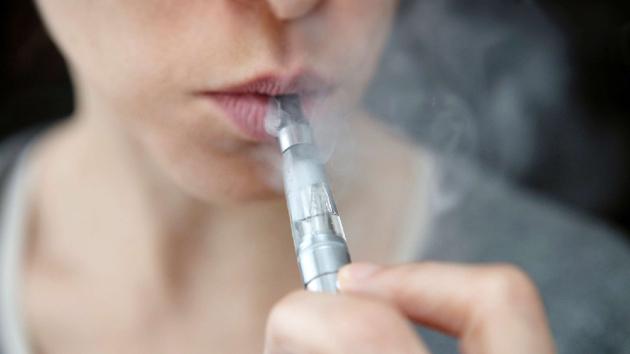
Unanimous Supreme Court upholds FDA block of flavored vapes

Unanimous Supreme Court upholds FDA block of flavored vapes
STOCK PHOTO/Getty Images

(WASHINGTON) — A unanimous Supreme Court on Wednesday backed the Food and Drug Administration’s refusal to authorize the sale of kid-friendly flavored e-cigarettes and vapes, including the flavors “Killer Kustard Blueberry,” “Rainbow Road,” and “Pineapple Express.”

Justice Samuel Alito, in his opinion for the court, rejected the manufacturers’ claims that the agency had acted arbitrarily and capriciously in violation of federal law by changing the requirements for product approval in the middle of the process.

“In the end, we cannot say that the FDA improperly changed its position with respect to scientific evidence, comparative efficacy, or device type,” Alito wrote. He returned the case to a lower court for further review.

The ruling effectively holds the line on the government’s decision to severely limit the number of flavored tobacco products legally available in the U.S. market out of concerns over the impact on children.

Kid-friendly flavors, such as fruit, candy, mint, menthol and desserts — which are largely not approved by the FDA and are currently sold on store shelves illegally — have been fueling an explosion in retail sales of e-cigarettes.

While vaping among youth is declining, more than 1.6 million children use the products, according to the Centers for Disease Control and Prevention. Nearly 90% of them consume illicit flavored brands.

“Today’s ruling is a major victory for the health of America’s kids and efforts to protect them from the flavored e-cigarettes that have fueled a youth nicotine addiction crisis,” said Yolanda Richardson, president of the Campaign for Tobacco-Free Kids, an advocacy group. She noted the FDA has denied over 26 million flavored e-cigarette product applications so far.

“While the FDA has authorized the sale of only 34 e-cigarette products, manufacturers continue to flood the market with thousands of illegal, unauthorized products,” Richardson said in a statement. “To end this crisis, the FDA must deny marketing applications for flavored e-cigarettes and step up enforcement efforts to clear the market of illegal products. Today’s ruling should spur the FDA to act quickly to do so.”

The companies — White Lion Investments LLC and Vapetasia LLC — did not immediately respond to ABC News’ request for comment on the Supreme Court’s ruling.

Since 2009, federal law requires sellers of new nicotine products to provide regulators with scientific evidence to show that the products would promote public health, but the statute does not spell out specifically what evidence is necessary and sufficient. The FDA’s guidance on how to meet that requirement was at the center of the case.

While the first Trump administration had taken a hard line against the marketing and sale sweet and candy flavored vapes, President Donald Trump said during the campaign that he wants to “save” flavored vapes. It’s not clear how the FDA, newly under his control, may modify regulations around flavored vapes or alter the approval process.

Despite their loss in the case, vape manufacturers are able to reapply for approval with the FDA in a new application and attempt to show how benefits of the product to public health would outweigh the dangers to teens.

“In light of the statutory text and the well-documented and serious risks flavored e-cigarette products pose to youth, it should have come as no surprise that applicants would need to submit rigorous scientific evidence showing that the benefits of their products would outweigh those risks,” Justice Sonia Sotomayor concluded in a short concurring opinion in the case.

Copyright © 2025, ABC Audio. All rights reserved.

Shares in Trump social media company sink following concerns about insider selloff

Shares in Trump social media company sink following concerns about insider selloff
Andrew Harnik/Getty Images

(WASHINGTON) — Shares in Donald Trump’s social media company sank in morning trading on Wednesday, a day after the company filed paperwork with the Securities and Exchange Commission that could allow the president’s trust to sell more than $2 billion of shares.

Trump Media and Technology Group filed a registration with the SEC on Tuesday that would open the door for the president’s trust to sell up to nearly 115 million shares, which are worth more than $2.3 billion.

The filing does not guarantee the sale of the shares nor provide any information about a future sale. Since Trump took office, he transferred his stake of the company into the Donald J. Trump Revocable Trust, which is controlled by his son, Donald Trump Jr.

A sell-off from Trump, the company’s largest individual shareholder, could panic investors and damage the company’s stock price.

As of midday Wednesday, the company’s stock price was down about 5%.

Trump Media and Technology Group pushed back on the possibility that Trump may attempt to sell any shares in a statement on Wednesday.

“Legacy media outlets are spreading a fake story suggesting that a TMTG filing today is paving the way for the Trump trust to sell its shares in TMTG. To be clear, these shares were already registered last June on an S-1 form, and today TMTG submitted a routine filing that re-registers them on an S-3 form in order to keep the Company’s filings effective. In fact, there currently is no open window for any affiliate to sell shares,” the statement said.

The president also has previously said he plans to hold his stake in the company.

“I don’t want to sell my shares. I don’t need money,” Trump told reporters in September.

Copyright © 2025, ABC Audio. All rights reserved.

Mayor Eric Adams’ case dismissed with prejudice despite Trump admin’s request to allow for later prosecution

Mayor Eric Adams’ case dismissed with prejudice despite Trump admin’s request to allow for later prosecution
Kayla Bartkowski/Getty Images

(NEW YORK) — A federal judge in New York on Wednesday dismissed corruption charges against Mayor Eric Adams, but not in the way the Trump administration wanted.

Judge Dale Ho dismissed the case with prejudice, meaning it cannot be revived.

The Justice Department sought to have the case dismissed to free up Adams to cooperate with the mayor’s immigration agenda, however, the department wanted the case dismissed without prejudice, meaning it could be brought again.

Adams was indicted last year in the Southern District of New York on five counts in an alleged long-standing conspiracy connected to improper benefits, illegal campaign contributions and an attempted cover-up. He had pleaded not guilty.

Ho declined to endorse the DOJ’s desired outcome.

“In light of DOJ’s rationales, dismissing the case without prejudice would create the unavoidable perception that the Mayor’s freedom depends on his ability to carry out the immigration enforcement priorities of the administration, and that he might be more beholden to the demands of the federal government than to the wishes of his own constituents. That appearance is inevitable, and it counsels in favor of dismissal with prejudice,” Ho decided.

Ho’s 78-page opinion dismantled the Justice Department’s stated rationale for dismissal: so Adams could focus on the Trump administration’s immigration priorities.

The judge said he could find no other example of the government dismissing charges against an elected official to enable the official to facilitate federal policy goals.

“DOJ’s immigration enforcement rationale is both unprecedented and breathtaking in its sweep,” Ho said. “And DOJ’s assertion that it has ‘virtually unreviewable’ license to dismiss charges on this basis is disturbing in its breadth, implying that public officials may receive special dispensation if they are compliant with the incumbent administration’s policy priorities. That suggestion is fundamentally incompatible with the basic premise of equal justice under the law.”

Ho also made clear he was not weighing the facts of the case and said his decision “is not about whether Mayor Adams is innocent or guilty.”

Still, Adams’ lawyer celebrated the decision to drop the charges without the fear of them being revived after the mayoral election in November — as the Justice Department had threatened.

“The case against Eric Adams should have never been brought in the first place — and finally today that case is gone forever,” Alex Spiro, Adams’ lawyer, said in a statement. “From Day 1, the mayor has maintained his innocence and now justice for Eric Adams and New Yorkers has prevailed.”

The decision to dismiss the charges came just days after Adams’ lawyer had pushed for them to be dismissed ahead of the April 3 deadline for petitions to be submitted for mayoral candidates to get on the June primary ballot. Adams has said he will run as a Democrat in the primary despite criticism from opponents he has cozied up to the Trump administration in recent months, meeting with the president and attending his Inauguration instead of scheduled Martin Luther King Day events in the city.

The decision by Ho followed the recommendation from Paul Clement, who served as solicitor general under the Bush administration and was appointed by Ho to make an independent assessment of the case.

“A dismissal without prejudice creates a palpable sense that the prosecution outlined in the indictment and approved by a grand jury could be renewed, a prospect that hangs like the proverbial Sword of Damocles over the accused,” Clement said.

The eventual dismissal came after a scathing letter from acting U.S. Attorney Danielle Sassoon to U.S. Attorney General Pam Bondi, suggesting acting Deputy Attorney General Emil Bove and other members of DOJ leadership were explicitly aware of a quid pro quo suggested by Adams’ attorneys, saying Adams’ vocal support of Trump’s immigration policies would be boosted by dismissing the indictment against him.

Sassoon, who was appointed by President Donald Trump, resigned in protest along with several other career DOJ officials.

Spiro, Adams’ lawyer, balked at the notion of a quid pro quo following Sassoon’s resignation: “The idea that there was a quid pro quo is a total lie. We offered nothing and the department asked nothing of us.”

Copyright © 2025, ABC Audio. All rights reserved.