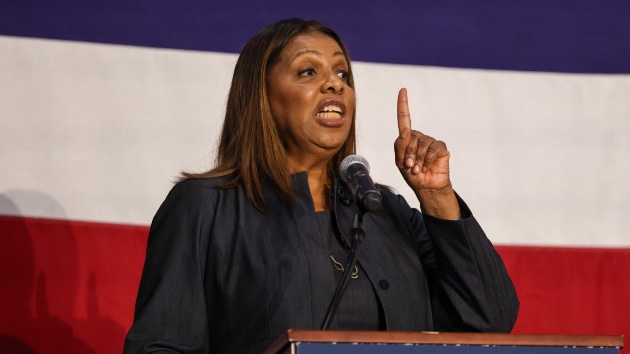
NY Attorney General Letitia James hosts a town hall at SUNY Westchester Community College to hear from residents about the impact of former President Donald Trump’s policies on their lives on May 08, 2025 in Valhalla, New York/ (Photo by Spencer Platt/Getty Images)
(NEW YORK) — Federal prosecutors in Albany have issued subpoenas to New York Attorney General Letitia James inquiring about her office’s civil fraud case against President Donald Trump and corruption case against the National Rifle Association, multiple sources told ABC News.
The Justice Department declined to comment.
A spokesperson for James called the subpoenas a “weaponization of the justice system,” invoking a criticism Trump used to describe her case against him that resulted in a half-billion-dollar penalty.
“Any weaponization of the justice system should disturb every American. We stand strongly behind our successful litigation against the Trump Organization and the National Rifle Association, and we will continue to stand up for New Yorkers’ rights,” the spokesperson said in a statement.
The civil fraud case is on appeal with the New York State Appellate Division’s First Department. Trump, his eldest sons and his business were found liable for 10 years of fraud that inflated the president’s net worth.
James sued the NRA in 2020, accusing the gun rights group’s former CEO, Wayne LaPierre, and others of misappropriating donor funds to finance luxury items for themselves. The jury determined LaPierre owed more than $4 million.
The subpoenas, from the U.S. Attorney’s Office for the Northern District of New York, are part of an investigation into whether James and her office violated the civil rights of Trump or the NRA executives, the sources said.
An attorney for James, Abbe Lowell, called the probe “a dangerous escalation” and “the most blatant and desperate example of this administration carrying out the president’s political retribution campaign.”
“If prosecutors carry out this improper tactic and are genuinely interested in the truth, we are ready and waiting with the facts and the law,” Lowell said in a statement.
This is a developing story. Please check back for updates.
US President Donald Trump (R) meets Russian President Vladimir Putin (L) on the first day of the G20 summit in Osaka, Japan on June 28, 2019. (Photo by Kremlin Press Office / Handout/Anadolu Agency/Getty Images)
(WASHINGTON) — President Donald Trump’s Friday deadline has arrived for Russia’s Vladimir Putin to agree to a ceasefire with Ukraine or face “secondary sanctions” against countries that buy oil from Russia.
But uncertainty remains as to whether the U.S. will hit Moscow with new economic penalties amid talk of a possible bilateral meeting between Trump and Putin happening soon.
Trump on Thursday was asked directly if his Aug. 8 deadline for Putin to make peace or face consequences still applied.
“It’s gonna be up to him,” the president responded. “We’re going to see what he has to say. It’s gonna be up to him. Very disappointed.”The White House is pushing for a trilateral summit between Trump, Putin and Ukrainian President Volodymyr Zelenskyy, though Trump said Putin meeting with Zelenskyy wasn’t a condition for he and Putin to meet.
“They would like to meet with me and I’ll do whatever I can to stop the killing,” Trump said on Thursday.
Trump, who once said he could end the Russia-Ukraine war within his first 24 hours in office and touted his personal relationship with Putin, has expressed increasing frustration with the Russian leader.
In mid-July, Trump said he was giving Putin a 50-day ultimatum to stop the fighting. He then moved up the timeline to 10 days, citing his disappointment with Putin.
“I want to be generous, but we just don’t see any progress being made,” Trump said at the time. “I’m not so interested in talking anymore. He talks, we have such nice conversations, such respectful and nice conversations, and then people die the following night in a — with a missile going into a town and hitting.”
Tensions between the U.S. and Russia escalated last week when Trump announced he was moving nuclear submarines in response to what he called “highly provocative statements” from the deputy chair of Russia’s security council, Dmitry Medvedev.
Medvedev, also the former president of Russia, had sounded off on Trump’s ceasefire deadline, writing on social media that “each new ultimatum is a threat and a step towards war.”
While Trump said the nuclear submarines would be moved in response, he and the White House would not specify what capabilities the submarines have or other questions surrounding the announcement.
And earlier this week, Trump indirectly upped the pressure on Russia by doubling his tariff rate against India over India’s imports of Russian oil.
Tracy Glantz/The State/Tribune News Service via Getty Images
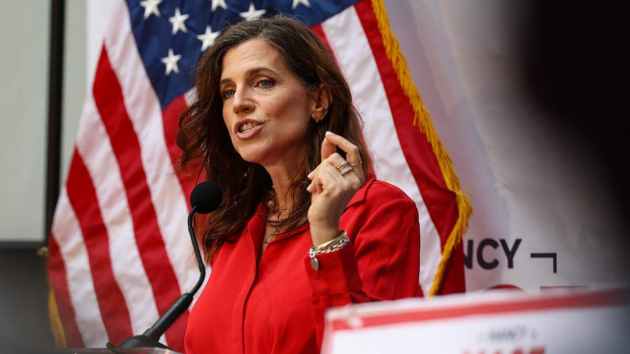
(MYRTLE BEACH, S.C.) — During a town hall event, Republican Rep. Nancy Mace compared herself to President Donald Trump and requested he endorse her for South Carolina’s governor — a race where there is already a crowded slate of five candidates.
In Myrtle Beach, South Carolina, Mace encountered a friendly crowd at her first town hall since launching her bid for governor and called on them to have Trump — and his supporters — back her.
“I’m just saying I’ve done a lot for the president, and if you talk to him, I would really like his support for governor,” she said Wednesday during her first stop on her so-called “Mother of All Town Halls” tour.
Mace is one of several Republicans who have already thrown their hats into the ring for the state’s top job. Attorney General Alan Wilson, Lt. Gov. Pamela Evette and Rep. Ralph Norman have also announced their campaigns.
Mace outlined her campaign promises, urging the audience to support her run to lead the state. She also likened herself to Trump, who is popular in the state after winning it in his 2016, 2020 and 2024 presidential runs.
“I want to take what’s broken in South Carolina, and I want to burn it down to the ground and build it right back up, right where it needs to be, because you’ve earned it. You deserve it, and you deserve someone who’s going to work 24/7. I don’t sleep. I went to bed at 1 a.m., and I was up at 4 a.m. OK, I am Trump in high heels. I love what I am doing. I mean, he doesn’t sleep,” she said.
Trump enthusiastically backed Mace for Congress in 2024 after she endorsed him in the state’s presidential primary. Their support for each other was a change after an earlier clash. One day after the Jan. 6 attack on the U.S. Capitol, Mace said Trump’s “entire legacy” was “wiped out” by the siege. Later, during the 2022 midterms, Trump called Mace “terrible” and a letdown.
Trump has not yet publicly commented on Mace’s recent request for his endorsement.
As governor, Mace said child rapists would get the death penalty, eliciting a loud applause from the crowd. She said businesses who employ “illegal aliens” will be fined $1,000 a day, and hopes to bring down the state income tax.
“We’re going to stop that in South Carolina, because on day one, if you give me a bathroom bill — state legislature, I will sign it into law. We’re going to keep men out of women’s spaces,” she said.
Mace also recounted how she helped get Mike Johnson elected as speaker of the House by getting Trump on the phone with remaining Republican holdouts.
“When there’s one guy in the room that can bring all of us together, I witnessed it, and that man was Donald J. Trump, so I was there for him when we got the speaker elected.”
Mace engaged with an agreeable crowd during the short question-and-answer portion, during which topics including the Department of Government Efficiency, fluoride in water and Trump’s promise to provide a tax credit on generators were raised.
Pressed by an audience member about Trump’s promise to provide a tax credit on generators for individuals who live in dangerous or coastal communities following the floods, Mace said, “I can absolutely remind him.”
Mace said she hopes “like hell” DOGE is “on its way” to South Carolina, claiming she has helped DOGE find “some of these crazy contracts” that DOGE claims are wasteful.
“We’ve got to audit some of our agencies, particularly the Department of Education. I want to know where all the money is going, and can we take some of it out of the bureaucracy and give it to our teachers?” she said.
The congresswoman said she would support “any action to remove fluoride from our water and also ban chemtrails,” the widely debunked conspiracy theory that claims the white lines from aircraft are releasing chemicals — including for nefarious reasons.
Her friendly town hall came at a time when many other members of Congress are facing hostile crowd at rowdy events. Earlier this week, a town hall crowd shouted at and heckled Republican Rep. Mike Flood as he touted Trump’s massive policy and tax bill that was signed into law in July.
ABC News’ Sarah Beth Hensley contributed to this report.
(NEW YORK) — The redistricting battle gripping Texas has put a spotlight on the ongoing debate over gerrymandering and its long-term effects on the electorate.
Sam Wang, the founding director of the Electoral Innovation Lab and the creator of the Gerrymandering Project , a research lab focused on creating the most fair district maps, told ABC News that state leaders from both sides of the aisle have changed election boundaries to make it stacked with constituents who vote in their favor.
In the last 20 years, with access to advanced computer algorithms, those gerrymandering attempts have become more egregious as whole counties have been divided up with pinpoint precision, resulting in districts with areas with outlandish shapes, he said.
“Gerrymander is partisanship maximized above all of the other things,” Wang said.
The practice was first identified and coined in 1812 when Massachusetts Gov. Elbridge Gerry signed a bill that redrew the state’s congressional maps to benefit the Democratic-Republican party. Maps are typically redrawn at the beginning of each decade to reflect changes in the population from the latest census.
Kareem Crayton, the vice president of the Washington D.C. office of the Brennan Center for Justice, who has spent years researching redistricting, told ABC News the redistricting campaigns since the 2000s have led to a systemic cycle of gerrymandering, especially in the South.
“States like Florida and Texas have the worst examples of gerrymandering,” he said.
But Crayton also pointed out that states with Democratic majorities, like Illinois, have responded with their own maps that also skew districts in their favor, leading to an endless cycle.
“All of these states are looking around at each other like ‘The Good, the Bad and the Ugly’ thinking who’s going to fire first,” he said, referring to the Western film. “There is no sheriff in town saying this is not helping everyone.”
While Republican and Democratic leaders in those states have contended they are redrawing their maps to adequately reflect their communities, Wang said the math and geography aren’t backing their arguments.
Wang’s lab created a mathematical algorithm that creates district maps using key demographic factors. Racial demographics from the Census, environmental and geographic information from local data and other public sources are used to create district maps that remove political bias. Those maps are then compared to the district maps currently in place.
“That tells us what someone who didn’t care about political parties would do,” he explained. “We have harnessed the power of computer simulation to see what would be neutral.”
Texas is one of the 15 states in the map that earned an F grade based on the Gerrymander Project’s formula.
Although the state legislature and congressional delegation are led by a Republican majority, Texas’s current districting map is divided in a way that gives the GOP an advantage, according to the project. The analysis shows that the redistricting negates a challenging vote.
Travis County, for example, includes the city of Austin, which has leaned Democratic, but the county includes five congressional districts around it. By not including Austin in the suburban areas, the congressional district will lean Republican, according to the analysis.
The Gerrymander Project’s analysis found that the county splits in Texas, which is the number of districts within a single county, are higher than the average split per state, based on its analysis.
For example, more dense Dallas County is home to five congressional districts, and two of the districts’ boundaries extend into the next county.
Such division leads to confusion among voters as to what their district is, according to Crayton.
Crayton said that such county splits have led to more examples of elected officials running unopposed.
“If you’re a candidate from an opposing party, you’re going to have an uphill battle trying to run in a district where the majority of the voters are registered to the majority,” he said.
“We’ve seen it happen all of the time where a Democrat or Republican simply won’t put the time and effort to run because the gerrymandered district puts the odds against them,” Crayton said.
Although the majority of the states that got the project’s F grade are in the South and show more of a Republican advantage, the experts warned that blue states in other parts of the country have used gerrymandering as well.
Illinois, which is one of the Midwest states with an F grade, is the prime example, they said.
Its current map, which was adopted in 2021, contains non-compact districts, which leads to unequal voter density per area, and more county splits than the average, according to the Gerrymander Project.
One egregious example is the state’s 13th congressional district, which covers a nearly 2,300 square mile boundary that extends from its southern point near the border with Missouri to Springfield, right in the center of the state, and then east to the city of Champaign.
The boundaries keep a huge concentration of Democratic leaning voters, according to the Gerrymander Project.
Wang noted that the Supreme Court’s 2019 decision that ruled gerrymandering for party advantage cannot be challenged in federal court has removed key guardrails for preventing states from taking part in severe party redistricting.
The case involved gerrymandering allegations in North Carolina, and while the court’s majority ruled that the practice may be “incompatible with democratic principles,” federal courts had no jurisdiction in reviewing those cases.
Wang said that most states have taken gerrymandering to their limit and made it extremely hard for state legislatures to revert their boundaries to more fair areas.
“The lemon has been squeezed dry,” he said.
However, Wang noted that gerrymandering cases have prompted the public to speak out and take action to turn the tide and rein in gerrymandering in some key states.
Virginia, for example, used a special master in 2022 to draw up its current maps following a court case brought by the state’s constituents and some local elected officials.
The court ordered the special master to create district maps to adhere to federal requirements of population equality, the Voting Rights Act mandates, state constitution and statutes in its districting process.
As a result of its changes, the state, which has a slight Democratic majority in its state legislature, has no partisan competitiveness in its congressional districts, according to the Gerrymander Project, which awarded Virigina an A rating.
The district’s geography is “Fairly compact” and has the national average number of county splits, according to the project’s analysis.
Wang said ballot initiatives that removed the legislature from the districting process have risen in popularity in many states and have made a huge difference.
Arizona, which also has an A rating by the project, has been using an independent redistricting commission after voters passed a ballot initiative in 2000 that changed state regulations.
The state, which has a Republican majority in its state legislature, does not have a partisan advantage in its state districts, according to the Gerrymandering Project. Its districts are seen as “fairly compact” and are the average number of county splits, according to the analysis.
Crayton and Wang said the state-run solutions to redistricting are a good step forward, but ultimately, it is going to take Congressional legislation to end partisan influence in these maps.
Wang said that public opinion has consistently shown that constituents seek fair maps regardless of their political affiliations.
“If Congress were to really pursue it, it could be bipartisan and get a lot of support,” he said of legislation that prohibited gerrymandering tactics. “And we’ve seen it work.”
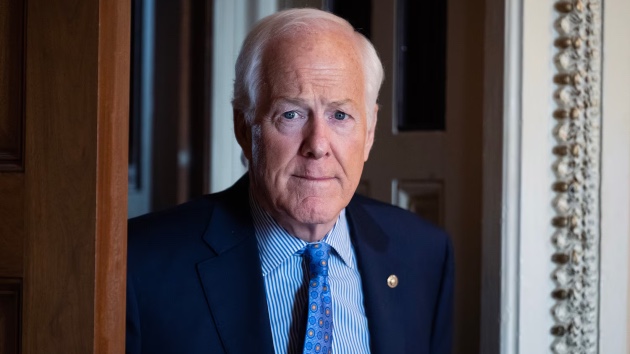
Sen. John Cornyn leaves a senate luncheon in the U.S. Capitol, June 3, 2025. (Tom Williams/CQ-Roll Call via Getty Images)
(WASHINGTON) — Sen. John Cornyn, a Texas Republican, said on Thursday that FBI Director Kash Patel has granted his request for the federal government to assist with locating Texas House Democrats who fled the state in protest of GOP-led redistricting efforts.
Cornyn’s letter requesting federal help with locating and investigating the state legislators was sent on Tuesday.
“I thank President Trump and Director Patel for supporting and swiftly acting on my call for the federal government to hold these supposed lawmakers accountable for fleeing Texas. We cannot allow these rogue legislators to avoid their constitutional responsibilities,” Cornyn said in a news release.
The FBI declined to comment on the matter.
Cornyn also joined “The Mark Davis” radio show on Thursday morning and expressed his gratitude for Patel’s prompt response.
“Just to get to the bottom of it, I asked Kash to look into it and he responded promptly, I’m grateful to him,” the senator said.
Cornyn also called the Democrats “irresponsible” for breaking quorum — and rendering the legislature unable to take up any legislation, including some in responds to the floods that devastated the region recently.
“There are a number of things on the call that Gov. Abbott has listed, including redistricting, but they’re missing all of those. And I think that’s irresponsible, and I think we just need to get to the bottom of it,” said Cornyn. “They got to come back home sometime … it’s not going to be successful. They’re not going to be able to ultimately escape their responsibility. It’s a stunt.”
The Texas House of Representatives failed again on Tuesday to move forward on enacting the GOP’s new congressional map, which could net Republicans between three and five seats in next year’s midterm elections. Those added seats could be the difference maker over who has control of the U.S. House — a chamber where Republicans have a small majority.
House Speaker Rep. Dustin Burrows, a Republican, said the legislature would try again on Friday to establish a quorum.
In the meantime, Texas Gov. Greg Abbott ordered the Texas Department of Public Safety to find and arrest those Democrats, an order Abbott said will remain in effect until they are “accounted for and brought back” to Austin.
President Donald Trump earlier this week told ABC News Chief White House Correspondent Mary Bruce the FBI “may have to get involved.”
“You can’t just sit it out. You have to go back. You have to fight it out. That’s what elections are all about,” the president said at the time.
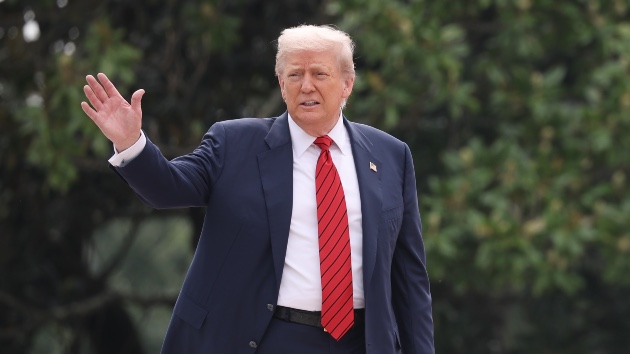
U.S. President Donald Trump waves from the roof of the West Wing of the White House as he takes a tour on August 05, 2025 in Washington, DC. (Photo by Win McNamee/Getty Images)
(WASHINGTON) — President Donald Trump on Thursday demanded work begin on a new census as redistricting battles are spreading across the country.
In a social media post, Trump announced he directed the Commerce Department to “immediately begin work on a new and highly accurate CENSUS based on modern day facts and figures and, importantly, using the results and information gained from the Presidential Election of 2024.”
“People who are in our Country illegally WILL NOT BE COUNTED IN THE CENSUS,” Trump added.
The U.S. Census Bureau says it “collects data from all foreign born who participate in its censuses and surveys, regardless of legal status” and has done so for its 235-year history. The data determines how the 435 House seats are divided among the 50 states every 10 years.
Trump’s announcement on Thursday comes amid a showdown in Texas over a proposed congressional map that, if enacted, could net Republicans between three and five U.S. House seats in next year’s midterm elections.
Texas Democrats fled the state in protest, denying Republicans the necessary quorum to vote on the changes. Republican Gov. Greg Abbott is now exploring legal consequences for those lawmakers, ordering Texas Department of Public Safety to find and arrest lawmakers who left the state and asking the Texas Supreme Court to remove a top Texas House Democrat from office.
With control of the U.S. House potentially at stake, blue-state Democrats are vowing to respond in kind should Texas Republicans succeed in changing their map.
New York Gov. Kathy Hochul and California Gov. Gavin Newsom said they will explore ways to gerrymander their maps. Both states currently use independent commissions to draw their maps following constitutional amendments.
More Republican governors, too, are exploring possibly redrawing congressional maps ahead of the 2026 elections given the GOP’s razor-thin margins in the House. Democrats would need to only net three seats next November to win back the House.
Vice President JD Vance is visiting Indiana on Thursday to discuss redistricting and other topics with Republican leaders.
Trump in his first term attempted to change the U.S. census to exclude noncitizens. In 2019, the Supreme Court ruled that Commerce Department’s attempt to add a citizenship question to the 2020 census violated federal law.
(WASHINGTON) — A bilateral meeting between President Donald Trump and Russian President Vladimir Putin could happen as soon as next week, according to a White House official.
White House special envoy Steve Witkoff returned from Moscow on Wednesday and relayed to President Trump that Putin would like to meet with him, the official said.
In response, Trump indicated he is open to that if Putin also meets with Ukrainian President Volodymyr Zelenskyy, the official added.
Witkoff met with Putin for several hours on Wednesday ahead of the Friday deadline imposed by Trump for Russia to agree to a ceasefire with Ukraine or face sanctions.
According to a senior administration official, the meeting “went well” but secondary sanctions are still expected to be deployed against Moscow this week.
Trump has expressed increasing frustration with Putin over the conflict, shortening the deadline for a ceasefire from 50 to 10 days as he said he was “disappointed” in the Russian leader.
Trump, in a social media post on Wednesday, called the meeting between Witkoff and Putin “highly productive.”
“Great progress was made! Afterwards, I updated some of our European Allies. Everyone agrees this War must come to a close, and we will work towards that in the days and weeks to come,” Trump wrote.
This is a developing story. Please check back for updates.
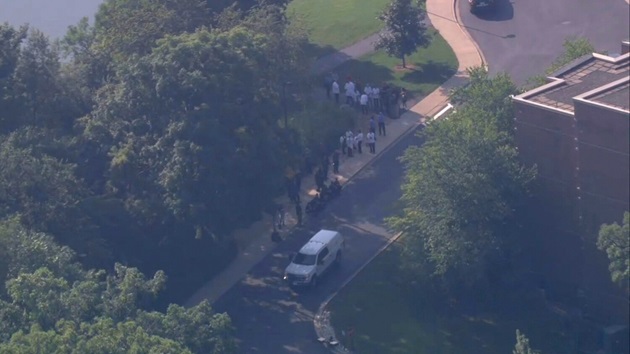
The St. Charles Police Department said they responded to a report of a bomb threat at the Q Center hotel outside Chicago. No device was found, authorities said.
“St. Charles Police and Fire departments and the Kane County Sheriff’s Office bomb squad conducted a thorough search and no device was found. In response to the threat, 400 people were immediately evacuated and the area was secured as bomb squad units conducted their investigation,” the department said in a statement.
According to authorities, all guests and staff were able to return safely to the premises and the investigation is ongoing.
Several Texas Democrats released statements on the threat and said they won’t be deterred from trying to block the new congressional map that would heavily favor Republicans.
“Early this morning, a bomb threat forced us to evacuate our hotel. Thankfully, no one was harmed. But this is the kind of danger that comes from reckless rhetoric. When the Attorney General tells people to ‘hunt us down,’ it’s not just politics — it’s a threat to our safety,” state Rep. Ann Johnson said in a statement.
“We’ve been threatened by the Governor, the Attorney General, and our colleagues in the House,” state Rep. John Bucy said in a statement. “This harmful discourse emboldens bad actors and encourages violence. It’s unacceptable and needs to end.”
Bucy added that Texas Democrats are “determined” still.
“We will push through the threats and the noise to keep fighting for our constituents, our democracy, and our country. This is a fight worth having,” Bucy said.
Texas House Democratic Caucus Chair Rep. Gene Wu and state Reps. Ramón Romero and Barbara Gervin Hawkins said in a statement that their cohort in Illinois is safe.
“This morning, a threat was made against the safety of the members of the Texas House Democratic Caucus. We are safe, we are secure, and we are undeterred. We are grateful for Governor Pritzker, local, and state law enforcement for their quick action to ensure our safety.”
Illinois Gov. JB Pritzker, who has been a vocal supporter of Texas Democrats, said in a social media post that he was aware of the reported threats made against Texas officials in the state and that he’s been in touch with state police.
“Threats of violence will be investigated and those responsible will be held accountable,” Pritzker wrote on X.
The redistricting fight continues to escalate after dozens of Texas House Democrats fled the state on Sunday to prevent Republicans from moving to enact the new election map, which could impact which party controls the U.S. House after the 2026 midterm elections.
Texas Gov. Greg Abbott, a Republican, has ordered the Texas Department of Safety to find and arrest the Democrats who fled the state, an order which will remain in effect until they are “accounted for and brought back” to Austin.
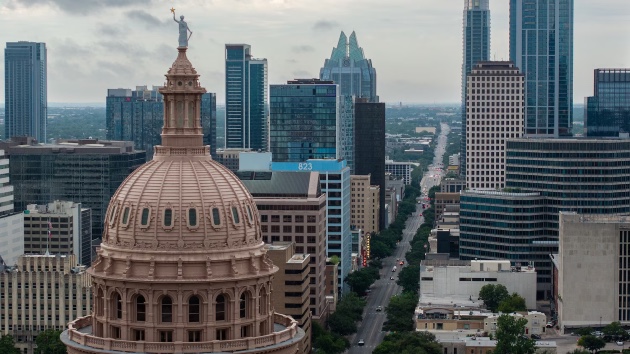
(AUSTIN, Texas) — The redistricting battle in Texas continues to escalate as Republican Gov. Greg Abbott urged the state Supreme Court to remove state Rep. Gene Wu, the chairman of the Texas House Democratic caucus.
Abbott argued that Wu has “forfeited” his office by fleeing the state along with other Democratic lawmakers to prevent the quorum necessary for Texas House to vote on enacting the new GOP-proposed congressional map — with Republican control of the U.S. House of Representatives potentially at stake.
Wu accused Abbott of “silencing my dissent” and said he’s undeterred in his mission to fight the Republican-led redistricting effort.
“Let me be unequivocal about my actions and my duty. When a governor conspires with a disgraced president to ram through a racist gerrymandered map, my constitutional duty is to not be a willing participant,” Wu said in a statement.
Abbott asked the Texas Supreme Court for a ruling by Thursday evening, before Texas Republicans try again Friday to convene the legislature and make a quorum.
Texas Republicans failed for the second time on Tuesday to move ahead with the redistricting effort — one backed by President Donald Trump, who has claimed the GOP is “entitled” to five more U.S. House seats in the state.
The faceoff has nationwide implications, with control of the U.S. potentially at stake. Democrats would need to only net three seats in next year’s midterm elections to win back the House.
Texas Democrats are set to continue speaking out against the redistricting effort across the country on Wednesday. Texas Senate Democrats are hosting a news conference in Massachusetts.
Abbott’s emergency petition to the Texas Supreme Court comes as he and Texas Attorney General Ken Paxton, also a Republican, pursue legal options against Democrats who left the state — including civil arrest warrants and investigations of potential law violations including bribery for soliciting funds to support their effort.
“Representative Wu and the other Texas House Democrats have shown a willful refusal to return, and their absence for an indefinite period of time deprives the House of the quorum needed to meet and conduct business on behalf of Texans. Texas House Democrats abandoned their duty to Texans, and there must be consequences,” Abbott said in his filing to the Texas Supreme Court.
Paxton, though, said the governor does not have the authority to file the emergency petition.
“Texas is taking every available avenue to force runaway Democrats to return to Texas and hold them accountable for breaking quorum,” Paxton said in a statement released on Tuesday evening. “Under the Texas Constitution and Texas law, the Office of the Attorney General has the legal authority to bring these cases against the renegade House members. I have alerted the Texas Supreme Court that I will be making additional filings on Friday if the Democrats continue to abandon their legislative duties.”
U.S. Sen. John Cornyn, a Texas Republican, requested the FBI work with Abbott and state law enforcement to help bring back and investigate Texas Democrats.
ABC News Chief White House Correspondent Mary Bruce asked President Trump on Tuesday afternoon if he wanted the FBI to get involved.
“Well, they may have to. They may have to,” Trump responded.
“No, I know they want them back. Not only the attorney general. The governor wants them back. If you look, I mean, the governor of Texas is demanding they come back. So a lot of people have demanded they come back. You can’t just sit it out. You have to go back. You have to fight it out. That’s what elections are all about,” the president added.
ABC News’ Alexandra Hutzler contributed to this report.
Aimee Dilger/SOPA Images/LightRocket via Getty Images
(WASHINGTON) — Vice President JD Vance on Wednesday evening is expected to host a group of top administration officials at his residence for a strategy session as the administration considers whether to release the transcript from the Department of Justice interview with Ghislaine Maxwell, sources familiar with the matter told ABC News.
It’s one of many meetings that has consumed the White House and top administration officials as they attempt to quell the fallout from their handling of the Epstein files and as pressure mounts for the DOJ and the White House to be transparent about what Maxwell said in her nine hours of meetings last month with Deputy Attorney General Todd Blanche.
During her interview, Ghislaine Maxwell said nothing that would be harmful to President Donald Trump, telling Blanche that Trump had never done anything in her presence that would have caused concern, according to sources familiar with what Maxwell said.
Attorney General Pam Bondi, Blanche, FBI Director Kash Patel and White House chief of staff Susie Wiles are expected to attend the session with Vance, the sources said.
As ABC reported Tuesday, the administration could release a transcript of the interview as soon as this week.
The White House didn’t immediately respond to request for comment.
Vance’s office didn’t immediately respond to a similar request.