
Trump has taken steps to make his campaign promise to seek ‘retribution’ reality, critics say

Trump has taken steps to make his campaign promise to seek ‘retribution’ reality, critics say
Chip Somodevilla/Getty Images

(WASHINGTON) — President Donald Trump, upon his return to the White House, appears to have quickly turned one of his more ominous campaign promises into reality.

Among his first acts after being sworn in inside the Capitol Rotunda was to strip the security clearances from 51 former intelligence officials who signed a letter during the 2024 campaign describing a news story abut the public release of emails from Hunter Biden’s laptop as potentially part of a Russian disinformation operation.

In the days that followed, he removed protective details for former officials who received threats over their work, including retired Gen. Mark Milley, Dr. Anthony Fauci, former Secretary of State Mike Pompeo and others. Trump’s reasoning at the time was, “You can’t have a security detail for the rest of your life.”

Trump told supporters at his first 2024 rally, back in March 2023: “I am your retribution.”

Now, 100 days into his second term, his list of targets appears to be growing. And much of the action is aligned with his own political interests.

“He’s really taking it to the next level,” said Nick Akerman, a former federal prosecutor who helped investigate President Richard Nixon during the Watergate scandal.

Some predictable Trump targets have included former President Joe Biden and former Vice President Kamala Harris, whose access to classified information he revoked. (While it is the norm for former presidents to receive briefings, the move against Biden came after Biden stripped Trump of having access to them in 2021, citing his “erratic behavior.”)

Trump’s list of his critics who he said should no longer have access to classified material also included Hillary Clinton, his 2016 opponent; former Republican Reps. Liz Cheney and Adam Kinzinger, who investigated his role in the Jan. 6 Capitol attack; New York Attorney General Letitia James, who prosecuted his company for fraud; and Manhattan District Attorney Alvin Bragg, who led the hush money case against Trump that resulted in the first-ever criminal conviction of a former president.

Trump also signed executive orders against some of the nation’s top law firms.

Perkins Coie, which represented Clinton’s 2016 campaign, was the subject of an order mandating its lawyers have their security clearances stripped. The executive action also sought to terminate any government contracts that might exist with the firm or other entities that it represents, bar agencies from hiring employees of Perkins Coie and prohibit the firm’s staff from accessing government buildings.

Trump also took aim at WilmerHale, which has ties to former special counsel Robert Mueller, with an order alleging it engages in “conduct detrimental to critical American interests” in its pro-bono work. Trump ordered his administration to suspend the security clearances of WilmerHale employees and also requires government contractors to disclose any business they do with the law firm.

Richard Painter, who served as a White House ethics lawyer in the George W. Bush administration, criticized Trump’s attacks on law firms as an affront to the rule of law.

“The executive orders against law firms are a fundamental infringement on the right to counsel and the right of lawyers to represent clients of their choice without retribution by the government,” Painter said.

“The First Amendment right to petition the government for redress of grievances includes the right to legal representation in court for anybody, even Democrats,” Painter added.

Several universities have found themselves in Trump’s crosshairs as his administration made demands regarding campus policies and governance. Harvard University, after refusing, had $2.2 billion in federal grants frozen.

News media, too, hasn’t been spared.

The Associated Press was barred from White House events because the outlet wouldn’t refer to the Gulf of Mexico only as the “Gulf of America,” after Trump’s order renaming the body of water, though the outlet appeared to gain back some access as the White House instituted a new policy lumping wire service reporters into a broader collective of print outlets. The White House has also suggested funding for NPR and PBS, which Trump accused of being left-leaning, is a waste of taxpayer money.

Trump signed orders directing the Department of Justice to investigate two individuals who worked in his first administration who became outspoken critics of his leadership.

Chris Krebs, resigned from his job at a private cybersecurity firm after Trump directed Attorney General Pam Bondi to review Krebs’ actions while leading the Cybersecurity and Infrastructure Agency (CISA) — a job Trump appointed him to in 2017. Krebs has long assured the 2020 election was secure, criticizing Trump for spreading debunked claims of election fraud.

“For those who know me, you know I don’t shy away from tough fights. But I also know this is one I need to take on fully — outside of SentinelOne,” Krebs said in a social media post announcing his resignation. “This will require my complete focus and energy. It’s a fight for democracy, for freedom of speech, and for the rule of law. I’m prepared to give it everything I’ve got.”

Miles Taylor, the deputy chief of staff to former Homeland Security Secretary Kirstjen Nielsen, was also the target of an order from Trump directing the Justice Department to launch an investigation as Trump alleged he may have committed “treason.”

Taylor penned a 2018 New York Times op-ed describing Trump as “detrimental to the health of our republic” and a 2019 book about the first administration under the pseudonym “Anonymous” before going public in 2020.

Trump’s targeting of various individuals and institutions come after he, for years, accused President Joe Biden of weaponizing law enforcement.

“Those days are over and they are never going to come back. They’re never coming back. Now, as the chief law enforcement officer in our country, I will insist upon and demand full and complete accountability for the wrongs and abuses that have occurred,” Trump said as he spoke at the Justice Department in March.

Republicans have praised some of Trump’s moves, namely against universities and some news outlets.

“The vast majority of the American people do not want to prop up these institutions,” Republican Rep. Elise Stefanik said when the Trump administration made demands of Harvard and other schools. Stefanik added, “Higher education has fundamentally lost its way, and it’s increasingly out of touch, and the tuition rates go higher and higher. So we need to defund across the board, and President Trump is rightly holding these schools accountable.”

House Speaker Mike Johnson, while criticizing NPR and PBS, said, “The American people support the free press, but will not be forced to fund a biased political outlet with taxpayer funds.”

But critics said it’s Trump who is wielding the powers of the presidency to go after political opponents in sweeping fashion.

“All of these things are much more blatant and much more out in the open,” Akerman said, attributing Trump’s boldness, in part, to the Supreme Court’s blockbuster ruling last year granting presidents some immunity from criminal prosecution for official acts.

Painter’s message for Trump, as a former White House ethics chief: “He’s got to focus on carrying out his agenda as president, not just going after his personal enemies and political enemies.”

“Using the presidency to go after political enemies is a very dangerous thing, very dangerous for democracy, and he shouldn’t be doing that,” Painter said.

Copyright © 2025, ABC Audio. All rights reserved.

Liberal Mark Carney wins Canada election amid Trump’s 51st state comments

Liberal Mark Carney wins Canada election amid Trump’s 51st state comments
Chip Somodevilla/Getty Images

(WASHINGTON) — While final seat totals are still pending, Canadian broadcasters have called that Mark Carney led the Liberals to victory in Canada’s election on Monday.

It is still not clear whether the Liberals will form a minority or majority government. As of Tuesday morning, the Liberals had won or were leading in 168 out of 343 ridings. Pierre Poilievre’s Conservatives are set to remain in opposition, with 144 ridings so far. Parties need 172 seats to form a majority.

Carney’s victory cements the Liberal Party’s decade in power, replacing former Prime Minister Justin Trudeau, who had been leading the country since 2015.

Carney stepped in as prime minister-elect when Trudeau resigned in March.

In a social media post on the day of Canada’s election, President Donald Trump suggested that Canadians should vote for him in order for Canada to become the 51st state.

“Elect the man who has the strength and wisdom to cut your taxes in half, increase your military power, for free, to the highest level in the World, have your Car, Steel, Aluminum, Lumber, Energy, and all other businesses, QUADRUPLE in size, with ZERO TARIFFS OR TAXES, if Canada becomes the cherished 51st. State of the United States of America,” Trump said on Monday, seeming to refer to himself as the candidate.

He added, “America can no longer subsidize Canada with the Hundreds of Billions of Dollars a year that we have been spending in the past. It makes no sense unless Canada is a State!”

Despite Trump’s suggestion, Canadians cannot vote for him since he is not on the ballot. There are 16 registered political parties in Canada — with the Liberals and the Conservatives being the most dominant. Other parties include the Green Party, the Libertarian Party, the United Party and the Canadian Future Party.

In response to the president’s post, Conservative Party leader Pierre Poilievre issued a sharp reply, saying Trump should “stay out of our election.”

“The only people who will decide the future of Canada are Canadians at the ballot box. Canada will always be proud, sovereign, and independent, and we will NEVER be the 51st state,” Poilievre wrote in a post on X. “Today, Canadians can vote for change so we can strengthen our country, stand on our own two feet, and stand up to America from a position of strength.”

Canadian Prime Minister and Liberal Party leader Mark Carney posted a video on X on Monday with the message: “This is Canada — and we decide what happens here.”

Canada has a parliamentary system, meaning if the Liberals win a majority of seats in the election, or are able to form a minority government with members of another party, Carney will continue to serve as prime minister.

Nearly all of the polls for the election are expected to close by 9:30 p.m. ET on Monday.

Copyright © 2025, ABC Audio. All rights reserved.

Trump’s war on ‘woke’: Both sides say the issue is further dividing the country

Trump’s war on ‘woke’: Both sides say the issue is further dividing the country
Tom Williams/CQ-Roll Call, Inc via Getty Images

(WASHINGTON) — In a speech to a joint session of Congress in March, President Donald Trump took direct aim at diversity, equity and inclusion policies, saying hiring and promotion practices should be based on merit, not race and gender.

“We’ve ended the tyranny of so-called diversity, equity and inclusion policies all across the entire federal government and indeed the private sector and our military. And our country will be ‘woke’ no longer,” said Trump, using the term some conservatives have adopted to negatively describe progressive values.

In the first 100 days of his new administration, Trump has wielded the power of the Oval Office in an attempt to root out DEI programs beyond the federal government, threatening to withhold billions of dollars in federal funding and grants from universities, including Harvard University, unless they fall in line.

A new ABC News/Washington Post/Ipsos poll released on Sunday indicated that the country is almost evenly split on the issue. While 51% of respondents said they believe DEI efforts help level the playing field, 47% said such policies create unfair discrimination.

Despite the president’s claim that DEI in America is history, supporters say Trump’s war against what they refer to as “wokeism” is far from over.

“It’s definitely not over. And those of us who want to see corporate America get back to neutral and focusing on uniting Americans around creating value rather than dividing us on the basis of race and sex, we have a long, long way to go,” said Stefan Padfield, executive director of the Free Enterprise Project, which is part of National Center for Public Policy Research, a non-partisan conservative think tank in Washington, D.C.

Padfield said one of his primary focuses is on “reversing what we might refer to as the woke capture of corporate America” by filing shareholder proposals, engaging in litigation and conducting educational research across the nation.”

“One of the things that I and others on our side are concerned about is this idea and this notion that somehow we’ve won,” Padfield told ABC News.

Using the analogy of the Allied troops storming the beach at Normandy during the 1944 D-Day invasion, Padfield said, “Could you imagine if the Allied forces just packed up and left and claimed to have won World War II after they took Normandy beach? It would be a very different world.”

“So, we’ve got a very long march to go and certainly the proponents of DEI and related ESG [environmental, social and governance] agendas, they’re making very clear that they’re not going to go quietly, certainly,” Padfield said.

Target boycott

In a letter dated Feb. 12, 2025, a coalition of the nation’s largest civil and human rights organizations, including the NAACP and the National Urban League, asked for an urgent meeting with congressional leadership “to discuss actionable steps to protect diversity, equity, and inclusion programs to ensure equal opportunity for all Americans.”

The letter was addressed to House Speaker Mike Johnson, R-La., Senate Minority Leader Chuck Schumer, D-N.Y., Senate Majority Leader John Thune, R-South Dakota, and House Minority Leader Hakeem Jeffries, D-N.Y. “We are deeply concerned about the recent executive actions by the Trump Administration that seek to undo decades of bipartisan support for civil and human rights,” the coalition wrote.

“Diversity is and will always be one of America’s greatest strengths because a diverse America is an innovative and prosperous America,” the letter said. “Diversifying our institutions, providing opportunities, and working to ensure that everyone is included are not partisan values. These values strengthen our nation and are rooted in our country’s history of advancing equal opportunity and ‘liberty and justice for all.'”

The letter goes on to characterize the actions taken by the Trump administration as “misguided” and, according to the coalition, “seek to erode progress and stifle opportunity for all.”

The letter emphasizes that America’s strength and leadership “in an increasingly diverse and competitive world depends on our ability to be an inclusive society.” It goes on to say that history has shown that without clear-cut guidelines that encourage diversity, equity and inclusion, institutions will “continue discriminatory and exclusionary patterns that hold us all back.”

Some corporations have taken Trump’s cue and have started to eliminate or roll back DEI programs. After Minnesota-based retailer Target announced in January that it would phase out some of its DEI initiatives, the Rev. Jamal Bryant, senior pastor of New Birth Missionary Baptist Church, a megachurch in the Atlanta suburb of Stonecrest, Georgia, organized a 40-day “fast” of Target.

Bryant said he encouraged followers of his movement to fight back with their pocketbooks and not shop at the chain’s stores from the first day of Lent, March 5, until Easter Sunday.

In an interview with ABC News, Bryant said he announced at his church on Easter that the “fast” is now a full-fledged boycott of Target.

“We began the boycott against Target because the Black community felt betrayed,” Bryant said.

Among the programs Target said it is phasing out is one established in the wake of the 2020 police-involved killing of George Floyd, a 46-year-old African American man. The program assists Black employees in building meaningful careers and promoting Black-owned businesses.

“For them to roll back DEI, it was felt as a slap in the face,” Bryant said.

Bryant noted that the Montgomery bus boycott led by the Rev. Martin Luther King Jr. in 1955 and 1956 lasted 381 days.

“We have just been boycotting Target for 10 weeks and I think that the African American community is resolved that we’re not going back into the store until we see a market change,” Bryant said.

In response to the boycott, Target, which has 2,000 stores nationwide and employs more than 400,000 people, said in a April 23 statement, “We have an ongoing commitment to creating a welcoming environment for all team members, guests, and suppliers.”

“It’s core to how we support and grow our business,” Target said. “We remain focused on supporting organizations and creating opportunities for people in the 2,000 communities where we live and operate.”

But Target isn’t the only major U.S. company scaling back on DEI programs. McDonald’s, Meta, Walmart, Ford, John Deere and Harley-Davidson have all announced they are eliminating some DEI programs.

Some of the companies changed their DEI programs after coming under pressure from conservative groups.

Conservative political commentator and anti-woke activist Robby Starbuck publicly attacked Walmart’s DEI programs. This prompted the big-box retail giant to announce it was rolling back diversity policies and pivoting from the term DEI in internal communications.

After Walmart said it was eliminating the use of the phrase “DEI” altogether, Starbuck said in a social media post, “This is the biggest win yet for our movement to end wokeness in corporate America.”

In a statement to ABC News, Walmart said, “Our purpose, to help people save money and live better, has been at our core since our founding 62 years ago and continues to guide us today. We can deliver on it because we are willing to change alongside our associates and customers who represent all of America.”

Universities under fire

The Trump administration has also threatened to withhold federal funding and grants from universities nationwide that decline to roll back DEI programs or curb protests on campuses, including pro-Palestinian demonstrations that the administration deems antisemitic.

Some universities have fought back against the administration.

The Trump administration threatened to withhold from Harvard University $2.2 billion in multi-year grants and $60 million in multi-year contract value after demanding that the school end its DEI programs, adopt what the administration deems merit-based admissions, and cooperate with immigration authorities.

But Harvard President Alan Garber has refused to give in to the White House’s demands, writing in an April 14 letter addressed to members of the Harvard community, that the school “will not surrender its independence or relinquish its constitutional rights” by agreeing to the terms proposed by the Trump administration.

On April 21, Harvard sued the Trump administration, asking a Massachusetts federal judge to block Trump’s funding freeze, arguing that it is “unlawful and beyond the government’s authority.” Harvard also argued that by withholding funds, the Trump administration is violating the First Amendment, flouting federal law, and threatening life-saving research.

“All told, the tradeoff put to Harvard and other universities is clear: Allow the Government to micromanage your academic institution or jeopardize the institution’s ability to pursue medical breakthroughs, scientific discoveries, and innovative solutions,” Harvard’s lawyers wrote.

Trump’s Department of Education has also attempted to pressure public schools K-12 to do away with DEI programs or risk losing federal funding. Education groups sued the administration over the move.

Federal judges in both Maryland and New Hampshire issued rulings this month siding with the education groups.

“This Court takes no view as to whether the policies at issue here are good or bad, prudent or foolish, fair or unfair,” wrote U.S. District Judge Stephanie A. Gallagher of Maryland, a Trump appointee, on Thursday. “But this Court is constitutionally required to closely scrutinize whether the government went about creating and implementing them in the manner the law requires. The government did not.”

New Hampshire U.S. District Court Judge Landya McCafferty also issued an order Thursday partially blocking the Department of Education from withholding funding to public schools that did not end DEI programs.

“Ours is a nation deeply committed to safeguarding academic freedom, which is of transcendent value to all of us and not merely to the teachers concerned,” McCafferty wrote, adding the “right to speak freely and to promote diversity of ideas and programs is…one of the chief distinctions that sets us apart from totalitarian regimes.”

The Department of Education did not immediately respond to the rulings on Thursday.

Two sides, similar arguments

Supporters of doing away with DEI programs claim the policies are racist, discriminatory and further divide the nation, while advocates for keeping the programs argue it is racist, discriminatory and divisive to end them.

Rev. Bryant told ABC News that he believes Trump is pursuing his “war on woke” to appeal to his base.

“I think he’s playing to his base of uneducated white males, who for some reason feel threatened,” Bryant said. “They’re getting ready to see that America is better when we’re together, not when we are segregated.”

Bryant said Trump’s fight against wokeism has been an attack on civil rights that demonstrators have shed blood and died for going back to the 1950s and 1960s.

“It looks like we’re going back to yesteryear and it’s a very disturbing probability,” Bryant said.

On the other hand, Padfield described most DEI programs in corporate America as “overt racial discrimination.”

“It’s problematic because it sets the corporation up for legal liability and it’s problematic on a moral basis because that’s not the country that we want to live in, where some of our most powerful institutions have decided that the way to get what they want in terms of demographic outcomes is just start brazenly and, in fact, proudly, discriminating on the basis of race and sex,” Padfield said.

Padfield added, “The problem is that the pro-DEI solution actually makes things worse and divides us further. And what I’m hoping for is that ultimately corporate America wakes up and starts addressing these inequalities on a colorblind basis.”

Copyright © 2025, ABC Audio. All rights reserved.
220 lawsuits in 100 days: Trump administration faces unprecedented legal blitz

220 lawsuits in 100 days: Trump administration faces unprecedented legal blitz
Allison Robbert for The Washington Post via Getty Images

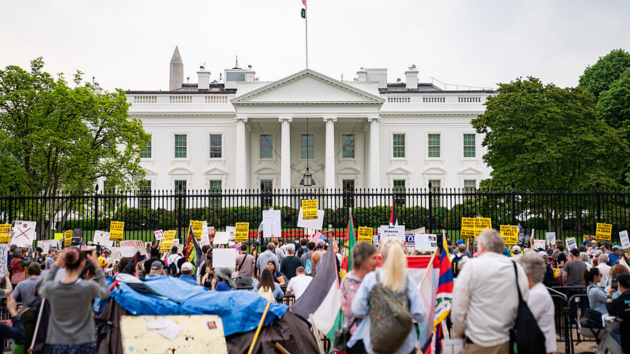
(WASHINGTON) — Since Donald Trump took office 100 days ago, the president and his administration have faced an average of more than two lawsuits per day, challenging nearly every element of his agenda.

The breakneck pace of the president’s policies has been matched in nearly equal force by a flood of litigation — at least 220 lawsuits in courts across the country — challenging more than two dozen executive orders, the firing of twenty high-ranking government officials, and dozens of other executive actions.

While the Trump administration has had some victories in the courts, federal judges have blocked key parts of Trump’s agenda ranging from parts of his immigration policy and military guidelines to his effort to roll back diversity and equity initiatives.

“The administration has basically gone on a shock-and-awe bombing campaign,” said Justin Levitt, a law professor at Loyola Marymount University. “There is a huge amount of what they are currently doing that they probably could have achieved lawfully, but they have crashed through any of the existing legal guardrails in an attempt to do everything, everywhere, all at once.”

The suits have come at a steady clip — 20 in January, approximately 70 in both February and March, and about 50 so far in April — as the Trump administration has rolled out its new policies.

Approximately 60 of those cases have focused on the president’s immigration policy, with courts so far blocking the president’s attempts to remove birthright citizenship, withhold funding from sanctuary cities, remove noncitizens to countries other than their place of origin with little-to-no due process, and strip thousands of their temporary protected status. Some of those policies have earned the president rebukes from judges questioning the rationale for his unilateral immigration policy.

“It has become ever more apparent that to our president, the rule of law is but an impediment to his policy goals,” U.S. District Judge John Coughenour, a Reagan appointee, said of Trump’s executive order on birthright citizenship. “There are moments in the world’s history when people look back and ask, ‘Where were the lawyers, where were the judges?’ In these moments, the rule of law becomes especially vulnerable. I refuse to let that beacon go dark today.”

Courts have also blocked the Trump administration from effectively banning transgender people from military service, limiting gender-affirming care, requiring proof of citizenship to register to vote, attempting to freeze trillions in funding to states and nonprofits, and moving to block billions in foreign aid.

But in many cases federal courts have not stopped the president outright — tentatively allowing the mass firing of thousands of government employees, greenlighting a historic federal buyout, and, for now, allowing the dismantling of the United States Agency for International Development. The Department of Education and the Consumer Finance Protection Bureau are also undergoing massive staffing reductions as judges actively consider the legality of the Trump administration’s cuts.

The president’s supporters have decried the litigation as a “judicial coup,” while those opposing his policies have praised judges for serving as a check against the administration. But the seemingly constant conflict between the Trump administration and the judiciary could risk permanent damage to the separation of powers at the heart of the Constitution, some judges have warned.

“Now the branches come too close to grinding irrevocably against one another in a conflict that promises to diminish both. This is a losing proposition all around,” wrote federal Judge Harvie Wilkinson III, a Reagan appointee who rebuked the Trump administration inaction after being ordered to return a man from a Salvadoran prison.

Acting in ‘bad faith’

In the first hundred days since Trump took office, lawyers challenging his actions in court alleged that his administration violated court orders at least six times, according to court records reviewed by ABC News.

While no judge has held members of the Trump administration in contempt of court, two federal judges have sharply rebuked the government for acting in “bad faith” during ongoing lawsuits. U.S. District Judge James Boasberg — who heard arguments over the deportation of two planeloads of alleged migrant gang members to El Salvador under the Alien Enemies Act — an 18th century wartime authority used to remove noncitizens with little-to-no due process — ultimately determined the Trump administration likely violated his order by failing to return the migrants to the United States.

An appeals court temporarily blocked Judge Boasberg from beginning the process of contempt proceedings, but his most recent ruling invoked the words of former Chief Justice John Marshall to describe the stakes of the Trump administration’s actions.

“The Constitution does not tolerate willful disobedience of judicial orders — especially by officials of a coordinate branch who have sworn an oath to uphold it. To permit such officials to freely ‘annul the judgments of the courts of the United States’ would not just ‘destroy the rights acquired under those judgments’; it would make ‘a solemn mockery’ of ‘the Constitution itself,'” Boasberg wrote.

Lawyers representing the Trump administration have argued that Judge Boasberg’s order fell outside his jurisdiction because the flights in question had left U.S. airspace, and have insisted that a federal judge should not dictate U.S. foreign policy.

The Trump administration has also faced legal challenges for its refusal to return Kilmar Abrego Garcia, a Salvadoran native living in Maryland, to the United States after he was mistakenly deported to his home country despite an order barring his deportation there due to fear of persecution.

The administration has so far declined to bring Abrego Garcia back to the United States despite the Supreme Court ordering his release, though administration officials have complied with a lower court’s order to provide regular updates about him.

The administration has rebutted orders to bring Abrego Garcia back to the United States despite the Supreme Court ordering them to facilitate his release.

Judge Wilkinson, in the meantime, has condemned the Trump administration’s attempt to send alleged migrant gang members to El Salvador’s notorious CECOT prison.

“The government is asserting a right to stash away residents of this country in foreign prisons without the semblance of due process that is the foundation of our constitutional order,” he wrote. “This should be shocking not only to judges, but to the intuitive sense of liberty that Americans far removed from courthouses still hold dear.”

In an ABC News/Washington Post/Ipsos poll, 65% of respondents said Trump’s administration is trying to avoid complying with federal court orders, and 62% said they don’t think his administration respects the rule of law.

‘It was a sham’

With the Trump administration just 100 days in, most lawsuits have not made their way through the appeals process to the Supreme Court — but the Trump administration has asked the Supreme Court to block some court orders on an emergency basis.

Those appeals have led to some losses for the Trump administration — among them a 5-4 Supreme Court decision ordering the Trump administration to unfreeze nearly $2 billion in foreign aid funds for work that aid groups have already completed on the government’s behalf.

On the flip side, the Supreme Court — citing largely technical reasons — handed the Trump administration a series of temporary wins, including vacating an order blocking deportations under the Alien Enemies Act. In that case, the justices opted to throw out the case because the case was filed in the wrong court, declining to weigh in on the merits of the issue.

The Supreme Court also handed the Trump administration a temporary win by blocking a lower court’s ruling that barred the Trump administration from firing thousands of probationary government employees without cause. The district judge who blocked the firings slammed the Trump administration for using a “sham” and “gimmick” to fire thousands of federal workers.

“I just want to say it is a sad day when our government would fire some good employee and say it was based on performance when they know good and well that’s a lie,” U.S. District Judge William Alsup said. “That should not have been done in our country. It was a sham in order to try to avoid statutory requirements.”

But the Supreme Court vacated his order because the plaintiffs who brought the lawsuit — a group of unions and interest groups — lacked the legal standing to bring the lawsuit.

Over the next month, the Supreme Court is set to hold oral arguments for the first time in a lawsuit challenging the Trump administration’s attempt to eliminate birthright citizenship as guaranteed by the 14th Amendment, which confers American citizenship to anyone born on U.S. soil regardless of their parents’ immigration or citizenship status.

The Trump administration also asked the Supreme Court to take up a legal challenge to the Pentagon’s transgender service ban after three judges blocked it from taking effect.

‘A shocking abuse of power’

Despite President Trump’s vow to restore free speech and end censorship, his administration has faced multiple lawsuits challenging his actions on the grounds they violate the First Amendment.

Four law firms have sued the Trump administration after they were targeted for their past work, with each firm arguing the Trump administration unlawfully retaliated against them and violated their First Amendment rights. Judges have temporarily blocked the Trump administration from targeting Susman Godfrey LLP, Jenner & Block LLP, Wilmer Cutler Pickering Hale and Dorr LLP, and Perkins Coie LLP.

“The framers of our Constitution would see this as a shocking abuse of power,” U.S. District Judge Loren AliKhan said regarding the order targeting Susman Godfrey LLP.

At least nine law firms have already acquiesced to the Trump administration’s demands, agreeing to donate a total of $940 million in legal services to promote causes supported by the president.

After the Trump administration attempted to freeze more than $2 billion dollars in federal funding to Harvard University, the country’s oldest school cited the First Amendment in their lawsuit challenging the funding freeze, arguing the “threat of additional funding cuts will chill Harvard’s exercise of its First Amendment rights.” More than two in three Americans support Harvard in their ongoing dispute with the Trump administration, according to an ABC News/Washington Post/Ipsos poll.

“Harvard will be unable to make decisions regarding its faculty hiring, academic programs, student admissions, and other core academic matters without fear that those decisions will run afoul of government censors’ views on acceptable levels of ideological or viewpoint diversity on campus,” Harvard’s lawyers argued.

At least nine current or recent students have challenged the Trump administration’s attempt to revoke their visas or green cards, with several alleging they were targeted for their outspoken support of Palestinians. The Trump administration’s policy of revoking student visas marks the government’s most aggressive approach in more than two decades and the first time students have been targeted over their speech, according to immigration attorney Renata Castro.

“The government is looking at speech — the exercise of free speech — and using that to dig into perceived immigration violations so that they can revoke student visas,” Castro said.

The Trump administration also invoked a rarely used law — 8 U.S.C. § 237 (a)(4)(C)(i) — to justify removing noncitizens such as Mahmoud Khalil, a legal permanent resident who was a prominent figure during student protests at Columbia, because he and others allegedly harm U.S. foreign policy.

According to an analysis of past immigration cases conducted by political scientists Graeme Blair and David Hausman, the United States had only used that provision as a basis to remove a noncitizen two times in the last 25 years.

“The Trump administration is targeting me as part of a broader strategy to suppress dissent,” Khalil wrote in a public letter last month from an ICE detention facility in Louisiana. “At stake are not just our voices, but the fundamental civil liberties of all.”

Earlier this month, an immigration judge ruled that Khalil can be deported on the grounds that he threatens U.S. foreign policy. While he remained in ICE detention and prepared an appeal, Khalil’s wife gave birth to their child last week.

Copyright © 2025, ABC Audio. All rights reserved.

Most Americans oppose Trump 3rd term, taking control of Greenland and Canada: POLL

Most Americans oppose Trump 3rd term, taking control of Greenland and Canada: POLL
Kevin Dietsch/Getty Images

(WASHINGTON) — Most Americans take President Donald Trump at his word when he talks about sending American citizens to foreign prisons, serving a third term as president and trying to take control of Greenland and Canada — even as sweeping majorities oppose each of these potential actions.

About 7 in 10 adults in this ABC News/Washington Post/Ipsos poll think Trump is serious when he talks about sending American citizens who are convicted of violent crimes to prisons in other countries (71%) and the United States trying to take control of Greenland (68%).

Fewer, but still a broad 62%, say the same about his serving a third term, even though the Constitution prohibits him from running again. A slim majority, 53%, think Trump is serious when he talks about the United States trying to take control of Canada.

That doesn’t mean most people think these are good ideas: The survey, produced for ABC by Langer Research Associates with fieldwork by Ipsos, finds that Americans by wide margins oppose these proposals. At the high end, a vast 86% oppose the United States trying to take control of Canada. Eighty percent oppose Trump serving a third term, 76% oppose trying to take control of Greenland and 66% oppose sending U.S. citizens to foreign prisons.

See PDF for full results.

For his part, Trump insisted in an interview last week that he wasn’t trolling about trying to take control of Canada and Greenland. He also has said he is not joking about running for a third term; upping the ante, Trump 2028 merchandise appeared for sale on the Trump Organization’s website last Thursday.

Unsurprisingly, these proposals are especially well received by the 39% of Americans who approve of the way Trump is handling his job as president. One, indeed, reaches majority support — sending U.S. citizens who are convicted of violent crimes to foreign prisons, backed by 59% of Trump approvers.

Half of those in his base, 49%, support the United States trying to take control of Greenland. Forty-three percent in this group like the third-term idea; taking control of Canada lags, even among Trump approvers, at 29%.

Kidding me?

Notably, too, Republicans, conservatives and Trump approvers are most likely to say he’s not serious about any of these proposals. On the other side of the political spectrum, Democrats, liberals and Trump disapprovers are far more apt to think he means it.

Just 35% of Republicans think Trump is serious about taking over Canada, compared with 75% of Democrats. Thirty-eight percent of Republicans think he’s serious about a third term, compared with 88% of Democrats. And while more Republicans — just shy of six in 10 — think he’s serious about taking control of Greenland and sending U.S. prisoners abroad, again, these go much higher among Democrats.

On each item:

Third term

Opposition to a third term is substantial even among some of the key support groups that elected Trump last fall, including white men without four-year college degrees (74% of whom oppose another Trump term), white evangelical Protestants (70%), conservatives (67%) and Republicans (60%).

Wishful thinking may be a factor for some: Among Republicans who think Trump is serious about a third term, support for the idea rises to 60%. That compares with 24% among Republicans who don’t think he’s serious. On the other hand, a vast majority of Democrats (88%) think he’s serious about a third term; nearly none of them (3%) support it.

Canada/Greenland

When it comes to Canada and Greenland, perceptions of Trump’s intentions are associated with broader approval of his handling of U.S. relations with other countries — which has a strong partisan flavor. Among people who approve of his handling of international relations — 51% and 30%, respectively — support trying to take control of Greenland and Canada. Among those who disapprove of Trump’s work on international relations, support for these actions drops to 4% in the case of Greenland and 3% for Canada.

Notably, in partisan terms, 45% of Republicans support trying to take control of Greenland. That drops to 27% who support trying to take control of Canada.

Deporting Americans

As reported Friday, 47% of Americans support sending undocumented immigrants who are suspected members of a criminal group to El Salvador prisons without a court hearing. Fifty-seven percent in this group also support shipping out U.S. citizens convicted of violent crimes, while 41% oppose it.

At 32% overall, support for sending convicted Americans to foreign prisons peaks in especially Trump-friendly groups, including 59% of those who approve of his work in office, 58% of people who call themselves very conservative and 57% of Republicans. Support drops to 30% of independents and 12% of Democrats.

Methodology

This ABC News/Washington Post/Ipsos poll was conducted online via the probability-based Ipsos KnowledgePanel® April 18-22, 2025, in English and Spanish, among a random national sample of 2,464 adults. Partisan divisions are 30%-30%-29%, Democrats-Republicans-independents.

Results have a margin of sampling error of 2 percentage points, including the design effect. Error margins are larger for subgroups. Sampling error is not the only source of differences in polls.

The survey was produced for ABC News by Langer Research Associates, with sampling and data collection by Ipsos. See details on ABC News survey methodology here.

Copyright © 2025, ABC Audio. All rights reserved.

Trump voters are confident in how he’s handling the economy — but some have concerns about prices, tariffs

Trump voters are confident in how he’s handling the economy — but some have concerns about prices, tariffs
Anna Moneymaker/Getty Images

(WASHINGTON) — As President Donald Trump nears the 100th day of his second presidency, polling shows Americans largely disapproving of his handling of the economy, tariffs, and recent stock market turmoil.

But his 2024 voters largely say they’re still confident in his handling of the economy, and they overwhelmingly stand by their vote for Trump.

“I believe Trump will turn things around; I’m glad he’s president,” said Jessianna Bartier, 53, of Ohio. “With Biden, I felt there was so much waste. He was causing a lot of damage economically,” she said, and she had felt depressed by the former president’s efforts. “Trump has definitely got his work cut out for him.”

According to a new ABC News/Washington Post/Ipsos poll, only 39% of Americans approve of how Trump has handled the economy; fewer approve of his handling of tariffs on imported goods or recent stock market turmoil. Seventy-one percent of Americans said that Trump’s handling of tariffs will contribute to inflation in the United States, although 59% think tariffs will create more manufacturing jobs.

But among Americans who voted for Trump in 2024, 87% approve of how he is handling the economy, while 78% approve of his handling of tariffs. A softer 71% said they approve of his handling of recent turmoil in the stock market.

Furthermore, among 2024 Trump voters, 74% think his economic policies will put the U.S. economy on a stronger foundation for the long term; at the same time, 45% of those voters think it’s very or somewhat likely that his economic policies will cause a recession in the short term.

An overwhelming 96% of those who voted for Trump believe how they voted was the right thing to do.

Bartier, a former flight attendant, now works as a bartender and lives in Ohio. She said she used to be a Democrat but became Republican as she “started dating more mature men.” She said she has always voted because “my voice matters.”

Bartier said her family is struggling financially at the moment, because her fiance lost his job and her own income is “definitely not enough.”

But she’s optimistic that Trump will be able to strengthen the economy.

She has mixed feelings about Trump on some issues, saying she appreciates his border crackdown but is at odds with his views on LGBTQ issues and abortion.

But on tariffs, she said she feels they may cause challenges at first but will be effective later on — although the recent stock market turmoil does give her pause.

“I think the tariffs are, in the short term, going to hurt us economically; but in the long term, [they’re] going to bring back jobs to America,” she said. She acknowledged feeling uncertain about how the tariff news impacted stocks: “Do I like seeing the Dow go down on itself? No.”

“[Trump’s] gonna do what he’s gonna do. He’s kind of a rogue agent,” Bartier added.

Anthony Romano, 64, a retired purchasing agent who lives by himself in Philadelphia, said he feels positive about Trump but has some concerns about the stock market.

“Overall I think he’s doing a really good job,” Romano said, but he added that it “seems like the stock market has been crashing — it’ll put a lot of stress on people.”

Stocks have fluctuated in the wake of what some experts described as continued uncertainty over the White House’s tariff policies and announcements. Treasury Secretary Scott Bessent told ABC’s “This Week” on Sunday that the White House is “setting the fundamentals for a strong dollar, a strong economy, a strong stock market”.

Romano said he’s still confident in the president, citing Trump’s experience as a businessman.

“I have my trust in him; he knows what he’s doing,” he said.

Another of Trump’s voters who took the poll, Deborah Williams, 71, of Nevada, considers herself an independent politically and said she just retired from running a home-based business. Her husband, 78, has a part-time job and earns minimum wage.

She said she’s keeping an eye on the economy, especially given their dwindled income, and is “cautious about where I’m spending my money these days,” including with travel.

On tariffs, she has mixed feelings. She’s concerned they could impact prices and may be being done too bluntly, but called Trump’s philosophy behind them “a noble idea.”

“I want America to be the tough kid on the block again,” Williams said, and she does not want think Americans should be paying for or subsidizing other countries’ expenses. “Trump’s my man for doing that at this point,” she said, adding later, “He has the opportunity to put our economy back together by playing hardnose with some of these people we import from.”

The poll only asks respondents for their first names; some respondents contacted by ABC News declined to share their last name.

Irene, 63, who works for the library and local government in a northern New Jersey town, told ABC News that she has mixed feelings over how the Trump administration has rolled out tariffs.

“I’m kind of favorable for the tariffs, because I think we have been taken advantage of by different countries,” she said. “It’s just that, maybe he’s going a little overboard or too fast with all of this. And the tariffs are going to affect a lot more than they were originally going to.”

She hasn’t felt any impact on her or her family’s finances yet. Asked what she hopes to see from the White House going forward, she said she was hoping for the economy she felt America had during the first Trump administration.

“I look back to when he was in the office the first four years, and I just felt like the economy was in better shape,” she said, mentioning interest rates and gas prices. “I was kind of hoping we could get somewhere towards that point.”

She also told the poll she feels a recession is somewhat likely, and she hopes it does not impact the jobs she holds or her finances.

“But I’m at the point where I’m trying to get in a better financial position, just in case that recession should happen, it won’t hit me as hard,” she said.

That has not caused her to rethink how she voted for Trump in November: “I’m still behind my vote because I definitely didn’t have a good feeling about the Democrats,” she said.

The ABC News/Washington Post/Ipsos poll was conducted online via the probability-based Ipsos KnowledgePanel® April 18-22, 2025, in English and Spanish, among a random national sample of 2,464 adults. Partisan divisions are 30%-30%-29%, Democrats-Republicans-independents.

Results have a margin of error of plus or minus 2 percentage points, including the design effect. Error margins are larger for subgroups. Sampling error is not the only source of differences in polls.

See details on ABC News survey methodology here.

ABC News’ Gary Langer and Christine Filer contributed to this report.

Copyright © 2025, ABC Audio. All rights reserved.
‘Unprecedented’: How Trump has pushed the limits of presidential power in his first 100 days

‘Unprecedented’: How Trump has pushed the limits of presidential power in his first 100 days
Andrew Harnik/Getty Images

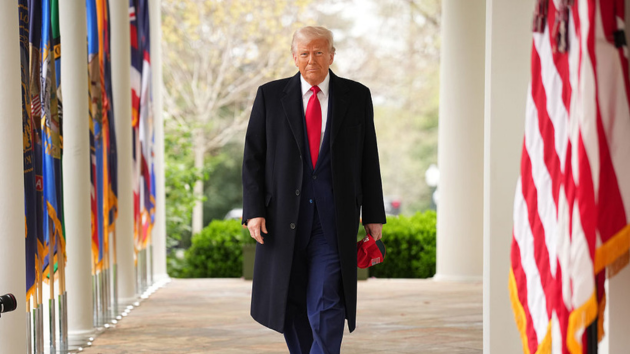
(WASHINGTON) — One hundred days ago this week, just hours after taking the oath of office and reveling before a crowd of thousands at Capital One Arena, President Donald Trump signed the first executive orders of his second term.

With the stroke of his pen, he maintained he could freeze environmental and other agency regulations Congress had authorized. With another, he withdrew the U.S. from an international climate agreement.

“You’re witnessing the dawn of the golden age of America,” he told the roaring crowd. “That’s what it’s going to be.”

Overall, he’s issued more than 130 executive orders and even more memorandums, declared at least eight national emergencies and engaged in a showdown with the courts that has prompted debate on whether a constitutional crisis is underway.

Driving much of his action is a legal theory advocated by conservatives that the Constitution gives a president nearly unquestioned control over the federal government.

Trump and his top officials also contend that he’s simply working to implement the agenda that Americans voted for in November.

But other constitutional and legal experts who spoke with ABC News call it unparalleled overreach.

“This really is unprecedented,” Elizabeth Goitein, the senior director of the Brennan Center’s Liberty and National Security Program, told ABC News.

“We’ve seen really broad theories of executive power advanced in previous administrations,” Goitein said. “There’s been a steady trend over the last few decades towards increasingly broad views of executive power, especially after 9/11. But this is unprecedented and it’s different in kind, not just in degree.”

Trump, in a recent interview with Time to mark 100 days, disagreed.

“Well, I don’t feel I’m expanding it,” Trump told the magazine when asked about amassing presidential power. “I think I’m using it as it was meant to be used.”

Trump’s ‘government by executive order’

Nearly every day since Jan. 20, Trump has signed executive actions in the Oval Office, often in front of television cameras. He’s signed the greatest number of executive orders in his first 100 days of any president going back 88 years.

“He’s trying to do government by executive order on a whole range of issues,” said David Schultz, a constitutional law expert at Hamline University.

Following Trump’s lead, his administration has carried out a dramatic purge of what Congress had set up as independent agencies, firing tens of thousands of employees, even those with civil service protections. He’s also sought to wipe out diversity, equity and inclusion (DEI) initiatives across the federal government.

Trump signed an order to diminish the Department of Education, with the ultimate goal of wiping away the agency established by law. He’s tried to effectively end birthright citizenship, which is enshrined in the 14th Amendment and has been upheld repeatedly by the Supreme Court.

To move forward with his immigration and economic policies, Trump has declared national emergencies that Goitein, an expert on presidential emergency powers, said are unjustified.

Despite border crossings being down, Trump invoked the 1798 wartime Alien Enemies Act to deport hundreds of Venezuelan migrants his administration alleged to be gang members, affording them little to no due process.

He invoked the 1977 International Emergency Economic Powers Act in order to impose sweeping tariffs on virtually all U.S. trading partners. Though it is Congress, not the president, that has the power to impose taxes and regulate trade — and the emergency power used by Trump makes no mention of tariffs.

At times, he’s used the power of the presidency to pursue retribution on political opponents. Seemingly contrary to his promise to end the “weaponization” of government and the justice system, he’s signed orders targeting specific law firms that took on clients or cases he disagreed with politically. He directed the Justice Department to investigate Chris Krebbs and Miles Taylor, two officials from his first term who’ve criticized him or challenged his 2020 election falsehoods.

Trump’s harshest critics say some action verges on authoritarianism, noting his open respect for “strongman” leaders, including China’s President Xi Jinping, Russia’s Vladimir Putin and Hungary’s Viktor Orban.

“Sometimes you need a strongman,” Trump told Fox News host Sean Hannity last September while campaigning.

Pushback from the courts — but not from Congress

“Our Framers were envisioning that if a president tried to do things like this, Congress would step in,” said Schultz. “And right now, it looks like partisanship is more powerful than checks and balances.”

Despite having Republican majorities (albeit narrow ones) in the House and Senate, Trump has opted to largely go it alone on his agenda in his first 100 days. Republicans on Capitol Hill, so far, appear uninterested or unwilling to seriously challenge him.

“We’re all afraid,” GOP Sen. Lisa Murkowski, one of the few Republicans to be critical of Trump, told her Alaskan constituents last month. Murkowski added that “retaliation is real.”

While congressional pushback has been minimal, a clear clash is underway between the Trump administration and the courts as various groups and individuals challenge his policies.

Trump has berated judges who ruled against him as “radical left” and called for District Judge James Boasberg’s impeachment. He and Vice President JD Vance openly floated the idea of not abiding by lower court orders — “He who saves his Country does not violate any Law,” Trump posted on social media — though later said they would comply with decisions from the Supreme Court.

Chief Justice John Roberts issued a rare statement in rebuke of the rhetoric — and though he didn’t mention Trump by name, the context was clear.

In a major escalation of the administration’s standoff with the courts, the FBI last week arrested a Milwaukee judge, Hannah Dugan, and accused her of obstructing immigration agents. An attorney for Dugan said she will “defend herself vigorously and looks forward to being exonerated.” White House press secretary Karoline Leavitt, when asked about the incident, left open the possibility of the Justice Department taking more action against federal judges or even Supreme Court justices if they were obstructing the arrest of anyone suspected of being in the country illegally.

“He thinks he can either ignore or bully his way through,” Schultz said of Trump’s posture toward the judiciary. “And so far, he’s got a mixed record at best in terms of being able to do that.”

Several legal experts and presidential scholars who spoke to ABC News expressed concern that the courts will become inundated by Trump’s moves as his second term continues, and the system of checks and balances will continue to break down.

“The separation of powers is probably the most important protection that we have against presidents becoming kings,” said Goitein. “If this is the new normal, then we can say goodbye to democracy.”

Copyright © 2025, ABC Audio. All rights reserved.

Trump administration investigating Harvard Law Review for alleged discrimination

Trump administration investigating Harvard Law Review for alleged discrimination
Scott Eisen/Getty Images

(WASHINGTON) — President Donald Trump’s administration is launching an investigation into Harvard University’s law journal over alleged discriminatory practices, expanding its weeks-long battle over federal funding with the elite institution.

The civil rights offices of the Education and Health and Human Services departments announced Monday they are investigating the Harvard Law Review, an independent, student-run organization that promotes legal scholarship.

The offices are investigating allegations that the journal discriminates based on race “in lieu of merit-based” standards, in violation of the Title VI anti-discrimination law, according to a release by the two agencies.

“Harvard Law Review’s article selection process appears to pick winners and losers on the basis of race, employing a spoils system in which the race of the legal scholar is as, if not more, important than the merit of the submission,” Craig Trainor, acting assistant secretary within the Education Department’s Office for Civil Rights, said in a statement on Monday.

The agencies said the Harvard Law Review risks losing federal funding if found to have broken Title VI law.

The Harvard Law Review has been published and edited by students for over 135 years. It aims to be an effective research tool for practicing lawyers and students, according to its website.

“Harvard Law School is committed to ensuring that the programs and activities it oversees are in compliance with all applicable laws and to investigating any credibly alleged violations,” a spokesperson for the university said in a statement to ABC News, noting that the journal “is a student-run organization that is legally independent from the law school.”

The latest investigation comes after the Trump administration froze over $2.2 billion in federal funding to Harvard after the university refused to comply with a series of demands following an antisemitism task force review earlier this month.

Harvard University President Alan Garber said in a letter at the time that “no government — regardless of which party is in power — should dictate what private universities can teach, whom they can admit and hire, and which areas of study and inquiry they can pursue.”

The university has filed a lawsuit over the Trump administration’s threats to withhold funding, asking a judge to block the funding freeze from going into effect, arguing the move is “unlawful and beyond the government’s authority.”

During a short conference on Monday, U.S. District Court Judge Allison Burroughs scheduled oral arguments in the lawsuit challenging the funding freeze on July 21. In the meantime, the funding freeze will remain in effect.

The Internal Revenue Service is also considering revoking Harvard’s tax-exempt status, sources told ABC News earlier this month.

In other developments, the Department of Education said Monday its civil rights office found that the University of Pennsylvania violated Title IX by allowing transgender athletes to compete on its women’s sports teams.

The department is demanding the university issue a statement to its community that it will comply with the law, apologize to athletes whose athletic participation was “marred by sex discrimination,” and restore all athletics records or accolades “misappropriated by male athletes.” The school has 10 days to resolve the violation or risk a referral to the Department of Justice.

Earlier this year, the Trump administration said it suspended $175 million in federal contracts awarded to Penn, citing the participation of a transgender athlete on a women’s swimming team.

A Penn spokesperson said at the time that the university has “always followed” NCAA and Ivy League policies regarding student participation on athletic teams.

ABC News’ Peter Charalambous contributed to this report.

Copyright © 2025, ABC Audio. All rights reserved.

Trump and Johnson strategize as budget reconciliation reaches ‘game time’

Trump and Johnson strategize as budget reconciliation reaches ‘game time’
Kayla Bartkowski/Getty Images

(WASHINGTON) — House Speaker Mike Johnson met with President Donald Trump Monday afternoon in the Oval Office, where they huddled over the GOP’s political strategy heading into a pivotal period of legislative business — with their congressional majorities on the line.

As Congress returns to Washington following a two-week recess and the president approaches 100 days in office, Republicans hope to sharply reshape federal spending to align with the president’s domestic agenda.

After meeting with the president, Johnson returned to the Capitol to meet with top administration officials, including Treasury Secretary Scott Bessent, and leading congressional Republicans grappling over budget reconciliation.

“We’re working on the big, beautiful bill, the reconciliation bill,” Johnson told reporters. “Now is game time as the big developments will be coming together. We’re excited about that. I think it’s going to be a great piece of legislation.”

Flanked by White House National Economic Council Director Kevin Hassett and James Blair, assistant to the president, Bessent told reporters after the meeting on Monday that he found “great unity” among congressional Republican leaders, with the House and Senate moving quickly and “in lockstep” on a budget bill focused on Trump’s priorities.

The meeting included Senate Majority Leader John Thune, Johnson, Senate Finance Committee Chairman Mike Crapo and House Ways and Means Committee Chairman Jason Smith.

“We think that they are in a substantial agreement, and that this is going to be a win for the American people. Very-pro growth,” Bessent continued.

He said there were “three legs” to the president’s economic agenda: trade, tax and deregulation. He said they hoped to get the tax portion of the budget package done by July 4.

“Both sides have proposals in front of the President, and we think there’s a path to deliver the requisite spending reforms to get a great pro-growth tax package, along with the president’s priorities that he laid out on the campaign trail,” Bessent said.

Hassett reiterated Trump’s claim that a billionaire tax cut is off the table. Bessent said priorities for the package would be to make tax cuts and the Jobs Act permanent, no tax on tips, no tax on Social Security, no tax on overtime, and deductibility for loans for American-made cars.

Asked if Bessent’s July 4 timeline was realistic, Thune said, “I think so. You know, I mean, it’s, it all depends on how progress goes in the next few weeks.”

“I think we, everybody, feels like we’re making significant progress in trying to get the House, the Senate and the White House, kind of in the same place. But it’s going to take time. It’s complicated — a lot of moving parts,” Thune said.

Republicans have begun releasing legislative text to codify their lofty ambitions to cut at least $2 trillion from federal spending over the next decade, with six markups scheduled this week and additional hearings anticipated in the coming weeks as conservatives face the latest test of their narrow majority.

“It’s going to solve a lot of problems,” Johnson predicted. “It’s going to be a turbo-boost for the economy, and we’re looking forward to getting that done.”

But as Trump reaches his 100th day in office this week, polling shows the public souring on the president’s job performance. Nevertheless, Johnson maintains the belief that the GOP is poised to defend its narrow majority — claiming Republicans “are playing offense.”

“We talked about the upcoming races, the midterm elections and we’re very bullish on it,” Johnson proclaimed. “There’s 13 Democrats sitting in districts that President Trump won. Those are the obvious targets. We have an offensive map. There’s only three House Republicans sitting in districts that Kamala Harris won. So it’s a lopsided map, it gives us a great opportunity and we’re going to go make history.”

Still, Johnson acknowledged there have been some ups and downs in the early stages of the administration.

“These presidential terms are roller-coaster sometimes. There’s been a little tumult in the markets with the tariff policy and all of that, but I think this is settling out,” Johnson said. “People are in very good spirits. They understand that this is a long game to be played.”

ABC News’ Isabella Murray contributed to this report.

Copyright © 2025, ABC Audio. All rights reserved.

Exodus at DOJ civil rights division as official says ‘over 100’ attorneys departed

Exodus at DOJ civil rights division as official says ‘over 100’ attorneys departed
Kent Nishimura / Los Angeles Times via Getty Images

(WASHINGTON) — The Justice Department’s division tasked with enforcing the nation’s federal civil rights laws has recently seen a mass exodus of “over 100” attorneys, the newly confirmed official leading the division said in an interview this week.

“What we have made very clear last week in memos to each of the 11 sections in the Civil Rights Division is that our priorities under President Trump are going to be somewhat different than they were under President Biden,” DOJ Assistant Attorney General Harmeet Dhillon said in an interview with conservative host Glenn Beck. “And then we tell them, these are the President’s priorities, this is what we will be focusing on — you know, govern yourself accordingly. And en masse, dozens and now over 100 attorneys decided that they’d rather not do what their job requires them to do.”

The resignations come as Dhillon and Attorney General Pam Bondi have made clear the priorities of the division — which was established in the wake of the Civil Rights movement in the 1950s — would shift away from priorities like enforcing voting rights laws and cracking down on unconstitutional policing to culture war issues touted by President Trump in his 2024 campaign.

In recent weeks, the department has said it would pursue legal action against states that permit transgender athletes to participate in girls’ and women’s sports, withdrawn from a Biden-era lawsuit against Georgia’s voting laws and convened a task force to investigate incidents of “anti-Christian bias.”

Of the recent resignations, Dhillon said in the interview that she thinks it’s “fine” the attorneys opted to leave.

“We don’t want people in the federal government who feel like it’s their pet project to go persecute, you know, police departments based on statistical evidence or persecute people praying outside abortion facilities instead of doing violence,” Dhillon said. “That’s not the job here. The job here is to enforce the federal civil rights laws, not woke ideology.”

At the same time, Dhillon said in the interview she was seeking to staff up the division so they could pursue issues like the administration’s actions targeting Harvard University.

“You need more lawyers, investigators and commitment to do the work, and you need the people in the United States identifying these things for us,” Dhillon said. “We’re going to run out of attorneys to work on these things at some point.”

Several top Democrats sent a letter to Bondi, Dhillon and DOJ Inspector General Michael Horowitz Monday raising concerns over what they described as the “politicization” of the DOJ’s civil rights division.

Copyright © 2025, ABC Audio. All rights reserved.