Minnesota Gov. Tim Walz, for the first time this cycle, will soon hit the campaign trail with former President Barack Obama and former President Bill Clinton, according to a senior campaign official.
The vice presidential nominee will be out with his party’s former standard bearers this week and next week in an effort to push for early voting in battleground states, ABC News has exclusively learned.
The governor will first rally with Clinton in Durham, North Carolina, on Thursday — the first day of early voting in the critical battleground state. Next Tuesday, Walz will travel to Wisconsin, another battleground, with Obama for the start of early voting in that state.
The joint campaign blitzes come as the Harris-Walz ticket has deployed both former presidents — some of its strongest political assets — headed into the final stretch of the election cycle.
Obama hit the trail for the ticket starting on Oct. 10 and has additional stops planned in the run-up to Election Day, according to the campaign.
His first stop was in battleground Pennsylvania in the Pittsburgh area — a visit where he sternly chided Black men over “excuses” to not vote for Harris, saying he finds them sitting out or voting for former President Donald Trump “not acceptable.”
Obama will also independently hit the campaign trail in the Sun Belt this week, with stops on Friday in Arizona and on Saturday in Nevada — the first days of early voting in the state.
On Sunday and Monday, Clinton made his trail debut with travel across rural communities in Eastern and South Georgia to encourage Georgians to vote early.
Last night, on the eve of early in-person voting in the state, Clinton stumped for the Harris-Walz ticket in battleground Georgia, mounting the stakes of the election and the importance of voting.
“I want you to be happy, and I want you to know that I am here because I believe. I believe, based on my personal knowledge of the job and the candidates, that Kamala Harris will be a fine president,” he said.
“All we gotta do is show up. If we show up, we’ll win,” Clinton added.
The joint principal campaign events also come as Walz himself has made campaign stops related to early voting. The governor campaigned last week in Phoenix and Tucson on the first day of early voting in Arizona.
“I know you’ve started voting here in Arizona. It’s happening across the country. We can make a difference. And I think just the idea of having an administration building on these strong relationships, this is our opportunity to take this to the next level that we need to do,” Walz said at event with tribal leaders in Chandler, Arizona last Wednesday.
ABC News’ Selina Wang, Fritz Farrow, Gabriella Abdul-Hakim and Lalee Ibssa contributed to this report.
The Pentagon on Tuesday granted honorable discharges to more than 800 veterans who were separated from the U.S. military because of their sexual orientation during the “Don’t Ask, Don’t Tell” policy, which was in effect from February 1994 to September 2011.
More than 13,000 service members were kicked out under the policy, close to 2,000 of whom received less than fully honorable discharges, according to Christa Specht, head of legal policy at the DOD’s Office of the Undersecretary of Defense for Personnel and Readiness. After 2011, most of those who filed appeals were upgraded, but others might not have been aware this was an option.
Last year, the Defense Department began a proactive review of the remaining cases. The Pentagon announced Tuesday that its review has led to an upgrade for more than 800 veterans, without them having to appeal. This could affect the benefits they have access to.
“After a year of exceptional work, the Military Department Review Boards directed relief in 96.8% of the 851 cases that they proactively reviewed. What this means is that of the nearly 13,500 individuals who were administratively separated under Don’t Ask, Don’t Tell policy, and served long enough to receive a merit-based characterization of service, 96% now have an honorable discharge,” Defense Secretary Lloyd Austin said in a statement.
The vast majority of those separated under the policy now have honorable discharges, according to Austin.
DADT was signed into law in 1993 under the administration of then-President Bill Clinton. In December 2010, then-President Barack Obama signed into law a repeal of the policy. It took effect in 2011.
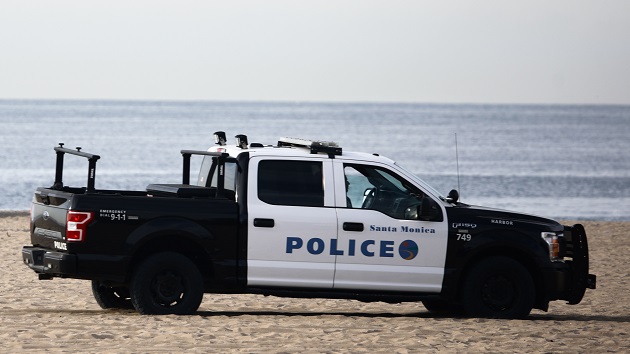
A suspect remains at large after a shooting at a California college critically injured an employee, school police said.
The shooting occurred at the Center for Media and Design, a Santa Monica College satellite, in Santa Monica shortly before 10 p.m. local time, school police said.
The shooting was “a workplace violence incident, not a random act,” Santa Monica College Chief of Police Johnnie Adams said in a statement.
The employee was transported to a local hospital in critical condition, according to Adams.
The suspect remains at large, Adams said Tuesday.
The Santa Monica Police Department is leading the investigation into the shooting. The incident is believed to be isolated and “there is no information suggesting the suspect remains in Santa Monica or is a threat to the community,” the department said in a statement.
No additional details are being released on the suspect or victim at this time amid the ongoing investigation, a school spokesperson said.
All Santa Monica College campuses are closed on Tuesday “to prioritize the safety and well-being of our community,” Adams said.
“Santa Monica College remains committed to maintaining a safe environment for all employees and students,” he said.
The Santa Monica Police Department said it will be providing extra patrols around schools on Tuesday.
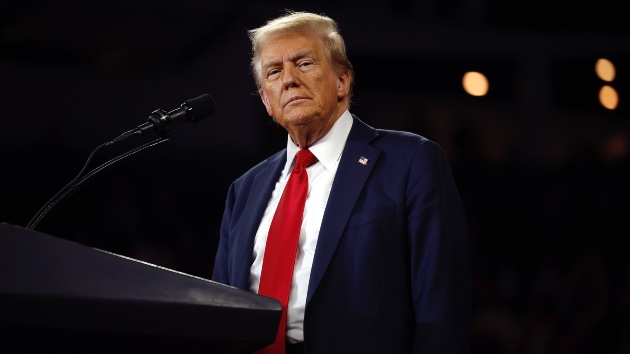
Former President Donald Trump’s town hall in Oaks, Pennsylvania, on Monday evening was interrupted twice by medical emergencies in a very warm Greater Philadelphia Expo Center and Fairgrounds before he pivoted — turning the concert into an impromptu concert where he stood on stage swaying to music for nearly 45 minutes.
There was a medical emergency that required an attendee to be placed on a stretcher about 30 minutes into the event. As the crowd started singing “God Bless America,” Trump requested that “Ave Maria” be played on the loudspeakers as medics tended to the man.
Moments later, there was a second medical emergency.
“The safety and well-being of President Trump’s supporters is always his top priority,” Karoline Leavitt, Trump’s campaign press secretary, said in a statement to ABC News after the event. “The two individuals who fainted were immediately given medical attention. As President Trump said tonight, they are great patriots,” Leavitt added.
Trump took four questions, before the first medical emergency occurred.
Following the medical emergencies, Trump requested that the doors be opened but he was advised that for security reasons that wasn’t possible. Both Trump and moderator South Dakota Gov. Kristi Noem commented on the heat in the room.
“Open the doors. I wish we could open those doors to outside,” Trump said. “For security reasons, they can’t. But you know what I suggest? Open them. Because anybody comes through those doors, you know what’s going to happen to them.”
“Personally, I enjoy this. We lose weight, you know. No, you lose weight. We could do this — lose four or five pounds,” Trump quipped.
Trump then requested that “Ave Maria” be played again and remained on stage as more music was played.
He continued, “Let’s not do any more questions. Let’s just listen to music. Let’s make it into a music fest. Who the hell wants to hear questions right? Isn’t that beautiful?”
The former president, adamant about playing his music, stood on stage for nearly 45 minutes swaying to several songs on his playlist as the crowd sang and danced along.
The crowd slowly dispersed, but many stayed for the entirety of the campaign event.
“To lighten the mood, President Trump turned the town hall into an impromptu concert and the crowd loved it,” Leavitt told ABC News, adding, “The room was full of joy.”
On Tuesday, Trump addressed the town hall on his social media platform, calling the event “so different.”
“It ended up being a GREAT EVENING!” Trump wrote on social media.
The Trump campaign has classified those who fell ill as “great patriots” and suggested, “the room was full of joy.”
Notably, with 22 days until Election Day, Vice President Kamala Harris was also in Pennsylvania on Monday evening stumping to voters in the critical battleground swing state whereas Trump largely dodged answering questions during the actual town hall portion of his event.
In a post on X early Tuesday morning, Harris reposted a video from her campaign’s Kamala HQ account of Trump swaying to music for nearly 45-minutes at his Oaks town hall on Monday, writing “Hope he’s okay.”
Following the concert, Trump made his way to the front row, signing red MAGA hats and 47 signs.
Trump’s movement was noteworthy as he hasn’t interacted with a large crowd to that extent since his attempted assassination in Butler, Pennsylvania.
Ninety-two people remain unaccounted for in hard-hit North Carolina in the wake of the “catastrophic disaster” left behind by Hurricane Helene, Gov. Roy Cooper said Tuesday.
The number will continue to fluctuate as new reports come in and other reports are resolved, Cooper said.
This comes as North Carolina continues to face “a persistent and dangerous flow of misinformation” about recovery efforts, the governor said.
“If you’re participating in spreading this stuff, stop it,” Cooper said. “Whatever your aim is, the people you are really hurting are those in western North Carolina who need help. The safety of our government and volunteer response workers, including FEMA, remains a top priority. “
The governor said he’s directed the state’s Department of Public Safety to “coordinate law enforcement assistance for FEMA and other responders who need it to help assure their safety and security, so people can keep getting the help that they desperately need.”
This weekend, a Bostic, North Carolina, man armed with a handgun and rifle was arrested for allegedly threatening to harm workers from the Federal Emergency Management Agency in the state, authorities said.
FEMA Administrator Deanne Criswell did not address the arrest at Tuesday’s news conference, but she said, “Over the weekend, out of an abundance of caution, we made operational changes to keep FEMA personnel safe, but none of the changes we made impacted ongoing search and rescue or other life safety operations.”
“It’s heartbreaking to see words or acts of hatred toward anyone, let alone federal responders who are here to help people in this critical time,” Criswell said.
“We are not going anywhere,” she said. “Misinformation will not deter us from our mission.”
This is a developing story. Please check back for updates.
As part of its ongoing investigation into Rep. Matt Gaetz, the House Ethics Committee recently issued a subpoena for documents from a civil lawsuit brought by one of the Florida congressman’s longtime friends against several third parties, ABC News has learned.
The subpoena, which has not been previously reported, requests all documents related to Gaetz that are part of a lawsuit brought last year by Gaetz’s longtime friend, prominent Florida lobbyist Chris Dorworth, who alleged he was defamed by several third parties over the course of the yearslong sex trafficking probe into Gaetz, sources told ABC News.
The documents from the lawsuit, which include witness depositions and affidavits, could provide Congress with new details regarding allegations that have dogged Gaetz for years, including the allegation he had sex with a minor who was introduced to him by his onetime friend Joel Greenberg, who pleaded guilty to sex trafficking and is serving an 11-year prison sentence.
Gaetz has long denied any wrongdoing. Last year, following a yearslong investigation, the Justice Department declined to bring any charges against the congressman.
Last week, Gaetz stated that he would no longer voluntarily participate in the House Ethics probe, which he blasted as a “political payback exercise,” and said that he had recently learned that the committee had issued — but not yet served him — a subpoena for his testimony.
The Florida congressman also reiterated his denial that he ever had sex with a minor. “Your correspondence of September 4 asks whether I have engaged in sexual activity with any individual under 18. The answer to this question is unequivocally NO. You can apply this response to every version of this question, in every forum,” Gaetz said in a statement to the committee posted on social media.
Members of the House Ethics Committee declined to comment to ABC News. Representatives for Gaetz did not respond to a request for comment.
When reached for comment, Greenberg’s attorney, Fritz Scheller, told ABC News, “While I am reluctant to comment on a pending congressional investigation, Joel Greenberg’s position remains the same. He will fully cooperate with all congressional inquiries, whether by subpoena or not, and regardless of whether the cooperation occurs in the rain or on a train, with a fox or in a box. Yes, Mr. Greenberg will fully cooperate here or there, he will cooperate anywhere.”
Among the documents related to the civil lawsuit, according to court filings, is the deposition of the woman who Gaetz allegedly had sex with when she was a minor, as well as testimony from another woman who was a witness in the DOJ investigation, plus Dorworth’s deposition and an affidavit from Gaetz’s former girlfriend. Those documents could be turned over to Congress as part of its ongoing probe into related allegations.
The documents Congress is seeking stem from a lawsuit brought last year by Dorworth, who alleged that the onetime minor, identified in the lawsuit only as “A.B.,” and others, including Greenberg and his family, worked to defame him amid the Justice Department’s probe.
Gaetz, who was not a party in the suit, was scheduled to sit for his own deposition as a witness in the lawsuit prior to Dorworth dropping the suit in early September. Dorworth has a separate ongoing defamation lawsuit against the Greenbergs in state court.
It is unclear if and what documents have been handed over to Congress. And while many of the lawsuit’s documents, including depositions and sworn statements, remain sealed, recent public court filings shed some light on what alleged details could be included in the underlying documents requested by Congress.
One filing, Exhibit 23 in a motion for attorneys fees filed by attorneys representing the Greenbergs, details some of the allegations made during discovery in the lawsuit, including that Gaetz was allegedly among the guests at a July 2017 party that “A.B.,” who was 17 years old at the time, also attended. The filing states that according to a woman who attended the party, there was “alcohol, cocaine, ecstasy also known as molly, and marijuana” present, that there was “access to the bedrooms” for “sexual activities,” and that A.B. was seen naked at the gathering.
In July, the House Ethics Committee released a rare statement updating the status of its probe into Gaetz. The committee stated that it had stopped looking into certain claims, including whether the Florida congressman misused state identification records or accepted a bribe or improper gratuity, but that its investigation had found that other allegations “merit continued review.”
The committee said that it would continue to review claims that Gaetz “engaged in sexual misconduct and illicit drug use” and that he “sought to obstruct government investigations of his conduct.”
In Gaetz’s statement last week regarding the committee probe, he reiterated his denial of any wrongdoing while seemingly responding to a string of questions the committee issued to him earlier in the month.
In response to whether or not he had ever used illicit drugs, Gaetz stated, “I have not used drugs which are illegal, absent some law allowing use in a jurisdiction of the United States. I have not used ‘illicit’ drugs, which I consider to be drugs unlawful for medical or over-the-counter use everywhere in the United States.”
(NEW YORK) With just weeks to go until the presidential election, a Georgia judge has ruled that certification of election results by county officials in the state is “mandatory” — a new ruling that is likely to be heralded by election experts amid rising fears that rogue election officials could seek to delay or decline to certify results after Election Day due to allegations of fraud or error.
“Election superintendents in Georgia have a mandatory fixed obligation to certify election results,” the order states.
Judge Robert McBurney, as part of an ongoing election case, found that the law is clear: “the superintendent must certify and must do so by a certain time.”
“There are no exceptions,” he wrote in the Monday night ruling.
The ruling comes after Georgia’s controversial State Election Board recently passed new rules that some voting rights activists are concerned would cause chaos in the certification process. One of those new rules allows election officials to conduct a “reasonable inquiry” prior to certification.
Specifically, McBurney’s ruling Monday noted that certification by the county superintendents must occur, even in the case where there are concerns about fraud or error.
“While the superintendent must investigate concerns about miscounts and must report those concerns to a prosecutor if they persist after she investigates, the existence of those concerns, those doubts, and those worries is not cause to delay or decline certification,” McBurney wrote. “That is simply not an option for this particular ministerial function in the superintendent’s broader portfolio of functions.”
Broadly, McBurney noted that the election officials must still certify the results, but report concerns to authorities:
“And if in the course of her canvassing, counting, and investigating, a superintendent should discover what appears to her to be fraud or systemic error, she still must count all votes — despite the perceived fraud — and report her concerns about fraud or error to the appropriate district attorney,” the judge wrote.
(NEW YORK) — Former President Donald Trump has again asked an appeals court to transfer his New York criminal hush money case to federal court, reigniting an effort to stall his sentencing or throw out his conviction on 34 felony courts.
In a filing on late Monday, Trump’s lawyers asked the New York-based U.S. Court of Appeals for the Second Circuit to reconsider a lower court’s September decision denying the former president’s attempt to remove the state case to federal court.
Defense lawyers argued in the filing that the jury in the case improperly saw evidence of Trump’s official acts as president which would have been protected by the Supreme Court’s July ruling on presidential immunity.
“This case presents complex first-impression issues relating to the Supremacy Clause, federal-officer removal, appearances of impropriety and conflicts in connection with an unprecedented and baseless prosecution of the leading candidate in the 2024 Presidential election, and the ability of future Presidents to serve the American people without fear of reprisal from hostile local officials,” lawyers Todd Blanche and Emil Bove wrote in the 99-page filing.
Trump was found guilty in May on 34 felony counts of falsifying business records related to a hush money payment to adult film actress Stormy Daniels in order to boost his electoral prospects in the 2016 presidential election.
In July, the Supreme Court ruled in a blockbuster decision that Trump is entitled to immunity from criminal prosecution for official acts undertaken while in office.
Criminal or civil cases against federal officials can be removed to federal court if the officials can prove the case centers on official conduct. When Trump sought to remove his hush money case to federal court in 2023 by arguing that the allegations related to his official acts as president, U.S. District Judge Alvin Hellerstein denied the move, writing that “hush money paid to an adult film star is not related to a President’s official acts.”
Judge Hellerstein then denied Trump’s request to reconsider his decision in September, as Trump was seeking to delay his sentencing, because the former president failed to show “good cause” for why the issue should be examined again.
“Nothing in the Supreme Court’s opinion affects my previous conclusion that the hush money payments were private, unofficial acts, outside the bounds of executive authority,” Judge Hellerstein wrote.
Trump is now appealing Hellerstein’s September decision, which defense lawyers argue relied on a “profoundly flawed analysis.”
Trump is scheduled to be sentenced on Nov. 26, after the New York judge overseeing the case, Juan Merchan, granted Trump’s request to delay sentencing until after the November election.
In their filing Monday, Trump’s lawyers also aired grievances about an alleged conflict of interest by Judge Merchan and political motivations of the prosecutors, writing that witnesses “concocted the type of false and implausible story President Trump’s political opponents wanted to hear.”
If the effort to remove the case to federal court is successful, it could give Trump the authority to kill the prosecution if he is elected to the presidency in November. Unlike his federal criminal cases, Trump is unable to direct the prosecution or pardon himself if the case remains in state court.
The removal attempt could also impact the timing of Trump’s Nov. 26 sentencing if the motion remains unresolved by then.
Separately, Judge Merchan is expected to issue a ruling on Trump’s effort to throw out the conviction based on presidential immunity by Nov. 12.
Elijah Nouvelage for The Washington Post via Getty Images
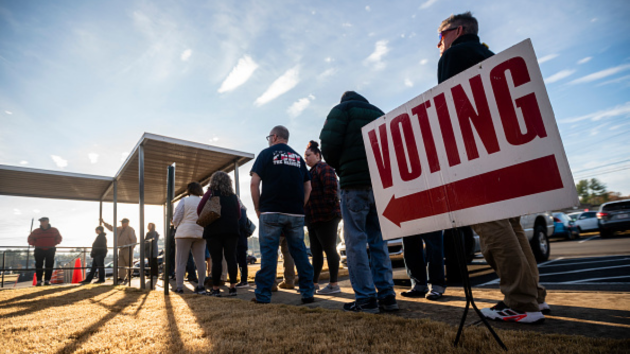
(ATLANTA) — Early in-person voting kicks off in Georgia on Tuesday as uncertainty over new election rule changes looms large in one of the crucial states that will decide this year’s presidential election.
Georgia counties will provide early in-person voting for at least 16 days, with some counties offering an extra voting day on Sunday. Nov. 1 will be the last day of early in-person voting.
The commencement of Georgia’s three-week period for early voting comes as the Georgia state election board recently passed sweeping new changes to the state’s election system, including how votes are tabulated.
Over the summer, the Republican-controlled State Election Board passed a rule requiring all ballots to be hand counted on election night, prompting legal challenges and pushback from both major parties as officials warned about potential delays in reporting results.
Georgia’s Attorney General Chris Carr, a Republican, told the board it was operating outside of its authority, and warned that the rule changes were likely not lawful. Vice President Kamala Harris’ campaign joined a lawsuit from Georgia Democrats suing to block the last-minute rule changes.
Fulton County Superior Court Judge Thomas A. Cox Jr. scheduled hearings this week to hear about the lawsuits challenging the new rules, including the hand-counting provision and new rules that expand access to poll watchers.
Another prominent Republican in the state, Secretary of State Brad Raffensperger, also promised that while Georgia law mandates certification on Nov. 12, he raised concerns about potential false claims that could arise as potential reporting delays linger.
“Everything we’ve been fighting for since 2020 has been to give the voter quicker, you know, responses, quicker results, and that’s why we’re going to post all the early votes by 8 p.m,” Raffensperger said in an interview with the Washington Post on Monday.
“Well, this now drags on for the final 30 percent until one, two, three, or four o’clock in the morning.” he said. “Really, that just becomes a breeding ground for conspiracy theories, and so we don’t support it, but the judge will make that determination. We’ll find out. We’ll follow the law.”
Georgia voters will already face changes this election cycle due to the state’s Election Integrity Act, SB 202, passed in 2021, which adds more verification for voters requesting absentee ballots, limits the amount of ballot drop box locations, and, in one of the most controversial rule changes, the law now makes it a misdemeanor to give away food or water within 150 feet of a polling place or within 25 feet of a voter in line.
Advocates of the rule change argue that those rule changes will provide more transparency to the election process and have been set in place well before November’s election so poll workers and voters have had time to understand the changes.
However, Democrats have repeatedly attempted to block provisions of the law, claiming that the strict rules on identification will disenfranchise voters and criminalize portions of the election process.
Candidates are educating their voters about the new voting landscape in Georgia, emphasizing how crucial turnout will be in the state.
Former President Bill Clinton spent time in middle Georgia on Sunday and Monday, focusing on mobilizing supporters in rural areas for Vice President Kamala Harris.
“They’ve been able to make it easier for states that agree with them to make it harder for people to vote, but not impossible, and Georgia has more experience than almost any other state in climbing those barriers and breaching them,” he said at a campaign stop in Columbus on Monday.
Former President Donald Trump will mark the start of early voting in Georgia with a series of campaign stops on Tuesday. He will first tape a Fox News town hall focused on women’s issues before delivering remarks at a rally in Atlanta.
The Harris campaign is deploying surrogates around the state on Tuesday and the vice president is expected to visit the state later this week as polling shows an extremely tight race in the Peach State — which helped secure President Joe Biden’s victory in 2020 after it narrowly flipped in favor of Democrats.
According to polling forecasts from 538, a victory in Georgia for either campaign would be pivotal to ensuring an electoral victory, which would give Trump around a 3-in-4 shot at winning the presidency and Harris about a 9-in-10 chance of becoming the next president.
That polling is reflective of how both campaigns have been prioritizing Georgia.
“If we lose Georgia, we lose the whole thing and our country goes to hell. Because we can’t have her be president of the United States. She’s grossly incompetent. We can’t let that happen,” Trump said during a rally in Atlanta in August.
Trump in recent weeks has publicly mended his relationship with Brian Kemp, the state’s popular Republican governor, after furiously lashing out at him after Kemp refused to give in to Trump’s demands in 2020 to prevent state officials from certifying the election.
Earlier this month, the two appeared together for the first time since 2020 when Trump toured the state after Hurricane Helene devastated parts of Georgia.
Harris has campaigned on the issue of abortion in Georgia, using the state’s six-week abortion ban and Trump’s role in overturning Roe vs. Wade to appeal to suburban women — a key voter bloc.
“Now we know that at least two women, and those are only the stories we know here in the state of Georgia, died, died because of a Trump abortion ban,” Harris said last month after a ProPublica report tied the deaths of two Georgia women to the state’s restrictive ban.
“This is a health care crisis, and Donald Trump is the architect. He brags about overturning Roe v. Wade in his own words, quote, ‘I did it, and I’m proud to have done it.’ He is proud, proud that women are done.”
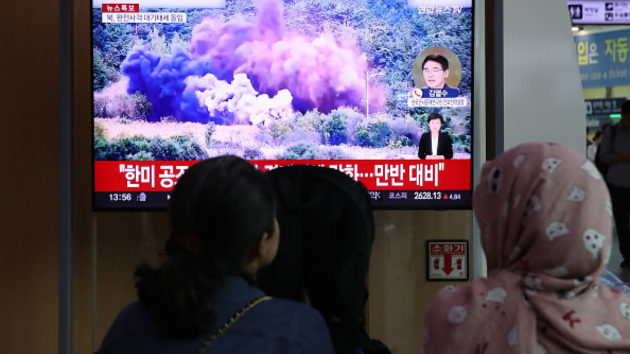
(SEOUL) — South Korea’s military said Tuesday it detected explosions on two cross-border roads connecting the country to North Korea, amid a significant recent deterioration in inter-Korean relations.
The South Korean Joint Chiefs of Staff said in a statement that North Korean forces detonated explosives on the Gyeongui Line and Donghae Line, “presumably to block connection roads.”
North Korean forces also deployed “heavy equipment” for “further operations,” the JCS said.
There was no damage to South Korean forces, it added.
“Our military has fired warning shots in areas south of the Military Demarcation Line,” the JCS statement said.
“The military is closely monitoring North Korean activities and has reinforced surveillance and alert posture in cooperation with the U.S., maintaining a state of full readiness,” the JCS said.
Seoul warned on Monday that Pyongyang appeared to be preparing to destroy the roadways.
“The North Korean military has been carrying out activities assumed to be linked to explosions on the roads along the Gyeongui and Donghae lines,” JCS spokesperson Col. Lee Sung-jun said.
“If North Korea undertakes a provocation, we will strongly retaliate in terms of our right to self defense,” he added.
The North Korean military said last week that it would permanently seal off its border with its southern neighbor, cutting rail and road connections and reinforcing defensive fortifications.
The Gyeongui line connects the western South Korean city of Paju to North Korea’s city of Kaesong, while the Donghae line runs along the east coast. North Korea has spent months laying mines, removing lights and dismantling buildings along the two routes, Seoul said.
Pyongyang said it communicated its intentions to U.S. forces in South Korea to “prevent any misjudgment and accidental conflict over the fortification project.”
Tuesday’s explosions followed almost a year of rising cross-border tensions, with North Korean leader Kim Jong Un having declared the two nations as “hostile states” in December 2023.
North Korea has sent thousands of “trash balloons” into South Korea since May, according to tallies released by the JCS.
South Korean civic groups also send balloons into North Korean territory, often carrying rice, essential medicine and leaflets critical of the regime in Pyongyang. North Korea has repeatedly protested such action and threatened a response.
Last week, North Korea accused South Korea of flying drones over Pyongyang and ordered eight artillery brigades to be ready to open fire across the border, according to state media.
Seoul’s Defense Ministry warned that Pyongyang will see “the end of its regime” if it causes any harm to South Koreans.