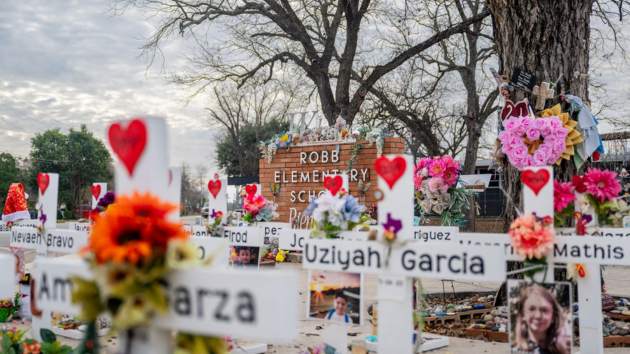
A memorial dedicated to the 19 children and two adults murdered on May 24, 2022 during a mass shooting at Robb Elementary School is seen on January 6, 2026, in Uvalde, Texas. Brandon Bell/Getty Images
(UVALDE, Texas) — Editor’s note: Some of the testimony described below is extremely graphic.
Gonzales — who was one of nearly 400 law enforcement officers to respond to Robb — is charged with child endangerment for allegedly ignoring his training during the botched police response. Nineteen students and two teachers were killed, and investigations have faulted the police response and suggested that a 77-minute delay in police mounting a counterassault could have contributed to the carnage.
Gonzales has pleaded not guilty and his legal team says he did all he could to help students.
Judge Sid Harle issued a warning to the gallery before the jury entered on Friday.
“I want to forewarn you, these photographs are going to be shocking and gruesome, and if anybody wants to step out, you are welcome to step out, but we cannot have any displays in front of the jury,” Harle said. “I’m forewarning you — these are not going to be pleasant to look at, and I’m sorry you’re going to have to look at them just like I had to.”
“There was a lot of shell casings,” said Torrez, who spent three days photographing the room. “There’s a lot of blood, a lot of blood swipes, and the weapon was in the closet.”
Using a pointer to highlight parts of the photos, Torrez testified about the location of the classroom, damage to the door and areas of the room where students didn’t attempt to hide. Defense lawyers had objected to showing the more graphic images, but Harle allowed the bulk of them into evidence due to their relevance to the prosecution’s case.
“Does the scene change?” prosector Bill Turner asked Torrez about some of the photos.
“As far as the presence of blood, it changes dramatically,” Torrez said. “A lot of bullet holes, a lot of shell casings covered in blood, a lot of bullet defects, perforations, penetrations, and just a lot of blood.”
Over the next hour, the courtroom fell almost entirely silent, other than the testimony and occasional ruffling of tissues and sniffling. Some of the jurors craned their necks to see the photos, while others covered their mouths or lifted tissues to wipe their eyes. The families of the victims sat quietly and no one left the courtroom during the testimony.
The photos did not show the bodies of students, which were removed prior to the photos being taken. But jurors did see photos showing large pools of blood and the drag marks made when the bodies were removed. Photos also showed dried bloodstains on desks, textbooks and office supplies.
Torrez testified that investigators placed rods in the cavities left by the bullets to demonstrate the direction of the gunshots. The pink and yellow rods showed that the shooter likely fired downward — through the desks — toward the sheltering students, Torrez said.
Torrez offered his testimony with little context other than his experience as a crime-scene photographer that day. Prosecutors did not explain how the images relate to Gonzales, other than suggesting that his alleged inaction contributed to the loss of life that day.
Defense attorneys say Gonzales is being scapegoated for a broader failure by law enforcement. In its opening statement this week, the defense alleged that prosecutors were playing on jurors’ emotions and that convicting Gonzales would be an injustice piled on top of one of the worst school shootings in U.S. history.
ABC News’ Juan Renteria contributed to this report.
(SPARTANBURG COUNTY, S.C.) — At least 99 new measles cases are being reported in South Carolina amid the state’s outbreak.
This brings the total number of cases in the state to 310. There are currently 200 people in quarantine, according to health officials.
The outbreak has been ongoing as state health officials continue to push for vaccinations. The majority of cases are located around Spartanburg County.
“The number of those in quarantine does not reflect the number actually exposed,” Dr. Linda Bell, the state epidemiologist, said in a press releases. “An increasing number of public exposure sites are being identified with likely hundreds more people exposed who are not aware they should be in quarantine if they are not immune to measles. Previous measles transmission studies have shown that one measles case can result in up to 20 new infections among unvaccinated contacts.”
South Carolina’s department of public health said it sent a statewide health alert on Jan. 7, “advising health care providers and facilities of the importance of heightened awareness for measles and recommended measures for the use of masks and rapid isolation of suspect measles cases to protect people in health care settings from exposures.”
The Centers for Disease Control and Prevention currently recommends that people receive two doses of the MMR vaccine, the first at ages 12 to 15 months and the second between 4 and 6 years old. One dose is 93% effective, and two doses are 97% effective against measles, the CDC says.
However, CDC data shows vaccination rates have been lagging in recent years. During the 2024-2025 school year, 92.5% of kindergartners received the MMR vaccine, according to data. This is lower than the 92.7% seen the previous school year and the 95.2% seen in the 2019-2020 school year, prior to the COVID-19 pandemic.
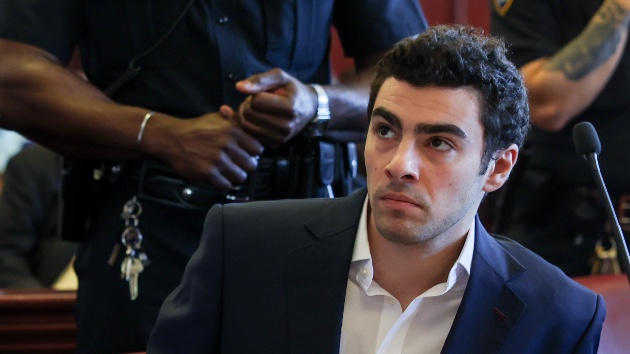
Luigi Mangione attends a suppression of evidence hearing in the killing of UnitedHealthcare CEO Brian Thompson in Manhattan Criminal Court on December 18, 2025 in New York City. (Photo by Shannon Stapleton-Pool/Getty Images)
(NEW YORK) — Accused CEO killer Luigi Mangione could stand trial by the end of the year, the judge in his federal case said Friday at a hearing in a Manhattan courtroom that was filled with Mangione’s supporters.
Mangione was back in federal court, where the defense presented arguments seeking to dismiss the death penalty counts against him if he is convicted of stalking and killing UnitedHealthcare chief executive Brian Thompson on a New York City sidewalk in 2024.
U.S. District Judge Margaret Garnett did not rule on the death penalty question at the conclusion of the hearing, but suggested that if the death penalty remains on the table, jury selection would begin in early September, and the trial would commence sometime in December or January.
If the death penalty is excluded, the judge suggested the trial could start in September.
She set a date for the next hearing on Jan. 30.
Judge Garnett also ruled Friday that Mangione’s backpack was lawfully seized by police when Mangione was apprehended in a Pennsylvania McDonalds’s five days after the shooting.
Two women who flew in from Sicily and came straight from the airport were among those in the courtroom gallery, which was filled with Mangione’s supporters, mostly young women. Many of them were wearing green, the color that has come to represent advocacy for Mangione.
“We have a full house here today,” Judge Garnett said at the outset of the hearing. “It is very important that decorum be maintained.”
The appearance of Mangione, who has pleaded not guilty to federal charges, follows a three-week hearing in state court during which Mangione sought to convince the judge in his state case to exclude some of the critical evidence police said they found in his backpack, including writings and the alleged murder weapon. The judge has yet to issue a ruling.
Judge Garnett, in issuing her ruling on the legality of the backpack’s seizure, said, “I don’t think it’s really disputed that if you’re arrested in a public place, the police are supposed to safeguard your personal property.”
Garnett said she does not need to schedule a hearing to determine whether to exclude evidence taken from the backpack, but that she reserves the right to reconsider that decision. She has yet to rule on what, if anything, should be suppressed.
“The Government searched the contents of the defendant’s notebook pursuant to a judicially authorized search warrant that expressly covered, among other things, handwritten materials, including notebook entries, contained within the defendant’s backpack,” prosecutor Sean Buckley argued in an earlier court filing.
“To the extent that the defendant now seeks to challenge the validity of the Government’s warrant — an argument the defendant similarly did not make in either his moving or reply papers — that argument would also fail on the merits because the warrant, which disclosed the initial search of the defendant’s backpack by the Altoona Police Department, was supported by ample probable cause,” wrote Buckley.
Paresh Patel, a lawyer from Maryland who recently joined Mangione’s defense team, argued stalking “fails to qualify as a crime of violence” and therefore cannot be the predicate to make Mangione eligible for the death penalty.
Mangione entered the courtroom with his ankles shackled but his hands free. Unlike his recent appearance in state court, when he wore slacks and blazer, Mangione was dressed in a beige smock and pants and a white long-sleeve T-shirt as he took a seat at the defense table between defense attorneys Karen and Mark Agnifilo.
Earlier this week, prosecutors disputed a defense claim that Mangione should not face the death penalty because of a purported conflict of interest by Attorney General Pam Bondi.
The defense said Bondi is continuing to benefit from a 401k established while she worked at the lobbying firm Ballard Partners, which represents UnitedHealthcare.
Prosecutors said Ballard has made no contributions to her retirement plan since her Senate confirmation as attorney general, and argued that she stands to gain nothing from a “capital outcome” in the Mangione case.
“There is simply no factual basis for the assertion that outside corporate interests influenced the Attorney General’s charging decision in any fashion. The defendant’s insinuations otherwise rest on an inaccurate financial narrative,” Buckley wrote in a court filing.
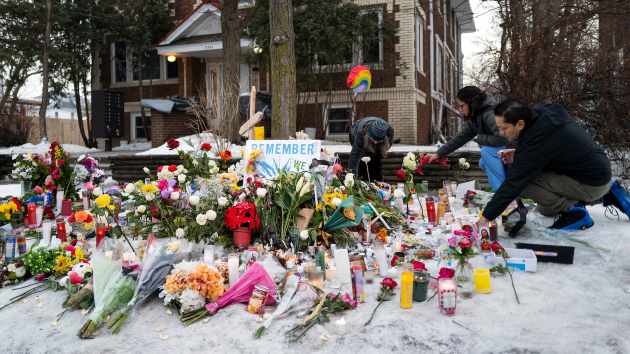
People tend to a memorial for Renee Nicole Good near the site of her shooting on January 8, 2026 in Minneapolis. (Stephen Maturen/Getty Images)
(MINNEAPOLIS) — Renee Good, a 37-year-old Minneapolis mom fatally shot by an Immigration and Customs Enforcement officer in Minneapolis on Wednesday in an alleged vehicle-ramming incident, “sparkled” and “was made of sunshine,” her wife said in an emotional statement to Minnesota Public Radio.
Becca Good told MPR Friday that on Jan. 7., she and her wife “stopped to support our neighbors” before the incident, which was caught on video and has sparked outrage and protests, occurred.
“We had whistles. They had guns,” she said, according to the statement.
Videos of the incident where Good is seen in her maroon Honda SUV as ICE agents confronted her have gone viral and sparked outcry from people around the country who say that Good was unnecessarily killed.
According to Department of Homeland Security spokesperson Tricia McLaughlin, Good was allegedly “attempting to run over our law enforcement officers” with her car when an ICE officer fatally shot her.
Minneapolis Mayor Jacob Frey and Minnesota Gov. Tim Walz have disputed the federal government’s claims surrounding what led up to the shooting, saying video of the incident shows the agent’s actions were not self-defense.
Messages of sympathy for Renee Good have been pouring out since the shooting.
“Renee lived by an overarching belief: there is kindness in the world and we need to do everything we can to find it where it resides and nurture it where it needs to grow,” Becca Good said in her statement.
“Renee was a Christian who knew that all religions teach the same essential truth: we are here to love each other, care for each other, and keep each other safe and whole,” she added.
Renee Good was a 2020 graduate from Old Dominion University in Virginia, according to the school’s president, Brian Hemphill, who said it is “with great sadness that Old Dominion University mourns the loss of one of our own.”
She graduated from the College of Arts and Letters with a degree in English, according to Hemphill.
“May Renee’s life be a reminder of what unites us: freedom, love, and peace,” he said in a statement. “My hope is for compassion, healing, and reflection at a time that is becoming one of the darkest and most uncertain periods in our nation’s history.”
Walz said that Good is survived by a 6-year-old child. During a news conference Thursday the governor offered his “deepest sympathies” to her family “on an unimaginable tragedy.”
Renee Good was also the mother of two other children, according to her wife. The 6-year-old’s father died, according to Becca Good.
“I am now left to raise our son and to continue teaching him, as Renee believed, that there are people building a better world for him. That the people who did this had fear and anger in their hearts, and we need to show them a better way,” she told MPR.
Becca Good told MPR she and her wife moved to Minnesota “to make a better life for ourselves.”
“Our whole extended road trip here, we held hands in the car while our son drew all over the windows to pass the time and the miles,” she said.
Becca Good talked about the “vibrant and welcoming community,” the two met once they arrived.
“Here, I had finally found peace and safe harbor. That has been taken from me forever,” she said.
“We were raising our son to believe that no matter where you come from or what you look like, all of us deserve compassion and kindness. Renee lived this belief every day. She is pure love. She is pure joy. She is pure sunshine,” Becca Good added.
DHS, along with President Donald Trump and Homeland Security Secretary Kristi Noem, has called the agent’s actions “self-defense” and said he followed ICE training.
Noem said during a press conference on Wednesday that Good was using her car as a “deadly weapon” and said it was an “act of domestic terrorism.”
Minneapolis police said preliminary information indicates that she was in her car and blocking the road.
“At some point, a federal law enforcement officer approached her on foot, and the vehicle began to drive off,” police said. “At least two shots were fired … the vehicle then crashed on the side of the roadway.”
“There is nothing to indicate that this woman was the target of any law enforcement investigation or activity,” police added.
Becca Good told MPR that on Jan. 7. she and her wife “stopped to support our neighbors.”
“We had whistles. They had guns,” she said.
Renee Good suffered gunshot wounds to the head and was transported to an area hospital, where she died, according to city officials.
Following the shooting, a large crowd gathered in the area, which is less than a mile from where George Floyd was killed in May 2020.
Gov. Walz said he has issued a “warning order” to prepare the Minnesota National Guard, saying there are soldiers in training and prepared to be deployed “if necessary,” while urging “peaceful resistance.”
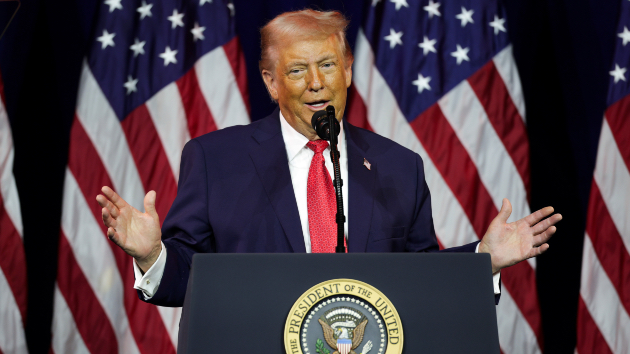
(WASHINGTON) — The White House will host America’s oil titans Friday as President Donald Trump is expected to lay out his plan for a post-Nicolas Maduro Venezuela with an economic revamp of its oil industry as its centerpiece.
The president, who said a recovery plan for Venezuela could require years of American involvement, told Fox News’ Sean Hannity Thursday that the U.S. would be “running the oil” and that he expected “at least $100 billion” of investment from the major companies.
“We’re going to rebuild the oil and the oil infrastructure, we’ll be in charge of it,” Trump said. “It’s going to do great, make a lot of money, and we’re going to take it from there, but we’re going to rebuild the country. And ultimately, you’re going to have elections.”
A White House official told ABC News that Secretary of State Marco Rubio, who has led the administration’s Venezuela policy, will attend the meeting that will include Chevron, Exxon, Conoco Phillips, Continental, Halliburton, HKN, Valero, Marathon, Shell, Trafigura, Vitol Americas, Repsol, Eni, Aspect Holdings, Tallgrass, Raisa Energy and Hilcorp.
A handful of those companies are European.
Only hours after American aircraft returned from an audacious mission in Caracas to arrest Maduro and take him to the U.S. for prosecution, Trump identified oil as the key to the U.S. strategy, asserting that American oil companies would quickly seize on a market newly friendly to them, generating revenues for America’s energy industry and establishing favorable ties with Venezuela. Trump and Rubio have said those revenues would ultimately benefit the people of Venezuelan people, some 82% of whom live in poverty, according to a 2024 report by the United Nations.
A risky choice for private industry
Experts told ABC News that the plan’s heavy reliance on the private American oil sector will present the industry with a risky choice to do business in a country some argue is less stable and harder to predict after the toppling of its president.
“The very first thing on oil all the oil companies checklist is going to be the outlook for political stability – durable political stability – that, by the way, needs to last a lot longer than the Trump administration,” said Clayton Seigle, a senior fellow at the Centers for Strategic and International Studies who focuses on energy security.
On Tuesday, the White House announced Venezuela would relinquish 30 to 50 million barrels of oil to the U.S., which would then sell the crude on the market and store revenues in American accounts.
Rubio on Wednesday fleshed out a three-phase strategy, including stabilization in Venezuela, economic recovery, and finally, a political transition there.
“They understand that the only way they can move oil and generate revenue and not have economic collapse is if they cooperate and work with the United States,” Rubio said. “And that’s what we are going to [see] happen.”
Rubio said the U.S. would continue enforcing a legal “quarantine” of illicit oil tankers transiting to and from Venezuela to bend Caracas to Washington’s will, citing the U.S. seizure of two such tankers this week. A third was seized Friday morning.
“We don’t want [Venezuela] descending into chaos,” he said, arguing the threat to the tankers would force the government, run by interim President Delcy Rodriguez, to the table.
Venezuela’s leadership, which has condemned the U.S. attack on its capital and the ouster of its president, has signaled a lukewarm embrace of cooperation on oil.
“Venezuela is open to energy relations where all parties benefit,” Rodriguez said.
Democrats called what the administration labels “leverage” as a form of brute control over the country.
“This is an insane plan,” said Sen. Chris Murphy, a Connecticut Democrat. “They are talking about stealing the Venezuelan oil at gunpoint for a period of time – undefined – as leverage to micromanage the country. I mean, the scope and insanity of that plan is absolutely stunning.”
‘Realist’ view of facts on the ground
Kimberly Breier, a former assistant secretary of State for Western Hemisphere Affairs during the first Trump administration, said the U.S. plan – which removed Maduro from power but kept the rest of his regime, including other U.S.-sanctioned officials, in place – was a “very realist” view of the facts on the ground.
“I think this is a transition to a transition,” Breier said. “I think this current situation is an intermediate step where there’s a hope and a plan that you’re going to be able to get the regime to do some of the harder things that are going to need to be done to allow for a real democratic transition to the rightfully elected government.”
Whether the energy dimension of the plan, which would require U.S. energy companies to work with the same regime that was hostile to them, is only “a hope and an aspiration” at this stage, said Seigle. “We don’t know how feasible it is.”
Oil executives who will sit down with the president in Washington will bring a checklist of questions on sanctions, tax regime, property rights, and political stability, experts told ABC News. Investments the White House might ask of them, which would include rebuilding and modernizing infrastructure, would require years and billions of dollars, they said.
“When it comes to energy, item number one is giving confidence in enduring political stability,” Seigle said.
The administration knows that oil companies “are looking for stability,” said Breier, who is now a senior adviser at Covington. “I think they’re looking for a leader that they think is not a transitional leader.”
“Certainly, oil companies operate all over the world in places that are not democracies. But from a policy standpoint…the durable, lasting leadership of Venezuela is the democratically elected one,” she said, referring to Edmundo Gonzalez, who won the 2024 Venezuelan presidential election but has been exiled.
Oil execs may not be ready to jump in
Oil companies will “express interest and to sincerely look into the matter and try to understand what their contributions could be and maybe some of the associated planning,” Seigle predicted. “But I do not think that we will see major new commitments from U.S. oil companies to leap into the Venezuelan operating environment until a lot of things on their checklists are satisfied.”
“The problem is [the administration] got the sequence backwards,” he said. “The sequence is the oil companies need to see that Venezuela is an attractive environment with a long runway of stability, and then in the future, the oil can flow.”
Breier said the energy dimension of the president’s plan is part and parcel of a broader set of objectives to counter migration and drug flows and promote a democracy in the country.
ABC News reported that the administration has made two demands to Rodriguez that must be met for the U.S. to allow the country to pump more oil. Venezuela must cut its economic ties with China, Russia, and Iran, sources said, and must agree to partner exclusively with the U.S. on oil production and favor America when selling heavy crude oil.
Breier said the reporting rings true with her experience at the State Department, where she worked with the former opposition leader of Venezuela, another elected president in exile, Juan Guaidó.
“With the Guaidó team, there were conversations about…not going [through] all this trouble for [Venezuela] to then cut deals with the Russians and the Chinese and the oil sector,” she said. “So that’s a very consistent approach.” Breier said the administration’s approach will be “private sector led” by Western companies, including the Europeans.
The White House “view[s] US companies as the most nimble and able to go in and start rebuilding the sector quickly so that you don’t end up with the U.S. taxpayer having to put the tab for reconstructing Venezuela,” she said.
Luigi Mangione attends a suppression of evidence hearing in the killing of UnitedHealthcare CEO Brian Thompson in Manhattan Criminal Court on December 18, 2025 in New York City. (Photo by Shannon Stapleton-Pool/Getty Images)
Mangione returned to Manhattan federal court Friday, where prosecutors have said they would seek the death penalty if he’s convicted of stalking and killing UnitedHealthcare chief executive Brian Thompson on a New York City sidewalk in 2024.
Two women who flew in from Sicily and came straight from the airport were among those in the courtroom gallery, which was filled with Mangione’s supporters, mostly young women. Many of them were wearing green, the color that has come to represent advocacy for Mangione.
“We have a full house here today,” U.S. District Judge Margaret Garnett said at the outset of the hearing. “It is very important that decorum be maintained.”
The appearance of Mangione, who has pleaded not guilty to federal charges, follows a three-week hearing in state court during which Mangione sought to convince the judge in his state case to exclude some of the critical evidence police said they found in his backpack, including writings and the alleged murder weapon. The judge has yet to issue a ruling.
Judge Garnett, in issuing her ruling on the legality of the backpack’s seizure, said, “I don’t think it’s really disputed that if you’re arrested in a public place, the police are supposed to safeguard your personal property.”
The judge she does not need to schedule a hearing to determine whether to exclude evidence taken from the backpack, but has yet to rule on what, if anything, should be suppressed.
“The Government searched the contents of the defendant’s notebook pursuant to a judicially authorized search warrant that expressly covered, among other things, handwritten materials, including notebook entries, contained within the defendant’s backpack,” prosecutor Sean Buckley argued in an earlier court filing.
“To the extent that the defendant now seeks to challenge the validity of the Government’s warrant — an argument the defendant similarly did not make in either his moving or reply papers — that argument would also fail on the merits because the warrant, which disclosed the initial search of the defendant’s backpack by the Altoona Police Department, was supported by ample probable cause,” wrote Buckley.
The remainder of Friday’s hearing was expected to focus on oral arguments over a defense motion to dismiss the charges that make Mangione eligible for the death penalty.
Paresh Patel, a lawyer from Maryland who recently joined Mangione’s defense team, argued stalking “fails to qualify as a crime of violence” and therefore cannot be the predicate to make Mangione eligible for the death penalty.
Mangione entered the courtroom with his ankles shackled but his hands free. Unlike his recent appearance in state court, when he wore slacks and blazer, Mangione was dressed in a beige smock and pants and a white long-sleeve T-shirt as he took a seat at the defense table between defense attorneys Karen and Mark Agnifilo.
Earlier this week, prosecutors disputed a defense claim that Mangione should not face the death penalty because of a purported conflict of interest by Attorney General Pam Bondi.
The defense said Bondi is continuing to benefit from a 401k established while she worked at the lobbying firm Ballard Partners, which represents UnitedHealthcare.
Prosecutors said Ballard has made no contributions to her retirement plan since her Senate confirmation as attorney general, and argued that she stands to gain nothing from a “capital outcome” in the Mangione case.
“There is simply no factual basis for the assertion that outside corporate interests influenced the Attorney General’s charging decision in any fashion. The defendant’s insinuations otherwise rest on an inaccurate financial narrative,” Buckley wrote in a court filing.
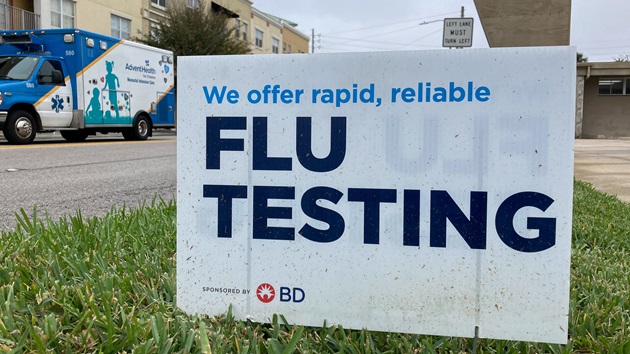
A sign advertising flu testing is seen in front of a pharmacy in Orlando. Paul Hennessy/SOPA Images/LightRocket via Getty Images
(ATLANTA) — Flu activity continues to remain elevated throughout the United States, according to newly released data from the Centers for Disease Control and Prevention.
The CDC on Friday estimated there have been at least 15 million illnesses, 180,000 hospitalizations and 7,400 deaths from flu so far this season.
This is a developing story. Please check back for updates.
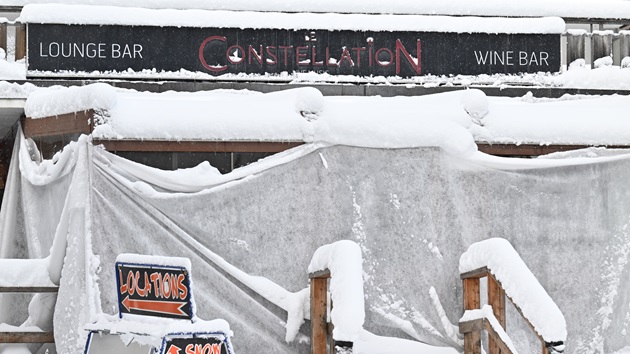
A general view of Le Constellation wine bar after a memorial ceremony in tribute to victims of the Crans-Montana bar fire on January 09, 2026 in Crans-Montana, Switzerland. Harold Cunningham/Getty Images
(LONDON) — Prosecutors on Friday detained the owner of a Swiss bar where a deadly New Year’s Day fire killed 40 people and injured 116 others, according to officials.
Jacques Moretti was placed in pre-trial detention after a meeting with prosecutors in Sion, the prosecutor’s office for Switzerland’s Valais region said.
The blaze ripped through Le Constellation, a popular bar in the resort town of Crans-Montana in the Swiss Alps, early on Jan. 1.
Moretti’s wife and business partner Jessica Moretti also attended the meeting but was not detained, according to the office. She was present at the bar during the fire and was burned on her arm.
“My constant thoughts are with the victims and those who are fighting today. This is an unimaginable tragedy,” Moretti told reporters outside the prosecutor’s office.
The bar had not had any inspections in the last five years, Swiss officials said at a press conference on Tuesday.
“There was a culture of reckless risk-taking”, Nicolas Féraud, the municipal chief of Crans-Montana, said at a press conference earlier this week. “This endangered customers and staff,” he said.
Féraud said that the municipal government had “never received any alerts” about problems in the bar. He also confirmed that there was an emergency exit in the basement, but could not say whether it was open, closed or blocked.
The blaze of “undetermined origin” broke out at the bar at about 1:30 a.m. local time on Jan. 1, the Cantonal Police of Valais said in a statement at the time of the fire.
On Jan. 2, the Valais attorney general told reporters that investigators are “pursuing several hypotheses” based on evidence they’ve gathered.
“We currently assume that the fire was caused by sparklers attached to champagne bottles that came too close to the ceiling,” she said at a news conference.
(PORTLAND, Ore.) — A Customs and Border Protection Agent shot and injured two people in Portland, Oregon, Thursday, who federal authorities said “weaponized” their vehicle against law enforcement.
The incident came after an ICE officer on Wednesday allegedly shot and killed a woman in her car in Minneapolis, Minnesota, sparking outrage and backlash against the presence of federal agents there. Similarly, the mayor of Portland called for immigration enforcement operations to halt while the investigation is ongoing.
In the Minneapolis case as well, federal officials alleged the motorists tried to ram agents, who fired defensive shots.
The Department of Homeland Security alleged the shooting in Portland occurred while Border Patrol agents were conducting a “targeted” stop on a vehicle carrying two people allegedly affiliated with the Tren de Aragua (TdA) gang. The passenger, who was identified Friday as Yorlenys Betzabeth Zambrano-Contreras, was the target of the investigation, DHS said.
The agents on the stop were part of a CBP operation dubbed “Operation Oregon,” according to multiple law enforcement sources.
“When agents identified themselves to the vehicle occupants, the driver weaponized his vehicle and attempted to run over the law enforcement agents,” DHS said in a statement.
The driver, who was identified by DHS as Luis David Nico Moncada, was not the target of the operation, according to sources. He was stopped driving a red Toyota, before he and Zambrano-Contreras attempted to flee, according to sources.
The agent, as DHS said in their statement, feared for their safety and fired at the vehicle.
Homeland Security alleged Friday that both victims were believed to have been undocumented Venezuelan nationals with ties to TdA.
Sources stressed the investigation is in the preliminary stages and the information could change.
The two people who were shot Thursday were treated at a hospital for their injuries and their conditions are unknown, according to law enforcement sources.
During the press conference Thursday, Portland Police Chief Bob Day said local officials “do not know the facts of this case,” but an investigation is ongoing.
Asked whether the passenger, Zambrano-Contreras, is linked to a previous shooting, the police chief said, “I can’t comment on whether or not that’s the case. We don’t know who these individuals are.”
Portland Mayor Keith Wilson told reporters, “We know what the federal government says happened here. There was a time when we could take them at their word. That time is long past.”
“We are calling on ICE to halt all operations in Portland until a full and independent investigation can take place,” he said. “Our community deserves answers.”
Later Thursday evening, Oregon Attorney General Dan Rayfield said he was opening an investigation into the shooting.
In a social media post, Rayfield said the Oregon Department of Justice investigation will examine whether any federal officers acted outside the scope of their lawful authority during the encounter. The post said the investigation would include witness interviews and video evidence.
The shooting incident occurred around 2:18 p.m. local time on Thursday, officials said. Portland police said officers responded to the 10200 block of Southeast Main Street near Adventist Health, a medical office, for the report of a shooting.
Several minutes later, Portland police officers responding to a call for help at an apartment complex some three miles away from the shooting scene found a man and woman with “apparent gunshot wounds,” according to the police department.
The victims then drove themselves to an apartment complex in the area of Northeast 146th Avenue and East Burnside Street, where the man who had been shot called for help, according to police.
“Officers confirmed that federal agents had been involved in a shooting,” the Portland Police Department said in an earlier statement, adding, “Portland Police were not involved in the incident.”
Police Chief Day urged calm amid “heightened emotion” following the deadly ICE officer-involved shooting in Minneapolis.
“We are still in the early stages of this incident,” Day said in a statement. “We understand the heightened emotion and tension many are feeling in the wake of the shooting in Minneapolis, but I am asking the community to remain calm as we work to learn more.”
During the press conference, Oregon Gov. Tina Kotek called for transparency from the federal government in the investigation.
“The priority right now is a full, completed investigation, not more detentions. My message to the federal government is this: We demand transparency. We demand your cooperation with Portland Police and the Multnomah County DA, because we need to investigate this incident efficiently and effectively so we can rebuild trust with our nation’s government,” Kotek said.
Earlier, Mayor Wilson called the incident “deeply troubling” while also calling on residents to “show up with calm and purpose during this difficult time.”
“Portland does not respond to violence with violence,” he said in a statement. “We respond with clarity, unity, and a commitment to justice. We must stand together to protect Portland.”
Early Friday, Portland police confirmed that at least six people were arrested during protests as crowds gathered outside an ICE facility.
“At about 9 p.m., officers requested that people move to the sidewalk, as traffic remained open in the area. An officer in the PPB Sound Truck, a loudspeaker-equipped police vehicle, broadcast that request repeatedly to the group,” the Portland Police bureau said in their statement. “PPB moved in and made targeted arrests resulting in five custodies,” while another arrest was made later on.
Multnomah County District Attorney Nathan Vasquez told reporters at the scene of the shooting that he is “very concerned.”
“We are here from this attorney’s office to monitor, to assist and to make sure that there’s a thorough and complete investigation, that evidence is fully preserved, and that we’re certainly hoping that we can get all of the facts about what transpired,” he said.
This is a developing story. Please check back for updates.
U.S. Attorney for the Northern District of New York John A. Sarcone III at a news conference on Monday, April 28, 2025, in the U.S. Attorney’s Office at the James T. Foley Federal Courthouse in Albany, N.Y. Will Waldron/Albany Times Union via Getty Images
(NEW YORK) — A day after ruling that Trump-appointed U.S. attorney John Sarcone is not lawfully serving in his position, a federal judge has denied Sarcone’s application to release tax information for an investigation his office is conducting.
U.S. District Judge Lorna Schofield on Thursday disqualified Sarcone from serving as U.S. attorney for the Northern District of New York, and quashed subpoenas he had issued as part of an investigation into New York Attorney General Letitia James.
On Friday, Schofield ruled that Sarcone lacks the authority to request a court order directing the Internal Revenue Service to disclose tax return information for a criminal probe.
“The Application is denied because Mr. Sarcone was not lawfully serving as Acting United States Attorney and therefore lacked authority to authorize the Application,” Schofield wrote. “Because Mr. Sarcone was not lawfully serving as Acting U.S. Attorney for NDNY, the Application fails to satisfy statutory requirements and provides no basis to permit disclosure of federal tax return information.”
In disqualifying Sarcone, Schofield joined several other judges across the country who have similarly disqualified federal prosecutors after maneuvers by the Trump administration to bypass the usual way they’re installed into office.
Last month The 3rd U.S. Circuit Court of Appeals sided with a lower court judge’s ruling disqualifying President Donald Trump’s former personal attorney Alina Habba from serving as U.S. attorney in New Jersey, and in November a federal judge in Virginia dismissed criminal cases against James and former FBI Director James Comey after concluding the prosecutor who brought them, former White House aide Lindsey Halligan, was unlawfully appointed.
Neither Sarcone, Habba or Halligan were either confirmed by the U.S. Senate or appointed by the federal judiciary.
It is not clear whose tax return information Sarcone was seeking in his application to the court, only that it is “a limited liability company.”
The October application claimed there was reasonable cause to believe that certain criminal acts have been committed, that the tax return information may be relevant to those crimes, and that the information cannot reasonably be obtained from any other source.