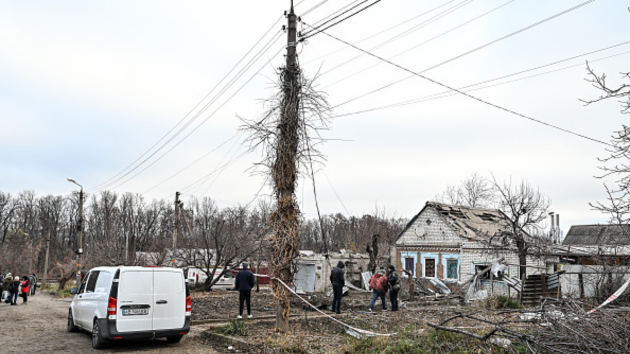
(LONDON) — Russia launched a record-high 188 strike drones into Ukraine on Monday night and Tuesday morning, expanding its long-range campaign against Ukrainian infrastructure to coincide with the onset of winter.
Ukraine’s air force said on Telegram that it downed 76 drones. Another 95 were lost in flight — possibly due to jamming efforts — and five flew into Belarus.
Russia also fired four Iskander-M ballistic missiles as part of the assault, the air force said. None were shot down.
“Unfortunately, critical infrastructure objects have been hit, and private and multi-apartment buildings have been damaged in several regions due to a mass attack by UAVs,” the air force wrote.
Recent weeks have seen a clear intensification of Russian drone and missile strikes on Ukraine, with the scale and regularity of such attacks on the rise. The previous largest attack of 145 drones occurred on Nov. 10.
As in previous winters, Russia is attacking critical energy infrastructure in a bid to deny Ukrainians power and warmth through the coming freezing months. Temperatures in Ukraine have already fallen below freezing and will remain low until early spring.
Monday night’s drone attack damaged energy infrastructure in the western city of Ternopil, Serhii Nadal — the head of the local regional defense body — said on Telegram.
Russia’s Defense Ministry, meanwhile, reported the downing of at least 39 Ukrainian drones over multiple Russian regions on Monday night. The ministry reported no damage or casualties.
(CAPE CORAL, FL) — A 22-year-old social media influencer on TikTok with nearly 300,000 followers has been arrested after using fake barcodes to steal from Target and filming herself getting ready before the alleged theft, police say.
The Cape Coral Police Department in Florida responded to a Target branch located at 1890 NE Pine Island Road in Cape Coral last Wednesday regarding a past retail theft that occurred on Oct. 30, according to a statement from the Cape Coral Police Department.
“Loss Prevention at Target stated that on October 30, 2024, an unknown female entered the store and selected items listed for sale,” police said. “Once at the self-checkout register, the female suspect did not scan the items’ barcodes, instead scanning a false barcode with cheaper prices.”
In total, 16 items of miscellaneous household goods and clothing were stolen with a total retail value of $500.32, which was verified by officers via Target’s security cameras.
In an attempt to help identify the suspect through public assistance, the Cape Coral Police Department’s Facebook and Instagram accounts posted the female’s picture, describing her as appearing to be “approximately 20-35 years old, had long black hair, and was wearing a tan shirt, tan pants, and glasses.”
An anonymous caller who saw the post on social media subsequently contacted the police and gave the possible identification for the suspect as Marlena Velez and informed them of her social media profiles.
“Officers then found Marlena’s TikTok account, which documents her getting ready on October 30, 2024, in the same outfit and glasses and going to Target,” police said. “Marlena documents herself picking out items inside the store and placing them in her car after exiting the store. Marlena appears to be a content creator with almost 300,000 followers.”
Velez has since been arrested and taken to the Lee County Jail and charged with petit theft of less than $750.
McGee’s home was destroyed by Hurricane Helene (left). Her sons inspect the damage after the hurricane (right). Courtesy of Angela McGee
(ASHEVILLE, NC) — When Angela McGee fled her home in Asheville, North Carolina, on the night of Sept. 27 to escape the ravages of Hurricane Helene, she never imagined the destruction the powerful storm would bring.
McGee and four of her eight children who were with her that night grabbed essential items from their trailer near the Swannanoa River in the western part of the state and, through torrential rain and mudslides, made it to higher elevation.
When the storm passed and McGee returned, she found her home razed to the ground and priceless sentimental items gone forever.
“My kids’ baby pictures…I will never be able to flip through the photo album to be able to show my kids,” McGee, 42, told ABC News. “Not being able to show them their certificates, three of my kids [graduated], and not having their diplomas. I’ve lost a lot of my furniture, stuff I work hard for, I lost, and I can’t get it back. The more I think about it, the more I cry about it.”
McGee is one of hundreds of thousands of socially vulnerable North Carolinians who were the hardest hit by Hurricane Helene — the deadliest hurricane to hit the continental U.S. since Hurricane Katrina in 2005 — which claimed more than 200 lives.
Many of the same inequities that contribute to economic and health disparities when natural disasters hit also make it more difficult for some communities to recover and receive aid.
Some communities more socially vulnerable to disasters
According to an October report from the U.S. Census Bureau, more than half a million North Carolinians living under disaster declarations during Hurricane Helene were already highly vulnerable to disasters.
This equates to about 577,000 people across 27 counties in North Carolina living in areas that suffered catastrophic flooding, wind damage, power outages and property destruction after Helene.
The Census Bureau said social vulnerability can include those who suffer from poverty, are in advanced age, have communications barriers or don’t have access to internet.
Other experts who are working in the area say they are other vulnerable communities such as those who are disabled.
Lisa Poteat, interim executive director of The Arc of North Carolina — a statewide nonprofit organization that focuses on advocacy and services for people with intellectual and developmental disabilities and their families — said people with disabilities are among those who are hit harder during disasters. She said she’s seen lots of needs from the disabled community as a result of Hurricane Helene.
“Folks with intellectual and developmental disabilities, for instance, often are reliant on their families or others around them for support, so it’s been critical that we get information to those groups,” she told ABC News.
“As you can imagine, many people with intellectual disabilities have trouble reading and sometimes don’t communicate well. So when we’re sending out blast in emails or texts. It’s often not helpful unless there’s someone there who can interpret or read or help them understand what’s going on.”
She added that many North Carolinians in the west live creekside, riverside and high up in the hills in isolated areas, making them very “self-reliant” but also difficult to reach.
FEMA struggles to reach hard-hit areas
Following the destruction of her home, McGee eventually managed to reach a fire station in Black Mountain, east of Asheville.
She said she and her children were forced to live out of her car for four days with not much food and water, no phone signal and no money, surviving with the help of other evacuees.
McGee said she went to the information desk at the fire station every day to ask when assistance was coming, and she was told it would be a while before officials from the Federal Emergency Management Agency (FEMA) could reach them. McGee was frustrated by the news.
“It took FEMA, like, a whole week to get to us…And I don’t understand that. I’m mad about that,” she said. “‘Oh, FEMA can’t get in here because it’s so damaged, they will have to fly in here to get to us.’ That’s why they say that FEMA took a long time to get to us. There’s no [excuse] for that.”
Craig Levy, deputy federal coordinating officer for FEMA officials in North Carolina, acknowledged that getting to the devastated communities was difficult for aid workers.
Levy told ABC News that FEMA faced several challenges trying to get to people in need, including landslides, roads that were washed out and rough terrain only accessible by helicopter. He said FEMA had Disaster Survivor Assistance Teams partner with the active-duty soldiers to hand out food, water and emergency supplies in isolated areas.
“One of our teams teamed up with those soldiers as they were going into an isolated area in order to reach a community, and that particular community had a very high number of elderly and homebound individuals that needed the assistance, and we were able to get in there,” he said. “We brought with us a portable satellite data terminal so that we could get online, help those folks register and help them also get the word out a little bit if they hadn’t been able to reach loved ones.”
Levy acknowledges the challenges faced in getting help to those who likely faced hardship long before Hurricane Helene made landfall.
He says FEMA has and will continue to try to adapt their services accordingly. For those without internet access, challenges with technology or with language barriers, Levy says FEMA’s Disaster Survivor Assistance Team goes door to door to register residents for assistance and translates resource materials into as many different languages as are spoken in the region being served.
Levy states that FEMA sets up disaster recovery centers in community spaces, such as government office buildings or near grocery stores, to meet residents in need where they are.
FEMA hopes that recent individual assistance reform allows residents to receive money up front a lot sooner, expand access to resources for the uninsured and for accessibility improvements to housing.
As of Nov. 25, McGee is still waiting for FEMA assistance and has been trying to push for updates on her request.
Helping vulnerable communities look forward
As extreme weather events become more frequent, advocates say official emergency response efforts need to account for those most vulnerable and the challenges they face before, during and after a tragedy.
This response, advocates say, should also address the root causes for social vulnerability, as well. Ana Pardo, an activist at the North Carolina Justice Center, says disaster preparedness and economic preparedness go hand-in-hand.
“Allowing families to make enough of a living from their labor to be prepared and to have some economic resilience in the face of a disaster is part of disaster preparedness,” Pardo told ABC News. “We’ve stretched people and put them in a corner for so long that they don’t have anything of their own to rely on right now.”
But when emergency and recovery response falters, some residents hope to step up for their neighbors in need.
The Eastern Band of Cherokee Indians (EBCI), a federally recognized Indian tribe in western North Carolina, say they were spared from much of the devastation, allowing them to create distribution centers and gather donations to deliver supplies to a large swath of the state devastated by Hurricane Helene.
“I have never seen our community come together as a whole and support each other and support our neighbors,” Anthony Sequoyah, the Secretary of Operations for EBCI, told ABC News.
Pardo said she’s emotional just thinking about the volunteers who came to the region to muck out homes filled with mud and to gut wet drywall to prevent mold buildup in flooded buildings.
“We’ve had hundreds of people coming through every week to dig mud off the streets and try to save the businesses that are in our town,” said Pardo. “There’s just been such an outpouring of care and resources and effort.”
(WASHINGTON) — The judge overseeing Donald Trump’s election interference case has dismissed the case, after special counsel Jack Smith asked the judge to toss the case due to a long-standing Justice Department policy that bars the prosecution of a sitting president.
Smith earlier Monday moved to dismiss Trump’s election interference case and the appeal of his classified documents case ahead of Trump’s impending inauguration, due to the DOJ’s presidential immunity policy and not because the charges lacked merit.
U.S. District Court Judge Tanya Chutkan dismissed the charges against Trump without prejudice, leaving open the highly unlikely possibility of a future prosecution.
In a two-page opinion, Judge Chutkan wrote that dismissing the case without prejudice is “appropriate” and would not harm the “public interest,” agreeing with Smith’s argument that Trump’s immunity would not cover him when he leaves office.
“Dismissal without prejudice is also consistent with the Government’s understanding that the immunity afforded to a sitting President is temporary, expiring when they leave office,” Chutkan wrote.
However, it’s extremely unlikely that any prosecutor would attempt to bring the same charges in the future, in part because the statute of limitations for the alleged crimes will have expired by the time Trump leaves office in four years.
Trump’s lawyers did not oppose the government’s motion to dismiss the case without prejudice.
Smith also asked the judge in Trump’s classified documents case that his appeal against Trump’s two co-defendants in that case, Walt Nauta and Carlos De Olivera, be allowed to continue.
Smith’s requests came nearly 16 months after a grand jury first indicted Trump over his alleged efforts to unlawfully overturn the results of the 2020 election.
“That prohibition is categorical and does not turn on the gravity of the crimes charged, the strength of the Government’s proof, or the merits of the prosecution, which the Government stands fully behind,” Smith stated in his motion.
“The country have never faced the circumstance here, where a federal indictment against a private citizen has been returned by a grand jury and a criminal prosecution is already underway when the defendant is elected President,” the motion said. “After careful consideration, the Department has determined that OLC’s prior opinions concerning the Constitution’s prohibition on federal indictment and prosecution of a sitting President apply to this situation and that as a result this prosecution must be dismissed before the defendant is inaugurated.”
Smith moved to dismiss his appeal of the charges against Trump in his classified documents case, in which Trump pleaded not guilty last year to 40 criminal counts related to his handling of classified materials after leaving the White House, after U.S. District Judge Aileen Cannon dismissed the case in July over her finding that Smith was improperly appointed to his role. Smith appealed that ruling to the 11th Circuit Court of Appeals, arguing that legal precedent and history confirm the attorney general’s ability to appoint special counsels.
Monday’s filing asked the court to dismiss that appeal — but it sought to keep the appeal in place for Nauta and De Olivera, two Trump employees who pleaded not guilty to obstruction charges.
“The appeal concerning the other two defendants will continue because, unlike defendant Trump, no principle of temporary immunity applies to them,” the filing said.
In a statement, John Irving, a lawyer for De Oliveira, said, “The Special Counsel’s decision to proceed in this case even after dismissing it against President Trump is an unsurprising tribute to the poor judgment that led to the indictment against Mr. De Oliveira in the first place. Just because you can doesn’t mean you should. If they prefer a slow acquittal, that’s fine with us.”
Trump campaign spokesperson Steven Cheung, in a statement, called Smith’s motions to dismiss a “major victory for the rule of law” and said, “The American People and President Trump want an immediate end to the political weaponization of our justice system and we look forward to uniting our country.”
In the election interference case, Trump last year pleaded not guilty to federal charges of undertaking a “criminal scheme” to overturn the results of the 2020 election by enlisting a slate of so-called “fake electors,” using the Justice Department to conduct “sham election crime investigations,” trying to enlist the vice president to “alter the election results,” and promoting false claims of a stolen election during the
Jan. 6 attack on the Capitol, all in an effort to subvert democracy and remain in power.
Smith subsequently charged Trump in a superseding indictment that was adjusted to respect the Supreme Court’s July ruling that Trump is entitled to immunity from criminal prosecution for official acts undertaken as president.
Earlier this month, Judge Chutkan cancelled the remaining deadlines in the election interference case after Smith requested time to “assess this unprecedented circumstance and determine the appropriate course going forward consistent with Department of Justice policy” following Trump’s election.
Judge Chutkan had been in the process of considering how the case should proceed in light of the Supreme Court’s immunity ruling.
Smith had faced filing deadlines of Dec. 2 for both the election interference case and the classified documents case, after Smith’s team requested more time to determine how to face the unprecedented situation of pending federal cases against someone who had just been elected to the presidency.
Getting Monday’s filings in a week ahead of schedule now raises the question of whether Smith will be able to beat the clock to officially close his office down and submit his final report to Attorney General Merrick Garland — as is required of him per the DOJ’s special counsel regulations — before Inauguration Day.
The final report will have to go through a classification review by the intelligence community, a process that can sometimes take weeks before it is approved for any kind of public release.
Garland has made clear in appearances before Congress and in public statements that he is committed to making public the final reports of all special counsels during his tenure, which included reports by special counsel Robert Hur following his probe of President Joe Biden’s handling of classified documents before assuming the presidency, and by special counsel John Durham following his probe of the 2016 Russia investigation.
Special counsel David Weiss is still continuing his investigation of FBI informant Alexander Smirnov, who pleaded not guilty to charges of lying about President Biden and his son Hunter Biden, and is set to take the case to trial in California next week. It’s unclear whether he will formally close his investigation down and submit a final report prior to Trump taking office.
(KENTUCKY) — A former Kentucky sheriff accused in the fatal shooting of a judge in September was arraigned on new charges Monday.
Monday’s arraignment hearing was held in the Letcher County Courthouse — the same courthouse where Shawn “Mickey” Stines is accused of gunning down Kentucky District Judge Kevin Mullins in his chambers on Sept. 19.
An attorney for Stines, 43, pleaded not guilty on his behalf Monday to a new charge of murder of a public official.
The judge denied Stines bond, citing concerns with security, community safety and the charges against him.
Stines previously pleaded not guilty to first-degree murder charges, for which a special judge appointed to preside over the case has said he could face the death penalty.
It is still not clear what led up to the alleged murder of Mullins, 54.
Just days before the shooting, Stines had been deposed in a lawsuit, which alleged he had failed to investigate one of his deputies who sexually abused a woman in Mullins’ chambers.
Kentucky State Police previously said the shooting occurred “following an argument inside the courthouse.” Letcher County Circuit Clerk Mike Watts said Stines and Mullins had lunch together earlier that day.
Mullins was found in his chambers with multiple gunshot wounds after a 911 caller reported gunfire inside the courthouse.
Stines was taken into custody without incident at the courthouse, police said. He retired from his position as sheriff shortly after his arrest.
Erik Menendez, left, and is brother Lyle, in front of their Beverly Hills home, Nov. 30, 1989 Los Angeles Times via Getty Images
(LOS ANGELES, Calif.) — Erik and Lyle Menendez’s infamous case was back in front of a judge Monday, with their aunts appealing to the judge on their behalf, during a status hearing regarding the brothers’ habeas corpus petition, which was filed last year for a review of new evidence not presented at trial.
The hearing was delayed 40 minutes due to challenges with trying to get Lyle and Erik Menendez to be available in court via video. After several attempts, the brothers were able to listen to the proceedings on the phone.
A lottery drawing was held for 16 public seats in the courtroom. Dozens of members of the public arrived early in the morning to wait for a chance to witness the hearing.
Judge Michael Jesic allowed testimony Monday from two of the brothers’ aunts — their mother’s sister, Joan VanderMolen, and their father’s sister, Terry Baralt — due to health concerns.
The aunts “both made impassioned pleas with the judge to send the brothers home,” defense attorney Mark Geragos told reporters after the hearing, calling it a “moving experience.”
The aunts testified about “all of the good things” the brothers have done in prison, Geragos said.
Jesic pushed back another scheduled hearing regarding the brothers’ resentencing recommendation from Dec. 11 to Jan. 30 and Jan. 31.
Jesic said he needs time to go through 17 boxes of files on the case and said he wants to give the newly elected Los Angeles district attorney ample time to get up to speed.
“By Jan. 30 or 31, we’re hoping that by the end of that, or sometime sooner, that we will, in fact, get the brothers released,” Geragos said.
Two new pieces of evidence are at the center of the brothers’ habeas corpus petition.
One is allegations from a former member of the boy band Menudo, who revealed last year that he was raped by the brothers’ father, Jose Menendez.
The second piece is a letter Erik Menendez wrote to his cousin eight months before the murders detailing his alleged abuse from his father. The cousin testified about the alleged abuse at trial, but the letter — which would have corroborated the cousin’s testimony — wasn’t found until several years ago, according to the brothers’ attorney.
The case began in 1989, when Lyle Menendez, then 21, and Erik Menendez, then 18, fatally shot their parents, Jose and Kitty Menendez, in the family’s Beverly Hills home. The defense claimed the brothers acted in self-defense after enduring years of sexual abuse by their father, but prosecutors alleged they killed for money.
The first trial, which had separate juries for each brother, ended in mistrials. In 1996, after the second trial — during which the judge barred much of the sex abuse evidence — the brothers were convicted and both sentenced to two consecutive terms of life without parole.
As the habeas corpus petition moves through the courts, the brothers have two other potential paths to freedom.
One path is through resentencing. Los Angeles County District Attorney George Gascón announced last month he was recommending the brothers’ sentence of life without the possibility of parole be removed, and they should instead be sentenced for murder, which would be a sentence of 50 years to life. Because both brothers were under 26 at the time of the crimes, they would be eligible for parole immediately with the new sentence.
The DA’s office said its resentencing recommendations take into account many factors, including rehabilitation in prison, and abuse or trauma that contributed to the crime. Gascón praised the work Lyle and Erik Menendez did behind bars to rehabilitate themselves and help other inmates.
Shortly after Gascón’s announcement, he lost his race for reelection to Nathan Hochman. The incoming DA, who is set to take office on Dec. 2, said he plans to read through the evidence — including confidential prison files and interviews with family, lawyers and law enforcement — before showing his support for resentencing.
The other possible path to freedom is the brothers’ request for clemency, which they’ve submitted to California Gov. Gavin Newsom.
Last week, Newsom said he’ll defer to Hochman’s “review and analysis of the Menendez case prior to making any clemency decisions.”
ABC News’ Alex Stone, Matt Gutman and Ashley Riegle contributed to this report.
Photo by Saul Martinez for The Washington Post via Getty Images
(WASHINGTON) — President-elect Donald Trump responded Monday to special counsel Jack Smith’s move to dismiss the two felony cases against him.
“These cases, like all of the other cases I have been forced to go through, are empty and lawless, and should never have been brought,” he wrote on his social media platform.
“It was a political hijacking, and a low point in the History of our Country that such a thing could have happened, and yet, I persevered, against all odds, and WON. MAKE AMERICA GREAT AGAIN!” Trump added.
Vice President-elect JD Vance said Trump could have “spent the rest of his life in prison” had the outcome of the 2024 race been different.
“If Donald J. Trump had lost an election, he may very well have spent the rest of his life in prison,” Vance wrote on X. “These prosecutions were always political. Now it’s time to ensure what happened to President Trump never happens in this country again.”
Smith, in back-to-back court filings, cited the Justice Department’s “categorical” policy that he said bars the prosecution of a sitting president as the reason for his request to drop the federal election interference case and the classified documents case.
Trump pleaded not guilty to four charges, including conspiracy to defraud the United States, brought by Smith in connection with Trump’s alleged attempts to overturn his 2020 election loss to President Joe Biden. The case was plagued with delays and developments, including a Supreme Court decision that a president is entitled to some immunity from criminal prosecution for official acts during their time in office.
Trump also pleaded not guilty to the 40 criminal counts related to his handling of classified material after leaving the White House. The case was dismissed by a federal judge in Florida in July, though Smith had been appealing the decision.
During his presidential campaign, Trump told supporters he was their “retribution” and that he was “being indicted for you.”
Steven Cheung, the incoming White House communications director, called Smith’s decision a “major victory for the rule of law” and said Americans want Trump to end “weaponization of our justice system.”
Some of Trump’s allies on Capitol Hill also celebrated the development.
“Huge win for America, President Trump, and the fight against the weaponization of the justice system,” House Speaker Mike Johnson wrote on X. “This was ALWAYS about politics and not the law.”
California Democratic Sen.-elect Adam Schiff, however, said the Justice Department and the courts “failed to uphold the principle that no one is above the law.”
Schiff was a member of the House Jan. 6 Committee that spent more than a year investigating the Capitol attack. The panel, which voted to recommend charges against Trump, identified Trump and his actions after the 2020 election as the “central cause” of what transpired on Jan. 6, 2021.
“DOJ by neglecting to promptly investigate the events of Jan 6, and the courts by willfully delaying progress of the case and providing immunity,” Schiff wrote on X. “The public deserved better.”
(CAIRO) — More than a dozen tourists were feared missing after a diving boat sank off Egypt’s Red Sea coast, authorities said on Monday.
The boat, The Sea Story, sank off the southeastern Egyptian town of Marsa Alam, near the Shaab Satayah area, which is popular for its coral reefs, the Red Sea Governorate said in a statement.
Sixteen of the 44 people on board were still missing Monday afternoon, officials said. The other 28 had been rescued, officials said.
The boat had 31 tourists of various nationalities and at least a dozen crew members on board when it sank, officials said. Two Americans were on board, a local council source told ABC News on Monday.
The U.S. Embassy in Cairo told ABC News it was not aware of any U.S. citizen fatalities in the incident.
“We are aware of the incident that occurred and are in touch with the authorities to provide assistance as necessary. At this time, we are not aware of any U.S. citizen fatalities or unaccounted for U.S. citizens,” spokesperson Gina Cabrera told ABC News.
Some passengers were trapped inside cabins on the tourist boat and were unable to escape, the Red Sea Governate said.
The search-and-rescue operations have stopped for the day, the governate added.
Gov. Amr Hanafy had said earlier that some tourists were rescued, without revealing how many remained missing. A search-and-rescue helicopter airlifted some survivors from the Wadi el Gemal reserve area to receive treatment, and a frigate was dispatched to assist with the ongoing rescue efforts.
The Sea Story set sail from the port of Ghalib in Marsa Alam on Sunday for a diving trip and was scheduled to arrive at Hurghada Marina on Friday.
A crew member sent a distress signal at 5.30 a.m. on Monday before the ship dropped off the radar, officials said.
Egypt’s Red Sea resorts are popular with tourists for their beaches and diving spots.
ABC News’ Joe Simonetti contributed to this report.
(WASHINGTON) — The election of a new chair of the Democratic National Committee, along with other top leadership positions, will be Feb. 1, 2025, at the party’s winter meeting in National Harbor, Maryland, according to a DNC official.
This selection of incoming DNC officers, which includes chair, vice chairs, treasurer, secretary, and national finance chair positions, comes as the party grapples with the results of the 2024 election, when they lost the presidency, control of the U.S. Senate and were not able to earn the majority in the House.
Laying out the next steps for party leadership, current DNC Chair Jamie Harrison — who is not vying for a second term — also announced on Monday that the party will host four forums for candidates to make their case to the 448 active DNC members who will be voting on their bids.
The forums, set to be both in-person and virtually, will provide “opportunities for engagement of grassroots Democrats,” a party official said, and will “focus on the questions and concerns of DNC members, elected representatives who will ultimately vote to elect the incoming officers.”
“As my time as Chair comes to a close and we prepare to undertake the critical work of holding the Trump Administration and Republican Party accountable for their extremism and false promises, we are beginning to lay out the process for upcoming DNC officer elections in the New Year. The DNC is committed to running a transparent, equitable, and impartial election for the next generation of leadership to guide the party forward,” Harrison said in a statement on Monday.
Harrison and all DNC staff will maintain complete neutrality throughout the process, including abstaining from endorsing or campaigning for any candidate, a party official told ABC.
“Electing the Chair and DNC officers is one of the most important responsibilities of the DNC Membership, and our staff will run an inclusive and transparent process that gives members the opportunity to get to know the candidates as they prepare to cast their votes,” Harrison added.
The DNC’s Rules and Bylaws Committee is set to meet on Dec. 12 to first develop a process for selecting Democratic Party officers. They’ll recommend a “Rules of Procedure” for the nomination and election of the candidates that will be sent to full membership for the vote during the winter meeting, which begins Jan. 30 in National Harbor.
Included in these rules are the requirements for gaining access to the ballot. In 2021, candidates were required to submit a nominating statement alongside the signatures of 40 DNC members. The DNC intends to use this 40 signature threshold for candidate participation in the forums, a party official said to ABC.
Thus far, there are two candidates actively campaigning to be the next chair. Former Maryland governor and Baltimore mMayor Martin O’Malley, who has served since December 2023 as the commissioner of the Social Security Administration, a week ago was the first to throw his hat into the ring for what is expected to be many bids to lead a Democratic party left in disarray following their election losses earlier this month.
“We must connect our Party with the most important place in America — the kitchen table of every family’s home. Jobs, Opportunity, and Economic Security for all. Getting things done. Hope. A 50 state strategy. Now.” he said on Monday in a post on X.
Shortly after, Ken Martin of Minnesota, a vice chair of the DNC who also serves as chairman of the Minnesota Democratic-Farmer-Labor (DFL) Party and president of the Association of State Democratic Committees, entered the race.
In a statement, Martin says he’s already garnered the endorsement of 83 DNC members and will be “working to earn every vote between now and the party elections.” In his launch, Martin emphasized the party’s need to “hit the pavement, get out of DC for a bit, and go to the states — to listen, reconnect with the voters, and restore a strong and resilient party.”
Other names floated for DNC chair have been ambassador to Japan and former Chicago mayor Rahm Emanuel, Democratic Party of Wisconsin Chairman Ben Wikler, and Chuck Rocha, a political strategist who worked for Sen. Bernie Sanders’ presidential campaign, among others. New Jersey Gov. Phil Murphy won’t be running for the role, ABC News has confirmed, after some speculation about his candidacy had been rumored.
The 448 DNC members who will vote on Feb. 1 includes 200 state elected members from 57 states, territories, and Democrats Abroad; members representing 16 affiliate groups; and 73 current at-large members elected by the DNC.
-ABC News’ Brittany Shepherd and Hannah Demissie contributed to this report.
(WASHINGTON) — Special counsel Jack Smith has moved to dismiss his federal election interference case and his classified documents case against President-elect Donald Trump due to a long-standing Justice Department policy that bars the prosecution of a sitting president, not because of the merits of the charges.
Nearly 16 months after a grand jury first indicted Trump over his alleged efforts to unlawfully overturn the results of the 2020 election, Smith has asked U.S. District Judge Tanya Chutkan to throw out the case ahead of Trump’s impending inauguration, according to a motion filed Monday.
“That prohibition is categorical and does not turn on the gravity of the crimes charged, the strength of the Government’s proof, or the merits of the prosecution, which the Government stands fully behind,” Smith said in his motion, in which he said, “the country have never faced the circumstance here, where a federal indictment against a private citizen has been returned by a grand jury and a criminal prosecution is already underway when the defendant is elected President.”
“Confronted with this unprecedented situation, the Special Counsel’s Office consulted with the Department’s Office of Legal Counsel (OLC), whose interpretation of constitutional questions such as those raised here is binding on Department prosecutors. After careful consideration, the Department has determined that OLC’s prior opinions concerning the Constitution’s prohibition on federal indictment and prosecution of a sitting President apply to this situation and that as a result this prosecution must be dismissed before the defendant is inaugurated,” said the motion.
Earlier this month, Judge Chutkan cancelled the remaining deadlines in the case after Smith requested time to “assess this unprecedented circumstance and determine the appropriate course going forward consistent with Department of Justice policy” following Trump’s election.
Trump last year pleaded not guilty to federal charges of undertaking a “criminal scheme” to overturn the results of the 2020 election by enlisting a slate of so-called “fake electors,” using the Justice Department to conduct “sham election crime investigations,” trying to enlist the vice president to “alter the election results,” and promoting false claims of a stolen election during the Jan. 6 attack on the Capitol, all in an effort to subvert democracy and remain in power.
Smith subsequently charged Trump in a superseding indictment that was adjusted to respect the Supreme Court’s July ruling that Trump is entitled to immunity from criminal prosecution for official acts undertaken as president.
Judge Chutkan had been in the process of considering how the case should proceed in light of the Supreme Court’s immunity ruling.
Smith had faced filing deadlines of Dec. 2 for both the election interference case and the classified documents case against Trump, after Smith’s team requested more time to determine how to face the unprecedented situation of pending federal cases against someone who had just been elected to the presidency.
Trump pleaded not guilty last year to 40 criminal counts related to his handling of classified materials after leaving the White House, before U.S. District Judge Aileen Cannon dismissed the case in July over her finding that Smith was improperly appointed to his role. Smith appealed that ruling to the 11th Circuit Court of Appeals, arguing that legal precedent and history confirm the attorney general’s ability to appoint special counsels, but after Trump’s reelection he asked the court to pause the appeal until Dec.2, in the same manner as the election interference case.
Getting Monday’s filing in a week ahead of schedule now raises the question of whether Smith will be able to beat the clock to officially close his office down and submit his final report to Attorney General Merrick Garland — as is required of him per the DOJ’s special counsel regulations — before Inauguration Day.
The final report will have to go through a classification review by the intelligence community, a process that can sometimes take weeks before it is approved for any kind of public release.
Attorney General Garland has made clear in appearances before Congress and public statements that he is committed to making public the final reports of all Special Counsels during his tenure, which included reports by Special Counsel Robert Hur and Special Counsel John Durham.
Special Counsel David Weiss is still continuing his investigation and is set to take his case against an FBI informant charged with lying about President Biden and his son Hunter to trial in California next week. It’s unclear whether he will formally close his investigation down and submit a final report prior to Trump taking office.
This is a developing story. Please check back for updates.