
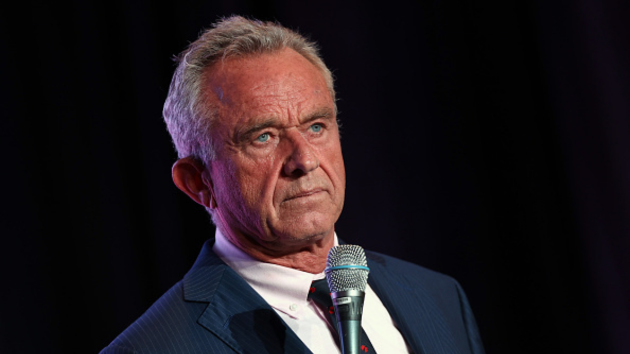
What policies could RFK Jr. actually change at HHS?

What policies could RFK Jr. actually change at HHS?
Kevin Dietsch/Getty Images

(WASHINGTON) — Named to lead the nation’s sprawling Department of Health and Human Services, Robert F. Kennedy Jr. has big ideas for busting public health policy norms.

His Senate confirmation hearings — should they happen — will come with lots of questions about what Kennedy’s ideas would look like in practice.

His new role would mean relinquishing his outsider critic status and working from within a massive government system, leading an agency of 80,000 employees and dealing with everything from drug approvals to food recalls to the pandemic response.

So, what happens when his motto “Make America Healthy Again” collides with one of Washington’s largest government bureaucracies?

“He seems very clear on what it is he wants to get done. I’m just not sure he has an understanding of what it will take to get that done,” said one former senior HHS official who worked in the Biden administration.

Vaccines

On vaccines, President-elect Donald Trump’s picks of Johns Hopkins University professor Marty Makary to lead the Food and Drug Administration, former GOP Rep. Dave Weldon to head the Centers for Disease Control and Prevention and Dr. Janette Nesheiwat as surgeon general certainly add to Kennedy’s ability to make changes — if they’re confirmed by the Senate.

Both Makary and Weldon have raised questions about vaccine side effects, although they’ve also at times been supportive overall of the role vaccines play in public health. Kennedy himself has falsely claimed that vaccines cause autism, which has been debunked by numerous studies.

In their new positions, Makary, Weldon and Kennedy would have the power to select the experts who sit on important FDA and CDC advisory panels. Those panels play a key role in vaccine recommendations and authorizations for the general public, ultimately creating public health guidance for years to come.

“I think massively, in large part, the health care community would continue to move forward on vaccines as they do now, as they are considered to be one of the massive successes of public health in the last 100 years. And I don’t think that would change,” said Tom Inglesby, a former senior adviser to HHS and the White House during COVID-19 during the Biden administration.

“But what could change is potentially the cost of vaccines, the access to vaccines, guidance around new vaccines that might come online, and also confusion around public messaging from the federal government about safety and effectiveness of vaccines,” Inglesby said.

Food and nutrition

When it comes to chemicals and the food Americans consume, it’s less clear how Kennedy could make changes at HHS, as opposed to the Environmental Protection Agency or the Department of Agriculture, which have more oversight of areas such as water fluoridation, which Kennedy opposes, or school lunches, which he says he wants to make healthier. He has said, however, that he would gut the entire nutrition department at the FDA.

Kennedy could also move around funding — he’s said he’d deprioritize infectious disease research in favor of chronic illness research, for example. As avian flu cases continue to rise — raising concerns about a new pandemic — public health experts and former government officials have pushed back strongly on that idea.

But he has also called for restrictions on food additives, dyes and ultra-processed foods, something he could have direct influence over through the FDA, which determines safe thresholds for the “Acceptable Daily Intake” on substances.

Kennedy has generally received a more cautious welcome from the public health community regarding his focus on healthy food.

“There are some things here that are worth working on. You know, if we’re looking at the school lunch program in America, 30 million children get more than half of their calories from that program. It would be a wonderful thing to make that the best school lunch program possible,” said Dr. Richard Besser, former CDC acting director.

But many public health experts are also wary of giving Kennedy credit, for fear it could lend credibility to other false information he promotes. He advocates drinking raw milk, for example, even though the pasteurization process kills off bacteria that can cause serious illness, including the fast-spreading avian flu.

“One of the dangerous things about RFK Jr. is that there are bits of things he says that are true, and they’re mixed in. And it makes it really hard to sort out what things you should follow because they’re based on fact, and which things are not,” Besser told ABC News, where he was former chief health and medical editor.

Experts also question Kennedy’s ability to counter powerful Washington lobbies — one of his stated main goals — in a Trump administration focused on working with big business on deregulating industries.

Abortion access

Another area where Kennedy could be out of line with the Trump administration is abortion access. Kennedy has said he supports legal abortion access until fetal viability (despite an earlier comment on the campaign trail that he later walked back about supporting a 15-week ban) and that such decisions should be up to women.

Many abortion rights advocates still expect the Trump administration to quickly move to rescind protections and halt legal fights the Biden administration initiated after the fall of Roe v. Wade — but are hopeful that Kennedy and the broader administration would not attempt sweeping bans.

“[Trump’s] obviously waffled on this and other issues a thousand times so I’m not going to trust every word he says, but I do think there’s the possibility that he and his administration has seen that actually, abortion access is very popular,” said Katie O’Connor, senior director of abortion policy at the National Women’s Law Center.

“We have seen that over the past three elections, and there could be pushback if this administration does something to further restrict abortion access.”

There are certainly members of Trump’s orbit who would support broader restrictions on abortion, but Trump himself has said he would not sign a federal ban if Congress passed one.

Some of the policies O’Connor expects to see rolled back would include the Pentagon paying for service members who need to cross state lines to get an abortion because of where they were stationed, as well as expanded access to abortion pills through telemedicine.

As HHS secretary, Kennedy could undo these rules and also build on the first Trump administration’s efforts. He could expand protections for health care providers who don’t want to perform abortion procedures, allowing more providers to deny care, and make it more difficult for private insurers to cover abortion, leaving it more expensive for patients, O’Connor said.

Large-scale bans, were they executed, would focus on removing access to the medication abortion pill called mifepristone, either by attempting to take medication abortion off the market by way of the FDA approval process, or employing a very old law called the Comstock Act to prohibit the pills from being mailed.

“I do hold out hope that this administration doesn’t want to expand political capital on abortion,” O’Connor said.

Copyright © 2024, ABC Audio. All rights reserved.

Alexander Smirnov, ex-FBI informant charged with lying about Biden family business, faces new tax charges

Alexander Smirnov, ex-FBI informant charged with lying about Biden family business, faces new tax charges
Alexander Smirnov, center, a confidential human source with the FBI, leaves the Lloyd George U.S. Courthouse, on Tuesday, Feb. 20, 2024, in Las Vegas. Smirnov is accused of falsely stating that executives with the Ukrainian energy company Burisma paid Hunter and Joe Biden $5 million each in 2015 or 2016. (Bizuayehu Tesfaye/Las Vegas Review-Journal/Tribune News Service via Getty Images)

(WASHINGTON) — The former FBI informant charged by special counsel David Weiss for allegedly lying about President Joe Biden and his son Hunter Biden’s business dealings is facing a separate new indictment on tax-related charges, court records show.

Alexander Smirnov is alleged to have evaded paying taxes on more than $2 million in income he received from multiple sources between 2020 and 2022, according to an indictment unsealed Tuesday in California federal court.

Smirnov was set to face trial beginning next week in Los Angeles on charges he concocted “fabrications” about President Biden and his son accepting $5 million in bribes from the Ukraine energy company Burisma, which Republicans repeatedly sought to seize on in their yearslong effort to impeach the president. He has pleaded not guilty to the charges.

That trial has since been pushed to January by the federal judge overseeing Smirnov’s case.

The newly unsealed indictment paints Smirnov as living a lavish lifestyle during the years he was allegedly also peddling lies to his FBI handler about the Biden family — detailing expenditures that include a $1.4 million Las Vegas condominium, a Bentley he allegedly leased for over $122,000, and hundreds of thousands of dollars of clothes, jewelry and accessories he allegedly purchased for himself and his domestic partner.

Despite receiving more than $2 million in revenue streams, prosecutors say that on a credit card application in June of 2022 he listed only $60,000 in total annual income and $250,000 in gross business income.

The indictment further alleges that when Smirnov sought the assistance of a professional tax return preparer who refused to sign his returns, Smirnov told the preparer that they “should not inquire about how he earned his income,” and further instructed them to delete any emails or messages sent by Smirnov.

“Mr. Smirnov intends to vigorously fight these allegations with the same intensity as he has fought the original indictment,” Smirnov’s attorneys, David Chesnoff and Richard Schonfeld, said in a statement.

As of Tuesday afternoon, Smirnov had not yet entered a plea to the newly filed indictment, according to court records.

Smirnov has remained detained since his arrest in February, on the belief that he poses a flight risk due to his extensive overseas contacts that allegedly include known senior intelligence agents in Russia.

Copyright © 2024, ABC Audio. All rights reserved.

Trump names COVID lockdown critic Dr. Jay Bhattacharya as pick for NIH director

Trump names COVID lockdown critic Dr. Jay Bhattacharya as pick for NIH director
Tom Williams/CQ-Roll Call, Inc via Getty Images

(WASHINGTON) — President-elect Donald Trump is nominating a critic of COVID-19 lockdown policies to serve as the head of the National Institutes of Health.

In a statement, Trump said he has picked Dr. Jay Bhattacharya to serve as NIH director to work in cooperation with Robert F. Kennedy Jr. — whom Trump named as his pick for secretary of the Department of Health and Human Services — to direct the nation’s medical research.

“Together, Jay and RFK Jr. will restore the NIH to a Gold Standard of Medical Research as they examine the underlying causes of, and solutions to, America’s biggest Health challenges, including our Crisis of Chronic Illness and Disease,” Trump said in the statement. “Together, they will work hard to Make America Healthy Again!

Bhattacharya is a professor of health policy at Stanford University who gained notoriety for openly opposing COVID-19 lockdown restrictions.

In addition to a medical degree, he has a doctorate in economics.

Trump also nominated Jim O’Neil to serve as the deputy secretary of the Department of Health and Human Services to “oversee all operations and improve Management, Transparency, and Accountability,” according to a statement.

Copyright © 2024, ABC Audio. All rights reserved.

Judge says Ralph Yarl shooting suspect is fit to stand trial after mental exam

Judge says Ralph Yarl shooting suspect is fit to stand trial after mental exam
ABC News

(KANSAS CITY, Mo.) — Andrew Lester, the Kansas City man charged in the April 2023 shooting of Ralph Yarl after the teenager mistakenly went to the wrong house, is fit to stand trial in February 2025, a judge said on Tuesday, according to Kansas City ABC affiliate KMBC.

The ruling came after the judge reviewed the findings of Lester’s mental exam, which he ordered last month after Lester’s attorney argued that the 86-year-old’s mental and physical capacity have diminished.

ABC News reached out to Lester’s attorney Steven Salmon for comment.

In October, a Clay County judge rescheduled Lester’s trial, which was initially set for Oct. 7, to begin on Feb. 18, 2025, pending the results of the mental evaluation. That exam was ordered by the judge after Salmon filed a motion requesting it, according to court documents obtained by ABC News.

In the motion, Salmon claimed that Lester, who is 86, is facing health conditions that could impair his ability to understand legal proceedings or assist in his defense at trial.

He said in the motion that Lester has lost more than 50 pounds, experienced issues with his memory and has exhibited confusion surrounding the details of the case. He also noted that Lester had also suffered a broken hip, heart issues and hospitalization since the case began.

Salmon also noted that Lester has faced “stress” due to “overwhelming media attention, as well as death threats and other unwanted attention, making it difficult for him to interact socially with anyone.”

Lester was charged with one count of felony assault in the first-degree and one count of armed criminal action, also a felony, in the shooting of Yarl, a Black teenager who mistakenly went to Lester’s Kansas City home after arriving at the wrong address to pick up his twin brothers from a play date on April 13, 2023.

Lester, who is white, pleaded not guilty later that month and was released on a $200,000 bond.

Yarl, who was 16 at the time, was shot in the head and in the right arm, by Lester, according to police. The now 18-year-old suffered a traumatic brain injury, his family previously told ABC News.

According to a probable cause statement obtained by ABC News, Lester told police that he “believed someone was attempting to break into the house” and grabbed a gun before going to the door because he was scared.

Yarl opened up about the shooting in an exclusive interview with Good Morning America co-anchor Robin Roberts in July 2023, where he reflected on his recovery and the harrowing experience.

“He points [the gun] at me … so I kinda, like, brace and I turn my head,” Yarl told Roberts. “Then it happened. And then I’m on the ground … and then I fall on the glass. The shattered glass. And then before I know it I’m running away shouting, ‘Help me, help me.'”

Copyright © 2024, ABC Audio. All rights reserved.

Dow closes at record high, defying fears of panic sparked by Trump’s tariff threat

Dow closes at record high, defying fears of panic sparked by Trump’s tariff threat
Michael M. Santiago/Getty Images

(NEW YORK) — The Dow Jones Industrial Average closed at a record high on Tuesday, achieving the milestone less than 24 hours after a tariff pledge from President-elect Donald Trump sparked fears of a panic in the stock market.

The S&P 500 also closed at a record high, surging about 0.55% on Tuesday to end the day at 6,021.63. The Dow ticked up about 0.25% during the day’s trading, closing at 44,860.31.

The tech-heavy Nasdaq advanced about 0.60%, ending the trading session at 19,174.30.

Trading began on Tuesday hours after Trump announced plans to slap tariffs on Canada, China and Mexico by executive order on the first day of his administration.

Trump late Monday said he would charge Mexico and Canada with a 25% tariff on all products coming into the United States until action is taken by those countries to stem illegal immigration and the overflow of drugs across the border.

For China, Trump said that he’d impose an additional 10% tariff on products coming to the U.S.

Economists widely forecast that tariffs of this magnitude would increase prices paid by U.S. shoppers, since importers typically pass along a share of the cost of those higher taxes to consumers.

Trump’s tariffs would cost the average U.S. household about $2,600 per year, according to an estimate from the Peterson Institute for International Economics.

The major indexes were bolstered by steady performance among some major firms.

Apple — which assembles many of its products in China but enjoyed key tariff exemptions during Trump’s first term — ticked up 0.12% on Tuesday. While Nvidia, the AI chipmaker that imports most of its semiconductors from Taiwan, rose 0.66% during the trading session.

Tesla, the electric vehicle company led by Trump-ally Elon Musk, has a manufacturing plant in Shanghai, China. Shares of the EV maker ticked down 0.11% on Tuesday.

ABC News’ Lalee Ibssa , Kelsey Walsh, and Soo Rin Kim contributed to this report.


Copyright © 2024, ABC Audio. All rights reserved.

State and local governments could be a roadblock for some of Trump’s more radical policies

State and local governments could be a roadblock for some of Trump’s more radical policies
Brandon Bell/Getty Images

(WASHINGTON) — President-elect Donald Trump and his allies have vowed to radically shift American policy from Day 1.

From mass deportations to eliminating the Department of Education, Trump’s policies could impact millions of people and communities across the country. However, experts say there is a big obstacle that will make it harder — if not impossible — for the incoming administration to implement these plans: States and municipalities.

Alison LaCroix, professor of constitutional law at the University of Chicago Law School, told ABC News that the power to regulate and implement key laws lies strictly within the states and many local leaders have already been working to prepare for a possible future Trump administration.

“The states have a lot of levers in the constitutional system, legal system and other systems,” she said. “This usually comes as a lot of shock to people who don’t know how much power they wield but we’re going to soon find out how valuable they are.”

Other experts who have focused on some of the biggest sectors targeted by Trump, such as public health and immigration, agreed but said they are likely gearing up for a legal and policy fight that could last a long time.

Immigration
For example, Trump and his allies have been very open about their proposals to deport millions of undocumented immigrants.

Trump has said he aims to remove at least 1 million immigrants living in the country illegally from the U.S. as soon as possible.

Elora Mukherjee, the director of Columbia Law School’s immigration clinic, told ABC News that states can’t outright act as immigration enforcement for the federal government without an agreement.

“It is the principle that the federal government cannot order local law enforcement to enact federal priorities,” she said.

Democratic governors like Gavin Newsom of California and JB Pritzker of Illinois have vowed not to assist Trump with any mass deportation plan, and Mukherjee said their claims are not empty words.

She said states already showed their power during the first Trump administration by blocking Immigration and Customs Enforcement agents from entering courthouses for potential raids and denying the agency detainers that would have kept jailed immigrants in custody longer without an arraignment.

She added that any attempts by the Republican-controlled Congress to change immigration and deportation laws to take away rights from the states will take some time and likely be met with resistance even among Republican members who think it is too extreme.

“The Trump administration will issue many executive orders, but a large number that will be illegal and unconstitutional,” Mukherjee added.

At the same time, Mukherjee said that conservative states and municipalities may bolster anti-immigrant policies and make it harder for migrants and asylum seekers to gain a path to citizenship.

Sixty counties and police districts, many of them in Florida, have entered into 287(g) agreements with ICE, in which local law enforcement can conduct immigration policies on behalf of the federal government such as executing warrants and detaining undocumented immigrants, according to Mukherjee.

Florida also passed SB 1718 last year which cracks down on undocumented immigration with several provisions, including making it illegal to transport undocumented immigrants and requiring hospitals to ask patients for their immigration status.

Mukherjee stressed that states cannot try to enforce their own laws in other jurisdictions due to the 1842 Supreme Court case Prigg vs. Pennsylvania. That case, which overturned the conviction of a man convicted under a state law that prevented slave-catching, held that while federal law supersedes state law, states are not required to use their resources to uphold federal laws.

“It’s extremely difficult and illegal for one state to impose their laws onto another,” Mukherjee said.

Even when it comes to executive orders, Mukherjee said the laws are mostly on the side of states and municipalities.

Trump’s “border czar” choice Tom Homan has already threatened to go after states and cities that refuse to comply with the president-elect’s deportation plans, including arresting mayors.

Mukherjee said there is no legal mechanism or modern legal precedent that allows the federal government to incarcerate local leaders for not adhering to an administration’s policy.

“Sanctuary city laws are entirely allowed within the U.S. Constitution,” she said. “The 10th Amendment is extremely clear. The powers not given to the federal government are reserved to the states or the people. This is a bedrock principle of U.S. constitutional law.”

Public education
State education officials are in the same boat when it comes to federal oversight, experts said.

Although Trump and other allies have made it clear that they want to eliminate or weaken the federal Department of Education, funding for schools and education programs lies mostly in the hands of state legislatures and local school boards, according to Alice O’Brien, the general counsel for the National Education Association.

“Those campaign promises in reality are much harder to achieve,” O’Brien told ABC News. “They would require federal legislation to accomplish.”

Federal oversight has little control over local school curriculum policies, she added.

O’Brien noted that much of the federal oversight on public schools lies outside of the jurisdiction of the Department of Education. For example, state school districts must adhere to laws set forth at the federal level such as non-discrimination against race and religion and disabilities.

“States and school systems can not run in any way that conflicts with the federal Constitution,” O’Brien said.

When it comes to funding, although the federal DOE does provide funding as a floor to many school districts, it is a small fraction compared to the funding that comes from city and state coffers, O’Brien explained.

Public health
“It really comes down to a state-by-state basis in terms of how much dollars are allocated to the schools,” she said. “Ultimately it really comes down to how much money the state budgets have.”

Dr. Georges C. Benjamin, the executive director of the American Public Health Association and former Maryland health secretary, told ABC News that state public health offices operate under the same localized jurisdiction and thus would have more autonomy on health policies.

Trump’s pick for the head of Health and Human Services, Robert F. Kennedy Jr., has been a staunch promoter of anti-vaccination policies and has pushed for the end of fluoride in water supplies.

Benjamin said he is worried about the effects of having someone with no professional health experience and public dismissiveness of proven health policies, however, he remarked that states and municipalities still hold immense power in implementing policies.

Georges noted that fluoride levels in the water supply are dictated at a local level, and many counties have chosen not to implement them. Federal health agencies can make recommendations but cannot block a municipality from implementing fluoridation, he said.

“There is no fiscal penalty for not following it,” Benjamin said of federal recommendations.

The same rules govern local vaccination requirements, he added.

“[The federal government does] control vaccine mandates at the federal level, with the federal workforce, but they don’t control the bulk of childhood mandates,” Benjamin said.

He noted that the country saw the effectiveness and ineffectiveness of state-run public health systems during the two years that COVID-19 hit the nation and the rollout of the vaccines. Republican and Democratic states all instituted shelter-in-place and social distancing rules during the peak of cases, Benjamin said.

“I do think we have a wait-and-see attitude,” he said.

In the meantime, several states have taken measures to bolster their state health policies, particularly when it comes to reproductive rights, through legislative action and ballot measures.

Power in state prosecutors
One of the biggest ways that states will be able to “Trump-proof” their laws and policies is through state prosecutors and the courts, LaCroix said.

“We will see a lot of arguments in local government and what they can do,” she said.

Mukherjee said several state attorneys general were able to take Trump to court during his first administration and push back against immigration proposals such as his ban on residents from Muslim countries and deportation plans.

Mukherjee said despite the increase in Trump-backed judges in the federal courts, there is still the rule of law when it comes to immigration. For example, earlier this year, a federal judge struck down the provision in Florida’s SB 1718 that threatens felony charges for people who transport an undocumented immigrant.

U.S. District Judge Roy Altman, a Trump-appointed judge, issued an injunction against that provision stating that immigration-related enforcement was not in the state’s power.

“It will be harder this time around to win sweeping victories for immigrants and non-citizens … but federal judges across party lines reined in the worst abuses of the Trump administration the first time around,” she said.

LaCroix echoed that statement and said that partisanship can only go so far, especially when it comes to laws enshrined in the state and federal constitutions.

“Judges still have to give reasons for what they do and ‘because our party is in charge’ doesn’t hold weight,” she said.

Copyright © 2024, ABC Audio. All rights reserved.

Man arrested after alleged Florida golf course murder: Police

Man arrested after alleged Florida golf course murder: Police
Palm Beach County Sheriff’s Office

(WEST PALM BEACH, Fla.) — A suspect is in custody after allegedly killing a man on a Florida golf course with his own golf clubs on Monday in what police said appeared to be a “random act of violence.”

Junior Boucher, 36, faces first-degree murder charges for the death of the man, identified by police as 65-year-old Brian Hiltebeitel, at Sandhill Crane Golf Club in West Palm Beach.

A witness said he heard the victim yelling “he’s trying to kill me” while running away from Boucher, who was allegedly brandishing a golf club, according to a Palm Beach Gardens Police Department affidavit.

Boucher allegedly began beating Hiltebeitel with the golf club, striking him in the head, and then chased him toward a pond on the golf course’s first hole, according to police.

He allegedly continued beating Hiltebeitel in the pond, and while in the water, “jumped on top of Hiltebeitel and appeared to be choking him,” the police report stated.

After Hiltebeitel was no longer moving, Boucher allegedly struck him several more times in the head, police said in the affidavit, then got out of the water and “stripped his clothes off.”

Officers pulled Hiltebeitel out of the pond, where he was observed with “multiple deep lacerations to the back of his head and on his person.”

He was pronounced dead at the scene, police said.

Palm Beach Gardens Police Chief Dominick Pape said Boucher was taken into custody “after a short foot pursuit,” and was found “unclothed.” According to the affidavit, Boucher attempted to flee from police and was arrested “only after the use of an electronic control weapon.”

Pape said police are not currently aware of any connection between the suspect and victim, and are still working to determine a motive.

“At this time, it does not appear that Boucher had any legitimate purpose for being at the golf course. This appears to be a random act of violence where Boucher used the victims’ golf clubs as weapons and viciously attacked the victim, ultimately killing him,” Pape said.

About an hour before the incident, police said Boucher’s family reported him missing.

Boucher has an extensive criminal history, including arrests on drug charges and domestic battery.

Copyright © 2024, ABC Audio. All rights reserved.

Biden says Israel, Lebanon agree to ceasefire designed to be permanent end to fighting

Biden says Israel, Lebanon agree to ceasefire designed to be permanent end to fighting
Chris Kleponis/CNP/Bloomberg via Getty Images

(WASHINGTON) — President Joe Biden announced Tuesday that Israel and Lebanon have agreed to a deal brokered by the U.S. “to end the devastating conflict between Israel and Hezbollah.”

“This has been the deadliest conflict between Israel and Hezbollah in decades,” Biden said in remarks from the Rose Garden.

Biden said the agreement reached will go into effect early Wednesday.

“At 4 a.m. tomorrow local time, the fighting across the Lebanese-Israeli border will end. Will end,” Biden said. “This is designed to be a permanent cessation of hostilities.”

This is a developing story. Please check back for updates.

Copyright © 2024, ABC Audio. All rights reserved.

Jack Smith defends appointment as special counsel in case against Trump co-defendants

Jack Smith defends appointment as special counsel in case against Trump co-defendants
Saul Loeb/AFP via Getty Images

(WASHINGTON) — One day after moving to dismiss both his cases against President-elect Donald Trump, special counsel Jack Smith is continuing to defend the validity of his own appointment as he appeals the dismissal of the classified documents case against Trump’s co-defendants.

In a filing Tuesday, Smith urged a federal appeals court to reverse U.S. District Judge Aileen Cannon’s decision to toss the classified documents case based on the constitutionality of Smith’s appointment as special counsel.

Smith moved to drop Trump from the case Monday due to a long-standing Justice Department policy that bars the prosecution of a sitting president, as he continues his appeal of the case’s dismissal with Trump’s two co-defendants, his longtime valet Walt Nauta and Mar-a-Lago property manager Carlos De Oliveira.

Trump pleaded not guilty last year to 37 criminal counts related to his handling of classified materials, after prosecutors said he repeatedly refused to return hundreds of documents containing classified information ranging from U.S. nuclear secrets to the nation’s defense capabilities, and took steps to thwart the government’s efforts to get the documents back.

Trump, along with Nauta and De Oliveira, also pleaded not guilty to allegedly attempting to delete related surveillance footage at Trump’s Mar-a-Lago estate.

Judge Cannon dismissed the case against all three defendants this past July on the grounds that Smith’s appointment as special counsel overseeing the case was unconstitutional because he was not appointed by the president or confirmed by Congress.

Smith, in Tuesday’s filing, urged the Court of Appeals for the 11th Circuit to reverse Cannon’s “flawed” conclusion so he can continue the case against Nauta and De Oliveira.

“The Supreme Court held more than 50 years ago that Congress vested the Attorney General with the power to appoint special prosecutors like the Special Counsel, and the text, context, and history of the four statutes the Supreme Court identified, as well as the long history of special-counsel appointments, confirm that Nixon was correct,” the filing said.

In a statement Monday, John Irving, a lawyer for De Oliveira, said, ““The Special Counsel’s decision to proceed in this case even after dismissing it against President Trump is an unsurprising tribute to the poor judgment that led to the indictment against Mr. De Oliveira in the first place. Just because you can doesn’t mean you should. If they prefer a slow acquittal, that’s fine with us.”

This is likely to be Smith’s last filing against Trump as a defendant, though Trump’s inclusion in the brief is a technicality. While Smith moved on Monday to drop Trump from the case, the court hasn’t yet dismissed the appeal for the president-elect.

“The government has moved to dismiss this appeal as to Donald Trump. If granted, defendant Trump will not appear in the caption in future filings in this case,” Smith wrote in a footnote of Tuesday’s filing.

Smith’s other case against Trump, involving the former president’s alleged efforts to overturn the 2020 election results, was dismissed Monday at Smith’s request, due to the Justice Department’s presidential immunity policy.

Copyright © 2024, ABC Audio. All rights reserved.

Judge to determine if Ralph Yarl shooting suspect is fit to stand trial after mental exam

Judge says Ralph Yarl shooting suspect is fit to stand trial after mental exam
ABC News

(KANSAS CITY, Mo.) — Andrew Lester, the man charged in the April 2023 shooting of Ralph Yarl after the teenager mistakenly went to the wrong house, is set to appear in court Tuesday after his attorney submitted a mental evaluation — the results of which could determine whether Lester is fit to stand trial in February 2025.

Steven Salmon, Lester’s attorney, confirmed to ABC News on Wednesday that the examination has been filed with the court.

“I suspect the judge will make a ruling based on that evaluation at the next hearing [on Nov. 26],” he said. “I am not able to provide that report or its contents as it is covered under the gag order entered in the case.”

In October, a Clay County judge rescheduled Lester’s trial, which was initially set for Oct. 7, to begin on Feb. 18, 2025, pending the results of the mental evaluation. That exam was ordered by the judge after Salmon filed a motion requesting it, according to court documents obtained by ABC News.

In the motion, Salmon claimed that Lester, who is 86, is facing health conditions that could impair his ability to understand legal proceedings or assist in his defense at trial.

He said in the motion that Lester has lost more than 50 pounds, experienced issues with his memory and has exhibited confusion surrounding the details of the case. He also noted that Lester had also suffered a broken hip, heart issues and hospitalization since the case began.

Salmon also noted that Lester has faced “stress” due to “overwhelming media attention, as well as death threats and other unwanted attention, making it difficult for him to interact socially with anyone.”

Lester was charged with one count of felony assault in the first-degree and one count of armed criminal action, also a felony, in the shooting of Yarl, a Black teenager who mistakenly went to Lester’s Kansas City home after arriving at the wrong address to pick up his twin brothers from a play date on April 13, 2023.

Lester, who is white, pleaded not guilty later that month and was released on a $200,000 bond.

Yarl, who was 16 at the time, was shot in the head and in the right arm, by Lester, according to police. The now 18-year-old suffered a traumatic brain injury, his family previously told ABC News.

According to a probable cause statement obtained by ABC News, Lester told police that he “believed someone was attempting to break into the house” and grabbed a gun before going to the door because he was scared.

Yarl opened up about the shooting in an exclusive interview with Good Morning America co-anchor Robin Roberts in July 2023, where he reflected on his recovery and the harrowing experience.

“He points [the gun] at me … so I kinda, like, brace and I turn my head,” Yarl told Roberts. “Then it happened. And then I’m on the ground … and then I fall on the glass. The shattered glass. And then before I know it I’m running away shouting, ‘Help me, help me.'”

Copyright © 2024, ABC Audio. All rights reserved.