
Trump to meet Venezuelan opposition leader, who vowed to share Nobel Prize

Trump to meet Venezuelan opposition leader, who vowed to share Nobel Prize
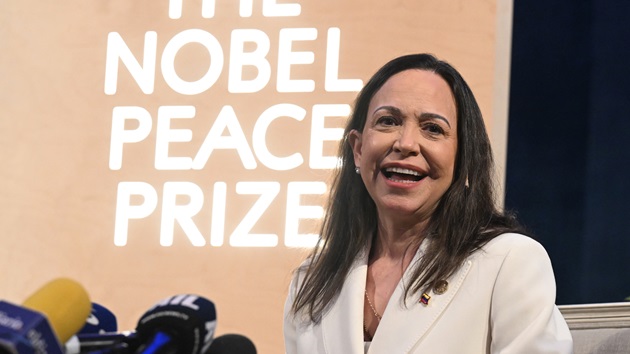
Maria Corina Machado, the Venezuelan opposition figure and 2025 Nobel Peace Prize recipient, attends a press conference on December 11, 2025 in Oslo, Norway. Rune Hellestad/Getty Images

(WASHINGTON) — President Donald Trump is set to hold a lunch meeting with Venezuelan opposition leader Maria Corina Machado at 12:30 p.m. ET Thursday, the White House said. The meeting, which is currently scheduled to be closed to press, will take place in the White House private dining room.

“She’s a very nice woman,” Trump said of Machado on Wednesday, according to Reuters. “I’ve seen her on television. I think we’re just going to talk basics.”

Trump also said Wednesday he had a “great conversation” with Venezuela’s acting President Delcy Rodríguez, their first since authoritarian Venezuelan leader Nicolas Maduro was seized by the U.S. on Jan. 3.

“We had a call, a long call. We discussed a lot of things,” Trump said during a bill signing in the Oval Office. “And I think we’re getting along very well with Venezuela.”

The president said last week on his social media platform that he had “cancelled the previously expected second Wave of Attacks” on Venezuela after the government released several political prisoners, but he added that “all ships will stay in place for safety and security purposes.” 

Machado won the Nobel Peace Prize last year for her work “promoting democratic rights for the people of Venezuela” and her push to move the country from dictatorship to democracy.

“Machado is receiving the Nobel Peace Prize first and foremost for her efforts to advance democracy in Venezuela,” the Nobel Committee said at the time. “But democracy is also in retreat internationally. Democracy — understood as the right to freely express one’s opinion, to cast one’s vote and to be represented in elective government — is the foundation of peace both within countries and between countries.”

Machado said last week that she would like to give or share the prize with Trump, who oversaw the successful U.S. operation to capture Maduro. Maduro is now facing drug trafficking charges in New York, to which he has pleaded not guilty.

“I certainly would love to be able to personally tell him that we believe — the Venezuelan people, because this is a prize of the Venezuelan people — certainly want to, to give it to him and share it with him,” Machado told Fox News host Sean Hannity on Monday. “What he has done is historic. It’s a huge step towards a democratic transition.”

When asked earlier in January whether Machado could become the next leader of Venezuela, Trump said it would be “very tough for her” because she “doesn’t have the support or the respect within the country.”

The Norwegian Nobel Institute issued a statement last week saying that once the Nobel Peace Prize is announced, it “can neither be revoked, shared, nor transferred to others. Once the announcement has been made, the decision stands for all time.”

Machado dedicated the prize to Trump, along with the people of Venezuela, shortly after it was announced in October 2025.

“I dedicate this prize to the suffering people of Venezuela and to President Trump for his decisive support of our cause,” she said then.

Trump has coveted and openly campaigned for winning the Nobel Prize himself since his return to office. White House Director of Communications Steven Cheung slammed the Nobel Committee for its decision after Machado was announced as the most recent winner.

“[Trump] has the heart of a humanitarian, and there will never be anyone like him who can move mountains with the sheer force of his will,” Cheung said in an X post. “The Nobel Committee proved they place politics over peace.”

Jorgen Watne Frydens, the Nobel Committee chair, was asked about Trump’s “campaign” for the prize last year but denied it had any impact on the decision-making process.

“We receive thousands and thousands of letters every year of people wanting to say what, for them, leads to peace,” Frydens said. “This committee sits in a room filled with the portraits of all laureates and that room is filled with both courage and integrity. We base only our decision on the work and the will of Alfred Nobel.”

Copyright © 2026, ABC Audio. All rights reserved.

Ellen Greenberg’s family celebrates prospect of federal investigation into her death

Ellen Greenberg’s family celebrates prospect of federal investigation into her death
Ellen Greenberg,(L) in a photo provided by family. Lamb McErlane PC

(PHILADELPHIA) — The family of Ellen Greenberg is celebrating the prospect of a federal investigation into the way various agencies in Philadelphia handled her death. 

The Philadelphia Inquirer reported Thursday that the U.S. Attorney’s office for the Eastern District of Pennsylvania issued subpoenas as part of an inquiry into whether Greenberg’s death was properly investigated. 

The family of the 27-year-old teacher has long claimed the case was “embarrassingly botched” and warranted additional investigation. 

“The prospects of the federal United States attorneys investigating any aspect of Ellen’s murder is a dream come true for [her parents] Sandee and Josh,” family attorney Joseph Podraza said in a statement to ABC News. “We have only wanted justice for Ellen and now have renewed hope this will occur. Sandee and Josh and their lawyers will continue to pursue and support all avenues to secure justice in this matter.”

The US Attorney’s office for the Eastern District of Pennsylvania declined to comment. ABC News has reached out to various offices involved in Greenberg’s case, including the Philadelphia District Attorney’s office and the Pennsylvania Attorney General’s office, which have not immediately returned request for comment.

Greenberg was found by her fiancé in January 2011 in the kitchen of their home with a 10-inch knife in her chest and over a dozen stab wounds. The fiancé told police at the time the door was locked from the inside and investigators said there were no signs of forced entry or defensive wounds.

The Philadelphia medical examiner’s office initially ruled Greenberg’s death a homicide, then switched to suicide.

In October, the medical examiner affirmed she died by suicide after the medical examiner’s office agreed to reassess the case following lawsuits from her family that contested the initial finding. Dr. Marlon Osbourne, the pathologist who performed the original autopsy, stated in a sworn statement in 2024 that “Ellen’s manner of death should be designated as something other than suicide.”

The Philadelphia Medical Examiner’s Office agreed to review the case again as part of a settlement with her family to determine whether her manner of death should be changed to “could not be determined” or “homicide.”

Chief Medical Examiner Dr. Lindsay Simon stated in the 32-page review that it was her opinion that Greenberg’s death is “best classified as ‘Suicide.'”

Simon determined Greenberg had 23 stab and incised wounds in her neck, head and front torso — up from the initial autopsy report’s finding of 20 wounds — many of which “would best be categorized as hesitation wounds.” Additionally, she determined there were another 20 bruises from the initial report, raising the number to 31. No defensive wounds were found on her body, and “the fact remains that Ellen would be capable of inflicting these injuries herself,” Simon stated.

The evidence did not indicate any foul play or that there was anyone else in the apartment at the time of her death, but that Greenberg was “suffering from anxiety at the time of her death” and that the “anxiety appeared mostly to be due to her work as a teacher,” according to the review.

If you or someone you know is struggling with thoughts of suicide — free, confidential help is available 24 hours a day, 7 days a week. Call or text the national lifeline at 988.

Copyright © 2026, ABC Audio. All rights reserved.

US seizes 6th tanker in the Caribbean

US seizes 6th tanker in the Caribbean
Motor Tanker Veronica is seized in the Caribbean by U.S. Coast Guard tactical team, Jan. 15, 2026. U.S. Southern Command

(WASHINGTON) — The United States seized another tanker in the Caribbean Thursday morning, Department of Homeland Security Secretary Kristi Noem announced — saying in a social media post that the vessel was “operating in defiance of President Trump’s established quarantine of sanctioned vessels in the Caribbean.”

Department of Homeland Security Secretary Kristi Noem announced the seizure in an X post along with video of the operation, which she said happened without incident.

“Early this morning, a Coast Guard tactical team conducted a pre-dawn boarding and seizure of Motor Tanker Veronica in the Caribbean,” she said.

“As another sanctioned ghost fleet tanker, Motor Tanker Veronica had previously passed through Venezuelan waters, and was operating in defiance of President Trump’s established quarantine of sanctioned vessels in the Caribbean,” she added.

The U.S. Southern Command said the Marines and sailors from Joint Task Force Southern Spear launched from USS Gerald R. Ford and “apprehended Motor/Tanker Veronica without incident.”

This is the sixth tanker linked to Venezuela boarded by U.S. troops in the last several weeks, following growing escalations between the U.S. and Venezuela.

The tanker’s seizure comes less than two weeks after U.S. military forces captured President Nicolás Maduro and his wifewho are facing federal charges including narcoterrorism conspiracy and conspiracy to import cocaine. Both Maduro and his wife have entered not guilty pleas.

This is a developing story. Please check back for updates.

Copyright © 2026, ABC Audio. All rights reserved.
Tensions escalate as Trump threatens Insurrection Act, Blanche accuses Minnesota governor of ‘terrorism’

Tensions escalate as Trump threatens Insurrection Act, Blanche accuses Minnesota governor of ‘terrorism’
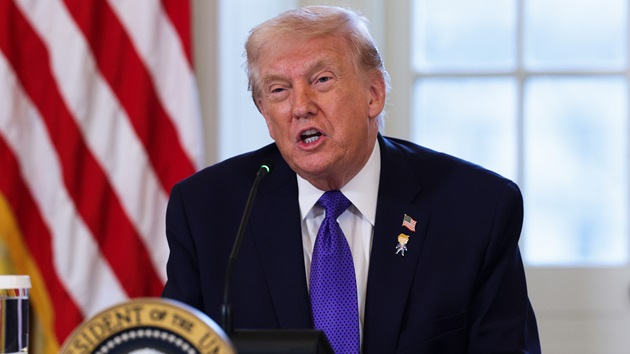
.S. President Donald Trump speaks during a meeting with oil and gas executives in the East Room of the White House on January 9, 2026 in Washington, DC. Alex Wong/Getty Images

(MINNEAPOLIS) — President Donald Trump on Thursday threatened to invoke the Insurrection Act to send in the U.S. military as tensions intensify in Minneapolis following a second shooting in a week involving a federal officer amid Immigration and Customs Enforcement operations in the city.

“If the corrupt politicians of Minnesota don’t obey the law and stop the professional agitators and insurrectionists from attacking the Patriots of I.C.E., who are only trying to do their job, I will institute the INSURRECTION ACT, which many Presidents have done before me, and quickly put an end to the travesty that is taking place in that once great State,” Trump wrote in a social media post.

On Wednesday night, Deputy Attorney General Todd Blanche said Minnesota Gov. Tim Walz and Minneapolis Mayor Jacob Frey, both Democrats, needed to be stopped from “terrorism.”

“Minnesota insurrection is a direct result of a FAILED governor and a TERRIBLE mayor encouraging violence against law enforcement. It’s disgusting,” Blanche posted on X. “Walz and Frey — I’m focused on stopping YOU from your terrorism by whatever means necessary. This is not a threat. It’s a promise.”

ABC News has reached out to Walz and Frey’s offices for comment on Blanche’s statement.

The deputy attorney general’s blunt post came after Walz earlier on Wednesday evening had issued a sharp rebuke of the federal government’s law enforcement presence after a federal officer shot a person who they said had fled a traffic stop and then, along with two other people, began attacking the officer.

The shooting came one week after Renee Good, a 37-year-old mother, was fatally shot by an ICE agent. The Department of Homeland Security has said that Good was allegedly attempting to run over law enforcement officers, a claim disputed by local officials.

“It’s a campaign of organized brutality against the people of Minnesota by our own federal government,” Walz said in an address on Wednesday. He urged residents to “protest loudly, urgently, but also peacefully.” 

Frey, who has called on ICE to “get the f— out” of Minneapolis, said on Wednesday “the situation we are seeing in our city is not sustainable.”

Trump previously threatened to invoke the 1807 Insurrection Act last summer when protests were unfolding in Los Angeles over the administration’s immigration crackdown and deployment of the National Guard.

The law, which authorizes the use of the military on U.S. soil for certain purposes, hasn’t been enacted for decades. It was last implemented was in 1992 by President George H.W. Bush during the Los Angeles riots following the murder of Rodney King at the request of the governor. It hasn’t been used without coordination with a governor since the 1960s.

Overall, the Insurrection Act has been used in response to 30 crises over its history, according to the Brennan Center for Justice, including by Presidents Dwight D. Eisenhower and John F. Kennedy to desegregate schools after the Supreme Court’s landmark ruling in Brown v. Board of Education.

The Insurrection Act states, in part: “Whenever there is an insurrection in any State against its government, the President may, upon the request of its legislature or of its governor if the legislature cannot be convened, call into Federal service such of the militia of the other States, in the number requested by that State, and use such of the armed forces, as he considers necessary to suppress the insurrection.”

Copyright © 2026, ABC Audio. All rights reserved.
Gaza peace plan moving into next phase, Middle East special enjoy Steve Witkoff says

Gaza peace plan moving into next phase, Middle East special enjoy Steve Witkoff says
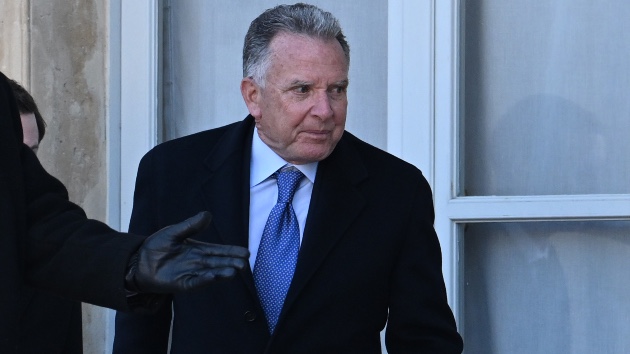
Steve Witkoff, US special envoy, arrives for a meeting at the Elysee Palace in Paris, France, on Tuesday, Jan. 6, 2026. US negotiators will join European leaders in Paris on Tuesday in the latest effort to hash out post-war security guarantees for Ukraine, President Volodymyr Zelenskiy said. Photographer: Benjamin Girette/Bloomberg via Getty Images

(WASHINGTON) — The Trump administration said Wednesday the Gaza peace plan is moving into the next phase, which it said “begins the full demilitarization and reconstruction of Gaza.”

“Today, on behalf of President Trump, we are announcing the launch of Phase Two of the President’s 20-Point Plan to End the Gaza Conflict, moving from ceasefire to demilitarization, technocratic governance, and reconstruction,” U.S. special envoy to the Middle East Steve Witkoff said in a statement on X.

The announcement comes as officials and observers question the stability of the Israel-Hamas ceasefire, which has largely held despite isolated violations.

According to Witkoff, phase two “establishes a transitional technocratic Palestinian administration in Gaza, the National Committee for the Administration of Gaza (NCAG), and begins the full demilitarization and reconstruction of Gaza, primarily the disarmament of all unauthorized personnel.”

Witkoff said the U.S. expects Hamas to “comply fully,” including by immediately returning the final deceased hostage, identified by Israeli officials as Ran Gvili.

“Failure to do so will bring serious consequences,” Witkoff said.

The Israeli Prime Minister’s Office said Wednesday that the return of Gvili “is a top priority.”

“Hamas is required to meet the terms of the agreement to exert 100% effort for the return of the fallen hostages, down to the very last one, Ran Gvili, a hero of Israel,” the office said in a statement on X.

Hamas spokesperson Hazem Qassem called the announcement on the second phase an “important positive development” and said they are “fully prepared to hand over the administration of the Gaza Strip” to the NCAG.

Qassem said they demand that the U.S. “compel” Israel to “fulfill the requirements of the first phase of the ceasefire agreement and move towards the second phase.”

The NCAG is a body of an expected 15 Palestinian leaders tasked with the monumental challenge of governing Gaza. The committee would be responsible for Gaza’s day-to-day management, including sanitation, infrastructure and education. 

The NCAG will ultimately be run by a “Board of Peace,” which is expected to be made up of 12 as-yet-unannounced leaders. Trump and other European leaders are expected to lead the Board of Peace and oversee this newly formed committee. The announcement is expected in the coming days.

Speaking aboard Air Force One Sunday, Trump said the Board of Peace council would be made up of “the most important leaders of the most important countries,” though he did not name them.

U.S. officials confirmed Nickolay Mladenov, the former United Nations special coordinator for Middle East peace and a former Bulgarian foreign minister, will be appointed as the new senior representative for the Board of Peace and will oversee implementation of the plan. Mladenov is expected to serve as a liaison between the NCAG and the peace council.

American officials have said they hope that establishing the committee will help loosen Hamas’ grip on Gaza.

Witkoff on Wednesday thanked Egypt, Turkey and Qatar “for their indispensable mediation efforts that made all progress to date possible.”

In a joint statement, the three Middle Eastern countries said they “welcome the formation” of the NCAG, saying it is an “important development that will contribute to strengthening efforts aimed at consolidating stability and improving the humanitarian situation in the Gaza Strip.”

The initial phase of the peace plan, which launched in October 2025, saw the release of the remaining living hostages and the return of the remains of 27 deceased hostages in Gaza, as well as the release of more than 1,900 Palestinian prisoners that had been held by Israel. The first phase also entailed that the Israel Defense Forces pull back to the so-called “yellow line” in Gaza, intended as the first of three demarcation lines, and saw restrictions on humanitarian aid going into Gaza lifted.

Copyright © 2026, ABC Audio. All rights reserved.
2nd federal officer shooting in Minneapolis prompts protests, calls for calm

2nd federal officer shooting in Minneapolis prompts protests, calls for calm
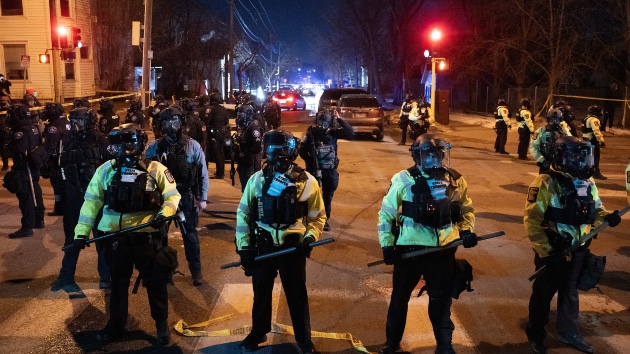
Minnesota State Troopers hold back a crowd after Federal law enforcement officers confronted residents following a shooting incident in Minneapolis, Minnesota, US, early on Thursday, Jan. 15, 2026. (Photographer: Victor J. Blue/Bloomberg via Getty Images

(MINNEAPOLIS) — The Department of Homeland Security said a federal law enforcement officer shot a person in Minneapolis on Wednesday evening, saying the latter fled a traffic stop and then — along with two other people — began attacking the officer.

“Fearing for his life and safety as he was being ambushed by three individuals, the officer fired defensive shots to defend his life,” DHS said in a statement on social media. “The initial subject was hit in the leg.”

Both the officer and the person who was shot were taken to the hospital, DHS said.

Minneapolis Police Chief Brian O’Hara said the person shot was an “adult male,” and that his injuries were not believed to be life-threatening.

DHS said federal law enforcement officers were conducting a “targeted traffic stop” Wednesday evening at 6:50 p.m. local time. The DHS statement identified the person being stopped as “an illegal alien from Venezuela.”

DHS said the person drove away in his car, crashed into a parked vehicle and then fled on foot.

When a pursuing officer caught up to the person, “the subject began to resist and violently assault the officer,” DHS said in the statement. 

“While the subject and law enforcement were in a struggle on the ground, two subjects came out of a nearby apartment and also attacked the law enforcement officer with a snow shovel and broom handle,” the statement said.

The statement added, “As the officer was being ambushed and attacked by the two individuals, the original subject got loose and began striking the officer with a shovel or broom stick.”

After the officer fired, the three people ran back into the apartment and barricaded themselves inside, DHS claimed in the statement.

It’s unclear from the statement when and how an arrest was made, but DHS said both of the two people, who were not shot, it alleges attacked the officer were taken into custody.

A crowd later gathered at the scene of the second shooting. O’Hara said the crowd amounted to an “unlawful assembly” and accused some people of throwing fireworks and rocks at officers.

“People need to leave. This is already a very tense situation and we do not need this to escalate any further,” O’Hara told reporters at a news conference Wednesday night.

Minneapolis Mayor Jacob Frey said the situation was “not sustainable” and urged residents to protest peacefully.

“There’s still a lot that we don’t know at this time,” Frey said. “But what I can tell you for certain is that this is not sustainable. This is an impossible situation that our city is being put in.”

ICE and Border Patrol officers are “creating chaos,” in the city, Frey said, adding, “I’ve seen conduct from ICE that is disgusting and is intolerable. If it were your city, it would be unacceptable there too.”

ICE officials have disputed those claims, saying federal officers are seeking only those who’ve broken the law. “If Frey truly cared about safety in his community, he would work with ICE to get the worst of the WORST out of Minnesota,” the agency said on Wednesday.

Customs and Border Patrol said on Monday that additional officers were “are on their way to restore order and we welcome cooperation from state and local law enforcement” in Minneapolis. The agency, which sits under the DHS, described Frey’s leadership as “weak,” accusing his administration of encouraging “lawlessness.”

“We are not going to let our officers be attacked in an aggressive manner and sit idly by,” Gregory K. Bovino, a senior Border Patrol official, said on Wednesday. “In addition to the most important mission of enforcing Title 8 Immigration laws, we will also arrest those who attack and assault our agents. You will go to jail.”

Frey said protesters should avoid confrontations with federal officers. “And for anyone that is taking the bait tonight — stop,” he said. “That is not helpful. Go home. We cannot counter Donald Trump’s chaos with our own brand of chaos.”

Frey said there were 600 Minneapolis Police Department officers working to “keep our streets safe” as the protests continued. About 3,000 federal officers had been dispatched to Minnesota, he said.

In a rare primetime address, Minnesota Gov. Tim Walz Wednesday called on President Trump and DHS Secretary Kristi Noem to “end this occupation” in Minnesota, 

“Donald Trump wants this chaos. He wants confusion, and yes, he wants more violence on our streets. We cannot give him what he wants,” Walz said. “We can, we must protest loudly, urgently, but also peacefully. Indeed, as hard as we will fight in the courts and at the ballot box, we cannot and will not let violence prevail.”

Noem had said on Tuesday that the ICE officers were on the scene for an operation that was “rapidly removing the criminal illegal aliens who have found sanctuary in Tim Walz’s Minnesota.”

“The men and women of DHS law enforcement are working day and night to arrest and deport sickos, dirtbags, and fraudsters from across the state,” she added.

Deputy Attorney General Todd Blanche, meanwhile, accused both Frey and Walz of inciting unrest.

“Minnesota insurrection is a direct result of a FAILED governor and a TERRIBLE mayor encouraging violence against law enforcement,” Blanche said on Wednesday on social media. “It’s disgusting.”

He added, “Walz and Frey — I’m focused on stopping YOU from your terrorism by whatever means necessary. This is not a threat. It’s a promise.”

Copyright © 2026, ABC Audio. All rights reserved.

17 college basketball players charged in point shaving scheme: Indictment

17 college basketball players charged in point shaving scheme: Indictment
Basketball on court (Matt_Brown/Getty Images)

(NEW YORK) — Former college All-American Antonio Blakeney is among 17 basketball players charged in a point-shaving scheme to fix games in the NCAA and Chinese Basketball Association and rig bets, according to an indictment unsealed Thursday in Philadelphia. 

Federal officials are announcing the charges on Thursday.

This is a developing story. Please check back for updates.

Copyright © 2026, ABC Audio. All rights reserved.

Damage to the ocean nearly doubles economic cost of climate change, new study finds

Damage to the ocean nearly doubles economic cost of climate change, new study finds
danilovi/Getty Images

(NEW YORK) — Scientists have factored damage to the ocean into the social cost of carbon for the first time — finding it nearly doubles the economic impact from climate change.

Ocean damage from climate change — dubbed the “blue” social cost of carbon — causes the global cost of carbon dioxide emissions to society to nearly double, according to new findings by researchers at the Scripps Institution of Oceanography at the University of California San Diego.

The researchers calculated an additional $46.2 per ton of carbon dioxide — amounting to a total of $97.2 per ton of carbon dioxide, a 91% increase, according to the study, published Thursday in Nature Climate Change. Global carbon dioxide emissions were estimated to be 41.6 billion tons in 2024, according to the Global Carbon Budget, implying nearly $2 trillion in ocean-related damages in one year that are currently missing from standard climate cost estimates.

The ocean has never been accounted into the economic harm caused by greenhouse gas emissions before, the researchers said. The ocean was largely overlooked in the standard accounting of the social cost of carbon, despite widespread degradation to coral reef ecosystems, losses from fisheries and damage to coastal infrastructure — all of which are “well documented” and have impacted millions of people globally.

In addition, the distribution of impacts is “highly unequal” across the globe, according to the paper. Islands and small economies will be disproportionately affected, given the regions’ dependence on seafood and nutrition, according to the study.

Scripps researchers felt the need to put a price tag on the harm that climate change causes to the ocean in order to properly inform key decision-makers with a cost-benefit analysis, said environmental economist and assistant professor at the National Autonomous University of Mexico Bernardo Bastien-Olvera, who led the study during a postdoctoral fellowship at Scripps Oceanography.

“The ocean was the big missing piece in these models that calculate the climate impacts on humans,” Bastien-Olvera told ABC News.

Human-amplified climate change damages oceans by warming temperatures and altering its chemistry, according to the Scripps researchers. The changes then alter the distribution of species and damages ecosystems such as reefs, mangroves, seagrass beds and kelp forests.

Coastal infrastructure, such as shipping ports, can also be damaged by increased flooding and stronger storms.

The social cost of carbon is an economic metric used in climate policy to estimate the damages that a ton of carbon dioxide causes to humans today, Bastien-Olvera said.

The researchers estimated the social cost of carbon by using integrated assessment models to run different future scenarios of how people and the economy might behave during the next century, also incorporating the potential climate impacts on systems such as coral reefs, mangroves, fisheries and seaports, Bastien-Olvera said.

The accounting was further developed by looking at straightforward market-use values, such as decreased fisheries revenue or diminished trade, as well as non-market values such as health impacts of reduced nutrition availability from impacted fisheries and recreational opportunities at the ocean, according to Scripps.

The research accounted for reduced availability of key nutrients in seafood, including calcium, omega-3 fatty acids, protein and iron — the loss of which can be linked to increases in disease risk and additional deaths.

The economic cost is caused by losses in the fishing industry, damage to coastal communities and impacts to systems that help fortify those communities, like mangroves and reefs.

The social cost of carbon is considered a more accurate accounting of harm from climate change than other calculations used as the basis of carbon credits or carbon offsets to travelers, according to Scripps.

Copyright © 2026, ABC Audio. All rights reserved.
Iran protests: Iranian airspace reopens amid fears of US strikes

Iran protests: Iranian airspace reopens amid fears of US strikes
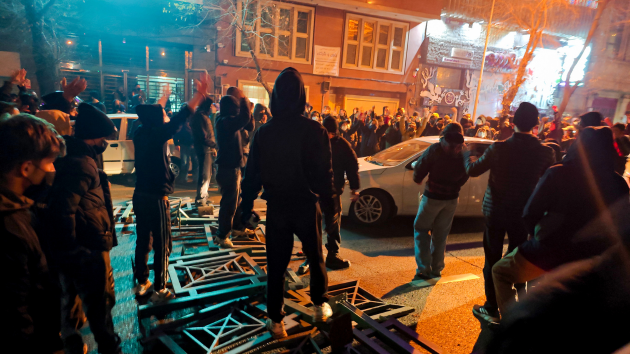
People gather during protest on January 8, 2026 in Tehran, Iran. Demonstrations have been ongoing since December, triggered by soaring inflation and the collapse of the rial, and have expanded into broader demands for political change. (Anonymous/Getty Images)

(LONDON) — Iran’s Civil Aviation Organization confirmed on Thursday morning that flights were back in operation over the country, according to a statement carried by Iranian state-aligned media.

Iran issued a notice, known as a NOTAM, on Wednesday closing its airspace to all flights except international civil arrivals and departures with prior permission from Iran’s aviation authorities. The NOTAM was initially extended through 10:30 p.m. ET but then expired.

The NOTAM was issued after U.S. President Donald Trump hinted at possible action against Iran and in support of anti-government protests which have roiled the country in recent weeks.

As of Wednesday, 18 days of protests and a resulting crackdown by security forces had seen 2,615 deaths and 18,470 people arrested, according to the U.S.-based Human Rights Activists News Agency (HRANA). Among the dead were 13 children and 14 non-protesting civilians, HRANA said.

On the government side, HRANA said it had confirmed the deaths of 153 members of the security forces.

Another 882 additional deaths remain under investigation, HRANA said.

The HRANA data relies on the work of activists inside and outside the country. ABC News cannot independently verify its numbers.

Protests have been spreading across the country since late December. The first marches took place in downtown Tehran, with participants demonstrating against rising inflation and the falling value of the national currency, the rial. As the protests spread, they took on a more explicitly anti-government tone.

The subsequent security crackdown has included a sustained national internet blackout, which — according to online monitoring group NetBlocks — had been in place for 156 hours as of Thursday morning.

On Wednesday, Cloudflare’s threat-intelligence unit said in a statement that it had “observed Iranian authorities targeting Instagram accounts with tools that perform bulk extraction of follower lists and account activity.”

Estimates of the death toll from the protests have varied, with the internet and communications blackout making it difficult to establish clear figures.

Stephane Dujarric, the spokesperson for United Nations Secretary-General Antonio Guterres, told reporters at a briefing on Wednesday, “We’ve seen numbers vary from 2,000 to 12,000. All of those numbers are horrendous, but I don’t have a number to share with you.”

Trump has repeatedly threatened military action against the government in Tehran — which is headed by its Supreme Leader Ayatollah Ali Khamenei — in response to violence against protesters.

Trump said Wednesday that he had been informed that the “killing” in Iran had stopped and that anticipated executions of arrested protesters would not take place.

The information was coming from “very important sources on the other side,” Trump said during an event in the Oval Office on Wednesday. “We’ve been told on good authority, and I hope it’s true. Who knows, right?” he added.

Asked by a reporter if this means that military action was now off the table, Trump responded, “We’re going to watch and see what the process is. But we were given a very good statement by people that are aware of what’s going on.”

On Tuesday, Trump had addressed protesters on social media, urging “Iranian Patriots” to “TAKE OVER YOUR INSTITUTIONS!!!” He added, “HELP IS ON ITS WAY.”

Khamenei and top Iranian officials have said they are willing to engage with the economic grievances of protesters, though have framed the unrest as driven by “rioters” and “terrorists” sponsored by foreign nations — prime among them the U.S. and Israel — and supported by foreign infiltrators.

Iranian officials have also threatened retaliatory strikes against U.S. and Israeli targets in the event of any outside intervention.

On Wednesday, a U.S. official confirmed to ABC News that some personnel had been advised to leave al-Udeid Air Base in Qatar due to increased tensions in the region.

Meanwhile, Tehran has signaled an intent to proceed with expedited trials and executions for those arrested during the protests.

The head of Iran’s judiciary, Gholamhossein Mohseni-Ejei, said Wednesday, “If we want to do a job, we should do it now. If we want to do something, we have to do it quickly,” in a video shared online by Iranian state television, according to The Associated Press

“If it becomes late, two months, three months later, it doesn’t have the same effect,” Mohseni-Ejei said.

Speaking to Fox News on Wednesday, Iranian Foreign Minister Abbas Araghchi acknowledged that “hundreds” of people had been killed and again characterized the protests as an “Israeli plot” and a “terrorist operation.”

Araghchi said that the protests had died down and that the government is “in full control.”

Copyright © 2026, ABC Audio. All rights reserved.

Shrinking forests are giving mosquitoes a greater taste for human blood, study suggests

Shrinking forests are giving mosquitoes a greater taste for human blood, study suggests
Joao Paulo Burini/Getty Images

(NEW YORK) — As forests shrink and wildlife disappears, mosquitoes are increasingly turning to people for their blood meals, a shift that raises real concerns about the potential spread of diseases that affect humans.

A new study published in the journal Frontiers suggests these buzzing, biting insects are playing a growing role in the increased transmission of Zika, yellow fever, dengue and other diseases that mosquitoes pass on to people, thanks in part to disappearing habitats.

Deforestation, which is the widespread clearing of forests, and other human activity has vastly reduced local populations of plants and animals while increasing human populations in the same areas, according to the study.

“Mosquitoes that are normally feeding on other hosts within the habitat can shift to humans if the habitat is no longer suitable for those hosts and they leave,” Laura Harrington, a Ph.D.-level professor of entomology at Cornell University, told ABC News.

Human blood was widely found in nine types of mosquitoes in two formerly uninhabited areas in the state of Rio de Janeiro, Brazil, preliminary study results found. This area was once a part of the Atlantic Forest that covered 502,000 square miles. Today, it has shrunk to 29% of its original size as a result of deforestation and development, according to the final study.

The researchers point to past studies showing that areas with heavier deforestation have a higher mosquito abundance and higher rates of mosquito-borne disease because disturbed habitats favor species that thrive near people. At the same time, reduced biodiversity removes animals that can dilute disease transmission, making humans more likely to become the primary blood source.

Sérgio Lisboa Machado, a co-author of the paper and a professor at Federal University of Rio de Janeiro in Brazil, said mosquitoes are opportunists who don’t venture far to find food.

“So they start searching for humans because mosquitoes rarely fly very long distances,” he told ABC News. “They are not going to pay a lot of energy to find [other food sources].”

More than 17% of all infectious diseases are caused by vector-borne diseases, meaning a disease that’s transmitted to humans by a living organism, such as mosquitoes, ticks, and flies, the World Health Organization (WHO) reports. These biting insects cause more than 700,000 deaths globally.

Mosquitoes alone transmit dozens of serious diseases to humans, according to the WHO, which consequently considers them the deadliest animals on Earth.

Female mosquitoes are the culprit. They must drink blood to get the protein and iron they need to develop their eggs, according to the Centers for Disease Control and Prevention.

There is a “reproductive drive for them to feed on blood, and if there’s no other host there, most mosquitoes would feed on a human,” Harrington told ABC News.

Male mosquitoes buzz, but they don’t bite, instead dining on nectar and plant sugars.

There are 3,500 mosquito species globally, Harrington said, noting that there are only a handful that truly prefer the taste of human blood over other animals. When given a choice, only a small fraction of mosquito species regularly seek out humans.

“It’s something that we’ve known for a long time,” Harrington said. “This notion that manipulating the landscape can alter mosquito feeding patterns and sometimes shift feeding patterns towards humans.”

Copyright © 2026, ABC Audio. All rights reserved.