
Democratic senator’s bill would prevent political appointees from serving as an IG

Democratic senator’s bill would prevent political appointees from serving as an IG
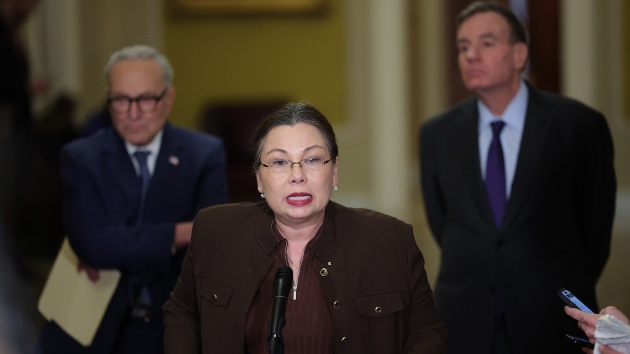
Sen. Tammy Duckworth speaks during a news conference following a weekly Democratic policy luncheon at the Capitol, Jan. 6, 2026. (Kevin Dietsch/Getty Images)

(WASHINGTON) — Sen. Tammy Duckworth is introducing legislation Friday that would put restraints on the current and former political appointees to be nominated as inspectors general. 

The Inspector General’s Independence Act would bar President Donald Trump and future presidents from nominating political appointees who have served or are serving in their administration from serving as an inspector general. 

“Whether this is acquisitions or our VA or DoD or Commerce or HHS, inspectors general are supposed to be calling balls and strikes and be independent and say, ‘Hey, you can’t do that,'” Duckworth told ABC News. “But if you put a political appointee in that position they are going to lean in favor of who put them there.”

The move comes nearly one year after the administration moved to unilaterally dismiss 17 inspectors general across a number of agencies at the beginning of Trump’s second term. 

Lawmakers on both sides of the aisle pushed back on the administration’s move at the time, raising concerns that the firing of inspectors generals would introduce partisanship into a role that is meant to serve as an independent watchdog. Lawsuits challenging the viability of those firings are going through the courts.

“There have been lawsuits that are in courts right now that say that those firings were illegal,” Duckworth said. “So this piece of legislation in particular will make it very clear that what he did was illegal, and not just leave it to courts to interpret existing law.” 

Duckworth points to the nomination and subsequent Senate confirmation of Cheryl Mason as Veterans Affairs inspector general as one example of why the legislation is critical.

Mason was appointed to fill a vacancy left after the administration fired the previous inspector general. She was serving as a senior adviser to Trump’s Veterans Affairs Secretary Doug Collins at the time she was nominated by the president to serve as the department’s IG.

During her confirmation hearing before the Senate Veterans Affairs Committee in June, a number of Democratic lawmakers, including Duckworth, raised concerns about Mason’s ability to serve as an independent watchdog for the agency she had served in as a political adviser.

Republican Sen. Jerry Moran, the committee chairman, also raised questions about how Mason would ensure her independence, but ultimately voted with all Republicans to confirm her.

Mason at the time vowed to serve as an independent actor, citing her years of experience at VA working at the Board of Veterans’ Appeals before returning as an adviser. Her role as an adviser, she said at the time, was to gather information and convey it in a nonpartisan manner.

“I consider myself to be an impartial, independent aid to the department because that’s my role,” Mason told senators on the panel when questioned about her loyalty to the VA secretary. “I am loyal to the veterans. That’s who I am loyal to.” 

“I work for the president and the secretary,” Mason said in the hearing when pressed by Democrats about her independence. “But also if confirmed will work for this committee.”

Mason was confirmed by the Senate in July by a vote of 53-45. No Democrats voted to confirm her. 

Duckworth’s legislation would have barred Mason from being nominated. Her bill, if passed, would prevent similar politically aligned nominees from serving as IGs.

The legislation is being co-sponsored by Democratic Sens. Dick Durbin, Richard Blumenthal, Adam Schiff, Kirsten Gillibrand and Peter Welch. It does not currently have any Republican co-sponsors.

It’s unclear whether it would have the necessary support to advance through either chamber of Congress, and unlikely that President Trump would sign it into law.

Copyright © 2026, ABC Audio. All rights reserved.
Trump accepts Nobel Peace Prize medal from Venezuelan opposition leader Machado

Trump accepts Nobel Peace Prize medal from Venezuelan opposition leader Machado
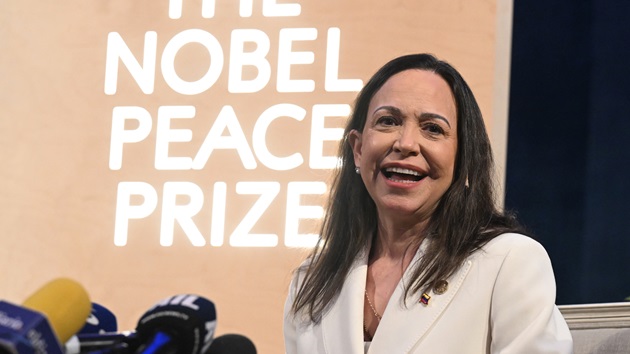
Maria Corina Machado, the Venezuelan opposition figure and 2025 Nobel Peace Prize recipient, attends a press conference on December 11, 2025 in Oslo, Norway. (Rune Hellestad/Getty Images)

(WASHINGTON) — President Donald Trump met Thursday with Venezuelan opposition leader Maria Corina Machado, who presented him with her Nobel Peace Prize medal. The president called it a “wonderful gesture of mutual respect.”

“María presented me with her Nobel Peace Prize for the work I have done,” Trump wrote on his social media platform. He also said that Machado was a “wonderful woman who has been through so much” and that it was a great honor to meet her.

Following the meeting, a White House official confirmed to ABC News that Trump did accept the medal.

Further details about the closed-door meeting were not immediately revealed by the White House. Asked about the meeting by ABC News’ Mary Bruce, Trump said it went “great.”

Machado told reporters as she was exiting the White House that she presented Trump with her prize and reflected on the history between the two countries.

“I told him this … Listen to this — 200 years ago, General Lafayette gave Simon Bolivar a medal with George Washington’s face on it. Bolivar, since then, kept that medal for the rest of his life,” she told reporters.

“Actually, when you see his portraits, you can see the medal there. And it was given by General Lafayette as a sign of the brotherhood between the United States, people of United States, and the people of Venezuela in their fight for freedom against tyranny. And 200 years in history, the people of Bolivar are giving back to the heir of Washington, a medal, in this case a medal of a Nobel Peace Prize, and a recognition for his unique commitment with our freedom,” she added.

Simon Bolivar liberated Venezuela and several other Latin American countries from Spanish rule in the 1800s. The Marquis de Lafayette was a French national who volunteered to fight with American colonists during the Revolutionary War and eventually rose to be one of George Washington’s most trusted generals.

Machado didn’t offer any more details about her meeting with Trump.

She won the Nobel Peace Prize last year for her work “promoting democratic rights for the people of Venezuela” and her push to move the country from dictatorship to democracy.

Machado dedicated the prize to Trump, along with the people of Venezuela, shortly after it was announced in October 2025.

She said last week that she would like to give or share the prize with Trump, who oversaw the successful U.S. operation to capture Venezuelan leader Nicolás Maduro. Maduro faces drug trafficking charges in New York, to which he has pleaded not guilty.

“I certainly would love to be able to personally tell him that we believe — the Venezuelan people, because this is a prize of the Venezuelan people — certainly want to, to give it to him and share it with him,” Machado told Fox News host Sean Hannity on Monday. “What he has done is historic. It’s a huge step towards a democratic transition.”

The Norwegian Nobel Institute issued a statement last week saying that once the Nobel Peace Prize is announced, it “can neither be revoked, shared, nor transferred to others. Once the announcement has been made, the decision stands for all time.”

When asked earlier this month whether Machado could become the next leader of Venezuela, Trump said it would be “very tough for her” because she “doesn’t have the support or the respect within the country.”

Trump said Wednesday he had a “great conversation” with Venezuela’s acting President Delcy Rodríguez, their first since authoritarian Venezuelan leader Nicolas Maduro was seized by the U.S. on Jan. 3.

“We had a call, a long call. We discussed a lot of things,” Trump said during a bill signing in the Oval Office. “And I think we’re getting along very well with Venezuela.”

The president said last week on his social media platform that he had “cancelled the previously expected second Wave of Attacks” on Venezuela after the government released several political prisoners, but he added that “all ships will stay in place for safety and security purposes.” 

Trump has coveted and openly campaigned for winning the Nobel Prize himself since his return to office. White House Director of Communications Steven Cheung slammed the Nobel Committee for its decision after Machado was announced as the most recent winner.

“[Trump] has the heart of a humanitarian, and there will never be anyone like him who can move mountains with the sheer force of his will,” Cheung said in an X post. “The Nobel Committee proved they place politics over peace.”

Jorgen Watne Frydens, the Nobel Committee chair, was asked about Trump’s “campaign” for the prize last year but denied it had any impact on the decision-making process.

“We receive thousands and thousands of letters every year of people wanting to say what, for them, leads to peace,” Frydens said. “This committee sits in a room filled with the portraits of all laureates and that room is filled with both courage and integrity. We base only our decision on the work and the will of Alfred Nobel.”

Copyright © 2026, ABC Audio. All rights reserved.
3 more Democratic lawmakers say they are under federal investigation over illegal orders social media video

3 more Democratic lawmakers say they are under federal investigation over illegal orders social media video
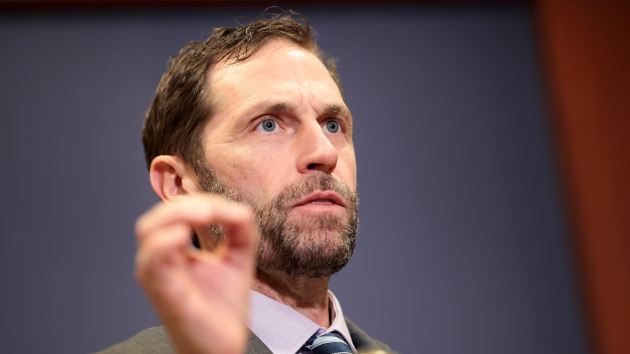
Rep. Jason Crow speaks to the media following a closed door meeting with members of the House of Representatives on Capitol Hill, December 16, 2025 in Washington. (Heather Diehl/Getty Images)

(WASHINGTON) — Three House Democrats said they are under federal investigation for their participation in a November social media video telling military and intelligence service members that they can refuse illegal orders — joining two Senate Democrats who are also facing the wrath of the Trump administration for appearing in the clip.

Democratic Reps. Jason Crow, Maggie Goodlander and Chrissy Houlahan shared on Wednesday that they were being investigated by federal prosecutors after the group of Democrats — who had previously served in the military or in the intelligence community — said in a video posted on social media that U.S. service members have a right to refuse unlawful orders.

Crow said because of the video, President Donald Trump is “using his political cronies in the Department of Justice to continue to threaten and intimidate us.”

“But he’s picked the wrong people,” Crow, a former Army Ranger, continued in a video post on X Wednesday. “We took an oath to the Constitution, a lifetime oath when we joined the military and again as members of Congress. We are not going to back away. Our job, our duty is to make sure that the law is followed. We will not be threatened, we will not be intimidated, we will not be silenced.”

Goodlander, who served as an intelligence officer in the U.S. Navy Reserve, agreed in a social media post Wednesday that “these threats will not deter, distract, intimidate, or silence me.”

“It is sad and telling that simply stating a bedrock principle of American law caused the President of the United States to threaten violence against me, and it is downright dangerous that the Justice Department is targeting me for doing my job,” Goodlander said in the post.

Houlahan, an Air Force veteran, said in a post on X Wednesday that the group of Democrats are “being targeted not because we said something untrue, but because we said something President Trump and Secretary Hegseth didn’t want anyone to hear.”

The trio of statements come after Sen. Elissa Slotkin, a Democrat, said earlier this week that she was under federal investigation for her participation in the video.

Slotkin said the investigation inquiry came from U.S. Attorney for the District of Columbia Jeanine Pirro, a Trump ally.

A spokesperson for the U.S. attorney’s office said Thursday that they could neither confirm nor deny the existence of an investigation into the other lawmakers.

The basis of the investigation is not clear.

The latest fallout from the video comes after Democratic Sen. Mark Kelly, who also appeared in the video, was censured by Secretary of Defense Pete Hegseth. In a censure letter, Hegseth said that the video “Undermines the Chain of Command; Creates Confusion About Duty; Brings Discredit Upon the Armed Forces; and Is Conduct Unbecoming an Officer.”

The censure will result in a reduction in rank and Kelly’s retirement pay, a process Hegseth said would take 45 days.

Kelly responded by filing a lawsuit against Hegseth, arguing that the censure violated his constitutional rights.

Democrats involved in the video have defended its message as being in line with the Uniform Code of Military Justice and the Constitution.

President Donald Trump has repeatedly criticized the Democrats featured in the video, saying in social media posts in November that they are “traitors” whose actions are “SEDITIOUS BEHAVIOR, punishable by DEATH!”

Asked in November if Trump wants to execute members of Congress, White House press secretary Karoline Leavitt said the president did not — adding that the Democrats in the video are “encouraging [service members] to defy the president’s lawful orders.”

In an interview with ABC News after the censure, Kelly said he still would “absolutely not” change his message to U.S. troops about not following illegal orders.

In his video, Crow similarly said he would not back down from his message.

“I am more emboldened than ever to make sure that I am upholding my duty, and I will not back down,” Crow said.

Copyright © 2026, ABC Audio. All rights reserved.

3 deaths, dozens of illnesses linked to California poisonous mushroom outbreak: Officials

3 deaths, dozens of illnesses linked to California poisonous mushroom outbreak: Officials
Minh Hoang Cong/500px via Getty Images

(SONOMA COUNTY, Calif.) — Foragers are being warned of what could be the largest toxic mushroom outbreak in California history, which state health officials say has caused three deaths and sickened more than 30 people who ingested the poisonous fungi.

Recent heavy rains have caused death cap mushrooms to flourish in the wild, including one of the deadliest fungi, the Western destroying angel mushroom, according to the California Department of Public Health (CDPH).

“Early rains and a mild fall have led to profusion of the toxic death cap mushroom in Northern California,” Dr. Michael Stacey, the interim health officer for Sonoma County, said in a statement after the most recent poison mushroom-linked death occurred.

A Sonoma County resident died on Jan. 4 after unwittingly consuming death cap mushrooms, health officials said.

“Eating wild mushrooms gathered without expert identification can be unsafe,” Stacey said. “Some harmful varieties closely resemble edible mushrooms, even to experienced foragers.”

The problem of state residents consuming poisonous mushrooms has persisted despite the CDPH issuing its first warning on Dec. 5 after the California Poison Control System identified 21 people who had sought medical attention since mid-November after consuming death cap mushrooms, also known by the scientific name Amanita phalloides.

Stacey said in his statement that between Nov. 18 and Jan. 4, 35 mushroom poisoning cases, including the three deaths, were reported to state officials. Three of those poisoned individuals, including a child, were sickened to the point they required liver transplants, officials said.

Fewer than five mushroom poisoning cases are reported statewide in an average year, according to California health officials.

The recent poisoning incidents have been reported in the Northern California counties of Alameda, Contra Costa, Monterey, San Francisco, San Luis Obispo, San Mateo, Santa Clara, Santa Cruz, and Sonoma, according to the CDPH.

“This is probably the largest outbreak in California history; 35 total cases, including three fatalities and three liver transplants,” Rais Vohra, a medical director for the California Poison Control System, told ABC San Francisco television station KGO.

Vohra said the effects of mushroom poisoning aren’t evident until six to 24 hours after consumption.

Early symptoms of mushroom poisoning typically include diarrhea, nausea, vomiting and abdominal pain, according to the CDPH.

Laura Marcelino of Salinas told KGO that she and her husband, Carlos, recently became ill after cooking and eating wild mushrooms they gathered during a family hike in November. While she recovered, she said her husband needed a liver transplant, from which he’s now recovering.

State health officials are advising people to avoid foraging for wild mushrooms and to be cautious when buying them from street vendors and at farmers’ markets.

Copyright © 2026, ABC Audio. All rights reserved.
What is the Insurrection Act that Trump is threatening to use against Minnesota protests?

What is the Insurrection Act that Trump is threatening to use against Minnesota protests?
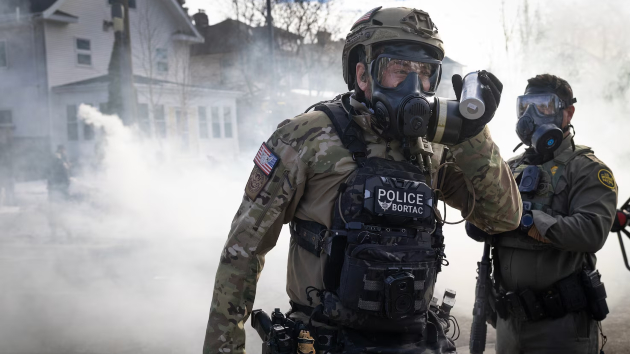
Border Patrol agents deploy tear gas as they clash with residents in a residential neighborhood after a minor traffic accident, January 12, 2026 in Minneapolis, Minnesota. (Scott Olson/Getty Images)

(MINNEAPOLIS) — President Donald Trump threatened to invoke the Insurrection Act to send in federal troops as protests unfold in Minneapolis against Immigration and Customs Enforcement operations.

“If the corrupt politicians of Minnesota don’t obey the law and stop the professional agitators and insurrectionists from attacking the Patriots of I.C.E., who are only trying to do their job, I will institute the INSURRECTION ACT, which many Presidents have done before me, and quickly put an end to the travesty that is taking place in that once great State,” Trump wrote in a social media post.

Democratic officials in Minnesota have decried ICE’s presence after two shootings involving federal law enforcement in the span of a week. Gov. Tim Walz called the ICE operations a “campaign of organized brutality against the people of Minnesota by our own federal government” and encouraged residents to “protest loudly, urgently, but also peacefully.”

Trump previously threatened to invoke the 1807 law, which hasn’t been used in over 30 years, last June amid protests in Los Angeles over the administration’s immigration crackdown and deployment of the National Guard and again in October for Chicago.

What to know about the Insurrection Act
Generally, the use of federal troops on U.S. soil is mostly prohibited. The 1878 Posse Comitatus Act limits the military from being involved in civilian law enforcement unless Congress approves it or under circumstances “expressly authorized by the Constitution.”

One exception is the Insurrection Act, a law signed by President Thomas Jefferson in 1807.

The Insurrection Act states, in part: “Whenever there is an insurrection in any State against its government, the President may, upon the request of its legislature or of its governor if the legislature cannot be convened, call into Federal service such of the militia of the other States, in the number requested by that State, and use such of the armed forces, as he considers necessary to suppress the insurrection.”

Another provision states it can be used “whenever the President considers that unlawful obstructions, combinations, or assemblages, or rebellion against the authority of the United States, make it impracticable to enforce the laws of the United States in any State by the ordinary course of judicial proceedings.”

Some legal experts have warned the law is overly broad and vague, and there have been various calls for it to be reformed to provide greater checks on presidential power.

The Insurrection Act has been invoked in response to 30 crises over its history, according to the Brennan Center for Justice, including by presidents Dwight D. Eisenhower and John F. Kennedy to desegregate schools after the Supreme Court’s landmark ruling in Brown v. Board of Education.

Most of its uses involved federal troops being deployed, though a few situations were resolved after troops were ordered to respond but before they arrived on the scene, the Brennan Center noted.

When it was last used in 1992 by President George H.W. Bush to send the National Guard to Los Angeles, it was at the request of then-GOP Gov. Pete Wilson as riots exploded in the city after the acquittal of white police officers charged in the beating of Rodney King.

Invoking the act without coordination with state officials is something that hasn’t been done since President Lyndon B. Johnson in the 1960s to deal with civil unrest.

Copyright © 2026, ABC Audio. All rights reserved.
Uvalde sergeant recounts entering Robb Elementary with Gonzales

Uvalde sergeant recounts entering Robb Elementary with Gonzales
Brandon Bell/Getty Images

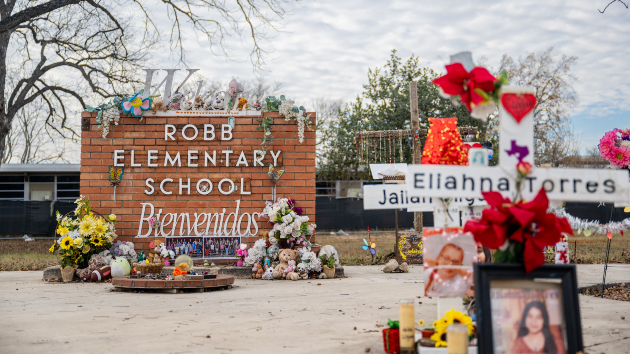
(CORPUS CHRISTI, Texas) — Jurors on the trial of former Uvalde, Texas, school police officer Adrian Gonzales listened to a firsthand account of the emergency response from a police sergeant who tried to enter Robb Elementary School with Gonzales.

Prosecutors allege Gonzales, who is charged with child endangerment, did not follow his training and endangered the 19 students who died and an additional 10 surviving students. He has pleaded not guilty and his lawyers argue he is being unfairly blamed for a broader law-enforcement failure that day. It took 77 minutes before law enforcement mounted a counterassault to end the rampage.

Former Uvalde Police Sgt. Daniel Coronado was called as a state witness, but he appeared to defend some of Gonzales’ actions during the May 24, 2022, mass shooting.

“He was yelling at them to be careful, because the shooter was on that side of the building from the information that we had, and I think he was concerned with officers approaching,” Coronado testified on Thursday about first seeing Gonzales. “He was trying to get around to see what was going on.”

Coronado said that he tried to enter Robb Elementary with three other officers — Gonzales, Uvalde Schools Police Chief Pete Arredondo and a third — once they realized the shooter had gone in the school. Jurors also saw body camera footage of their actions.

“As we are making our way through the hallway, it’s dark. There are no lights on. It’s extremely quiet, we don’t hear anything,” Coronado said, noting that the hallways smelled like gunpowder and the walls were “perforated” by bullets.

Coronado said they heard gunfire when they were in the hallway and saw another officer retreat after being hit on the back of his head.

“He yells out, ‘He’s in the classroom over here to my left,'” Coronado said.

Within seconds of the gunman firing from inside a classroom, Coronado said that Gonzales and Arredondo tried to use their radio to request support from SWAT.

“Would that be the opposite of confronting the shooter?” prosecutor Bill Turner asked.

“The opposite? No, I think we were trying to formulate a plan to confront the shooter, and that would be to call SWAT,” Coronado responded.

After they retreated from inside the school, Coronado said Gonzales was covering the east side of the building in case the gunman jumped out of the building.

On Wednesday, jurors heard testimony from Michael Witzgall, an instructor who taught Gonzales a class on active shooting response, SWAT tactics and hostage negotiations.

“We’ve got to stop the killing. There’s no other way I have to say that, folks. You can’t wait for backup,” Witzgall said, speaking to the jurors as if they were his students. “In my opinion, in the way I train people, you don’t have time to wait. You’ve got to make a move.”

During a lengthy cross examination, defense attorney Nico LaHood pressed Witzgall about whether a 40-hour training response fully prepared Gonzales for the real thing.

Dad Christopher Salinas also testified on Wednesday about the physical and mental impact the shooting took on his son, Samuel.

Samuel still has shrapnel embedded in his thigh and the wound has left him in constant pain, Salinas said.

Salinas testified that hearing popping sounds, arguments and slamming doors and seeing the color red triggers memories of the shooting for Samuel.

“Mr. Salinas, is the child that you picked up from the hospital on May 24 the same child that was taken to school that day?” District Attorney Christina Mitchell asked.

“No,” he answered.

Arredondo — the on-site commander on the day of the shooting — is also charged with multiple counts of endangerment and abandonment of a child and has pleaded not guilty. Arredondo’s case has been delayed indefinitely by an ongoing federal lawsuit filed after the U.S. Border Patrol refused repeated efforts by Uvalde prosecutors to interview Border Patrol agents who responded to the shooting, including two who were in the tactical unit responsible for killing the gunman at the school.

ABC News’ Juan Renteria contributed to this report.

Copyright © 2026, ABC Audio. All rights reserved.
Appeals court says judge had no jurisdiction to order Mahmoud Khalil’s release

Appeals court says judge had no jurisdiction to order Mahmoud Khalil’s release
Selcuk Acar/Anadolu via Getty Images

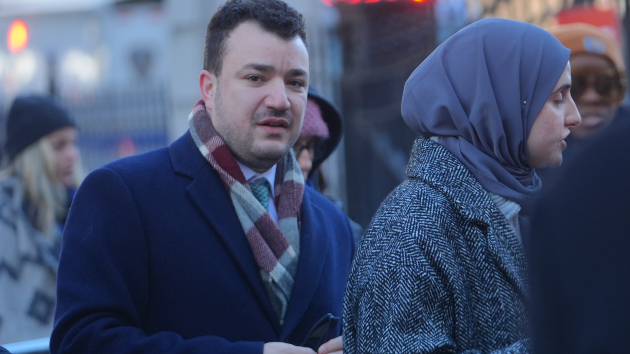
(NEW YORK) — A federal appeals court ruled Thursday a judge had no jurisdiction to order Columbia University pro-Palestinian activist Mahmoud Khalil released from immigration detention last summer, a decision that could lead to his re-arrest.

Khalil, a green card holder who is married to an American citizen, was released from ICE custody last June following his arrest by ICE agents in New York City in March.

U.S. District Judge Michael Farbiarz issued an order on June 20 granting Khalil ‘s release on bail after determining that he presented neither a danger nor a flight risk and that extraordinary circumstances justified his temporary release while his habeas case proceeded — a decision that was sharply criticized by the Trump administration.

On Thursday, the 3rd U.S. Circuit Court of Appeals ordered Judge Farbiarz to dismiss a petition Khalil had filed challenging his detention, on the grounds that Farbiarz lacked jurisdiction in the case.

“On consideration whereof, it is now ORDERED and ADJUDGED that the District Court’s orders entered on April 29, May 28, June 11, June 20, and July 17, 2025, are hereby VACATED and the case is REMANDED to the District Court with instructions to dismiss the petition for lack of subject-matter jurisdiction,” the opinion said.

Khalil was picked up at his Columbia University housing complex last March and jailed as part of the Trump administration’s crackdown on pro-Palestinian protests. He spent about three months in a Louisiana detention center and missed the birth of his son.

Khalil was detained on the basis of Secretary of State Marco Rubio’s determination that Khali’s speech would “compromise a compelling U.S. foreign policy interest.” Judge Farbiarz granted Khalil’s request for a preliminary injunction after concluding that he would continue to suffer irreparable harm if the government continued efforts to detain and deport him.

Prior to ordering his release, the judge also found that Khalil was likely to succeed on the merits of his constitutional challenge to his detention and attempted deportation on the “foreign policy ground.”

“Today’s ruling is deeply disappointing, but it does not break our resolve,” Khalil said in a statement Thursday. “The door may have been opened for potential re-detainment down the line, but it has not closed our commitment to Palestine and to justice and accountability. I will continue to fight, through every legal avenue and with every ounce of determination, until my rights, and the rights of others like me, are fully protected.”

Khalil’s lawyers said they are now considering whether to pursue an appeal to the full circuit — an interim step before a possible appeal to the U.S. Supreme Court.

“Today’s decision is deeply disappointing, and by not deciding or addressing the First Amendment violations at the core of this case, it undermines the role federal courts must play in preventing flagrant constitutional violations,” said Bobby Hodgson, deputy legal director at the New York Civil Liberties Union.

“The Trump administration violated the Constitution by targeting Mahmoud Khalil, detaining him thousands of miles from home, and retaliating against him for his speech,” Hodgson said. “Dissent is not grounds for detention or deportation, and we will continue to pursue all legal options to ensure Mahmoud’s rights are vindicated.” 

Copyright © 2026, ABC Audio. All rights reserved.
Relative speaks out on plight of arrested Iranian protester Erfan Soltani, who had faced execution

Relative speaks out on plight of arrested Iranian protester Erfan Soltani, who had faced execution
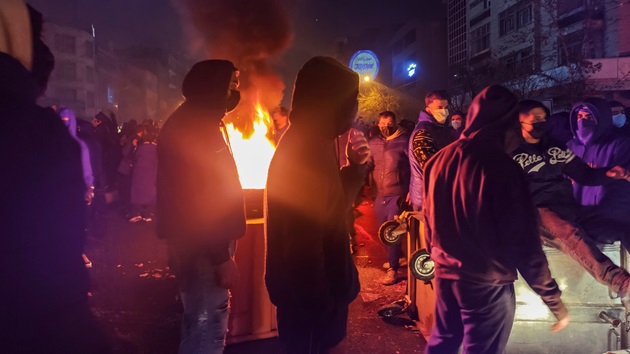
Protesters rally on January 8, 2026 in Tehran, Iran. Anonymous/Getty Images

(LONDON) — Erfan Soltani is one of thousands of Iranian protesters who have been arrested amid deadly anti-government protests nationwide, according to his family and human rights organizations. 

Days after his arrest last week in Fardis — near the capital of Tehran — the 26-year-old was sentenced to death following an expedited trial, according to his second cousin, Somayeh, who has drawn attention to his case as ongoing internet and communication blockages limit information coming out of Iran about the protests.

“As someone who is an activist myself and who has fought this regime for many years, I felt it was my right — and my duty — to be Erfan’s voice outside the country, despite all the pressure and sanctions that fall on families,” Somayeh, who is based in Germany, told ABC News in an interview in Persian on Wednesday. 

Somayeh, who did not want to share her last name, said Soltani’s family members had been told that he would be executed on Wednesday.

She was informed through the family that he had not been executed that day, she told ABC News. Somayeh added that the family said they had not seen her cousin in person yet. 

President Donald Trump said on Wednesday that he had been told by “very important sources on the other side” that the executions are not happening.

“It was supposed to be a lot of executions today, and the executions won’t take place,” Trump said during remarks from the Oval Office on Wednesday.

Following President Trump’s remarks, the Islamic Republic judiciary media center announced Thursday that Soltani was not sentenced to death.

The judiciary, as quoted by the Islamic Republic of Iran Broadcasting (IRIB), said Soltani was currently being held at the central penitentiary in the city of Karaj on charges of “gathering and colluding against the country’s internal security and propaganda activities against the regime.” If convicted, the judiciary said, Soltani would be imprisoned but not executed, as “the death penalty does not exist in the law for such charges,” according to IRIB.

Reacting to the latest Islamic Republic judiciary’s announcement, Somayeh, said she is “happy to hear the news” but is still “concerned.”

“I am happy to hear this news from the media, but there is still concern because as far as we know, no contact has been made and Erfan is still in prison. We hope that his sentence will be completely overturned and he will be released,” Somayeh told ABC News Thursday morning.

In an interview with Fox on Wednesday, the Iranian foreign minister said there were no hangings on Wednesday, and that there won’t be for the rest of the week.

Somayeh said she is speaking out about her cousin, whom she described as a “kind soul” who is “so compassionate to people,” in hopes of having his sentence overturned.

“I felt responsible to make sure his voice was heard, so that maybe this sentence could be overturned — and beyond Erfan,” she said. “He is not the first and he will not be the last person to receive a death sentence overnight.”

According to the Human Rights Activists News Agency (HRANA), Iran carried out an “unprecedented” number of executions last year. In 2025, there were 2,063 recorded executions, the highest annual figure over the past 11 years, according to the report from the group.

Soltani’s case has been highlighted by international human rights groups such as the Hengaw Organization for Human Rights and Amnesty International, which said the international community must call on Iranian authorities to “immediately halt all executions.”

“Amid the Iranian authorities’ unprecedented crackdown on ongoing nationwide protests, marked by mass killings and sweeping arrests, concerns are mounting that authorities will once again resort to swift trials and arbitrary executions to crush and deter dissent,” Amnesty International said in a statement on Monday that highlighted Soltani’s case. “Iran’s head of judiciary ordered prosecutors to ‘act without leniency’ against protesters heightening fears for the lives of detained protesters and other dissidents.”

The first marches took place in late December in downtown Tehran, with participants demonstrating against rising inflation and the falling value of the national currency, the rial. As the protests spread, they have taken on a more explicitly anti-government tone.

More than 2,500 people have died during nationwide protests in Iran since Dec. 28, HRANA said Wednesday. The HRANA data relies on the work of activists inside and outside the country. ABC News cannot independently verify these numbers. 

The Iranian foreign minister told Fox News on Wednesday that “hundreds” are dead.

Iranian Supreme Leader Ayatollah Ali Khamenei and top Iranian officials have said they are willing to engage with the economic grievances of protesters, though have also framed the unrest as driven by “rioters” and sponsored by foreign nations, prime among them the U.S. and Israel.

ABC News’ David Brennan contributed to this report.

Copyright © 2026, ABC Audio. All rights reserved.
Iran protests: US sanctioning Iranian officials over ‘brutal crackdown’

Iran protests: US sanctioning Iranian officials over ‘brutal crackdown’
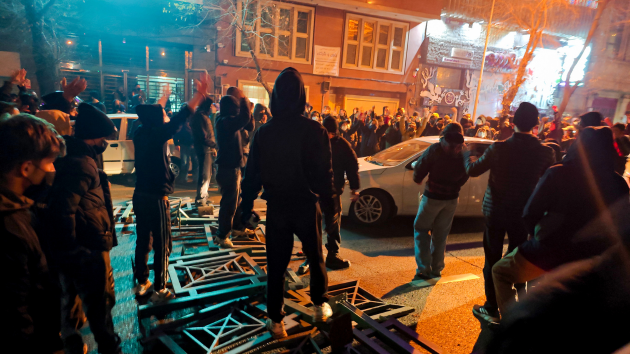
People gather during protest on January 8, 2026 in Tehran, Iran. Demonstrations have been ongoing since December, triggered by soaring inflation and the collapse of the rial, and have expanded into broader demands for political change. (Anonymous/Getty Images)

(LONDON) — The Trump administration said Thursday it is sanctioning five top Iranian officials who they say are responsible for the nation’s “brutal crackdown on peaceful demonstrators.” 

“Our message to the Iranian people is clear: Your demands are legitimate,” Treasury Secretary Scott Bessent said in a video on social media about the action. “You are protesting for a noble cause, and the United States supports you and your efforts to peacefully oppose the regime’s mismanagement and brutality.

The targeted security officials include Ali Larijani, the secretary of Iran’s Supreme Council for National Security, who the Treasury said was “one of the first Iranian leaders to call for violence in response to the legitimate demands of the Iranian people.”

Commanders with the Law Enforcement Forces of the Islamic Republic of Iran and Islamic Revolutionary Guard Corps were also targeted, according to the Treasury Department.

“The officials sanctioned today — and their organizations — bear responsibility for the thousands of deaths and injuries of their fellow citizens as protests erupted in each of these provinces,” the Treasury Department said in a statement.

As part of the sanctions, the State Department said the U.S. is also designating the “notorious” Fardis Prison.

“As the brave people of Iran continue to fight for their basic rights, the Iranian regime has responded with violence and cruel repression against its own people,” State Department spokesperson Tommy Pigott said in a statement, which added, “We will continue to deny the regime access to financial networks and the global banking system while it continues to oppress the Iranian people.”

As of Wednesday, 18 days of protests and a resulting crackdown by security forces had seen 2,615 deaths and 18,470 people arrested, according to the U.S.-based Human Rights Activists News Agency (HRANA). Among the dead were 13 children and 14 non-protesting civilians, HRANA said.

On the government side, HRANA said it had confirmed the deaths of 153 members of the security forces.

Another 882 additional deaths remain under investigation, HRANA said.

The HRANA data relies on the work of activists inside and outside the country. ABC News cannot independently verify its numbers.

Iran briefly issued a notice, known as a NOTAM, closing its airspace to most flights, after U.S. President Donald Trump hinted at possible action against Iran and in support of anti-government protests which have roiled the country in recent weeks.

Iran’s Civil Aviation Organization confirmed on Thursday morning that flights were back in operation over the country, according to a statement carried by Iranian state-aligned media.

Protests have been spreading across the country since late December. The first marches took place in downtown Tehran, with participants demonstrating against rising inflation and the falling value of the national currency, the rial. As the protests spread, they took on a more explicitly anti-government tone.

The subsequent security crackdown has included a sustained national internet blackout, which — according to online monitoring group NetBlocks — had been in place for 156 hours as of Thursday morning.

On Wednesday, Cloudflare’s threat-intelligence unit said in a statement that it had “observed Iranian authorities targeting Instagram accounts with tools that perform bulk extraction of follower lists and account activity.”

Estimates of the death toll from the protests have varied, with the internet and communications blackout making it difficult to establish clear figures. 

Stephane Dujarric, the spokesperson for United Nations Secretary-General Antonio Guterres, told reporters at a briefing on Wednesday, “We’ve seen numbers vary from 2,000 to 12,000. All of those numbers are horrendous, but I don’t have a number to share with you.”

Trump has repeatedly threatened military action against the government in Tehran — which is headed by its Supreme Leader Ayatollah Ali Khamenei — in response to violence against protesters.

Trump said Wednesday that he had been informed that the “killing” in Iran had stopped and that anticipated executions of arrested protesters would not take place.

The information was coming from “very important sources on the other side,” Trump said during an event in the Oval Office on Wednesday. “We’ve been told on good authority, and I hope it’s true. Who knows, right?” he added.

Asked by a reporter if this means that military action was now off the table, Trump responded, “We’re going to watch and see what the process is. But we were given a very good statement by people that are aware of what’s going on.”

On Tuesday, Trump had addressed protesters on social media, urging “Iranian Patriots” to “TAKE OVER YOUR INSTITUTIONS!!!” He added, “HELP IS ON ITS WAY.”

Khamenei and top Iranian officials have said they are willing to engage with the economic grievances of protesters, though have framed the unrest as driven by “rioters” and “terrorists” sponsored by foreign nations — prime among them the U.S. and Israel — and supported by foreign infiltrators.

Iranian officials have also threatened retaliatory strikes against U.S. and Israeli targets in the event of any outside intervention.

On Wednesday, a U.S. official confirmed to ABC News that some personnel had been advised to leave al-Udeid Air Base in Qatar due to increased tensions in the region.

Meanwhile, Tehran has signaled an intent to proceed with expedited trials and executions for those arrested during the protests. 

The head of Iran’s judiciary, Gholamhossein Mohseni-Ejei, said Wednesday, “If we want to do a job, we should do it now. If we want to do something, we have to do it quickly,” in a video shared online by Iranian state television, according to The Associated Press.

“If it becomes late, two months, three months later, it doesn’t have the same effect,” Mohseni-Ejei said.

Speaking to Fox News on Wednesday, Iranian Foreign Minister Abbas Araghchi acknowledged that “hundreds” of people had been killed and again characterized the protests as an “Israeli plot” and a “terrorist operation.”

Araghchi said that the protests had died down and that the government is “in full control.”

ABC News’ Ayesha Ali, Morgan Winsor, Somayeh Malekian and Michelle Stoddart contributed to this report.

Copyright © 2026, ABC Audio. All rights reserved.
Pokemon store robbed at gunpoint in Manhattan

Pokemon store robbed at gunpoint in Manhattan
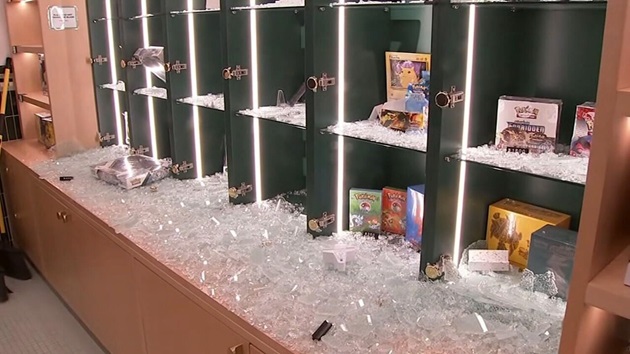
A Pokemon store was robbed at gunpoint on Jan. 14, 2026, in New York. WABC

(NEW YORK) — Three men robbed a Pokémon store in Manhattan on Wednesday, stealing $1,000 in cash from a register, an unknown amount of merchandise and a cell phone, according to the New York Police Department. 

The three entered the store on 412 West 13th Street at 6:45 p.m. before fleeing westbound on West 13th Street, the NYPD said. 

No one was injured in the robbery, and no arrests have been made, according to police.

More than $100,000 worth of merchandise was stolen, workers at the store told ABC News, New York station WABC. 

Surveillance video obtained by WABC showed the armed and masked suspects inside the store during Wednesday night’s robbery. 

The three masked individuals reportedly held the entire store — with more than 40 people inside — at gunpoint. The robbery lasted about 3 minutes, according to WABC.

Copyright © 2026, ABC Audio. All rights reserved.