

Europe ‘united’ in face of Trump’s Greenland threats, tariffs, EU chief says

Europe ‘united’ in face of Trump’s Greenland threats, tariffs, EU chief says
People bear Greenlandic flags as they gather in front of the U.S. consulate protest against U.S. President Donald Trump and his announced intent to acquire Greenland on January 17, 2026 in Nuuk, Greenland.(Sean Gallup/Getty Images)

(LONDON) — European leaders hit back at U.S. President Donald Trump’s announcement that he would impose sanctions on nations that deployed small numbers of military forces to Greenland last week, as the president continues his push to acquire the Arctic territory.

Trump said Saturday that a 10% tariff would be imposed on all goods sent to the U.S. from Denmark, Norway, Sweden, France, Germany, the U.K., the Netherlands and Finland.

Trump said the new tariffs will come into force on Feb. 1, and will increase to 25% on June 1. The president said the measures would remain in place until the U.S. is able to purchase Greenland.

Greenland is a self-governing territory of the Kingdom of Denmark. Trump first raised the prospect of acquiring the minerals-rich island in his first term. Danish and Greenlandic politicians have repeatedly rebuffed such proposals.

European Commission President Ursula von der Leyen on Saturday said the bloc’s members will meet Trump’s pressure as a united front.

“We have consistently underlined our shared transatlantic interest in peace and security in the Arctic, including through NATO,” she wrote in a post to X. “The pre-coordinated Danish exercise, conducted with allies, responds to the need to strengthen Arctic security and poses no threat to anyone.”

“Tariffs would undermine transatlantic relations and risk a dangerous downward spiral. Europe will remain united, coordinated and committed to upholding its sovereignty,” von der Leyen said.

Kaja Kallas, the EU’s foreign affairs chief, suggested in a post to X that the escalating tensions between the U.S. and its European allies is a boon for Moscow and Beijing.

“China and Russia must be having a field day,” she wrote. “They are the ones who benefit from divisions among allies. If Greenland’s security is at risk, we can address this inside NATO.”

“Tariffs risk making Europe and the United States poorer and undermine our shared prosperity,” Kallas wrote, suggesting the furor was distracting from allied efforts to support Ukraine against Russia’s ongoing full-scale invasion.

The eight countries — all NATO members — threatened with the tariffs issued a joint statement on Sunday saying they “stand in full solidarity with the Kingdom of Denmark and the people of Greenland.”

The statement says tariffs “undermine transatlantic relations and carry the risk of a dangerous downward spiral.” The signatories added that they are “committed to strengthening security in the Arctic region as a shared transatlantic interest,” and in this context, the planned military exercise in Greenland, “poses a threat to no one.”

EU pushback against Trump came alongside criticism from national leaders.

“France is committed to the sovereignty and independence of nations,” French President Emmanuel Macron said in a statement Saturday, adding that “no intimidation nor threat will influence us, neither in Ukraine, nor in Greenland, nor anywhere else in the world when we are confronted with such situations.”

“Tariff threats are unacceptable and have no place in this context. Europeans will respond to them in a united and coordinated manner if they were to be confirmed. We will know how to uphold European sovereignty,” Macron said.

British Prime Minister Keir Starmer said, “Applying tariffs on allies for pursuing the collective security of NATO allies is completely wrong.”

“Our position on Greenland is very clear — it is part of the Kingdom of Denmark and its future is a matter for the Greenlanders and the Danes,” he said.

Swedish Prime Minister Ulf Kristersson said discussions are ongoing between the affected nations to build a coordinated response.

“We will not let ourselves be blackmailed. Only Denmark and Greenland decide on issues concerning Denmark and Greenland,” he said.

Italian Prime Minister Giorgia Meloni said on Sunday that Trump’s decision to impose new tariffs was “a mistake and I do not agree with it.”

“The intention of some European countries to send troops, to take part in greater security, should have been understood not as an initiative directed against the United States but rather against other actors,” Meloni said.

Meloni said she spoke with Trump “a few hours ago” and “told him what I think.”

“A core meeting of the European Union has been organized but I believe that at this stage it is very important to talk to one another and that it is very important to avoid an escalation,” she added.

Trump has repeatedly suggested that U.S. sovereignty over the world’s largest island is necessary to ensure American security and blunt Chinese and Russian influence in the Arctic region.

“This is a very dangerous situation for the Safety, Security, and Survival of our Planet. These Countries, who are playing this very dangerous game, have put a level of risk in play that is not tenable or sustainable,” Trump posted on social media on Saturday, referring to deployment of small contingents of troops by European allies.

“Only the United States of America, under PRESIDENT DONALD J. TRUMP, can play in this game, and very successfully, at that!” he said in the post.

As a part of the Kingdom of Denmark, Greenland is covered by NATO’s collective defense clause. Greenland hosts the U.S. Pituffik Space Base and around 150 American troops, the U.S. having significantly downgraded its footprint from its high point during the Cold War.

A 1951 defense agreement grants the U.S. military access to Greenland. Danish politicians have repeatedly expressed willingness to work with Washington to expand the American and NATO presence there.

Danish officials have also sought to head off concerns about the supposed vulnerability of the Arctic. Last year, Copenhagen announced a $6.5 billion Arctic defense package in response to U.S. criticism that it had failed to adequately protect Greenland.

But such steps do not appear to have deterred Trump, who has said he would consider taking Greenland by force if other means to acquire the land fail.

A meeting in Washington, D.C., last week between U.S., Danish and Greenlandic representatives seemingly failed to de-escalate the standoff.

“It’s clear that the president has this wish of conquering over Greenland,” Danish Foreign Minister Lars Løkke Rasmussen told reporters after meeting with Vice President JD Vance and Secretary of State Marco Rubio. Rasmussen said that outcome was “totally unacceptable.”

Rasmussen said Saturday that the president’s threat came as a surprise, citing his “constructive meeting” with Vance and Rubio last week.

Rasmussen said in a statement that the purpose of last week’s military deployments to Greenland “is to enhance security in the Arctic.”

The continued U.S. focus on Greenland prompted protests there this weekend, with crowds of people turning out for a “Stop Trump” march through the capital Nuuk. Greenlandic politicians have collectively and repeatedly said they do not wish to join the U.S.

Trump’s efforts have also prompted congressional resistance. On Friday, a bipartisan group of House members and senators traveled to Greenland and said they had “constructive” conversations with members of Denmark’s parliament.

U.S. Sens. Jeanne Shaheen, D-N.H., and Thom Tillis, R-N.C., who were part of the delegation, released a statement Saturday warning that the tariff threat will hurt the U.S.’s relationships with its European counterparts.

“There is no need, or desire, for a costly acquisition or hostile military takeover of Greenland when our Danish and Greenlandic allies are eager to work with us on Arctic security, critical minerals and other priorities under the framework of long-standing treaties,” the lawmakers said in the statement.

Senate Minority Leader Chuck Schumer said on Saturday that Democrats will introduce legislation to block tariffs against countries who oppose a takeover of Greenland.

Copyright © 2026, ABC Audio. All rights reserved.
Bloody crackdown appears to have quelled Iran protests for now

Bloody crackdown appears to have quelled Iran protests for now
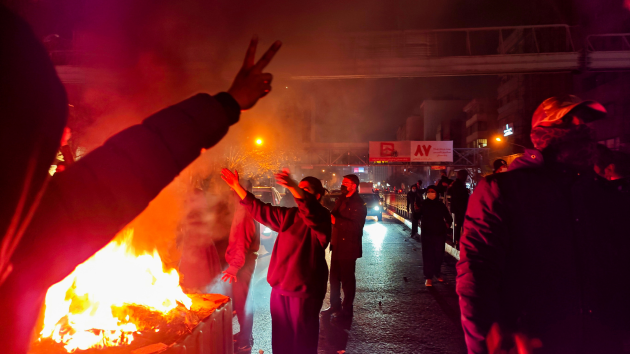
Fires are lit as protesters rally on January 8, 2026 in Tehran, Iran. (Anonymous/Getty Images)

(NEW YORK) — An extraordinarily violent crackdown by Iranian security forces appears to have succeeded for now in driving protesters from the streets, according to activists and analysts who managed to speak with people inside the country despite the information blackout.

Demonstrations began in late December with protesters chanting in Tehran against rising inflation and the falling value of the national currency before spreading across Iran and becoming more explicitly anti-government. Authorities have shut down the internet in Iran for more than a week as security forces moved to crush the protests.

The internet blackout in Iran continues to make it very difficult to get a clear picture from the ground, but accounts are emerging from people now able to use phone lines, those few with access to working Starlink satellite terminals and Iranians who have recently left the country.

These people describe an eerie calm over Iran’s cities, where heavily armed security forces are deployed on the streets enforcing what many are describing as a de-facto curfew.

Mehdi Yahyanejad, an Iranian activist based in Washington, D.C., says he has helped send in hundreds of Starlink terminals to citizen journalists and others in Iran to help get around the government blackout.

“Unfortunately, the crackdown has been so severe the protests have pretty much come to a halt,” he said told ABC News on Thursday.

“There are security forces everywhere — there is a state of fear,” said Yahyanejad, who co-founded Net Freedom Pioneers, an anti-censorship group.

The smothering of the protests would seem to make U.S. military intervention less likely. President Donald Trump initially signaled there could be possible U.S. military action in support of protesters.

Yahyanejad said in the past few days there are still signs of dissent — people were heard chanting anti-regime slogans from windows. In some neighborhoods groups of youths have also gathered and shouted slogans, before quickly fleeing when security forces arrive. 

The death toll from the crackdown continues to grow as more information comes out. The D.C.-based Human Rights Activists News Agency, HRANA, now puts it at more than 3,308 protesters killed since Dec. 28.

A total of 24,266 people have been arrested in the protests since they began, including 2,107 injured protesters with serious wounds, according to HRANA.

ABC News cannot independently verify these numbers. Although there have not been signs of major demonstrations in recent days, human rights groups are continuing to verify the identities of those killed over the weeks of unrest.

The Islamic Republic has not released a death toll, but Ayatollah Ali Khamenei said Saturday that thousands have been killed. Other Iranian authorities have said before that two-thirds of those dead are “martyrs” killed by protesters that they describe as “terrorists” and “mercenary agents of Israel and the U.S.”

Yahyanejad said while there was intense anger under the surface still, he doubted the protests would restart unless the U.S. launched strikes.

“I think if there is no action from the U.S., I don’t think they are going to come back that soon,” he said.

Regarding a possible U.S. response, President Donald Trump told reporters Friday afternoon that it was not Arab and Israeli officials who convinced him not to strike Iran, but that he made the decision himself not to strike the country.

“Nobody convinced me. I convinced myself,” Trump said. 

Trump applauded the Iranian regime for what he claims is the cancellation of over 800 scheduled hangings on Thursday, according to what he said “are very important sources on the other side.”

“I greatly respect the fact that all scheduled hangings, which were to take place yesterday (Over 800 of them), have been cancelled by the leadership of Iran,” Trump said on his social media platform Friday.

The head of Iran’s judiciary, Gholamhossein Mohseni-Ejei, had suggested Wednesday that there would be expedited trials and executions for those who have been arrested in the nationwide protests. The Iranian government has yet to comment on Trump’s claim that the scheduled hangings have been halted.

Concerns about the safety of injured protesters
There are fears the arrests are just beginning as the regime moves to round up protesters, activists and independent analysts told ABC News.

Injured people are frightened to visit hospitals or clinics because security officers are waiting for them there, according to Yahyanejad.

There are also allegations that during the mass killing, some severely injured protesters were removed from hospitals and executed, according to activists and analysts. The accusations are based on videos that show bodies still intubated or with catheters, but with bullet wounds to the head.

Reviewing the pictures of the bodies, Yasser Ghorashi, an Iranian doctor, told ABC News that hospitals in Iran never send a body to the morgue without removing all medical tools and devices.

The Toronto-based Iranian doctor said that he had been in touch with doctors inside the country who reported security forces had raided hospitals and taken injured protesters.

Their accounts match videos verified by ABC News that shows security forces raiding hospitals in Ilam, a city in west Iran, during the early days of the protests.

Copyright © 2026, ABC Audio. All rights reserved.

Trump announces tariffs on NATO allies for opposing US control of Greenland

Trump announces tariffs on NATO allies for opposing US control of Greenland
People hold Greenlandic flags and placards as they gather by the United States Consulate to march in protest against U.S. President Donald Trump and his announced intent to acquire Greenland on January 17, 2026 in Nuuk, Greenland.(Sean Gallup/Getty Images)

(NEW YORK) — President Donald Trump said on Saturday that the NATO countries who have sent small contingents of troops to Greenland amid the White House’s push to acquire the island will be charged a 10% tariff on all goods sent to the United States starting on Feb. 1.

The tariffs on Denmark, Norway, Sweden, France, Germany, the United Kingdom, the Netherlands and Finland will then increase to 25% on June 1, until the U.S. is able to purchase Greenland, according to the president.

Greenland is a self-governing territory of the Kingdom of Denmark.

“This is a very dangerous situation for the Safety, Security, and Survival of our Planet. These Countries, who are playing this very dangerous game, have put a level of risk in play that is not tenable or sustainable,” Trump posted on social media.

Trump, in his post, repeated his claim that China and Russia would threaten to take Greenland if the U.S. does not. He claimed Denmark cannot protect Greenland.

“Only the United States of America, under PRESIDENT DONALD J. TRUMP, can play in this game, and very successfully, at that!” he said in the post.

Some leaders from the targeted countries slammed Trump over his tariff threats.

“France is committed to the sovereignty and independence of Nations,” French President Emmanuel Macron said in a statement Saturday, adding that “no intimidation nor threat will influence us, neither in Ukraine, nor in Greenland, nor anywhere else in the world when we are confronted with such situations.”

“Tariff threats are unacceptable and have no place in this context. Europeans will respond to them in a united and coordinated manner if they were to be confirmed. We will know how to uphold European sovereignty,” Macron said.

UK Prime Minister Keir Starmer said in a statement that “Applying tariffs on allies for pursuing the collective security of NATO allies is completely wrong.”

“Our position on Greenland is very clear – it is part of the Kingdom of Denmark and its future is a matter for the Greenlanders and the Danes,” he said.

Swedish Prime Minister Ulf Kristersson said in a statement Saturday that discussions are being had between the countries for a coordinated response.

“We will not let ourselves be blackmailed. Only Denmark and Greenland decide on issues concerning Denmark and Greenland,” he said. “I will always stand up for my country, and for our allied neighbors.”

Trump has said he would consider taking Greenland by force as an option to acquire the land.

Leaders from Greenland and Denmark, which governs international matters for the country, have repeatedly said Greenland is not for sale.

“It’s clear that the president has this wish of conquering over Greenland,” Danish Foreign Minister Lars Løkke Rasmussen told reporters after meeting with Vice President JD Vance and Secretary of State Marco Rubio Wednesday.

Rasmussen called that outcome “totally unacceptable.”

Several leaders from European nations, including France and Germany, have slammed Trump’s rhetoric and sent military forces to Greenland this week as part of training exercises launched by the Danish military.

Trump’s controversial plan to acquire Greenland has been met with disapproval on the island, where protests against the U.S. have taken place.

On Saturday, huge crowds hit the streets in Greenland lashing out at Trump over his proposal. A large crowd of protesters conducted a “Stop Trump” march through the streets of Nuuk.

Trump’s proposal has also not sat well among many Americans where people and leaders across the aisle have spoken out against the idea of acquiring Greenland.

A Quinnipiac University poll found 55% of voters are opposed to the United States trying to buy Greenland, with majorities of Democratic voters (85%) and Independent voters (58%) opposed and a majority of Republican voters in support (67%).

On Friday,  a bipartisan group of House members and senators traveled to Greenland and said they had “constructive” conversations with members of Denmark’s parliament.

The delegation said the visit was to nurture the relationship between Denmark, Greenland and the United States and to reassure NATO partners that many members of Congress do not support any effort by the United States to acquire Greenland.

“I think it’s important that it be recognized that when it comes to matters of relationships with our friends, with our allies, as we have here in Denmark, as we have in Greenland, that it is — it is not a subject of Republicans versus Democrats. It is a recognition, again, of a strong and continuing relationship over decades,” Sen. Lisa Murkowski, R-Alaska, said.

Trump’s tariffs have been hit with lawsuits which have been appealed all the way the Supreme Court. It is not known when the high court will rule on the case.

Copyright © 2026, ABC Audio. All rights reserved.
Back-to-back winter storms hit the East this weekend with arctic blast behind them next week

Back-to-back winter storms hit the East this weekend with arctic blast behind them next week
ABC News

(NEW YORK) — Two winter storms will move through the East this weekend, with cold air coming right behind it in an arctic blast forecast for next week.

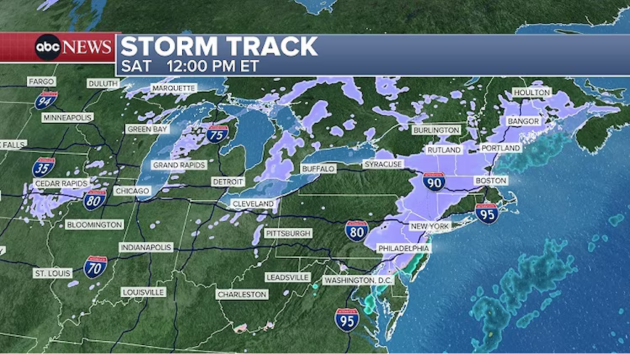
The first of the two storm systems will be a quick-moving, clipper system that continues to bring scattered snow showers to the Midwest and Great Lakes before bringing two rounds of snow for the Northeast and Mid-Atlantic on Saturday.

The first round of snow showers moved through early Saturday morning from the central Appalachian Mountains in West Virginia and Virginia up into Pennsylvania, as well as New England. The next round moves in later Saturday morning.

By noon, there will be either snow or mixed conditions along the I-95 corridor from Baltimore to Philadelphia to New York City.

By mid-afternoon, Washington, D.C., to Philadelphia will be clear with New York City and Bridgeport, Connecticut, seeing a change to a light wintry mix as things begin drying up.

Most of New England will see snow on Saturday except along the coast. Boston is likely seeing mostly rain from this, but could get in on a wintry mix at times.

Heading into Saturday night, the first storm system moves out and things begin to clear out across the Northeast, with only a few isolated showers remaining.

The next storm system, which will be a coastal storm that forms off the Southeast coast early Sunday morning, will slide up the East Coast for Sunday.

A light wintry mix or snow will be present for parts of Georgia on Sunday morning by 8:00 a.m., with it possibly extending down to the Florida Panhandle. Atlanta could even get in on a few snow showers, while Macon, Georgia, is likely to see more concentrated wintry weather.

Rain elsewhere along the Southeast coast extends up into the Carolinas.

As the coastal storm moves up the East Coast later Sunday morning into the afternoon, the next round of snow looks to develop along the Northeast coast from Washington, D.C., to New York City to Boston. 

It’s not set yet who will see snow with this coastal storm, as it all depends on how close it is to the coast. There is a chance for more snow near the I-95 corridor. However, it’s becoming clearer that there’ll be more snow for areas along the coast rather than areas inland with this second storm system.

Overall, both of these storm systems will bring minor accumulations along the I-95 corridor and parts of New England.

Some higher snowfall amounts of 2 to 6 inches will be possible north and west of the I-95 corridor and parts of interior New England.

Behind these two systems will be a big arctic blast that will sweep across much of the Eastern and Central U.S. to start the new work week.

Copyright © 2026, ABC Audio. All rights reserved.

How the Diplomatic Security Service is helping to secure the Winter Olympics for fans and athletes

How the Diplomatic Security Service is helping to secure the Winter Olympics for fans and athletes
(aire images/Getty Images)

(NEW YORK) — Athletes and fans will start arriving at the 2026 Winter Olympics in Milan next month, but one U.S. agency has been on the ground working to ensure safety at the games.

Special agents from the U.S. Diplomatic Security Service (DSS) have been working with the local authorities in Italy since 2022 to secure the Winter Olympic games, according to two top officials involved in the planning.

As the State Department’s law enforcement arm, DSS is responsible for securing international events and embassies around the world. As they have in years past, the agency takes a front and center role in helping to secure the Olympic Games, working in concert with authorities from the host country.

“We have a memorandum of understanding with the U.S. Olympic and Paralympic Committee to provide intelligence and security support for them while they’re overseas to keep them safe so they can concentrate on winning the gold medals,” Timothy Ayers, the major events coordinator for DSS, told ABC News.

In addition to providing security for U.S. athletes, DSS also helps to provide security for American corporations that are on the ground at the games, and the agency is ready to deploy if something were to happen.

DSS also provides training for the host country in order to better work together, including bringing officials to National Special Security Events in the United States, such as the Super Bowl and The Masters.

“Our team is focused really on strengthening relationships with our Italian counterparts, both at the national and subnational level,” Nick Fanelli, the Olympic security coordinator in Milan, told ABC News. “A lot of our engagement started in Rome, with contacts within the ministries and then going down to the provincial level, making contacts with the provincial counterparts both from the local police and local governments down to municipal level.”

Fanelli has been in Italy for two years planning and creating on-the-ground relationships with Italian security services, he said.

Agents from DSS are physically embedded with the teams and in the Olympic village, according to Ayers.

Both said they see the lone wolf actor as the biggest threat to the games, but said there are no credible threats currently.

“One thing that we’re always concerned about at an Olympics or a World Cup is that lone wolf attack,” Ayers aid. “We’re very comfortable with the fact that we can track things that are organized and things like that … when things happen we can track those kinds of things, but that lone wolf attack, that lone actor, it’s very difficult to track as they’re acting on their own, they’re acting with less resources and they can do what they want so that is usually a very concerning thing.”

Given the sprawling nature of events at the games, securing the transportation is key, according to the two senior DSS agents.

“The Italians are supremely prepared for this,” Fanelli said. “They have been hosting a number of different exercises across fields, if you will, transportation structure, critical infrastructure, to stress test their systems, to iron out their communications, and we have a lot of redundant comps with them as well.”

He said that DSS has people on the ground in constant contact with Italian authorities should something happen, including putting an agent at every one of the events. Those agents could be a resource for U.S. citizens who attend the games, in addition to the athletes.

“My team and I know these venue managers very personally,” Fanelli said. “We know our security contacts and police contacts on a first name basis throughout all of Northern Italy. So, they know that if there’s an American citizen that’s in crisis or has an issue, in addition to following their normal protocols, they’re going to notify us as well, so we’ll get that information and we can marshal resources.”

Ayers said there will be over 100 agents in Milan for the games.

Copyright © 2026, ABC Audio. All rights reserved.
Democrats grapple with ‘rising clamor’ for Trump impeachment ahead of midterms

Democrats grapple with ‘rising clamor’ for Trump impeachment ahead of midterms
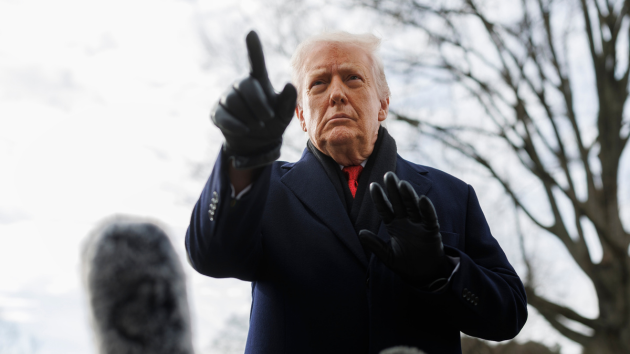
President Donald Trump speaks to reporters on the South Lawn before boarding Marine One at the White House on January 16, 2026 in Washington, DC. (Tom Brenner/Getty Images)

(NEW YORK) — From the campaign trail to Capitol Hill, a growing number of Democrats have said they believe President Donald Trump has committed impeachable offenses in his first year back in office.

But with their focus on the midterms, fewer elected Democrats are willing to commit to impeaching Trump if they win back control of the House, given likely Republican control of the Senate and potential for backlash from voters. 

Trump has predicted that Democrats will impeach him if they retake the House, and Republicans plan to make that threat a key piece of their midterm messaging.

“They will do anything to stop the Trump agenda,” Rep. Dan Meuser, a Republican from Pennsylvania, said of Democrats. “People, if they don’t want a two-year president, who they voted for pretty overwhelmingly in 2024, can’t allow the House to flip.”

Instead, many Democrats said they are focusing on the cost of living and the state of the economy.

“There’s a lot for me to be concerned about,” said Rep. Eugene Vindman, a Democrat from Virginia.

Vindman is an Army veteran and former national security official who played a role in raising concerns about Trump’s 2019 phone call with Ukrainian President Volodymyr Zelenskyy at the center of his first impeachment.

“The American people are concerned about costs, and meanwhile, the president is pursuing foreign adventures,” Vindman told ABC News.

Impeachment calls have picked up in 2026 amid the U.S. attack on Venezuela and the Justice Department’s investigations into Trump’s perceived opponents. A number of progressive Democrats from liberal districts and candidates in crowded blue-seat primaries have called for the impeachment of Trump and key cabinet officials.

Democrats are also setting their sights on Cabinet officials: More than 80 Democrats have cosponsored Illinois Democrat Rep. Robin Kelly’s articles of impeachment against Homeland Security Secretary Kristi Noem following the deployment of federal agents to Minnesota and the killing of a Minneapolis woman by a federal agent. 

Still, Democratic leaders are moving cautiously ahead of the midterms, when they will need to gain at least three seats to win control of Congress.

“If candidates and members of Congress are not relentlessly focusing on people’s everyday lives, they are making a mistake,” former Democratic Rep. Cheri Bustos, who led the House Democrats’ campaign committee, told ABC News.

“There’s so much of what President Trump has done, is doing, will do that can be labeled ‘impeachable offenses,’ but in the end what good is it going to do? Even if the House has the votes, the Senate will not go along with it,” she said.

The House has already rejected two impeachment pushes from Rep. Al Green, a Democrat from Texas. In June, 128 Democrats voted with Republicans to block his charges over the U.S. strikes on Iranian nuclear facilities without approval from Congress. 

In December, just 23 Democrats voted with Republicans to kill a second effort focused on Trump’s comments about Democrats who posted a social media video urging service members to refuse illegal orders, while another 47 voted present.

In a statement after that vote, House Democratic leaders called impeachment a “sacred constitutional vehicle” requiring a “comprehensive investigative process” that had not taken place.

“None of that serious work has been done, with the Republican majority focused solely on rubber stamping Donald Trump’s extreme agenda,” Reps. Hakeem Jeffries, Pete Aguilar and Katherine Clark said, arguing that voting “present” allowed them to “continue our fight to make life more affordable for everyday Americans.”

Rep. Jamie Raskin, a Maryland Democrat and the top Democrat on the House Judiciary Committee, said there’s “definitely a rising clamor for impeachment.”

“Of course, it requires a majority vote of the House to get there, but we need a structured method of thinking through all the lawlessness and criminality taking place,” Raskin said.

Kat Abughazaleh, a 26-year-old activist who is running for Congress in Illinois, has argued that Democratic leaders need to “grow a f—ing spine,” and do more to challenge the Trump administration.

She has spoken out and protested against ICE activities in Chicago, and has pleaded not guilty to charges that she interfered with law enforcement during a protest outside an ICE facility in Illinois last fall that went viral on social media.

“One of the most critical failures in American politics is how our leaders have instilled this feeling that we shouldn’t fight for the world we want to see, that we shouldn’t take measures towards a future that we want to live in,” she told ABC News.

“Impeachment is just another tool in the accountability machine that’s supposed to work, but it doesn’t,” she said.

Raskin, who would lead impeachment proceedings in a Democratic House, said he would be “moving very quickly” in the next two months on “announcing a systematic way of thinking” about the various actions of the Trump administration that Democrats find objectionable, and potentially worth investigating.

Copyright © 2026, ABC Audio. All rights reserved.
Man accused of fatally shooting neighbor through wall charged with manslaughter

Man accused of fatally shooting neighbor through wall charged with manslaughter
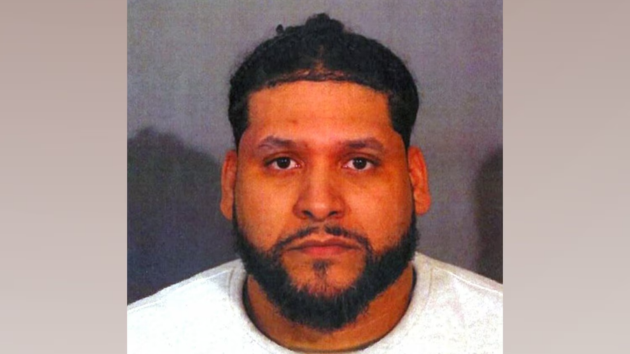
In this booking photo released by the Danbury Police Department, David Grullon, Jr., is shown. (Danbury Police Department)

(DANBURY, Conn.) — A man wanted for the fatal shooting of his neighbor, who was shot through a wall in a Connecticut townhouse last week, has been charged with manslaughter following his surrender, police said Friday.

Victor Quispe, 37, was shot inside his home in Danbury the night of Jan. 7, according to police. He was struck by a single round that traveled through a wall in the townhouse, police said. He was transported to a hospital, where he was pronounced dead.

The suspected gunman was not at the scene when police arrived, police said. Two days after the shooting, the City of Danbury Police Department said they had issued an arrest warrant for Quispe’s neighbor, 42-year-old David Grullon Jr., in connection with the homicide.

Grullon surrendered to police Thursday evening and has been charged with multiple offenses, including second-degree manslaughter, police said. Additional charges include reckless endangerment, risk of injury to a minor and firearm offenses, police said. 

His bond was set at $1 million during his arraignment on Friday. He has not posted bond and is next scheduled to appear in court on Feb. 2 for a plea hearing, according to a court official.

Police have not released any additional details on the shooting, including why Grullon allegedly discharged the firearm. 

“This matter remains under investigation,” the City of Danbury Police Department said in a statement on Friday announcing the arrest and charges in the deadly shooting. “No additional information will be released at this time to protect the integrity of the case.”

Grullon’s attorney, Gene Zingaro, told ABC News he has no comment on the charges at this time. Zingaro said he had picked Grullon up out of state and brought him in for a “safe surrender.”

“This was his request,” Zingaro said.

The shooting victim, Quispe, was a local barber known as Legends Barber Co. His fiancée is pregnant with their first child, according to a GoFundMe for the family.

“His generosity was boundless — he always remembered family back home, often providing meals or support to those in need,” his obituary stated. “His giving spirit extended to all of us; he was known for offering gifts so extravagant that we would lovingly argue with him about it.”

Quispe had moved to the U.S. from his native Peru at the age of five, his family said. He was remembered for his “contagious” laugh, sense of style, love of Peruvian food, “endless affection” and strong work ethic to provide for his family and first child, according to his obituary.

Quispe worked at Legends Barber Co. in Danbury, where he “wasn’t just a barber, but a trusted friend to countless people,” Danbury Mayor Roberto Alves said in a statement on social media last week.

One of his customers, Randy Hamilton, told ABC New York station WABC that Quispe was an “excellent barber,” but also a “good friend, good person.”

“I can always get a haircut, that’s nothing, I can get that from anywhere but the person that he was is like, you don’t find too many people like that,” Hamilton told the station.

Copyright © 2026, ABC Audio. All rights reserved.
Pentagon eyes surging carrier group to Middle East amid tensions with Iran

Pentagon eyes surging carrier group to Middle East amid tensions with Iran
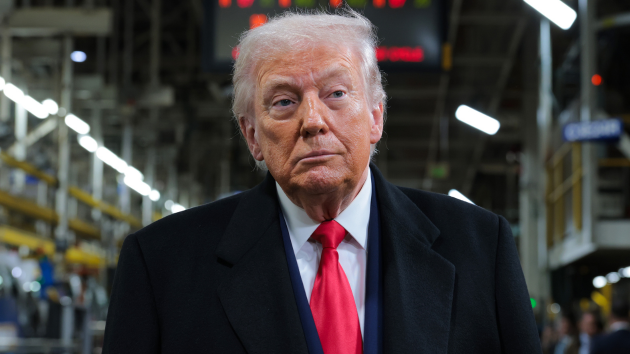
U.S. President Donald Trump tours the Ford River Rouge Complex on January 13, 2026, in Dearborn, Michigan. Trump is visiting Michigan where he will participate in a tour of the Ford River Rouge complex and later give remarks to the Detroit Economic Club. (Photo by Anna Moneymaker/Getty Images)

(WASHINGTON) — The Pentagon was expected to send additional military assets to the Middle East in coming days, according to several people familiar with the discussions, including possibly the USS Abraham Lincoln carrier strike group.

Such a move is considered a typical precaution at times of heightened tensions because of the 30,000 troops stationed throughout the region in countries like Qatar, Jordan, Syria and Iraq.

The added firepower would serve as a deterrent to attacks by adversaries against U.S. bases. But it also would give President Donald Trump additional options to strike Iran later if he chooses.

Examples of assets that could be surged include an aircraft carrier strike group accompanied by cruisers and missile destroyers, as well as Air Force fighter squadrons and land-based air missile defense systems.

Discussions of the additional military assets come as Trump threatened to attack Iran’s government because of violent clashes with protesters. Officials in Tehran responded by threatening to strike back at U.S. bases if he followed through.

According to one person familiar with the discussions this week, Trump was told that a military strike against Iran could be extraordinarily dangerous and potentially risk the lives of U.S. service members in the region, particularly if the government in Tehran felt it was on the brink of collapse. NBC News was first to report this detail.

On Wednesday, Trump told reporters he opted against strikes for now because the U.S. had been told “on good authority” that the killing of protestors in Iran had stopped. Trump also said Friday that 800 planned executions in Iran had been halted, a claim that could not be immediately verified.

In an interview with Fox News on Wednesday, Iranian Foreign Minister Abbas Araghchi denied Tehran had any plans to execute protesters.

Several sources said there had been long-running concerns among U.S. officials that the military didn’t have the right mix of assets in place to protect against a potential massive retaliatory strike from Iran, given that Trump had surged much of the military’s force to the Caribbean to support the capture of Venezuelan dictator Nicolas Maduro.

There is currently no aircraft carrier in the Middle East, although officials say there are six Navy ships, including three missile destroyers. The Pentagon declined to comment.

If the Lincoln is deployed to the Middle East from the South China Sea, it’s expected to take longer than a week to arrive. The USS Lincoln was spotted earlier this week on satellite sailing away from the Philippines.

ABC News’ Chris Looft contributed to this report.

Copyright © 2026, ABC Audio. All rights reserved.
Which states will host 1st Democratic primaries? DNC will decide amid momentum, diversity debates

Which states will host 1st Democratic primaries? DNC will decide amid momentum, diversity debates
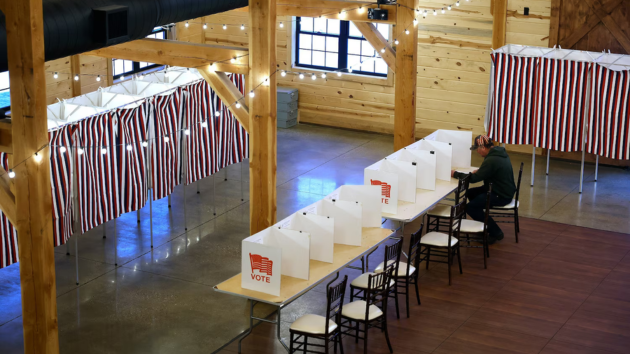
Voters cast their ballots in the New Hampshire presidential primary election at The Barn at Bull Meadow, January 23, 2024, in Concord, New Hampshire. Chip Somodevilla/Getty Images

(WASHINGTON) — Friday marks a key procedural deadline for how Democrats will figure out which states will hold the first presidential nominating contests of 2028, amid broader debates within the party over diversity and voter representation, and which states will show which candidates are viable for the long haul. 

The Democratic National Committee set a Friday afternoon deadline for state parties to apply to have their 2028 presidential nominating contests be held in the period before Super Tuesday, the first Tuesday in March during a presidential calendar year where the most primaries are held.

The order of the primaries and caucuses matters because the early contests help indicate which candidates have momentum and are striking a chord with voters, and often narrow the candidate field ahead of Super Tuesday.

The debate about the order is also about diversity and voter representation in the Democratic Party. Some Democrats have argued that states with larger Black and minority populations should be prioritized, to reflect the diversity of the country, while others say the party should prioritize traditional “early states,” such as New Hampshire, to spur turnout and buzz, even though their populations may be less diverse. 

Traditionally, Iowa has held first-in-the nation caucuses and New Hampshire has first-in-the-nation primaries. But in 2024, a reshuffled DNC primary calendar pushed the states from the first two slots on the party’s official calendar and officially put South Carolina first.

While Iowa Democrats found a compromise with the DNC by switching their in-person caucus to an entirely mail-in voting process, New Hampshire’s primaries were kept in January, causing conflict between the state and national party. 

Iowa Democratic Party Chair Rita Hart, in a statement to ABC News, said that the party is applying to hold its caucuses before Super Tuesday, and said Democrats need to keep Iowa toward the front of the line in order to stay competitive with Republicans.

“No matter what the Rules and Bylaws Committee decides, Republican presidential candidates will be in Iowa,” Hart wrote. “It was a mistake for the DNC to cut us out of the calendar, letting Republicans’ attacks go unanswered in Iowa while millions of dollars in advertising, organizing and the worldwide media flooded our state.”

Some state party leaders have said their states being early in the calendar will help candidates show if they can stick it out throughout 2028.

New Hampshire Democratic Party Chair Raymond Buckley said the case his party is making to the DNC is that New Hampshire is a prime state for 2028 candidates to build up support and to show their viability. He said its small size allows for easy campaigning in a purple state, “which is exactly what you need in the November general election.”

New Hampshire also has a state law requiring it to hold the nation’s first presidential primaries, which is what led in large part to the disarray in 2024 between the state party and the DNC. But Buckley said that it’s not a factor right now.

“It’s not about the tradition, it’s not about the law; it’s really about our involvement, and we just think that we have an unmatched record of being able to give the opportunity for candidates to talk to voters one-on-one,” Buckley said.

Buckley said New Hampshire’s population of union members, as well as the large percentage of students of color in the public school systems of the state’s two largest cities make it a great state for candidates to test the waters.

But the South Carolina Democratic Party said it wants to stay first in the calendar. 

Party Executive Director Jay Parmley told ABC News that the state is making its case to the DNC to remain in the early window because it’s compact and allows unknown candidates to compete. Also, Parmley said the state does not have a major population center, so candidates need to fan out across it. 

Regarding the debates surrounding diverse primary states, Parmley pointed to how the state has a “diverse electorate,” and highlighted its Black community. Around 1 in 4 registered voters in South Carolina are Black, according to data from the South Carolina Election Commission.

“Our Black electorate — it legitimizes and rewards the role of Black voters and as the backbone and soul, if you will, of the Democratic Party.”

Nevada’s Democratic Party also confirmed it’s submitting a bid to go early, arguing that galvanizing the state’s minority and working-class populations is critical for the Democrats. 

In a draft of their application, the state party wrote, “The Democratic Party is facing a critical moment where we must be strategic in our efforts to earn back Latino support, craft an economic message that resonates across the country, begin the work to reach working-class voters, and turn out diverse communities. We cannot afford to have overwhelmingly college-educated, white, or less competitive states kick off the process of selecting our party’s nominee.”

Michigan is also submitting a bid to be among the early states similar to how it was in 2024, the state’s party confirmed to ABC News — arguing in part that Michigan is the most important and diverse of the battleground states.

“For Democrats to have the strongest presidential candidate, the early nominating states should closely mirror Democratic voters nationwide and be representative of America,” Michigan Democratic Party Chair Curtis Hertel said in a statement to ABC News.

Illinois’, North Carolina’s and Georgia’s state Democratic parties also confirmed to ABC News that they are submitting bids. As Georgia’s state’s presidential primaries are usually held after Super Tuesday, they’d have to work with the Republican-dominated state legislature to move up the date.

Copyright © 2026, ABC Audio. All rights reserved.

Trump threatens tariffs for nations that don’t support his aim to acquire Greenland

Trump threatens tariffs for nations that don’t support his aim to acquire Greenland
Soldiers of the Bundeswehr, the German armed forces, arrive at Nuuk Airport, January 16, 2026 in Nuuk, Greenland. (Sean Gallup/Getty Images)

(WASHINGTON) — President Donald Trump on Friday said he is considering imposing tariffs on countries that don’t support his efforts to acquire Greenland, an autonomous Danish territory.

“I may put a tariff on countries if they don’t go along with Greenland, because we need Greenland for national security,” Trump said at an unrelated event on rural health care at the White House.

His comments leave many questions about what it would mean with recent U.S. trade agreements struck with European allies, particularly those with the United Kingdom and European Union.

Trump’s tariff threat comes after European nations have voiced objections to Trump’s repeated messaging about taking over Greenland, either by buying the island territory or by using military force.

In a show of support for Greenland, French President Emmanuel Macron said Thursday that a group of French troops were on the ground there to take part in military exercises with Danish forces and those from other NATO countries, including Germany, Norway, and Sweden.

Macron’s announcement came a day after top officials from Greenland and Denmark, following meeting with Vice President JD Vance and Secretary of State Marco Rubio at the White House, said “fundamental disagreements” remained with the Trump administration on the issue.

“It’s clear that the president has this wish of conquering over Greenland,” Danish Foreign Minister Lars Løkke Rasmussen told reporters after the meeting. Rasmussen called that outcome “totally unacceptable.”

Meanwhile, a bipartisan group of House members and senators on Friday touted “constructive” conversations with members of Denmark’s parliament during a delegation trip to Copenhagen.

The group — which included Republican Sen. Lisa Murkowski, Democratic Sen. Jeanne Shaheen, Democratic Sen. Chris Coons, Democratic Sen. Peter Welch, Democratic Sen. Dick Durbin, Republican Sen. Thom Tillis, Democratic Rep. Sarah Jacobs, Democratic Rep. Steny Hoyer and others — said the visit was to nurture the relationship between Denmark, Greenland and the United States and to reassure NATO partners that many members of Congress do not support any effort by the United States to acquire Greenland.

“I think it’s important that it be recognized that when it comes to matters of relationships with our friends, with our allies, as we have here in Denmark, as we have in Greenland, that it is — it is not a subject of Republicans versus Democrats. It is a recognition, again, of a strong and continuing relationship over decades,” Murkowski said.

Coons, who led the delegation, said the trip was designed for members of Congress to “listen respectfully” to NATO allies and to return to the United States “share those perspectives so that we can lower the temperature”.

“There’s a lot of rhetoric, but there’s not a lot of reality in the current discussion in Washington,” Coons said.

Aaja Chemnitz Larsen, one of Greenland’s representatives in the Danish parliament, said the group also discussed pressure that people in Greenland feel in light of President Trump’s recent rhetoric.

“We have also talked about the human dimension, the pressure that people are feeling back home in Greenland. I think it was well received, and of course, they understand the concerns that we have in Greenland,” Larsen said. 

Copyright © 2026, ABC Audio. All rights reserved.