
Scientists sue NIH, HHS, RFK Jr. over termination of research grants

Scientists sue NIH, HHS, RFK Jr. over termination of research grants
(boonchai wedmakawand/Getty Images)

(WASHINGTON) — Researchers who had millions of dollars’ worth of grants terminated by the National Institutes of Health (NIH) are suing the federal government in the hopes of stopping any further research cancellations.

The lawsuit was filed on Wednesday evening against the NIH and its director Dr. Jay Bhattacharya, as well as the Department of Health and Human Services (HHS) and HHS Secretary Robert F. Kennedy, Jr.

Among the plaintiffs are Dr. Brittany Charlton, an associate professor in the department of epidemiology at the Harvard T.H. Chan School of Public Health, who said all of her grants were terminated because they allegedly “no longer [effectuate] agency priorities,” according to termination letters.

“Why am I standing up? I am a scientist, and therefore not a lawyer, but I appreciate that contract law is complex, and yet NIH’s contract cancellations set off my alarm bell,” she told ABC News in a statement.

Co-plaintiffs include the American Public Health Association; Ibis Reproductive Health; and United Auto Workers as well as three other researchers.

Both the NIH and the HHS told ABC News that they don’t comment on ongoing litigation.

Over the past several weeks, active research grants related to studies involving LGBTQ+ issues, gender identity and diversity, equity and inclusion (DEI) have been canceled at the NIH because they allegedly do not serve the “priorities” of President Donald Trump’s administration.

As of late March, more than 900 grants have been terminated, an NIH official with knowledge of the matter, who asked not to be named, told ABC News.

The terminations come after Trump passed a flurry of executive orders including vowing to “defend women from gender ideology extremism,” which has led to new guidance, like that from HHS, which now only recognizes two sexes.

The administration has also issued several executive orders aiming to dismantle DEI initiatives.

In previous termination letters, viewed by ABC News, they state that, “Research programs based on gender identity are often unscientific, have little identifiable return on investment, and do nothing to enhance the health of many Americans. Many such studies ignore, rather than seriously examine, biological realities. It is the policy of NIH not to prioritize these research programs.”

The lawsuit alleges that the grant terminations are a “reckless and illegal purge to stamp out NIH-funded research that addresses topics and populations that they disfavor.”

Charlton said she was alarmed by Project 2025 — a nearly 1,000-page document of policy proposals unveiled by the Heritage Foundation during the 2024 campaign intended to guide the next conservative administration — which allegedly attacked fields like hers, centering on LGBTQ+ health research, as “junk gender science,” she said.

On the campaign trail, Trump tried to distance himself from Project 2025, saying he didn’t know anything about the proposals.

Five of Charlton’s grants were terminated, including a five-year grant, of which Charlton said she and her colleagues were in their fourth year, focused on documenting obstetrical outcomes for lesbian, gay and bisexual women, she said.

Another grant was focused on how to improve the experience of lesbian, gay and bisexual individuals who are trying to form their families, she said.

A third was research looking to understand how laws identified by the team as discriminatory affect mental health among LGBTQ+ teens and potentially lead to depression and suicide, according to Charlton.

Charlton said the cancellations are not only affecting her ability to conduct research but the ability to keep open the LGBTQ Health Center of Excellence — based at the Harvard T.H. Chan School of Public Health — of which she is the founding director.

“My current NIH research contracts are worth $15.9 million, of which $5.9 million still needs to be spent to finish our research,” Charlton said. “I have essentially no salary now, and I may need to shutter our newly launched LGBTQ Health Center of Excellence, which was a career goal of mine that I finally met when we launched less than a year ago.”

She went on, “These grant terminations may end my academic career, and I’ve already been forced to make really tough decisions like terminating staff, including our newly appointed center’s executive director.”

According to the lawsuit, Dr. Katie Edwards, a professor at the University of Michigan School of Social Work, has had at least six grants terminated worth about $11.9 million, including one studying sexual violence among men who fall under sexual minorities. She can no longer pay several of the roughly 50 staff members who are funded through the research grants, the lawsuit states.

Dr. Peter Lurie, president and CEO of the nonprofit Center for Science in the Public Interest, was a paid consultant and adviser on a grant evaluating the impacts of over-the-counter access to pre-exposure prophylaxis to reduce HIV transmission, according to the lawsuit. The grantee institution, Harvard Pilgrim Healthcare, received a termination letter from the NIH in late March, the lawsuit states.

Meanwhile Dr. Nicole Maphis — a postdoctoral fellow at the University of New Mexico’s School of Medicine — who was studying the link between alcohol use disorder and Alzheimer’s disease, applied for a MOSAIC grant, “intended to help diversify the profession,” according to the lawsuit. Her proposal was pulled and her current funding ends September 2025.

“Without additional funding, which the MOSAIC award would have provided, she will lose her job,” the lawsuit states.

Charlton said she is hopeful the lawsuit results in a preliminary injunction and therefore halts further NIH terminations.

“I believe these contracts are binding agreements and are constitutionally grounded,” she said. “It’s been less than 100 days since inauguration, and I’m concerned. Concerned about signs of growing authoritarianism, and yet there is absolutely hope executive orders can’t rewrite laws, and I pray courts ensure justice, pursuing truth, including via science, unites us, and it’s the only way to ensure a healthier future for all.”

Copyright © 2025, ABC Audio. All rights reserved.

Jobs report set to offer gauge of economic health amid Trump’s tariffs

Jobs report set to offer gauge of economic health amid Trump’s tariffs
(SimpleImages/Getty Images)

(NEW YORK) — Hiring data to be released on Friday will offer a gauge of the nation’s economic health, just a day after President Donald Trump’s sweeping new tariffs triggered a major stock selloff.

The jobs report, which details employer activity in March, is set to provide a snapshot of staff cuts imposed by the federal government last month amid cost-cutting efforts undertaken by the Department of Government Efficiency.

The fresh data may also offer clues about possible fallout from a previous round of tariffs imposed on Mexico, Canada and China at the outset of March.

Economists expect the U.S. to have added 140,000 jobs in March. That figure would mark a slight slowdown from hiring in the previous month, but it would still amount to solid job growth.

Despite escalating trade tensions and market turbulence since Trump took office in January, the economy remains in solid shape by several key measures.

The unemployment rate stands at a historically low level. Meanwhile, inflation sits well below a peak attained in 2022, though price increases register nearly a percentage point higher than the Fed’s goal of 2%.

“The economy is strong,” Fed Chair Jerome Powell said at a press conference in Washington, D.C., last month.

Tariffs announced earlier this week, however, threaten to derail hiring and worsen inflation, multiple analysts previously told ABC News.

The far-reaching levies increase the likelihood of a recession by driving up prices, sapping consumer spending, slowing business activity and risking layoffs, they said.

The White House plans to slap a 10% tax on all imported products and place additional duties on items from some of the largest U.S. trading partners, including China and the European Union.

“​​These policies, if sustained, would likely push the U.S. and global economy into recession this year,” J.P. Morgan said in a note to clients after the tariff announcement.

“Recession risks will likely rise,” Deutsche Bank added.

U.S. stocks plunged on Thursday in the first trading session after Trump unveiled the new tariffs.

The Dow Jones Industrial Average plummeted 1,679 points, or nearly 4%, while the tech-heavy Nasdaq declined almost 6%.

The S&P 500 tumbled 4.8%, marking its worst trading day since 2020.

Copyright © 2025, ABC Audio. All rights reserved.

South Korea Constitutional Court upholds Yoon’s impeachment

South Korea Constitutional Court upholds Yoon’s impeachment
(Photo by Chung Sung-Jun/Getty Images)

(SEOUL) — South Korea’s Constitutional Court upheld the impeachment of President Yoon Suk Yeol, whose short-lived declaration of martial law late last year plunged the country into political chaos, in a decision that removes the suspended leader from office.

The verdict was read in court shortly after 11 a.m. Friday local time (10 p.m. Thursday ET). Police across the country had been placed on the highest security alert level ahead of the verdict, with a security perimeter established around the court in Seoul, according to the Yonhap news agency.

With the court’s decision, Yoon is formally removed from office and South Korea will hold a snap presidential election within 60 days, according to the news agency.

Yoon was removed from office by the opposition-controlled National Assembly after declaring martial law in a televised speech on Dec. 3, claiming the opposition party sympathized with North Korea and was paralyzing the government.

The move sparked fierce protests, and several hours after the declaration, the National Assembly voted to demand that the president lift the martial law order.

Separate from his removal from office, Yoon was indicted by South Korean prosecutors on insurrection charges over the brief imposition of martial law.

An arrest warrant against him led to a standoff between his security team and police earlier this year.

In a dramatic scene, thousands of police descended on his home and were met with crowds of the impeached president’s backers, including some who lay down in front of police vehicles in an attempt to block authorities from reaching the residence.

Yoon was eventually arrested several days later and held in custody until March 8.

Copyright © 2025, ABC Audio. All rights reserved.

US stock futures slump amid escalating tariff fallout

US stock futures slump amid escalating tariff fallout
(lvcandy/Getty Images)

(NEW YORK) — Stock markets continued their slide on Friday morning, as the shockwaves of President Donald Trump’s “Liberation Day” tariffs continued to reverberate around the globe.

U.S. stock futures slipped further, with Dow Jones futures plummeting nearly 1,100 points — or 2.68% — on Friday morning. S&P 500 futures slid 137.5 points or 2.53% and NASDAQ futures were down 510.25 points or 2.73%.

Global markets gave early signals of the difficult to come on Friday. Japan’s Nikkei index lost 3.5% on Friday, while the broader Japanese Topix index fell 4.45%.

In South Korea, the KOSPI index was down 1.7%, with the country grappling with both Trump’s tariffs and the news that South Korea’s Constitutional Court upheld the impeachment of President Yoon Suk Yeol.

Indian investors joined the sell-off on Friday, with the Nifty 50 and BSE Sensex indexes both falling more than 1%. India’s stock markets had previously performed better than others thanks to lower tariffs than competitors like China, Indonesia and Vietnam.

Australia’s S&P/ASX, meanwhile, continued its slide into Friday with another 2% drop taking the index to an 8-month low.

In Europe, too, stock markets fell upon opening. Britain’s FTSE 100 index dropped more than 1%, Germany’s DAX fell 0.75%, France’s CAC lost 0.9% and Spain’s IBEX slipped 1.4%.

Trump’s Wednesday announcement of tariffs on nearly all American trade partners sent U.S. and foreign markets alike into a tailspin.

All three major American stock markets closed down on Thursday, marking their worst day since June 2020 during the COVID-19 pandemic.

The NASDAQ fell 6%, the S&P 500 4.8% and the Dow Jones nearly 4%.

Major companies were among those struggling. Nike plummeted 14% while Apple fell 9%. E-commerce giant Amazon slid nearly 9%.

Shares fell for each of the other so-called “Magnificent Seven,” a group of large tech firms that helped drive stock market gains in recent years.

Meta, the parent company of Facebook and Instagram, dropped nearly 9%. Chipmaker Nvidia slid 7%.

Tesla, the electric carmaker led by Trump-advisor Elon Musk, declined 5%.

Shares of U.S. retailers that depend largely on imported products also tumbled, with Dollar Tree down 13% and Five Below seeing 27% losses..

ABC News’ Leah Sarnoff, Max Zahn, Victor Ordoñez and Zunaira Zaki contributed to this report.

Copyright © 2025, ABC Audio. All rights reserved.
Kidney donor expected to be released by ICE after appeal to save his brother’s life

Kidney donor expected to be released by ICE after appeal to save his brother’s life
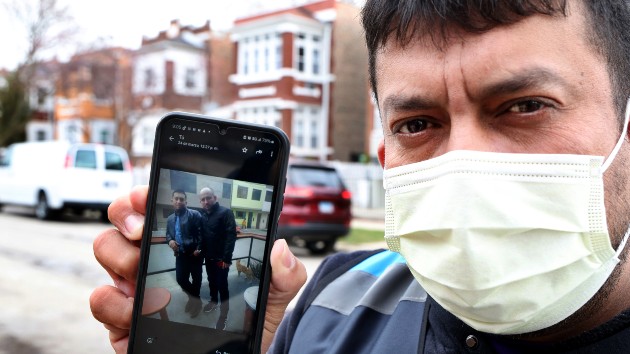
Alfredo Pacheco, a Venezuelan migrant who earlier this year was diagnosed with end-stage kidney failure, displays a photo of himself and his brother Jose Gregorio Gonzalez, March 26, 2025, in Cicero, Illinois. Gonzalez, also a migrant from Venezuela, was set to donate a kidney for his brother but was arrested and now detained by ICE. (Antonio Perez/Chicago Tribune/Tribune News Service via Getty Images)

(BROADVIEW, Ill.) — A man who was detained by Immigration and Customs Enforcement (ICE) earlier this month is expected to be released on Friday from a facility in Broadview, Illinois, after community advocates and officials appealed for his release so he can resume the kidney donation process in hopes of saving his brother’s life.

ICE records show that Jose Gregorio Gonzalez, a native of Venezuela who was detained on March 3 in Illinois, is being held in the Clay County Jail in Brazil, Indiana. But Peter Meinecke, an attorney representing Gonzalez, told ABC News on Wednesday that his client is expected to be released from ICE detention by Friday.

“I was in communication with the officer assigned to his case today. It sounds like they are going to release him under humanitarian parole, so that is still being coordinated,” Meinecke said. “The logistics of his release are not yet confirmed with ICE, but potentially as early as Friday, he could be released, and at which point he would be able to pursue the kidney donation. I don’t have any specifics regarding the duration of release.”

The duration and the conditions of Gonzalez’s expected release are unclear. ABC News reached out to ICE, but requests for comment were not returned.

Meinecke, an attorney with The Resurrection Project — a group advocating for Gonzalez’s release — told ABC News that Gonzalez’s brother, Jose Alfredo Pacheco, who suffers from kidney failure, reached out to the group earlier this month seeking support after Gonzalez was detained.

Speaking in Spanish, Pacheco addressed a crowd of supporters during a press conference on Monday and called for his brother’s release.

“My health is at serious risk—I have 100% kidney failure and depend on dialysis three times a week,” he said, according to a translation provided by The Resurrection Project.

“It’s extremely difficult—sometimes, I can barely get out of bed. I have three children, nine-year-old twins and a 17-year-old back home, and I want to live to see them grow up. My brother used to take me to my appointments, but now I’m alone. My brother is a good man, not a criminal in Venezuela or here—he came only with the hope of donating his kidney to me. I thought I was alone, but seeing the support of this community has moved me deeply.”

Meinecke said that he had been in touch with Gonzalez’s ICE officer over the past few weeks and submitted a request for release on temporary humanitarian parole on March 25.

“He needs to show that his release is either in the public interest or is necessary for like, urgent humanitarian factors. And in his case, we argue both,” Meinecke said. “You know, obviously, the medical conditions kind of speak to both. They’re both urgent humanitarian factors by now, but organ donation is in the public interest as well.”

Meinecke explained that Pacheco was admitted into the U.S. from Venezuela in 2023 and was permitted to apply for asylum, so he has a work permit while his asylum application is pending. His wife and three children remain in Venezuela. But soon after he arrived in the U.S., he suffered from stomach pain and was diagnosed with “end-stage kidney failure,” Meinecke said.

“He went to the hospital with severe abdominal pain, which is when he was diagnosed with end-stage kidney failure,” Tovia Siegel, director of organizing and leadership at the Resurrection Project, told ABC News on Wednesday. “At the time, he was told he had 2 percent functioning of his kidneys and would need dialysis consistently, multiple times a week to survive, and really, his best chance to live a full, healthy life would be a kidney transplant.”

Since his diagnosis in 2023, Pacheco’s condition has deteriorated, Siegel said.

“[Alfredo] currently receives [dialysis] three times a week, from 4 am to 8 am, and his brother Jose came here to help care for him, and with the intention of being able to donate his kidney and save Alfredo’s life,” Siegel said. “And so for the last year, Jose has essentially been a full-time caretaker for Alfredo, helping with cooking, cleaning, etc, and with the intent to donate his kidney.”

But unlike Pacheco, when Gonzalez arrived to the U.S. from Venezuela “primarily to assist” his brother, he failed to pass the credible fear screening, which did not allow him to apply for asylum like Pacheco had done, according to Meinecke, so he was detained by ICE for several months and then he was granted temporary supervised release but still faced a pending removal order. During his time on supervised release, Gonzalez routinely checked in with his ICE officer, provided his address and wore an ankle monitor, Meinecke said.

Siegel said that Gonzalez was detained while the brothers were leaving their home to go to Pacheco’s kidney dialysis appointment.

“It was shocking and devastating,” she said. “They had been living life together, and an incredibly difficult life where one of the brothers was undergoing incredible medical distress and suffering.”

“They were taking care of one another and surviving for a year together,” she added. “And during that time, clearly, you know, caring deeply for one another, loving each other as family members do. Jose [Gregorio] had no contact with police, the criminal legal system, and then one morning, with, you know, completely unexpected, ICE came to their home.”

Gonzalez’s expected release comes after ICE denied on Monday a stay of removal request submitted by his attorneys and then the case was elevated to an ICE Chicago Field Supervisor, according to The Resurrection Project.

“This is literally a matter of life and death,” said Erendira Rendón, vice president of Immigrant Justice at The Resurrection Project. “ICE has the discretionary authority to release Mr. Gonzalez on humanitarian grounds. Every day he remains detained is another day his brother’s life hangs in the balance.”

Copyright © 2025, ABC Audio. All rights reserved.

Stock markets slide deeper amid Trump tariffs fallout

US stock futures slump amid escalating tariff fallout
(lvcandy/Getty Images)

(NEW YORK) — Key foreign stock markets continued their slide after opening on Friday morning, as the shockwaves of President Donald Trump’s “Liberation Day” tariffs continued to reverberate around the globe.

Japan’s Nikkei index lost 3.5% on Friday, while the broader Japanese Topix index fell 4.45%.

In South Korea, the KOSPI index was down 1.7%, with the country grappling with both Trump’s tariffs and the news that South Korea’s Constitutional Court upheld the impeachment of President Yoon Suk Yeol.

Indian investors joined the sell-off on Friday, with the Nifty 50 and BSE Sensex indexes both falling more than 1%. India’s stock markets had previously performed better than others thanks to lower tariffs than competitors like China, Indonesia and Vietnam.

Australia’s S&P/ASX, meanwhile, continued its slide into Friday with another 2% drop taking the index to an 8-month low.

In Europe, too, stock markets fell upon opening. Britain’s FTSE 100 index dropped more than 1%, Germany’s DAX fell 0.75%, France’s CAC lost 0.9% and Spain’s IBEX slipped 1.4%.

Trump’s Wednesday announcement of tariffs on nearly all American trade partners sent U.S. and foreign markets alike into a tailspin.

All three major American stock markets closed down on Thursday, marking their worst day since June 2020 during the COVID-19 pandemic.

The NASDAQ fell 6%, the S&P 500 4.8% and the Dow Jones nearly 4%

Major companies were among those struggling. Nike plummeted 14% while Apple fell 9%. E-commerce giant Amazon slid nearly 9%.

Shares fell for each of the other so-called “Magnificent Seven,” a group of large tech firms that helped drive stock market gains in recent years.

Meta, the parent company of Facebook and Instagram, dropped nearly 9%. Chipmaker Nvidia slid 7%.

Tesla, the electric carmaker led by Trump-advisor Elon Musk, declined 5%.

Shares of U.S. retailers that depend largely on imported products also tumbled, with Dollar Tree down 13% and Five Below seeing 27% losses..

Stock futures suggested more pain for investors. Dow Jones, S&P 500 and NASDAQ futures were all down around 1% on Friday morning.

ABC News’ Leah Sarnoff, Max Zahn, Victor Ordoñez and Zunaira Zaki contributed to this report.

Copyright © 2025, ABC Audio. All rights reserved.

USA Fencing disqualifies athlete for refusing to compete against transgender woman

USA Fencing disqualifies athlete for refusing to compete against transgender woman
(Hill Street Studios/Getty Images)

(WASHINGTON) — A female fencer was disqualified from a competition for refusing to compete against a transgender opponent, USA Fencing said in a statement to ABC News on Thursday.

The incident occurred last month at a USA Fencing-sanctioned regional tournament where fencer Stephanie Turner decided to remove her mask and take a knee instead of competing against Redmond Sullivan, a transgender woman.

Following the act of protest, the referee of the University of Maryland match — which was not an NCAA tournament — issued a black card to Turner, removing her from the competition.

USA Fencing’s current transgender and non-binary athlete policy was enacted in 2023 and allows athletes to participate in sanctioned events “in a manner consistent with their gender identity/ expression, regardless of the gender associated with the sex they were assigned at birth.”

USA Fencing told ABC News on Thursday that the decision to disqualify Turner from the tournament was “not related to any personal statement” but because she refused to fence an “eligible opponent.”

Sullivan transferred to the Wagner College women’s fencing team from the men’s team in 2024.

“We understand that the conversation on equity and inclusion pertaining to transgender participation in sport is evolving,” USA Fencing said in a statement, adding that the organization “will always err on the side of inclusion, and we’re committed to amending the policy as more relevant evidence-based research emerges, or as policy changes take effect in the wider Olympic & Paralympic movement.”

In a statement to ABC News on Thursday, Turner detailed the moment she took a knee and decided not to compete against Sullivan.

“As a woman fencing in a women’s tournament, I do not believe men should fence in my category. I was not aware Mr. Sullivan was registered until the night before the tournament. I prayed about it and decided if Mr. Sullivan and I were to fence face-to-face, then I would peaceably protest by taking a knee,” Turner said, misgendering Sullivan.

Turner said she has previously refused to fence in tournaments in which she knew a transgender athlete was going to compete, including the 2023 Summer Nationals.

“I want to thank God for trusting me with this mission to fight for female-exclusive sports and putting me in a place to effectively protest,” Turner added.

ABC News has reached out to Redmond Sullivan for a comment. The University of Maryland declined to comment on the incident.

The incident between Turner and Sullivan comes amid a wider debate surrounding transgender athletes in women’s and girls’ sports.

In February, President Donald Trump signed an executive order banning transgender athletes from participating in women’s sports, fulfilling a promise that was at the center of his 2024 campaign.

Titled “Keeping Men Out of Women’s Sports,” the order mandates immediate enforcement, including against schools and athletic associations that “deny women single-sex sports and single-sex locker rooms,” according to the document, and directs state attorneys general to identify best practices for enforcing the mandate.

Opponents of the federal order said at the time that Trump’s action would lead to increased discrimination and harassment.

“This order could expose young people to harassment and discrimination, emboldening people to question the gender of kids who don’t fit a narrow view of how they’re supposed to dress or look,” Human Rights Campaign President Kelley Robinson said in a statement at the time. “Participating in sports is about learning the values of teamwork, dedication, and perseverance. And for so many students, sports are about finding somewhere to belong. We should want that for all kids — not partisan policies that make life harder for them.”

Proponents say, however, Trump’s federal direction brings clarity at the federal level.

“We’re a national governing body and we follow federal law,” NCAA President Charlie Baker told Republican senators at a hearing in December. “Clarity on this issue at the federal level would be very helpful.”

Copyright © 2025, ABC Audio. All rights reserved.

Rubio in hot seat as he faces European leaders at NATO headquarters

Rubio in hot seat as he faces European leaders at NATO headquarters
Omar Havana/Getty Images

(BRUSSELS) — Secretary of State Marco Rubio is visiting NATO’s headquarters in Brussels for a meeting of the alliance’s foreign ministers, putting him on the front lines of the Trump administration’s push against traditional American allies in Europe.

European leaders were already bracing for a contentious gathering. President Donald Trump’s decision to pull back aid from Ukraine amid its efforts to fight off Russia’s invasion marked a dramatic break with other allies, while his decision to engage Moscow in direct, one-on-one negotiations has left the continent’s diplomats back on their heels.

But on Wednesday, shortly before Rubio was set to depart for Belgium, Trump unveiled sweeping new “reciprocal” tariffs — including a 20% tax on imports from the European Union.

So far, Rubio has declined to address the tariff issue head on, but his Canadian counterpart said the global economic shock made it difficult to focus on the meeting’s pressing agenda.

“Clearly we’re passing that message to our American counterparts that it’s difficult to have these [NATO] conversations in the context of a trade war,” Foreign Minister Mélanie Joly said in an interview with CNN.

Rubio has also tried to skirt another topic of contention: Trump’s stated desire to “get” Greenland for the United States by any means necessary.

Rubio met with Danish Foreign Minister Lars Lokke Rasmussen on the sidelines of the NATO ministerial but didn’t respond to reporters’ questions asking what he would say about Greenland during the session. The State Department also made no mention of the Danish autonomous territory in its readout of the engagement.

“Secretary Rubio reaffirmed the strong relationship between the United States and the Kingdom of Denmark,” State Department spokeswoman Tammy Bruce said. “They discussed shared priorities including increasing NATO defense spending and burden sharing and addressing the threats to the alliance, including those posed by Russia and China.”

Rasmussen later said his meeting with Rubio was “good” but that while Greenland was not on the agenda “for many reasons,” he had still taken the opportunity “to very strongly object to claims and presidential statements of a vision of acquiring Greenland.”

It has amounted to a situation in which it’s not within the limits of international law,” he said, calling it “an attack on Danish sovereignty.”

“We have seen these statements from the president, and we can’t accept that,” Rasmussen added. “And I made it very, very clear.”

Rubio and Rasmussen’s meeting comes just days after Vice President J.D. Vance visited Greenland alongside his wife, Usha Vance, and national security adviser Mike Waltz.

The second lady was originally scheduled to headline the trip and spend several days on the world’s largest island, taking in Greenlandic cultural sites, but the visit sparked backlash from Greenland’s interim government and Danish leaders who noted an invitation was never extended.

In the aftermath, the White House added the vice president to the traveling delegation and whittled down the itinerary, shortening the trip to a one-day stop at a remote American military base in northwestern Greenland.

Rubio has taken a more measured approach in his comments about Greenland than the president, but he still emphasized what he said are the pressing U.S. national security concerns surrounding control of the island.

“This is not a joke,” Rubio said in January. “This is not about acquiring land for the purpose of acquiring land. This is in our national interest, and it needs to be solved.”

At NATO Headquarters on Thursday, Rubio tried to reassure allies that despite the president’s mixed signals, the Trump administration still views the alliance as central to U.S. security.

“President Trump’s made clear he supports NATO. We’re going to remain in NATO,” he said.

Still, Rubio pushed the administration’s message that allies need to increase their defense spending — calling on all of the alliance’s members to commit to putting up to 5% of their annual GDP toward it, a sharp uptick from the previous 2% benchmark.

“We do want to leave here with an understanding that we are on a pathway, a realistic pathway,” he said. “That includes the United States that will have to increase its percentage.”

Copyright © 2025, ABC Audio. All rights reserved.

Kentucky Bourbon industry caught in middle of global tariff war

Kentucky Bourbon industry caught in middle of global tariff war
Bryan Woolston/Getty Images

(NEW YORK) — The Kentucky bourbon industry said it is reeling from retaliatory actions taken by Canada and the European Union in response to President Donald Trump’s trade war against both global regions.

More than 90% of the world’s bourbon is from Kentucky, which advocates say is now jeopardized.

Last month, the EU announced it plans to impose a 50% tariff on all American whiskey in response to Trump’s decision to bring back tariffs on overseas steel and aluminum imports. Trump said on social media that he would retaliate by levying 200% tariffs on all wines, champagne and other alcoholic products imported from the region should the EU move forward with its spirits tariff. The EU will make its final decision on April 13.

Meanwhile, Canadian Prime Minister Justin Trudeau said Ottawa is imposing 25% tariffs on U.S. imports in response to Trump’s measures. In addition, the government-run Liquor Control Board of Ontario ordered all retailers, bars and restaurants to stop selling American products. The board reported that U.S. alcohol sold within the province accounts for “annual sales of up to $965 million,” representing “more than 3,600 products from 35 US states.”

New Brunswick and Quebec both passed similar restrictions by ordering all American spirits brands removed from retail shelves.

The import tariffs, Trump wrote, “will be great for the wine and champagne businesses in the U.S.”

Chris Swonger, president and CEO of the Distilled Spirits Council, a Washington-based trade group, disagrees, telling ABC News that rising tariffs on both sides are “catastrophic.”

“Our industry is collateral damage as the result” of the trade war, he said. “Which is unfortunate because American consumers love Canadian whiskey, and European consumers love American whiskey and vice versa.” Likewise, the Kentucky Distillers’ Association said, “retaliatory measures against bourbon harm these markets and jeopardize growth for years to come.”

Canada was the largest importer of Kentucky-made spirits, including bourbon, before the current trade war. In 2023, the state exported $43 million worth of whiskey to Canada, according to the latest data on the Canadian government’s website. Kentucky imported more than $40 million in whiskey from Canada that same year.

The issue is uniting Kentucky lawmakers from both parties. Democratic Gov. Andy Beshear and Republican Senators Mitch McConnell and Rand Paul have all blasted the tariffs, saying they will hurt jobs and sink the economy of the state.

“From bourbon distillers to car manufacturers to makers of fences to the builders of homes, to our farmers, nobody in Kentucky is coming up to me and say, ‘please put tariffs on things.’ We need to back away from this,” Paul said.

Swonger said the spirits industry has flourished because of a zero-for-zero tariff agreement among 51 countries around the world, which has allowed 3,1000 distillers to grow within the U.S. In Kentucky, the trade war will likely be hardest for small craft distilleries, many of which could “shut down trying to export to markets” impacted by the tariffs.

“Building a brand takes time. If you’re a little craft distillery going to an international market, it takes time and effort to talk to buyers. A massive tariff will shut that down,” he said.

That’s the worry of Victor Yarbrough, CEO of Brough Brothers Bourbon in Kentucky, which opened in 2020 and became the first African American-owned distillery in the state. Yarbrough said 2025 was planned as “a year of growth and expansion” for his company, which meant opening a second distillery and, for the first time, exporting to other countries, including Canada.

He told ABC News he was in negotiations with suppliers in New Brunswick in January, “when the tariff situation came out of nowhere.”

“It suspended our deal indefinitely,” as a result, Yarbrough said.

The tariffs imposed by the U.S., followed by the retaliatory tariffs from export countries, “shuttered our ability to go into these markets,” Yarbrough said. “And they’re huge markets. Ultimately, it reduces our ability to sell our product abroad.

He said in response that his company will focus on the 27 U.S. states where his product is not yet available. He is also looking at countries like Brazil and Colombia where the tariff war has not yet hit. The uncertainty, for him, is that that could change.

“I’m just the small bourbon producer being caught in the middle of it,” he said. “I hope we come to accord on both sides.”

Copyright © 2025, ABC Audio. All rights reserved.

‘Numerous people’ stabbed in DC, suspect in custody: Police

‘Numerous people’ stabbed in DC, suspect in custody: Police

(WASHINGTON) — “Numerous people” have been stabbed in Washington, D.C., on Thursday, police said.

A suspect is in custody, police said.

Seven people were transported from the scene to the hospital, according to a D.C. Fire and EMS spokesperson.

The stabbing incident occurred in the area of Meigs Place and Montello Avenue NE, D.C. police said on X.

Authorities did not provide details on their conditions.

The stabbing incident occurred in the area of Meigs Place and Montello Avenue NE, D.C. police said on X.

Authorities did not provide details on their conditions.

This is a developing story. Please check back for updates.

Copyright © 2025, ABC Audio. All rights reserved.