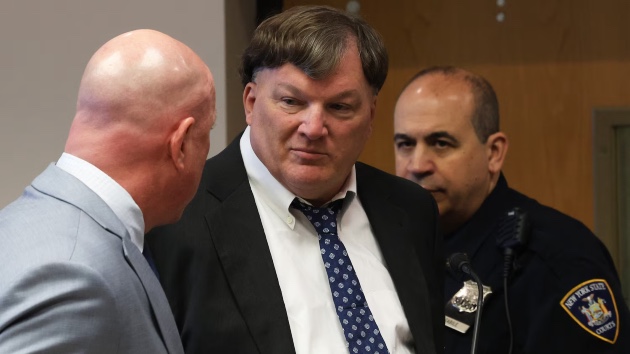
Rex A. Heuermann pleads guilty in court to the murders of eight women during a 17-year killing spree on April 8, 2026 in Riverhead, New York. (James Carbone/Pool/Getty Images)
(NEW YORK) — Gilgo Beach serial killer Rex Heuermann addressed by victims’ families at sentencing: ‘Disgusting coward’
Anguished relatives of the Gilgo Beach, New York, serial killing victims aimed decades of anger at their loved ones’ killer, Rex Heuermann, as they read victim impact statements at his sentencing on Wednesday.
“I can’t even put into words the eviscerating hatred I have for you,” said Jasmine Robinson, cousin of victim Jessica Taylor, who would have turned 43 on Wednesday. “You fill me with so much repugnance.”
Another cousin, Violet Swager, remembered Taylor as “fierce, kind, compassionate, beautiful and intelligent.”
She said to Heuermann, “You chose small women because you’re nothing more than a weak, disgusting coward.”
In April, Heuermann, 62, pleaded guilty to killing seven women: Taylor, Melissa Barthelemy, Megan Waterman, Maureen Brainard-Barnes, Amber Lynn Costello, Valerie Mack and Sandra Costilla. He also admitted to killing an eighth woman, Karen Vergata, though he was not formally charged in her death.
Brainard-Barnes’ sister Missy Cann broke down in tears as she read a statement prior to the imposition of the sentence.
“You are a coward who preyed on vulnerable, innocent women,” Cann said.
Mack’s parents, Ed and JoAnn Mack, said Heuermann robbed their daughter of the chance to achieve her dreams.
“I would like to say to Mr. Heuermann, what you have done to our family is beyond what words can express,” JoAnn Mack said. “Even though justice is done, it cannot replace what you have taken from us.”
At the April hearing, Heuermann agreed to serve three consecutive life sentences followed by four consecutive sentences of 25 years-to-life, according to prosecutors.
Prosecutors said the New York City architect targeted sex workers, strangled them and dumped their bodies near Long Island’s Gilgo Beach over the course of 17 years.
Heuermann “walked among us, play acting as a normal, suburban dad, when in reality, all along, he was obsessively targeting innocent women for death,” Suffolk County District Attorney Ray Tierney said in April.
The Gilgo Beach cases went unsolved for years, until Heuermann’s arrest in 2023.
Since then, Heuermann has been in custody at the Riverhead Correctional Facility. While in jail, Heuermann has been reading books about murder and serial killers, and he’s communicated with Keith Hunter Jesperson, a 1990s serial killer known as the Happy Face Killer, Suffolk County Sheriff Errol Toulon told ABC News.
Defense attorney Michael Brown said in April that the decision to plead guilty belonged solely to Heuermann. Brown said Heuermann would likely have more to say at sentencing.
Part of Heuermann’s plea agreement also requires him to be interviewed by the FBI’s behavioral analysis unit.
Rex A. Heuermann pleads guilty in court to the murders of eight women during a 17-year killing spree on April 8, 2026 in Riverhead, New York. (James Carbone/Pool/Getty Images)
(NEW YORK) — Gilgo Beach serial killer Rex Heuermann addressed by victims’ families at sentencing: ‘Disgusting coward’
Anguished relatives of the Gilgo Beach, New York, serial killing victims aimed decades of anger at their loved ones’ killer, Rex Heuermann, as they read victim impact statements at his sentencing on Wednesday.
“I can’t even put into words the eviscerating hatred I have for you,” said Jasmine Robinson, cousin of victim Jessica Taylor, who would have turned 43 on Wednesday. “You fill me with so much repugnance.”
Another cousin, Violet Swager, remembered Taylor as “fierce, kind, compassionate, beautiful and intelligent.”
She said to Heuermann, “You chose small women because you’re nothing more than a weak, disgusting coward.”
In April, Heuermann, 62, pleaded guilty to killing seven women: Taylor, Melissa Barthelemy, Megan Waterman, Maureen Brainard-Barnes, Amber Lynn Costello, Valerie Mack and Sandra Costilla. He also admitted to killing an eighth woman, Karen Vergata, though he was not formally charged in her death.
Brainard-Barnes’ sister Missy Cann broke down in tears as she read a statement prior to the imposition of the sentence.
“You are a coward who preyed on vulnerable, innocent women,” Cann said.
Mack’s parents, Ed and JoAnn Mack, said Heuermann robbed their daughter of the chance to achieve her dreams.
“I would like to say to Mr. Heuermann, what you have done to our family is beyond what words can express,” JoAnn Mack said. “Even though justice is done, it cannot replace what you have taken from us.”
At the April hearing, Heuermann agreed to serve three consecutive life sentences followed by four consecutive sentences of 25 years-to-life, according to prosecutors.
Prosecutors said the New York City architect targeted sex workers, strangled them and dumped their bodies near Long Island’s Gilgo Beach over the course of 17 years.
Heuermann “walked among us, play acting as a normal, suburban dad, when in reality, all along, he was obsessively targeting innocent women for death,” Suffolk County District Attorney Ray Tierney said in April.
The Gilgo Beach cases went unsolved for years, until Heuermann’s arrest in 2023.
Since then, Heuermann has been in custody at the Riverhead Correctional Facility. While in jail, Heuermann has been reading books about murder and serial killers, and he’s communicated with Keith Hunter Jesperson, a 1990s serial killer known as the Happy Face Killer, Suffolk County Sheriff Errol Toulon told ABC News.
Defense attorney Michael Brown said in April that the decision to plead guilty belonged solely to Heuermann. Brown said Heuermann would likely have more to say at sentencing.
Part of Heuermann’s plea agreement also requires him to be interviewed by the FBI’s behavioral analysis unit.
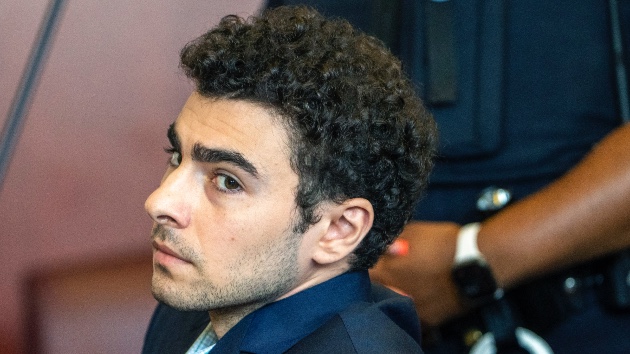
Luigi Mangione appears at an evidence suppression hearing at Manhattan Supreme Court on May 18, 2026 in New York City. Mangione is charged with murder in the fatal shooting of UnitedHealthcare CEO Brian Thompson in Manhattan in December 2024. (Photo by Steven Hirsch-Pool/Getty Images)
(NEW YORK) — Attorneys for Luigi Mangione plan to present an “affirmative psychiatric defense” at his state trial, alleging he was suffering an “extreme emotional disturbance” at the time of the killing of UnitedHealthcare CEO Brian Thompson, Judge Gregory Carro said at a hearing Wednesday.
Carro ordered Mangione’s attorneys to turn over his psychiatric records to prosecutors immediately.
Carro also agreed to dismiss one of the criminal counts related to possession of a large capacity ammunition magazine.
Prosecutors consented to drop the charge after a ruling earlier this year that prohibited them from using the magazine at trial because it was improperly searched by the officers who arrested Mangione in Pennsylvania.
Mangione pleaded not guilty to state and federal charges after he was arrested for allegedly gunning down Thompson, a husband and father of two, on a Midtown Manhattan street in December 2024.
Mangione’s state trial is scheduled to begin on Sept. 8 and his federal trial is set for next year.
Luigi Mangione appears at an evidence suppression hearing at Manhattan Supreme Court on May 18, 2026 in New York City. Mangione is charged with murder in the fatal shooting of UnitedHealthcare CEO Brian Thompson in Manhattan in December 2024. (Photo by Steven Hirsch-Pool/Getty Images)
(NEW YORK) — Attorneys for Luigi Mangione plan to present an “affirmative psychiatric defense” at his state trial, alleging he was suffering an “extreme emotional disturbance” at the time of the killing of UnitedHealthcare CEO Brian Thompson, Judge Gregory Carro said at a hearing Wednesday.
Carro ordered Mangione’s attorneys to turn over his psychiatric records to prosecutors immediately.
Carro also agreed to dismiss one of the criminal counts related to possession of a large capacity ammunition magazine.
Prosecutors consented to drop the charge after a ruling earlier this year that prohibited them from using the magazine at trial because it was improperly searched by the officers who arrested Mangione in Pennsylvania.
Mangione pleaded not guilty to state and federal charges after he was arrested for allegedly gunning down Thompson, a husband and father of two, on a Midtown Manhattan street in December 2024.
Mangione’s state trial is scheduled to begin on Sept. 8 and his federal trial is set for next year.
Luigi Mangione appears at an evidence suppression hearing at Manhattan Supreme Court on May 18, 2026 in New York City. Mangione is charged with murder in the fatal shooting of UnitedHealthcare CEO Brian Thompson in Manhattan in December 2024. (Photo by Steven Hirsch-Pool/Getty Images)
(NEW YORK) — Attorneys for Luigi Mangione plan to present an “affirmative psychiatric defense” at his state trial, alleging he was suffering an “extreme emotional disturbance” at the time of the killing of UnitedHealthcare CEO Brian Thompson, Judge Gregory Carro said at a hearing Wednesday.
Carro ordered Mangione’s attorneys to turn over his psychiatric records to prosecutors immediately.
Carro also agreed to dismiss one of the criminal counts related to possession of a large capacity ammunition magazine.
Prosecutors consented to drop the charge after a ruling earlier this year that prohibited them from using the magazine at trial because it was improperly searched by the officers who arrested Mangione in Pennsylvania.
Mangione pleaded not guilty to state and federal charges after he was arrested for allegedly gunning down Thompson, a husband and father of two, on a Midtown Manhattan street in December 2024.
Mangione’s state trial is scheduled to begin on Sept. 8 and his federal trial is set for next year.
Flint Hills, Kansas near Tallgrass Prairie National Preserve. (Wolfgang Kaehler/LightRocket via Getty Images)
(NEW YORK) — America has lost about half of one of its most prominent and iconic landscapes, and protecting what’s left is key to ensuring healthy ecosystems and biodiversity in the future, experts told ABC News.
The continental U.S. has lost about half of its historic grasslands prior to European settlement, according to a press release from America’s Grasslands Coalition, a network of conservation organizations, researchers and government agencies that aims to restore North America’s native prairie and grassland ecosystems. An estimated 98% of native tall grass prairies has been eradicated, Ryan Sensenig, a grassland ecologist at the University of Notre Dame, told ABC News.
While grasslands are typically associated with the Great Plains, they used to exist in nearly every region of the U.S., Dwayne Estes, co-founder and executive director of the Southeastern Grasslands Institute told ABC News.
Grasslands were common everywhere from the Atlantic coastlines to the Mississippi River and into the Rocky Mountains and the West Coast, according to experts. Regions that are not typically associated with grasslands, including New York, Maryland, Virginia, North Carolina and Florida, were covered in them, Estes said.
They are part of the very fabric of North America’s natural heritage, “from sea to shining sea,” Patrick Keyser, director of Tennessee’s Center for Native Grasslands, told ABC News.
Grasslands continue to be threatened, experts say
Today, grasslands continue to disappear at an “alarming rate,” the coalition said.
Invasive plant species have infiltrated many of the natural grasslands, said David Wedin, director of the University of Nebraska’s Center for Grassland Studies. And most recently, development of housing, shopping malls and interstate highways — and now data centers — are popping up in areas that would have been grasslands, Keyser said.
Currently, grasslands cover about 1 million square miles in the continental U.S., according to America’s Grasslands Coalition. This includes savannahs and shrublands.
The most prominent pockets of native grasslands that still exist today are in the Flint Hills of Kansas, which contains about 4.5 million acres of grasslands, and the Nebraska Sandhills, which has about 12 million acres of grasslands.
The area of Nebraska is still an intact grassland. Much of the land is privately owned cattle ranches, but there is still a lot of native grassland and species left there, Wedin said.
Central Montana also contains scattered patches of native grasslands, Keyser said.
There are more than 1,000 native grasses that have been documented in the U.S. The two species of dominant native grasslands in the U.S. include the big bluestem, a robust grass that can grow to 10 feet tall and make for “excellent” cattle forage, and the little blue stem, a much smaller plant that is common on sandier, drier soils, Keyser said.
When US grasslands began to vanish
Indigenous communities relied on grasslands to survive, Sensenig said. They would practice prescribed burning to maintain the grasslands and enhance its biodiversity, Sensenig said. Native Americans would use the plant species for basket-weaving and currency and feed on the grazers, such as bison, elk and deer, Sensenig added.
“Eastern Massachusetts was historically dominated by grasslands before European settlement, and in that area people used to eat these things called prairie chickens regularly,” Keyser said, adding that prairie chickens require extensive grassland for their habitat.
Other evidence of grasslands on the East Coast includes thousands of insect and plant species that are tied to grasslands that still exist in the region, Estes said.
Grasslands east of the Mississippi River have been gone for “a very long time,” Estes said.
As early as the 1690s, grasslands began to disappear from places like Philadelphia and Baltimore, even before the nation was founded, Estes said.
In the 1700s and 1800s, pioneers began to clear land where there were fewer trees to create their farms. They tended to prioritize semi-open areas, Keyser said.
“Eastern grasslands were lost so long ago that basically they’ve been erased from society’s collective memory,” Estes said. “They were lost before the camera was invented.”
Grasslands continued to be eradicated as settlers migrated West.
The Transcontinental Railroad later brought settlers into the Great Plains in the 1870s, and gasoline-powered tractors led to widespread plowing of the native grasslands in the region, Keyser said.
“So, consequently, what had been a grassland ecosystem became a cornfield,” Keyser said.
Why grasslands are so important
Grasslands play a vital role in supporting wildlife, storing carbon, sustaining food systems and maintaining ecosystem balance, according to America’s Grasslands Coalition.
Grasslands also store huge amounts of carbon, which helps to regulate the atmosphere, Sensenig said. It is important for soil conservation, water regulation and wildlife habitat, Wedin said.
Grasslands are thought to store 30% of the world’s soil-based carbon — and 80% of that carbon is beneath the ground in the soil, Sensenig said.
Keystone herbivore species such as the American bison, elk and mule deer live in grasslands and help to regulate the rich plant biota for other creatures to thrive, Keyser said. Birds, pollinators and smaller mammals, such as prairie dogs, also depend on the open, grassy ecosystem and assist in maintaining the biodiversity, Estes said.
Grassland ecologists are concerned about the gradual degradation of grasslands due to lack of management and climate change and other changes to the environment, such as intensive modern agriculture, Wedin said.
“These sorts of chronic, low-level threats have a cumulative impact on our grasslands,” Wedin said.
Nearly half of 2,014 Americans surveyed are unfamiliar with grasslands, according to findings released Wednesday by America’s Grasslands Coalition.
Increasing appreciation and awareness of America’s grasslands is key to accelerating conservation action, according to the coalition.
The upcoming 250th birthday of America is an integral time to raise awareness of the importance of grasslands, Ginette Hemley, senior vice president of wildlife conservation at the World Wildlife Fund, said in a statement.
“As the United States approaches its 250th anniversary, this is a moment to recognize the landscapes that have shaped the nation,” Hemley said. “From iconic species like bison to the communities that depend on them, grasslands are part of that heritage — and protecting them is part of our shared future.”
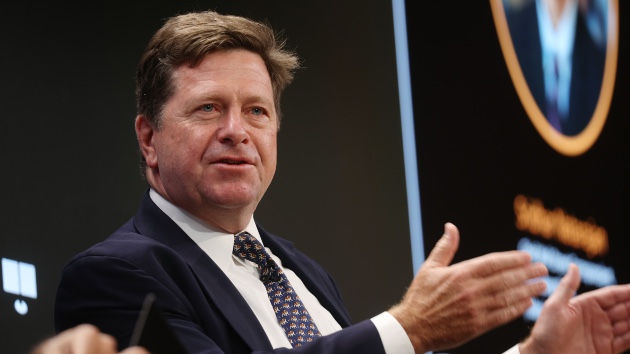
Jay Clayton, US attorney for the Southern District of New York (SDNY), during the Bloomberg Global Credit Forum in New York, US, on Wednesday, June 3, 2026. (Photographer: Michael Nagle/Bloomberg via Getty Images)
(WASHINGTON) — President Donald Trump said that Wednesday’s confirmation hearing for Jay Clayton to be the next Director of National Intelligence has been canceled and will not continue until his pick to replace Clayton as U.S. Attorney for the Southern District of New York, Jamie McDonald, is confirmed.
“Regarding the approval of our Great Patriot, Jay Clayton, we are cancelling the Senate Hearing RE: DNI today, and will not be going forward until Jamie McDonald is approved to be U.S. Attorney,” Trump posted on social media. “In the meantime, Bill Pulte will remain as the Acting Director of National Intelligence.”
Trump also repeated that he wanted both his SAVE America Act bill and an extension to the Foreign Intelligence Surveillance Act (FISA), which lapsed over the weekend after an extension vote failed in the House last week, to pass together after more than a dozen Republicans voted against a short-term extension.
Former Director of National Intelligence Tulsi Gabbard resigned from her post last month, saying that she was stepping down after her husband of 11 years, Abraham Williams, was diagnosed with “an extremely rare form of bone cancer,” according to a resignation letter she posted to social media.
Her departure marked another Cabinet-level shakeup during Trump’s second term after departures by former Attorney General Pam Bondi and Homeland Security Secretary Kristi Noem earlier this year.
Gabbard’s tenure was marked by two major conflicts abroad, politically charged election-related investigations at home and the unresolved tension between the anti-war message that first defined her rise in politics and the national security office she later came to hold.
Trump selected Bill Pulte as the acting director of national intelligence, but Democrats in both chambers signaled objections to him, saying that he does not have any national intelligence experience.
Pulte is best known in the Trump administration for launching probes into several of the president’s perceived political enemies over allegations of mortgage fraud and possible misuse of authority. Targets of the investigations include Federal Reserve Governor Lisa Cook, New York Attorney General Letitia James, Democratic Sen. Adam Schiff and former Democratic Rep. Eric Swalwell. They’ve all denied wrongdoing.
House Minority Leader Hakeem Jeffries said last week that reversing Pulte’s temporary appointment would only be a “starting point” to convince Democrats to pass FISA, but making another change at DNI wouldn’t be enough on its own to sway Democrats.
“It’s a step in the right direction, because it reverses something that is clearly out of bounds, unacceptable, and cannot be allowed to occur,” Jeffries said.
Former president Barack Obama and first lady Michelle Obama speak with “Good Morning America” co-anchor Robin Roberts at the Obama Presidential Center on June 13, 2026. (Michael Le Brecht IL/ABC News)
(CHICAGO) — For former President Barack Obama and former first Lady Michelle Obama, the opening of the Obama Presidential Center Friday is the culmination of their shared journey from Chicago’s South Side to the White House.
In their first joint network TV interview since leaving office in 2017, the couple reflected on their accomplishments in their eight years in the White House and the hope they have for the country ahead.
“People are a little discouraged right now,” Barack Obama told ABC News’ Robin Roberts in an interview that aired Wednesday on “Good Morning America.” “But, again, I believe that we go through these cycles, and there’s going to be a younger generation that pops up and there are going to be leaders who pop up.”
The former president said since leaving office, he has largely refrained from inserting himself too much into public policy debates as he sees himself these days as less of a “player” and more of a “coach” for the new generation of leaders.
“You pick and choose your spots. I’m not suggesting I’ve done it perfectly,” he said, going on to cite the example of how George Washington stepped away from politics after his time in office.
“He kind of said, ‘All right, I’ve done my stint. And now I’m going, you know, back home,'” Barack Obama said of the nation’s first president. “I think Michelle, you know, very much would prefer a quieter life for us. And on the other hand, there’ve been some folks who would like to see me out every day, right, banging the drum.”
With the Obama Presidential Center, part of the hope, he said, is to “encourage the next generation of leadership.”
The center’s campus encompasses 19 acres in Chicago’s Jackson Park, just steps from the University of Chicago. At a cost of $850 million, it includes 3.7 acres of parkland, offices for the Obama Foundation, an auditorium for public events, public art and athletic facilities, and a new branch of the Chicago Public Library.
In collaboration with the National Archives and Records Administration, the Obama presidential archives are fully digital.
The center’s centerpiece is a four-story museum that places the Obama years within a greater context of social change, starting with the Declaration of Independence and spanning the civil rights and labor movements, as well as the grassroots political movement in Chicago that led to Barack Obama’s political ascent.
Obama on his greatest accomplishment in office When asked by Roberts what he considers the greatest accomplishment of his two terms in office, Barack Obama cited the passage of the Affordable Care Act in March 2010, which expanded Medicaid, provided greater consumer protections, and lowered health insurance costs, especially for households at or below the federal poverty level.
He said the legislation continues to show that his administration represented all of America.
“For all the resistance from our political opposition, the Affordable Care Act has now helped 50, 60 million people, and continues to help people even though the current Congress has tried to weaken it and taken away some of the subsidies that were really helping a lot of working people,” the former president said. “I’m very proud of the message we sent to the country that we’re representing everybody.”
In addition to his legislative accomplishments, museum also tells the story of Barack Obama’s political ascendancy and how the core messages of “hope” and “change” were critical to his campaign for his first term.
Despite the harsh partisanship of today’s political culture, Michelle Obama said those messages are still possible.
“People just have to be fed up enough. They have to want more,” she said. “And I think the presidential center hopefully will remind people of just how close we are to moving this country in the direction that we want to move it in.”
Michelle Obama said an exhibit in the center that reflects on the Obamas’ position as the first Black first family in the history of America reflects that.
“You have one exhibit where people thought that it could never happen, that a Black man, a Black family would never live in the White House. That America would never accept that,” she said. “And lo and behold, the whole country, you know, the vast majority of the country believe differently.”
Amid the museum’s focus on the promise of democracy, Barack Obama said Americans, in times of disagreement, can focus on making their voice heard with their vote.
“The premise of this country is everybody gets a right to say, ‘No, I don’t agree with that. I challenge that. No, Obama, I think you’re making a mistake,’ you know?” he said. “And then we have a conversation about it, and then it gets settled in an election. And if enough people decide I didn’t know what I was doing, then you move on to the next person.”
Tune into the ABC News special “The Obama Legacy: First Joint Interview Post-White House,” streaming Thursday, June 18, on Disney+ and Hulu.
The Walt Disney Co. is the parent company of ABC News.
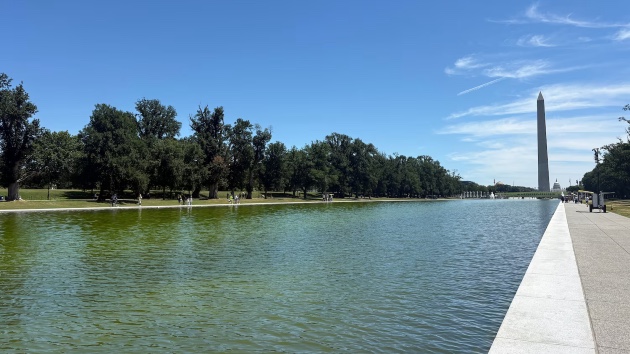
Algae can be seen in the water of the Reflecting Pool with the Washington Monument in the distance on June 16, 2006. (Elise Spenner/ABC News)
(WASHINGTON) — The National Park Service continued a push Tuesday to eradicate algae from the Lincoln Memorial Reflecting Pool as tourists and locals gathered to view the green-tinged water.
The Department of Interior has deployed both a hydrogen peroxide treatment and nanobubble ozone technology, a DOI spokesperson said, to rid the pool of algae blooms that have discolored the landmark and marred the rollout of President Donald Trump’s renovation project.
Algae bloomed late last week just days after the completion of the renovation, turning the pool from deep blue to green and murky. A DOI spokesperson told CNN in a statement that the algae was “residual” and came from reactivated supply lines.
Workers were spotted dumping hydrogen peroxide into the pool Tuesday morning in videos posted to X.
The nanobubble ozone technology is “actively killing algae” and other contaminants, the spokesperson wrote. The nanobubble process releases tiny gas bubbles filled with ozone into the water, which helps to eliminate algae blooms.
Rangers from the National Park Service were also in place midday Tuesday to continue scraping algae off the bottom of the pool. A tubing system was set up in an apparent effort to siphon contaminated water out of the pool and into storm drains.
The DOI spokesperson wrote that the hydrogen peroxide would have “no harmful side effects to marine life or to the environment.”
The water was noticeably cloudy, one Park Service ranger said, due to stirred-up algae that had not yet been extracted from the pool.
White House spokeswoman Taylor Rogers told ABC News on Tuesday, “under regular NPS maintenance, a high-tech nanobubble ozone technology will be deployed to kill the algae and keep the Reflecting Pool crystal clear.”
Trump has touted the pool renovation in public and on social media. He said in May that the landmark was “going to have the great color,” claimed the pool was “filthy” and “dirty” before the updates and criticized his predecessors for failed renovation attempts.
But the plan — originally an expedited effort to resurface the pool and revamp its filtration in advance of America’s 250th birthday — ballooned into a nearly $15 million endeavor, federal contract records show, and a public headache for the administration.
Employees from Greenwater Services — an Ohio-based organization that specializes in water purification and the nanobubble technology — were on site Tuesday and were seen filling plastic water bottles with samples from the pool.
Federal records show the government paid Greenwater $1.7 million in April to install new filtration technology for the Reflecting Pool.
Greenwater directed ABC News to the DOI in response to a request for comment.
Algae has long plagued the 1920s construction — a broad, shallow pool in which it and Cyanobacteria easily proliferate, especially during warm summer months. Former President Barack Obama made his own attempt at renovations in 2012 when he paid $35 million to construct a plumbing system that pulls water from the Tidal Basin and purifies it in a treatment plant.
Longtime Washington resident Redmond Walsh was biking by the pool on Tuesday and spoke to ABC News. He said he first inspected the pool on Sunday and posted a video of the green algae to X, where it now has 2 million views along with many detractors who claimed that he posted outdated material from 2012.
Walsh was back on Monday and Tuesday to check in on the progress. He said he would post an update to his followers saying that the pool was “getting a little better.”
Tourists said they weren’t surprised that the algae returned after the renovation.
David Janes, an engineer visiting from Louisville, Kentucky, said he thought the government was “back to square one” and is “going to have to do it all over again.”
Rex A. Heuermann pleads guilty in court to the murders of eight women during a 17-year killing spree on April 8, 2026 in Riverhead, New York. (James Carbone/Pool/Getty Images)
(NEW YORK) — Gilgo Beach, New York, serial killer Rex Heuermann may address the court when he is sentenced to life in prison on Wednesday.
In April, Heuermann pleaded guilty to killing seven women: Melissa Barthelemy, Megan Waterman, Maureen Brainard-Barnes, Amber Lynn Costello, Jessica Taylor, Valerie Mack and Sandra Costilla. He also admitted to killing an eighth woman, Karen Vergata, though he was not formally charged in her death. Their families will have the opportunity to address Heuermann on Wednesday.
At the April hearing, Heuermann agreed to serve three consecutive life sentences followed by four consecutive sentences of 25 years-to-life, according to prosecutors.
Prosecutors said the New York City architect targeted sex workers, strangled them and dumped their bodies near Long Island’s Gilgo Beach over the course of 17 years.
Heuermann “walked among us, play acting as a normal, suburban dad, when in reality, all along, he was obsessively targeting innocent women for death,” Suffolk County District Attorney Ray Tierney said in April.
The Gilgo Beach cases went unsolved for years, until Heuermann’s arrest in 2023.
Since then, Heuermann has been in custody at the Riverhead Correctional Facility. While in jail, Heuermann has been reading books about murder and serial killers, and he’s communicated with Keith Hunter Jesperson, a 1990s serial killer known as the Happy Face Killer, Suffolk County Sheriff Errol Toulon told ABC News.
Defense attorney Michael Brown said in April that the decision to plead guilty belonged solely to Heuermann.
“There came a point in this defense when Rex said, ‘I want to plead guilty,'” Brown said, adding that admitting his guilt brought Heuermann “a huge sense of relief.”
Brown said Heuermann would likely have more to say at sentencing.
Part of Heuermann’s plea agreement also requires him to be interviewed by the FBI’s behavioral analysis unit.