(WASHINGTON) — Majority Leader Chuck Schumer announced Wednesday that he’ll use a Senate procedure that allows home state senators to object to judicial nominees to attempt to block President Donald Trump’s picks for two keep prosecutor positions: the U.S. Attorneys for the Southern and Eastern Districts of New York.
The blue slip process, which has long been honored by the Senate Judiciary Committee, asks for the signoff of home-state senators before proceeding with nominations for U.S. Attorney positions.
Schumer, a New York Democrat, is refusing to return his blue slip for the nominations of Jay Clayton to be the U.S. attorney for the Southern District of New York and Joseph Nocella Jr. to be the lead prosecutor in the Eastern District of New York.
“Donald Trump has made clear he has no fidelity to the law and intends to use the Justice Department, the U.S. Attorney offices and law enforcement as weapons to go after his perceived enemies,” Schumer said in a statement. “Such blatant and depraved political motivations are deeply corrosive to the rule of law and leaves me deeply skeptical of the Donald Trump’s intentions for these important positions. For that reason, I will not return the blue slip for the U.S. Attorney nominees for the Southern and Eastern Districts of New York.”
This blue slip tradition in the Senate is just that: a tradition, not a law.
It will be up to Judiciary Committee Chairman Chuck Grassley whether he ultimately honors this blue slip process in this case.
“The Judiciary Committee has long honored the traditional blue slip process for U.S. Attorney nominees,” a spokesperson for Grassley, an Iowa Republican, told ABC News when reached for comment on Schumer’s intention not to return his blue slip on the two New York U.S. attorneys.
Grassley recently told the New York Times he would honor the right of Senators to refuse return of their blue slips.
“The answer is yes,” Grassley said when asked whether he would honor the blue slip position of senators. “If they are from the state the nomination comes from.”
Attorney General Pam Bondi ; Andrew Harnik/Getty Images
(WASHINGTON) — The Justice Department has filed suit against Maine in an effort to challenge the state’s policy regarding transgender athletes competing in girls’ and women’s sports, Attorney General Pam Bondi announced Wednesday.
The lawsuit alleges Maine’s policy violates Title IX and stems from a broader effort by the Trump administration to spotlight an issue that they see as politically damaging for Democrats.
“The State of Maine, through its Department of Education, is openly and defiantly flouting federal anti-discrimination law by enforcing policies that require girls to compete against boys in athletic competitions designated exclusively for girls,” the lawsuit said. “By prioritizing gender identity over biological reality, Maine’s policies deprive girl athletes of fair competition, deny them equal athletic opportunities, and expose them to heightened risks of physical injury and psychological harm.”
Bondi announced the lawsuit alongside anti-trans activist Riley Gaines and other parents and students from Maine who have objected to the state’s policies regarding transgender athletes.
“The Department of Justice will not sit by when women are discriminated against in sports. This is about sports. This is also about these young women’s personal safety,” Bondi said in remarks at DOJ. “I met many of these women throughout the past weeks and months, and what they have been through is horrific.”
The lawsuit is likely just the first in a series of legal challenges brought by the Trump administration, after Bondi previously sent warning letters in February to state officials in Maine, California and Minnesota ordering them to “comply with federal anti-discrimination laws that require them to keep men out of women’s sports.”
Maine’s Democratic Gov. Janet Mills has blasted the Trump administration’s efforts to strip federal funding from Maine as executive overreach.
“For decades — first as a District Attorney, as Attorney General, and now as Governor — I have fought tirelessly for the rights of women and girls, for the health and well-being of children and families, and defending the Constitution of Maine and the Constitution of the United States,” Mills responded in a statement Wednesday. “My Administration and Maine’s Attorney General will vigorously defend our state against the action announced today from the Department of Justice,” she said.
Earlier, she downplayed the issue of transgender athletes participating in girls’ and women’s sporting events.
“Because there are two, maybe two, trans athletes competing in Maine schools right now, they decided to shut off funding for the school nutrition program, the school lunch program, entirely,” Mills said in an interview this week on CBS affiliate WGME. “The law says if you don’t like what a state is doing over here, you can’t just take the funds away over here.”
In February, meeting with the nation’s governors at the White House, Trump discussed his executive order banning transgender athletes from women’s sports and asked Mills directly, “Are you not going to comply with that?”
She responded that she would comply with state and federal laws.
“Well, I’m — we are the federal law,” Trump said, adding, “Well, you better do it. You better do it because you’re not going to get any federal funding at all if you don’t.”
Mills responded: “See you in court.”
“Good,” Trump replied. “I’ll see you in court. I look forward to that. That should be an easy one. And enjoy your life after governor, because I don’t think you’ll be in elected politics.”
Dauphin County District Attorney’s Office/Getty Images
(HARRISBURG, Pa.) — The suspected arsonist who allegedly tried to kill Pennsylvania Gov. Josh Shapiro decided to firebomb his official residence because of “what he wants to do to the Palestinian people,” according to a search warrant signed by Pennsylvania State Police.
Investigators obtained several warrants as part of the investigation into the early Sunday morning arson attack, including for suspect Cody Balmer’s storage unit, electronic devices and parents’ home, where he told a Dauphin County judge he had recently been living.
Balmer, 38, targeted Shapiro “based upon perceived injustices to the people of Palestine,” one of the warrants said, law enforcement sources told ABC News.
Attorney General Pam Bondi strongly condemned the attack in remarks at the Department of Justice on Wednesday, but she declined to label the act “domestic terrorism” or commit to opening a separate federal case against the suspect.
“It is absolutely horrific what happened to him,” Bondi said. “We have been praying for Josh, for his family. Those photos, it was horrible. I firmly believe that they wanted to kill him. The defendant allegedly said he was going to use a hammer if he could have gotten to the governor. I’ve known the governor many, many years. It is horrible, and yes, we are working with state authorities to do — it’s now a pending investigation — anything we can to help convict the person that did this and keep them behind bars as long as possible.”
Bondi did not answer a direct question from a reporter about whether she would label the action “domestic terrorism,” as she has repeatedly described the wave of attacks carried out on Teslas and dealerships around the country in recent months.
The attack occurred hours after the Shapiro family hosted more than two dozen people for the first night of Passover.
The fire was reported at about 2 a.m. ET Sunday and the family was safely evacuated.
Investigators have not released a motive for the attack, but the search warrant represents the most direct indication of why Balmer allegedly hopped a fence at the governor’s mansion, broke windows and hurled Molotov cocktails police said he made from beer bottles and gasoline.
Balmer called 911 less than an hour after the attack, identified himself and told the call-taker that he will not take part in Shapiro’s plans “for what he wants to do to the Palestinian people,” the warrant said, according to the sources. Balmer added Shapiro needed to “stop having my friends killed.”
After turning himself in, Balmer allegedly told police he would have attacked Shapiro with a hammer if he happened upon the governor inside the residence, according to court documents.
Balmer faces eight criminal charges, including attempted murder, terrorism and aggravated arson. Prosecutors at this time have not invoked a hate crime law, which in Pennsylvania is known as ethnic intimidation.
(NEW YORK) — Evidence submitted by Department of Homeland Security lawyers attempts to support the government’s accusations that Mahmoud Khalil should be deported on the grounds that he lied on his green card application.
The evidence — which included reporting by some conservative news outlets — centers on accusations that he withheld information about his employment history and his participation in pro-Palestinian groups.
ABC News has reviewed over 100 pages of evidence submitted in immigration court by both DHS lawyers and those representing Mahmoud Khalil.
On Friday, Judge Jamee Comans, an immigration judge based in Louisiana, where Khalil is being held agreed with the government’s stance that Khalil is deportable under a section of the Immigration and Nationality Act that says a person can be deemed deportable “if the Secretary of State has reasonable ground to believe that the alien’s presence or activities in the United States would have potentially serious adverse foreign policy consequences for the United States.”
But Comans did not rule on the government’s allegations that he lied on his green card application.
Accusation: Khalil failed to disclose he’s a ‘member’ of CUAD
According to a Notice to Appear submitted in federal court filings, DHS has claimed Khalil “failed to disclose that you were a member of Columbia University Apartheid Divest (CUAD).”
CUAD has been prominently involved in protests against the war in Gaza held at Columbia University.
To support their allegations, government lawyers submitted articles that were published in April 2024, which feature Khalil as a lead negotiator between student protesters who had set up encampments on campus and university administration officials.
However, Khalil’s green card application, reviewed by ABC News and included in the government’s evidence, shows it was submitted on March 29, weeks before the articles were published.
“These articles from late April 2024 cannot possibly support an allegation that Mahmoud failed to disclose any affiliation with CUAD on that application. Furthermore, CUAD is a collection of organizations and there is no individual membership, so the allegation would be completely meritless even if all of the government’s evidence were not from a month after Mahmoud submitted his application,” Marc Van Der Hout, Khalil’s immigration attorney, told ABC News.
In response to the government’s claims, Khalil’s lawyers have submitted information they believe shows that CUAD is not standalone group, but rather a coalition of separate groups, and that Khalil was a negotiator for these and other protesters and not a member.
As evidence, his lawyers submitted letters from several people familiar with his role in the protests, including a professor at Columbia University.
“I want to emphasize that Mahmoud Khalil’s involvement was not as a member of CUAD. As I understood it — and also as is my understanding from the Columbia administrators with whom I spoke — Mr. Khalil served as a negotiator between CUAD and other student protesters, on the one hand, and the Columbia administration, on the other,” the professor wrote.
Accusation: Khalil did not disclose he was a member of UNRWA
According to court filings, DHS has also accused Khalil of failing to disclose that he was a “member” of the United Nations Relief and Works Agency for Palestine Refugees (UNRWA) from June 2023 – November 2023. The organization provides humanitarian assistance to Palestinian refugees.
As evidence, DHS lawyers included excerpts from an article titled “These are the extremist student leaders of the anti-Israel protest camp bringing Columbia to its knees” published in the New York Post.
“Khalil was a political affairs officer with UNRWA–the United Nations’ agency that supports Palestinian refugees from June to November 2023, according to LinkedIn,” the article read.
Another excerpt included in the evidence, cites an article from The Times of India published March 11, 2025, which similarly claims Khalil worked as political affairs officer at the U.N. organization.
“The agency lost significant federal funding following reports that some members participated in the October 7, 2023, Hamas attack on Israel, which resulted in 1,200 fatalities,” the excerpt says.
In immigration court, Khalil’s lawyers submitted a screenshot of his LinkedIn profile which says he was an intern at UNRWA as a political affairs officer on those dates. They also submitted a letter dated April 10 and written by a Columbia University official that says Khalil concluded a 12-week internship at UNRWA for credit.
In a statement to ABC News, a spokesperson for UNRWA confirmed Khalil did a six-month, unpaid internship at the UNRWA Representative Office in New York in 2023.
“He was not a staff member of the Agency nor was he ever on the Agency’s payroll,” the spokesperson said. But the spokesperson also said, the agency “does not have in its Human Resources the job title of “Political Affairs Officer”.
ABC News has reached out to Khalil’s attorneys for comment.
Accusation: Khalil failed to disclose his he was employed at the Syria Office in the British Embassy in Beirut ‘beyond 2022’
DHS lawyers allege that on his green card application, Khalil did not disclose his “continuing employment” as a Program Manager by the Syria Office in the British Embassy in Beirut “beyond 2022.”
On his green card application, under the “employment history” section, Khalil said he was a Program Manager at the British Embassy in Beirut from June 2018 to December 2022.
DHS submitted a profile of Khalil written on a website promoting an upcoming Society for International Development United States conference.
“Mahmoud Khalil works as a Program Manager at the Syria Office in the British Embassy in Beirut,” the profile says.
However, documents that Khalil’s lawyers have submitted indicates they plan to argue that the information about him was written for a conference in 2020, and have included a schedule from that year that lists him as a speaker.
Additionally, they included an email written by a British Embassy official dated April 11, 2025, that states Khalil “ended his contract at the British Embassy Beirut in December 2022 in order to take up a scholarship at Columbia University.”
ABC News has reached out to the Department of Justice for comment
During the Friday hearing, Khalil’s attorney Johnny Sinodis condemned DHS’ evidence against his client.
“DHS did zero investigation on its own other than to file tabloids,” he said in court.
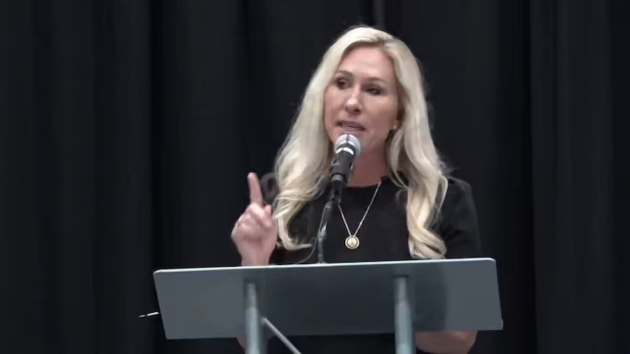
(COBB COUNTY, GA) — Rep. Marjorie Taylor Greene, one of President Donald Trump’s most loyal allies in the House, faced several protesters who were removed by police for disrupting her town hall on Tuesday.
Police said at least six attendees were escorted out without incident, while three others were arrested — two of whom were stunned with a Taser during their removal.
The event was held at the Acworth Community Center in Greene’s home state of Georgia on Tuesday, with disruptions breaking out almost immediately after the congresswoman took the stage.
“Well, welcome everyone,” Greene said, kicking off the meeting as police removed at least three protesters. “Thank you, Thank you to our great police officers… This is not a political rally. This is not a protest. If you stand up and want to protest, if you want to shout and chant, we will have you removed, just like that man was thrown out.”
At one point, a man was tased for not cooperating with police as they tried to escort him out for interrupting the meeting.
“This is a peaceful town hall. Now this is a peaceful town hall, ladies and gentlemen, this should not have to happen,” the Greene said in response.
While speaking at the town hall, Greene accused the media of “trying to defend an illegal alien that is a member of MS-13 that was deported to his home country, El Salvador. That is shameful and that should never happen,” she said, referring to Kilmar Abrego Garcia, a Maryland man who ICE officials have said was sent to El Salvador by error in March.
Following this, another protester was removed from Greene’s event.
“Bye,” Greene said. “Just like that illegal alien,” she said, despite Abrego Garcia’s legal status.
Outside of the disruptions, Rep. Greene did receive continuous support from the audience, which had about 80 people in attendance. Outside the venue, protesters lined up on the street.
Following the rally, Greene told reporters the protesters were “out of line,” saying there was a place designated outside of the venue for the protesters “because we support their First Amendment right.”
(WASHINGTON) — In the nearly three months since President Donald Trump’s inauguration, lawyers challenging his actions in court have alleged that his administration has violated court orders on a half dozen occasions, according to court records reviewed by ABC News.
From unilaterally freezing federal funding to the use of the Alien Enemies Act to deport noncitizens, the clashes have raised concerns about the separation of powers and the potential for a constitutional crisis.
Plaintiffs suing the Trump administration have alleged the government violated or ignored court orders on at least six different occasions, but no judge so far has held a member of the Trump administration in contempt of court. On at least four occasions, judges have expressed concerns about the Trump administration’s compliance with court orders.
Lawyers with the Justice Department have vigorously defended the actions of the Trump administration and argued that federal officials have strictly complied with lawful court orders, while also questioning the legality of some orders. Each of the cases are ongoing or being appealed, so the district court orders may be vacated as higher courts weigh in.
Trump has repeatedly vowed to respect a court order even if a judge rules against parts of his agenda, though he has attempted to cast doubt on the authority of some judges.
“Well, I always abide by the courts and then I’ll have to appeal it,” Trump told ABC’s Rachel Scott in February, referencing cases involving Elon Musk’s Department of Government Efficiency. In those cases, Trump suggested a judge’s order “slowed down the momentum, and it gives crooked people more time to cover up the books. You know, if a person’s crooked and they get caught, other people see that and all of a sudden it becomes harder later on.”
The Trump Administration now faces arguably its most high-profile legal battle, as it attempts to keep Kilmar Abrego Garcia in Salvadoran custody despite the Supreme Court ordering his administration to facilitate his release.
Using the Alien Enemies Act to remove alleged members of Tren de Aragua
Last month, the Trump administration removed more than 100 alleged members of the Venezuelan gang Tren de Aragua to a Salvadoran prison under the Alien Enemies Act despite a federal judge ordering they be returned to the U.S.
U.S. District Judge James Boasberg issued a directive that two planes carrying the men to El Salvador be returned to the United States on March 15. Despite both planes still being in the air at the time of the order, the planes landed in Honduras before flying to El Salvador.
Lawyers representing the Venezuelan men have argued that the Trump administration violated the court order, and Judge James Boasberg remarked that the government “acted in bad faith” when it rushed the deportation flights.
The Supreme Court vacated his order blocking any future removals under the Alien Enemies Act because the plaintiffs lacked jurisdiction to bring a case in D.C. Prior to the Supreme Court’s decision, Judge Boasberg was considering beginning contempt proceedings.
Trump defended his use of the Alien Enemies Act – telling reporters last month that he has the authority to remove noncitizens under the law – and has repeatedly criticized Judge Boasberg for blocking the removals.
“[Secretary of State Marco Rubio has] the authority to get bad people out of our country. And you can’t stop that with a judge sitting behind a bench that has no idea what goes on, who happens to be a radical left lunatic,” Trump told ABC’s Karen Travers.
Removal of Kilmar Abrego Garcia
After the Trump administration acknowledged it had deported a Salvadoran native who was living in Maryland under protected legal status due to an “administrative error,” a federal judge ordered the government to facilitate his return to the United States.
After the Trump administration appealed the decision, the U.S. Supreme Court concluded that Judge Paula Xinis “properly” required that the U.S. facilitate Abrego Garcia’s release from Salvadoran custody; however, the high court ordered Judge Xinis determine what “deference” Trump is owed related to his conduct of foreign affairs.
Since the Supreme Court’s ruling, the Trump administration has doubled down on its allegation that Abrego Garcia is a member of MS-13 — without providing any evidence — and claimed it lacks the authority to return him to the U.S. During a meeting with Trump in the Oval Office on Monday, Salvadoran president Nayib Bukele told reporters that he lacks the power to return Abrego Garcia to the U.S.
“The question is preposterous. How can I smuggle a terrorist into the United States?” Bukele said.
Benjamin Osorio, an attorney for Abrego Garcia, told ABC News that he believes the Trump administration is defying the court’s order and that a contempt order might be the only thing to prompt the U.S. government to return his client from El Salvador.
Before his meeting with Bukele, Trump told reporters that he would respect an order from the Supreme Court to return Abrego Garcia.
“If the Supreme Court said bring somebody back, I would do that. I respect the Supreme Court,” Trump said.
Removal of migrants to third countries
During a hearing last week, a federal judge gave lawyers with the Justice Department two weeks to provide more information about three recent removals of noncitizens to El Salvador that took place two days after he issued a temporary order blocking similar deportations to countries other than their place of origin without a hearing to raise concerns about their safety.
Judge Brian Murphy described the “potential violations of the temporary restraining order” as “concerning” and set an April 28 hearing to learn more about the deportations.
“This is something that is concerning to me,” Judge Murphy said. “I do think it’s something that we need to address.”
Lawyers with the Justice Department agreed to provide more information about the removals and defended the administration’s conduct.
Judge Murphy is considering extending his court order that prevents the Trump administration from removing noncitizens to countries other than their place of origin without allowing the noncitizens to raise concerns about their safety.
Two days after Judge Murphy temporarily blocked the deportations, the Trump administration announced that it had removed 17 alleged members of Tren de Aragua and MS-13 to El Salvador’s notorious CECOT prison. According to the plaintiffs, some of the men on those flights had final orders of removal to Venezuela and were never given the right to challenge their removal to El Salvador.
Unilaterally freezing funding to states
In February, U.S. District Judge John McConnell said that a group of state attorneys general presented evidence that the Trump administration “continued to improperly freeze federal funds and refused to resume disbursement of appropriated federal funds” to states despite a “clear and unambiguous” order barring them from blocking the funding.
He ordered the government to “immediately restore frozen funding” though the state attorneys general later provided evidence that the Trump administration continued to pause funding from FEMA. Many of the funding streams were restored in the months following Judge McConnell’s order.
Lawyers representing the Trump administration have argued the limiting of funds was a lawful way to identify and limit alleged fraud.
Blocking FEMA grants
Two months after Judge McConnell ordered the Trump administration to unfreeze funding to states, he determined that the government “covertly” paused millions of dollars in FEMA funding in direct violation of a court order.
Judge McConnell ordered the Trump Administration to “immediately cease” its efforts to impede the disbursement of federal funds, finding the government directly violated his order.
Last month, a coalition of 22 attorneys general asked Judge McConnell to stop the freeze after they presented evidence that FEMA continued to restrict more than 215 federal grants despite a court order blocking Trump’s unilateral funding freeze.
Lawyers with the DOJ pushed back on the request, arguing that FEMA was “merely implementing a manual review process” of each grant.
Judge McConnell disagreed, finding that the states presented “undisputed evidence” that FEMA “essentially [imposed] an indefinite categorical pause on payments” in direct violation of his preliminary injunction. He said the manual review process cited by the Trump administration “violates” a preliminary injunction issued in the case.
Freezing billions in foreign aid
A federal judge in February determined that the Trump administration was improperly withholding nearly $2 billion in foreign aid despite an order to restore the funding.
U.S. District Judge Amir H. Ali blocked the Trump administration from imposing a blanket freeze on funding from the U.S. Agency for International Development, yet the freeze continued for weeks, according to lawyers representing the foreign aid nonprofits. Lawyers representing the Trump administration have argued the funding freeze was necessary to identify and block potential fraud.
In an order, Judge Ali wrote that the Trump administration justified the freeze by advancing “an unbridled view of Executive power that the Supreme Court has consistently rejected—a view that flouts multiple statutes.”
After the Trump administration appealed the order, a divided U.S. Supreme Court denied the request to block the order, though the justices ordered the lower court to clarify its original order.
(WASHINGTON) — Former President Joe Biden in one of his first public speeches since leaving the White House offered a full-throated rebuke of the Trump administration’s efforts to cut Social Security on Tuesday, calling the amount of damage the White House has inflicted on the program “breathtaking” and “devastating,” — a sharp departure from his efforts while in office to protect it and “make it stronger.”
“Well, look what’s happening. In fewer than 100 days, this new administration has made so much … done so much damage, and so much, it’s kind of breathtaking it could happen that soon,” Biden said.
Biden avoiding saying his successor’s name. In his nearly 30-minute remarks, the 82-year-old often sounded hushed, with several distinct outbursts in defense of Social Security and its recipients. His only indirect mention of President Donald Trump was to call him “this guy.”
Biden was introduced by former Maryland Gov. and Social Security Administrator Martin O’Malley in front of roughly 180 attendees at the Advocates, Counselors and Representatives for the Disabled conference in Chicago.
“I will not go further and get in trouble …” Biden said wearily early in his speech, as he pivoted then from highlighting his own accomplishments as president to uplift Social Security to rebuking the current White House’s cuts.
“Last time this guy had the job, he raised the debt ceiling because of an enormous and profligate tax cut to the super wealthy,” Biden said later.
“They wanted to cut Social Security,” Biden added, calling out Republican members of Congress. “Not on my watch. We refused to go along with any of that,” he said.
Later in the former president’s remarks, he threw out any hesitancy to critique the current administration, even saying Trump voters in the 2024 election had “no heart.”
“What makes us distinct from the rest of the world? Basic, in my view, fundamental American values. Nobody’s king,” Biden said, again referencing Trump.
“You can’t go on like this, as a divided nation, as divided as we are, like I said, I’ve been doing this a long time. It’s never been this divided. Granted, it’s just 30 percent, but it’s a 30 percent that has no heart.”
He also warned of additional cuts to Social Security.
“They’ve taken a hatchet in Social Security, pushing additional 7,000 employees, 7,000 out the door in that time, including the most seasoned career officials. Now they’re getting ready to push something more out the door.”
Biden also hit directly at Trump’s Secretary of Commerce Howard Lutnick and his senior adviser Elon Musk.
“Based on [Lutnick’s] comments, he doesn’t seem to even care. You saw what he said the other day. By the way, he’s a billionaire … He said his 94-year-old mother-in-law wouldn’t complain, wouldn’t bother her. Probably lovely woman. No kidding…. her son-in-law is a billionaire. What about that 94-year-old mother living all by herself?
“Folks, it’s not just the Secretary of Commerce, where we heard how others, empowered and emboldened by this administration, talk about Social Security, one of them called it a ‘Ponzi scheme.’ A Ponzi scheme — what the hell are they talking about?” Biden said, referring to Musk.
Biden suggested that the White House’s moves were based on the tech industry adage of “move fast and break things.”
He also asserted that this Congress would move to cut the program through the Republican funding package that would make Trump’s 2017 tax cuts permanent.
“These guys are willing to hurt the middle class, working class, in order to deliver significant, greater wealth to the already very wealthy,” he said. “Who in the hell do they think they are? I really think they — I mean just basic, basic decency. Who do think they are?”
Biden’s speech came as Democratic congressional leaders billed Tuesday as a “Day of Action” focused on Social Security.
“Across the country, Democrats are leading the fight to oppose the Republican plan to gut Social Security. Our Save Social Security Day of Action will mobilize Americans from every corner of the United States to push back on Donald Trump, Elon Musk and DOGE’s cuts to Social Security,” Senate Democratic Leader Chuck Schumer, D-N.Y., and House Democratic Leader Hakeem Jeffries, D-N.Y., said in a joint statement.
“Republicans want to slash this critical lifeline by making it harder for seniors and people with disabilities to access their earned benefits. Shutting down local offices, firing large numbers of experienced constituent service workers and cutting phone services makes it harder for people to get their checks. Republicans are trying to kill Social Security from the inside — it is a cut by another name — and we won’t let that happen.”
Kevin Dietsch/Getty Images, Ken Ishii – Pool/Getty Images
(WASHINGTON) — President Donald Trump earlier this month announced far-reaching “reciprocal tariffs” on scores of countries, but he soon suspended the levies on all but one: China.
Instead, Trump ratcheted up China tariffs to a whopping total of 145%. In response, China slapped 125% tariffs on U.S. goods and issued other countermeasures.
The trade war between the world’s two largest economies amounts to a battle of wills in which each stands poised to draw on economic advantages and political pressure points, analysts said. An assessment of each side’s leverage, they added, helps reveal how the standoff may unfold.
“The stakes are extremely high and the only issue remaining is who is going to blink first,” Yasheng Huang, professor of global economics and management at MIT, told ABC News.
Potential economic damage
The U.S. and China each are among the other’s top trade partners, meaning a sizable chunk of each economy depends on the relationship.
U.S. consumers and firms purchase more goods and services from China than the other way around, putting China at risk of a larger loss in economic activity if trading comes to an effective halt, analysts said.
Still, they added, the trade imbalance also threatens acute product shortages and price increases for U.S. consumers.
“The U.S. imports more from China than it exports to China — that gives the U.S. an advantage,” Shang-Jin Wei, a professor of finance and economics at Columbia University who studies the U.S.-China trade relationship, told ABC News.
“But the very fact that the U.S. buys so much from them also means that it is dependent on their supply of low-cost goods,” Wei said.
Last year, the U.S. imported about $438 billion worth of goods and services from China, making it the largest destination for China’s exports. In all, that figure accounts for about 15% of China’s exports, according to the U.S. Trade Representative. China makes up a primary source of consumer electronics like laptops and smartphones, as well as footwear, apparel and toys.
U.S. tariffs are expected to lower China’s gross domestic product growth this year by 0.7%, though the Chinese economy is still forecast to expand by more than 4%, J.P.Morgan said on Tuesday.
The loss of relatively cheap Chinese goods, meanwhile, is expected to raise prices for U.S. shoppers. Over the weekend, the Trump administration issued a tariff exemption for some consumer electronics from China, but price hikes are expected for a host of other goods.
On the other hand, China purchased about $143 billion of U.S. goods last year, including crops such as soybeans and wheat, as well as oil and gas.
Roughly 930,000 U.S. jobs are supported by exports to China, the U.S.-China Business Council said in a report last year. During Trump’s first term, the U.S. provided financial relief to some farmers to make up for lost sales to China.
Essential materials
The U.S. or China could also derive leverage from specialized goods that would be difficult for the other country to replace in the event of trade restrictions.
Earlier this month, China imposed export restrictions on some rare earth elements and magnets that make up critical inputs in some U.S. auto, energy and defense products. For now, Chinese companies can still export to U.S. buyers, though the Chinese firms must receive approval from the Chinese government.
Rare earths are vital for a range of defense technologies, including F-35 fighter jets, Tomahawk missiles and radar systems, the Center for Strategic and International Studies, or CSIS, said on Tuesday.
The U.S. is not prepared to immediately make up for a potential loss of those components through domestic industry, CSIS found.
“The U.S. dependency on China for rare earths is extremely high,” Huang said. “China can shut it off or turn it on at will — that is leverage.”
Meg Rithmire, a professor of business administration at Harvard University, said the U.S. could seek out alternative sources abroad but China remains the dominant source of such materials.
“It doesn’t seem like this is the kind of thing that will cripple anyone in the short term, but the supply chains are such that it could get messy in the medium term,” Rithmire said.
Meanwhile, China relies on the U.S. for some important components of its electronics, auto and technology products, Huang said.
China could likely withstand a temporary shortfall, Huang added, though a long-term shortage of such goods would pose a problem.
“It would definitely hurt them — no question about it,” Huang said.
Tolerance for financial pain
Analysts told ABC News that China’s authoritarian form of government affords it greater capacity to tolerate a prolonged period of economic hardship.
By contrast, separate branches of government and regular elections in the U.S. make it more difficult for the country to hold out through potential widespread financial challenges, they added.
The Chinese public faces limits on public expression and little recourse for bringing its displeasure to bear on political representatives, analysts said.
“There’s a lot structurally built into the Chinese system to withstand political pain, which isn’t the case for the U.S.,” Rithmire said. “The U.S. system incorporates the unhappiness of people as they experience the economic effects.”
The countries’ different responses to COVID-19 exemplify how their respective political systems respond to flagging general welfare, analysts said.
China maintained a zero-COVID policy for several years, severely restricting individual mobility and hamstringing a broad swath of the nation’s economy. In the U.S., on the other hand, eight states never issued COVID lockdowns, while the federal government focused on economic stimulus and expedited vaccine development.
“The trade war, as substantial as it is, doesn’t compare to the COVID lockdown that China implemented,” Huang said. “We have solid evidence that the political system is quite immune from economic hardship.”
Still, that tolerance of economic pain has limits, Wei said. Over the past half century, the Chinese government has drawn legitimacy from its ability to deliver economic growth and improved living standards, he added.
“Anything that hurts that can undermine their power,” Wei said.
Ultimately, the standoff may endure until each country sees a pathway out of the trade spat that promises sufficient political benefit.
“Is there a productive off-ramp for each side?” Huang said.
(SAINT TERESA, NM) — Two service members were killed and another is in serious condition following a vehicle accident earlier Tuesday in Santa Teresa, New Mexico, the United States Northern Command (NORTHCOM) said in a statement.
Shortly before 9 a.m. “Three service members deployed in support of Joint Task Force Southern Border were involved in a vehicle accident,” NORTHCOM said.
Tuesday’s accident are the first fatalities associated with the United States military’s mission along the border with Mexico that have been disclosed.
More than 10,000 active duty service members have been authorized for the border mission.
The cause of the accident is under investigation, officials said.
This is a developing story. Please check back for updates.
(FORT HUACHUCA, AZ) — U.S. Army soldiers will soon be patrolling a 170-mile buffer zone along the southern border with Mexico in a newly created “National Defense Area” in Arizona and New Mexico.
It’s part of the Trump administration’s efforts to use the U.S. military to stop the flow of undocumented migrants into the United States.
The large swath of area will stretch 60-feet-deep along federal lands running the length of the border and will be considered a part of Fort Huachuca in Arizona, meaning that, just as at any Army base, trespassers would be apprehended by soldiers and held until turned over to law enforcement.
Some analysts see it as a way to militarize the border and skirt a federal law — the Posse Comitatus Act — that prohibits U.S. military personnel from carrying out law enforcement duties: by declaring the federal property a military base where migrants crossing into can be detained.
“Last week, President Trump signed a National Security Presidential Memorandum directing federal agencies administering federal land on the border to make land available to the Defense Department in a new national defense area,” Karoline Leavitt, the White House press secretary, told reporters on Tuesday.
“This new National Defense Area spans more than 170 miles across our border in New Mexico,” said Leavitt. “But in in the coming weeks, this administration will add more than 90 miles in the state of Texas.”
“This National Defense Area will enhance our ability to detect, interdict and prosecute the illegal aliens, criminal gangs and terrorists who were able to invade our country without consequence for the past four years under the Biden administration,” said Leavitt. “It will also bolster our defenses against fentanyl and other dangerous narcotics that have been poisoning our communities.”
U.S. officials told ABC News that the initial phase of the new area will stretch from Fort Huachuca in southeastern Arizona eastward into New Mexico.
The designation of a National Defense Area will apply only to federal lands that have been newly transferred to the control of the Defense Department and will not apply to privately held lands or territory belong to Native American reservations. That means it will be non-contiguous but will be in effect for much of New Mexico’s border with Mexico, which stretches for nearly 180 miles of the state’s border.
U.S. Army troops will be operating in what is essentially a buffer zone formally known as the Roosevelt Reservation that includes federal lands in California, Arizona, and New Mexico on the border with Mexico. In 1907, to prevent smuggling, President Theodore Roosevelt declared that a 60-foot-wide buffer zone on public lands along the border with Mexico belongs to the federal government.
Two U.S. officials told ABC News it was still to be determined whether the new authority would be applied to Texas given that the Roosevelt Reservation does not apply to lands in that state.
According to the officials, the U.S. Army will soon begin placing signs on both sides of that 60-foot buffer zone warning that they are about to enter Defense Department property and could be apprehended for trespassing.
Because of natural barriers along the border, the Roosevelt Reservation in some cases may stretch a mile into U.S. territory.
Some of the territory to now be considered an Army base already has existing fencing on the border but in some areas does not. Regardless, the Army will place signage in both English and Spanish warning that any trespassers into the area will be apprehended.
The move by the Trump administration has drawn criticism from legal analysts who describe it as a way to get around the U.S. military having law enforcement on the border which is done by U.S. Customs and Border Protection (CBP). Currently 10,000 U.S. military personnel have been authorized to serve along the border, but only in a support role to CBP.
“The president’s plan would empower U.S. soldiers patrolling the area to take on a civilian law enforcement function: apprehending and detaining migrants crossing the border into the U.S. Deploying the military to enforce civilian law is a clear violation of the Posse Comitatus Act,” said Elizabeth Goitein, the senior director of the Liberty and National Security Program at the Brennan Center for Justice.
“Under emergency powers law, the president is required to seek congressional approval for any transfer of federal land to the Defense Department,” said Goitein.