(WASHINGTON) — Janeese Lewis George won the Democratic primary for mayor of Washington, D.C., held earlier this week, according to a projection from the Associated Press on Thursday.
This is a developing story. Please check back for updates.
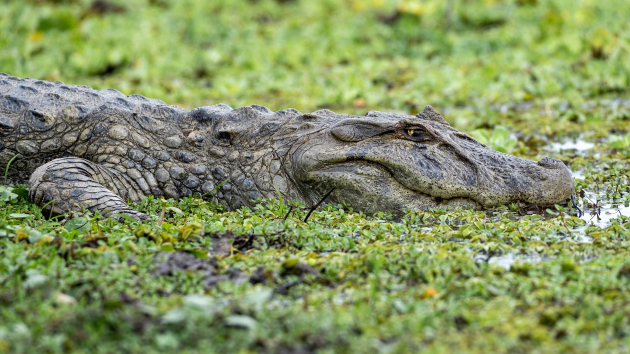
Stock photo of a crocodile. (Diego Kondratzky/500px/STOCK PHOTO/Getty Images)
(NEW YORK) — A man has been arrested on suspicion of attempted murder after a 3-year-old boy wound up in a crocodile enclosure at a zoo in eastern England, suffering serious injuries, according to police.
The “distressing incident” occurred Thursday afternoon at Johnsons of Old Hurst, a family-run farm and zoo located in Huntingdon in Cambridgeshire, police said.
The boy “ended up in the crocodile enclosure” and was taken to a local hospital, where he was in critical but stable condition, Cambridgeshire police said.
A 30-year-old man who is an apparent stranger to the child has been arrested on suspicion of attempted murder in connection with the incident, police said.
“At this stage we are speaking to people who were at the zoo at the time of this distressing incident to understand more about the circumstances,” Det. Insp. Verity McCann said in a statement. “We do not believe the man arrested and the child are known to each other.”
The incident remains under investigation.
Huntingdon Member of Parliament Ben Obese-Jecty said his “thoughts are with the young victim and his family during a hugely traumatic and difficult time.”
“This is now a live criminal investigation and I would ask people to refrain from speculation online,” he said in a statement on social media.
Johnsons of Old Hurst said its tropical house, which is home to multiple species of crocodiles and other reptiles, will remain closed until further notice “out of respect to the family.”
“Our thoughts and prayers are with the boy and his family following the incident that occurred today,” Johnsons of Old Hurst said in a statement on social media Thursday.
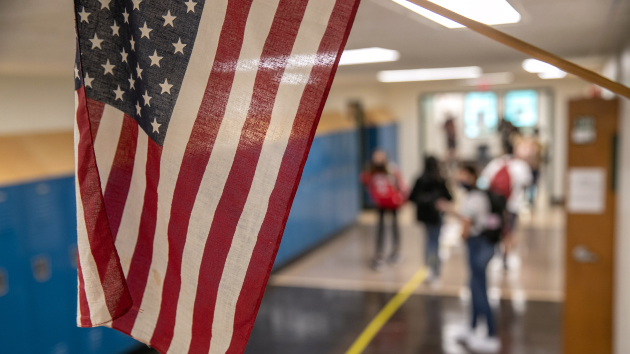
Students walk through the halls between classes at Rippowam Middle School on September 14, 2020 in Stamford, Connecticut. (John Moore/Getty Images)
(WASHINGTON) — Nayleen Escalante-Villatoro, a sixth grader at Brookland Middle School in Washington, D.C., has struggled significantly with attending school.
She said whenever there are family problems that force her mother to take off work, she has to step in.
“Me and my older sibling stay home to watch the little ones,” Nayleen told ABC News, adding, “It makes me feel stressed because I’m missing school and I’m not learning.”
This not only frustrates Nayleen, but it also impacts her studies: “I have to do a lot of makeup work after all the missing assignments that I haven’t done,” she added.
Kids like Nayleen face a multitude of challenges at school — when they’re there.
From the rigors of learning how to read and write to addressing mental health concerns and outside distractions, students juggle more than just their classroom workloads. A combination of these issues and other societal factors has fueled an attendance crisis that’s led to a spike in student chronic absenteeism — defined as missing at least 10% of the school year — in recent years, according to experts who spoke to ABC News.
While one in three students nationwide experienced chronic absenteeism during the 2021-2022 academic year, the rate is declining, from up to 30% to roughly 24% by the start of the past school year, according to estimates from the Return 2 Learn tracker reviewed by ABC News.
Government officials are also collecting data on K-12 chronic absenteeism but the Department of Education recently told ABC News it couldn’t yet provide it. Its National Center for Education Statistics (NCES) told ABC News in 2023 that chronic absenteeism increased from the impact of the COVID-19 pandemic.
However, there’s been no silver bullet to the problem. Different states have taken their own approach, from going door-to-door to check on students to providing high-impact tutoring at school. Education and health experts also emphasize family engagement, community relationships, extracurricular activities and outdoor recreation are potential solutions for chronically absent students.
Hedy Chang, CEO of Attendance Works, a nonprofit focused on addressing absenteeism, said that when kids aren’t showing up to school, it’s an indication that engagement isn’t happening.
“When you treat it as a matter of engagement, that’s when we build the relationships with families, which make them trust schools and it builds a relationship so that we can actually find out what are the underlying causes of why kids aren’t showing up,” Chang told ABC News.
United Family Advocates Executive Director Joanna Lack is calling for more attention to those underlying causes. Lack worked on the issue for many years as the chief performance officer in Camden, New Jersey, and has since transitioned to the non-profit organization dedicated to keeping families safe and together.
“We’ve been looking at the wrong problem instead of opening up the hood and saying ‘What’s actually going on here?'” she said.
Home life among ‘constellation’ of issues
Student absenteeism is often correlated with household or child welfare problems that impact the student’s school life, according to UFA’s Lack.
“Chronic absenteeism is like the symptom that you experience, but it’s not the disease, and we’ve been treating it like it’s the disease,” Lack said.
The Department of Health and Human Services does not have a specific initiative targeting chronic absenteeism. However, Head Start and the Family Opportunity, Resilience, Grit, Engagement-Fatherhood (FORGE) program under the Administration for Children and Families (ACF) both aim to improve outcomes in child welfare and enhance early childhood education, according to HHS officials.
Chang said there isn’t an urgent need for new federally funded programs or aid, just better use of ones that are available.
“I need existing programs to think about how they use chronic absence data to collaborate and work together to support kids and families and make sure the kids who need their resources, or the schools that need their resources, are getting it,” she said.
There’s a “constellation” of issues that contribute to increased absences, from child welfare involvement to unstable housing, but Lack noted that families are complex and kids don’t come in silos.
Activity makes a ‘huge difference’
Nayleen is one of the thousands of students across the country who participate in extracurricular activities through the SCORES program, which creates safe environments where young people can build connections with their communities, according to its website. She said DC SCORES — which provides soccer, poetry, and service-learning programs — has helped her return to class more regularly.
She explained that playing soccer with DC SCORES has empowered her and she looks forward to talking to her coach after attending school.
“It helps me because whenever I’m going through stuff he will understand me,” she said. “Sometimes he will help me. He will sit down and have a talk with me,” she said, adding, “Whenever I’m down, he will ask me if I’m OK.”
At the last month’s inaugural National Executive Forum on Health and Outdoor Recreation, which combined outdoor recreation industry and health leaders to promote using recreation as a pillar of public health, experts told ABC News that recess makes a “huge difference” for holistic growth in adolescents.
Outdoor Recreation Roundtable President Jessica Turner emphasized that being outside is fundamental to student health.
“We’ve stepped back so far from incorporating the outdoors into our lives and to step back into it doesn’t take very much,” Turner told ABC News. “It’s not a heavy lift.”
Schools supporting parents and kids
Chang, of Attendance Works, said chronic absenteeism isn’t inevitable.
She stressed that schools are starting to adopt more effective family engagement strategies for those dealing with attendance issues.
Shavar Jeffries, CEO of the KIPP Foundation, which operates the largest public charter school network in the nation, has utilized some simple yet effective solutions to correct absenteeism.
Jeffries told ABC News that when a student doesn’t show up, they call the family “immediately.”
“‘Johnny, Mary, didn’t come to school today. We really need them because they are going to miss an opportunity to learn,'” he said, adding “Then, frankly, sometimes we also say: You got to figure it out.”
“Get your baby to school because they can’t learn to fulfill that potential if you’re not able to do that,” Jeffries added.
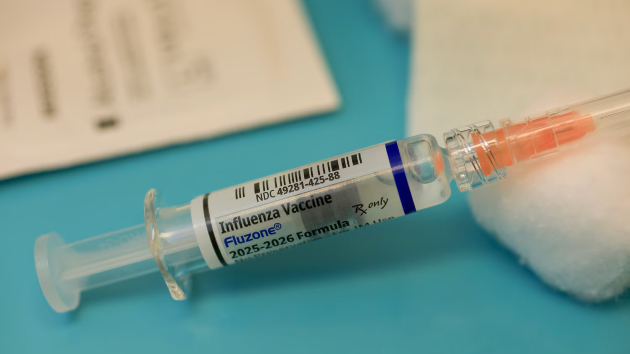
An Influenza Vaccine is prepared for a patient, Sept. 12, 2025, in Coral Gables, Fla. (Joe Raedle/Getty Images)
(SAN ANTONIO) — The basic training facility for the Air Force in San Antonio, Texas, is experiencing a flu outbreak following the end of mandatory vaccination for all service members.
As of Wednesday, there are at least 159 known cases among recruits and two hospitalizations at Joint Base San Antonio, two sources familiar with the matter told ABC News. One source told ABC News the number of cases and hospitalizations may be higher.
The outbreak comes after Defense Secretary Pete Hegseth announced in April that the annual flu vaccine would be optional for all U.S. military personnel, both active and reserve.
Previously, the flu vaccine was mandatory, but the new policy is in line with a previous change of making the COVID-19 vaccine optional.
The Pentagon has granted the military services exceptions to the policy, so the flu vaccine can be required in certain cases.
An Air Force spokesperson confirmed the outbreak to ABC News and said in a statement that over the last three weeks there has been a “localized influenza outbreak among trainees at Basic Military Training.”
“Medical professionals and Public Health officials have implemented mitigation measures to isolate and treat symptomatic trainees to reduce further exposure and continue to monitor the situation,” the statement read. “Medical personnel are also monitoring trainees who were in close contact with sick members in case they become symptomatic.”
The spokesperson said symptomatic trainees are receiving “the appropriate care” including antiviral medications such as Tamiflu.
“Once they are cleared by medical professionals they will return to training,” the statement said.
Earlier this year, when Hegseth ended mandatory vaccination, he referred to the policy as “overly broad and not rational.”
“Our new policy is simple: If you, an American warrior entrusted to defend this nation, believe that the flu vaccine is in your best interest, then you are free to take it; you should. But we will not force you,” Hegseth said.
The sources told ABC News that there is 40% flu vaccination rate among recruits at the San Antonio base since the mandate was lifted. Previously, the rate was nearly 100%.
Chief Pentagon spokesman Sean Parnell told ABC News that the Defense Department recently granted exceptions to the policy for the Army, Navy, Air Force, National Security Agency (NSA) and Defense Health Agency (DHA) through the Under Secretary of Defense for Personnel and Readiness.
“The decisions were based upon thorough risk assessments and are designed to maximize operational readiness, lethality, and force generation, while safeguarding at-risk populations,” Parnell said. “The Army, Navy, Air Force, NSA, and DHA are responsible for implementing the [exceptions to the policy]. The Department remains committed to the health and readiness of our warfighters and civilian personnel.”
The annual flu vaccine is currently recommended to everyone over 6 months old between September and the start of November. Although the typical flu season ends by February or March, people can become infected at any time.
People who travel internationally or live in group settings are at higher risk of transmitting and acquiring infectious diseases.
Public health specialists have warned that military members may suffer unnecessary complications from the flu after the vaccination mandate was ended and fear that severe cases will continue to climb in subsequent flu seasons if preventive vaccinations aren’t given to those most at risk.
Evidence has shown that young recruits are much more vulnerable to severe infection from influenza compared to other service members, though lower than the general population due to the military having historically high immunization rates.
A study published last year by the Defense Health Agency found that from the 2010-2011 to the 2023-2024 flu seasons, the highest rate of influenza hospitalizations among active service members were among those under the age of 25, especially young recruits.
The flu vaccine has been required for the military since 1945, at the end of World War II, partly tied to the threat of biological warfare use by rival nations and as well as the devastation that the flu pandemic of 1918-1920 wreaked on U.S. troops, according to a 2022 analysis from Wright State University in Ohio and the U.S. Air Force.
It’s estimated that between 20% and 40% of Army and Navy personnel fell ill, with more than 26,000 deaths among U.S. soldiers during the 1918-1920 flu pandemic.
After researchers noticed the effectiveness of the vaccine fading, the mandate was withdrawn in 1949. This was later found to be caused by abrupt and major changes to the flu virus — and the mandate was reinstated in the early 1950s after the changes became “clearer and combatable,” according to the analysis.
Compliance among military health care personnel has exceeded 95% in past years, compared to less than 75% among civilian health care personnel.
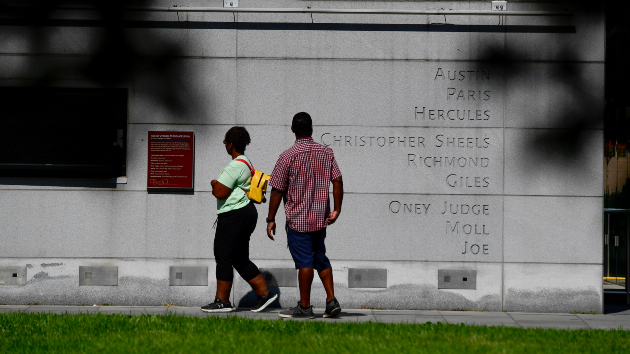
The names of enslaved people who lived in the President’s House are carved into a monument in Independence National Park on August 9, 2025 in Philadelphia, Pennsylvania. (Matthew Hatcher/Getty Images)
(WASHINGTON) — The Trump administration revealed the list of materials that the National Park Service removed from parks across the country that relate to civil rights, diverse populations, science and the environment.
The list was made public on Wednesday as part of a court filing brought by various organizations. The Interior Department is appealing a federal judge’s order to restore those materials ahead of America 250 celebrations on July 4.
Included in the list are vague descriptions of the materials that were removed and their location. The list, however, does not provide images of the content that NPS found objectionable.
Examples of items that were removed include signs about climate change at parks like Acadia National Park in Maine and Jamaica Bay Wildlife Refuge in New York; materials involving civil rights at the National Mall in Washington, D.C. and at the Medgar and Myrtle Evans Home National Monument in Jackson, Mississippi; materials involving slavery at the President’s House in Philadelphia and materials on women’s rights at the Jamaica Bay Wildlife Refuge at the Gateway National Recreation Area in New York.
The list also includes reasons for the removals.
“Disparages Americans past or living” appears to be the reason provided by NPS for the removal of items related to civil rights, diverse communities, slavery and atrocities committed by the United States against Native Americans.
“Unrelated to beauty, abundance and grandeur of the national landscape” was listed as the reason for the removal of items related to science and the environment.
A spokesperson for the Interior Department confirmed to ABC News in a statement that the government is appealing the judge’s order to restore the items.
“We fully believe politically charged language denigrating our Founding Fathers is inappropriate and only further divides Americans,” the spokesperson said. “Through President Trump, we have encouraged Americans to visit our cultural and historic sites and engage in meaningful conversations about the moments that have shaped our country.”
The spokesperson added that the government seeks to “strengthen our shared understanding and ensure that future generations inherit not just the land we love, but the truth of the journey that brought us here.”
ABC News reached out to the Interior Department and NPS for further comment.
U.S. District Judge Angel Kelley ordered the restoration of the materials in a Friday ruling and cast their removal by NPS as “a dangerous precedent of censorship and sanitization.” She ordered the government to restore all items by July 3.
The federal government has filed a motion asking for an emergency stay pending appeal, which would block the restoration as the appeals court considers the case. In the motion, the government argued that the restoration of the materials would cause “irreparable harm.”
In response, Kelley ordered the government to produce the list of changes and the condition of the materials, writing that this information was necessary for her to consider the government’s argument.
The removal of materials, which relate to civil rights, diverse communities, science and the environment, was made in compliance with a March 27, 2025, executive order in which President Donald Trump ordered the Interior Department to remove content that cast the United States’ “founding principles and historical milestones in a negative light.”
The complaint filed in February challenges the removal of the materials and was brought by a coalition of organizations committed to preserving history, the parks and the environment.
“National parks belong to the American people and censorship of any kind goes against the values these places represent,” said Alan Spears, a senior director ” said Alan Spears, a senior director at the National Parks Conservation Association, one of organizations suing NPS. “Americans count on national parks to help us understand our full, rich history. Stories of triumph and tragedy alike deserve to be told out loud at parks.”
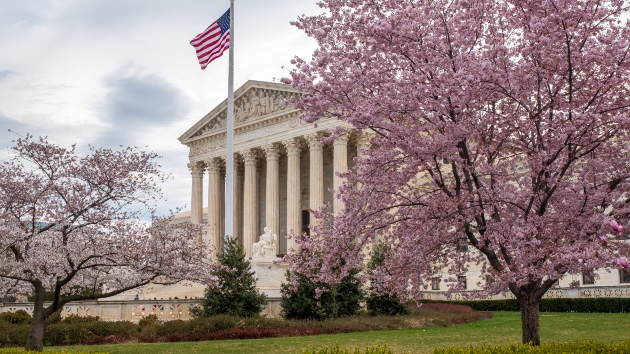
Cherry blossoms at the Supreme Court on a windy morning in Washington, D.C. (John Baggaley/Getty Images)
(WASHINGTON) — In a unanimous decision, the Supreme Court on Thursday ruled that a longstanding federal ban on guns for unlawful users of any controlled substance is unconstitutional as applied to a Texas gun owner who used marijuana several times a week.
The decision set new limits on federal prosecution of gun owners who are targeted simply for having a history of drug use. It was especially welcomed by millions of American cannabis users who have had to disarm or risk up to 15 years behind bars.
Justice Neil Gorsuch wrote in the court’s opinion that unlawful drug use alone cannot be grounds to seek to send someone to prison and potentially force them to give up firearms for life.
“We do not question that sometimes an individual’s unlawful use of marijuana (or any other controlled substance) may render him a danger to others,” Gorsuch wrote. “But, again, the government disclaims the need to show anything like that in this case. … affording the government that kind of broad power to designate any group as dangerous and thereby disqualify its members from having a gun would risk allowing it to quickly swallow the Second Amendment.”
The Justice Department has said it prosecutes roughly 300 cases a year in which a violation of the drug-user gun ban is a leading charge.
Gorsuch said the opinion was narrow and did not disturb other provisions of the law, which includes a ban on guns for drug addicts, ban on guns for people presently intoxicated and prohibition of firearms for those deemed a danger to themselves or others.
The ruling would not, for example, have prevented the prosecution of Hunter Biden under the law since he was a known and admitted drug addict while in possession of a firearm.
The decision was most immediately a victory for plaintiff Ali Hemani, a Texas man who admitted to using marijuana “every other day” while keeping a Glock 9mm pistol in his home. He was prosecuted by federal authorities for a single charge of unlawful possession as a drug user but was neither intoxicated nor physically holding the weapon when arrested.
A federal appeals court tossed out the Hemani indictment saying the ban as applied to him was unconstitutional. The justices agreed with that decision.
While more than 40 states have legalized marijuana in some form, it remains prohibited under federal law.
“Today’s unanimous 9-0 decision makes it clear that the government cannot make it crime for people to own a gun, which the Supreme Court has held is a fundamental constitutional right, simply because they use marijuana,” said Cecillia Wang, legal director at the American Civil Liberties Union.
“With nearly half of Americans reporting marijuana use at some point in their lives, this ruling protects the rights of millions and curbs the government’s ability to impose arbitrary and discriminatory penalties,” Wang wrote in a statement. “The court has sent a strong message that the government cannot criminalize the conduct of large numbers of people by making categorical and unfounded assumptions about whether they are dangerous.”
The decision was also praised by the National Rifle Association as “a major victory for the Second Amendment and peaceable gun owners across America.”
“No one should be deprived of their God-given right to keep and bear arms for engaging in nonviolent conduct, and there is no historical justification for doing so,” said NRA-ILA Executive Director John Commerford in a statement to ABC News.
Gun safety advocates, which had joined the Trump administration in opposing a rollback of the drug-user gun ban, said the bulk of the law remains a robust and “common-sense” public-safety measure.
“Although the Court said that the particular law at issue in this case cannot be upheld specifically as to the person challenging it, it reaffirmed the ability of legislatures to restrict firearms access by certain categories of people,” said Kris Brown, president of Brady, a gun safety group.
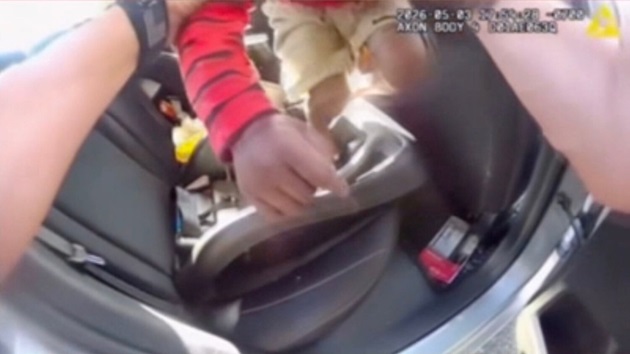
A deputy in Clark County, Washington, saved a 2-year-old boy who was alone in a car on a 92-degree day. (Clark County Sheriff’s Department)
(CLARK COUNTY, Wash.) — Heart-stopping video has been released showing the moment a deputy in Clark County, Washington, saved a 2-year-old boy who was left alone in a hot car on a 92-degree day.
Witnesses called 911 in May to report the child in a parked car, and the witnesses tried to create shade around the car as they waited for responders, the Clark County Sheriff’s Department said on Wednesday.
Deputy Ben Hulsey arrived at the scene to find the 2-year-old strapped in his car seat, “sweating heavily, with his head tilted to the side and not responding,” the sheriff’s department said. The car had a small crack in the back window, authorities said.
Hulsey broke a window to rescue the little boy, who was checked by medics, authorities said.
Investigators determined the boy was left alone for about 16 minutes, the sheriff’s department said. When deputies found his parents, they had been inside a nearby grocery store for almost 30 minutes, authorities said.
The parents are facing reckless endangerment charges, the department said.
“Never leave a child or pet alone in a vehicle. Not even for a few minutes,” the sheriff’s department said in a statement Wednesday. “If you see a child or pet left alone in a vehicle and believe they’re in distress, don’t hesitate to call 911. That’s exactly what these community members did.”
At least seven children have died in hot cars so far this year in the U.S., according to national nonprofit KidsAndCars.org. Last year, at least 37 children died in hot cars across the country, KidsAndCars.org said.
Click here for what to know to keep your children safe.
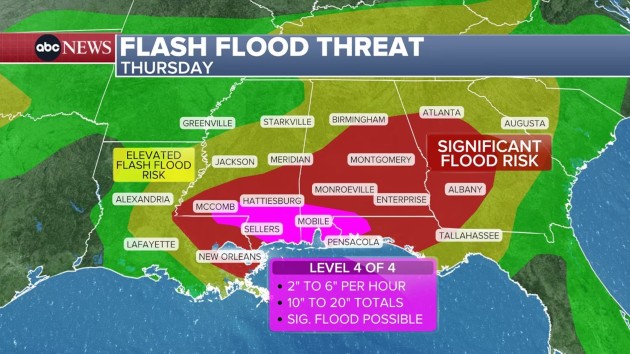
(NEW YORK) — Tropical Storm Arthur, the first named storm of the Atlantic hurricane season, weakened overnight but its energy is still powerful enough to cause serious flooding and other issues in the southeast Thursday.
A rare High Risk, level 4 of 4, for life-threatening flood potential was in place over southern Mississippi, southern Alabama and western Florida panhandle along the central Gulf Coast Thursday, according to the National Weather Service (NWS).
Historically, a third of all flood-related fatalities and 80% of all flood-related damages occur in such high-risk areas, according to NWS data.
Areas under the High Risk advisory include Pensacola, Florida; Mobile, Alabama; and the Mississippi cities of Gulfport, McComb and Hattiesburg.
Rainfall rates of multiple inches per hour are possible, and some areas could see up to 20 inches of rainfall accumulation.
Extremely heavy rain already hit the Gulf states Thursday morning. Kenner, Louisiana, near the New Orleans airport, saw a radar estimated rainfall rate of 6.5 inches per hour.
Some Gulf areas are under a level 3 of 4 risk for flooding, including Montgomery, Alabama, and Atlanta, Georgia.
Tornadoes are also possible in the central Gulf Coast Thursday.
The life-threatening flood threat will continue into the overnight hours and people need to remain aware of their flood risk overnight into early Friday morning, forecasters warn.
More heavy rain will continue in the South on Friday and more sporadically on Saturday.
Cherry blossoms at the Supreme Court on a windy morning in Washington, D.C. (John Baggaley/Getty Images)
(WASHINGTON) — The Supreme Court on Thursday ruled in favor of Ali Hemani, a Texas man charged with unlawful possession of a gun since he admitted that he regularly smoked marijuana.
The court said the law as applied to him is unconstitutional.
This is a developing story. Please check back for updates.
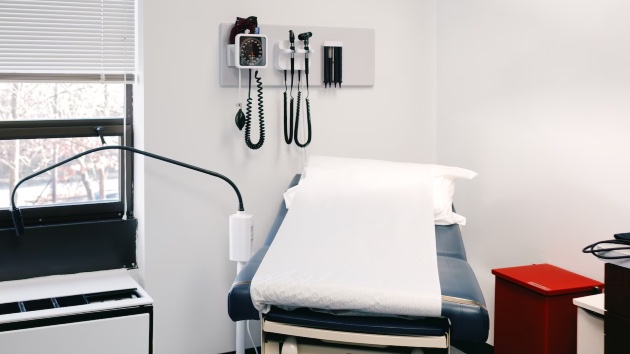
Close-up of examination table in doctor’s office (Grace Cary/Getty Images)
(NEW YORK) — Fewer than 49% of Americans can afford healthcare, the lowest rate since tracking began in 2021, according to Gallup data released Thursday.
In a single year, roughly 2.8 million people no longer identified as being “Cost Secure” meaning they could no longer afford access to quality care or pay for visits and prescriptions, according to the data. Worry about future healthcare costs, including visits and prescriptions, amongst Americans is also at an all-time high of over 40%, according to Gallup.
Gallup developed what it calls the “Healthcare Affordability Index,” which is sponsored by West Health, in 2021 drawing on self‑reported experiences from nationally representative surveys. The latest data comes from a study conducted between October and December of 2025, according to Gallup and West Health.
Healthcare has become a financial burden across income levels, according to the new data. According to the index, one in three upper-middle income households ($120,00 to $180,000) are not cost secure, nor are one in five households earning above $180,000.
Young adults, aged 18-29, have experienced the sharpest decline in ability to afford healthcare with those identifying as “cost secure” dropping 7 percentage points in a year.
Women continue to trail behind men when it comes to affording healthcare.
Between 2021 and 2024 the difference between men and women being able to afford care was 9% but in 2025 the gap widened to 15%, making it the largest gender gap in healthcare affordability on record.
Healthcare and inflation continue to rise with healthcare spending reaching $5.3 trillion in 2024. This, in part, is due to hospital prices increasing to 3.4% in 2024, the fastest rate increase since 2007, and insurance premiums going up by 20% after the expiration of subsidies under the Affordable Care Act.
With many Americans experiencing significant healthcare-related financial challenges, studies show that this can lead to significant consequences, including delaying or deferring care, leading to worse health overall.
Torie A. Livingston, MD, MPH, is a third-year pediatric resident physician at the University of Chicago and is a medical intern of the ABC News Medical Unit.