
DOJ says it will appeal Abrego Garcia ruling, releases documents tying him to gang

DOJ says it will appeal Abrego Garcia ruling, releases documents tying him to gang
Tasos Katopodis/Getty Images

(WASHINGTON) — The Department of Justice filed notice Wednesday that it will appeal the order from a federal judge requiring the government to facilitate the return of wrongly deported Kilmar Abrego Garcia from El Salvador, on the same day the it released two documents that were previously used to allegedly tie him to the criminal gang MS-13.

The two forms the government present as evidence — a gang field interview sheet from the Prince George’s County Police Department in Maryland and an additional form from the Department of Homeland Security — base Abrego Garcia’s alleged gang affiliation on his clothing and information from a confidential informant described as a “past proven and reliable source of information.”

The reports provide no other information beyond the clothing and confidential informant to justify the claim that Abrego Garcia is a ranking gang member.

Abrego Garcia is entering his second month in an El Salvador mega-prison after he was deported there on March 15 despite being issued a 2019 court order barring his deportation to his home country due to the fear of persecution.

His attorneys and his wife have denied he is a member of MS-13, and his lawyers have called into question the validity of the document by alleging the detective who authored it was later suspended.

DHS Assistant Secretary of Public Affairs Tricia McLaughlin told ABC News’ Jay O’Brien on Tuesday that Abrego Garcia’s deportation to El Salvador was the result of a “clerical error” and that “he should have been sent to a detention center in Mexico, Nicaragua, Egypt.”

According to the gang field interview sheet – a report of the police’s interaction with Abrego Garcia – he was approached by police in 2019 after they said he was loitering in a Home Depot parking lot in Hyattsville, Maryland.

The report noted that Abrego Garcia wore a Chicago Bulls hat and hoodie emblazoned with images of rolls of money covering the eyes and ears of former U.S. presidents, which police claimed tied Abrego Garcia to the gang.

“Officers know such clothing to be indicative of the Hispanic gang culture,” the report said, noting that the meaning of the clothing is “see no evil, hear no evil and say no evil.”

“Wearing the Chicago Bulls hat represents that they are a member in good standing with the MS-13,” the report said.

According to the report, officers contacted a “past proven and reliable source of information” who said that Abrego Garcia was a ranking member of MS-13. Abrego Garcia had the rank of “Chequeo” and had the moniker “Chele,” according to the informant. According to the DOJ, a chequeo is a low level member of MS-13.

The DHS report added that Abrego Garcia was in possession of $1,178 at the time of his arrest.

The report noted that Abrego Garcia was in the company of three other men when he was arrested, one of whom, according to police, had an extensive criminal history and was known as an active gang member. Another was linked to MS-13 based on a confidential source, the report said.

Police said they were unable to link the third man to the gang, writing that “MS-13 gang members are only allowed to hang around other members or prospects for the gang.”

The other document — a DHS I-213 form — cited the Prince George’s County Police Department field interview sheet to claim that Abrego Garcia was “identified” and “validated” as a member of MS-13. Abrego Garcia denied having any information about the gang or human smuggling, according to the DHS report.

An immigration judge who denied Abrego Garcia bond in 2019 cited both reports as the main evidence to conclude he posed a risk to the community.

Abrego Garcia’s lawyers have highlighted apparent inconsistencies in the DHS report, saying it offers contradictory assessments regarding whether Abrego Garcia feared being removed to El Salvador.

His attorneys have also highlighted that the confidential information linked Abrego Garcia to the Western clique of MS-13, which principally operates on Long Island, where they say he has never lived.

The report also noted that the two other alleged gang members at the Home Depot parking lot were members of a different MS-13 clique.

Wednesday’s developments came a day after U.S. District Judge Paula Xinis ordered government officials to testify under oath because, she said, they had “done nothing to aid in Abrego Garcia’s release from custody and return to the United States,” despite the Supreme Court directing the Trump administration to “‘facilitate’ Abrego Garcia’s release from custody in El Salvador.”

Per Judge Xinis’ orders, the Trump administration on Wednesday submitted its daily status update on Abrego Garcia, saying that were “no further updates.”

“Given the government’s prior clear and unequivocal notice to the Court regarding how the government will facilitate Abrego Garcia’s return within the contours of existing law and regulation, there are no further updates,” Joseph Mazzarra, the Acting General Counsel for the Department of Homeland Security, said in the update.

Copyright © 2025, ABC Audio. All rights reserved.

RFK Jr. lays out new studies on autism, shuts down ‘better diagnoses’ as a cause

RFK Jr. lays out new studies on autism, shuts down ‘better diagnoses’ as a cause
Alex Wong/Getty Images

(WASHINGTON) — On the heels of a new report showing that rates of autism diagnoses have again increased, Health and Human Services Secretary Robert F. Kennedy Jr. said he was determined to find the “environmental exposures” behind the rise and directed the National Institute of Health to launch new studies into “everything” — from mold to obesity — that could potentially be a factor.

Kennedy, who prioritizes autism as one of the chronic illnesses he’s determined to tackle in his aim to “Make America Healthy Again,” ardently pushed back against the explanation that a broadening definition of autism spectrum disorder is a meaningful contributor to more autism diagnoses.

Kennedy said he wanted to “move away” from the idea that “the autism prevalence increases — the relentless increases — are simply artifacts of better diagnoses, better recognition or changing diagnostic criteria.”

“This epidemic denial has become a feature in the mainstream media, and it’s based on an industry canard. And obviously there are people who don’t want us to look at environmental exposures,” Kennedy said, speaking at a press conference at the department headquarters on Wednesday in Washington, D.C.

The report Kennedy mentioned — published Tuesday by the Centers for Disease Control and Prevention — estimated that autism prevalence has increased to 1 in 31 children, which Kennedy called “shocking.”

In 2020, the same report found a prevalence of 1 in 36, and over two decades ago in 2000, the rate was 1 in 150.

Experts in the field agree that the rates of diagnoses are increasing and that environmental factors could be at play — but also say most of the increase can be attributed to the expanding definition of autism, which broadened dramatically in recent decades to include subtler features of the illness, including new descriptors as recently as 2013.

“It’s a fair question” to ask why autism prevalence has increased, Dr. Catherine Lord, a psychologist and autism researcher at UCLA’s David Geffen School of Medicine, told ABC News, but she said that it’s also important to acknowledge how much has changed.

“There’s been a huge shift in terms of awareness of autism, particularly awareness of autism without severe intellectual disability, that really changed even since I entered this field,” said Lord.

Studies also suggest that autism risk is heavily rooted in genetics, by as much as 80%.

Dr. Walter Zahorodny, a clinical psychologist and professor who studies autism at Rutgers University, joined Kennedy at Tuesday’s press conference to emphasize that there has been a “true increase” in cases, something he said he has seen throughout his career in New Jersey — though he acknowledged, unlike Kennedy, a wider variety of possibilities, from environmental exposures to other “risk factors.”

“It is a true increase. There is better awareness of autism, but better awareness of autism cannot be driving disability like autism to increase by 300% in 20 years,” Zahorodny said, referring to studies from New Jersey and the CDC report.

Zahorodny said finding the cause was crucial and lamented a lack of progress to “address this question seriously” over his career.

“I would urge everyone to consider the likelihood that autism, whether we call it an epidemic, tsunami or a surge of autism, is a real thing that we don’t understand, and it must be triggered or caused by environmental or risk factors,” he said.

Kennedy on Tuesday acknowledged that the increase in autism diagnoses could be in part caused by increased awareness, but said that still left a large portion of the jump in diagnoses unaccounted for.

He called it “indefensible” to accept awareness as the main reason, describing high stakes of ruined families and “individual tragedy.”

“Autism destroys families, and more importantly, it destroys our greatest resource, which is our children. These are children who should not be suffering like this,” Kennedy said. “These are kids who will never pay taxes, they’ll never hold a job, they’ll never play baseball, they’ll never write a poem, they’ll never go out on a date. Many of them will never use a toilet unassisted.”

“We have to recognize we are doing this to our children, and we need to put an end to it,” he added.

Not every case is as severe as Kennedy described, however; many people diagnosed with autism live highly functional adult lives. The recent CDC report found fewer than 40% of children diagnosed with autism spectrum disorder were classified as having an intellectual disability, meaning an IQ of less than 70.

Dr. Barry Prizant, an adjunct professor in the department of communicative disorders at the University of Rhode Island and director of the private practice Childhood Communication Services, told ABC News that Kennedy’s comments misrepresent what autism is like for families.

“I am not dismissing the challenges. There are considerable challenges, and a lot of those are barriers to services,” he said. “We’ve been doing a parent retreat weekend for 27 years, where we spend a weekend with 60 parents and family members, and we’re not meeting with family members and parents who say, ‘Autism is just a tragedy and it’s hell in our lives.’ They talk about the positives and the negatives, the joys as well as the challenges.”

Autism Speaks also released a statement on Wednesday, calling Kennedy comments “extremely disappointing and damaging.”

“Autism is not a preventable condition,” the nonprofit autism organization said. “The suggestion that it is—especially when linked to environmental toxins without scientific evidence—contributes to decades-old misinformation and distracts from the real needs of autistic people and their families.”

Kennedy said the NIH, led by Dr. Jay Bhattacharya, a former professor at Stanford University, will soon announce a series of new studies aimed at identifying precisely which environmental toxins are to blame. Kennedy cited mold, food, pesticides, medicines, ultrasounds, and the age and health of parents as possible culprits.

Kennedy qualified that the study would provide “some of the answers” by September, which is a variation — welcomed by experts — from his claim to President Donald Trump last week that “by September, we will know what has caused the autism epidemic.”

However, he also claimed on Tuesday: “We know it’s an environmental exposure.”

Asked by ABC News if he would commit to following the science revealed by the studies, regardless of his current expectations on what’s causing the rise in diagnosis, the secretary said yes.

“We’re going to follow the science no matter what it says,” he said.

Medical experts have been studying the potential causes of autism for decades. Research to date suggests that autism is driven by genetics, and the risk may increase when paired with certain outside factors, such as having children at an older age or exposure to pollutants.

“It’s not simple,” Lord said. “If you look at high-quality publications, the findings are small and, in terms of causes other than the genetics, have been quite hard to replicate. Not meaning they’re wrong, but just that we haven’t quite figured out what they should be.”

HHS or NIH have not provided details about how the new studies will be conducted within the given timeframe, but Kennedy pledged transparency, saying the studies would be conducted in the traditional way of funding to academic institutions through the NIH.

Copyright © 2025, ABC Audio. All rights reserved.

4 states aim to prevent food stamps recipients from using program to buy candy, soda

4 states aim to prevent food stamps recipients from using program to buy candy, soda
Steve Pfost/Newsday RM via Getty Images

(WASHINGTON) — Governors in several states have recently announced plans to eliminate some unhealthy foods from their food stamps programs, creating momentum for a key component of Health and Human Services Secretary Robert F. Kennedy’s “Make America Healthy Again” agenda.

The governors of Arkansas, Idaho and Indiana on Tuesday all said they would submit a waiver to the United States Department of Agriculture requesting permission to prevent Supplemental Nutrition Assistance Program recipients from using the money to buy candy and soft drinks.

The move follows a similar announcement from the governor of West Virginia last month.

Secretary of Agriculture Brooke Rollins, whose department oversees SNAP, has said she would approve such waivers. She appeared at a press conference Tuesday alongside Arkansas Gov. Sarah Huckabee Sanders, as Sanders announced her submission of a waiver.

The same morning, Kennedy appeared with Indiana Gov. Mike Braun for a similar announcement.

“You’re setting the stage at the federal level,” Braun told Kennedy.

“This isn’t a usual top-down one-size-fits-all public health agenda,” he said. “We’re focused on root causes, transparent information and real results. We’re taking on big issues like diet-related chronic illness.”

Eating too much added sugar can contribute to health problems such as obesity, type 2 diabetes and heart disease. Guidance from the USDA suggests that added sugar should not represent more than 10 percent of the daily caloric intake for children or adults. Based on a 2,000-calorie intake, that would be 200 calories or approximately 12 teaspoons. However, according to the Centers for Disease Control and Prevention, children are eating 17 teaspoons of added sugar per day on average as of 2017-2018.

Kennedy and Rollins have promoted changes to SNAP and have publicly encouraged governors to submit waivers.

Kennedy appeared last month with West Virginia Gov. Patrick Morrisey as he announced he would submit a waiver to ban soda from SNAP.

“The message that I want to give to the country today and to all the other governors is, get in line behind Governor Morrisey and apply for a waiver to my agency, and we’re going to give it to you. That’s the way we’re going to win this,” Kennedy said that day.

As it stands, according to the USDA website, SNAP recipients can use the money to buy fruits and vegetables; meat, poultry and fish; dairy products; breads and cereals; “other foods such as snack foods and non-alcoholic beverages”; and seeds and plants.

SNAP money may not be used to purchase alcohol or tobacco, among other things.

Experts say the state efforts to add soda and candy to the prohibited list is likely to be effective in shifting SNAP recipients away from junk food.

“If they have to spend their own money on junk food, they’re not going to buy as much junk food,” Marion Nestle, a professor emerita of public health at New York University, told ABC News.

But Nestle indicated it could be difficult for states to define what should be excluded from SNAP benefits.

“Candy can have nuts, it can have raisins, it can have other kinds of things in it that are real foods and are healthier,” she said.

An Idaho bill signed Tuesday by Gov. Brad Little defined candy as “a preparation of sugar, honey, or other natural or artificial sweeteners combined with chocolate, fruits, nuts, or other ingredients or flavorings in the form of confections, bars, drops, or pieces.”

The bill’s definition of candy does not include “any item that contains more than ten percent flour by weight or requires refrigeration.”

Dariush Mozaffarian, director of the Food Is Medicine Institute at Tufts University, told ABC News, “We need to try a lot of different things” to make Americans healthier, and expressed optimism about the state-level efforts to overhaul SNAP.

“If we make the program meet all its goals, including nutrition, which is in its name, then that strengthens the program,” he said.

Vani Hari — a healthy food activist also known as the Food Babe, the founder of Truvani and a front-facing leader of the MAHA movement — called this “a do-or-die moment” for American health.

“We need to question any legislator that doesn’t sign these bills, there is no legitimate reason to allow high fructose corn syrup water in government funded nutritional dollars. Governors who stand with Secretary Kennedy’s vision of MAHA will change the course of history of American health – it’s a do or die moment and we’ve never had momentum like this before,” Hari told ABC News in a statement.

Copyright © 2025, ABC Audio. All rights reserved.

‘I’m in ruins,’ teary Mike Lindell tells judge in Smartmatic sanctions hearing

‘I’m in ruins,’ teary Mike Lindell tells judge in Smartmatic sanctions hearing
Win McNamee/Getty Images

 (WASHINGTON) — Election denier and MyPillow CEO Mike Lindell continues to refuse to pay more than $50,000 in sanctions he has been ordered to pay to voting software company Smartmatic over “frivolous” election claims — alleging he’s left with no money after numerous legal battles.

“I’m in ruins,” a teary Lindell said through a Zoom screen during a motion hearing in the U.S. District Court in Washington on Wednesday, pleading to Judge Carl Nichols to allow him to wait until after the final judgement comes out to make any payment in the case, which he has already lost.

Last month, Smartmatic filed a motion to hold Lindell in contempt, alleging the MyPillow CEO has been dodging his court-ordered payment of $56,369 to Smartmatic for months.

Lindell, however, insisted that he does not have the means to pay the amount due to various financial difficulties he has suffered over the last few years due to what he again claimed was “lawfare” waged against him for trying to “secure the election.”

“I borrowed everything I can. Nobody will lend me any money anymore,” Lindell claimed. “I can’t turn back time … but I will tell you, I don’t have any money.”

Lindell claimed he was recently forced to lay off hundreds of MyPillow employees, lost multiple MyPillow warehouse units over the past two years and even owes millions of dollars to the IRS for what he described as a COVID-era employee retention credit.

He claimed he has “nothing” except for two houses, which he claimed are in the process of being liquidated, and a truck.

He even claimed he can no longer adhere to a previously proposed plan of making monthly installments of $5,000.

After listening through Lindell’s plight, Nichols acknowledged that these claims are “non-verifiable representation” at the moment and gave Lindell until Friday to file under seal financial statements and other documents to prove his claims.

“I have nothing to hide,” Lindell said as he agreed to do so and added he wants Smartmatic to see the financial situation he’s in as well.

Smartmatic’s attorney said his client would prefer to see the payment made in a lump sum as soon as possible but acknowledged he would respect the judge’s ruling.

Copyright © 2025, ABC Audio. All rights reserved.

3 killed in 2-boat collision on Alabama lake, state authorities say

3 killed in 2-boat collision on Alabama lake, state authorities say

(CULLMAN COUNTY, AL) — Three people were killed after two boats collided on an Alabama lake on Wednesday, authorities said.

The incident occurred during a Major League Fishing tournament and involved one of the event’s anglers, the organization said.

The two-vessel crash occurred shortly after 7 a.m. local time on Smith Lake in Cullman County, according to the Alabama Law Enforcement Agency (ALEA).

A Nitro bass boat struck a Center Console vessel, according to ALEA. The three people killed in the crash were all on board the Center Console boat, ALEA said.

Among them, Joey Broom, 58, of Altoona, Alabama, was “fatally injured” in the crash, ALEA said in a press release.

Additionally, John Clark, 44, of Cullman, Alabama, and Jeffrey Little, 62, of Brandon, Mississippi, were both thrown overboard during the incident and drowned, ALEA said. Their bodies were recovered from the lake, ALEA said Wednesday evening.

The incident remains under investigation.

Major League Fishing said the “serious boating accident” occurred during the second day of the Tackle Warehouse Invitational.

“This is a heartbreaking moment for our entire organization,” Kathy Fennel, the executive vice president and general manager of Major League Fishing, said in a statement. “Our deepest condolences go out to the families and friends of those affected by this tragedy.”

The final day of the competition, which had been scheduled for Thursday, has been canceled, the organization said.

Copyright © 2025, ABC Audio. All rights reserved.
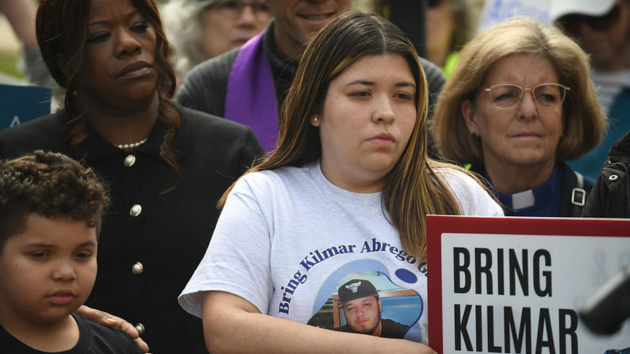
Wife of deported Maryland man Abrego Garcia said he hit, scratched her in 2021 court documents

Wife of deported Maryland man Abrego Garcia said he hit, scratched her in 2021 court documents
Astrid Riecken For The Washington Post via Getty Images

(WASHINGTON) — The wife of Kilmar Abrego Garcia, the Salvadoran migrant whose wrongful deportation to El Salvador is at the center of a legal battle with the Trump administration, had a temporary order of protection against him in 2021 in which she cited being slapped, hit with an object, and being detained against her will, according to court documents obtained by ABC News.

In a lengthy statement within a petition for protection “from domestic violence,” Jennifer Vasquez Sura mentioned an incident on May 4, 2021, in which she alleges that Abrego Garcia “punched and scratched her eye,” causing her to bleed.

That same day, Vasquez Sura said that when she told Abrego Garcia that she needed to go to a store, he “got angry, started yelling again to the point that he ripped [her] shorts and shirt off.”

“And I ran to the bathroom, he [ran] behind me and grabbed me by my arm,” Vasquez Sura said. “I have marks on my left arm as well.”

“At this point I am afraid to be close to him,” Vasquez Sura added. “I have multiple photos/videos of how [violent] he can be.”

Vasquez Sura obtained a temporary protective order against Abrego Garcia in May of 2021, according to state court records in Maryland. The order required that Abrego Garcia have no contact with Vasquez Sura, and that he stay away from their shared residence, the records show.

In a statement released to ABC News Wednesday through her attorney, Vasquez Sura — who has been vocal in her support of Abrego Garcia during his incarceration in El Salvador — said, “After surviving domestic violence in a previous relationship, I acted out of caution after a disagreement with Kilmar by seeking a protective order in case things escalated.”

“We were able to work through this situation privately as a family, including by going to counseling,” Vasquez Sura said. “Kilmar has always been a loving partner and father, and I will continue to stand by him and demand justice for him.”

Abrego Garcia, who the Trump administration alleges is a member of the criminal gang MS-13, is entering his second month in an El Salvador mega-prison after he was deported there on March 15 despite being issued a 2019 court order barring his deportation to his home country due to the fear of persecution.

He had been living in Maryland with Vasquez Sura , their 5-year-old child, and two step-children. Vasquez Sura has denied that he is affiliated with MS-13.

In the 2021 documents obtained by ABC News, Vasquez Sura noted two past incidents, alleging that in 2020, Abrego Garcia hit her with his work boot and that in August 2020, he hit her in the eye.

The protective order was dismissed a month after it was issued, on June 17, 2021, after Vasquez Sura failed to appear in court, according to a signed order of dismissal by a judge.

ABC News also obtained documents submitted to a Maryland court in August 2018 by a man who claimed to be the father of two of Vasquez Sura’s children. In a five-page motion for an emergency hearing, he said he feared for the children’s lives, in part, “because she is dating a gang member and attempted self-harm,” the records state.

The man did not include the name of the individual he alleged is a gang member. It is not known if he was referring to Abrego Garcia.

The initials of his children’s names, listed in a custody complaint, match the ones that Vasquez Sura listed for her kids in a declaration submitted in Abrego Garcia’s case.

He appears to have left some sections of the complaint unfinished, including what custody terms he was requesting. However, in the filing he said he would allow Vasquez Sura to visit the children on the condition that “we both agree on the time and date.”

According to court documents dated January 18, 2019, the case was dismissed because Vasquez Sura wasn’t served.

Vasquez Sura’s attorneys did not respond to a request for comment on documents involving her ex.

On Tuesday, a federal judge ordered government officials to testify under oath because, she said, they had “done nothing to aid in Abrego Garcia’s release from custody and return to the United States,” despite the Supreme Court directing the Trump administration to “facilitate” Abrego Garcia’s release from custody in El Salvador.

The Department of Homeland Security, in a social media post Wednesday, shared a 2021 court record from Abrego Garcia’s protective order case and said in the post that he “was not the upstanding ‘Maryland Man’ the media has portrayed him as.”

Copyright © 2025, ABC Audio. All rights reserved.

Gaza on the brink: Closed border crossings push population toward famine

Gaza on the brink: Closed border crossings push population toward famine
Diaa Ostaz/ABC News

(GAZA) — Since the end of the ceasefire between Israel and Hamas on March 18, the humanitarian situation in Gaza has sharply deteriorated.

The continued closure of all border crossings since March 2 has blocked the entry of humanitarian aid, triggering a severe food crisis and endangering the lives of millions of civilians.

Aid organizations warn that without urgent action, Gaza faces the real possibility of widespread famine, escalating malnutrition and the collapse of essential services.

One of the gravest consequences of the blockade is the complete disruption of the food supply chain. According to residents, bakeries across Gaza have been forced to shut down due to a lack of flour, fuel and operational supplies.

“There is no bread, no bread at all. There is no flour. The crossings are closed. The children are starving,” said Ahmed Abu Mustafa, a resident of Khan Younis, in an interview with ABC News. “Even if we had flour … the bakeries don’t have fuel to bake or cook food.”

The impact on civilians is visible and tragic.

Moath Fayez Abu Ramadan, also from Khan Younis, waited daily at a closed bakery earlier this month hoping to find food for his children.

“I have been here since six in the morning, waiting for the bakery to open so I can feed my children,” he told ABC News. “My wife was killed in the war, and my children need someone to take care of them and provide food.”

The World Food Programme (WFP) announced on March 31 that its aid supplies to Gaza have been fully depleted. The closure of the crossings has made resupply impossible, with catastrophic results.

“We are in a famine in every sense of the word,” said Umm Mohammed, a displaced resident from Rafah. “No matter how much we describe it, it is a famine. What is the fault of the children?” she asked during an interview with ABC News.

In a series of statements on Wednesday, Israeli Defense Minister Israel Katz said Israel would continue to bar the entry of humanitarian aid into Gaza, calling it “one of the main pressure tools that prevents Hamas form using this measure vis a vis the population.”

Katz said Israel planned to create an infrastructure for distributing aid using civilian companies later.

Aid organizations raise alarm

International aid organizations are also raising alarm over the humanitarian toll of the blockade.

Rosalia Bollen, a spokesperson for UNICEF, told ABC News, “Since March 18, hundreds of children have been killed, hundreds more have been injured. … Burns, shrapnel lodged in the bodies of children, children who’ve had their limbs amputated.”

She emphasized the urgent need to reestablish a ceasefire and reopen the crossings.

“The most impactful action that governments need to take is to ensure that the ceasefire is reestablished. That is the most important measure to save children’s lives,” she said.

Beyond food shortages, Gaza’s children are suffering psychologically from the relentless violence and deprivation.

“Children are deeply traumatized by what they’ve witnessed,” Bollen explained. “They’ve been exposed to really unprecedented levels of violence on a daily basis for months in a row. … Today, every child in Gaza needs mental health support.”

Violence has returned

The International Committee of the Red Cross (ICRC) echoed this concern and highlighted the challenges of operating under such extreme conditions.

“After a period of relative calm, violence has returned to Gaza and the civilian population once again is bearing the brunt,” said Hisham Muhanna, an ICRC spokesperson, in an interview with ABC News. “The entry of humanitarian aid – Gaza’s main lifeline – has been suspended … the situation is even more dire.”

ICRC’s operations in Gaza are ongoing but severely constrained, Muhanna said.

“Programs like common kitchens continue feeding people with, sometimes, the only meal they will receive a day,” Muhanna said.

However, he warned of a looming catastrophe.

“Flour supplies are dwindling, and many bakeries have had to shut down,” he said. “In short order, the impacts will be acute on nutrition and basic health.”

With no fuel entering Gaza, water purification systems and hospitals are on the verge of collapse, Muhanna said.

“Hospitals cannot operate without health care staff, who don’t live nearby and who are struggling to come to work safely during this period of hostility,” Muhanna said.

“With no proper sanitation and limited access to safe drinking water, the danger of communicable disease outbreaks is closer by the day,” he added.

‘In need of literally everything’

Citizens are also voicing their frustration and calling for urgent international action.

“We want the war on Gaza to stop. May God make the Arab countries stand with us,” said Abu Ramadan.

Umm Mohammed added, “We fear hunger. We no longer fear death; we have reached the point where we wish for death. … When your child asks for bread — his most basic right — what do you say?”

As aid agencies work tirelessly under impossible conditions, time is running out for Gaza.

“The suffering in Gaza isn’t just physical but also psychological,” said Bollen. “Children in Gaza are in need of literally everything: food, safe water, health care and emotional support.”

The international community faces a critical moment. Without immediate and sustained action to reopen the crossings and restore aid flows, aid agencies are warning that Gaza is at risk of plunging into an irreversible humanitarian catastrophe.

Copyright © 2025, ABC Audio. All rights reserved.

Rep. Elise Stefanik eyes New York governor seat in 2026, sources say

Rep. Elise Stefanik eyes New York governor seat in 2026, sources say
Andrew Harnik/Getty Images

(NEW YORK) — Rep. Elise Stefanik, a key Republican ally of President Donald Trump, is considering a run for governor of New York, a source familiar with her thinking told ABC News.

Stefanik’s office didn’t immediately comment.

Gov. Kathy Hochul is running for reelection in 2026 in the Empire State and is vying for her second full term in office.

President Donald Trump nominated Stefanik to be the United Nations ambassador and she was replaced as House Republican Conference Chair by Michigan Rep. Lisa McClain.

However, on March 27, a week before her Senate confirmation vote, Trump announced that he was withdrawing her nomination, citing the razor-thin Republican majority in the House of Representatives.

“There are others that can do a good job at the United Nations. Therefore, Elise will stay in Congress, rejoin the House Leadership Team, and continue to fight for our amazing American People,” Trump said on Truth Social.

“This is about stepping up as a team, and I am doing that as a leader, to ensure that we can take hold of this mandate and deliver these historic results,” Stefanik told Fox News that evening.

Addison Dick, a spokesman for the New York State Democrats, dismissed the news of Stefanik’s possible run, claiming in a statement that the New York GOP “can’t field a serious candidate from their pathetic crew of Trump minions.”

“New Yorkers want nothing to do with the clown show of Trump loyalists who are only focused on enabling Trump’s agenda that is raising costs, gutting health care, and attacking New Yorkers’ freedoms,” he said in a statement.

The upstate New York congresswoman has been rising among the ranks on the Hill for her hard conservative stances.

She played a key role in the congressional response to antisemitism on college campuses amid the Israel-Hamas war. She’s also accused the United Nations of antisemitism.

Although largely Democratic, New York state has seen voters shift red over the last couple of years.

Hochul won the 2022 election with just 377,834 votes, roughly 53% of the total vote, beating then U.S. Rep. Lee Zeldin. In the 2018 election, then-Gov. Andrew Cuomo won with over 1.4 million votes, roughly 59.55% of the total vote, beating then-Dutchess County Executive Marc Molinaro.

Copyright © 2025, ABC Audio. All rights reserved.

Missing 10-year-old boy who recently underwent kidney transplant found safe: Sheriff

Missing 10-year-old boy who recently underwent kidney transplant found safe: Sheriff
Clallam County Sheriff’s Office via Meta

(Clallam County, WA) — Authorities said a missing 10-year-old boy who recently underwent a kidney transplant and needed medication has been found safe following an “urgent” search.

Mason Combs was last seen leaving a friend’s house in Clallam County and running into a wooded area at approximately 4 p.m. local time on Tuesday, according to the local sheriff’s office.

He was found safe on Wednesday, the Clallam County Sheriff’s Office said.

“Thank you to all the wonderful volunteers and First Responders who searched diligently for Mason!! He’s been located safe and sound,” the sheriff’s office said in an update on social media while sharing a photo of the child holding a bottle of water.

No additional details were provided.

Mason had been reported missing by his family on Tuesday, according to Clallam County Sheriff’s Office Undersheriff Lorraine Shore.

“Mason needs medication for a recent kidney transplant and was only wearing a t-shirt and pants with no jacket,” the Clallam County Sheriff’s Office said in a social media post on Wednesday.

Without his medication, which he did not have Tuesday night, Mason could pass out, Shore told Seattle ABC affiliate KOMO.

“We are extremely concerned. We consider this to be an urgent search,” Shore told KOMO amid the search. “We are deploying all assets. Our entire focus is on finding this child.”

More than 30 people from multiple agencies aided in the search, which included an aerial search by helicopter and drones, Shore said. K9 teams were also searching buildings and ponds, the sheriff’s office said.

Residents were urged to check their outbuildings, ponds and property for Mason, the sheriff’s office said.

“This is a very rural area, people have a lot of outbuildings, they have a lot of places that a child could hide,” Shore told KOMO. “He might be passed out.”

Mason and his family are from North Carolina and have been in Clallam County for the past two weeks, according to Shore.

Mason’s desperate wait for a life-changing kidney transplant was featured in a November 2023 report by Raleigh station WRAL.

His mother told the station at the time that he was having dialysis multiple times a week after having both kidneys removed.

Copyright © 2025, ABC Audio. All rights reserved.

Fed Chair Powell sounds alarm on tariffs, sending stocks lower

Fed Chair Powell sounds alarm on tariffs, sending stocks lower
Win McNamee/Getty Images

(WASHINGTON) — Federal Reserve Chair Jerome Powell said Wednesday that he expects President Donald Trump’s tariffs policy to cause higher inflation and slower economic growth, complicating potential central bank efforts to ease the fallout.

“The level of the tariff increases announced so far is significantly larger than anticipated. The same is likely to be true of the economic effects, which will include higher inflation and slower growth,” Powell told the audience at the Economic Club of Chicago.

Powell’s remarks immediately sent stocks lower as investors digested the top central banker’s concern about the tariffs.

Within minutes, the Dow Jones Industrial Average fell 690 points, or 1.7%, more than tripling losses suffered over the course of the day before Powell’s comments. At the close of trading, the Dow dropped 1.7%.

The S&P 500 dropped 2.2% at market close, while the tech-heavy Nasdaq plunged 3%. Both indexes deepened losses suffered earlier in the day.

Stocks had fallen in early trading on Wednesday after chipmaker Nvidia disclosed it was recording a $5.5 billion charge in accordance with a new Trump administration restriction on exports to China.

Wednesday’s address marked Powell’s first public remarks since Trump last week paused his so-called “reciprocal tariffs” on most countries for 90 days. Stocks soared minutes after Trump’s announcement, recovering much of the losses suffered in the aftermath of the “Liberation Day” tariffs start a week earlier. It amounted to one of the most volatile weeks in the history of Wall Street.

“Markets are struggling with a lot of uncertainty and that means volatility,” Powell said on Wednesday. Still, he added, the volatility reflected the significance of the policy changes, rather than abnormal behavior in the markets.

“They’re functioning just about as you’d expect them to function,” Powell said.

At the same time Trump paused some tariffs last week, he also increased tariffs on China, bringing levies on Chinese goods to a cumulative level of 145%. In response, China hiked tariffs on U.S. goods to 125%, escalating a trade war between the world’s two largest economies.

Powell said earlier this month that he expected Trump’s tariff policy would hike prices and slow economic growth, while noting that key indicators “still show a solid economy.”

Policy changes implemented by the White House have contributed to a “highly uncertain outlook,” Powell said.

Last month, the Fed opted to hold interest rates steady, even as the central bank said it expected higher inflation and slower economic growth than it had forecast in December. The Fed will announce its next interest-rate decision on May 7.

Powell on Wednesday indicated that the Fed may approach interest rates with restraint as policymakers observe the economic effects of Trump’s tariffs.

“The U.S. economy is still in a solid position,” Powell said. “For the time being, we are well positioned to wait for greater clarity before considering any adjustments to our policy stance.”

Copyright © 2025, ABC Audio. All rights reserved.