(LONDON) — A 6.2 magnitude earthquake has rattled much of Turkey Wednesday morning, according to the United States Geological Survey.
The quake occurred at a depth of just 6.2 miles with the epicenter of the quake located approximately 14 miles southeast of Marmara Ereğlisi and 70 miles west of Istanbul.
No casualties have been reported so far, but hospitals reported that many patients were admitted due to anxiety and panic as citizens could be seen rushing into the streets and parks.
ABC News’ Engin Bas and Somayeh Malekian contributed to this report.
(OCEAN COUNTY, NJ) — A wildfire in New Jersey has exploded to approximately 8,500 acres since it was first reported on Tuesday afternoon.
The Jones Road Wildfire is now burning across 8,500 acres and is currently under 10% containment on Wednesday morning, according to the New Jersey Forest Fire Service.
The fire is located south of Toms River along the Garden State Parkway, bringing traffic there to a halt as the fire managed to jump one of New Jersey’s busiest roads and is now burning in Ocean and Lacey Townships in Ocean County.
According to ABC News’ Philadelphia station WPVI, more than a thousand structures are under threat and more than 3,000 residents have evacuated the area as evacuation notices remain in place.
A forced power outage due to the fires have also left at least 25,000 customers in the dark though no injuries across the states of New Jersey have been reported as of Wednesday morning.
Wednesday’s forecast is expected to be breezy through the morning with winds gusting up to 20 mph from the north, but winds should calm this afternoon as high pressure starts moving into the region with the next chance for rain for New Jersey beginning Friday night.
Evadulia Orta, mother of Rojelio Torres, a victim in the shootings at Robb Elementary School holds a photo of her son as she is interviewed with her sister by ABC News, Uvalde, Texas, May 26, 2022. (ABC News)
(UVALDE, TEXAS) — An attorney representing the families of the Robb Elementary School mass shooting victims confirmed to ABC News on Tuesday night that a settlement was reached and approved by a unanimous vote at a city council meeting in Uvalde, Texas.
Josh Koskoff, one of the attorneys who filed the lawsuit against the city, did not specify the exact terms of the settlement.
The lawsuit responds to the circumstances surrounding the school shooting that took place on May 24, 2022, claiming the lives of two teachers and 19 students.
In addition to a monetary settlement that would be paid out by the city’s insurance, the families were asking for Uvalde Police to adopt new fitness standards for the force and boost officer training, attorneys announced at a press conference in May 2024.
At the time of filing the suit, Koskoff told ABC News that the plaintiffs also were asking the city to maintain the cemetery where many of the victims are buried and to provide an updated accounting of the donations and spending related to May 24.
The plaintiffs were also asking to designate May 24 as an official day of remembrance in Uvalde and to create a committee for a permanent memorial in town.
The attorney confirmed all 21 victims’ families were represented in the lawsuit, but didn’t disclose any others who are listed as plaintiffs.
(CHANDLER, AZ) — Lori Daybell, the mother convicted of murdering two of her children in a so-called doomsday plot, has now been found guilty of conspiring with her brother to kill her fourth husband.
The jury in Maricopa County, Arizona, was handed the case Monday afternoon before reaching a verdict Tuesday afternoon.
Lori Daybell, 51, represented herself in the Phoenix trial. She did not take the stand or call any witnesses.
Dubbed the “doomsday mom,” Lori Daybell has maintained that her brother shot her then-husband of 13 years, Charles Vallow, in self-defense in her home in Chandler, Arizona, in July 2019. Her brother, Alex Cox, died from natural causes months after the shooting.
She had pleaded not guilty to conspiracy to commit first-degree murder.
Prosecutors, meanwhile, said the shooting was a ploy for Daybell to get rid of her estranged husband so she could get his $1 million life insurance policy and be with her current husband, Chad Daybell, whom she married four months after the shooting.
Prosecutors further said she invoked their “twisted” religious beliefs as justification for the murder and gave her brother “religious authority” to kill Vallow because they believed he was possessed by an evil spirit they referred to as “Ned.”
Over two weeks, the state called more than a dozen witnesses, including Daybell’s other brother, Adam Cox, who testified that he had “no doubt” his two siblings conspired to kill Vallow upon learning that his brother had fatally shot him.
In her closing argument, Maricopa County Deputy Prosecuting Attorney Treena Kay said the evidence at the scene showed that Vallow was not shot in self-defense, but was “executed” and the scene “staged.” She recounted text messages sent from Lori Daybell to her husband, Chad, seven days after Vallow was killed, discussing her now-deceased husband’s life insurance policy. Kay said that, upon learning she was no longer the beneficiary of the plan, the defendant messaged Chad that “Ned” probably changed it “before we got rid of him.”
The prosecutor also discussed a text message the defendant sent Alex Cox days before the deadly shooting in which she said they could “be like Nephi,” a prophet in the Book of Mormon who God commanded to kill Laban.
“Lori Vallow wanted the million dollars, and she wanted Chad Daybell, and she and Alex used that twisted religious beliefs they had so that they could kill the evil, possessed Charles and ‘be like Nephi,'” Kay said.
Three jurors who spoke to reporters following the verdict said the text message evidence in the case had stood out while they were deliberating. The jurors said they had no knowledge of Lori Daybell’s prior convictions, which were not discussed during the Phoenix trial.
Members of Vallow’s family expressed relief at the guilty verdict.
“I’m ready to move on,” Vallow’s sister, Kay Woodcock, told reporters outside the courthouse.
“This was thrust upon us, and our lives just went into, like a tornado, for a long time,” she said.
Following the guilty verdict, Lori Daybell agreed to several aggravating factors in the case, instead of having a jury make a finding on them. Among them, she agreed that this was a dangerous offense and that it involved the presence of an accomplice. When asked if she agreed that as a result of her conduct, the victim or the victim’s family “suffered emotional or financial harm,” she said, “Absolutely.”
She will be sentenced following another upcoming trial in Maricopa County, where she is further accused of scheming with her brother Alex Cox to kill Brandon Boudreaux, the ex-husband of her niece.
Three months after the shooting of Vallow, Boudreaux called 911 to report that someone driving by in a Jeep shot at his vehicle outside his home in Gilbert, Arizona.
She has pleaded not guilty in that case.
Both Lori and Chad Daybell were found guilty of first-degree murder for the deaths of her children, Joshua “J.J.” Vallow, 7, and Tylee Ryan, 16, who went missing months after Charles Vallow was killed. In separate trials in 2023 and 2024, prosecutors argued the couple thought the children were possessed zombies and murdered them so that they could be together. The children’s remains were found on an Idaho property belonging to Daybell in June 2020 following a monthslong search.
Lori Daybell is currently serving life in prison without parole for the murders of her two children. She has denied killing them.
Chad Daybell was sentenced to death after being convicted of murdering the two children, as well as his first wife, Tamara Daybell, and now awaits execution on Idaho’s death row.
(BOSTON) — A Massachusetts woman is on trial again for the death of her police officer boyfriend, after a jury was unable to reach a verdict in the initial murder trial last year.
Karen Read is accused of killing her boyfriend, John O’Keefe, a Boston police officer, in January 2022. The prosecution alleges that, following a night of drinking in Canton, Read struck O’Keefe with her SUV outside of a private residence, then left the scene. An autopsy found that he died of hypothermia and blunt force injuries to the head.
Read’s defense attorneys have long centered on allegations that the defendant was the subject of a cover-up.
Read has maintained her innocence. She pleaded not guilty to charges including second-degree murder, vehicular manslaughter while operating a vehicle under the influence of alcohol and leaving the scene of a collision causing death.
During opening statements Tuesday in Norfolk County Superior Court in Dedham, special prosecutor Hank Brennan focused on numerous accounts Read has given in interviews with the media, in which he claims Read makes a series of “admissions.” Brennan announced his intent to present Read’s numerous statements to the media as important evidence in the Commonwealth’s case.
“You are going to hear from her own lips, and many of her statements, her admissions to her extraordinary intoxication. Her admissions to driving the Lexus. Her admissions to being angry at John that night,” he said.
Brennan directed the jury’s attention to a clip of the defendant’s interview from October 2024.
“I didn’t think I ‘hit him,’ hit him,” Read said in the interview. “But could I have clipped him, could I have tapped him in the knee and incapacitated him?”
Brennan told jurors they will see a host of video and DNA evidence during the trial, including what he said is DNA of O’Keefe’s hair recovered from Read’s bumper.
He also pointed to evidence pulled from Read’s Lexus, which he said will show that the defendant’s vehicle reversed at least 70 feet around the time of the alleged murder. Brennan repeatedly highlighted the broken taillight identified on the defendant’s vehicle as evidence that her Lexus struck O’Keefe.
Defense attorney Alan Jackson asserted in his opening statement that Read did not cause the death of O’Keefe.
“There was no collision with John O’Keefe,” Jackson repeated three times.
Jackson said the assertion that O’Keefe was struck by Read’s Lexus SUV is “contrary to science.”
“John O’Keefe did not die from being hit by a vehicle, period,” Jackson said.
Jackson promised to show the jury that the police investigation on which the Commonwealth has based its case is “riddled with errors.”
He made numerous references to personal relationships that investigating officers held with witnesses in this case, including Boston police officer Brian Albert, who owned the residence where O’Keefe was found dead on the lawn.
The attorney also criticized the involvement of former Massachusetts State Police Trooper Michael Proctor, the lead investigator in the case. Jackson introduced Proctor as “a longtime family friend of the Alberts who has been disgraced by his own agency,” alluding to his dismissal by state police.
“You’ll see from the evidence in this case that this case carries a malignancy, one that is spread through the investigation,” Jackson said. “It’s spread through the prosecution from the very start, from the jump, a cancer that cannot be cut out, a cancer that cannot be cured, and that cancer has a name. His name is Michael Proctor.”
The attorney promised to show the jury personal text messages between Proctor and his high school friends, in which he made vulgar and sexist comments about Read. Jackson then alleged that Proctor admitted in the same text conversation to seizing the defendant’s cell phone without her permission and searching her phone for nude photos.
Proctor’s family responded to Jackson’s opening statement, calling it “yet another example of the distasteful, and shameless fabrication of lies that embodies their defense strategy” in a statement to ABC Boston affiliate WCVB.
“Jackson is under no oath to tell the truth; he does not have to speak in truths,” the statement continued. “The defense team continues to do anything to deflect from facts of the case and continues to use inappropriate analogies like casting someone as a cancer. We wholeheartedly believe the truth will prevail in this case, and justice for Officer John O’Keefe and his family will be achieved.”
The Commonwealth’s first witness, Timothy Nuttall, a Canton firefighter and paramedic who administered medical aid to O’Keefe, testified that he heard Read say, “I hit him,” at the scene.
“She said, ‘I hit him, I hit him, I hit him,'” Nuttall said. “I remember it very distinctly.”
In his cross-examination, Jackson focused on the witness’ ability to accurately recall details from that morning.
Jackson pointed to an inconsistency between Nuttall’s testimony in Read’s first trial, where he stated that Read said, “I hit him,” twice, and his statements Tuesday in court, where he now claims she repeated the statement three times.
“So your memory is clearer today, now, as you sit here, than it was a year ago, when you testified it was two times?” Jackson asked.
“Yes, sir,” Nuttall said with a nod.
The next witness, Kerry Roberts, testified that she saw Read point to an abnormality in the taillight of her SUV the morning that O’Keefe was found and that she recalled seeing a piece missing.
Roberts will resume her testimony on Wednesday. The trial is expected to last six to eight weeks.
Hours before the proceedings began on Tuesday, roughly two dozen protesters supporting Read gathered near the courthouse. Judge Beverly Cannone ordered a 200-foot no-protest zone around the courthouse in the interest of ensuring a fair trial.
A man “lingering and filming” within the buffer zone was arrested Tuesday morning after police say he ignored multiple requests to leave the zone, Massachusetts State Police said. The Arlington man was expected to be arraigned Tuesday on a trespassing charge, police said.
ABC News’ Nadine El-Bawab contributed to this report.
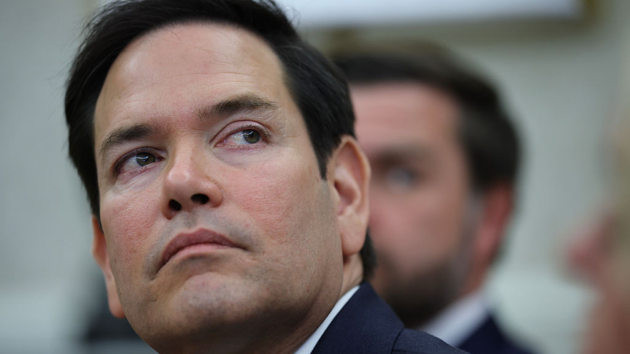
(WASHINGTON) — Secretary of State Marco Rubio on Tuesday unveiled a sweeping plan to dramatically restructure the State Department that would see many of its longstanding offices and hundreds of positions eliminated.
“In its current form, the department is bloated, bureaucratic, and unable to perform its essential diplomatic mission in this new era of great power competition,” Rubio said in a statement. “The sprawling bureaucracy created a system more beholden to radical political ideology than advancing America’s core national interests.”
Officials familiar with the plans say Rubio’s vision involves reducing the number of offices within the State Department from 734 to 602 and eventually wiping out roughly 700 Washington-based positions for Foreign Service and Civil Service employees.
The officials said that the reductions would not be immediate, and that leaders within the department would have 30 days to analyze and implement the plan.
An updated organizational chart released by Rubio shows offices on the chopping block include those that fall under the department’s Bureau of Energy Resources and its Bureau of Conflict and Stabilization Operations, which is aimed at helping the federal government “better anticipate, prevent, and respond to conflict,” according to the department.
Other offices that would be eliminated under the plan include the Office of the Science and Technology Advisor to the Secretary, the Office of International Religious Freedoms, the Office to Monitor and Combat Trafficking in Persons, the Office of Global Women’s Issues, the Office of Global Partnerships, and the Office of Global Criminal Justice, which is aimed at coordinating the government’s response to war crimes and promoting accountability for offenders.
Under the plan, the department will also combine two bureaus focused on arms control and eliminate units focused on countering violent extremism from the department’s counterterrorism bureau.
Officials also expect that several special envoys and their offices will be eliminated.
State Department spokesperson Tammy Bruce said that reorganization did not necessarily mean that the area of focus previously covered by an eliminated office was no longer a priority for the department.
“Certainly, all these issues are important,” Bruce said, adding that department would work at “blending” those topics within the new framework so they could be “dealt with as a whole.”
However, officials say that other reductions are planned for areas in the department that were not directly impacted by the reorganization, and that undersecretaries throughout the bureau have been instructed to draw up plans to reduce their personnel by 15% — a move that could lead to thousands of additional job cuts.
State Department leadership has been under increased pressure to reduce its workforce amid broader cuts across the federal government spearheaded by Elon Musk and his Department of Government Efficiency (DOGE).
On Tuesday, Bruce downplayed the role DOGE had in the reorganization plans.
“We know the American people love the result of DOGE. I think there were some questions, perhaps, about how it was applied,” she said.
“I would say that DOGE is not in charge of this, but this is the result of what we’ve learned and the fact that we appreciate results,” Bruce added.
The Trump administration has been considering a budget proposal that would cut the State Department’s budget by roughly half, according to officials familiar with internal deliberations and documents reviewed by ABC News.
Rubio’s restructuring doesn’t address the department’s overseas operations, which officials say are also likely to undergo significant cuts in the coming months.
(WASHINGTON) — The Supreme Court’s conservative majority on Tuesday signaled that it is poised to establish a right of parents to opt-out their children from public school instruction that conflicts with sincerely held religious beliefs.
The case, brought by a group of Christian, Muslim and Jewish parents from Montgomery County, Maryland, specifically seeks a guaranteed exemption from the classroom reading of storybooks with LGBTQ themes, including same-sex marriage and exploration of gender identity.
The parents allege use of the books in elementary school curriculum — without an opportunity to be excused — amounts to government-led indoctrination about sensitive matters of sexuality. The school board insists the books merely expose kids to diverse viewpoints and ideas.
The justices engaged in spirited debate for more than 2 1/2 hours of oral arguments, wrestling with where to draw the line between exposure and coercion, which is forbidden under the First Amendment.
“Is merely being exposed to the reading of the book out loud coercion?” asked Justice Sonia Sotomayor of the parents’ attorney Eric Baxter. “Is looking two men getting married — is that the religious objection?”
“Our parents would object to that,” Baxter replied.
Several of the court’s conservative members suggested an opt-out for sensitive subjects should be common sense.
“I’m a bit mystified as a lifelong resident of the county how it came to this,” said Justice Brett Kavanaugh. “I’m surprised that this is the hill we’re going to die on, in terms of not respecting religious liberty.”
In 2022, after introducing several LGBTQ-themed books into the language arts curriculum, the school board allowed parents to opt-out if the content was deemed objectionable as a matter of faith. One year later, officials reversed course and said an opt-out program had become unwieldy and ran counter to values of inclusion.
“I’m not understanding why it’s not feasible,” Kavanaugh said later. “The whole goal of some of our religious precedents is to look for the win/win.”
Justice Samuel Alito, who appeared most sympathetic to the parents, said he believes the five books in question — out of more than 100 in the school curriculum — “have a clear message” and that “a lot of people disagree with it.”
“What is the big deal about allowing them to opt out?” Alito asked Alan Schoenfeld, the county’s attorney. “Why is it not administrable? They are able to opt-out of the health class, right?”
Chief Justice John Roberts questioned whether elementary school students could realistically be assumed to understand that a presentation of the books was different than a teacher’s endorsement of them.
“I understand the idea when you’re talking about a sophomore, a junior, whatever, in high school,” Roberts said, “but I’m not sure that same qualifying factor applies when you’re talking about five-year-olds.”
Justice Neil Gorsuch suggested the board may have exhibited discriminatory “hostility” toward religion in reversing course on the opt-outs, while Justice Amy Coney Barrett appeared inclined to believe the board’s distinct purpose was to coerce children into accepting beliefs about sexuality.
“It was part of the curriculum to teach them that boys can be girls or boys can — or that your pronouns can change depending on how you feel one day to the next?” Barrett asked skeptically.
“Federal courts are not meant to sit as school boards in deciding these curriculum disputes,” Schoenfeld said later, noting that the Montgomery County board was democratically elected by local residents.
The court’s three liberal justices all vigorously challenged the parents’ request in the case, seeing opt-out rights as a slippery slope.
Sotomayor said the list of potential religiously offensive content is limitless, from depictions of women who work, to stories involving divorce, pictures of interfaith marriage, even teachings around evolution.
Justice Elena Kagan said the constitutional right parents are claiming is remarkably broad. “I’m searching for what in the legal arguments would allow us to draw lines in this area, and I’m not finding it,” Kagan said. “It’ll be like opt-outs for everyone.”
Justice Ketanji Brown Jackson worried aloud that a decision siding with the parents could have far-reaching implications beyond books.
She asked about a gay teacher with a photo of his wedding on a desk, or a student group putting “love is love” posters around the campus, or about exposure to a transgender student in the classroom, where a teacher refers to them by their preferred pronouns?
“Is it a burden for a religious student who is being taught at home and through their religion that gender is not a situation that can be changed … to be in a public school classroom where the teacher is referring to another student by what this student believes is the wrong pronoun?” Jackson asked.
“That would, in fact, constitute a burden on religious exercise,” replied Baxter, implying such a student might have a case for an opt-out.
A decision in the case is expected by the end of June.
(VATICAN CITY) — Pope Francis marked multiple firsts for the papacy, becoming the first Latin American pope and the first from the Southern Hemisphere when elected in 2013.
He was also the first head of the Roman Catholic Church born outside of Europe in over a millennium.
Following his death on Monday at the age of 88, the selection process to elect the 267th pontiff will soon begin.
Ahead of the secretive gathering of eligible cardinals for the vote, questions swirl over whether the next pope will similarly come from outside Europe, such as Asia or Africa, and potentially be another history-making leader.
“I do think it’s fair to say that election of an archbishop from Asia or Africa is certainly a real probability now. That is not unthinkable at all,” Bruce Morrill, the Edward A. Malloy chair in Roman Catholic studies and distinguished professor of theology at Vanderbilt University, told ABC News. “That’s very different from when, let’s say, someone like John Paul II was elected. It was a big deal back in 1978 because he wasn’t Italian.”
“To move a couple papacies later to a man from Argentina — clearly, it’s reflecting more than ever a global church,” he added.
The election of someone from the Global South would be a “move in that direction of how to be a global church,” Jaisy A. Joseph, an assistant professor of theology and religious studies at Villanova University, told ABC News.
“That move from a Eurocentric church to a truly global church — I think that’s what Francis really inaugurated,” she said.
Pope Francis’ successor could be someone who continues his progressive legacy and mirrors his pastoral approach, or someone who counters it with a more conservative approach, experts say.
“Is he going to be someone who really strongly continues the primary emphases of the Francis papacy, or do they want to go with someone that they would see as bringing a balance or a certain pendulum swing, to use that language, in counter or contrast of priorities from the Francis papacy?” Morrill said.
Such a swing occurred when Pope Francis was elected, succeeding Pope Benedict XVI, Morrill noted.
“Is he going to be someone who really strongly continues the primary emphases of the Francis papacy, or do they want to go with someone that they would see as bringing a balance or a certain pendulum swing, to use that language, in counter or contrast of priorities from the Francis papacy?” Morrill said.
Such a swing occurred when Pope Francis was elected, succeeding Pope Benedict XVI, Morrill noted.
“If the electors are going to turn to someone and discern the way to go is to continue, strongly, the priorities of the late Pope Francis, Tagle fits the bill,” Morrill said.
“He’s likewise someone who smiles readily and has this warm pastoral way,” he added. “That’s what makes him the figure that we would think of as providing the most continuity.”
If elected, Tagle would be the first Asian pope.
Should the voting cardinals move in a more conservative direction, a potential pope could be found in Sub-Saharan Africa, Morrill said. Such a move would make for the first Black pope in modern history.
“There would be archbishops, cardinal archbishops in Sub-Saharan Africa that are much more focused on preservation or guarding of the strict traditional practices and teachings of the church,” Morrill said.
One name that comes to mind for Morrill is Cardinal Fridolin Ambongo Besungu, 65, of the Democratic Republic of the Congo.
Other conservative candidates from Africa that could gain recognition include Ghanaian Cardinal Peter Turkson, 76, and Guinean Cardinal Robert Sarah, 79, according to Miles Pattenden, historian of the Catholic Church at Oxford University.
Cardinals under the age of 80 are eligible to participate in the secret conclave inside the Sistine Chapel to choose the next pontiff, a gathering that typically commences between 15 to 20 days after the pope’s death.
A two-thirds majority is required to elect a pontiff.
Francis appointed roughly 80% of the cardinals who are eligible to vote for his successor, which could impact the selection of the next pope, Morrill said.
“He was advancing and choosing more and more people from Asia and Africa, and so that does all feed these distinct probabilities or possibilities,” Morrill said. “But there really is no way to make any solid prediction.”
The Pew Research Center found that under Francis, voting-age cardinals from the Asia-Pacific region increased 10%, and those from Sub-Saharan Africa went up 8%, while those from Europe decreased 51%.
In all, there are 53 cardinal electors from Europe, 23 from Asia, 18 from Africa, 17 from South America, 16 from North America, four from Central America and four from Oceania, according to the Vatican.
For Phyllis Zagano, the senior research associate-in-residence in Hofstra University’s Department of Religion, it’s unclear at the moment how that shift in makeup will impact the election of the next pope.
“The College of Cardinals has expanded significantly under Pope Francis, who has included cardinals from the farthest reaches of the world,” Zagano told ABC News. “Whether that will make any difference in the election of his successor remains to be seen.”
(WASHINGTON) — The Department of Health and Human Services and the Food and Drug Administration announced on Tuesday a series of measures to phase out eight artificial food dyes and colorings from America’s food supply by the end of next year.
Speaking at a news conference, FDA Commissioner Dr. Marty Makary said the agencies are looking to revoke authorization for two synthetic food colorings and to eliminate six remaining synthetic dyes used in cereal, ice cream, snacks, yogurts and more.
“Today, the FDA is taking action to remove petroleum-based food dyes from the U.S. food supply and from medications. For the last 50 years, American children have increasingly been living in a toxic soup of synthetic chemicals,” he told reporters. “The FDA is also announcing plans today to authorize four additional natural color additives using natural ingredients in the coming weeks, while also accelerating the review and approval of other natural ingredient colors.”
Makary claimed studies have found a like between petroleum-based synthetic dyes and health conditions, including attention-deficit/hyperactivity disorder, obesity, diabetes, cancer and gastrointestinal issues.
‘Why are we taking a gamble?” he said. “While America’s children are sick and suffering, 41% of children have at least have at least one health condition, and one in five are on medication. The answer is not more Ozempic, more ADHD medication and more antidepressants. There’s a role for those medications, but we have to look at underlying root causes.
HHS Secretary Robert F. Kennedy Jr. was also due to speak at the news conference.
Former President Joe Biden’s administration in January started the process to ban one artificial dye, Red No. 3, which will need to be removed from food by January 2027 and from medications by 2028 because it was shown to cause cancer in rats.
Kennedy is now seeking to remove the six other petroleum-based dyes approved by the FDA. This includes Green No. 3, Citrus Red No. 2, Red No. 40, Orange B, Yellow No. 5, Yellow No. 6, Blue No. 1 and Blue No. 2. The agency is also taking steps to revoke the authorization for two synthetic food colorings — Citrus Red No. 2 and Orange B — within the coming months.
The department is also authorizing four new natural color additives.
It is not yet clear what enforcement mechanism Kennedy will seek to implement the new changes.
The timeline to phase out synthetic dyes comes after Kennedy told food industry leaders at a meeting last month that he wanted their companies to remove artificial dyes from their products by the end of his four-year term, according to a memo describing the meeting, which was obtained by ABC News.
Kennedy’s announcement Tuesday speeds up that process — and alert companies that Kennedy intends to make good on his warning quickly.
From candy to breakfast cereal to medication, synthetic food dyes are in a wide range of products that Americans consume. Studies suggest their vibrant color makes food more appealing and could even increase appetite.
The health effects of the dyes are not fully understood, but many other countries have either banned the additives outright or required food packaging warning labels about the health risks.
All dyes have the potential to spark allergic reactions for a small minority. Several dyes have been linked to hyperactivity and behavioral problems in children or have been shown to cause cancer in mice or rats — but none have shown to cause cancer in humans.
Already, red and blue states alike have taken matters into their own hands in removing artificial food dyes from certain foods. Both West Virginia and California have passed laws to ban a handful of food dyes from school lunches, with plans to extend the ban to a broader, statewide level too.
In West Virginia, the ban on artificial dyes in school lunch will go into effect in August, making it the first state in the country to implement such restraints. In California, it will take effect in 2028.
Twenty-six other states, from Iowa to Washington and from to Texas to Vermont, are considering similar legislation around banning food dyes or other chemical additives in foods, according to a list compiled by the Environmental Working Group, an advocacy organization that focuses on chemicals and toxins.
The Office of Environmental Health Hazard Assessment within California’s Environmental Protection Agency in 2021 concluded a two-year study into seven synthetic food dyes that found associations with certain neurobehavioral outcomes in some children.
Researchers also found that the FDA’s current level of “acceptable daily intake” levels for the dyes may be too high to protect children from the potential behavioral impact, the report said.
(NEW YORK) — Tesla’s profits fell 71% over the first three months of this year, a company earnings release on Tuesday showed. The company’s performance fell short of analysts’ expectations.
The decline coincided with a sales slump and stock woes at the electric carmaker, and comes amid worldwide protests against CEO Elon Musk over his role in the Trump administration
Total revenue decreased by 9% from one year earlier, to $19.3 billion, while revenue derived from car sales plunged 20% over the first three months of 2025 compared to a year ago, the earnings showed.
In a statement, Tesla cautioned about business impacts as result of the “current tariff landscape,” saying the company is “taking actions to stabilize the business in the medium to long-term and focus on maintaining its health.”
“Uncertainty in the automotive and energy markets continues to increase as rapidly evolving trade policy adversely impacts the global supply chain and cost structure of Tesla and our peers,” Tesla added.
The announcement holds implications for Musk, the world’s richest person, who derives much of his wealth from his Tesla holdings.
The new financial details arrive as some shareholders have called on Musk to step down from his White House role and return full-time to the helm of Tesla.
Musk, whose temporary status as a government employee expires next month, will likely face questions about his plans during a conference call with analysts after the earnings release.
“We view this as a fork-in-the-road time,” Dan Ives, a managing director of equity research at the investment firm Wedbush and a longtime Tesla booster, said in a memo to investors on Sunday.
Tesla shares have dropped in value by roughly half from an all-time high in December. Most of those losses have come since President Donald Trump took office and Musk began his controversial governmental cost-cutting efforts as the head of the newly created Department of Government Efficiency (DOGE).
Tesla remains a top electric carmaker but the company faces growing competition, especially from Chinese firms such as BYD.
Deliveries of Tesla vehicles over the first three months of 2025 dropped about 13% compared to the same period a year ago, the company said earlier this month.
When Tesla announced the decline in deliveries, the company made no mention of its CEO but did say that a “changeover of Model Y lines across all four of our factories led to the loss of several weeks of production in Q1,” but added that “the ramp of the New Model Y continues to go well.”
Tesla sold fewer cars in 2024 than it did the year prior, marking the company’s first year-over-year sales decline in more than a decade, earnings released in January showed.
As rivals have challenged Tesla’s dominance in the electric vehicle market, the company has promised a future revenue stream from autonomous taxis, also known as robotaxis.
Musk announced in late January that the company would roll out its robotaxi test program in Austin, Texas, in June. But within days, China-based competitor BYD unveiled advances in self-driving technology, which the company said was set to be included in models costing as little as $9,600.
Tesla boasts a more complete domestic supply chain than its rival U.S. carmakers but the company remains vulnerable to auto tariffs of the type President Trump imposed earlier this month, according to Musk.
“To be clear, this will affect the price of parts in Tesla cars that come from other countries. The cost impact is not trivial,” Musk said in a post on X in late March.
Gordon Johnson, CEO and founder of data firm GLJ Research, who is bearish on Tesla, voiced concerns about the company in a memo to investors on Monday, saying that the automaker faces a mix of “operational, financial, and reputational challenges.”
“Is Tesla facing an existential crisis?” Johnson added.