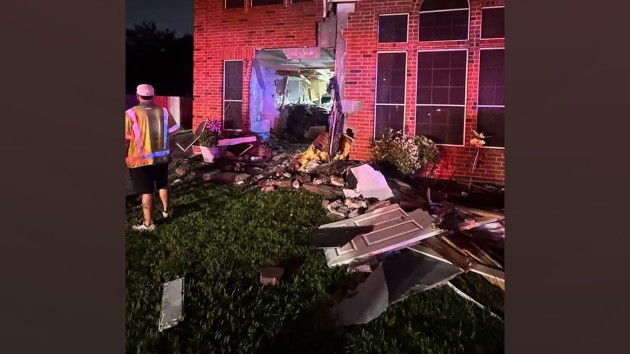
This image released by the Harris County Precinct 5 Constable’s Office shows the damage to a home after a Tesla crashed into it, in Katy, Texas, on June 19, 2026. (Harris County Precinct 5 Constable’s Office)
Editor’s note: This story has been updated for clarity.
(KATY, Texas) — A driver in a Tesla vehicle that was allegedly in driver-assist mode crashed into a Texas house Friday night, killing a woman who was inside the home, investigators said.
Michael Butler was traveling in his Tesla Model 3 around 8 p.m. local time in Katy, Texas, and was operating the vehicle “with an automated driving assistance system,” the Harris County Sheriff’s office said in a statement.
Butler allegedly failed to drive in a single lane, left the roadway and struck the residence, according to the sheriff’s office.
“Butler’s Tesla entered through the brick residence, at a high rate of speed, and struck M. Avila who was inside the residence,” the sheriff’s office said in a statement.
Avila was airlifted to a hospital where she was later pronounced dead, the sheriff’s office said.
Investigators said Butler, who was injured, showed no signs of intoxication and he was cooperating with officers. Attorney information for the driver wasn’t immediately available.
The investigation is ongoing and as of Saturday afternoon there were no charges.
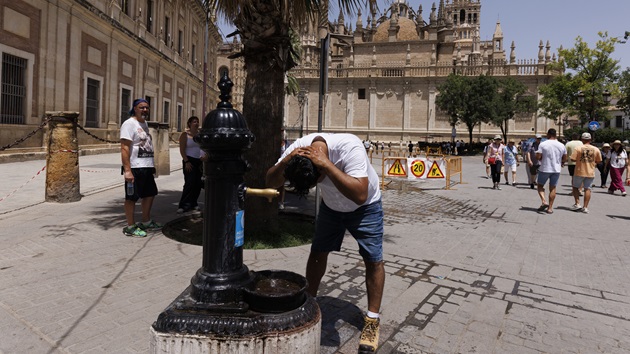
A man cools himself at a public fountain on June 21, 2026 in Seville, Spain. (Marcelo del Pozo/Getty Images)
(LONDON) — The number of people who experience heat stress around the world every year has increased exponentially in the last several decades due to climate change, according to new research.
One billion more people are currently facing at least one day of “extreme heat stress” annually compared to the 1970s, according to a study published Monday in Nature Climate Change.
Heat stress is defined as the net heat load on an individual and can be influenced by temperature, humidity, wind and radiation, according to the paper. Heat stress is the leading cause of weather-related deaths and can exacerbate underlying illnesses, including cardiovascular disease, diabetes, mental health and asthma, according to the World Health Organization.
“Heat is a leading cause of weather-related mortality at the global scale,” Rebecca Emerton, senior scientist for the European Centre for Medium-Range Weather Forecasts, in Reading, U.K., and lead author of the paper, told ABC News.
Researchers quantified the Universal Thermal Climate Index (UTCI), a thermal stress index, essentially a feels-like temperature that accounts for temperature, humidity, wind speed, solar radiation and how the human body reacts to the environment, Emerton said.
The scientists analyzed a global dataset of human heat stress from 1950 to 2024 to determine that the hottest days of the year looked like in decades past, especially in the 1970s, when the global feels-like trends started to rise, Emerton said. They then compared those figures to maximum UTCI values that are being seen today.
They found that the 10 warmest nights of each year have warmed faster than the 10 warmest days — by about a global average rate of .58 degrees Fahrenheit, according to the paper.
Extreme feels-like temperatures are also more frequent on every continent, the new research shows. Subtropical regions, including southern North America, southern Europe and northern and southern Africa, now experience up to 50 additional days annually with “strong to extreme heat stress,” defined by researchers as a UTCI greater than or equal to 89.6 degrees and 114.8 degrees Fahrenheit, respectively.
Exposure to at least one day of extreme heat stress has risen from 16% to 22% of the global population, equivalent to about one billion people, according to the paper.
As a result, global heat stress is increasing in frequency, severity and duration — both during the day and at night, the researchers found.
Nighttime heat is especially significant for health, because if the temperatures remain high overnight, the human body doesn’t have as much of an opportunity to recover from the heat of the day, Emerton noted.
Extreme heat stress, now occurs 2.5 times more often in Europe and South America, twice as often in North America and 1.8, 1.7 and 1.2 times more often in Africa, Oceania and Asia, respectively, according to the paper.
The increased instances of heat stress experienced by modern populations is a direct result of climate change, Emerton noted.
While empirical evidence shows that heatwaves are becoming more frequent, longer and more intense, the changes experienced by people around the world — including how the heat impacts them both during the day and at night — has not yet been well-studied, the researchers said.
Action plans for heat health, as well as early-warning systems, urban cooling interventions and the integration of heat stress metrics in climate risk assessments, will be necessary to protect populations from increased heat stress, according to the paper.
“We hope this helps people across the world understand the changes that are happening, and we hope that information can support decision-making on how to plan and adapt for the future,” Emerton said.
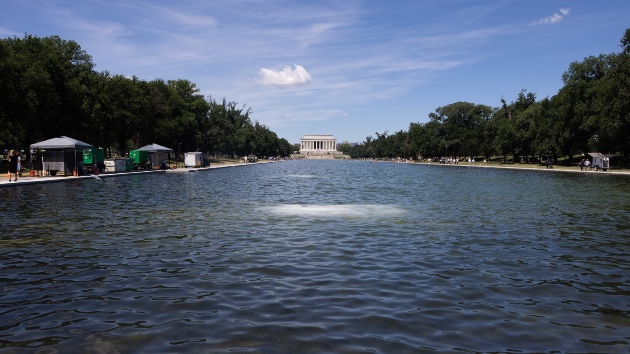
The Lincoln Memorial is seen on June 20, 2026 in Washington, DC. The National Park Service continues to work to control and remove the algae bloom that has turned the pool green following the Trump Administration’s recent $14 million repair, resealing and painting project. (Photo by Anna Rose Layden/Getty Images)
(WASHINGTON) — Three-time U.S. Olympian David Hearn told ABC News that police arrested him on Friday after he touched a piece of blue coating that was partially detached from the bottom of the Lincoln Memorial Reflecting Pool.
Hearn said he went on a bike ride on Friday afternoon and stopped by the Reflecting Pool as a “curious, concerned citizen”. Given his background in materials science, Hearn says he was interested to see the situation for himself after reading about reports of algae in the water and paint peeling off.
“I saw a piece of this loose end of this blue coating … I reached out and touched the end of that piece that was loose but still attached to the bottom,” Hearn told ABC News. “I was able to reach out and touch the edge of that that was still attached at the bottom and handled it a little bit.”
Hearn, who represented the U.S. in canoeing, said he was able to feel and bend the coating a bit.
“I did not remove, I did not damage, I did not rip, tear, break, destroy or harm any part of the Reflecting Pool,” Hearn said.
“The condition of that part and all other parts of the Reflecting Pool were in the same condition after I walked away as they were before I walked up to it.”
Hearn said as he was touching the material, a National Park Service employee told him to stop touching it. He said he then walked back to his bike where National Guardsmen told him that the Park Police wanted to talk to him.
“I had no idea I was about to be arrested,” Hearn said. “They didn’t say they were charging me, but they did start to handcuff me. They did not ever read me my rights. They did not allow me any phone calls for the ensuing five hours, and they did not detail the charges that were going to be leveled against me.”
The National Park Service has not replied to a request from ABC News about Hearn’s arrest or any others.
Hearn is set to appear in court on July 9.
Hearn said he was “fully cooperative” the whole time, did not resist and was held for five hours before being released Friday night.
Asked whether he is worried about what will happen to him next, Hearn said: “I am concerned. I’m very wary of our current government; I’m a single citizen being singled out in this way by my government. It’s not fair, and it’s not right.”
The Reflecting Pool has been plagued with algae and peeling paint in the days since the Trump administration completed a $14.65 million renovation. Visitors have been flocking to the pool over the weekend and some have taken to social media with photos and videos showing the algae and peeling paint.
President Donald Trump claims, without evidence, that the damage was committed by vandals, saying Saturday in a lengthy post on his social media platform that the pool would need to be partially drained to repair the peeling lining.
Trump said multiple people had been arrested for vandalism and blamed the condition of the pool on someone pouring “corrosive and destructive chemicals” into the pool and that “They took some form of knife or blade, and put a 250 foot long gash into the beautiful facade of what took so much work, competence, and money to build and complete.”
An administration official said on Sunday that as of Saturday night, five individuals had been arrested for vandalism, and five others had been issued citations.
The official added that 14 police reports had also been filed for alleged vandalism, including the alleged crime Trump described.
Hearn said he has “a lot of support.”
“I have several very respectable law firms who are offering to provide pro bono counsel, and we will be vigorously defending against these charges,” he said.
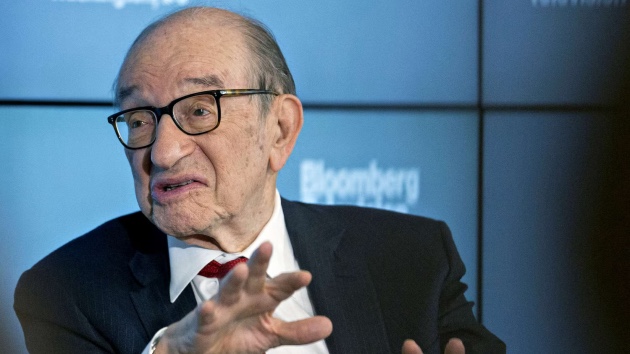
In this June 27, 2016 file photo Alan Greenspan, former chairman of the Federal Reserve and president and founder of Greenspan Associates, speaks during a Bloomberg Television interview in Washington, D.C. (Andrew Harrer/Bloomberg via Getty Images, FILE)
(NEW YORK) — Alan Greenspan, the longtime chairman of the Federal Reserve, has died, his wife confirmed. He was 100 years old.
“Alan passed away at our home this morning at the age of 100 from complications of Parkinson’s Disease,” Andrea Mitchell, his wife and a chief correspondent at NBC News, said in a statement published by the network on Monday.
The economist is remembered for leading the American central bank amid periods of historic U.S. economic expansion, while critics have also said his policies contributed to and exacerbated the mortgage crisis and financial crash of 2008.
Greenspan, a libertarian Republican, became the 13th chairman of the Board of Governors of the Federal Reserve System two months before the stock market crash on Oct. 19,1987, known as Black Monday. He was credited with moving quickly to alleviate investors’ fears after the crash and was instrumental in ensuring the Federal Reserve made plenty of money available to alleviate the impact on financial markets. Stocks quickly rebounded.
He was appointed Fed chair by four different presidents during his career, first by Ronald Reagan in 1987. Greenspan continued to serve as Fed chairman under presidents George H. W. Bush, Bill Clinton and George W. Bush. He steered the U.S. economy through the economic boom in the 1990s, the dotcom bubble, and the Sept. 11, 2001, terrorist attacks. His final term as chair ended on Jan. 31, 2006.
Under his leadership, the Fed fostered a distaste for regulation and promoted very low interest rates in the early 2000s — two phenomena critics say encouraged a bubble in housing prices that eventually burst with disastrous effects on the global economy.
During his tenure, and before the financial crisis began, the nation experienced one of the longest periods of economic growth in its history.
A decorated economist, first inspired by music
Greenspan was born on March 6, 1926, in New York City, the only child of Herbert Greenspan, a stockbroker, and Rose Goldsmith Greenspan, a retail worker. His parents divorced when he was 4 years old, and he was raised mainly by his mother and his grandparents.
An aspiring musician, Greenspan attended Juilliard for a year and played saxophone and clarinet before dropping out and enrolling at New York University. He went on to gain his bachelor’s, master’s and doctoral degrees in economics from New York University. He also engaged in some advanced graduate work at Columbia University in New York, where he studied under the influential economist Arthur Burns.
Though short-lived, his music career was an influential portion of Greenspan’s life, and he considered the move into economics a logical progression. He saw the organization of economic data into sound fiscal modeling as analogous to the organization of musical notes into tunes, according to Greenspan biographer Justin Martin in his book, “Greenspan: The Man Behind Money.”
“I get the same kind of joy from solving a hard mathematical problem as I do from hearing a Haydn quartet,” Greenspan once told The New York Times Magazine.
Greenspan taught economics at NYU between 1953 and 1955 and then founded the economic consulting firm Townsend & Greenspan, where he served as chairman and president from 1954 to 1974. He returned to the firm in 1977 and stayed until 1987.
President Richard Nixon nominated Greenspan to chair the President’s Council of Economic Advisers in 1974, the first of many government economic positions he would hold. Nixon resigned as president hours after Greenspan was nominated, but he continued to serve under President Gerald Ford. Greenspan also served as a member of President Ronald Reagan’s Economic Policy Advisory Board and was a consultant to the Congressional Budget Office.
In the private sector, Greenspan served as corporate director for many companies, including Alcoa, General Foods and J.P. Morgan & Co. He also served as a member of Time magazine’s Board of Economists and a senior adviser to the Brookings Panel on Economic Activity.
In 2002, Greenspan received an honorary knighthood from Queen Elizabeth II in recognition of his contribution to global economic stability. In 2005, President George W. Bush presented Greenspan with the Presidential Medal of Freedom.
He held the position of Fed chairman from the time Reagan appointed him in 1987 until 2006, serving an unprecedented five terms under four presidents before being succeeded by Ben Bernanke.
Greenspan is credited by many with facilitating the longest economic expansion in U.S. history. One day after the Black Monday stock crash, Greenspan affirmed the Fed’s “readiness to serve as a source of liquidity to support the economic and financial system” and the central bank moved to encourage banks to lend on their normal terms. Unlike prior financial crises, the events of Black Monday notably were not followed by an economic recession or a banking crisis and less than two years later, the U.S. stock market surpassed its pre-crash highs.
During his tenure, Greenspan developed a reputation for being a consensus-builder and for his strong anti-inflation stance, focusing more on controlling prices than on promoting full employment. He led the Federal Reserve through several events with major economic consequences, including two U.S. recessions, the 1997 Asian financial crisis and the Sept. 11, 2001, terrorist attacks.
‘How could we have possibly got it so wrong?’
Starting in June 2003, the Federal Reserve set the federal funds rate, the rate at which banks typically borrow from each other, to one percent for a year. Though its intention was to lower the cost of borrowing and stimulate the economy, critics said the rate was too low and encouraged investments in risky subprime mortgage-backed securities, which they say contributed to the financial crisis in 2008.
The National Bureau of Economic Research, a research organization seen as an authority on measuring economic performance, later said that the recession officially began in December 2007.
In September 2007, Greenspan published a book that was both a memoir and economic commentary, “The Age of Turbulence: Adventures in a New World,” in which he criticized the George W. Bush administration for overspending and admitted that he supported the administration’s tax cuts without stressing the need for spending cuts.
In an interview with Bloomberg Businessweek in August 2012, Greenspan said, “one day before Lehman Brothers crashes, conventional wisdom was not even certain that we would fall into a recession.”
“In fact, we learned many months later that the downward trend had actually started,” Greenspan said. “How could we have possibly got it so wrong? I mean, I actually was saying, ‘Yes, recession is coming, not that we’re here yet.’ We didn’t know that it had already hit.”
In October 2008, Greenspan acknowledged to a congressional committee discussing financial regulation that, “I made a mistake in presuming that the self-interests of organizations, specifically banks and others, were such as that they were best capable of protecting their own shareholders and their equity in the firms.”
After Greenspan finished his term as chairman of the Federal Reserve in 2006, he established Greenspan Associates, an economic consulting firm in Washington, D.C.
With Greenspan as president, the firm had four employees as of October 2012. His client list has included giant finance clients like German firm Deutsche Bank and hedge fund Paulson & Co.
Personal life
Greenspan married artist Joan Mitchell in 1952. The couple divorced in 1953 after less than a year of marriage, and the marriage was later annulled. The two remained friends.
His first wife is remembered for introducing him to novelist and philosopher Ayn Rand, with whom Greenspan shared a friendship, a belief in free-market economic ideals and a philosophy of objectivism. In his 30s and early 40s, Greenspan spent many hours sitting with Rand’s band of followers, known as the “Collective,” discussing topics including politics philosophy, current events and economics.
In addition to Burns at Columbia, Rand and her group were instrumental in helping hone Greenspan’s capitalist, free-market economic philosophy, according to Martin, Greenspan’s biographer.
The group’s open style of debate and discussion served Greenspan well in his various governmental roles. During his career in public service, he became known for a well-developed ability to communicate with Congress without offending those with opposing viewpoints or politicizing his messages.
Though he was said to back revamping the Social Security system and raising the retirement age, Greenspan was wary of how his public statements as Fed chairman might move markets. He rarely granted interviews. He was known for making openly ambiguous public statements about the state of the U.S. economy, once telling Congress, “If I’ve made myself too clear, you must have misunderstood me.”
Greenspan married NBC News correspondent Mitchell in 1997. Their marriage was officiated by the late Supreme Court Justice Ruth Bader Ginsburg.
“We’ve had the most wonderful marriage,” he told Bloomberg Businessweek in August 2012. “It gets better every year. We’re still very much together in love.”
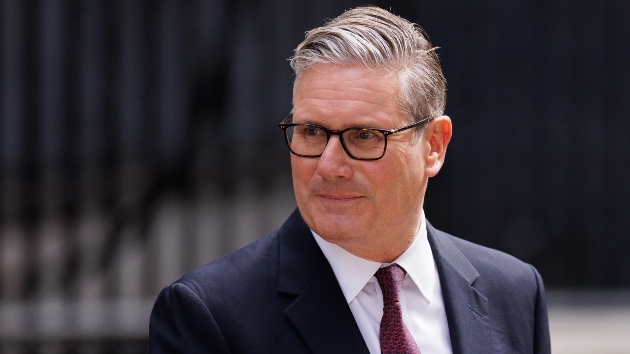
Prime Minister Keir Starmer announces his resignation as UK Prime Minister and Leader of the Labour Party, outside No.10 Downing Street on June 22, 2026 in London, England. (Photo by Dan Kitwood/Getty Images)
(LONDON) — Prime Minister Keir Starmer announced on Monday he would resign as the leader of his party and as prime minister, setting the stage for the United Kingdom’s seventh prime minister within a decade.
Starmer, who said he spoke on Monday with King Charles, said he expected to remain in office until a successor was chosen from within his Labour Party.
“The question my party is asking now is whether I am best placed to lead us into the next general election,” he said outside 10 Downing Street. “I have heard the answer of my parliamentary party to that question, and I accept that answer with good grace.”
Starmer, who had led Labour since 2020, was elected to lead the country in a general election 2024. His replacement is expected to be chosen by his party.
Starmer said he asked party leaders to open nominations for a successor on July 9. He did not give a date for his departure from 10 Downing Street, but said he expected a new prime minister to be in place by September, when Parliament returns from its summer recess.
The resignation announcement followed months of turmoil for Starmer, with some members of his own party criticizing his leadership, saying he had not been able to deliver the rapid change needed after taking office following 14 years of Conservative Party rule in Britain.
Many in Starmer’s Labour party had written to Starmer asking him to step down following local elections in May, which saw the party lose more than 1,000 seats on local councils, results that were widely interpreted as a repudiation by British voters of Labour’s performance under the prime minister’s leadership.
A formal challenge to his premiership had not yet begun as of Monday, but some members of his party have in recent weeks coalesced in public support of Andy Burnham, the former mayor of Greater Manchester, as his potential successor.
Burnham, who won a special election on Friday to become a member of parliament representing Makerfield, was expected to be sworn in in the House of Commons on Monday.
Following Starmer’s announcement, Burnham said on social media that he would seek a nomination in the Labour leadership contest.
“People want to see progress on economic growth, cost of living, public services, housing and opportunities for the next generation,” he said. “Political change should never distract from the responsibility to improve people’s lives.”
Another potential successor, Wes Streeting, a member of parliament who resigned from his position as Starmer’s health secretary in May, threw his support behind Burnham on Monday.
“We could spend the summer exaggerating our small differences, or we can roll up our sleeves and help [Burnham] to deliver the change our Party and our country needs,” Streeting said in a statement. “That is the choise that I am making and I hope that everyone else will back Andy, too.”
Starmer long said he intended to see out his full five-year term, which began with his party’s 2024 landslide election victory, which also delivered Labour a historic majority in the House of Commons.
Ursula von der Leyen, the president of the EU Commission, praised Starmer after his announcement, saying, “It can take many leaders years to grow into the statesman you became in just two years. European and Ukrainian security is stronger because of you. Thank you, dear Keir.”
ABC News’ David Brennan, Jamie Dorrington and Zoe Magee contributed to this report.
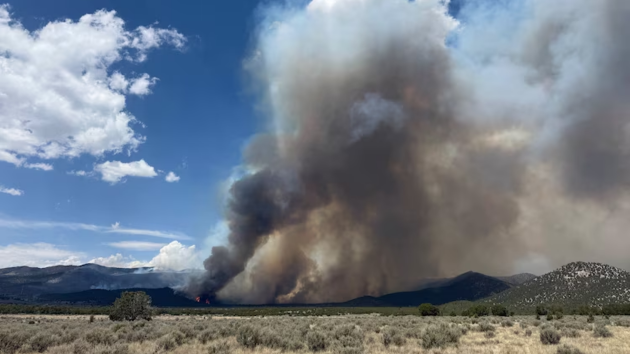
The Iron Fire burning in Northern Utah is threatening structures in the town of Eureka, where a mandatory evacuation order was in effect, June 21, 2026. (Utah Fire Info)
(EUREKA, Utah) — Mandatory evacuations are underway for hundreds of people on Sunday in a central Utah town being threatened by a wind-driven, out-of-control wildfire, officials said.
The Iron Fire is burning in Juab County, about 28 miles southwest of Provo, and officials said on Sunday that flames are bearing down on Eureka, Utah, a small town in the East Tintic Mountains.
The wildfire, which started on Friday night, had burned more than 13,300 acres by Sunday morning and remains 0% contained, according to Utah Fire Info.
The wildfire, according to Utah Fire Info, was human-caused, but details of what sparked the blaze have not been released.
Shifting winds and dry vegetation fueled the wildfire on Saturday and sent it in the direction of Eureka, where authorities issued mandatory evacuation orders on Saturday. Fire officials said flames were threatening “numerous structures” in the area.
The fire rapidly grew from about 5,000 acres on Saturday to more than 13,000 overnight.
“That’s way closer than anybody wants it to be,” Daylan Hermanson, a Eureka resident, told ABC Salt Lake City affiliate station KTVX, as he watched flames creep over a mountainside headed for Eureka.
Kelly Wicken, a spokesperson for the Utah Division of Forestry, said the blaze started on private land and has now spread across Juab and two other counties, crossing onto federal land and shutting down a highway.
Before the fire, the National Weather Service had issued red flag fire danger warnings for a large part of the state.
Utah is also in the middle of a severe drought that has dried out vegetation, providing fuel for any fires.
“With June temperatures rising, Utah is facing a deepening drought that has accelerated the drying of soils and vegetation across the state,” the Utah Department of Natural Resources said in a June 11 statement. “Wildfire season has already been active with over 230 fires so far this year, a majority of which were human-caused.”
The Iron Fire is the biggest of 11 wildfires that have ignited across the state since Friday.
The Hastings Fire, which started on Saturday west of Salt Lake City, had burned 2,500 acres by Sunday morning and was 0% contained, according to Utah Fire Info.
The Middle Fork Fire near Ogden and the Boonville Fire, just east of the University of Utah campus in Salt Lake City, had both burned more than 300 acres since starting on Saturday and were both 0% contained on Sunday.
“Utah is facing multiple wildfires across the state today, and we are using every available resource to support response efforts,” Utah Gov. Spencer Cox said in a social media post on Saturday evening. “Conditions remain dry and dangerous. Please use extreme caution, follow evacuation notices, and do your part to prevent new fires.”
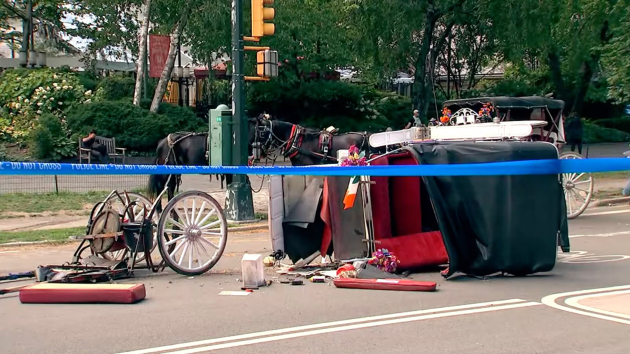
An 18-year-old man was transported to NewYork-Presbyterian Weill Cornell Medical Center in critical condition after he fell from a horse carriage in Central Park on June 17, 2026, the NYPD said. (WABC)
(NEW YORK) — Horse-drawn carriage rides will be suspended in Central Park until next week following the death of an 18-year-old Indian tourist who was in a runaway carriage with his family.
The move comes after growing calls from advocates and elected officials to fully ban the rides following a string of incidents over the last year where people and the horses were put in danger.
The Transport Workers Union announced Thursday, a day after Romanch Mahajan was killed, that rides would be suspended while they assess safety protocols. The union announced on Friday that the suspension would continue until at least Tuesday.
The 18-year-old victim was with his parents and younger brother in a carriage Wednesday afternoon when the driver got out to take a picture of the family and suddenly the horse took off “for unknown reasons,” according to the TWU and police.
The carriage clipped the wheel of another carriage and toppled, according to TWU Local 100 Administrative Vice President Alexander Kemp.
Mahajan fell out of the carriage, and died at the hospital later in the afternoon, police said.
Deepak Mahajan, the victim’s father, told the New York Times Thursday that his son jumped out of the carriage to help his wife, Priya, who fell out of the carriage first.
This was the first time the family had visited New York City, Deepak Mahajan told the Times.
The other family members suffered minor injuries, police said. This is the first time a person has been killed during a carriage ride in the park, according to the union.
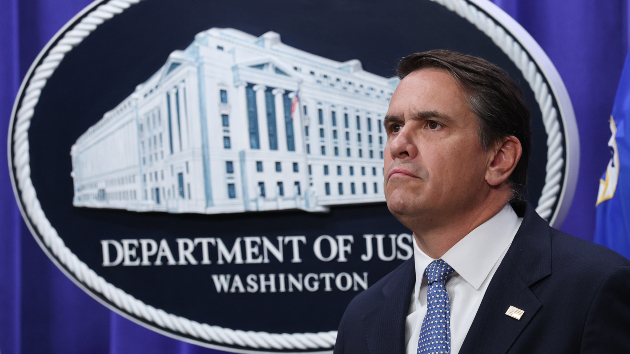
Acting U.S. Attorney General Todd Blanche listens to a reporter’s question during a press conference at the Department of Justice June 11, 2026 in Washingon, DC. (Win McNamee/Getty Images)
(WASHINGTON) — The Justice Department on Friday refused to issue a signed declaration from acting Attorney General Todd Blanche verifying that it no longer intends to pursue President Donald Trump’s “Anti-Weaponization Fund.”
The DOJ’s refusal comes after a federal judge last week gave the administration seven days to verify in a declaration that it wouldn’t create the controversial fund.
“Such declarations are unnecessary and the compelled testimony of senior officials from the Executive Branch implicates serious separation of powers concerns,” the DOJ said in a court filing Friday to U.S. District Judge Leonie Brinkema, who last week issued an injunction indefinitely blocking the administration from creating the fund.
Brinkema had given the Trump administration seven days to verify in a declaration from acting Attorney General Todd Blanche and Treasury Secretary Scott Bessent that it wouldn’t create the fund, which she said would likely lead to the dismissal of the lawsuit she was overseeing against the fund.
But in their filing Friday, the department argued that Brinkema’s offer was a potentially unconstitutional infringement of the executive branch by effectively requiring “testimony” of top officials on a matter that the administration has repeatedly said would not be moving forward.
The fund, which was announced last month by the DOJ to compensate those who allege they were wrongly targeted under the Biden administration, was proposed in exchange for Trump agreeing to drop his $10 billion lawsuit against the IRS as well as two civil claims for $230 million related to the Russia collusion investigation he faced during his first term in office and the 2022 search of his Mar-a-Lago estate — sparking accusations of self-dealing and a bipartisan uproar over the possible use of taxpayer money to pay rioters who attacked the U.S. Capitol on Jan. 6, 2021.
In her ruling last week, Judge Brinkema pointed repeatedly to President Trump’s own shifting statements in recent weeks about the fund, including his pointed attack on Brinkema herself after she had temporarily paused the fund earlier this month, in which he referred to her as a “radical left judge.”
“When the president of the United States says he’s disappointed that something is not going forward,” Brinkema said, that would only add to the evidence that the fund might “rear its head” in the future.
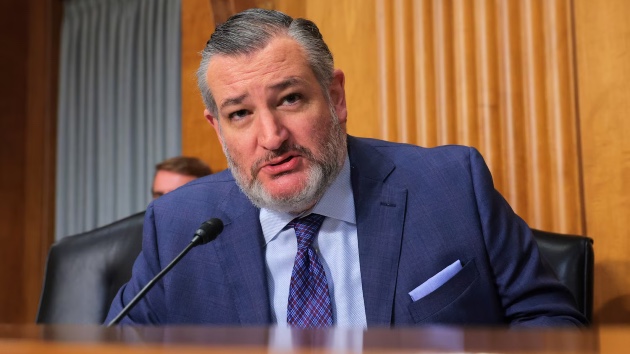
Sen. Ted Cruz questions Secretary of State Marco Rubio as he testifies during a Senate Foreign Relations Committee hearing in the Dirksen Senate Office Building on June 02, 2026, in Washington, D.C. (Anna Moneymaker/Getty Images)
(WASHINGTON) — From calling it “the worst foreign policy blunder in decades” to calling President Donald Trump’s memorandum of understanding with Iran “out of step” with his stated objectives, several Republican senators have broken with the president over the agreement.
Core concerns from some of Trump’s closest Hill allies have revolved around the significant economic opportunity for Iran to rebuild with few concessions in return outlined in the short-term agreement Trump signed on Wednesday.
“I do have concerns that certain aspects of this deal are stepping in the wrong direction,” Republican Sen. Tom Cotton, chairman of the Senate Intelligence Committee, told Fox News on Thursday.
“[Trump] deserves enormous credit for making Iran weaker than it’s been in decades, and we need to make sure that we don’t squander the leverage that we built across six years,” the Arkansas senator said.
Cotton’s comments are notable as he has been one of the Senate’s most hawkish voices on the war in Iran and has pushed the president to continue to attack the Iranian regime.
Others Republican senators had similar views of the deal, arguing that it gives Iran immediate relief on oil revenues and pledges to work to unfreeze $24 billion in Iranian assets and help create a $300 billion reconstruction fund for Iran.
‘An exceptionally bad idea’
“History demonstrates that giving billions of dollars to theocratic lunatics who want to murder us is an exceptionally bad idea, and I think unfortunately the president is receiving some really bad advice on this deal,” Sen. Ted Cruz, R-Texas, said of the reconstruction fund. “I don’t want to see us send a penny to the ayatollah, and I hope that we don’t.”
“I support President Trump, and I think his leadership on Iran has been extraordinary. I believe he is getting poor advice, and I think sending billions of dollars to Iran is a mistake,” he added.
Senate Armed Services Committee Chairman Sen. Roger Wicker, of Mississippi, issued a bruising statement about the MOU, saying the proposal to create a $300 billion account to fund the rebuilding of Iran “would make Iran’s payoff under President Obama’s 2015 deal look like a pittance by comparison.”
The memorandum says the U.S. and Middle East partners would develop a $300 billion account for reconstruction and economic development, but Trump said the U.S. wouldn’t be contributing to it.
“We’re not putting up 10 cents,” Trump said Wednesday. “People can decide to do that, but that’s up to them.”
Wicker also said he opposes lifting sanctions on Iran, unfreezing Iranian assets or forcing Israel to stand down against Hezbollah.
“The Iranian regime has not renounced its ultimate goal — death to America, death to Israel. The regime wiill invest every penny it receives to further that aim,” Wicker said.
Additionally, while the agreement calls for the toll-free reopening of the Strait of Hormuz, senators said the future of the strait is unclear and could potentially open the door for Iran to impose fees for safe passage.
Sen. John Cornyn, R-Texas, said whil. “some important things” have been accomplished by the campaign against Iran, “I’m afraid we will look back at this and see a missed opportunity to basically eliminate the threat going forward because there is nothing to stop the regime from beginning to block the Strait of Hormuz again basically at will.”
No demands of Iran on nuclear weapons
Senators also had concerns over the MOU not demanding that Iran destroy its stockpile of highly enriched uranium and that it doesn’t doesn’t provide a mechanism to prevent it from obtaining nuclear weapons in the future, which was one of Trump’s main objectives.
Instead the MOU says Iran reaffirms a longstanding commitment not to pursue a nuclear weapon and to negotiate what to do with the country’s nuclear stockpile.
“Since Day 1, I have supported President Trump’s efforts to end Iran’s 47-year threat to the United States and our partners. I am concerned that the memorandum of understanding negotiates away the victories of Operation Epic Fury in ways that are completely out of step with the President’s goals,” Wicker said in his Thursday statement.
“The terms of the MOU that have been released start off at the outset with 10s of billions of dollars immediately being released to Iran before they make a single nuclear concession. I think that’s a mistake,” he said.
Sen. Bill Cassidy, R-La., also expressed doubts about the agreement, saying, “Iran’s nuclear ambitions were not curbed.”
Graham: Upside outweighs the downside
Other Republicans like Sen. Lindsey Graham, voiced initial skepticism over the agreement but said he was cautiously optimistic that a possible future deal would ease his initial concerns.
While Graham said some of the criticism of the MOU is valid, without it “there’s no pathway to diplomacy to end the nuclear ambitions of Iran. What does that leave you with? War continuation of the status quo, so the upside of signing the MOU was greater, I think, than the downside.”
“Time will tell, but I’m glad we’re on the course on the path to diplomacy, and we’ll know in the coming weeks what kind of deal we will get.
Graham said he told Trump’s Middle East special envoy Steve Witkoff “Pursue a good deal, but be ready to walk away.”
The administration has pushed back on some of those criticisms saying the sanction relief and asset access it has made to Iran is tied to “very concrete nuclear commitments” Iran has made, as well as saying that there will be further negotiations toward a final agreement, calling the memorandum a framework, not a final agreement.
Vice President JD Vance addressed skeptics during a White House press briefing on Thursday.
“People say the Iranians will never change their behavior. Well, maybe that’s true,” he said. “And if so, they don’t get any of the benefits of the bargain. But isn’t it worth trying? Isn’t it worth seeing whether this incredibly weakened position that the president of the United States has put the Iranians under, whether that motivates them to change their behavior, not just vis-a-vis the West, but vis-a-vis the Middle East.”
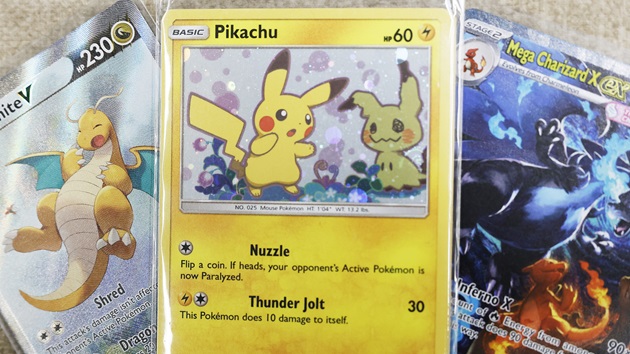
In this photo illustration, collectible Pokémon cards are viewed in a store on January 23, 2026 in Pasadena, California. (Mario Tama/Getty Images)
(STOCKTON, Calif.) — Two Northern California stores were burglarized and had thousands of dollars worth of Pokémon trading cards stolen within hours of each other this week, according to police and the stores’ owners.
Investigators in Stockton are looking for clues and suspects in the Wednesday burglaries, which have become the latest incidents in a string of Pokémon card thefts across the country.
Police do not immediately know if the two burglaries are connected.
The first incident took place at Dragon’s Den Games around 1:55 a.m. local time when a hooded suspect broke a glass display case and made off with the cards in under a minute, according to police and surveillance footage.
Tom Douglas, the store’s owner, told ABC affiliate KXTV that the thief was only looking for one thing in his store.
“They’re looking for Pokémon [cards],” Douglas said. “They’re not interested in board games.”
Around 3:30 a.m. a suspect, who was also wearing a similar black hood, broke into JNA Collectibles on Fremont Street, roughly three-and-a-half miles away from Dragon’s Den Games, according to police and surveillance footage.
JNA Collectible’s owner, Joshua Lawson, told KXTV that the suspect used a crowbar to break through the front door, smash a glass display case with the Pokémon cards and flee the scene with the cards in just a minute.
“In one minute, I lost thousands of dollars,” he said.
Lawson noted Pokémon cards can range in value from about a dollar to tens of thousands of dollars for some graded cards. There have been similar thefts in California, New Jersey and other states.
“This is a problem for every single store in this area,” Lawson said.
Douglas told the affiliate that the ongoing thefts are one of the reasons he’s decided to close Dragon’s Den Games at the end of the month after nearly a decade of business.
He said the store has been burglarized four times since January.
“This is brand new this year,” Douglas said. “It kind of feels like it came out of nowhere.”