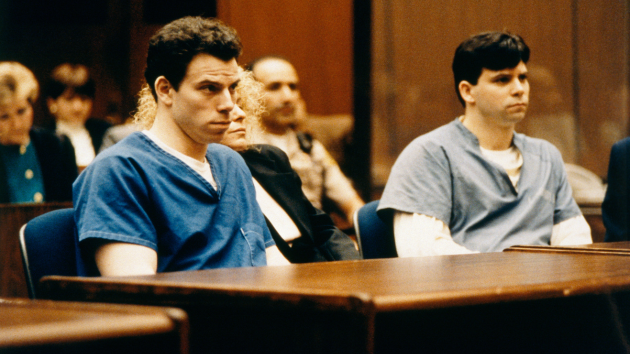
(LOS ANGELES) — Erik and Lyle Menendez‘s much-anticipated resentencing hearing will move forward on May 13 and 14, a judge ruled on Friday, as new details about the brothers’ alleged behavior behind bars were revealed in court.
A hearing was held Friday to determine whether the brothers’ resentencing case should include information from the California Board of Parole’s newly completed risk assessment, which was conducted as a part of a separate clemency path. The risk assessment came at the request of Gov. Gavin Newsom as a part of the brothers’ clemency bid; the brothers are pursuing multiple avenues to freedom, and the clemency path is separate from the resentencing path.
Judge Michael Jesic indicated he will take some of the risk assessment into account, but that the information in it is preliminary and attorneys can’t question the forensic psychologists who performed the examinations.
The risk assessment said Erik and Lyle Menendez pose a moderate risk to the community if they’re released.
The assessment revealed the brothers possessed illegal cellphones in prison, among numerous other violations. Erik Menendez had a phone as recently as January of this year, which Los Angeles County District Attorney Nathan Hochman stressed was during the resentencing effort when he should have been on his best behavior.
Erik Menendez allegedly bought and traded drugs and allegedly helped inmates commit tax fraud years ago, according to the assessment. The psychologists found Lyle Menendez to be narcissistic.
The assessment said the brothers had a likelihood to not follow the law out of prison if they ignored rules in prison.
Jesic appeared to dismiss many of the findings.
The assessment likely includes the positive work the brothers have done in prison, too. Hochman’s predecessor, George Gascón, has praised them for furthering their education, rehabilitating themselves and starting programs to help other inmates.
Also at Friday’s hearing, defense attorney Mark Geragos withdrew his attempt to get Hochman kicked off the case after making allegations against his background and alleging the DA hired a crisis public relations firm to go after the brothers. Hochman denied that, saying the PR firm was not for the brothers but for his campaign, and that the PR firm ended its work after he was elected in November.
Friday’s hearing followed a dramatic court appearance on April 17, which was initially set to be the brothers’ resentencing hearing. However, on April 16, the district attorney’s office in a filing urged Jesic to delay the resentencing hearing if he couldn’t obtain a copy of the risk assessment report in time for court.
Hochman, who wants to keep the brothers behind bars, argued the risk assessment is relevant to the resentencing case, while Geragos noted a strong desire for the assessment to be used only for the June 13 parole hearing.
For next week’s resentencing hearing, Geragos said he will have seven witnesses rather than his previously planned 20 witnesses. Two experts are expected to testify.
Erik and Lyle Menendez — who are serving life in prison without the possibility of parole for the 1989 murders of their parents, Jose and Kitty Menendez — have the support of over 20 family members in their efforts to be freed after 35 years behind bars.
Their resentencing case gained momentum in October when Gascón announced he was in support of resentencing.
Gascón recommended the brothers’ sentences of life without the possibility of parole be removed, and said they should instead be sentenced for murder, which would be a sentence of 50 years to life. Because both brothers were under 26 at the time of the crimes, they would be eligible for parole immediately with the new sentence.
Gascón’s office said its resentencing recommendations take into account many factors, including rehabilitation in prison and abuse or trauma that contributed to the crime.
Photo by Grant Halverson/NCAA Photos via Getty Images
(BAY VILLAGE, Ohio) — A sophomore at a high school in Ohio has died after sustaining an injury during a lacrosse match, according to Bay High School, where he played.
Dylan Veselic was playing in a game for the school, located in Bay Village, against Olmsted Falls on Tuesday when he was injured.
The school did not release what injuries Veselic suffered during the game, but Veselic was taken into surgery Tuesday evening and he died on Thursday morning, a district official confirmed to ABC News.
“With heavy hearts, the Veselic Family shares the news that Dylan has passed away from injuries suffered during a lacrosse game,” the school said in a statement on its website.
“Dylan was a well-liked and respected young man who touched the lives of many with his kindness, character and spirit. We extend our deepest condolences to his family during this unimaginably difficult time. Our thoughts and prayers are with them, and we hope they find comfort in the love and support of our community,” Bay High School Principal Jason Martin said in a statement on Thursday.
“We are also deeply grateful to our neighboring communities for their outpouring of compassion and support. The response and comments throughout the day from his teachers, coaches, teammates and classmates have been a powerful reminder of the positive impact he had on those around him and the enduring mark he has left on all of us,” Martin said.
Matt Spellman, the athletic director of Bay Village Schools, said the team and coaches are grateful for the support they have been shown by surrounding teams and communities.
“Dylan was an amazing student, always wearing a smile on his face while supporting his fellow teammates. He was kind, hardworking, and dedicated, consistently showing leadership, empathy, and a positive attitude both on the field and in the classroom. Dylan’s enthusiasm, determination, and willingness to help others made him a role model for his peers,” Spellman said.
The school district posted photos of tributes that had popped up around campus for Veselic, including a rock painted with his number and signs created by younger students.
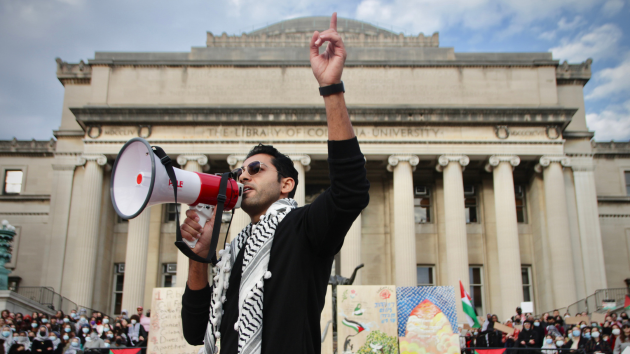
(NEW YORK) — Mohsen Mahdawi, the Columbia University student who was arrested last month during his citizenship interview, can remain free from custody while his case proceeds, a federal appeals court said on Friday.
The three-judge panel for the U.S. Court of Appeals for the 2nd Circuit denied an effort by the Trump administration to stay a federal judge’s ruling ordering Mahdawi’s release.
Mahdawi, who co-founded a university organization called the Palestinian Student Union with detained Columbia student Mahmoud Khalil, was born in a refugee camp in the West Bank before moving in 2014 to the U.S. where he has been a legal resident for 10 years.
His lawyers believe that, like Khalil, he is being targeted by the Trump administration under Immigration and Nationality Act section 237(a)(4)(C)(i), which asserts that the secretary of state can deem a person deportable if they have reasonable ground to believe that the person’s presence or activities in the U.S. could have adverse foreign policy consequences.
U.S. District Judge Geoffrey Crawford last week ordered Mahdawi released from detention while his case proceeds, finding that Mahdawi presents no flight risk and saying that the Columbia University student should remain in Vermont, where he has a home, and attend school remotely.
On Friday, the appeals court agreed with Judge Crawford’s order and concluded that the government has not shown any “irreparably injury from either his release on bail or continued presence in the District of Vermont pending his removal proceedings.”
The three-judge panel also said the government is “unlikely to succeed” on its arguments that Judge Crawford did not have jurisdiction over Mahdawi’s habeas petition and said the Justice Department was also “unlikely to succeed” on its claims that the district court lacked the authority to order Mahdawi’s release.
“The practical effect of the relief the government seeks would be Mahdawi’s re-detention,” the judges said. “Individual liberty substantially outweighs the government’s weak assertions of administrative and logistical costs.”
Mahdawi, who is expected to graduate from Columbia next month, was arrested at a U.S. Citizenship and Immigration Services office in Vermont, where he was taking his last step in the process to become a U.S. citizen.
In an interview with ABC News after his release, Mahdawi recounted his arrest and detainment, saying that he feared his citizenship interview was a “trap.”
“It was a moment of like, should I be happy or should I be cautious when I received the notice?” Mahdawi told ABC News about receiving the notice for his citizenship interview. “And I sense that this might be a trap. And for sure, indeed, it was an alarm bell where I directly reached out to my legal team in order to navigate, you know, the pros and cons and this risk that I think that I may lose my freedom.”
In response to the government’s allegations against him, Mahdawi and his lawyers have disputed accusations that he ever threatened Israelis or those of the Jewish faith.
“So for them to accuse me of this is not going to work, because I am a person who actually has condemned antisemitism,” Mahdawi told ABC News. “And I believe that the fight against antisemitism and the fight to free Palestine go hand in hand, because, as Martin Luther King said, injustice anywhere is a threat to justice everywhere.”
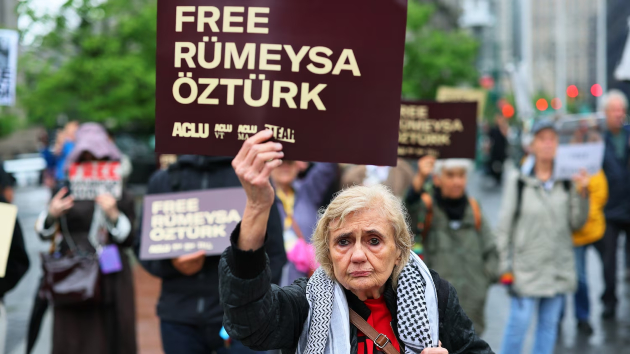
(NEW YORK) — A federal judge in Vermont has ordered that a Tufts University doctoral student be released on bail from ICE custody after her visa was revoked by the Trump administration.
Rumeysa Ozturk testified remotely at her bail hearing Friday from the detention facility in Louisiana where she has been held since ICE agents detained her near her home in Massachusetts on March 25.
Her lawyers argued that the Turkish national and former Fulbright scholar is being targeted by the Trump administration because of a column she co-wrote in her student newspaper criticizing the university’s response to resolutions approved by the Tufts Community Union Senate.
Those resolutions called on the university to “acknowledge the Palestinian genocide, apologize for University President Sunil Kumar’s statements, disclose its investments and divest from companies with direct or indirect ties to Israel,” she wrote in the op-ed.
The judge ordered her released on bail while the government’s case against her proceeds.
In sworn declarations and court hearings, Ozturk and her lawyers stressed the urgent need for her to be released, noting she has had at least 12 asthma attacks since she was detained. They also accused the detention facility of being overcrowded and unsanitary, which they said may be affecting her well-being.
Wearing a hijab, glasses, and an orange jumpsuit, Ozturk testified via Zoom about the humanitarian work she is involved in as part of her studies in child development. She also testified about her involvement in school groups and projects.
Ozturk told the judge that she organized an event she called “collective grieving for children experiencing war and conflicts” that aimed to help children “from Gaza to Israel, from Russia to Ukraine … from all parts of the world.”
“I think as people who are working in academia for child development and well-being, it is sometimes possible that we forget the emotional touch or grief extending to children that we don’t necessarily work with,” she said. “But that doesn’t mean that we don’t grieve for other children, all of them are ours, from all parts of the world experiencing very sad events including war and conflict.”
Ozturk said during the hearing that, should she be released on bail, Tufts has offered her several housing options she hopes to take up in order to finish her Ph.D.
At one point during the hearing, she was granted a break to take asthma medication after appearing at several points to clutch her chest as she struggled to speak. She testified she had an asthma attack at an airport in Atlanta when she was being transported to Louisiana.
“I was afraid and I was crying,” she testified, adding that her daily maintenance inhaler was not initially provided to her.
Secretary of State Marco Rubio said last week that the government revoked Ozturk’s visa due to her pro-Palestinian activism.
“If you apply for a visa to enter the United States and be a student, and you tell us the reason you are coming to the United States is not just because you want to write op-eds, but because you want to participate in movements that are involved in doing things like vandalizing universities, harassing students, taking over buildings, creating a ruckus — we’re not going to give you a visa,” stated Rubio, who said that the State Department may have revoked more than 300 student visas since the beginning of the second Trump administration.
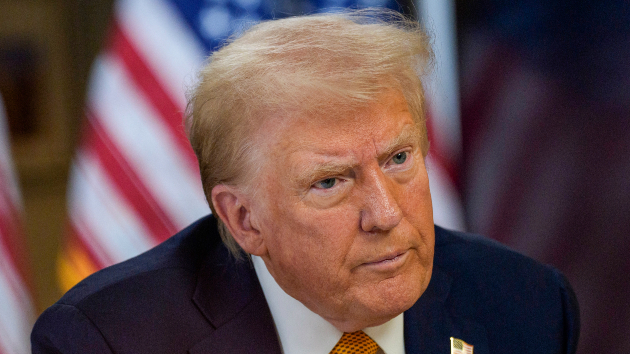
(WASHINGTON) — President Donald Trump on Friday voiced a willingness to ease tariffs on China, saying on social media it “seems right” to slash levies from 145% to 80%.
The announcement arrives a day before Treasury Secretary Scott Bessent is set to begin trade negotiations with Chinese officials at a meeting in Geneva, Switzerland.
The potential tariff reduction floated by Trump may avert a virtual standstill of trade between the world’s two largest economies, but the move would not substantially ease expected price increases for goods such as clothes, sneakers and toys, analysts told ABC News.
Product shortages would also remain a possibility at the lower tariff rate, they added.
“A tariff of 80% would still have a dramatic effect,” Christian vom Lehn, an economics professor at Brigham Young University, told ABC News. “It would mean a significant impact for consumers.”
Trump last month sharply increased tariffs on China, prompting China to retaliate with 125% tariffs on U.S. goods. The tit-for-tat measures set off a trade war with the third-largest U.S. trade partner, which accounted for nearly $440 billion worth of imports last year.
The tariffs elicited warnings from a slew of companies about the risk of price increases for U.S shoppers.
Toy giant Mattel warned in an earnings report this week of plans to shift some of its supply chain outside China, adding that when necessary it would take “pricing action in its U.S. business.” The move follows similar messages from electronics chain Best Buy as well as Chinese e-commerce retailers Shein and Temu.
Chinese shipments to the U.S. have dropped significantly, falling 21% in April compared to a year earlier, data from China’s General Administration of Customs on Friday showed.
Risks for consumers would continue to linger for two key reasons, analysts said: An 80% tariff would still amount to a punishing tax on imports, while uncertainty about the chance of another policy shift would make it difficult for companies to take full advantage of the lower rate.
Tariffs raise prices for consumers if importers fail to swallow the tax burden by eating into their profits or requesting a supplier sell the product at a lower rate in order to offset a share of the cost.
Under the current 145% tariff on Chinese goods, suppliers and importers face immense pressure as they try to bear some of the tax cost out of concern that higher prices would hurt sales, experts told ABC News. Due to the sky-high tariff, however, many sellers have little choice but to hike prices or risk losses, they added.
Those dynamics would remain in place at an 80% tariff rate, since it would still far exceed many companies’ capacity to offset the added cost with lower profits, Jason Miller, a professor of supply chain management at Michigan State University.
“An 80% tariff really doesn’t change things too much,” Miller said.
Trump’s announcement of a potential reduction of the tariff on China came two days after Trump ruled out any such lowering of the tariff level before negotiations.
The developments followed a weeks-long back and forth during which the two sides disputed whether they had already started discussing the tariffs.
The general sense of uncertainty would remain even after U.S. tariffs were to reach 80%, making it difficult for businesses to adapt their supply chains in a manner that would substantially ease costs and, in turn, offer relief for consumers, some analysts said.
“Even at a lower tariff, companies would have to be wondering whether this might go up again or or possibly come down again,” David Andolfatto, an economist at the University of Miami, told ABC News.
If companies could trust the possible 80% tariff level as a long-term policy stance, they may choose to reroute supply chains outside China or even initiate plans for some domestic production, Andolfatto said.
But each trade policy announcement put forward by Trump appears subject to change, Andolfatto said, noting several modifications already undertaken by Trump.
“If anything changes, the Trump administration can unilaterally react and come back to the negotiating table,” Andolfatto added.
For his part, Bessent has referred to the White House approach as a negotiating tactic, describing the policy changes as “strategic uncertainty.”
Testifying before a House subcommittee this week, Bessent said the Trump administration had commenced negotiations with 17 of the top 18 U.S. trade partners, excluding China. Those countries account for the vast majority of U.S. foreign trade, Bessent said.
Trump unveiled the framework for a trade agreement with the United Kingdom on Thursday, marking the first such accord with any nation since the White House suspended some of its far-reaching “Liberation Day” tariffs last month.
“Every country wants to be making deals,” Trump said in the Oval Office on Thursday, noting the upcoming talks between Bessent and Chinese officials.
(NEW YORK) — The family of an Arizona man killed in a road rage incident nearly four years ago brought him back last week as an AI-generated image to face the man responsible for his killing give an impact statement to the judge.
The video message created by Christopher Pelkey’s sister that used his likeness and voice during the May 1 sentencing was the first time the technology was used in an Arizona court at a sentencing, according to records.
Pelkey was killed in November 2021 by Gabriel Paul Horcasitas, who was ultimately convicted of manslaughter charges. The AI-generated Pelkey spoke to Horcasitas in court and sought forgiveness.
“In another life, we probably could have been friends,” the avatar said in the video. “I believe in forgiveness and in God who forgives. I always have and I still do.”
Stacey Wales, Pelkey’s sister, told ABC affiliate KNXV that the slain victim’s friends and family “agreed this capture was a true representation of the spirit and soul of how Chris would have thought about his own sentencing as a murder victim.”
Wales said she wrote the script for the video and noted that her brother was a forgiving, God-fearing man.
Dozens of other family members also provided victim impact statements and expressed anger over Horcasitas’ actions.
Prosecutors asked the judge for Horcasitas to be sentenced to nine and a half years in prison, but Judge Todd Lang ultimately issued a 10 and a half year sentence. Lang said he was moved by the AI-generated video.
“I loved that AI, thank you for that. As angry as you are, as justifiably angry as the family is, I heard the forgiveness,” the judge said during the sentencing. “I feel that that was genuine.”
Horcasitas’s attorney, Jason Lamm, told ABC News that he was not given advanced notice about the video. He argued in court that Pelkey was the one who instigated the road rage incident and what the judge heard was a “kinder, more gentle” version of Pelkey.
“I appreciate the fact that victims have the right to address the court, and this was a cathartic endeavor for Stacey Wells, but this was cringe,” Lamm told ABC News.
He said he has filed a notice of appeal for his client and that the use of the AI-generated video will likely be one of the points of contention.
“This will be a bellwether case not just for Arizona but also courts around the country to rule on the use of AI in victim impact statements,” Lamm said.
Arizona Supreme Court Chief Justice Ann Timmer provided a statement to KNXV about the use of AI in court cases.
“AI has the potential to create great efficiencies in the justice system and may assist those unschooled in the law to better present their positions. For that reason, we are excited about AI’s potential. But AI can also hinder or even upend justice if inappropriately used,” she said in her statement.
“A measured approach is best. Along those lines, the court has formed an AI committee to examine AI use and make recommendations for how best to use it. At bottom, those who use AI—including courts—are responsible for its accuracy,” she added.
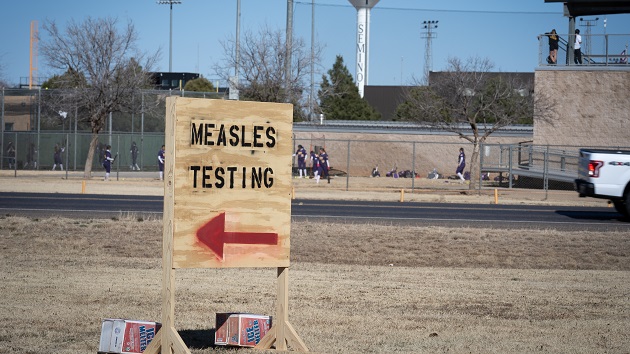
(NEW YORK) — The U.S. has surpassed 1,000 measles cases for the first time in five years, according to new data from the Centers for Disease Control and Prevention (CDC) published Friday.
A total of 1,001 cases have been confirmed in 30 states including Alaska, Arkansas, California, Colorado, Florida, Georgia, Hawaii, Illinois, Indiana, Kansas, Kentucky, Louisiana, Maryland, Michigan, Minnesota, Missouri, Montana, New Jersey, New Mexico, New York, North Dakota, Ohio, Oklahoma, Pennsylvania, Rhode Island, Tennessee, Texas, Vermont, Virginia and Washington.
The last time the U.S. recorded more than 1,000 cases occurred in 2019, when there were 1,274 confirmed infections over the course of a year, CDC data shows.
The CDC says 13% of measles patients in the U.S. this year have been hospitalized, the majority of whom are under age 19.
Among the nationally confirmed cases, CDC says about 96% are among people who are unvaccinated or whose vaccination status is unknown.
Meanwhile, 2% are among those who have received just one dose of the measles, mumps, rubella (MMR) vaccine and 2% are among those who received the required two doses, according to the CDC.
This is a developing story. Please check back for updates.
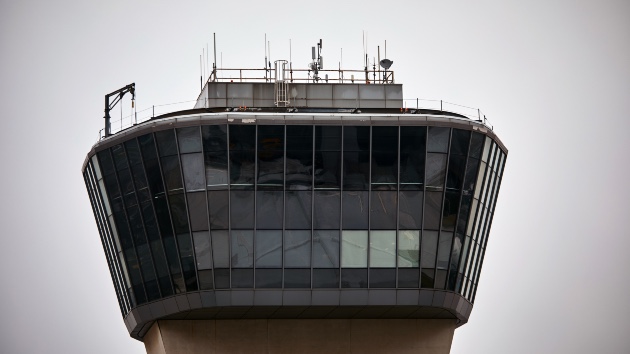
(NEWARK, N.J.) — Radar screens at New Jersey’s Newark Liberty International Airport went black again early Friday morning.
The brief outage happened at 3:55 a.m.
Air traffic controllers could be heard telling a FedEx plane that their screens went dark and then asking the aircraft to tell their company to put pressure on to get the problem fixed.
In another transmission, a controller told an arriving private jet that the airport just had a brief radar outage and to stay at or above 3,000 feet in case the controllers couldn’t get in touch during the aircraft’s descent.
Last week, an outage at Newark caused ATC computer screens to go dark for roughly 60 to 90 seconds and prevented controllers from talking to aircraft during that time, according to multiple sources with knowledge of the incident. As a result, the Federal Aviation Administration briefly halted all departures to the airport.
Following the outage, several controllers went on medical leave, calling the experience a traumatic event. The controllers are entitled to at least 45 days away from the job and must be evaluated by a doctor before they can return to work.
The facility where controllers work the airspace around Newark airport is located in Philadelphia and was already short on air traffic controllers.
This increased shortage sparked massive delays and cancellations at Newark over the last two weeks.
On Thursday, the Department of Transportation announced plans for a new, “state-of-the-art” air traffic control system to replace the “antiquated” system, saying it will improve safety and cut back on delays.
Changes include swapping out old telecommunications for “new fiber, wireless and satellite technologies”; “installing new modern hardware and software”; replacing 618 old radars; and building six new air traffic control centers and replacing towers, the Transportation Department said.
Transportation Secretary Sean Duffy said he hopes to have the system built in the next three to four years.
Duffy didn’t ballpark a price tag, simply saying it will cost “billions.” Duffy said he will ask for the full amount up-front from Congress, which has previously signaled support over calls for the modernization of ATC systems.
This is a developing story. Please check back for updates.
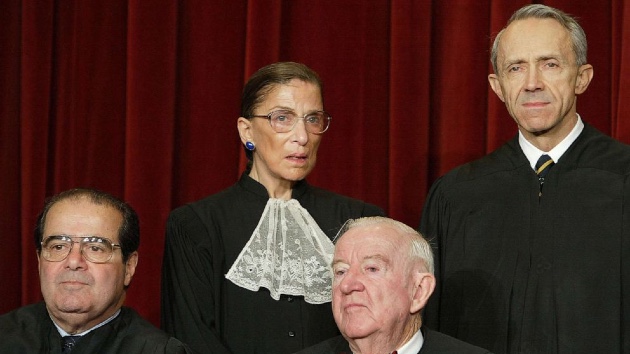
(L-R, Standing) Associate Justice Ruth Bader Ginsburg and Associate Justice David H. Souter, (L-R, Seated) Associate Justice Antonin Scalia and Associate Justice John Paul/ Mark Wilson/Getty Images
(WASHINGTON) — Former U.S. Supreme Court Justice David Souter, a lifelong public servant, judicial moderate and advocate for humanities and civics education, has died. He was 85 years old.
Chief Justice John G. Roberts Jr. said of Souter: “Justice David Souter served our Court with great distinction for nearly twenty years. He brought uncommon wisdom and kindness to a lifetime of public service. After retiring to his beloved New Hampshire in 2009, he continued to render significant service to our branch by sitting regularly on the Court of Appeals for the First Circuit for more than a decade. He will be greatly missed.”
Souter was nominated in 1990 by President George H.W. Bush, who praised him as “a remarkable judge of keen intellect and the highest ability.”
In more than 19 years on the bench, he authored notable opinions on abortion, religion and property rights.
His moderate positions surprised and disappointed many Republicans, who had hoped Souter would solidify as conservative the seat vacated by Justice William Brennan, a longtime leader of the court’s liberal wing.
Just five years after his appointment, the conservative Weekly Standard branded Souter a “stealth justice,” excoriating his position as “one of the staunchest liberals on the court.”
For many conservatives, Souter became a symbol of what future Republican presidents should avoid in a nominee.
His most controversial opinion came in 1992, jointly authored by Justices Sandra Day O’Connor and Anthony Kennedy, reaffirming the right to abortion under Roe v. Wade and creating an “undue burden” standard for judging state restrictions on the procedure.
“To overrule under fire, in the absence of the most compelling reason to re-examine a watershed decision, would subvert the Court’s legitimacy beyond any serious question,” the three justices wrote in Planned Parenthood v. Casey.
Souter’s defenders have long denied he was a secret liberal, emphasizing his respect for precedent and the philosophy of “originalism,” which emphasizes the historical meaning behind constitutional clauses and federal laws.
“The original meaning of conservatism was reluctance to embrace radical change,” Ernest Young, a former clerk of Souter’s and Duke law professor, told ABC News in 2009.
Souter, who was Episcopalian, was also known for advocating strict government neutrality in matters of religion and consistently opposing religious displays in public spaces.
During his confirmation hearing, he called it an “appalling fact” that Jewish children felt excluded when Christian prayers were recited in public schools.
In 2005, he authored a 5-4 decision blocking three Kentucky counties from displaying framed copies of the Ten Commandments in courthouses and public schools. He also voted against allowing organized prayers at high school graduation ceremonies and football games.
“He had no predisposed answer. He really relied on an analysis of [historical] materials to decide how he would come out in that case,” Stuart Benjamin, former clerk to Souter and Duke law professor, said in 2009.
Souter was one of four justices who strongly dissented from the 2000 decision in Bush v. Gore, which ended the contested Florida ballot recount and effectively handed the presidency to George W. Bush.
“To recount these manually would be a tall order, but before this Court stayed the effort to do that the courts of Florida were ready to do their best to get that job done,” Souter wrote. “There is no justification for denying the State the opportunity to try to count all disputed ballots now. I respectfully dissent.”
He was reportedly so distraught over the decision he contemplated resigning from the court, sources familiar with his thinking told Jeffrey Toobin, author of “The Nine, Inside the Secret World of the Supreme Court.” Some of the justice’s friends strongly rejected the notion.
In 2005, Souter joined the court’s more liberal members to expand the ability of local governments to seize private land for public use. His vote drew fierce protests and even prompted a ballot measure to seize his 200-year-old New Hampshire farmhouse as payback. It failed.
In testimony during his confirmation hearings, Souter also surprised conservatives with a robust defense of affirmative action. “There will be a need — and I am afraid for a longer time than we would like to say — a need for affirmative action which seeks out qualified people who have been discouraged by generations of societal discrimination from taking their place in the mainstream of America,” he said at the time.
Souter’s rejection of political ideology has been celebrated among his former clerks and friends.
“He was a classic frugal Yankee Republican,” former Souter clerk and Harvard law professor Rebecca Tushnet told ABC News in 2009.
“The Republican Party now has moved considerably to the right,” University of Pennsylvania law professor Kermit Roosevelt, who clerked for Souter in 1999 and 2000, told ABC News. “He doesn’t look like a modern Republican; he’s not a modern person in a lot of ways.”
Souter rarely spoke publicly about his jurisprudence, but when he did he pointedly rejected what he considered a simplistic approach to constitutional interpretation embraced by some of his Republican-appointed peers.
“Constitutional judging is not a mere combination of fair reading and simple facts,” Souter said in a 2010 commencement address at Harvard University.
“Judges have to choose between the good things that the Constitution approves, and when they do, they have to choose, not on the basis of measurement, but of meaning,” he added, rejecting the strict textualism endorsed by conservative icons Justice Clarence Thomas and the late Justice Antonin Scalia.
Retiring at just 69 years old, the never-married Souter quickly escaped Washington to return to his native New Hampshire and beloved two-centuries-old farmhouse.
To admirers, Souter brought a sense of compassion to the high court.
“He urged all judges to recognize the human aspect of their decisions, and to use all the power of their hearts and minds and beings to get their decisions right,” said Subra Suresh, former president of Carnegie Mellon University, where Souter spoke in October 2014.
Announcing Souter’s retirement in 2009, President Barack Obama hailed the justice as a “fair-minded and independent” judge who combined a “feverish work ethic” with a good sense of humor and integrity.
“He consistently defied labels and rejected absolutes, focusing instead on just one task — reaching a just result in the case that was before him,” said Obama, who later appointed Justice Sonia Sotomayor to fill his seat.
“He really was someone who saw himself as someone working in Washington but not being of Washington,” Meir Feder, one of Souter’s clerks from the 1990 term, told ABC News in 2009.
For years, he had shied from the Washington social scene when the court was not in session, retreating to the White Mountain woods where he loved to hike and read by the fire. Souter famously had no television or access to email.
“Far from being out of touch with the modern world, he has simply refused to surrender to it control over aspects of his own life that give him deep contentment,” said David McKean, former CEO of the John F. Kennedy Presidential Library Foundation, at a joint appearance with the retired justice in 2010.
Born in Massachusetts an only child, Souter spent most of his life in the rural town of Weare, New Hampshire. He enrolled in Harvard University as an undergraduate, studying philosophy, and later attended Oxford University as a Rhodes Scholar.
He returned to Boston to complete his law degree at Harvard, where he graduated in 1966. He quickly climbed the ranks of the legal world, rising to attorney general of New Hampshire and, later, associate judge in the state’s Supreme Court.
When Souter was plucked out of New Hampshire by President George H.W. Bush in 1990, he was little known outside of the state. The U.S. Senate confirmed Souter to the Supreme Court by a vote of 90-9.
“I loved my colleagues. I liked the work that I was doing. There were days when I wished things had turned out differently, but I still loved the court and just about everybody in that building,” Souter said in 2010, during a rare public appearance at the JFK Presidential Library. “But I feel liberated to do things that I couldn’t do on that court.”
For years after leaving the high court bench, Souter continued to be a judge, hearing more than 300 cases by designation for the 1st Circuit U.S. Court of Appeals in Boston and authoring dozens of opinions.
While he stayed largely out of the limelight, Souter spoke passionately about the need to bolster the humanities and civics education across America.
“I don’t believe there is any problem in American politics or American public life which is more significant today that the pervasive civic ignorance of the Constitution of the United States and the structure of government,” Souter said in a speech at the University of New Hampshire Law School in 2012.
“Some of the aspects of current American government that people on both sides find frustrating are in part a function of the inability of people to understand how government can and should function,” he said.
Asked in 2010 to name the most important part of the U.S. Constitution, Souter singled out the equal protection clause of the 14th Amendment.
“Ultimately, it is the golden rule,” he said. “Treat others the way you want to be treated with the corollary that if you don’t, you are not going to be treated that way either.”
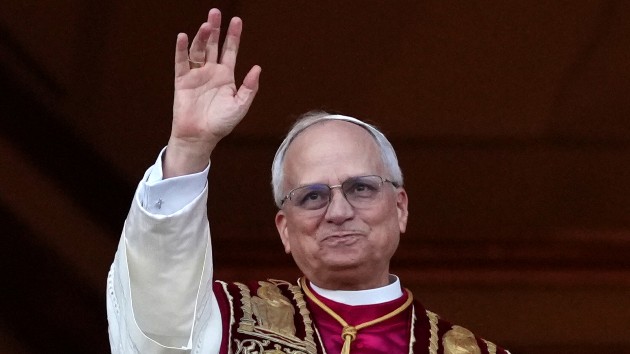
(VATICAN CITY) — Prior to being elected pontiff, Pope Leo XIV had a presence on Twitter, and later X, where he sometimes shared messages that appeared to be critical of some of President Donald Trump’s policies.
Cardinal Robert Prevost appears to have an X account with the handle @drprevost and posted, replied and reposted content since 2011, according to his page.
A picture of Prevost and Pope Francis holding each others arms in their robes inside a church is the profile image for the account.
While most of the new pope’s 439 posts involved posting articles about the latest developments from the Vatican and dioceses from around the world, he did share other posts from time to time dealing with political matters.
He last posted on April 14, when he shared a post from prominent American Catholic commentator Rocco Palmo that criticized Trump and El Salvadoran President Nayib Bukele’s controversial immigration policies.
“As Trump & Bukele use Oval to 🤣 Feds’ illicit deportation of a US resident …, once an undoc-ed Salvadorean himself, now-DC Aux +Evelio asks, “Do you not see the suffering? Is your conscience not disturbed? How can you stay quiet?” Palmo’s post read.
Palmo linked to a Catholic Standard editorial written by Bishop Evelio Menjivar, an auxiliary bishop of The Roman Catholic Archdiocese of Washington.
In an interview with ABC News on Thursday, Pope Leo’s brother John Prevost in Chicago said immigration is an important issue for his brother.
“I think because the way our country is going, I don’t think he necessarily will always agree [with] what’s happening. I think a big thing for him is immigration and is it right — what’s going on? I think that will be a challenge for him, because I think he’ll say something about it, too.”
Asked about his brother’s X account, John Prevost said, “I know that’s his feelings, but I didn’t know he was putting it out on social media.”
The pope’s last original X post was on Feb. 13, when he posted a link to an America magazine editorial that criticized Vice President JD Vance about his interpretation of the Latin phrase “ordo amoris.” Vance contended in a Fox News interview, that the idea meant that one must love their family first before the community.
Pope Francis sent a letter to bishops after Vance’s comment rebuking that interpretation without naming the vice president.
Pope Leo, however, appeared to criticize Vance directly in a Feb. 3 post, where he linked to a National Catholic Reporter editorial that dismissed the vice president’s stance on immigration.
He shared the headline of the article “JD Vance is wrong: Jesus doesn’t ask us to rank our love for others” and linked to the full story in his post.
Leo had not posted on X between July 2023 and Feb. 3.
The Vatican has not immediately commented about the social media account or posts.
Vance and Trump both congratulated the pope on his election on social media posts.
“I’m sure millions of American Catholics and other Christians will pray for his successful work leading the Church. May God bless him!” Vance wrote on X Thursday.