(MEADE COUNTY, SD) — South Dakota has reported its first case of measles this year. The state is now the 33rd in the country to confirm a measles case, with at least 1,088 cases reported nationally so far this year.
An adult who recently traveled outside the country tested positive for measles in Meade County, South Dakota, according to the South Dakota Department of Health.
It comes as federal officials are urging all Americans to get vaccinated against measles before traveling abroad, according to guidance updated last week from the Centers for Disease Control and Prevention (CDC). Previously, the guidance stated that those traveling to countries with an ongoing outbreak should be vaccinated before leaving.
The measles, mumps, and rubella (MMR) vaccine is part of the routine immunization schedule and has been shown to be up to 97% effective after two doses, the CDC says. Adults without immunity through vaccination or infection should also get vaccinated, the agency notes.
At least 62 people in the U.S. were infected with measles while traveling on an airplane this year, a CDC spokesperson told ABC News in part of a statement. “There has been only one situation during this period in which measles appeared to have been transmitted during air travel, ” the spokesperson added.
In South Dakota, the person infected with measles visited two medical centers where others may have been exposed to the virus.
The Department of Health says anyone who was at the Rapid City Medical Center Urgent Care waiting room on May 28 between 7:15 a.m. and 10 a.m., or at Monument Health Sturgis Urgent Care waiting room on May 29 between 9:45 a.m. and 3 p.m., should watch for signs of illness.
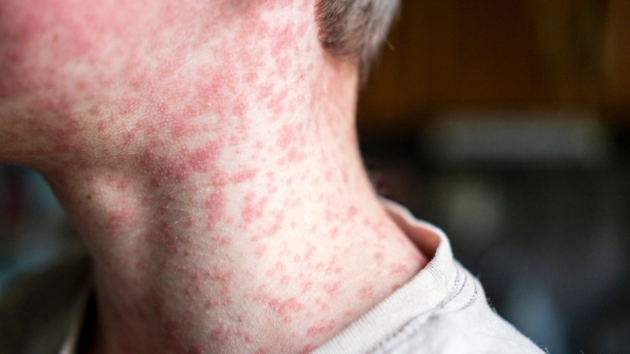
Health officials explain that the early signs of measles appear in two stages. In the first stage, symptoms include a runny nose, cough and slight fever. The eyes may become red and sensitive to light while the fever rises each day. The second stage begins between three and seven days after symptoms start, with temperatures reaching 103 to 105 degrees Fahrenheit and a red blotchy rash that lasts between four to seven days. The rash typically starts on the face before spreading to the shoulders, arms and legs.
“Measles is a highly contagious viral disease and spreads through the air from an infected person,” Dr. Joshua Clayton, state epidemiologist, told ABC News. “Individuals who lack immunity from vaccination or past infection are at high risk of measles infection if they have contact with an infected person.”
According to state health officials, the measles vaccine offers the best protection against infection. People are considered immune to measles if they were born before 1957, received one dose of the measles vaccine (MMR) as an adult, received two doses of the measles vaccine (MMR) as a child or high-risk adult, have measles antibodies shown by a lab test, or had a previous measles infection confirmed by a lab test.
The Department of Health notes that the MMR vaccine is typically given at 12 to 15 months of age, with a second dose at four to six years. For international travel with children, MMR vaccines can be given starting at 6 months of age.
Learn more about measles on the Department of Health website, where information includes fact sheets, frequently asked questions, and a webinar for healthcare providers.
(NEW YORK) — A former assistant to Sean “Diddy” Combs concluded three days on the witness stand, with attorneys for the music mogul grilling her so intensely that a prosecutor asked the judge to stop the cross-examination, calling it “humiliating” and “harassing.”
The witness, testifying under the pseudonym “Mia,” told jurors last week that Combs tormented and sexually assaulted her during her time working as his personal assistant.
Defense attorneys tried to assail her credibility over her last two days appearing on the stand, pressing her about dozens of text messages and social media posts she authored about Combs that were playful, respectful and even adoring.
Combs’ lawyers argued Mia misrepresented how Combs treated her and fabricated part of her story. Mia largely stood by her testimony, telling jurors that she was “brainwashed” by Combs and explained that she now wants to speak truthfully about the years of harassment and abuse she endured.
“It’s the worst thing I ever had to talk about in my life,” Mia told the jury about her reluctance to talk about how Combs sexually assaulted her.
Mia’s testimony marked the beginning of the fourth week of testimony in Combs’ sex-trafficking and racketeering conspiracy trial. Prosecutors charge that Combs used his wealth and influence to run a criminal enterprise that served to protect his reputation and coerce women into sex.
If convicted on all counts, the music mogul could spend the rest of his life behind bars. Combs has pleaded not guilty, and his lawyers argue that, while he might have been violent towards romantic partners and abused illicit drugs, he did not commit the crimes alleged by the Department of Justice.
Defense attorneys stress Mia’s loving messages to Combs
Continuing his cross-examination from last week, defense attorney Brian Steel returned to Mia’s social media posts and text messages to challenge the woman and the version of events she shared with the jury.
“Life is f—— insane and supposedly it all happens for a reason in order to elevate us in our human experience, but it’s rough,” Mia wrote Combs in 2020, more than three years after she stopped working for him. “I love you with all of my heart and I’m here for you forever.”
Steel also showed the jury other text messages from the 2019-2022 time frame in which Mia expressed love and admiration to Combs.
“Hey. Saw our doc on Netflix top 10. Congrats I miss you,” read one text from July 2022.
Combs responded, “Love, love, love, love.” Mia wrote back, “And I love, love, love you.”
“Everything is positive and loving from you to Mr. Combs, would you agree with that?” Steel asked.
“Yes, of course,” Mia answered. She quickly explained to the jury she was still “brainwashed” by Combs from her years working for him.
Once the lengthy and contentious cross-examination of Mia concluded, federal prosecutors tried to minimize any damage that might have been done to her credibility.
“Did you post on social media as part of your job?” prosecutor Madison Smyser asked on re-direct examination.
“Yes,” Mia answered, adding that posting about Ciroc, Diddy Door, the Bad Boy reunion, and Combs himself were part of her job. She described her Instagram posts “like the highlight reel” of Combs and not meant for posts about the downside of working for him.
“Is that why you didn’t post about Mr. Combs slamming Cassie’s head into a bed frame?” Smyser asked. “Yes,” Mia answered.
“Is that why you didn’t post about Mr. Combs throwing a computer at your head?” Smyser asked. “Yes,” Mia answered.
“Is that why you didn’t post about Mr. Combs sexually assaulting you?” Smyser asked. “Yes,” Mia answered.
Steel tries to cast doubt on Mia by asking why she didn’t document abuse Throughout his searing cross-examination, defense attorney Steel tried to poke holes in Mia’s testimony by highlighting how she did not document the abuse she said she suffered from Combs, even as she documented the upside.
“Do you have any recording of Mr. Combs berating you?” asked Steel, who highlighted that part of Mia’s job was to carry a small camera to document Combs’ life. “No, I would not have been allowed to record that,” Mia responded.
“Because it’s not true, is it, Mia?” Steel accused. “Your statements that you were the victim at the hands of Mr. Combs of brutality isn’t true?”
Mia fired back, testifying, “Everything I’ve said in this courtroom is true.”
Steel also questioned Mia’s account of escaping Combs with Ventura in Turks and Caicos by paddleboarding out to sea. Steel asked whether there were any text messages, emails or photographs documenting those allegations.
“Was that just made up by you?” Steel pointedly asked. “No,” Mia testified.
Steel’s next question — “How is it that all these events have no photograph or text message or email from you?” — was stopped by the judge after an objection.
At one point, prosecutors asked the judge overseeing the case to intervene, arguing the “humiliating” cross-examination borders on harassment and could deter other crime victims from coming forward in other cases.
“Eyes are on this trial. Victims in other cases are going to see how victims are treated,” Comey said in a clear nod to the global headlines being created by the Combs trial. “Our concern is that if this victim is not protected from further harassment, it will deter other victims in other cases.”
Judge Arun Subramanian said he heard no yelling and saw no improper treatment, but he did caution Steel about the form of his questions.
Steel suggests Mia fabricated her story after Ventura’s lawsuit
Steel suggested Mia timed her disclosure of alleged sexual assault by Combs with the filing of a civil lawsuit by the singer Cassie Ventura, Combs’ former longtime girlfriend. Ventura is the prosecution’s star witness, and she has alleged that Combs abused her for a decade. Her lawsuit, the starting point for the federal investigation that culminated with the current prosecution, was settled after a day for $20 million, Ventura testified. There was no admission of wrongdoing.
Steel questioned why Mia did not tell federal prosecutors about her claim that Combs sexually assaulted her until June 2024, six months after she began meeting with the authorities and seven months after Ventura’s civil lawsuit. The defense emphasized to the jury that Mia met with federal prosecutors a total of 28 times.
“Do you remember the first time you ever made a claim Mr. Combs ever sexually assaulted you was on June 18, 2024?” Steel asked.
“I don’t remember the dates, but I do remember that horrible conversation,” Mia answered.
On redirect examination, Smyser asked Mia to clarify why she met so often with federal prosecutors. “I met with the government so much in order to understand my story and because I was so terrified and I was learning at the same time,” she testified, and, using Combs’ earlier street name, said she was “terrified of Puff.” She said she has never been able to talk about her claim that Combs sexually assaulted her without looking down.
“It’s the worst thing I ever had to talk about in my life,” she explained.
Latest witness tells jury about damage to Combs’ hotel room
Prosecutors concluded the day by calling Susan Oken, manager of the Beverly Hills Hotel, to testify about the times when Combs was a guest of her establishment.
She said Combs checked into the Beverly Hills Hotel under aliases like “Frank Black” or “Phillip Pines” and Cassie Ventura was listed under Combs’ profile as a guest.
Oken testified that Combs once incurred an extra $300 charge to clean the drapes and another $500 charge to clean “oil damage.” Oken said the charge reflected something “beyond the scope of what we’d normally clean.” The prosecution’s questioning was a callback to earlier testimony about the so-called “freak-off” orgies that Combs would allegedly host and, according to testimony, featured gallons of baby oil.
Court is set to resume on Tuesday with Eddie Garcia, an employee of the InterContinental Hotel in Century City, CA., the scene of Combs’ caught-on-camera attack on Ventura that has created perhaps the most enduring images to come from the high-profile criminal trial.
Relatives of Palestinians, who lost their lives in Israeli attack towards Jabalia Camp, mourn at al Ahli-Baptist Hospital in Gaza Strip on June 03, 2025. (Photo by Dawoud Abo Alkas/Anadolu via Getty Images)
(LONDON) — At least 27 people were killed and more than 90 injured by Israeli forces as they waited to collect humanitarian aid at a distribution center in the southern Gaza Strip on Tuesday morning, according to Gaza’s Hamas-run Ministry of Health.
Many of the victims — 24 deceased and 37 wounded — arrived at Nasser Medical Complex in Khan Younis, according to Atef Al-Hout, the hospital’s director-general, who said most of the casualties were from gunfire.
The Israel Defense Forces released a statement acknowledging a shooting around 500 meters from one of the aid sites run by the U.S.- and Israel-backed Gaza Humanitarian Foundation.
“Earlier today, during the movement of the crowd on the regulated routes on the way to the distribution complex, about half a kilometer from the complex, IDF forces identified a number of suspects moving towards them while deviating from the access routes,” the statement read.
“The forces fired evasive shots, and after they did not move away, additional shots were fired near the individual suspects who were advancing towards the forces,” it added.
“Reports of casualties are known, details of the incident are under investigation,” the IDF said.
The IDF said that it allows GHF “to operate independently to distribute aid to Gaza residents and prevent it from reaching the Hamas terrorist organization.”
“IDF forces do not prevent Gaza residents from reaching the aid distribution complexes,” it added. “The shooting was carried out about half a kilometer from the distribution complex at individual suspects who approached the forces in a manner that endangered them.”
The GHF released a statement on Tuesday morning saying “aid distribution was conducted safely and without incident at our site today.”
However, the organization acknowledged that the IDF “is investigating whether a number of civilians were injured after moving beyond the designated safe corridor and into a closed military zone.”
“This was an area well beyond our secure distribution site and operations area,” GHF said. “We recognize the difficult nature of the situation and advise all civilians to remain in the safe corridor when traveling to our distribution sites.”
GHF’s aid distribution operation — which the United Nations and other aid groups have so far refused to take part in, citing concerns that the GHF is not operating independently of Israeli forces — has been beset by reports of violence.
On Sunday, Gaza’s Hamas-run Ministry of Health said dozens of people were shot dead and more than 200 wounded by Israeli fire around a kilometer from an aid distribution site in the south of the strip near the city of Rafah.
The IDF and GHF disputed the account given by the ministry. United Nations UN Secretary-General Antonio Guterres on Monday called for an independent investigation into the incident.
A GHF spokesperson told ABC News on Monday, “There hasn’t been what we would consider a major incident at our distribution sites or the surrounding facility and so far it is going relatively well.”
“However, we are looking for ways to improve it so we can get more meals delivered,” the spokesperson added. “We are encouraged by our operations in the first week and the fact that we were able to provide nearly six million meals in first full week.”
ABC News’ Morgan Winsor, Guy Davies, Diaa Ostaz and Jordana Miller contributed to this report.
(INDIAN RIVER COUNTY, FL) — Three people have been rescued from the Atlantic Ocean in the dark after their plane went down several miles offshore off the coast of Florida, officials said.
Officials from Air and Marine Operations, an operational component of U.S. Customs and Border Protection, were alerted to a single-engine Cessna Skyhawk crashing down into the ocean on Sunday evening several miles offshore, according to a statement from of U.S. Customs and Border Protection on Monday.
“During the evening of June 1, an AMO Fort Pierce Marine Unit was alerted by the Indian River Shores Police Department that a single-engine Cessna Skyhawk had crashed approximately 2 to 3 miles offshore,” officials said. “AMO crews immediately responded and arrived at the location, joining search and rescue efforts already underway by the U.S. Coast Guard, Indian River County Sheriff’s Office, Florida Fish and Wildlife Conservation Commission, and Indian River Shores Police Department.”
An Indian River County Sheriff’s Office helicopter was able to locate three heat signatures in the water which led to a focused search of the area and, at approximately 9:50 p.m. on Sunday night, AMO Marine Interdiction Agents located two survivors before finding the third one shortly after and bringing him on board as well.
“The survivor identified himself as the pilot and confirmed that only three individuals had been aboard the aircraft at the time of the crash,” CBP officials said. “AMO agents assessed the pilot’s condition, monitoring his vitals and providing initial care as he reported severe rib pain. The pilot was transferred to the Coast Guard 45-foot vessel for Emergency Medical Technician evaluation.”
All three survivors were immediately taken to Coast Guard Station Fort Pierce for further medical treatment by local fire rescue personnel.
“AMO remains committed to protecting lives and supporting partner agencies in search and rescue efforts across the nation’s coastal regions,” officials said.
(WASHINGTON) — No one elected her and you don’t hear much about her, but she’s about to be one of the most important people on Capitol Hill.
Senate Parliamentarian Elizabeth MacDonough can usually be seen perched atop the Senate dais, helping to make sure the Senate floor runs according to the rules. But she’s about to step into the role as arbiter of the Senate’s reconciliation package, where she’ll have the final say in whether a number of key provisions in the House-passed One Big Beautiful Bill Act are in keeping with the Senate’s rules.
Senate Republicans want to make changes to the bill the House passed by a single vote and sent to them. But Senate rules could force a number of changes they find less desirable, too. A veto of any provision by MacDonough could mean major parts of the package are thrown to the wayside, so her rulings will be watched closely by Democrats and Republicans alike in the coming weeks.
MacDonough is responsible for making calls on whether the provisions in the bill are in keeping with the Byrd Rule, named after the late Sen. Robert Byrd, who helped institute the rules governing budget reconciliation packages like President Donald Trump’s “one big, beautiful bill.”
MacDonough has been parliamentarian since 2012 after serving as senior assistant parliamentarian for 10 years. She is the first woman to fill the job since it was created in 1935.
She was called to make several rulings when Democrats used reconciliation to get then-President Joe Biden’s Inflation Reduction Act passed in 2022 as well as the COVID relief package the year before. She also advised Chief Justice John Roberts during Trump’s impeachment trials.
The Byrd Rule
In order for the Senate to use the reconciliation process, which allows it to pass budget packages like this with a simple majority of votes instead of the usual 60 necessary to overcome the Senate’s filibuster, everything in the bill must follow the Byrd Rule.
In the Senate, the process of the Budget Committee reviewing the bill and the parliamentarian to make sure it’s up to snuff is sometimes referred to cheekily as the “Byrd Bath.”
So what are the rules?
The Byrd Rule bars the Senate from including any “extraneous provisions” in budget bills. Anything in the bill, according to the rule, should be necessary to implement the underlying budget resolution that Congress already passed.
Simply stated: If a policy provision doesn’t have an effect on the budget, it can’t be included. Even budget changes that are “merely incidental” to policy provisions are considered out of order.
Now, things are always a bit more complicated in the Senate. The Byrd rule also prohibits Congress from touching Social Security in a reconciliation bill, from increasing the deficit for a fiscal year beyond the period included in the bill, and more. But its basic form is this: everything in the bill must be related to the budget.
It may seem in the weeds, but this review process can have meaningful impacts on reconciliation bills. In the Democrat-backed “Build Back Better” package in 2022, for example, the parliamentarian struck a number of provisions Democrats wanted focused on immigration reform. Democrats ended up having to give up those provisions to pass their package under then-President Joe Biden.
Big policy agenda items that are critical to some Republicans in the One Big Beautiful Bill Act could in theory be slashed out by the parliamentarian, so the process matters.
What does it mean for Trump’s megabill?
There are a number of provisions facing a tenuous path in the Senate because of the Byrd Rule.
Democrats are already vowing to fight policies they say are out of order.
“In the Senate, our committees have been working overtime to prepare for the Byrd Bath, targeting the litany of policies included in the Republican plan that are in clear violation of the reconciliation rules and in some cases, an assault on our very democracy,” Senate Minority Leader Chuck Schumer wrote in a letter to his colleagues Sunday night.
We’ll ultimately have to wait for MacDonough to rule, but if it sounds like policy and not budget, it might be at risk.
Here are a few provisions in the House-passed bill that appear to be potentially at risk of being struck out by the parliamentarian. This is not an exhaustive list and doesn’t account for things that Senate Republicans might want to change or remove from the bill:
AI regulations: The House bill includes language that prohibits state and local governments from enforcing “any law or regulation regulating artificial intelligence models, artificial intelligence systems, or automated decision systems” over a 10-year period.
Federal court provisions: The bill creates a new requirement that could restrict how parties suing the federal government get relief in court. Sen. Joni Ernst, R-Iowa, as recently as Friday suggested at a town hall, when pressed by a constituent about the provision, that it likely wouldn’t pass muster in the Byrd Bath. “I don’t see any argument that could ever be made that this affects mandatory spending or revenues, so I just don’t see that I don’t see that getting into the Senate bills,” Ernst said then.
Planned Parenthood funding ban: The House bill includes a provision that would ban Medicaid funding to Planned Parenthood if it provides abortion services. The parliamentarian stripped a similar provision from a 2017 reconciliation package. It stands to reason she could rule similarly this go-round.
State Emergency Service of Ukraine/Anadolu via Getty Images
(LONDON) — At least seven people were killed and 27 were injured across Ukraine overnight into Tuesday as Russia continued long-range attacks on multiple cities, local officials said.
Ukraine’s air force said it recorded 112 Russian drones launched into the country overnight, 75 of which were either shot down or neutralized in flight. The air force reported impacts in 11 locations across the country.
Most of the reported deaths were clustered in two northeastern regions of Ukraine, close to the front lines.
Three people were killed and 20 were injured by a Russian cluster rocket attack on the city of Sumy, local authorities said. At least five rockets landed in open areas of the city center, the Sumy Regional Administration said, including along a busy road filled with cars and morning commuters.
President Volodymyr Zelenskyy said in a post to social media that the “savage strike” was a “fully deliberate attack on civilians.”
Another three people were killed and six were injured in the Kharkiv region as a result of Russian shelling, the regional military administration said.
One person was killed and 13 were injured by Russian fire in the southern Kherson region, said Oleksandr Prokudin, the head of the local military administration.
Five people were also injured by strikes in the northern city of Chernihiv and five others in the southern Black Sea coast city of Odesa, according to officials there.
In his Tuesday morning message, Zelenskyy said the ongoing Russian attacks indicate that Russian President Vladimir Putin has no genuine interest in peace, despite the Kremlin’s participation in ongoing U.S.-brokered talks to end its 3-year-old invasion.
Ukrainian and Russian representatives met in Istanbul, Turkey, on Monday for a second round of direct negotiations, the two sides having previously gathered in the city for the first round in May. That meeting allowed the first face-to-face peace talks between the two sides since the spring of 2022.
“It is obvious: without global pressure — without decisive actions from the United States, Europe, and everyone in the world who has the power — Putin will not agree even to a ceasefire,” Zelenskyy wrote on Tuesday.
“Not a single day goes by without Russia striking Ukrainian cities and villages,” the president continued.
“Every day, we lose our people to Russian terror. Every day, Russia gives new reasons for tougher sanctions and stronger support for our defense. I am grateful to everyone around the world who is promoting exactly this agenda: sanctions for aggression and the killing of people, and assistance in defending the lives of Ukrainians.”
Ukraine continued its own long-range strike campaign into Russia overnight. The Defense Ministry in Moscow said its forces downed eight Ukrainian drones on Monday night into Tuesday morning.
Monday’s Istanbul talks were held despite Ukraine’s audacious covert operation targeting Russian strategic bombers on Sunday, in which drones concealed in the back of trucks attacked at least five airfields deep inside Russian territory.
Zelenskyy told ABC News’ Chief Global Affairs Correspondent Martha Raddatz that the attack was a “strategic operation” that “is definitely reducing Russia’s potential, and demonstrates that Ukraine is working on certain steps.”
“Unless they will stop, we will continue,” he said.
Asked whether he was satisfied with President Donald Trump’s administration’s involvement, Zelenskyy told Raddatz, “We are looking for very strong steps on the part of President Trump to support the sanctions and to force President Putin to stop this war, or at least proceed with the first stage of putting an end to this war — that is the ceasefire.”
ABC News’ Will Gretsky and Oleksiy Pshemyskiy contributed to this report.
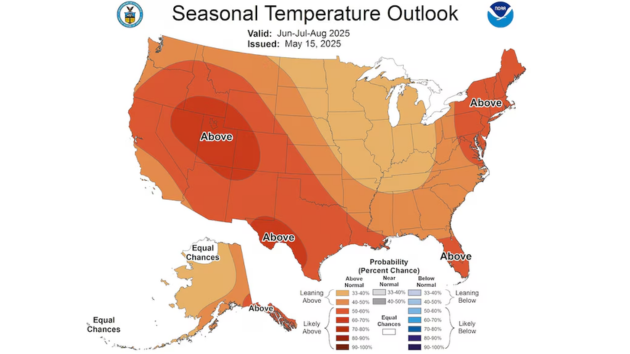
(NEW YORK) — The latest summer season outlook by the National Oceanic and Atmospheric Administration (NOAA) shows hotter-than-average temperatures are predicted across much of the country this summer, with the greatest likelihood of extreme heat hitting swaths of the East Coast, southern Plains and West.
The outlook from NOAA’s Climate Prediction Center forecasts whether the seasonal average temperature for a particular area will end up above, below or near average during the three-month period of the meteorological summer.
However, the outlook focuses on a seasonal average temperature and does not detail temperature variations that occur over the course of days, weeks or even one out of the three months included in the forecast.
June in a particular region could feature rather typical summer conditions, however, July and August could end up well above average, tipping the 3-month average to above for the entire season.
What this means for a local area depends greatly on the typical climate of a certain location.
For example, average high temperatures in Phoenix, Arizona, this summer range from 104 to 106 degrees Fahrenheit. This is already hot, as it is typically expected to be.
Contrast this with Caribou, Maine, where average high temperatures during the summer months range from 72 to 77 degrees Fahrenheit. Some people may consider this warm, but not hot.
Both locations are shaded red on NOAA’s forecast map, indicating that temperatures are expected to average above the typical summer range. However, “above average” could mean just one degree higher — or several.
And for places like Caribou, above average doesn’t necessarily mean hot. These forecasts also consider overnight lows, so in some areas, warmer-than-average temperatures might come from milder nights rather than scorching afternoons.
While the seasonal outlook highlights where above-average warmth is likely, it doesn’t tell us how hot or long-lasting any extreme heat might be.
When do summer’s hottest temperatures typically occur?
The hottest temperatures of the summer typically occur much later in the season, with different regions of the country experiencing their warmest average temperatures at varying times.
For the contiguous United States, on average, July is the hottest month of the year.
However, some regions of the country typically don’t experience their warmest average temperatures until August or even September.
A majority of the country, including much of the Northeast, Midwest and West, experiences the hottest temperatures of the year on average, during the second half of July and first half of August.
Much of the South typically experiences its peak average temperatures during the second half of August. However, along much of the West Coast, the warmest temperatures of the year usually don’t occur until September.
What previous summers have taught us For the past two summers in a row, the seasons in the Northern Hemisphere ranked as the warmest on record with extreme heat bringing persistent, dangerously hot conditions across several continents, according to a 2024 report by Copernicus, the European Union’s Climate Change Service.
Summer 2024 (June through August) was the warmest summer on record for the Northern Hemisphere, beating the previous record set in 2023 by .66 degrees Celsius, or 1.19 degrees Fahrenheit, the report found. The Northern Hemisphere’s top 10 warmest summers on record have all occurred within the past 10 years, according to Copernicus.
“The temperature-related extreme events witnessed this summer will only become more intense, with more devastating consequences for people and the planet unless we take urgent action to reduce greenhouse gas emissions,” Samantha Burgess, deputy director of Copernicus, said in a statement at the time.
The last time Earth recorded a cooler-than-average year was in 1976, according to the National Oceanic and Atmospheric Administration (NOAA).
While it is unlikely that summer 2025 will surpass last year’s record, this forecast shows that scorching temperatures could be on the way for much of the U.S. this season.
(WASHINGTON) — Democratic Sen. Adam Schiff in a letter to White House chief of staff Susie Wiles sent Monday, repeated his calls for the White House to issue a full disclosure of financial transactions from senior officials.
The new ask comes after the California senator — along with 25 other Democratic members of Congress — sent a separate letter to Wiles in April that outlined his concern surrounding potential ethics violations, asking for a commitment from all senior White House and executive branch employees to “expeditiously” transmit all reports related to their securities transactions since the start of Trump’s term to the Office of Government Ethics, and that the reports be made public.
That April letter was sent in the wake of President Donald Trump’s sudden pause that month of his sweeping set of tariffs, which triggered widespread concern from Schiff and other Democrats that those close to the president might have engaged in insider trading as markets rose following the pause.
In his Monday letter, addressed to Wiles like the first but also including White House Counsel David Warrington, Schiff notes that senior executive White House officials are “now beyond the maximum allowable filing period for individuals who began their service at the outset of the Administration” under federal ethics laws, which mandate that they file public annual financial disclosure documents, including a new entrant report, within 30 days of assuming their duties.
“The White House has yet to disclose any financial disclosure or transaction reports, even after widespread concern of potential insider trading following President Trump’s sudden pause of sweeping tariffs in early April,” Schiff writes in the letter, first shared first with ABC News.
“According to OGE’s disclosure database to date, no new entrant reports for any senior White House officials have been made available for public disclosure, despite legal requirements under the Ethics in Government Act and the clear public interest in the financial disclosures of senior executive branch leaders, raising questions as to whether the required public reports have yet to be submitted to OGE for certification,” he added.
Asked by ABC News for comment on the letter, White House spokesman Kush Desai said on Monday, “The American people remain highly concerned about Nancy Pelosi’s long, documented history of insider trading and eagerly await Adam Schiff refocusing his political stunt on serious issues, like Pelosi’s portfolio.”
Pelosi has faced allegations of trading on inside information during her time in Congress but has denied any impropriety.
Copied on Schiff’s letter is also Jamieson Greer, the acting director of the U.S. Office of Government Ethics, and Scott Gast, the ethics attorney in the White House counsel’s office.
In their April letter, the Democrats requested a response from Wiles no later than May 9, 2025, and for a “detailed plan” for how the administration plans to address any officials and employees who might have failed to file required disclosures from the start of the administration.
A spokesperson for Schiff said that they received from the White House an acknowledgement that they had received the letter, but provided no answers to their demands.
In the newest letter, Schiff asked for Wiles and Warrington to send, no later than on June 10, a list of all White House officials required to file new entrant reports; an explanation for the failure to transmit any new entrant reports to OGE for second-level review and certification; the current status and anticipated timeline for the submission and public posting of all overdue disclosures; a list of any filing extensions requested and granted by designated White House ethics officials and the duration of those extensions; and whether any late filing fees have been imposed for delinquent filings, as required by law.
“Transparency and compliance with ethics laws are essential. The American public deserves to know that those serving at the highest levels of government are free from financial conflicts of interest and have complied with the laws designed to safeguard the integrity of public service. I look forward to reviewing your responses,” the senator concluded.
Trump’s tariffs have faced a number of court challenges. An appeals court reinstated Trump’s tariffs this week after a Wednesday court order blocked them. The appeals court decision stands for the time being.
The block on the tariffs came after the Court of International Trade decided that the administration’s evocation of the International Emergency Economic Powers Act does not give the president the right to set “unlimited” tariffs. The Trump administration argued that the court order may harm their progress in negotiations.
Schiff has been a critic and target of Trump since his days in the House. Former President Joe Biden, during his last hours in office, issued a preemptive pardon for Schiff in connection with his work on the House’s Jan. 6 select committee. Schiff has called that pardon “unnecessary” and “unwise.”
(WASHINGTON) — The Supreme Court on Monday turned away an appeal by a group of gun-rights advocates seeking to overturn Maryland‘s ban on assault-style rifles and high-capacity magazines under the Second Amendment.
The decision, a major win for gun-safety advocates, leaves in place a ruling by the Fourth Circuit U.S. Court of Appeals which ruled that the state may constitutionally prohibit sale and possession of the weapons.
The state legislation, enacted in 2013 after the Sandy Hook elementary school shooting, specifically targets the AR-15 — the most popular rifle in America with 20-30 million in circulation. They are legal in 41 of the 50 states.
Justices Samuel Alito, Neil Gorsuch and Clarence Thomas dissented from the decision, saying they would have taken up the case to decide the issue nationwide. Legal challenges to other state bans remain pending in lower courts.
“I would not wait to decide whether the government can ban the most popular rifle in America,” Justice Thomas wrote. “The question is of critical importance to tens of millions of law-abiding AR-15 owners throughout the country.”
Justice Brett Kavanaugh agreed with the court’s decision to let the Maryland law stand, for now, but wrote separately to call the appeals court ruling “questionable.” Kavanaugh said that he expects the high court to weigh in formally on the legality of the AR-15 in the “next term or two.”
Maryland has seen a decline in gun violence since the enactment of a series of laws aimed at curbing access to dangerous weapons.
Officials particularly credit a series of federal, state and local restrictions imposed on gun kits in 2022 and 2023 with slowing online sales of untraceable firearms, requiring background and age checks of buyers and banning some kit sales in Maryland altogether.
While the Supreme Court’s conservative majority has issued rulings expanding the rights of gun owners, recent decisions have underscored support for some longstanding restrictions. In June 2024, the high court upheld a ban on firearm purchases and possession by Americans under domestic violence restraining orders. Earlier this year the Court also upheld federal regulations targeting ghost guns.
“Yesterday’s horrific attack in Boulder, Colorado, WILL NOT BE TOLERATED in the United States of America,” Trump wrote on his conservative social media platform.
“Acts of Terrorism will be prosecuted to the fullest extent of the Law. This is yet another example of why we must keep our Borders SECURE, and deport Illegal, Anti-American Radicals from our Homeland. My heart goes out to the victims of this terrible tragedy, and the Great People of Boulder, Colorado!” the president added.
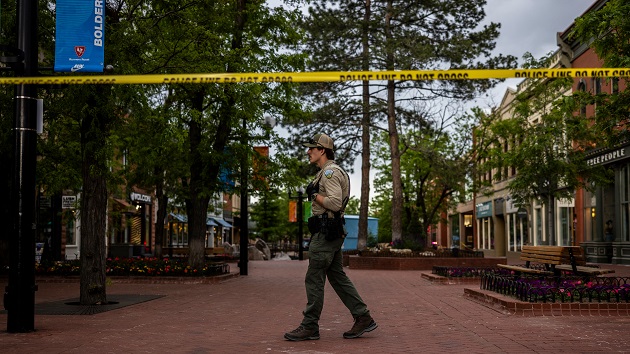
Eight people were injured on Sunday in what the FBI is calling an “act of terror.” Boulder police said the motive for the attack still has not been established.
The suspect, Mohamed Sabry Soliman, was allegedly heard yelling “Free Palestine” while throwing a “makeshift flamethrower” at a demonstration to raise awareness about the remaining hostages in Gaza, according to authorities.
Soliman has been charged with a federal hate crime, according to court documents. He allegedly told police “he wanted to kill all Zionist people and wished they were all dead.”
The Department of Homeland Security on Monday said Soliman is in the U.S. illegally. He entered the country on a B2 visa, which is typically a tourism visa, in August 2022 and in September 2022 applied for asylum. The B2 visa expired in February 2023.
Soliman was granted a work permit after his B2 visa expired, a senior official told ABC News. That work permit expired on March 28, so he has been in the country illegally since then, the official said.
Trump sought to cast blame over Soliman’s immigration status on former President Joe Biden, criticizing his predecessor’s policies and saying “he must go out under ‘TRUMP’ Policy.”
White House press secretary Karoline Leavitt made a similar argument on Monday as she took some questions from reporters outside the White House.
Leavitt said the suspect was “foolishly given a tourism visa” by the previous administration.
“These individuals are going to be deported, and we’re not going to tolerate such violence in our country,” Leavitt said.
While Trump seized on the fact that the alleged attacker was in the country illegally, the president did not mention antisemitism in his statement.
Though a White House senior official said Trump was briefed on Sunday, his first public comments came nearly 24 hours after the attack.
Leavitt, in her gaggle with reporters, was asked for the administration message to the Jewish community.
“We have seen two horrific cases of anti-semitic violence in our country in the last two weeks, and it is unacceptable to this president and this White House,” she said. “And rest assured to all Jewish Americans across our great country, this president has your back and he’s not going to allow anyone to take part in violent terrorism, acts of terrorism, in our country.”
Attorney General Pam Bondi also released a statement Monday in which she condemned “vile anti-Semitic violence.”
“The Department of Justice has swiftly charged the illegal alien perpetrator of this heinous attack with a federal hate crime and will hold him accountable to the fullest extent of the law. Our prayers are with the victims and our Jewish community across the world,” Bondi said.